Wrong Leather Thickness? Match It to Hardware & Structure
The most expensive mistake in bag manufacturing is not a design flaw or a stitching error — it is the wrong leather thickness. Choose leather that is too thin and the bag flops, the handles stretch, the hardware pulls loose, and customers return it within months. Choose leather that is too thick and the bag fights its own structure, seams pucker, folding is impossible, and the product feels like a brick. Both failures look like quality problems, but they are specification problems — and they are completely preventable.
Thickness is the hidden specification. Brands rarely think about it, factories inherit it, and both sides pay for the mismatch. This guide explains how leather thickness is measured, how it interacts with bag hardware and structure, and how to specify the right thickness for every panel, every part, and every product — from the factory floor perspective that has seen both the failures and the fixes.
How Leather Thickness Is Measured
Before matching thickness to hardware, the language of thickness must be clear — because brands and factories often talk past each other here.
The units. Leather thickness is measured in millimeters in most of the world, and in ounces in the Anglo-American leather trade. The relationship is fixed and simple: one ounce equals approximately 0.4 mm (the precise conversion is 1 oz ≈ 0.3969 mm). A common bag leather at 1.2–1.4 mm is therefore about 3.0–3.5 oz. The two systems are used interchangeably in tech packs, and a specification should always state the unit to avoid a 2.5× error.
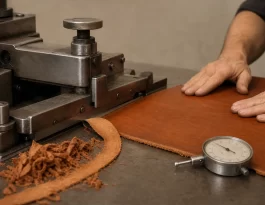
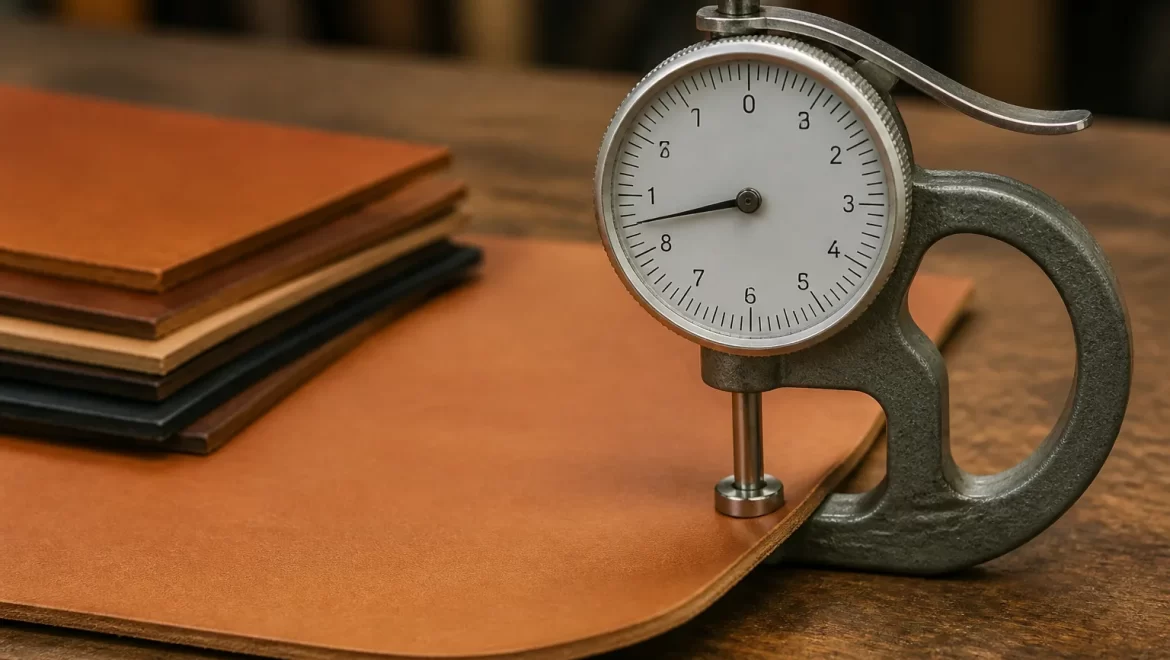
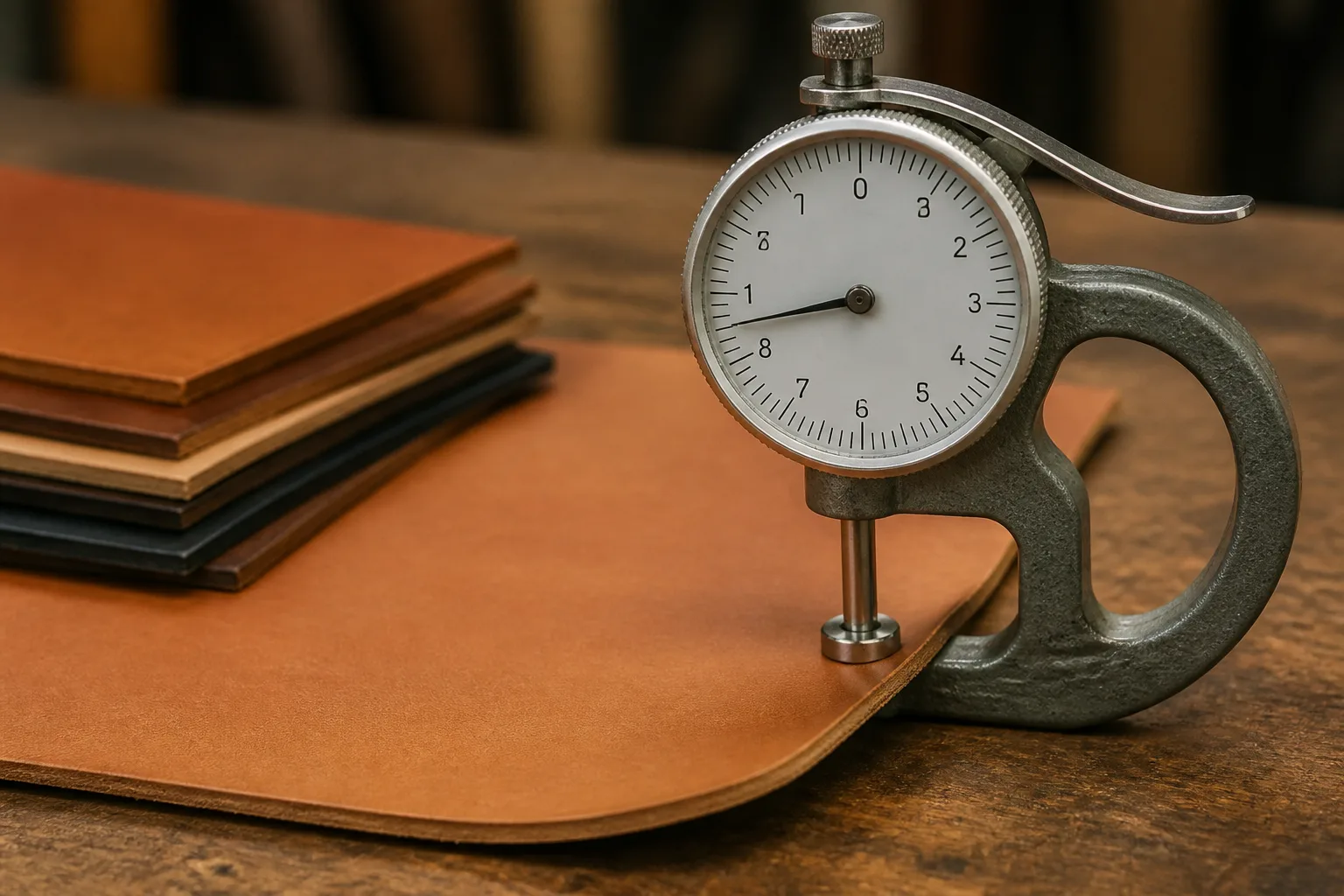
Where it is measured. Thickness is measured with a leather thickness gauge (a dial gauge that reads through the material without compressing it) at defined points on the hide. Because hides vary across their area — thicker at the spine, thinner at the belly — the specification includes both a nominal thickness and a tolerance. A typical bag spec: 1.2–1.4 mm, with acceptable range 1.15–1.45 mm. The tolerance matters as much as the number: a leather "1.2 mm" that arrives at 0.9 mm changes the product's behavior entirely.
Shaved versus natural. Thickness is controlled at the tannery by shaving (splitting and skiving the flesh side to a uniform thickness). "Shaved to 1.2 mm" means the entire hide was mechanically brought to that thickness — the standard for production leather. Natural-thickness leather (unshaved) varies across the hide and is used only where variation is acceptable. The tech pack should say "shaved to X mm" — that is the spec the tannery can meet.
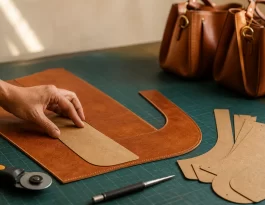
The thickness map. A serious tech pack specifies thickness per panel group, not one number for the whole bag: body panels, gussets, flaps, handles, straps, and linings each have their own optimal thickness. One thickness for the entire bag is a specification shortcut that produces a compromised product.
What Thickness Actually Does
Thickness is not just weight — it is the mechanical property that determines how leather behaves in every dimension of the product's life.
Structure and shape. Thicker leather is stiffer; it holds shape, stands up, and supports structure. Thinner leather drapes; it bends, softens, and conforms. The bag's intended silhouette is the first thickness decision: a structured tote needs body (1.4–1.6 mm body panels), a slouchy hobo needs drape (0.9–1.2 mm). Matching thickness to the silhouette is the foundation of the whole specification.
Strength and load. The leather panel's strength scales with its thickness — a 1.4 mm panel carries roughly 40% more tensile load than a 1.0 mm panel of the same leather. Handles, straps, and stress points need the thickness to carry the load; body panels carry less. The load map of the bag — where the weight is applied — dictates where the thickness must be.
Hardware retention. Hardware is anchored into leather: rivets, screws, Chicago screws, and stitching hold metal parts to the material. Thin leather (under 1.0 mm) does not hold anchors securely — rivets pull through, screws strip, and hardware wobbles or detaches. Thickness is the mechanical foundation of hardware retention, and this is where most hardware failures actually originate: not a bad zipper, but leather too thin to hold the zipper's anchor points.
Flex and fatigue. Thinner leather flexes more easily, which sounds like an advantage — but flexing at a stress point concentrates fatigue. A bag that opens and closes at a crease line (gussets, flaps, corners) needs enough thickness to resist fatigue cracking, while panels that never flex can be thinner. The flex map, like the load map, decides where thickness matters.
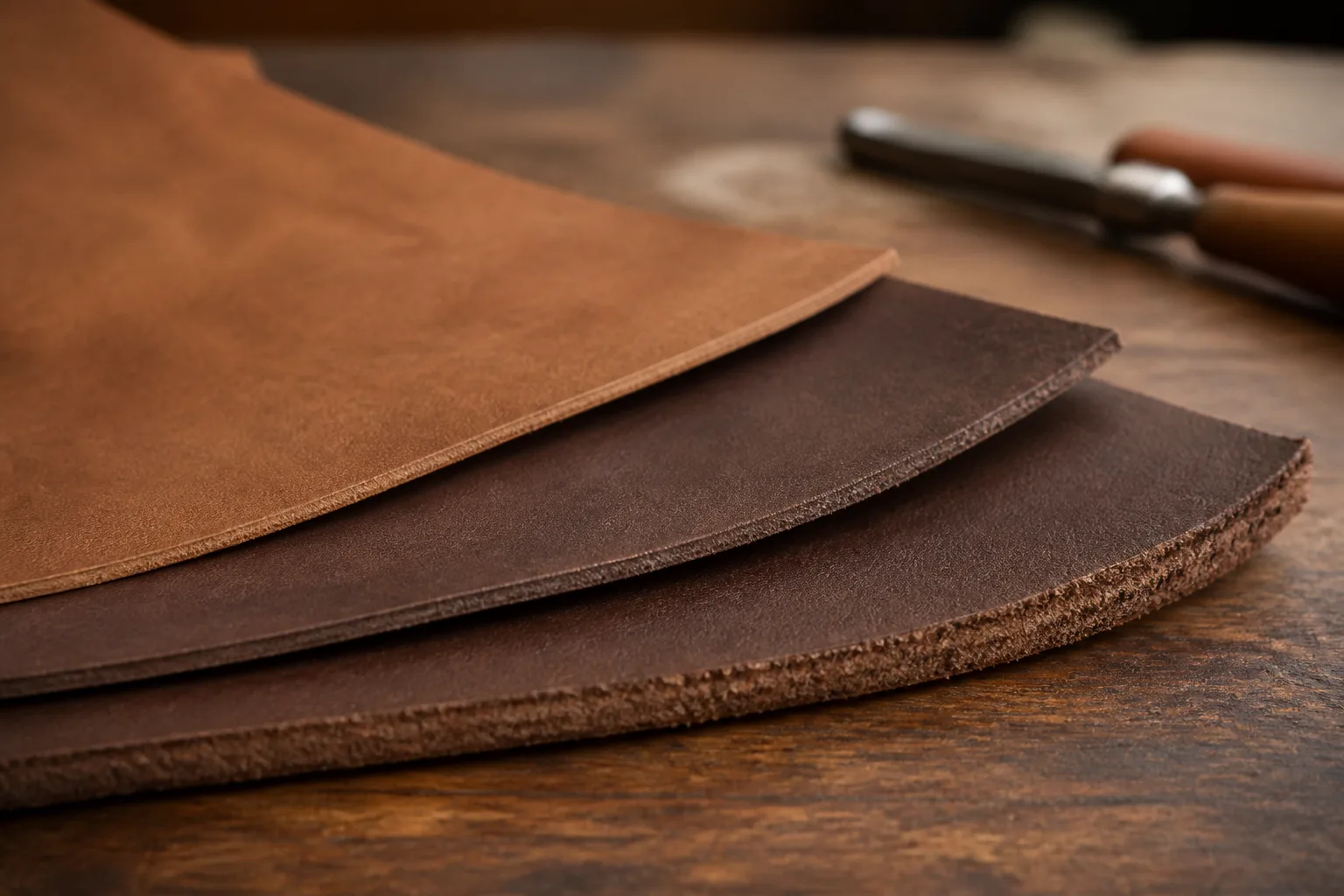
Edge and finishing behavior. Thicker leather produces thicker, bulkier edges that need careful skiving and edge finishing; thinner leather produces neat edges but less robust structure. The edge treatment — fold-over, edge paint, burnished — interacts with thickness: edge-painted edges need a certain minimum thickness to hold paint without chipping.
Weight and feel. Thickness is the largest driver of bag weight and hand feel. A "premium heavy" feel is often just thicker leather — but every 0.2 mm adds noticeable weight to a large bag. The feel target and the weight budget are part of the thickness decision.
Thickness and Hardware: The Engineering Rules
Hardware is the part of the bag that carries metal — and metal does not flex, stretch, or forgive. The rules for matching thickness to hardware are the most critical in the specification:
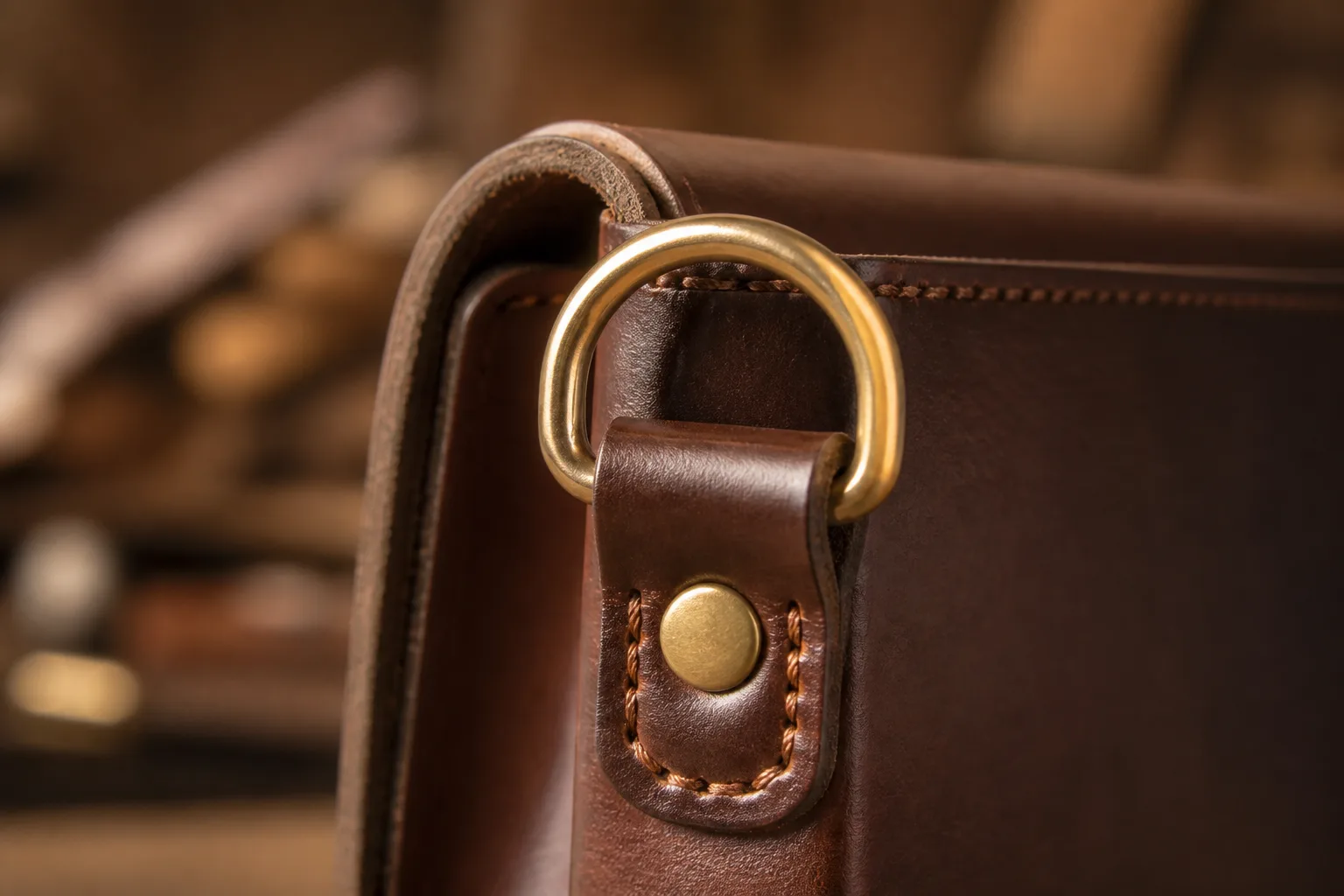
The anchor rule. Any hardware that bears load — handle attachments, strap hooks, D-rings, buckles — must be anchored into leather thick enough to hold the anchor. The working rule: load-bearing hardware needs at least 1.2 mm at the anchor point, ideally 1.4 mm, with reinforcement (lining, interlining, or a leather patch) where the load is concentrated. Under 1.0 mm, anchors fail; no amount of glue or careful assembly fixes an anchor that is too thin.
The rivet rule. Rivets compress the leather between their two heads. Too-thin leather (under 1.0 mm) allows the rivet to tear through over time, especially at flexing points. The rivet length must match the total stack thickness (leather + lining + reinforcement); a rivet that is too long wobbles, and one that is too short distorts. The thickness specification feeds directly into the hardware BOM — the rivet size is a function of the thickness, not an independent choice.
The zipper rule. Zippers are sewn into openings that flex constantly. The zipper tape is sewn to the leather with a seam that carries the flex load; thin leather (under 1.0 mm) tears at the zipper seam, and too-thick leather makes the zipper opening stiff and hard to operate. The working range for zipper-adjacent panels is 1.0–1.4 mm, chosen by how much the opening flexes.
The hardware proportion rule. Heavy hardware (large buckles, thick D-rings, substantial feet) visually and physically overwhelms thin leather. The proportion between hardware weight and leather thickness is a design rule as much as an engineering one: heavy hardware demands substantial leather (1.4 mm+) or the bag looks unbalanced and the anchors strain. Light, delicate hardware suits thinner leathers.
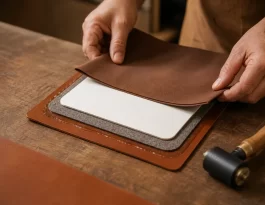
The reinforcement interaction. Hardware anchors are often backed by reinforcement: a leather patch, webbing, or interlining behind the anchor point. Reinforcement changes the effective thickness — the anchor holds the total stack, not just the outer leather. The spec should define the stack (outer + reinforcement + lining) at every hardware point, because that is what the hardware actually grips.
Thickness by Panel: The Specification Map
A professional bag spec assigns thickness per panel group. The working map for a typical structured leather bag:
| Panel group | Recommended thickness | Why |
|---|---|---|
| Body panels (outer) | 1.2–1.6 mm | Structure, shape, wear resistance |
| Gussets (sides, base) | 1.0–1.4 mm | Flex at seams, balance with body |
| Flaps and closures | 1.0–1.4 mm | Flex, hold shape without stiffness |
| Handles and top handles | 1.4–2.0 mm | Load-bearing, must not stretch |
| Straps (adjustable) | 1.2–1.6 mm | Load-bearing, flex at buckle points |
| Pockets and dividers | 0.8–1.2 mm | Function over structure, lighter |
| Linings | 0.5–0.9 mm (or lining leather) | Protection, weight, drape |
| Stress patches and reinforcements | Same as host panel + 0.4–0.8 mm | Load concentration points |
Two specification disciplines complete the map. First, transition rules: where thick and thin panels meet (handle to body, strap to gusset), the difference should not exceed ~0.4 mm at the seam, or the seam will pucker and the thinner panel will fatigue at the transition. Skiving the thicker panel down at the join is standard practice — the skive spec belongs in the tech pack. Second, the flex zone rule: panels that flex (gussets, flaps, closures) get the lower end of their range; panels that carry load (handles, straps) get the higher end. The same leather can be specified at different thicknesses for different roles within one bag.
Thickness by Bag Type: The Decision Framework
Different bag categories have established thickness profiles that have been proven across thousands of production runs. These are starting points, not rules — but they save years of trial and error:
Structured totes and briefcases. Body 1.4–1.6 mm, handles 1.6–2.0 mm. The bag must stand, hold shape, and carry laptop loads; the thickness profile is the structure. Heavier hardware (solid brass feet, substantial buckles) is supported by the thicker body.
Slouchy hobos and soft silhouettes. Body 0.9–1.2 mm, handles 1.2–1.6 mm. The drape is the design; thinner body panels create the softness, while handles stay thick enough to carry the load without stretching. This is the category where thickness mismatches are most visible — too thick and the slouch becomes a sag.
Backpacks. Body 1.2–1.4 mm, straps 1.4–1.8 mm, base 1.4–1.6 mm (often reinforced). Backpacks carry heavy loads on straps; the strap thickness and reinforcement are the critical spec. A backpack with fashionably thin straps fails in the first season.
Travel and weekender bags. Body 1.4–1.8 mm, handles 1.8–2.2 mm, base reinforced. Heavy loads, frequent handling, and airport abuse demand the heavy end of the range. Weight is a trade-off to accept for durability in this category.
Crossbody and small bags. Body 1.0–1.3 mm, strap 1.2–1.6 mm. Small bags carry less but move more — the strap flexes constantly at the buckle; the strap spec matters more than the body spec.
Clutches and evening bags. Body 1.0–1.3 mm. Minimal structure, light loads, and a refined hand feel; the thin end of the range is deliberate. Hardware is light and proportionally matched.
Children's and everyday bags. Body 1.0–1.2 mm, handles 1.2–1.4 mm. Balance of durability, weight, and cost; the workhorse profile.
The framework is a map, not a law — but every deviation from it needs a deliberate reason, not an accident. Most thickness problems in production are not bad decisions; they are unspecified decisions that the factory made by default.
The Failure Modes: What Wrong Thickness Actually Looks Like
The factory sees the failure modes before the customer does — at production, at QC, and in the return data. The patterns are consistent:
"The floppy bag" (too thin). The bag does not stand, the silhouette collapses, and the customer perceives poor quality even though the workmanship is fine. The fix is not better construction; it is thicker leather or additional structure. Brands often misdiagnose this as a pattern problem and re-pattern the bag — wasting time on the wrong variable.
"The stretched handle" (too thin at load points). Handles and straps stretch under load and stay stretched — the bag's handles grow longer over months of use. The leather has yielded; the fix is thicker leather at the handle spec, or reinforcement. This failure generates the highest return rates after hardware failure.
"The shedding hardware" (too thin at anchors). Rivets pull through, D-rings detach, zipper ends tear out. The anchors were specified in hardware terms (part number, size) without the thickness that holds them. The fix is the anchor rule: thickness at the anchor point, plus reinforcement stack.
"The stiff box" (too thick). The bag cannot flex where it should — the flap resists, the gusset fights the fold, the zipper pulls hard. The bag feels rigid and uncomfortable to use. The fix is thinner leather at flex zones, or skiving at the fold lines.
"The puckered seam" (thickness mismatch at joins). Panels of different thickness meet and the seam puckers, the thinner panel cups, and the line looks unprofessional. The fix is the transition rule: skive the thicker panel, or spec closer thicknesses.
"The cracked crease" (fatigue at flex zones). Gussets and flaps crack at the crease line after months of flexing — too thin to resist fatigue, or too thick to flex cleanly. The fix is the flex zone rule: match thickness to the flex demand.
Each failure mode is traceable to a thickness decision. The pattern across the industry is not that brands choose wrong thicknesses — it is that they do not choose at all, and the factory's default becomes the product.
Specifying Thickness: The Tech Pack Discipline
Thickness becomes a controlled specification when it is written, measured, and verified. The tech pack discipline has five parts:
Write the number with the unit. "Body panels: 1.2–1.4 mm (shaved), tolerance ±0.1 mm." A specification without the unit, the shaving method, or the tolerance is an invitation to ambiguity.
Write it per panel group. The panel map — body, gusset, flap, handle, strap, lining, reinforcement — each with its own thickness. One number for the whole bag is not a spec; it is a guess.
Write the hardware stack. For every load-bearing hardware point: outer leather thickness + reinforcement + lining = the stack the hardware must grip. The hardware BOM (rivet length, screw size) is derived from the stack.
Write the transition rules. Where thicknesses change, specify the skive: "handle leather skived to 1.2 mm at the 40 mm attachment zone." The transition is where the product's quality is visible.
Verify against the sample and the lot. The sealed sample embodies the thickness spec — verify the sample's thickness at each panel group, and verify production lots against it. The thickness gauge is as important as the color standard in the QC checkpoint.
The brands that write thickness specs get consistent products; the brands that leave thickness to the factory get the factory's convenience, not their design.
Thickness and Cost: The Honest Economics
Thickness costs money — not because leather is sold by weight (it is sold by area), but because thickness changes the entire economics of the product:
| Factor | Thinner leather (0.9-1.1 mm) | Thicker leather (1.4-1.8 mm) |
|---|---|---|
| Raw material per hide | Same area, similar price | Same area, higher price per hide (premium selection) |
| Utilization | Higher (more usable area, fewer grade issues) | Lower (thicker hides are scarcer, grading stricter) |
| Skiving labor | Less (thinner needs less skiving) | More (edges and joins need more skiving) |
| Hardware cost | Same hardware, more failures | Same hardware, better retention (fewer returns) |
| Rework and returns | Higher failure-driven costs | Lower failure-driven costs |
| Perceived value | Lower (light, floppy feel) | Higher (weight, substance) |
| Total cost per good bag | Deceptively low at first, higher after returns | Higher upfront, lower total cost |
The honest economics: thickness is not a cost to minimize — it is a cost to match. The cheapest bag (thin leather) is often the most expensive bag in total, because returns, replacements, and brand damage carry real costs. The professional calculation is total cost per surviving bag, not material cost per bag.
The weight trade-off. Thicker leather means heavier bags, and weight has its own costs: higher shipping cost, more customer complaints about heavy bags, and a different hand feel. The thickness decision balances durability against weight and feel — the brand's market position decides where the balance sits.
The yield reality. Thicker hides are scarcer and more expensive per hide; utilization is lower because grading is stricter. A full 1.6 mm spec on a large tote can add 15-25% to the material cost versus a 1.2 mm spec on the same pattern. The premium is real — and so is the durability it buys.
The Factory's Thickness Checklist
When a factory evaluates a thickness spec, it runs a checklist — and brands should know what the factory is checking:
- Is the thickness specified per panel group? If not, the factory will default to one thickness for everything.
- Is the unit stated? mm or oz — ambiguity is a risk flag.
- Does the thickness match the silhouette? Structured product with thin leather will not hold; slouchy product with thick leather will not drape.
- Are the load points covered? Handles, straps, and anchor points must be at the heavy end of the range.
- Is the hardware stack defined? The anchors' grip depends on the total stack, not the outer leather alone.
- Are the transitions skived? The joins between thick and thin must be specified or the seams will pucker.
- Is there a tolerance? Natural hides vary; a tolerance of ±0.1 mm is standard.
- Will the sample be verified? The sealed sample's thickness at each panel group is the production standard.
The checklist is the same one the factory's QC runs at every lot — and it is the same one brands should run at every sampling. Thickness verification belongs in the sampling process, not discovered at production.
Thickness and Edge Finishing: The Visible Craftsmanship
Edge finishing is the most visible craftsmanship signal on a leather bag — and it is inseparable from the thickness decision. The edge treatment chosen for a bag places its own constraints on the leather spec.
The edge-paint minimum. Edge-painted edges need a minimum thickness to hold paint without chipping: below roughly 1.0 mm, the edge is too thin for the paint layer to grip through the bag's life, and chipping appears at the corners and flex points. The working range for edge-painted panels is 1.0–1.4 mm, chosen by how much the edge flexes. A panel specified for a clean edge-paint look but delivered at 0.8 mm will show edge chips within months — a defect that reads as "cheap" even when the rest of the bag is excellent.
The burnish trade-off. Burnished (folded and waxed) edges can work with slightly thinner leather because the edge is folded rather than painted — but the fold itself adds thickness at the seam line, which changes the join behavior. The burnish specification and the thickness spec must be written together; they are two halves of one edge decision.
Skiving as the bridge. Where the design demands a thick panel (structure, load) but a neat thin edge (refined look, easy fold), skiving bridges the gap: the panel is cut thick and skived down at the edges before assembly. The skive spec — where, how much, and over what width — belongs in the tech pack alongside the thickness map. A well-skived edge is invisible craftsmanship; a poorly skived edge is a puckered seam and a bulky fold.
The fold-over edge. Fold-over construction (leather wrapped around the edge) needs leather thin enough to fold cleanly without cracking the grain — typically 1.0–1.3 mm depending on the radius — while the panel behind the fold carries the structural thickness. The fold and the panel are different thickness decisions in the same edge.
The visible quality of a bag's edges is the factory's signature — and it is written in the thickness specification long before the edge is finished. The brands that pair the thickness map with the edge treatment spec get the crisp, clean edges that customers read as quality; the brands that specify one without the other get whatever the edge work happens to produce.
Thickness in Sampling: Verify Before Production
The thickness specification is only real when it is measured — and the sampling process is where the spec is first tested. A brand that approves a sample without measuring its thickness has approved an appearance, not a specification.
Measure the sample's panel map. When the development sample arrives, measure every panel group against the spec: body, gusset, flap, handle, strap, lining. A sample can look exactly right and be 0.3 mm off spec across the board — the silhouette hides the difference until the bag is used. The thickness gauge belongs in the sample review, next to the measuring tape.
Verify the hardware stack. Check the anchor points against the stack spec: measure outer leather + reinforcement + lining at each load-bearing hardware location, and confirm the hardware (rivet length, screw size) matches the stack. The sample is the last cheap moment to catch a hardware-thickness mismatch — after production starts, the fix costs the whole order.
Check the transitions. Look at the joins between thick and thin panels: are the thick panels skived where they meet thinner panels? Is the seam flat, or does it pucker and cup? The transition quality is the visible signature of a well-specified thickness map.
Seal the sample with the numbers. The sealed sample's measured thicknesses become the production standard — record them on the sample tag and reference them in the tech pack. A sealed sample without measurements is a picture; a sealed sample with measurements is a specification.
Test the production lot. At production, the first-article check includes thickness verification at the panel groups and anchor points. The lot's thickness gauge readings are part of the QC evidence — the brands that ask for the readings get consistent thickness, and the brands that do not get whatever the tannery shipped.
Thickness problems found at sampling cost a sample remake. Thickness problems found at production cost the order. The sampling stage is where the thickness spec is converted from a number in the tech pack into a verified, sealed, reproducible standard.
FAQ
What is the standard leather thickness for bags?
A: There is no single standard — thickness is matched to the bag's structure and hardware. Body panels typically run 1.2-1.6 mm, handles and straps 1.2-2.0 mm, linings 0.5-0.9 mm. The right thickness depends on the silhouette, the loads, and the hardware.
What thickness leather do I need for handles?
A: Handles are the highest-load panels in most bags: specify 1.4-2.0 mm for top handles and carry handles, with reinforcement at the attachment points. Under 1.2 mm, handles stretch and deform under load — the most common handle failure.
How do I convert leather ounces to millimeters?
A: One ounce equals approximately 0.4 mm (precisely 1 oz ≈ 0.3969 mm). A 3.5 oz leather is about 1.4 mm. Always state the unit in the specification to avoid conversion errors.
Why do the rivets on my bag pull out?
A: Rivets pull out when the leather at the anchor point is too thin to hold them (under ~1.0 mm), when the rivet length does not match the stack thickness, or when the anchor sits at a flex point without reinforcement. The fix is thickness at the anchor, correct rivet sizing, and reinforcement.
What happens if the leather is too thick?
A: Too-thick leather makes the bag stiff and uncomfortable: flaps resist, gussets fight folds, zippers pull hard, seams pucker at joins, and the bag feels heavy. The fix is thinner leather at flex zones or skiving at fold lines.
Should all panels of a bag use the same leather thickness?
A: No. Professional specs assign thickness per panel group: body panels for structure, handles and straps for load, gussets and flaps for flex, linings for weight. One thickness for the whole bag is a specification shortcut that compromises the product.
What is a thickness tolerance and why does it matter?
A: Tolerance is the acceptable range around the nominal thickness — typically ±0.1 mm for bag leather. Natural hides vary across their area, so the spec must bound the variation; without a tolerance, a "1.2 mm" leather can arrive at 0.9 mm and change the product's behavior.
Does thicker leather mean better leather?
A: Not necessarily — thickness and quality are different specifications. A thick split is weaker than a thin full-grain. What matters is matching thickness to the bag's structural and hardware demands: the right thickness for the job, not the maximum thickness.
How is leather thickness measured in a factory?
A: With a dial thickness gauge that reads through the material without compressing it, at defined points on the hide (spine, belly, and specific panels). The measurement is taken at incoming inspection and at the cutting table, and verified against the sealed sample.
What thickness should my lining leather be?
A: Leather linings typically run 0.5-0.9 mm — thick enough to protect and feel substantial, thin enough to keep the bag light and let the exterior structure dominate. Suede splits around 0.8-1.0 mm are a common lining choice.
Conclusion
Leather thickness is the hidden specification that decides whether a bag stands or flops, whether handles stretch or hold, whether hardware stays or sheds — and whether the product survives its first season. The professional approach is not a single thickness but a specification map: body panels for structure, handles and straps for load, gussets and flaps for flex, linings for weight, and the hardware stack defined at every anchor point. Write the numbers with units and tolerances, verify them against the sealed sample, and match them to the hardware that will carry the bag's real life.
The lesson from the factory floor is simple: thickness is not a cost to minimize or a number to inherit — it is an engineering decision that matches the leather to the hardware and the structure. Specify it deliberately, and your bags will hold their shape, keep their hardware, and survive their customers. Leave it unspecified, and the factory's default — not your design — becomes your product.
Ready to spec your next bag correctly? Contact our factory — we will map the thickness specification for your design, match it to your hardware stack, and seal the sample so production matches your spec.