From Sketch to Tech Pack: Specs Every Bag Factory Needs
- Why a Tech Pack Exists
- The Core Documents in a Tech Pack
- Technical Drawings and Views
- The Measurement Chart
- Material Specifications
- Bill of Materials and Hardware Callouts
- Construction and Stitching Specifications
- Colour, Labels and Branding
- Version Control and Change Management
- Common Tech Pack Failures
- Patterns, Grading and Size Ranges
- Sampling Rounds and the Feedback Loop
- How Factories Read a Tech Pack When Quoting
- Building a Tech Pack Template That Scales
- Reorders, Repeat Runs and Second Sources
- Working With a Factory on Definition
- FAQ
A sketch sells an idea. A tech pack builds it. Between the two sits the document set that determines whether a bag arrives as designed, arrives approximately as designed, or arrives as something nobody asked for.
Most disputes between brands and bag factories trace back to a gap in the tech pack rather than to a problem in the workshop. A missing measurement point, an unstated tolerance, an ambiguous callout, a hardware reference that no longer exists: each of these is small on paper and expensive in production.
A complete tech pack does not need to be long. It needs to be unambiguous. Every dimension a cutter sets, every material a buyer orders, every stitch a machinist sews and every inspection a quality controller performs should be traceable to a stated requirement.
This guide breaks a bag tech pack into its components, explains what each component must contain, shows how tolerances and callouts are written so quotes come back accurate, and covers version control, sampling feedback and the failures that cause the most trouble.
Why a Tech Pack Exists
A tech pack is a translation document. It converts a design intention into instructions that survive language barriers, staff changes and repeat production.
The Three Functions
It communicates the design: what the bag looks like, what size it is and how it is built. It enables costing: what materials and processes are required, in what quantity. It defines quality: what is acceptable and what must be rejected.
A document that serves only the first function produces beautiful drawings and unreliable production.
Why Approximate Communication Fails
Factories work from documents, not intentions. When a requirement is implied rather than stated, the factory resolves it using its own judgement, which may be sensible and still not what the brand wanted.
The consequences are consistent: wrong proportions, wrong material weight, wrong edge treatment, hardware too large or too small, and samples that need multiple rounds to correct.
Cost of Incompleteness
Every missing specification becomes a question, and every question becomes a delay. Late corrections also carry rework cost, because changing a specification after cutting has begun wastes material and machine time.
A tech pack that prevents two correction rounds pays for itself in a single production run.
What a Tech Pack Prevents
| Gap | Typical consequence |
|---|---|
| Missing measurement point | Wrong proportion, disputed fit |
| No tolerance stated | Disagreement on accept or reject |
| Material unnamed | Substitute material, wrong hand |
| Hardware not specified | Wrong size, wrong plating |
| Stitch specs absent | Wrong stitch density, weak seams |
| Logo placement unclear | Misplaced label, rework |
| No version control | Old spec produced |
The Core Documents in a Tech Pack
A practical tech pack is a set of documents with distinct jobs. Most failures come from producing one and omitting another.
Technical Drawings
Flat, dimensioned line drawings showing the bag from each relevant view, with numbered callouts that refer to written specifications. Drawings show structure; they do not replace measurements.
Measurement Chart
A table of points of measure with target dimensions and tolerances. This is the document that makes inspection possible, because it defines what is measured and where.
Bill of Materials
A complete list of every component in the bag: leather, lining, interlining, reinforcement, thread, zipper, hardware, labels, adhesive, edge paint and packaging.
Construction Notes
Written instructions covering stitch type and density, seam allowances, reinforcement placement, edge treatment, lining attachment and assembly sequence.
Callout Sheet
A numbered list that ties every callout on the drawings to its specification, including supplier references and load requirements.
Documents and Purpose
| Document | Job | Failure if missing |
|---|---|---|
| Technical drawings | Shows structure | Shape interpreted loosely |
| Measurement chart | Defines size and tolerance | Inspection impossible |
| Bill of materials | Lists every component | Substitutions appear |
| Construction notes | Defines how it is built | Methods vary by operator |
| Callout sheet | Ties numbers to specs | Ambiguity at every reference |
| Colour and material specs | Fixes the surface | Wrong shade or finish |
| Label placement | Positions branding | Misplaced logo |
| Packaging spec | Defines presentation | Damage or inconsistency |
Technical Drawings and Views
Drawings are the fastest way to communicate structure, and they are frequently too thin to be useful.
Which Views Are Needed
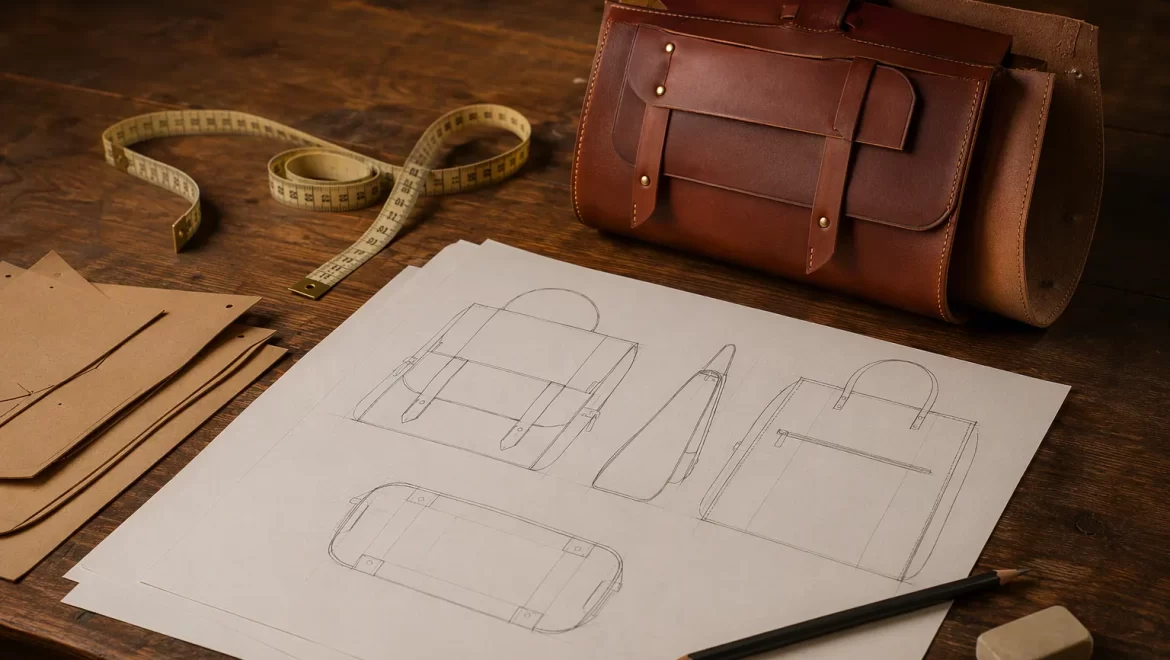
At minimum, most bag tech packs need a front view, a back view, a side profile, a top view showing openings and closures, a base view and an interior layout showing pockets and dividers.
Where a construction detail is not visible in a general view, add a detail drawing at larger scale. A strap attachment, a gusset corner or a zip end rarely reads clearly at full-bag scale.
Callouts Over Wordiness
Numbering callouts and listing them separately keeps drawings readable and specifications precise. A drawing cluttered with text becomes unreadable, and text inside a drawing is difficult to update.
Each callout should appear on the drawing as a number linked by a leader line to the exact feature it describes.
Scale, Views and Consistency
Consistent views make drawings comparable between rounds. If the first sample is drawn at one scale and the revision at another, reviewers misjudge proportions.
Where hardware is drawn, show it at true relative size rather than approximately, because hardware proportion is one of the most common visual errors in samples.
Drawing Requirements
| Requirement | Purpose |
|---|---|
| All relevant views | Prevents assumed structure |
| Detail drawings | Shows complex construction |
| Numbered callouts | Links drawing to specification |
| Consistent scale | Allows round comparison |
| True-size hardware | Prevents proportion errors |
| Section views where needed | Shows internal build |

The Measurement Chart
The measurement chart is the most practically important document in the pack and the one most often under-specified.
Points of Measure
Every measurement needs a defined point of measure: the exact start and end of the measurement, described precisely enough that two people measure the same thing.
"Bag width" is not a point of measure. "Across the front panel at the widest point, seam to seam, measured flat" is.
How Measurements Are Taken
State whether measurements are taken on the bag lying flat or filled to shape, and whether the bag is closed or open. Soft bags measured flat can be several centimetres different from the same bag measured filled.
State the units explicitly. Mixed units within one pack create errors that are almost impossible to catch downstream.
Tolerances
Every dimension needs a tolerance. A tolerance of plus or minus a few millimetres is normal for cut and sewn leather panels; tighter tolerances increase cost and rejection rates.
Where a dimension is critical to function, such as a strap length or a hardware opening, the tolerance should be stated separately and marked as critical.
Measurement Chart Structure
| Column | Content |
|---|---|
| Point of measure | Numbered and described precisely |
| Reference drawing | View and callout number |
| Target dimension | Nominal figure |
| Tolerance | Acceptable range |
| Critical flag | Yes where functional |
| Method | Flat, filled, closed or open |
| Units | Stated once, applied throughout |
Material Specifications
Materials determine cost, look and durability. A material specification that names only a colour and a general type is an invitation to substitution.
Leather Specification
State the animal, tannage type, finish type, thickness range with tolerance, colour reference, grain expectation and any performance requirement. Where a specific tannery or article is intended, name it and state whether substitution requires approval.
Where the same leather is used in different weights, list each separately with its own tolerance.
Lining and Interlining
Lining material, weight, colour and weave should be stated, along with whether the lining is bonded, stitched or both. Interlining and stiffeners need thickness, stiffness and dimensions, because they determine how the bag holds shape.
Thread, Adhesive and Edge Paint
Thread needs a size, fibre and colour reference; stitch appearance depends on it. Adhesive should be named by type and suitability for the materials being joined. Edge paint needs a colour, finish and application thickness.
Material Specification Elements
| Material | Must specify |
|---|---|
| Leather | Animal, tannage, finish, thickness, colour |
| Lining | Material, weight, colour, attachment |
| Interlining | Thickness, stiffness, dimensions |
| Thread | Size, fibre, colour |
| Adhesive | Type, intended substrates |
| Edge paint | Colour, finish, thickness |
| Reinforcement | Material, position, dimensions |
Bill of Materials and Hardware Callouts
The bill of materials is the purchasing document. If a component is not on it, it will be sourced by whoever notices the gap.
Structure of the Bill of Materials
List components by assembly area, with description, material, colour, quantity per bag, unit of measure and supplier reference. Include consumables that affect cost, such as thread and adhesive.
State allowances for waste and wastage on cut materials, because the allowance affects the quoted price and the quantity ordered.
Hardware Callouts
Every piece of hardware needs an internal dimension, an external dimension, a material, a finish, an attachment method and a load requirement where relevant. A zipper needs a tape colour, a slider type and a length measured in a defined way.
Where an existing catalogue component is used, give the supplier and the article number. Where a custom component is required, state that a mould is needed and who owns it.
Load and Functional Requirements
For handles, straps, rings and attachments, state the working load the component must support. Without this, a supplier may deliver a component that looks correct and fails in use.
Bill of Materials Columns
| Column | Purpose |
|---|---|
| Component | Name and assembly area |
| Description | Enough to identify exactly |
| Material and finish | Prevents substitution |
| Colour | Matches colour standard |
| Quantity per bag | Costing and ordering |
| Waste allowance | Cut material planning |
| Supplier reference | Repeatability |
| Load requirement | Functional safety |
Construction and Stitching Specifications
Construction notes tell the factory how to build the bag. Where they are absent, methods vary between operators and between batches.
Stitch Specification
State stitch type, stitch density, thread size and seam allowance for each seam type. Where a seam is load-bearing, say so, and specify any additional reinforcement.
Stitch density affects both strength and appearance. A visually fine stitch can be structurally weaker if it perforates the leather too densely.
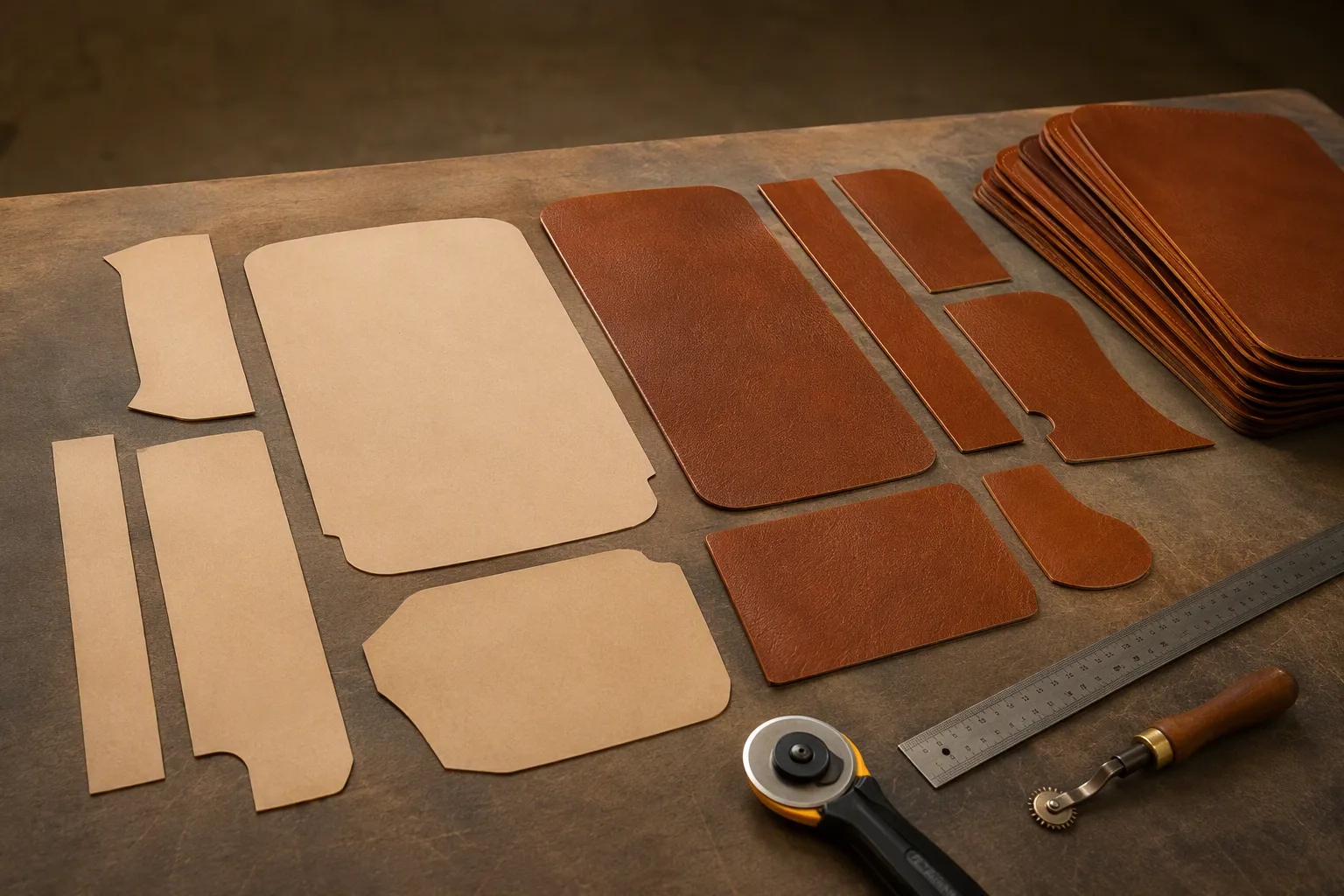
Reinforcement and Structure
State where reinforcement is placed, what material it is, and how it is attached. Gusset corners, base panels, handle attachments and zip ends are typical reinforcement points.
Where interlining is bonded rather than stitched, state the bonding method and any temperature constraint imposed by the leather finish.
Edge Treatment and Lining
Edge treatment should be defined per edge type: raw, folded, bound, painted or turned. Each produces a different appearance and a different cost.
Lining attachment method, turning method and any interior pocket construction belong in the same section, since they interact with edge treatment.
Construction Specification Items
| Item | Must state |
|---|---|
| Stitch type and density | Per seam type |
| Seam allowance | With tolerance |
| Load-bearing seams | Flagged with reinforcement |
| Reinforcement placement | Material and position |
| Edge treatment | Per edge type |
| Lining attachment | Bonded, stitched or both |
| Assembly sequence | Where order matters |
Colour, Labels and Branding
Colour and branding carry the brand's identity, and small errors here are highly visible.
Colour Specification
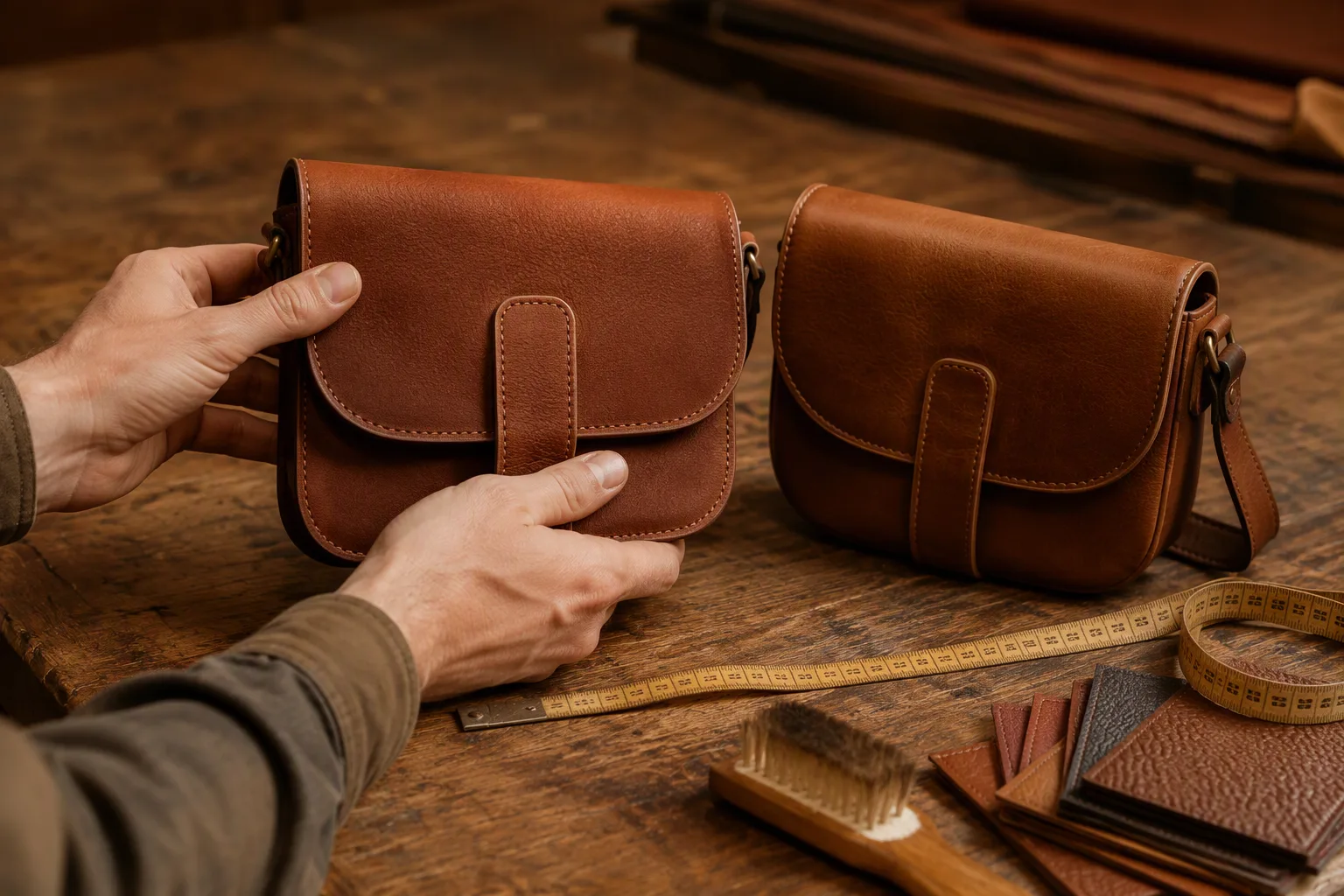
Colour should be defined against a physical standard, with an approved reference retained by both parties. Under different lighting, colours shift, so specify the light conditions used for approval.
Where multiple materials appear in one colour story, they should be approved together, because a leather, a lining, a thread and an edge paint that each match individually may not match as a set.
Labels and Logo Placement
State the label type, size, content and placement, and show placement on a drawing with a measurement from a defined reference point rather than an approximate position.
Where embossing or foil stamping is used, specify the die, the depth, the size and the placement tolerance.
Packaging
Packaging specification covers the poly bag, any tissue or stuffing that preserves shape, hangtags, and the carton arrangement. It matters because packaging determines whether the bag arrives in the condition it left in.
Branding and Colour Specification
| Item | Must state |
|---|---|
| Colour reference | Physical standard |
| Approval light | Conditions for matching |
| Leather and lining | Approved as a set |
| Thread and edge paint | Included in set |
| Label type and size | Material and content |
| Placement | Measured from defined point |
| Emboss or foil die | Size, depth, placement |
| Packaging | Bag, stuffing, carton |
Version Control and Change Management
A tech pack is a living document. Without disciplined versioning, production will eventually run to a superseded specification.
Versioning Discipline
Give every revision a number and a date, record what changed, and distribute the new version to everyone holding the old one. Retired versions should be marked clearly as superseded rather than deleted, because they explain past production.
State which version is approved for production, and make that statement prominent.
Change Approval
Any change after sample approval should be documented, costed and approved before it enters production. Undocumented changes made on the factory floor produce bags that match neither the old specification nor the new.
Where a change originates with the factory, it should be proposed as a documented deviation rather than implemented silently.
Record Keeping
Keep the approved sample, the approved tech pack and the change log together. This combination resolves almost every later dispute about what was agreed.
Version Control Elements
| Element | Purpose |
|---|---|
| Sequential version numbers | Unambiguous reference |
| Date of revision | Chronology |
| Change description | Traceability |
| Approval signature | Accountability |
| Production version flag | Prevents wrong build |
| Retained superseded files | Explains history |
| Retained approved sample | Physical reference |
Common Tech Pack Failures
The same weaknesses appear repeatedly, and each one has a known consequence.
Missing Tolerances
A chart of target dimensions without tolerances makes every inspection a negotiation. The factory produces within normal variation, the brand measures against a nominal figure and a dispute follows.
Ambiguous Points of Measure
Where a measurement point is described loosely, two competent people measure differently. The fix is a description precise enough to be repeatable, ideally with a marked drawing.
Unnamed Materials
Naming a colour and a general material type invites substitution, particularly when the material is unavailable. Name the article, or state that substitution requires written approval.
Hardware Without References
A hardware callout without a supplier reference or a dimensioned drawing produces components that are approximately right, which is visibly wrong in hardware.
Drawings Without Callouts
Illustration without numbered specifications leaves every detail to interpretation, and interpretation varies by factory.
Change Without Documentation
Changes agreed in a conversation and never recorded will be half-implemented, and the resulting bag will not match either specification.
Failure and Consequence
| Failure | Consequence |
|---|---|
| No tolerance | Endless inspection disputes |
| Vague point of measure | Inconsistent measurement |
| Unnamed material | Substitution |
| Hardware without reference | Wrong component |
| Drawings without callouts | Interpreted details |
| Undocumented change | Half-applied revision |
| No approved sample | No ground truth |
Patterns, Grading and Size Ranges
The tech pack describes the product; the pattern makes it. The two must agree, and the pattern must be owned by someone.
From Spec to Pattern
A pattern maker converts the technical drawings and measurement chart into pattern pieces, accounting for seam allowance, material thickness, stretch behaviour and the way the bag is turned or assembled.
Two pattern makers working from the same tech pack can produce different patterns, which is why the approved sample and the pattern that produced it should be recorded together.
Grading Across Sizes
Where a design is offered in more than one size, grading rules must be specified: which dimensions change, by how much, and which stay fixed. Hardware, strap widths and pocket proportions do not always scale linearly.
Grading a bag by percentage, as garment grading sometimes does, usually produces poor results, because bag proportions are determined by function rather than by body measurement.
Pattern Ownership and Reuse
State who owns the pattern and whether it may be reused for other clients. Where a factory owns the pattern, buying it out is a separate negotiation and should be agreed before the relationship begins rather than after.
For brands using more than one factory, holding the pattern is what makes a second source possible at all.
Pattern and Grading Items
| Item | Must be agreed |
|---|---|
| Pattern ownership | Named owner |
| Pattern version | Tied to tech pack version |
| Grading rules | Which dimensions change |
| Fixed dimensions | Hardware, strap, pocket positions |
| Seam allowance | Stated per material |
| Pattern archive | Held by brand or factory |
Sampling Rounds and the Feedback Loop
Sampling is where the tech pack is validated, and the quality of feedback determines how many rounds the process needs.
The Sampling Sequence
Most programmes move through a development sample, one or more fit or correction samples, a pre-production sample built with final materials, and a production run.
Each stage answers a different question. The development sample tests whether the concept works; the correction samples refine dimensions and construction; the pre-production sample confirms that production materials and methods produce the approved result.
Giving Feedback That Can Be Acted On
Feedback should reference the tech pack callout and measurement point, state the observed problem and state the required outcome. Comments like "strap feels wrong" cannot be implemented; a comment specifying which dimension must change and by how much can be.
Marked-up photographs are the most efficient format, because they locate the issue visually and tie it to a specification line.
Closing Each Round
At the end of each round, update the tech pack to reflect every accepted change and issue it as a new version. A round that ends with comments in an email thread rather than in the pack guarantees that the same corrections reappear later.
Sampling Stages
| Stage | Question answered | Output |
|---|---|---|
| Development sample | Does the concept work? | Design direction confirmed |
| Correction sample | Are dimensions right? | Revised measurements |
| Pre-production sample | Does production material work? | Production approval |
| Production | Does the line repeat it? | Shipped goods |
How Factories Read a Tech Pack When Quoting
A quote is a response to a document. The clearer the document, the closer the quote comes to the final cost.
What Drives the Quoted Figure
Material quantities and prices, cutting and stitching time, hardware cost, finishing and edge treatment, packing, and the allowance for rejections and rework. Each of these is estimated from the tech pack.
Where a specification is unclear, a responsible factory adds contingency, and contingency is charged whether or not the risk materialises.
The Cost of Missing Information
Every question raised during quoting delays the price. Where a factory quotes without asking, it has assumed something, and assumptions about material weight or construction method shift cost significantly.
A missing tolerance, an unnamed leather or an undefined edge treatment can move a quote by a wide margin, which is why completeness is a commercial issue rather than a documentation preference.
Comparing Quotes Fairly
Quotes are only comparable when they are based on the same specification. Where two factories quote the same design using different assumptions about materials or construction, the cheaper figure often reflects a simpler interpretation rather than a better price.
Requiring both factories to quote against the same tech pack version is the simplest way to make comparison meaningful.
Quote Inputs
| Input | Source in tech pack |
|---|---|
| Material quantities | Bill of materials with allowances |
| Cutting time | Number of panels and material |
| Stitching time | Construction notes |
| Hardware cost | Hardware callouts |
| Finishing cost | Edge treatment specification |
| Packing cost | Packaging specification |
| Rejection allowance | Tolerance and difficulty |
Building a Tech Pack Template That Scales
Most brands start with one product and end up with twenty, and a template built for one product becomes a liability across twenty.
Standard Blocks
Build the pack from fixed blocks: cover page, revision history, drawings, measurement chart, bill of materials, construction notes, colour and material specifications, branding placement and packaging.
Standard blocks mean reviewers know where to look and new team members can work from an existing example.
A Pre-Issue Checklist
Before a pack is issued, check that every drawing callout appears on the callout sheet, every measurement point is described precisely and tolerated, every material is named with a supplier reference, and every version reference is current.
This check takes minutes and prevents most sampling delays.
Template Blocks
| Block | Present in every pack |
|---|---|
| Cover and product summary | Yes |
| Revision history | Yes |
| Technical drawings | Yes |
| Measurement chart | Yes |
| Bill of materials | Yes |
| Construction notes | Yes |
| Colour and material specs | Yes |
| Branding and packaging | Yes |
| Pre-issue checklist | Yes |
Reorders, Repeat Runs and Second Sources
A tech pack earns most of its value after the first order, when the same bag must be produced again, months later, often by a different team.
Reorders Without the Original Team
Staff change on both sides of the relationship. The person who negotiated the first order may have moved on by the second, and the factory line that built it may have been reassigned.
What survives that turnover is documentation: the approved tech pack version, the approved sample, the measurement chart actually used and the change log. Where those exist, a reorder restarts cleanly. Where they do not, the brand is effectively starting from zero and pays sampling costs again.
Adding a Second Factory
Producing the same design at more than one factory is the standard way to add capacity or reduce dependency, and it only works when the pack is complete enough to be handed over.
The second factory will read the pack without the context of the original conversations, so requirements that were resolved verbally the first time must be written down before the second factory starts. Sending the approved sample along with the pack resolves most of the remaining ambiguity.
Consistency Between Sources
Where two factories produce the same design, tolerances must be tight enough that output from both is interchangeable. If the pack is loose, each factory will interpret within its own habits and the two runs will not match.
Comparing first article samples from both sources against the same measurement chart is the practical way to confirm alignment before volume production.
Reorder and Multi-Source Practice
| Practice | Purpose |
|---|---|
| Retained approved sample | Physical reference |
| Retained tech pack version | Written reference |
| Measurement chart as used | Records actuals |
| Change log | Explains evolution |
| First article comparison | Aligns new sources |
| Pack handover to new factory | Removes verbal context |
Working With a Factory on Definition
Some specification work belongs to the brand and some to the factory, and blurring the line produces both idle time and rework.
What the Brand Owns
The brand owns the design intent, the dimensions that matter commercially, the material direction, the branding placement and the acceptable tolerance for visible quality. These are decisions, not technical derivations.
Where a brand cannot state a required dimension precisely, it should still state the range it can accept rather than leaving the figure to the factory.
What the Factory Owns
The factory owns construction method, assembly sequence, pattern engineering within the stated dimensions, reinforcement placement where the brand has not specified it, and the manufacturing tolerances achievable with its equipment.
Asking a factory to make commercial decisions that belong to the brand, such as how loose a bag should drape, transfers responsibility without transferring authority.
Joint Decisions
Some items are genuinely joint: edge treatment options that fit the design and the available equipment, hardware selections that meet the load requirement within the target cost, and reinforcement choices that preserve shape without adding unacceptable weight.
These are best resolved in a documented review during sampling rather than in a later email exchange.
Ownership Split
| Decision | Owner |
|---|---|
| Design intent and silhouette | Brand |
| Commercial dimensions | Brand |
| Material direction | Brand |
| Branding placement | Brand |
| Construction method | Factory |
| Assembly sequence | Factory |
| Reinforcement detail | Joint |
| Edge treatment method | Joint |
| Hardware selection | Joint |
FAQ
What is a tech pack for a bag?
A: It is the document set that translates a design into production instructions: dimensioned drawings, a measurement chart with tolerances, a bill of materials, construction notes, colour specifications and branding placement.
How long should a bag tech pack be?
A: Length matters less than completeness. A pack that is short but states every dimension, tolerance, material and construction method is more useful than a long pack that leaves key details open.
What is a point of measure?
A: It is the precise definition of where a measurement starts and ends, described so that two people measuring the same bag get the same result. Loose descriptions such as "bag width" are not points of measure.
Why do tolerances matter so much?
A: Cut and sewn leather varies naturally, so every dimension needs an acceptable range. Without a stated tolerance, inspection becomes a negotiation and production disputes become routine.
Should measurements be taken flat or filled?
A: State which, because a soft bag measured flat can differ noticeably from the same bag measured filled. The measurement chart should say whether the bag is closed or open as well.
How many drawing views does a bag need?
A: Front, back, side profile, top with openings, base and interior layout as a minimum, plus detail drawings at larger scale for any construction that does not read clearly at full-bag scale.
What should a hardware callout include?
A: Internal and external dimensions, material, finish, attachment method, supplier reference or a dimensioned drawing, and a load requirement where the component carries weight.
Do I need to name the exact leather?
A: Yes, or state clearly that substitution requires written approval. Naming only a colour and a general type invites substitutes, particularly when the original material is unavailable.
What is the bill of materials used for?
A: Purchasing and costing. It lists every component with description, colour, quantity, waste allowance and supplier reference, including thread, adhesive and packaging consumables.
How do I specify stitching?
A: State stitch type, stitch density, thread size and seam allowance for each seam type, and flag load-bearing seams together with the reinforcement required at those points.
Who owns the pattern?
A: That depends on the agreement, and it should be settled before production rather than later. Holding the pattern is what allows a brand to use a second factory for the same design.
Why do my samples keep needing more rounds?
A: Usually because feedback is descriptive rather than specific. Comments that name the callout, the measurement point and the required change are implemented in one round; vague comments are not.
How should I give sample feedback?
A: Reference the tech pack callout and measurement point, describe the problem, state the required result, and mark up photographs so the issue is located visually as well as in writing.
Do changes after approval need to be documented?
A: Yes. Undocumented changes made during production produce a bag that matches neither the old specification nor the new, and they make later disputes unresolvable.
Why do quotes differ so widely for the same design?
A: Often because the factories read different assumptions from the same pack. Comparing quotes fairly requires that both are based on the same approved tech pack version.
What is the most common tech pack failure?
A: A measurement chart without tolerances on vague points of measure. It removes the basis for inspection, so neither the brand nor the factory can establish whether a bag is acceptable.
Ready to turn your design into documents a bag factory can quote and build accurately? Share your sketch, target dimensions and material direction, and we will help you build a complete tech pack: dimensioned views with numbered callouts, a measurement chart with defined points and tolerances, a full bill of materials, construction and stitching specifications, and a version control system that keeps every production round aligned.