Bag Dimensions and Proportions: Design Rules That Sell
- Why Dimensions Decide Whether a Bag Works
- The Three Numbers: Width, Height and Depth
- Capacity Math: Volume Versus Usable Space
- Proportion Rules That Read Well
- Opening Design and Access
- Depth, Gussets and Base Behaviour
- Handle Drop and Carry Position
- Sizing a Range: Gradation Across Sizes
- Dimensions in E-Commerce Photography
- Tolerances and Measuring Standards
- Common Proportion Failures and Fixes
- Testing a Size Before Committing to Tooling
- FAQ
A bag is a set of dimensions before it is a design. Width, height and depth decide what fits inside, how it hangs, where it sits against the body and how large it looks on a product page. When those three numbers are wrong, no amount of hardware, stitching or leather quality rescues the product.
Most sizing errors made in development are small and predictable. A gusset that is two centimetres too shallow turns a usable bag into one that bulges when it is filled. A handle drop that is a centimetre short stops the bag from sitting on a coat sleeve. A body that is two centimetres too wide reads as oversized in photographs even though the volume barely changed.
None of these problems is a matter of taste. They are measurable, and they can be checked before a sample is cut. This guide covers how dimensions should be defined, which proportions behave predictably, how openings and gussets change capacity, and how to specify numbers a factory can verify.
Why Dimensions Decide Whether a Bag Works
Function follows geometry. A bag either accepts the objects it was designed for, or it does not, and no material upgrade changes that outcome.
The Objects Come First
Before choosing numbers, list what must fit. A pet carrier has to hold a specific animal size and a folded mat. A work bag has to hold a laptop, a charger and a water bottle. A crossbody has to hold a phone, a wallet, keys and a small pouch.
Each of those objects has three dimensions. The bag must exceed the largest object in two directions and accommodate the total packed volume in the third. Writing that list down prevents the most common failure: designing a beautiful body that cannot hold any of its intended contents.
The Body Comes Second
Human dimensions then constrain the bag. A shoulder bag hangs where the arm can comfortably reach it, and a crossbody strap has to clear the chest without riding up the neck.
Body proportions matter as much as height. A short torso and a long strap produce a bag that swings below the hip. The same bag on a tall wearer sits at the waist. This is why a well-built range offers at least two strap lengths rather than one.
The Page Comes Third
Dimensions also control how the product reads online. Buyers judge scale from photographs, and absent a reference object they overestimate size. Stating dimensions prominently is not only a search feature; it is the main corrective against returns caused by scale surprise.
The Three Numbers: Width, Height and Depth
Every bag is described by three outside measurements, but each one means something different in use, and each is measured from a different reference.
Width
Width is the widest point of the body when the bag is empty and standing flat. On a soft bag, width is often measured at the base rather than the top, because the top may narrow or flare.
Where the widest point sits changes the silhouette. A bag that is widest at the base looks grounded and stable. A bag that is widest near the top looks top-heavy, which can be useful for a tote that must accept a wide object.
Height
Height runs from the lowest point of the base to the highest point of the body, excluding handles and straps. On a flap bag, that means the flap is excluded.
Height determines how the bag sits against the torso. Increase height without widening, and the bag becomes a slim column that swings less but holds more in a single stack. Increase width instead, and the bag becomes a horizontal form that distributes weight along the body.
Depth
Depth is the third dimension and the one most often underestimated, because it controls capacity almost linearly while affecting appearance only slightly when seen from the front.
A common error is treating depth as a comfort variable rather than a capacity variable. In reality, moving from eight to twelve centimetres of gusset depth adds roughly half again to the volume of the main compartment, with almost no change to the bag's front silhouette.
| Measurement | Reference point | Primary effect | Common error |
|---|---|---|---|
| Width | Widest point of body, empty and flat | Silhouette balance, load spread | Measuring at top on a flared bag |
| Height | Base to top of body, handles excluded | Torso coverage, stacking | Including handle height |
| Depth | Front panel to back panel at base | Capacity, bulge resistance | Specifying too shallow for planned contents |
Outside Versus Inside
Listings usually show outside dimensions because they are easy to measure on a finished bag. Capacity, however, is governed by inside dimensions, which may be two to six centimetres smaller depending on lining, padding, stiffeners and hardware intrusion.
For a padded pet carrier, the difference is larger still. Foam, lining and a rigid base panel can reduce usable interior height and depth noticeably. Quoting only outside dimensions on a padded carrier invites complaints from buyers measuring the inside.
Capacity Math: Volume Versus Usable Space
Capacity is usually quoted in litres, and the number is almost always more optimistic than the bag in practice.
The Reference Volume
The simple calculation multiplies width, height and depth in centimetres and divides by a thousand to give litres. A bag measuring 30 by 25 by 12 is nominally nine litres.
That figure describes the space the body could contain if it were a rigid, fully filled box. A real bag is neither. Soft panels bow outward under pressure, the bag is rarely filled to the top, and hardware, lining and internal pockets occupy volume that the calculation counted.
What Actually Eats Capacity
Several features consume usable space without affecting the outside dimensions. Internal organisation is the largest consumer: a padded laptop sleeve can remove a substantial slice of the main compartment. A zip pocket on the back face removes depth. A rigid base adds structure while reducing interior height.
The useful rule for planning is to expect a practical capacity roughly 70 to 85 percent of the nominal reference volume, with padded or structured bags near the lower end.
| Bag type | Nominal volume | Practical capacity | Main losses |
|---|---|---|---|
| Unstructured tote | 18 L | 15 to 16 L | Open top, no compression |
| Structured satchel | 12 L | 9 to 10 L | Stiffening, base board, dividers |
| Padded pet carrier | 20 L | 14 to 16 L | Foam, lining, base panel, vent openings |
| Small crossbody | 4 L | 3 L | Lining, flap, internal card slots |
Gusset Depth Changes the Maths Faster Than Anything Else
Depth multiplies capacity while adding only a narrow band to the front silhouette, which makes it the most efficient dimension to increase. Broadening a bag by two centimetres adds a visible horizontal band that changes how the product reads. Deepening it by two centimetres is barely visible from the front.
The practical ceiling for depth is set by the wearer's silhouette, not by capacity. Beyond roughly fifteen centimetres, a shoulder bag projects noticeably and tends to be knocked in crowds. Beyond twenty centimetres, the bag reads as luggage rather than as an everyday carry.
Weight Follows Volume
Capacity also drives weight, and weight drives strap width. A bag that grows from twelve to eighteen litres may end up carrying half again the load when full, which changes the strap specification entirely.
Planning capacity and strap width together avoids the common outcome where a generously sized bag ships with a strap that was specified for a much lighter one.
Proportion Rules That Read Well
Proportion is how the relationship between the three numbers is perceived, and some relationships are consistently more pleasing than others.
Height to Width Ratio
The most reliable proportions for a hand or shoulder bag sit between roughly 0.8 and 1.2 for height divided by width. Inside that range the bag reads as balanced from the front.
Below 0.7 the bag becomes a horizontal form that suits a tote or a pouch. Above 1.4 it becomes a vertical form that suits a slim shoulder bag or a phone bag, but starts to look unstable when wide.
Depth Relative to Width
Depth is usually kept between 30 and 50 percent of width. Below 30 percent the bag becomes flat and difficult to fill. Above 50 percent the bag reads as a box rather than as a bag.
Pet carriers are the exception. A carrier needs a stable base and room for an animal to turn around, so its depth often runs closer to 60 percent of width, and the visual result is deliberate.
Front Panel Dominance
The front panel is the surface the buyer sees most in photography. Making it visually dominant, by keeping the body slightly narrower than the flap or by aligning hardware on a vertical axis, produces a bag that photographs better than an equally good bag with a busy front.
A practical trick is to check the front elevation at thumbnail size. If the bag still reads clearly at the size used in search results, the proportions are doing their job.
| Ratio | Recommended range | Reads as | Watch out for |
|---|---|---|---|
| Height / Width | 0.8 to 1.2 | Balanced everyday bag | Below 0.7 reads horizontal |
| Depth / Width | 0.3 to 0.5 | Standard body | Above 0.5 reads boxy |
| Handle drop / Height | 0.35 to 0.6 | Comfortable carry | Below 0.35 restricts hand entry |
| Base width / Top width | 0.9 to 1.1 | Stable stance | Above 1.25 looks top-heavy |
Symmetry and Deliberate Asymmetry
Most bags read better when the vertical centreline is respected: flap, clasp, and front pocket centred, with straps mirrored. Breaking that symmetry deliberately, with an offset strap or an asymmetric flap, produces a distinctive product but makes the bag harder to photograph.
If a design breaks symmetry, the tech pack should state the offset as a dimension from the centreline rather than describing it as off-centre. Factories build what is dimensioned.
Opening Design and Access
The opening is where sizing meets daily use. A bag can be correctly sized overall and still be annoying because its mouth is too narrow.
The Zip Opening Is Not the Bag Width
A zipper that spans the full width of the bag still does not create a full width opening. The slider path stops short of both ends, the fabric at the ends folds, and the teeth pinch the opening narrower than the tape length suggests.
As a rule of thumb, plan for a usable opening roughly 15 to 25 percent narrower than the bag's outside width, depending on how the zipper ends are finished. On a curve, the reduction is larger.
Flap Drop and Front Access
On a flap bag, the flap drop determines how far the bag opens and how easily the contents can be reached one-handed. A short drop produces a stiff, protective bag; a long drop produces easy access with less protection.
The drop also affects the visual proportion of the front. State it as a dimension measured from the top edge, not as a description such as "three quarter flap", so that every sample matches.
Top Width Versus Base Width
A bag that tapers from a wide base to a narrow top looks stable and holds contents low. A bag that flares open at the top is easier to load but reads as wider than it is.
| Opening type | Usable width | Access | Notes |
|---|---|---|---|
| Straight zip, flat top | 75 to 85 percent of body | One-handed, limited | Best for security and shape |
| Curved zip opening | 65 to 80 percent of body | One-handed, awkward at corners | Needs matched curve on both panels |
| Open tote mouth | 95 to 100 percent of body | Immediate, two-handed when full | Requires closure strategy |
| Flap with buckle | Depends on drop | Slower, deliberate | Popular on structured bags |
Depth, Gussets and Base Behaviour
The gusset is what converts a flat panel into a container, and its depth and shape determine how the bag behaves under load.
Straight Gussets Versus Tapered Gussets
A straight gusset holds constant depth from base to top. It fills predictably, keeps its shape, and is the simplest to specify. A tapered gusset narrows toward the top, which reduces visible bulk and helps the bag close neatly, at the cost of usable depth near the opening.
Base Panels and Sag
A bag with a wide base and a thin, unsupported panel will sag in the middle when loaded. The sag is a function of base area, load, and the stiffness of the material and interlining, not of thickness alone.
Adding a base panel, a shaped stiffener, or a layer of board material distributes the load. On pet carriers this is not optional: a carrier that sags lets the animal sit on a slope.
How Depth Fills Under Load
Depth also changes once the bag is full. Soft gussets bow outward, so a bag specified at twelve centimetres may reach fifteen under load. Panels that are stiffened hold closer to specification.
This is why depth tolerances and gusset construction belong together in the specification. Two factories can build the same nominal depth and deliver different behaviour because one used a soft gusset and the other a folded, stiffened one.
| Gusset construction | Depth under load | Shape retention | Cost driver |
|---|---|---|---|
| Single-layer soft gusset | Expands, bows | Low | Lowest labour |
| Lined gusset with interlining | Slight expansion | Medium | Extra material, cutting |
| Folded self-reinforced gusset | Close to nominal | High | Skilled folding, longer cycle |
| Rigid base with board panel | Fixed | Highest | Board, assembly steps |
Handle Drop and Carry Position
Drop is one of the few bag dimensions a wearer notices instantly, because it decides whether the bag can be picked up without removing a coat.
Defining Drop
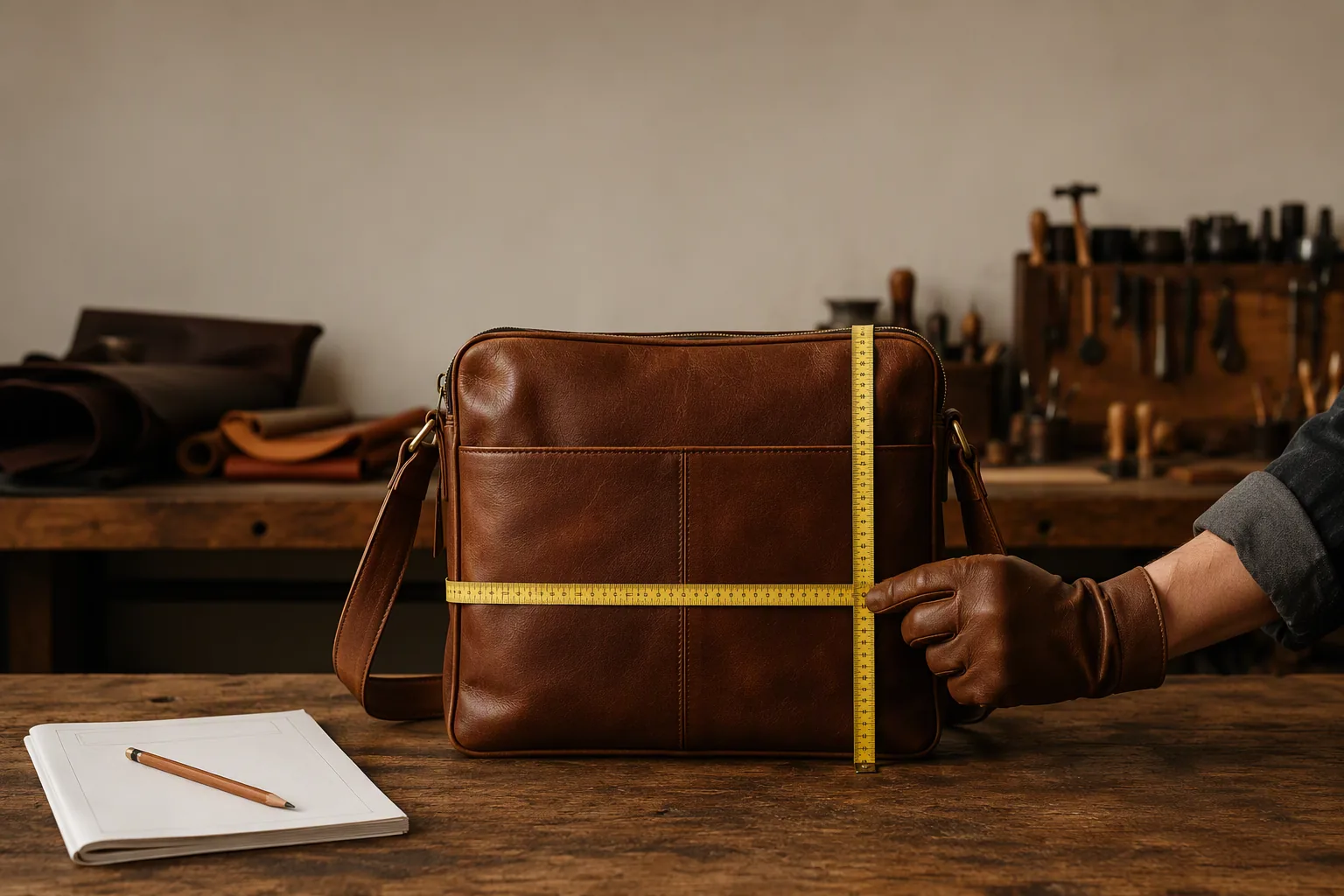
Drop is measured from the highest point of the handle or strap to the highest point of the bag body, taken through the centre of the handle arc. It is not the length of the strap, and it is not the same as strap circumference.
Factories sometimes quote arc length instead, which produces a bag that sits higher than intended. Stating the measurement point unambiguously removes the ambiguity.
Hand, Elbow and Shoulder
Three drop ranges cover most everyday bags. A hand carry generally needs around ten to twelve centimetres to let a hand pass through comfortably. A forearm or elbow carry needs roughly twenty to twenty-five. A shoulder carry needs twenty-five to thirty to clear a coat.
| Carry position | Typical drop | Notes |
|---|---|---|
| Wrist or hand carry | 10 to 13 cm | Handle must clear a gloved hand |
| Forearm or elbow | 20 to 26 cm | Comfortable with outerwear |
| Shoulder | 26 to 32 cm | Should clear a winter coat |
| Crossbody | 40 to 60 cm, adjustable | Depends on torso height |
| Backpack-style carry | 45 to 65 cm straps | Requires load distribution |
Adjustability and Range
An adjustable strap should be specified as a range with defined minimum and maximum, plus the position of the adjustment holes or slider travel. A range that is only stated as "adjustable" cannot be verified at inspection.
For a range sold in multiple markets, two strap lengths are often cheaper than one universal length, because an over-long strap on a short-torso wearer produces a bag that sits too low to be comfortable.
Sizing a Range: Gradation Across Sizes
Most successful bags are sold in more than one size, and the grading rules determine whether the family looks deliberate or accidental.
What Should Scale
Width and height usually scale together, in increments of around ten to fifteen percent between sizes, so that the series reads as a family rather than as unrelated products.
Small bags can tolerate larger percentage steps than large ones. Going from a small to a medium crossbody at plus twenty percent is unremarkable. Doing the same between two large totes produces two products that overlap in use.
What Must Not Scale Blindly
Some elements must be held constant or scaled differently. Strap width, hardware gauge and zip size have practical minimums, and scaling a strap down with the body produces a strap that cuts into the shoulder.
Handle drop is another element that should not shrink proportionally. A small bag still needs enough drop for a hand to pass through, so the drop often stays the same across a range while the body shrinks. The result is a small bag with a relatively generous handle, which is correct.
| Element | Scaling approach | Reason |
|---|---|---|
| Body width and height | Proportional, 10 to 15 percent steps | Maintains family look |
| Depth | Slightly less than proportional | Prevents boxy look on large sizes |
| Handle drop | Held nearly constant | Hand entry minimum |
| Strap width | Held constant or increased | Load and comfort |
| Hardware size | Stepped, not scaled | Gauge and load minimums |
| Internal organisation | Reconfigured, not scaled | Contents change with size |
Naming and Positioning
Size names should map to use rather than to relative rank alone. A small, medium and large range tells the buyer nothing about intended use. Naming sizes after the contents they accept, such as laptop size or carrier size, gives the buyer a reason to choose one.
Dimensions in E-Commerce Photography
Dimensions control perception, and perception controls returns. A bag photographed without scale references is routinely judged larger than it is.
Reference Objects
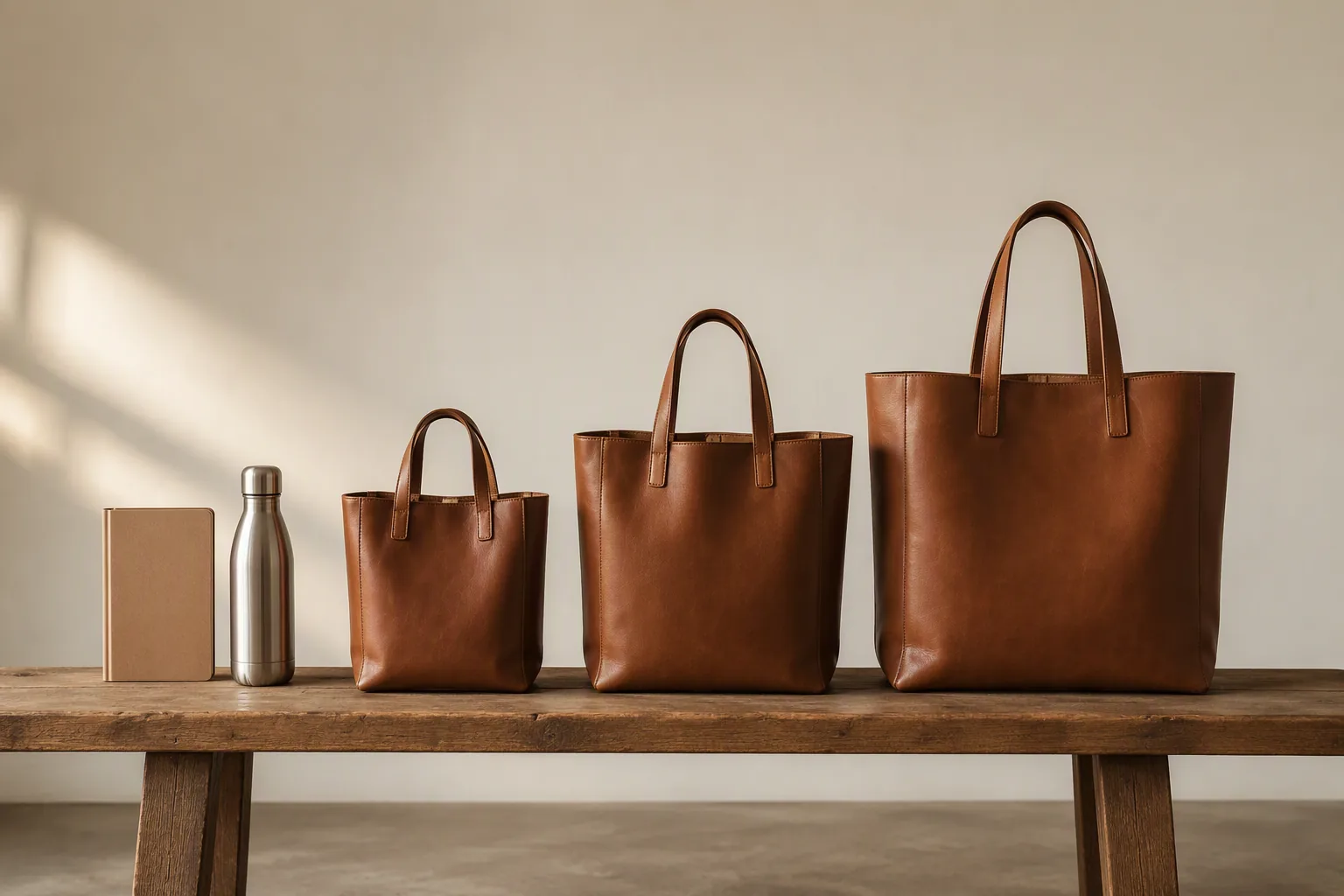
Including a recognisable object beside the bag, such as a standard notebook, a bottle or a phone, anchors scale immediately. The reference must be consistent across the range so sizes can be compared.
For pet products, a standard-size reference such as a bowl or a folded blanket communicates more than a ruler, because the buyer is imagining their animal, not measuring it.
Model Shots and Wearer Height
Worn photographs depend on the wearer's proportions. A crossbody photographed on a tall wearer looks longer and slimmer than the same bag on a short wearer. Where a range is sold in multiple markets, using more than one wearer height reduces the mismatch.
Stating the wearer's height in the image caption is a small change that removes a common source of complaint.
The Dimension Block
Every listing should carry the three outside dimensions plus depth of any external pocket, the drop of the main carry option, and the adjustable range of any strap. Weight completes the block.
| Listing field | Why it is needed | Common omission |
|---|---|---|
| Width, height, depth | Core sizing | Depth listed as gusset only |
| Interior dimensions | Capacity expectations | Omitted on padded products |
| Handle drop | Carry position | Confused with strap length |
| Strap adjustment range | Fit across body sizes | Stated as adjustable only |
| Weight | Load expectation | Omitted entirely |
| Internal pocket dimensions | Device fit | Listed by count only |
Tolerances and Measuring Standards
A dimension without a tolerance is a request, not a specification. Factories build to the numbers they are given, and every one of them will apply their own default tolerance unless told otherwise.
Where Dimensions Are Taken
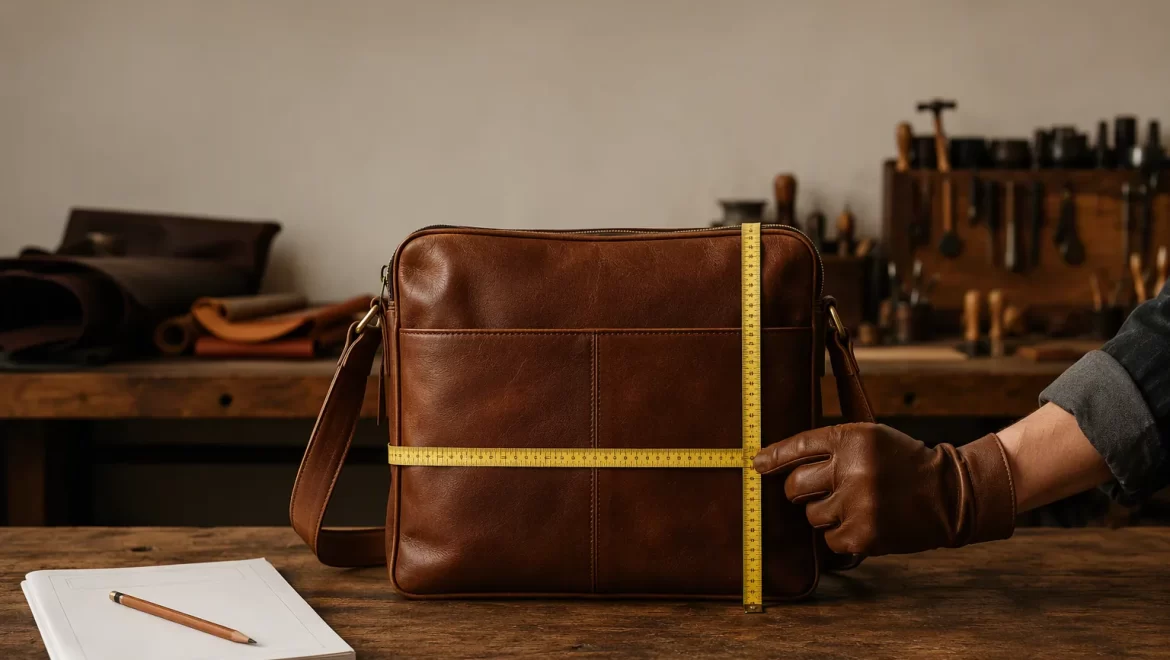
The measurement points must be defined. Body width is normally taken at the widest point with the bag empty, zipped and laid flat. Depth is commonly taken at the base between the two gussets. Height excludes handles and flaps.
If a specification lists dimensions without stating the points, the sample will match the drawing in appearance and fail inspection on the numbers. Adding a simple annotated drawing with dimension lines removes the risk at negligible cost.
Realistic Tolerances
Tolerance should reflect material behaviour. Rigid, board-backed structures hold dimensions closely, while soft leather bodies move with humidity and handling. Applying a rigid-product tolerance to a soft bag guarantees avoidable rejections.
| Product type | Typical tolerance | Notes |
|---|---|---|
| Rigid structured bag | Plus or minus 3 mm | Board and frame hold shape |
| Semi-structured leather bag | Plus or minus 5 mm | Stiffener plus lining |
| Soft unstructured bag | Plus or minus 8 mm | Material movement, relaxation |
| Padded carrier | Plus or minus 8 to 10 mm | Foam recovery varies |
| Strap length | Plus or minus 10 mm | Cutting and folding variation |
How to Verify
Verification should use the same method as the specification. Measuring a soft bag while it hangs produces a different number from measuring it flat. Agreeing the method, and writing it into the inspection checklist, prevents disputes that are really measurement disagreements.
For repeat orders, keep the approved sample and its recorded dimensions. Measuring a new production run against the recorded numbers is faster and more reliable than comparing it against memory.
Common Proportion Failures and Fixes
Most sizing problems arrive in predictable patterns, and each has a structural fix rather than a cosmetic one.
The Bulging Bag
The bag closes with difficulty once it is loaded, and the gusset bows outward. The cause is usually insufficient depth relative to the intended load, or a soft gusset on a bag that needs structure.
The fix is to increase depth rather than width, because depth adds capacity without changing the front silhouette. Where depth cannot grow, stiffening the gusset with interlining or a folded construction holds the shape closer to nominal.
The Bag That Will Not Sit
The bag slides forward or tips when placed on a chair or in a car footwell. This is a base proportion problem: the base area is too small relative to height, or the base panel is rounded rather than flat.
Flattening the base, widening it slightly, or adding feet changes stability without altering the front appearance.
The Strap That Cuts
A narrow strap on a heavy bag concentrates load, and the wearer feels it within minutes. The relationship is straightforward: as carried weight rises, strap width and padding must rise with it.
Widening the strap is usually the cheapest fix. Where the design cannot accept a wider strap, a removable pad solves the same problem while remaining optional for light loads.
The Handle That Traps the Hand
A drop that is too short turns a simple action into a struggle, particularly with gloves or a thick sleeve. The fix is a small increase in drop, usually one or two centimetres, which has almost no effect on the bag's appearance.
Where the handle is fixed leather rather than a strap, the change must be made at the pattern stage, so it is worth testing with the intended outerwear before approving the sample.
| Failure | Underlying cause | Recommended fix |
|---|---|---|
| Bulging when loaded | Depth too shallow for contents | Increase gusset depth |
| Losing shape when filled | Soft gusset on structured bag | Stiffen or fold the gusset |
| Tipping when set down | Base too small or rounded | Flatten and widen the base |
| Strap discomfort | Width not matched to load | Widen strap or add a pad |
| Restrictive handle | Drop below hand minimum | Increase drop at pattern stage |
| Reads larger online | No scale reference in images | Add reference object and state dimensions |
Testing a Size Before Committing to Tooling
Sizing problems are cheapest to fix on paper, slightly more expensive on a pattern, and expensive once tooling and stock are committed.
Paper and Card Mock Ups
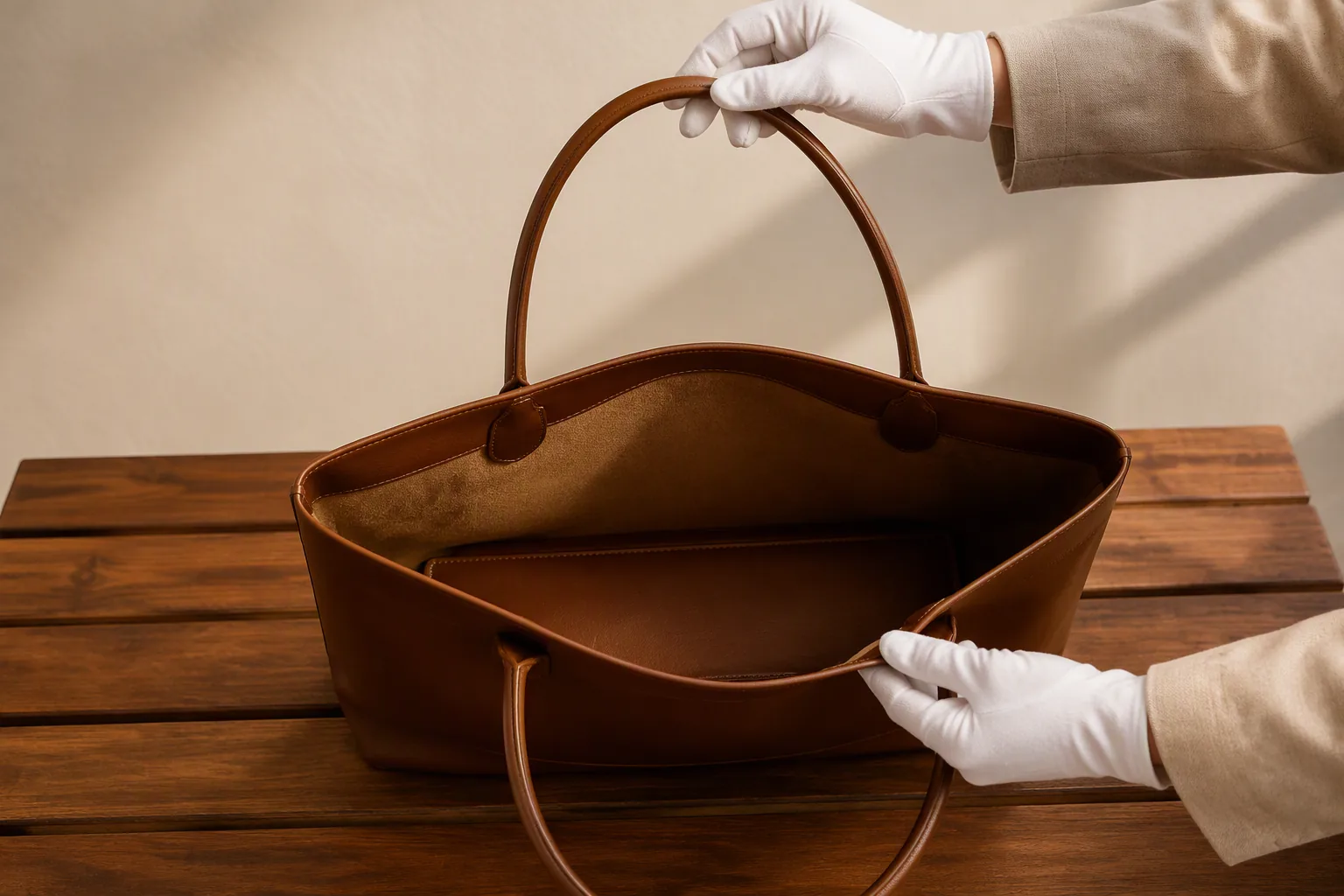
A card or paper mock-up built to the planned dimensions tests the contents list before any leather is cut. It answers the questions that matter: does the object fit, does the opening admit a hand, does the base sit flat.
The cost is negligible and the exercise catches the majority of gross sizing errors. Card mock-ups also produce a useful photograph for internal review, because proportion is easier to judge in three dimensions than on a flat drawing.
Soft Sample Before Hard Tooling
The first sample should be built in the intended material or something close to it, since a rigid mock-up will not reproduce how a soft gusset bows under load. Dimension checks on a soft sample should be taken both empty and lightly loaded.
Where a design requires a new custom clasp or a die-cut stiffener, that tooling should be ordered only after the soft sample's dimensions are approved. Committing to tooling first locks in proportions that have not been tested in the real material.
Recording the Approved Numbers
Once approved, the measured dimensions of the sample become the reference for production. Recording them alongside the sample photograph, in the same document as the tolerance notes, gives the factory an unambiguous target for the first run and for every reorder after it.
FAQ
How are bag dimensions measured?
A: Outside width, height and depth are normally measured with the bag empty, zipped and laid flat. Height excludes handles and flaps, width is taken at the widest point, and depth is taken at the base between the gussets.
Why does my bag hold less than the stated litres?
A: Quoted volume is a reference figure based on outside dimensions. Lining, padding, stiffeners, dividers and hardware consume interior space, so practical capacity usually runs 70 to 85 percent of the nominal figure.
Which dimension should I increase for more capacity?
A: Depth. Increasing gusset depth adds capacity almost linearly while adding only a narrow band to the front silhouette, whereas increasing width changes how the bag reads visually.
What handle drop do I need?
A: Around 10 to 13 cm for hand carry, 20 to 26 cm for forearm carry, 26 to 32 cm for shoulder carry, and 40 to 60 cm for crossbody. The drop should clear the outerwear the bag will be carried with.
Is handle drop the same as strap length?
A: No. Drop is measured from the highest point of the handle or strap to the top of the bag body through the centre of the arc. Strap length is the cut length of the material and is always longer.
What proportion of depth to width works best?
A: Most bags read well between 30 and 50 percent. Below 30 percent the bag is flat and hard to fill; above 50 percent it starts to look like a box. Pet carriers deliberately run deeper for stability.
How much tolerance should I allow?
A: It depends on construction. Rigid structured bags commonly hold plus or minus 3 mm, semi-structured leather bags around 5 mm, and soft unstructured bags or padded carriers 8 to 10 mm.
Should I scale handles and straps when grading sizes?
A: No. Handle drop should stay nearly constant so a hand still fits, and strap width should be held or increased. Hardware is usually stepped rather than scaled.
How large should a pet carrier be?
A: Large enough for the animal to stand, turn around and lie down, with interior dimensions measured rather than outside dimensions. Padded construction reduces usable space noticeably, so plan the interior first.
Does a wider bag always hold more?
A: No. Width increases capacity linearly but is limited by the wearer's silhouette and by how the bag reads. Depth is the more efficient dimension to increase for capacity.
How do I stop a bag looking bigger online than it is?
A: Include a recognisable reference object in the photographs, state the wearer's height in worn shots, and list outside dimensions, interior dimensions, handle drop and weight in the listing.
What is the biggest sizing mistake in development?
A: Specifying dimensions without measurement points or tolerances. Samples then match the drawing visually but fail inspection numerically, and the disagreement is about method rather than about quality.
Can a bag be resized after tooling is made?
A: Small changes to depth or interior organisation are usually possible. Changes to base area or hardware position often require new patterns or tooling, which is why soft samples should be approved before tooling is ordered.
How many sizes should a range include?
A: Two or three is typical, with ten to fifteen percent steps between them. More than three usually creates overlapping products unless each size is positioned for a clearly different use.
Does a heavier bag need a wider strap?
A: Yes. As carried weight rises, strap width and padding must rise with it to distribute load. Widening the strap is normally the cheapest fix for discomfort.
When should dimensions be finalised?
A: Before tooling and before bulk material is committed. Test the contents against a card mock-up, confirm the numbers on a soft sample in the real material, then record the approved dimensions as the production reference.
Ready to finalise a bag size that works in use, photographs honestly and survives inspection? Bring the intended contents list, the outside and inside dimensions, and the drop of every carry option to your next sampling round, and measure the approved sample flat before production begins.