Leather Thickness (Oz) and Bag Type Matching: A Manufacturer's Guide
Leather thickness is the most underrated specification in bag design. Brands obsess over color, grain, and finish — and then discover too late that a beautiful 1.0 mm leather collapses under the weight of a laptop, or that a 2.2 mm hide makes a fashion tote feel like a piece of luggage. Thickness is not an aesthetic choice; it is an engineering decision that determines whether a bag holds its shape, carries its load, sews cleanly, and lasts. Get it right and everything else falls into place. Get it wrong, and no amount of good hardware or stitching can save the product.
This guide is written from the factory floor. We will explain how leather thickness is measured, map the practical thickness ranges to the bag types that suit them, show how thickness interacts with structure, hardware, and production behavior, and give you a ready-to-use specification table for your next tech pack. By the end, you will know exactly what to write in the "material thickness" line of your product specification — and what to say to your factory when they recommend something different.
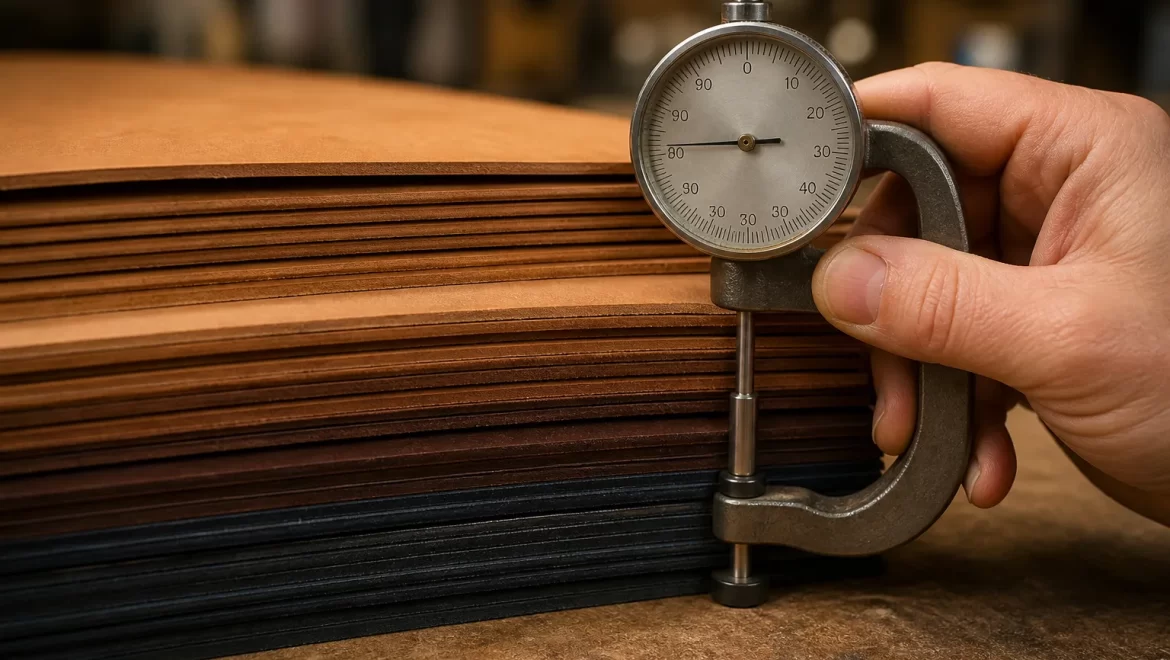
How Leather Thickness Is Measured
Leather thickness is expressed in two units, and every manufacturer must be fluent in both because tanneries, pattern makers, and clients each use their own.
Millimeters (mm). The metric measurement, used across most of Asia and Europe. A leather described as "1.4–1.6 mm" means the hide measures between those values, usually at the shoulder or backbone area where thickness is most representative.
Ounces (oz). The traditional measurement used in the US and much of the English-speaking leather trade. One ounce equals 1/64 of an inch (0.397 mm). So a "4 oz" leather is approximately 1.6 mm thick.
| oz | mm (approx.) | Common descriptor |
|---|---|---|
| 2.5 oz | 1.0 mm | Thin, garment/small goods |
| 3 oz | 1.2 mm | Light fashion |
| 3.5 oz | 1.4 mm | Mid-weight, everyday |
| 4 oz | 1.6 mm | Standard bag weight |
| 4.5 oz | 1.8 mm | Heavy bag weight |
| 5 oz | 2.0 mm | Structured/heavy |
| 5.5 oz+ | 2.2 mm+ | Extra heavy, work/travel |
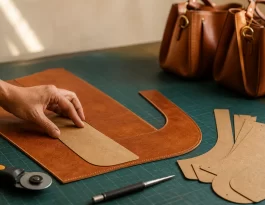
Two practical notes from the tannery side. First, a hide is never uniform — it tapers from the backbone to the belly, so "4 oz leather" is an average, and panels cut from different zones can differ by 10–20%. Second, many bag factories use skiving — thinning specific areas (seams, folds, edges) — so the leather you receive may be 1.6 mm overall with 0.8 mm seams. When you specify thickness, specify it for the main panels, and let the factory manage skiving for construction details.
The Thickness Spectrum at a Glance
| Thickness range | Typical use | Character |
|---|---|---|
| 0.8–1.0 mm (2–2.5 oz) | Linings, small accessories, delicate clutches | Flexible, drapes, light |
| 1.0–1.2 mm (2.5–3 oz) | Fashion totes, soft slouch bags, wallets | Soft, supple, light weight |
| 1.4–1.6 mm (3.5–4 oz) | Everyday handbags, crossbody bags, backpacks | Balanced: structure + softness |
| 1.8–2.0 mm (4.5–5 oz) | Work bags, laptop bags, structured totes | Firm, holds shape, sturdy |
| 2.0–2.4 mm (5–6 oz) | Travel bags, briefcases, heavy duffels | Rigid, weight-bearing, formal |
| 2.4 mm+ (6 oz+) | Frames, trims, special structural parts | Hard, requires special handling |
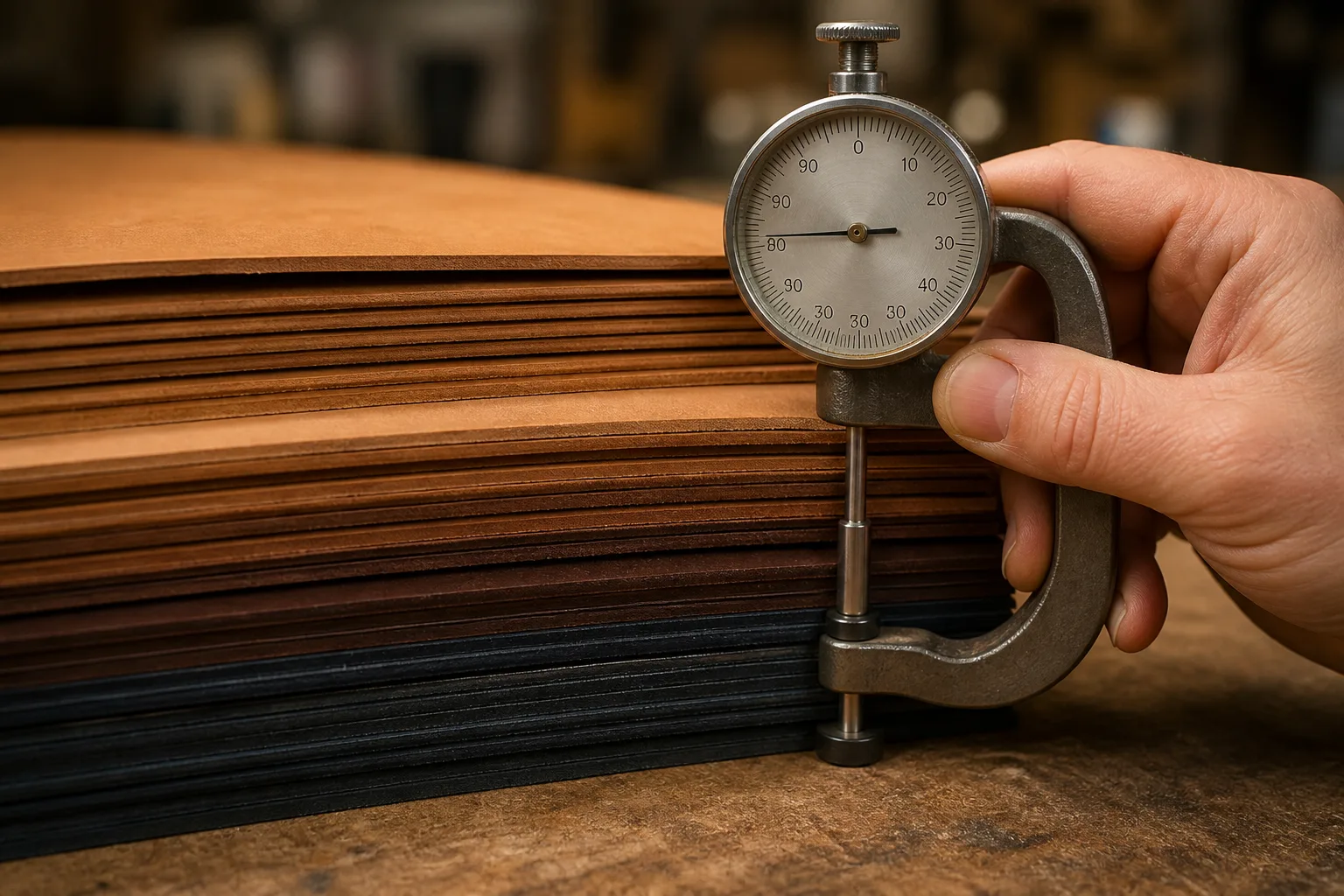
The rule of thumb: the bigger the bag and the heavier the load, the thicker the leather. But "bigger and heavier" interacts with silhouette — a large slouchy tote uses thin leather precisely because its softness is the design intent, while a small structured box bag uses thick leather to hold its architectural shape. Thickness follows function, not size alone.
Thin Leathers: 1.0–1.2 mm (2.5–3 oz)
Thin leather is the fashion designer's friend. At 1.0–1.2 mm, leather becomes soft, supple, and light — it drapes, gathers, and folds the way fabric does, which makes it the default for fashion-forward silhouettes.
Best suited for: soft slouch totes, bucket bags, delicate clutches, evening bags, wallet interiors, and any design built around gathering, pleating, or unstructured flow. Thin leather is also used as lining in higher-end bags, where it adds a premium touch versus fabric.
Manufacturing notes: thin leather sews easily and edge-folds cleanly, but it is unforgiving at stress points. Handles and strap attachments concentrate load, and a 1.0 mm panel at a handle seam can stretch or tear under heavy carry. The professional fix is reinforcement: skive-in stays, doubled panels at stress zones, or a slightly thicker leather for load-bearing parts while keeping thin leather for the body. If your design calls for thin leather with serious carry capacity, spec the reinforcement in the tech pack — do not leave it to chance.
Durability reality: thin leather is not "low quality" — it is a design choice. A well-made 1.0 mm bag that is not overloaded performs beautifully. The failure mode appears when the bag is used beyond its design intent: overstuffed, overloaded, or carried by thin straps every day. Match the leather to the intended use, and communicate that intent to your customers.
Mid-Range Leathers: 1.4–1.6 mm (3.5–4 oz)
The 1.4–1.6 mm range is the workhorse of the bag industry — the "standard bag weight" for good reason. It offers the best balance between structure and softness: enough body to hold a defined shape, enough flexibility to feel pleasant in the hand.
Best suited for: everyday handbags, crossbody bags, shoulder bags, backpacks, diaper bags, and most mid-market and premium lines. If you are launching a first collection and have no strong reason to go thinner or thicker, 1.4–1.6 mm is the safe, professional default.
Manufacturing notes: this range behaves predictably across every production step — clean cutting, good stitch seating, manageable skiving, and easy edge finishing (both burnishing and edge paint work well). Yield is consistent because the thickness tolerates natural hide variation. Production speed is highest in this range, which keeps your unit cost down.
Durability reality: 1.4–1.6 mm leather handles daily carry, a laptop in a padded sleeve, and years of normal use. It is the thickness where "premium feel" and "practical durability" overlap — which is exactly why the majority of successful bag brands build their core lines in this band.
Heavy Leathers: 1.8–2.4 mm (4.5–6 oz)
Heavy leather is the material of serious structure. At 1.8 mm and above, leather stops behaving like fabric and starts behaving like a structural material — it holds its own shape, supports hardware, and carries weight without sagging.
Best suited for: structured totes, work bags, laptop briefcases, travel bags, duffels, and any bag with a defined architectural silhouette. Heavy leather is also the right choice for bags that must stand up on their own, and for classic formal pieces like briefcases and document carriers.
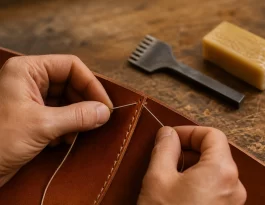
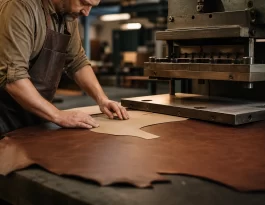
Manufacturing notes: heavy leather demands more from every production step. Cutting is slower and requires sharper dies. Stitching needs heavier needles, stronger thread, and careful tension — the classic "stitch tunnels" problem appears when thread is too thin for the leather. Edges are a major operation: a 2.0 mm edge must be skived, burnished or painted in multiple passes, and finished to a smooth radius. Hardware must be upgraded to match — a dainty 6 mm buckle looks lost and works poorly on a 2.2 mm flap. Skiving becomes essential at folds, where full-thickness leather would create bulky, stiff creases.
Durability reality: heavy leather, properly built, is the longest-lasting material in the bag world. The trade-offs are weight, stiffness, and cost. A 2.0 mm travel bag is heavier than a 1.4 mm equivalent, less forgiving to overstuff, and noticeably more expensive in both material and labor. Buyers who value "forever" products accept these trade-offs; buyers who want a light everyday bag will not.
How Thickness Interacts with Structure and Hardware
Thickness is never an isolated number — it couples with every other structural choice in the bag.
Handles and straps. The most common thickness failure is at the handle. A 10 mm handle on 1.0 mm leather is a guarantee of stretching and tearing under load. The professional approach is to match handle width to thickness, or to reinforce with webbing, stays, or doubled layers. Rule of thumb: the more weight the handle will carry, the thicker the leather at that point — many factories spec 2.0 mm at handles even when the body is 1.4 mm.
Hardware. Thick leather needs heavy hardware — not for aesthetics, but for mechanics. A rivet that is too short will not clinch properly through 2.2 mm of leather; a buckle prong that is too thin will bend under the resistance of stiff leather; a zipper tape that is too light will pucker against a heavy panel. When you upgrade thickness, audit your hardware spec at the same time.
Frames and structure. Bags with metal frames, rigid bottoms, or structured gussets need leather thick enough to hold the frame without distortion. Conversely, too-thick leather on a soft silhouette fights the design — the bag will not drape. The pairing of thickness and structure is where "the bag looks right" comes from: designers can feel the difference, and so can customers.
Lining and interlining. Thickness also changes how the bag is constructed underneath: thin leather often needs stiffer interlining to hold shape, while heavy leather needs none. Your factory's pattern maker will adjust the whole construction stack — leather, lining, interlining, reinforcements — around the chosen thickness. Changing thickness late in development is not a material swap; it is a construction change.
Thickness, Weight, and Shipping Economics
Thickness decisions ripple all the way into your logistics budget — a factor most designers never consider until the first container arrives. Because leather weight scales almost linearly with thickness, a "small" spec change has outsized effects at volume.
Consider a 40 × 30 × 12 cm tote. At 1.2 mm leather, the bag body weighs roughly 0.9–1.1 kg including lining and hardware. At 2.0 mm, the same bag weighs about 1.4–1.7 kg — a 50%+ increase. Now multiply by 5,000 units per production run, and you are carrying several extra tons per container. For brands shipping by sea, this raises freight cost per unit; for brands using air freight or express for DTC e-commerce, the per-kg rates make the difference painful. Some e-commerce brands find that staying under a weight threshold (for example, under 1.5 kg for certain express tiers) is worth designing the entire collection around.
Weight also affects the customer experience in ways that show up in reviews: a bag that feels "solid and premium" at the right weight feels "clunky and heavy" when over-thickened, and a bag that is too light can feel cheap regardless of material quality. The sweet spot is brand-dependent: luxury houses often lean heavier because heft reads as quality; fashion-forward brands lean lighter because ease matters more. Know which weight story your brand is selling, and let thickness serve it.
There is also a durability-versus-weight argument worth making to your customers: a 1.4 mm bag that is reinforced correctly at stress points performs nearly as well in daily use as a 2.0 mm bag at 70% of the weight. Engineering, not raw thickness, delivers most of the practical durability. When your cost structure and freight budget matter — and they always do — the professional move is to optimize construction first and add thickness only where the design genuinely requires it.
Manufacturing Behavior by Thickness
Every thickness range behaves differently on the production floor, and these behaviors affect your cost and lead time more than the leather price alone.
| Production step | Thin (1.0–1.2 mm) | Mid (1.4–1.6 mm) | Heavy (1.8–2.4 mm) |
|---|---|---|---|
| Cutting | Fast, clean | Fastest, best yield | Slower, heavier dies |
| Stitching | Easy; watch seam reinforcement | Optimal tension window | Needs heavy thread/needles |
| Skiving | Minimal needed | Moderate at folds | Essential at folds/seams |
| Edge finishing | Edge paint or folded edges | Both burnish and paint work | Multi-pass burnish/paint |
| Hardware setting | Light hardware | Standard hardware | Heavy hardware required |
| QC pass rate | High (design-dependent) | Highest | Lower (more variables) |
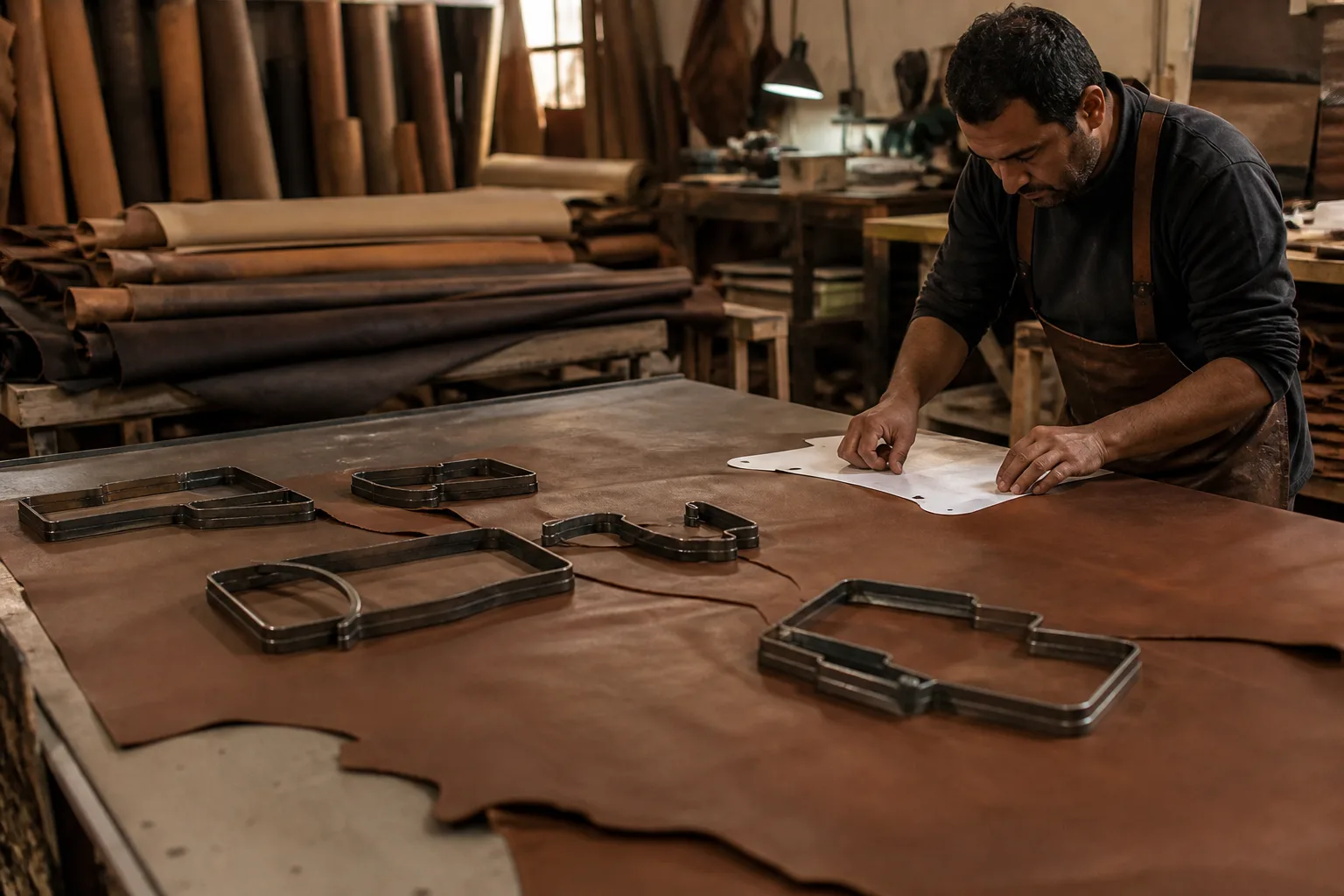
The practical takeaway: mid-range leather is the cheapest to produce per unit because it minimizes special handling. Thin and heavy leathers each add production time — thin because of reinforcement work, heavy because of heavier equipment and finishing passes. When comparing factory quotes for the "same" bag in different thicknesses, expect a visible difference; it is not markup, it is labor.
Thickness Selection Table by Bag Type
| Bag type | Recommended thickness | Why |
|---|---|---|
| Soft slouch tote / bucket bag | 1.0–1.2 mm | Drape and gather; lightweight carry |
| Fashion clutch / evening bag | 0.8–1.2 mm | Delicate, elegant, minimal load |
| Everyday handbag / crossbody | 1.4–1.6 mm | Balance of structure, feel, durability |
| Backpack (commuter) | 1.4–1.8 mm | Load distribution; comfort + structure |
| Diaper / family bag | 1.2–1.6 mm | Durability with reasonable weight |
| Structured tote | 1.6–2.0 mm | Holds shape, supports handles |
| Work / laptop bag | 1.6–2.0 mm | Carries weight without sagging |
| Travel duffel | 1.8–2.2 mm | Abrasion resistance, heavy loads |
| Briefcase / document carrier | 2.0–2.4 mm | Formal structure, stands upright |
| Wallets / small goods | 1.0–1.4 mm | Fine feel; some parts skived thinner |
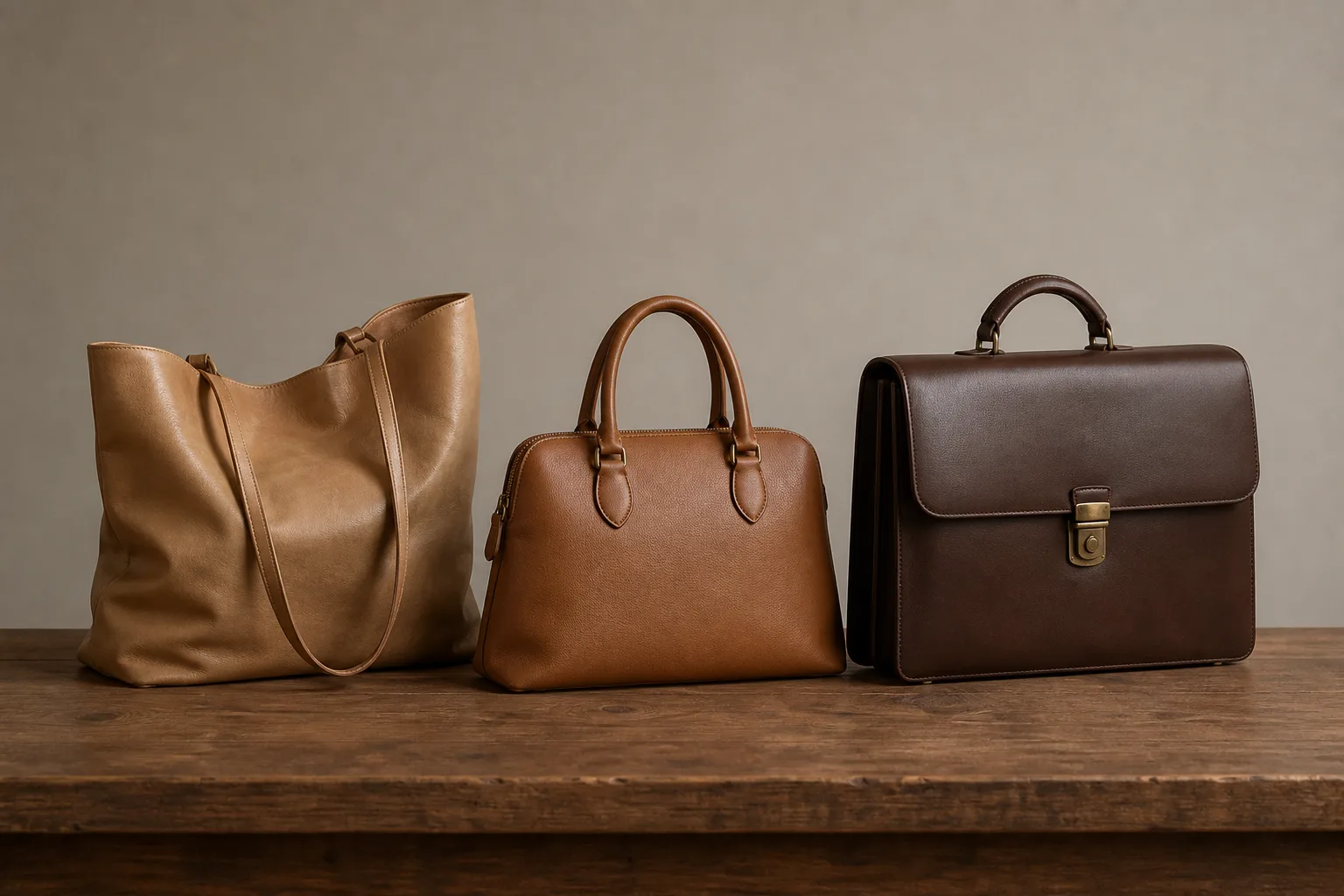
Use the table as a starting point, then adjust for silhouette, hardware, and brand positioning. A fashion house may deliberately use 1.0 mm for a "featherlight" story; a workwear brand may use 2.0 mm for a "bulletproof" promise. The table gives you the engineering baseline; your brand strategy sets the final number.
Common Mistakes and How to Avoid Them
Mistake 1: Choosing thickness by feel at the sample stage. A prototype in 1.4 mm feels great in the hand — but the production leather from a different batch, or a different tannery, may behave differently. Always lock thickness in the written spec and verify each production batch against it with a thickness gauge.
Mistake 2: Overloading thin leather. Fashion bags in 1.0 mm leather that are marketed for everyday laptop carry will generate returns. Match the marketing promise to the engineering reality, or reinforce the construction.
Mistake 3: Ignoring skiving at folds. Full-thickness leather at a 180-degree fold creates a stiff, cracking crease. Professional factories skive fold lines to half thickness. If a sample shows a clean fold, ask whether the production version will be skived identically — this is a classic sample-versus-production gap.
Mistake 4: Keeping the same hardware when changing thickness. Upgrading from 1.4 mm to 2.0 mm without changing zippers, rivets, and buckles produces hardware failure and pucker. Re-audit hardware whenever thickness changes.
Mistake 5: Specifying thickness as a single number without tolerance. "1.5 mm leather" without a range invites ambiguity. Spec "1.4–1.6 mm" or "1.5 mm ± 0.15 mm" so your QC team and the tannery are measuring the same thing.
FAQ
What does "4 oz leather" mean in millimeters?
A: One ounce equals 1/64 inch (about 0.4 mm), so 4 oz is roughly 1.6 mm. Always confirm with your tannery whether they quote in oz or mm — the two are often mixed up.
What is the best leather thickness for a handbag?
A: For a standard everyday handbag, 1.4–1.6 mm (3.5–4 oz) is the industry default: balanced structure, comfort, durability, and manufacturing efficiency.
Is thicker leather always better quality?
A: No. Thickness is a functional spec, not a quality score. The right thickness depends on the bag design and use. A 2.2 mm leather on a fashion clutch is a design error, not a quality win.
Can one bag use different thicknesses?
A: Yes — this is standard practice. Bodies at 1.4 mm with 2.0 mm handles, or 1.6 mm bodies with skived 0.8 mm fold lines. Spec each zone or let the factory propose the construction stack.
How much does thickness affect the bag's weight?
A: Directly — leather is roughly proportional to thickness in weight. Moving from 1.2 mm to 2.0 mm roughly doubles panel weight. For large bags, this is a real shipping and comfort consideration.
Does thicker leather cost more?
A: Yes, on two levels: the leather itself costs more per square foot, and heavy leather adds labor (heavier stitching, multi-pass edge finishing, skiving). Budget for both.
What thickness do luxury brands use?
A: Most luxury handbags sit in the 1.2–1.6 mm range for soft styles, with structured pieces (briefcases, box bags) at 1.8–2.4 mm. The "luxury feel" comes from finish quality and construction, not from maximum thickness.
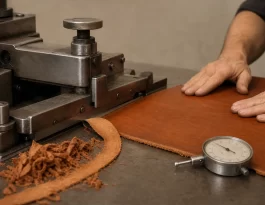
How do I verify the leather thickness I receive?
A: Use a leather thickness gauge (a simple caliper-style tool) at several points on a panel, especially after skiving areas. Compare against the spec range in your tech pack, and record readings in your QC log.
How to Specify Thickness in Your Tech Pack
A professional tech pack leaves no room for interpretation. Write thickness like this:
- Main panels: 1.4–1.6 mm (± 0.15 mm), vegetable-tanned cowhide
- Handles and straps: 2.0 mm, skived to 1.0 mm at stitch lines
- Fold lines: skived to 50% of panel thickness
- Gussets: 1.4–1.6 mm
- Hardware spec: updated to match panel thickness (rivet length, zipper tape weight, buckle gauge)
- QC check: thickness verified by gauge at 3 points per panel on incoming inspection
Add a note that any thickness change requires written approval before production. That single sentence prevents the most common factory shortcut — substituting a thinner, cheaper leather and hoping nobody notices until the samples ship.
Conclusion
Leather thickness is the specification where good bag design actually happens. It determines how a bag looks when empty, how it carries when full, how it sews, how it edges, how it ages, and how much it costs to produce. There is no single "best" thickness — only the thickness that matches your bag's silhouette, load, hardware, and brand promise. Thin leather gives fashion its drape; mid-range leather gives everyday bags their balance; heavy leather gives structure its authority. The professional path is to choose deliberately, specify precisely, and verify every batch — and to treat thickness as the engineering decision it is, not a detail you can leave to the factory's discretion.
Planning a new bag line and unsure which thickness fits your design? Contact our factory with your tech pack or sketch — we will recommend the thickness range, construction stack, and hardware spec for your specific bag, and prepare samples in 1.2 / 1.6 / 2.0 mm so you can feel the difference before you commit.