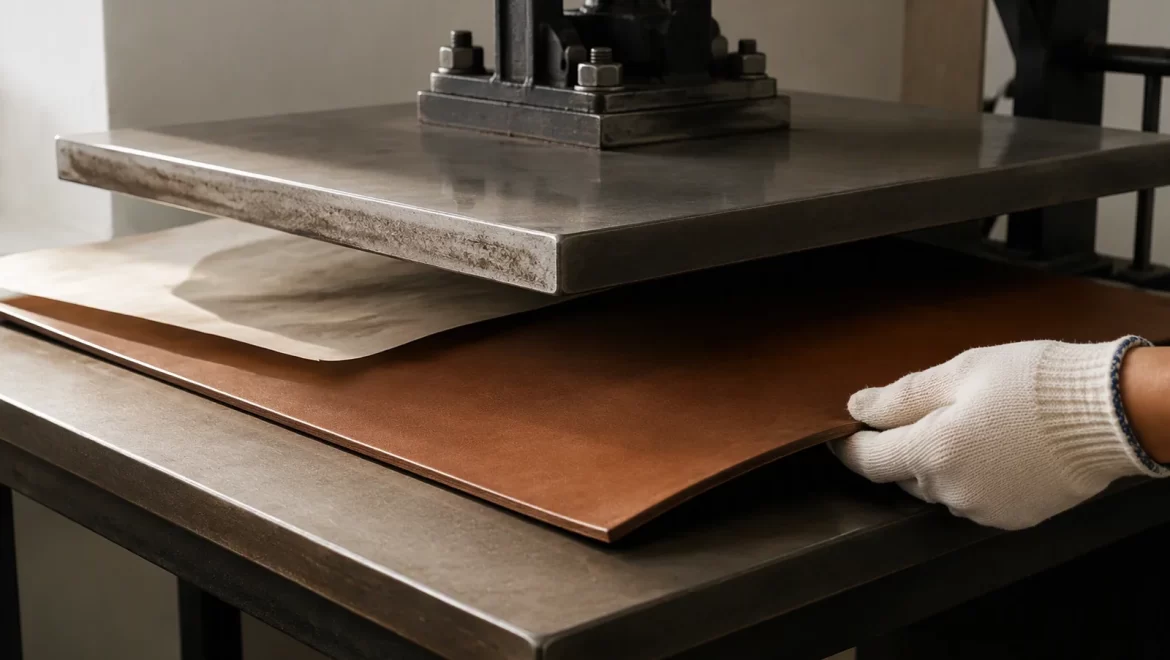
Why Does Pressing and Shaping Decide the Shape of a Leather Bag?
- What Pressing Actually Does to Leather
- Temperature Control and Its Boundaries
- Moisture and Conditioning
- Presses, Plates and Moulds
- Formers and Their Materials
- Skiving and the Intersections
- Forming the Three-Dimensional Parts
- Cooling and Holding the Shape
- Linings, Reinforcement and Pressing
- Tannage and Finish Differences
- A Defect Map for Pressing
- Measuring Dimensions After Forming
- Keeping Sampling and Bulk Consistent
- The Process Card for Pressing
- Skill, Training and Judgement
- When Pressing Cannot Fix a Shape
- Environment and Season
- Cost and Station Time
- Briefing a Supplier on Shape
- Re-Shaping and Repair
- Pressing Within the Assembly Sequence
- Former Care and Maintenance
- A Quality Gate After Forming
- Common Errors at the Press
- A Structured Bag, Step by Step
- FAQ
Two factories can cut the same pattern from the same hide, sew it to the same tolerances, and still produce bags that look like different products. The difference is almost always pressing and shaping, the least documented operation in bag making.
Pressing is not a finishing step added at the end. It is the operation that converts flat panels into a three-dimensional object, and it sets dimensions that sewing alone cannot recover once the leather has cooled.
What Pressing Actually Does to Leather
Leather is a fibrous material that softens with heat and moisture, then holds whatever shape it is given as it cools and dries.
The Plastic Range
Between roughly the temperature where the fibres relax and the point where they scorch, leather becomes plastic enough to be formed without damage. That window is narrow, and it differs between tannages.
Setting, Not Bending
Bending a panel springs back. Setting a panel changes the relationship between fibres so the new shape survives handling, packing and use. The distinction explains why a hand-bent curve looks fine in the sample room and flat on the shelf.
The Irreversible Point
Above a certain temperature the surface collapses and the grain is lost permanently. There is no repair, only re-cutting the panel and losing the material.
Temperature Control and Its Boundaries
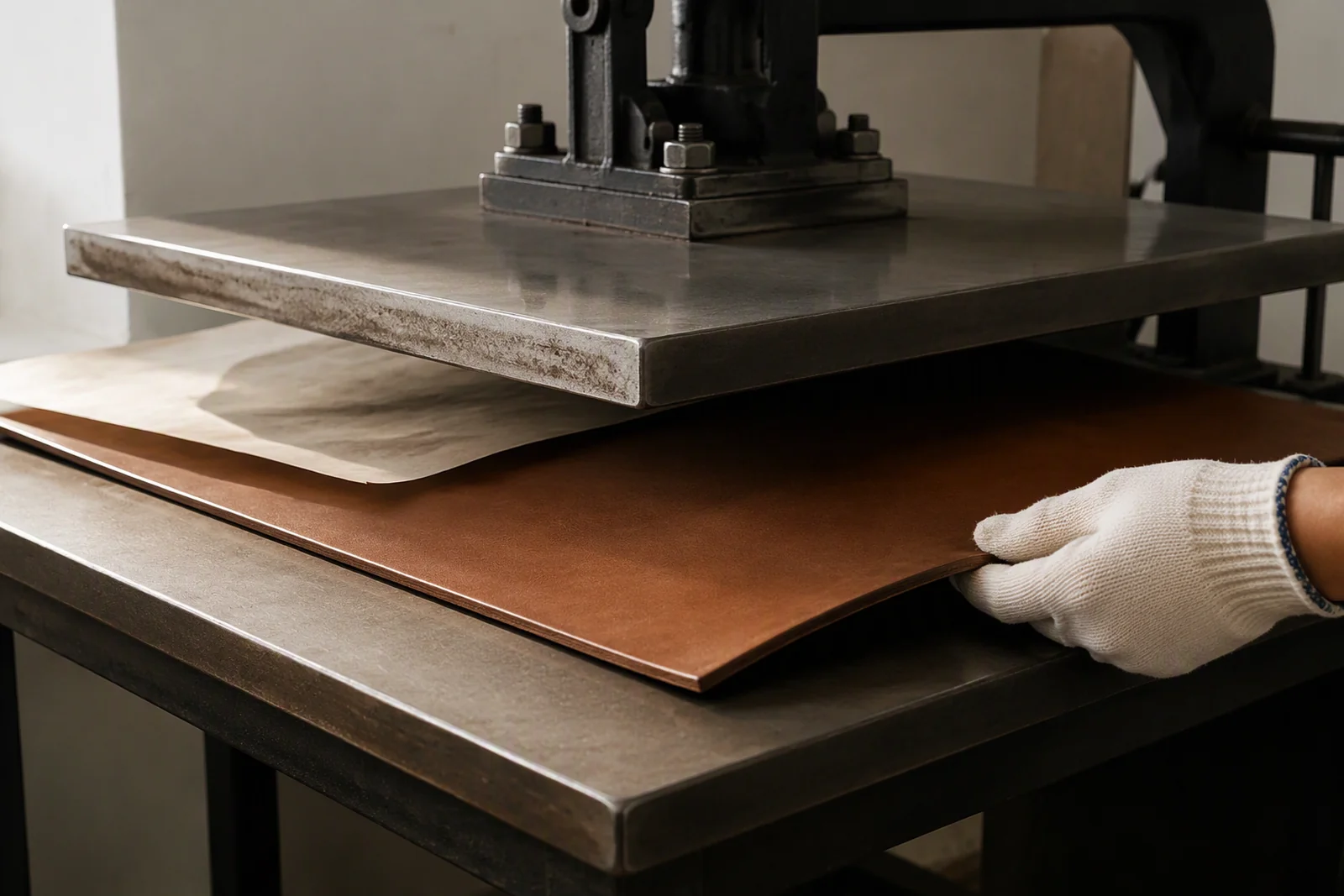
Temperature is the variable that operators adjust first and understand least, because the visible result of overheating appears hours later.
Working Temperature
Most bag leathers form comfortably in a band well below the temperature that damages grain. The band is set by the tannage, the finish and the thickness, so it has to be established per article rather than per factory.
Scorch and Grain Loss
Overheating produces a glassy patch that reflects light differently from the rest of the panel. On a finished bag this reads as a defect in the material, not in the process.
Plate on Hide
Direct contact with a hot plate is the common cause of scorch, and a pressing cloth or a paper interleaf removes most of the risk. The interleaf also prevents the plate from polishing the grain.
| Effect | Cause | Recovery |
|---|---|---|
| Softened panel | Heat within range | None needed |
| Glassy patch | Plate too hot | None |
| Shrinkage | Sustained heat | None |
| Even set | Correct band | Achieved |
Moisture and Conditioning
Dry leather will not form; wet leather will form too easily and then shrink as it dries, which is why moisture is a controlled input rather than a preparation step.
Casing and Re-Wetting
Vegetable-tanned leather forms best when cased evenly, with moisture through the thickness rather than on the surface. Surface wetting produces a soft skin over a stiff core and a curve that fails in a week.
Steam and Spritz
Steam heats and moistens at the same time, which suits thin panels and quick curves. A spritz suits small areas where steam would wet too wide a field.
Drying After Shaping
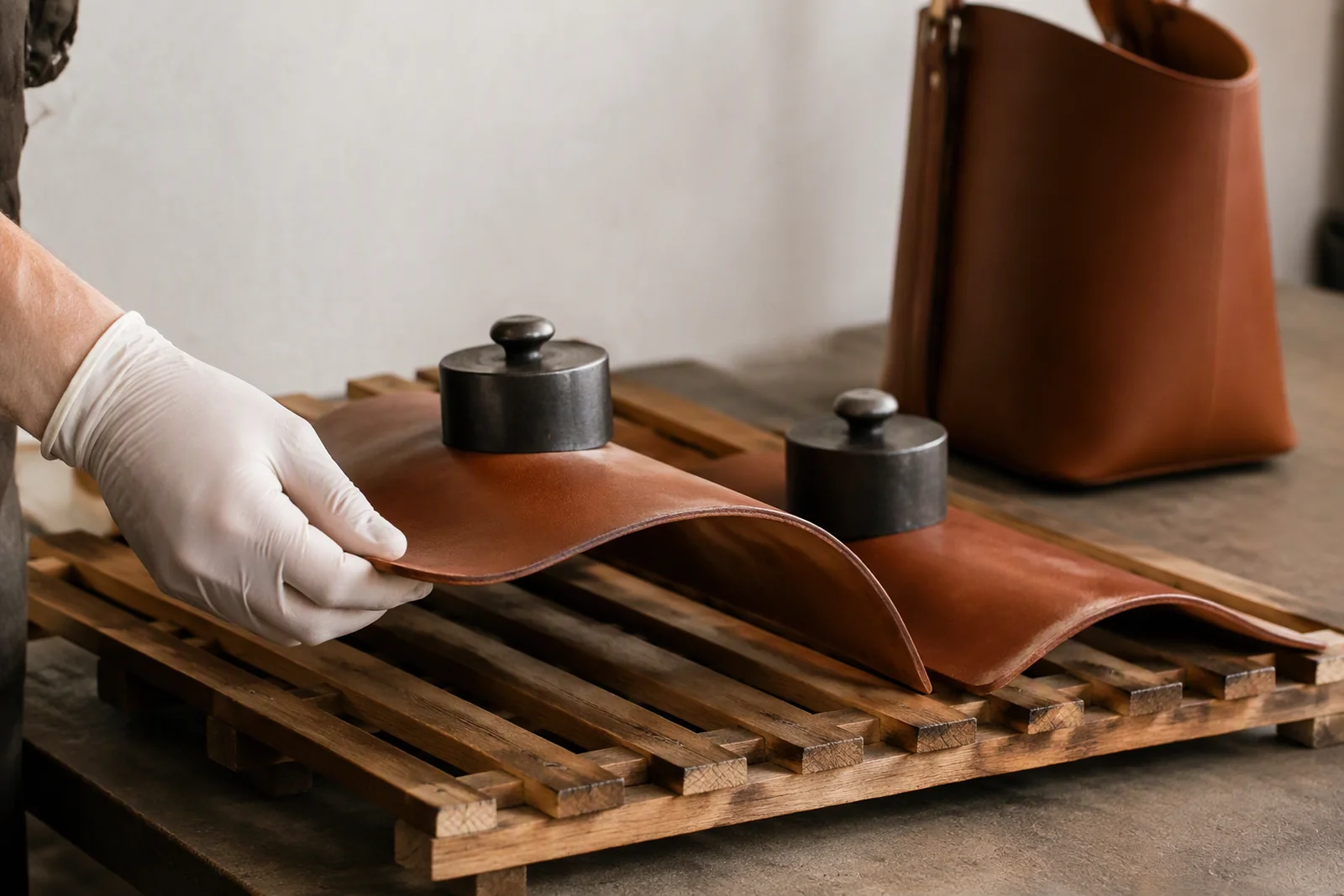
A shaped panel must dry in its former or under weight. Drying free lets the panel relax back toward flat, and the shape that was set becomes a suggestion.
| Method | Suits | Risk |
|---|---|---|
| Casing | Thick vegetable-tanned | Slow |
| Steam | Thin panels | Over-wetting |
| Spritz | Small areas | Uneven |
| Dry former | Complex shapes | Time |
Presses, Plates and Moulds
The equipment decides which shapes are possible, and the choice is usually made once for the whole factory rather than per product.
Flat Plate Presses
A flat press sets seams, flattens edges and bonds reinforcement. It cannot create curvature, so it is the tool for edge setting rather than for shaping.
Curved and Contoured Formers
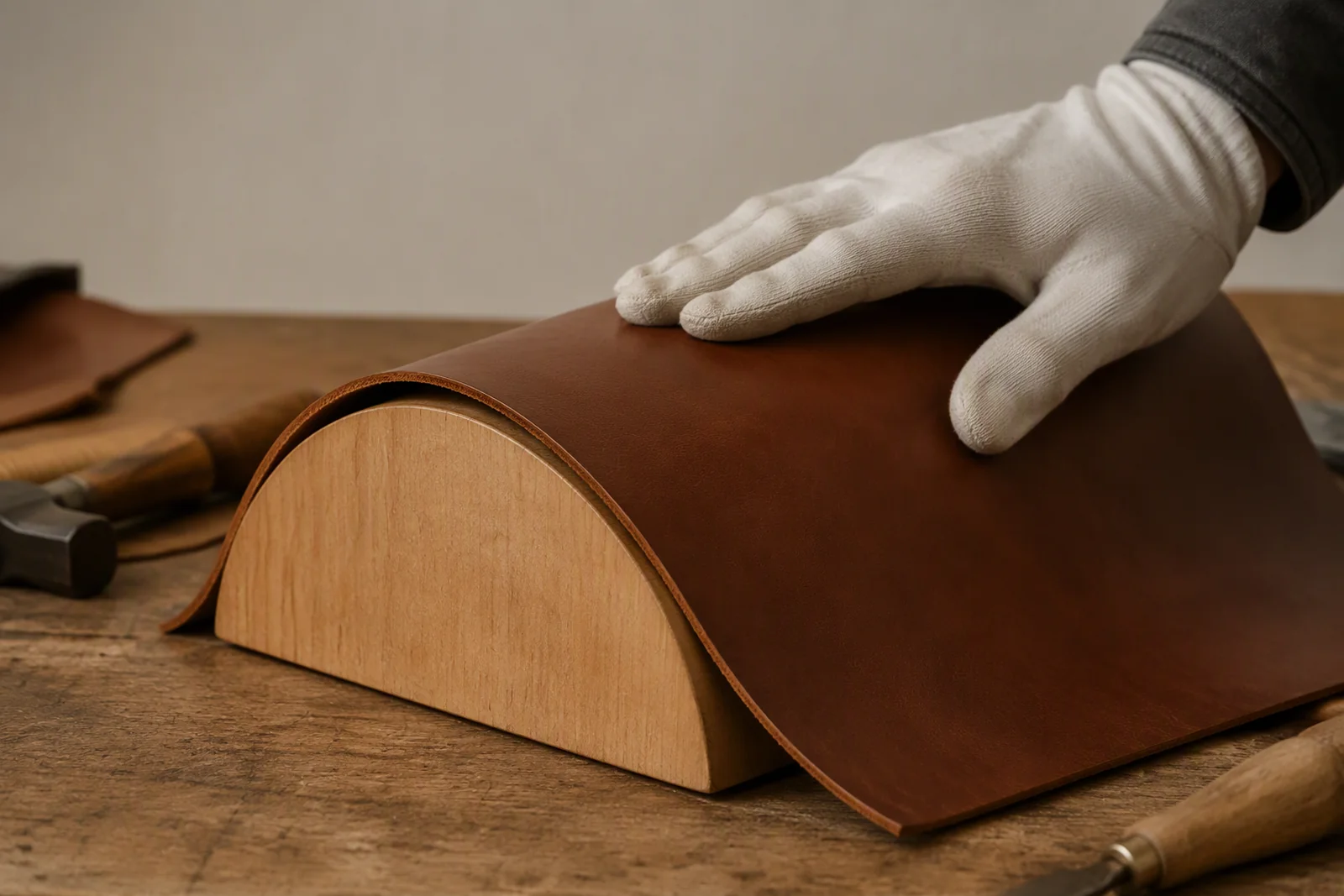
A contoured former sets a gusset or a base curve by pressing the panel against a shape. Its profile has to match the pattern, or the panel will be formed to the wrong radius.
Vacuum and Membrane Forming
A vacuum former draws the panel onto a mould with even pressure across the surface, which suits compound curves and thin leather. It also removes air from reinforcement bonds in the same operation.
| Equipment | Shape capability | Typical use |
|---|---|---|
| Flat press | None | Edge setting |
| Contoured former | Single curve | Gussets, bases |
| Vacuum former | Compound curve | Structured panels |
| Hand iron | Free form | Repairs, small runs |
Formers and Their Materials
A former is the physical definition of the shape, and its material decides how long the shape stays accurate across a production run.
Wooden Formers
Wood is cheap and easy to shape, and it moves with humidity. It suits sampling and short runs where the shape will be adjusted.
Resin and Composite
Resin formers hold dimensions well and can reproduce a compound curve accurately. They are the practical choice for a style that will run for several seasons.
Aluminium and Steel
Metal formers last indefinitely and conduct heat, which speeds forming and risks scorch if the temperature is not controlled. They suit high volume with a fixed shape.
| Former | Accuracy | Life |
|---|---|---|
| Wood | Moderate | Short |
| Resin | High | Medium |
| Aluminium | High | Long |
| Steel | Highest | Longest |
Skiving and the Intersections
A shape formed from panels of uneven thickness will show a ridge at every transition, and pressing cannot remove what skiving left behind.
Skiving Before Forming
Skiving thins the edge so the adjacent panel can lie level. Pressing then consolidates the two edges into one surface, and the transition becomes invisible.
Where Curves Need Relief
On a tight curve the outer layer has further to travel than the inner one. Without skiving or a dart, the excess has to go somewhere, and it goes into a fold that grows with time.
Darts and Seams in Curved Areas
A dart placed after forming also leaves a line where the panel has already been stretched, and that line survives every later operation. Marking the dart on the pattern, before any moisture is added, is the only point at which the surplus can be removed cleanly.
A dart removes the surplus deliberately, and its position must be marked before forming rather than after. A dart added to a formed panel leaves a mark that no amount of pressing will hide.
| Transition | Treatment |
|---|---|
| Panel to panel | Skive both edges |
| Tight curve | Skive and dart |
| Handle root | Skive plus patch |
| Base corner | Skive and reinforce |
Forming the Three-Dimensional Parts
The parts that give a bag its character are also the parts that are hardest to form consistently, because each is a compound curve with a seam in the middle of it.
Gussets
A gusset is formed around a former that matches its width and its taper. If the former is straight and the gusset tapers, the panel will be stretched at the narrow end and slack at the wide one.
Base Curves
A curved base needs the curve set before the sides are attached. Forming after assembly pulls the side seams out of line and creates a twist that shows when the bag stands.
Handle Roots
Handle roots are formed to sit flat against the panel under load. A root formed with a slight outward lift looks correct empty and digs into the panel when the bag is carried.
Rounded Corners
A rounded corner is a small compound curve that reveals every error in skiving and every inconsistency in moisture. It is the fastest visual check on a new operator's work.
| Part | Forming risk |
|---|---|
| Gusset | Stretch at taper |
| Base | Twist |
| Handle root | Lift under load |
| Corner | Wrinkle |
Cooling and Holding the Shape
A formed panel is not finished when the press opens. It is finished when it has cooled and dried in the shape it was given.
Cooling Under Constraint
Cooling while still held by the former or under weight keeps the fibres in their new arrangement. Removing the constraint while the panel is warm allows partial recovery.
Dwell Time
Dwell time is the interval the panel spends at temperature and pressure. Too short and the core does not reach temperature; too long and the surface over-processes while the core catches up.
Stacking Too Early
Panels stacked warm will take the shape of the panel beneath them. That is how a set of curved gussets becomes a set of slightly flat ones by the end of a shift.
| Stage | Requirement |
|---|---|
| Heating | Core to temperature |
| Pressing | Even pressure |
| Cooling | Held in shape |
| Drying | Constrained |
Linings, Reinforcement and Pressing
Every layer added to a panel changes how it responds to heat, and the layers are usually chosen before anyone considers pressing.
Foam and Padding
Foam compresses under pressure and recovers slowly, so a padded panel that is pressed hard loses loft permanently. Pressing padded panels requires lower pressure and a shaped former rather than a flat plate.
Boards and Reinforcement
A board inside a panel prevents the panel from forming at all unless the board is pre-shaped. Pressing a flat board into a curve either cracks the board or leaves the panel flat.
Lining Adhesives
Heat activates the adhesive used to bond lining to leather, and the pressing temperature has to suit the adhesive rather than the leather. Where the two requirements conflict, the adhesive is changed.
| Layer | Pressing consequence |
|---|---|
| Foam | Loft loss |
| Board | No forming |
| Bonded lining | Activation window |
| Interfacing | Even setting |
Tannage and Finish Differences
Chrome-tanned and vegetable-tanned leather behave so differently under the press that a single process setting cannot serve both.
Vegetable-Tanned Leather
Vegetable-tanned leather forms beautifully when cased and holds a shape well, but it darkens with moisture and marks where water sits. Forming has to be even to avoid a patchy colour.
Chrome-Tanned Leather
Chrome-tanned leather is softer, forms at lower temperature and springs back more. It needs a longer dwell and a constrained cool to keep a curve that vegetable-tanned leather would hold easily.
Coated and Corrected Grain
A coated surface can bond to a hot plate and lift, and a corrected grain can polish to a shine that reads as wear. Both are managed with an interleaf and a lower temperature rather than with more pressure.
| Tannage | Forming ease | Main risk |
|---|---|---|
| Vegetable | High | Water marking |
| Chrome | Moderate | Spring back |
| Coated | Low | Plate sticking |
| Corrected grain | Moderate | Shine |
A Defect Map for Pressing
Pressing defects are recognisable by shape, and each one points to a specific setting rather than to operator carelessness.
Wrinkles at the Edge
Wrinkles that fan from a seam mean the outer layer had too much material for the curve. The fix is skiving or a dart, not more pressure.
Shine and Plate Marks
A glossy patch in the shape of the plate is scorch or polishing. It cannot be removed, and preventing it costs one interleaf.
Edge Curl
An edge that curls away from the panel was pressed while too wet, or cooled without constraint. Curl that appears after packing is a drying problem rather than a pressing one.
Dimensional Spring Back
A panel that measures correctly on the bench and short after a day was formed without enough dwell. The dimension was elastic rather than set.
| Defect | Cause |
|---|---|
| Edge wrinkles | Excess material |
| Shine | Plate contact |
| Edge curl | Wet cooling |
| Spring back | Short dwell |
Measuring Dimensions After Forming
Forming changes dimensions, and a pattern that was correct on paper can be short or long after the press.
Why Panels Shrink
Heat and moisture relax the fibre structure, and as the panel dries it contracts. The contraction is not uniform, because it follows the direction of the hide's stretch.
Where to Measure
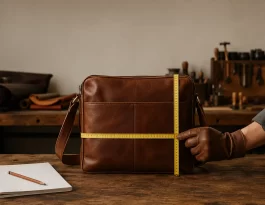
Measure across the seam and along the grain direction, at a marked distance from each edge. A single measurement across the middle hides the shrinkage that matters at the seam.
When to Measure
Measure after cooling and drying, never while warm. A warm panel measures long and gives a false confirmation of the pattern.
| Measurement | Timing |
|---|---|
| Length | After cooling |
| Width | After cooling |
| Diagonal | After drying |
| Seam distance | After drying |
Keeping Sampling and Bulk Consistent
The sample room forms panels one at a time with attention, and the line forms them at pace with a queue. That difference is where shape consistency is lost.
The Sample Room Advantage
A sample operator can re-wet a stubborn corner and wait for it to dry. Production has neither the time nor the space, so the process has to be robust rather than careful.
Formers That Travel
A sampled shape that depends on a wooden former will change when the former absorbs moisture. Bulk needs a former that holds dimensions across a season.
Approving the Shape Physically
Approve a formed panel, not a drawing. Keep the approved panel in the factory with the former, so the line has a physical definition of the shape rather than an interpretation.
| Risk | Control |
|---|---|
| Former drift | Dimension check |
| Operator variance | Marked positions |
| Moisture variance | Conditioned stock |
| Shape drift | Approved panel |
The Process Card for Pressing
Pressing is invisible on the finished bag, so the card is the only thing that tells a new operator what the last one did.
What the Card Records
Temperature, moisture method, former reference, dwell time, pressure, cooling method and the approved panel photograph. Seven entries describe the whole operation.
Where It Lives
At the press, not in the office. A card that has to be fetched is a card that is not used when the line changes style at short notice.
Who Signs It
The technician who established the setting signs the card, and the operator initials each shift. The signature makes the setting a decision rather than a habit.
| Field | Purpose |
|---|---|
| Temperature | Reproducibility |
| Moisture | Forming quality |
| Former | Shape definition |
| Dwell | Setting depth |
| Pressure | Consistency |
Skill, Training and Judgement
Pressing is the operation where judgement still matters most, because the correct moisture and dwell depend on how a particular panel feels.
Teaching by Touch
An experienced operator tests a panel by hand before pressing. That test can be taught: the panel should feel cool and slightly stiff, not damp on the surface.
Recognising the Limit
Training should include the moment to stop, when a panel is not forming and will not form without damage. Continuing to press a stubborn corner is how most scorch marks happen.
Rotating the Task
Operators who press all day lose sensitivity to the material. Rotating the task across a shift preserves the judgement that the operation depends on.
| Skill | Taught by |
|---|---|
| Moisture reading | Hand test |
| Heat judgement | Sample set |
| Stop point | Demonstration |
| Consistency | Rotation |
When Pressing Cannot Fix a Shape
Some shape problems are created upstream and cannot be corrected at the press, and recognising them saves a great deal of rework.
Cutting and Grain Direction
A panel cut across the natural stretch will not hold a curve the way a panel cut along it does. Pressing harder only stretches it further in the wrong direction.
Pattern Errors
If the panel is the wrong shape before pressing, it will be the wrong shape after. A press defines a surface, it does not add material.
Assembly Order
A base curve formed after the sides are attached will pull the seams. No amount of re-pressing restores the alignment that was lost.
| Problem | Real cause |
|---|---|
| Curve will not hold | Grain direction |
| Panel too small | Pattern |
| Seam pulled | Assembly order |
| Corner wrinkles | Skiving |
Environment and Season
Humidity in the workshop changes how leather behaves, and a process that works in one season can fail in another without any change to the settings.
Humid Seasons
In humid weather leather absorbs moisture from the air and forms more easily, then dries slowly. The process becomes forgiving, and operators stop watching the moisture.
Dry Seasons
In dry weather panels need conditioning before forming, and a panel that is not conditioned will crack at a tight curve rather than form around it.
Conditioning the Stock
A simple habit makes the difference visible: keep one panel from each delivery aside and form it before the run starts. If it forms cleanly at the recorded setting, the batch is ready; if it resists, the stock needs another day in the cutting room rather than more heat at the press.
Bringing material to the workshop's condition before cutting removes most seasonal variation. A day in the cutting room is usually enough.
| Season | Adjustment |
|---|---|
| Humid | Reduce added moisture |
| Dry | Condition stock |
| Transitional | Check daily |
| Air-conditioned | Watch dryness |
Cost and Station Time
Pressing adds time in the middle of the line, and its cost is easier to defend when it is expressed as seconds per panel rather than as a principle.
Time Per Panel
A flat press operation takes seconds; a contoured former takes tens of seconds including loading; a vacuum cycle takes a fixed interval regardless of the panel. The vacuum is the most predictable and the least flexible.
Waiting for Cooling
The hidden cost is cooling, because panels occupy space while they set. That space is a real constraint in a small factory and drives the temptation to stack early.
What the Cost Buys
A formed panel removes the need for edge paint touch-ups, reduces sewing distortion and prevents the returns that come from a bag that will not stand. The cost sits in one operation and the saving appears across several.
| Operation | Time | Predictability |
|---|---|---|
| Flat press | Seconds | High |
| Contoured former | Tens of seconds | Medium |
| Vacuum cycle | Fixed | High |
| Hand iron | Variable | Low |
Briefing a Supplier on Shape
Pressing is the operation most often left out of a technical pack, and a factory will fill the gap with whatever it normally does.
State the Shape, Not the Feeling
Describe the intended curvature, the parts that must be firm and the parts that must stay soft. An instruction to "make it structured" produces a different bag in every factory.
Supply the Former
Where the shape matters, the former should come from the buyer or be approved physically. A factory-made former that matches a drawing can still differ in the radius that the drawing does not specify.
Agree the Check
Name the check that will be used, such as standing unaided on a flat surface or matching an approved panel. A named check turns a preference into a specification.
| Brief element | Effect |
|---|---|
| Shape description | Common understanding |
| Former supplied | Shape control |
| Approved panel | Physical reference |
| Named check | Verifiable outcome |
Re-Shaping and Repair
A formed panel can sometimes be re-formed, and knowing when it can be saves material that would otherwise be scrapped.
When Re-Forming Works
A panel that was formed in the wrong position but not overheated can be re-cased and set again. The leather tolerates a second forming if the first was within temperature.
When It Does Not
A scorched or over-compressed panel cannot be recovered, and re-pressing a glossed surface only spreads the shine. Recognising the difference prevents wasted time.
Repair at the Finished Bag
A bag that has lost its shape in storage can often be re-formed with light moisture and a former. That is a service operation rather than a production one, and it belongs in the aftercare guidance.
| Condition | Re-formable |
|---|---|
| Wrong position | Yes |
| Under-dwelled | Yes |
| Scorched | No |
| Over-compressed | No |
Pressing Within the Assembly Sequence
Where pressing sits in the sequence decides what it can correct, and moving it later in the process usually costs more than it saves.
Before Sewing
Forming panels before assembly gives clean curves and allows the panel to be trimmed to the formed shape. It is the standard order for structured bags.
Between Operations
Pressing a seam flat between sewing steps is different from shaping, and it is often combined with the same station. Keeping the two purposes separate prevents over-pressing.
After Assembly
Pressing a finished bag is limited to seam setting and light shaping. Anything more risks distorting hardware, lining and the shape that was already set.
| Stage | Purpose |
|---|---|
| Before sewing | Form the panel |
| Between steps | Set seams |
| After assembly | Light shaping |
| After packing | Nothing |
Former Care and Maintenance
A former is a tool with a working life, and its condition shows up directly in the shape of every panel pressed against it.
Cleaning and Build-Up
Adhesive, dye and leather dust build up on a former and change its profile by fractions of a millimetre. Cleaning at each shift change keeps the shape where it was approved.
Wear at High Points
The high points of a curve take the most pressure and wear first. A worn former produces a panel that is slightly flatter than the approved sample, and the difference is invisible until bags are stacked side by side.
Storage
A former stored loose will be knocked out of shape or lost. Storage on a marked board with the style code prevents both, and costs one hook.
| Maintenance | Interval |
|---|---|
| Wipe clean | Each shift |
| Profile check | Monthly |
| Wear inspection | Quarterly |
| Replacement | As measured |
A Quality Gate After Forming
Forming deserves its own gate because defects created here cannot be corrected later without scrapping the panel.
What to Check
Shape against the approved panel, absence of shine, edges that lie flat, and dimensions after cooling. Four checks cover the operation and take under a minute per panel.
Who Checks
The press operator checks shape and shine; the line supervisor checks dimensions on a sample. Splitting the checks between the two keeps the gate fast without making it superficial.
What Happens on Failure
A panel that fails is quarantined with the reason recorded, not returned to the pile. Returned panels are how a single forming fault becomes a batch fault.
| Check | Owner |
|---|---|
| Shape | Operator |
| Shine | Operator |
| Edges | Operator |
| Dimensions | Supervisor |
Common Errors at the Press
The same errors recur in every factory that forms leather, and each has a cheap counter that does not require new equipment.
More Pressure to Fix a Wrinkle
Wrinkles come from excess material, so pressure turns them into a crease that no later step removes. Skiving or a dart is the counter, and neither is done at the press.
Wetting to Make It Form
Extra water makes any panel form, and it also guarantees shrinkage and a colour patch. The panel should be conditioned, not soaked.
Pressing a Warm Stack
Stacking formed panels while warm is the most common cause of a batch that is subtly flatter than the sample. Cooling racks cost floor space and nothing else.
No Record of the Setting
A setting that exists only in an operator's memory disappears with a shift change. The card takes minutes to write and saves a full re-establishment.
| Error | Counter |
|---|---|
| Extra pressure | Skive or dart |
| Over-wetting | Controlled casing |
| Warm stacking | Cooling racks |
| No record | Process card |
A Structured Bag, Step by Step
A short worked sequence shows how the decisions connect, using a soft-sided carrier with a curved base as the example.
Establishing the Setting
The technician cases a spare panel, forms it around the base former and records the temperature at which the curve sets without shine. That temperature becomes the card value.
Forming the Parts
Gussets are formed on their own former before the base, because the gusset taper governs how much material the base seam has to take. Corners are formed last, when the moisture has evened out.
Setting and Checking
Panels cool on racks under light weight, then are measured after drying and compared with the approved panel. The first three are checked individually and the rest by sample.
| Step | Control |
|---|---|
| Setting | Temperature recorded |
| Gussets | Own former |
| Base | After gussets |
| Cooling | Racks, weighted |
FAQ
Why does pressing matter so much in leather bag making?
A: It converts flat panels into the three-dimensional shape of the bag and sets that shape permanently. Two factories with the same pattern can produce visibly different bags purely from how they press.
What temperature should leather be pressed at?
A: There is no universal figure, because the safe band depends on tannage, finish and thickness. It should be established per article by testing a spare panel until the shape sets without shine.
What happens if the plate is too hot?
A: The grain collapses into a glassy patch that reflects light differently from the rest of the panel. The damage is permanent and the panel has to be re-cut.
Should leather be wet before pressing?
A: It should be conditioned through the thickness, not wetted on the surface. Vegetable-tanned leather cases well, while surface wetting produces a soft skin over a stiff core.
Why do formed panels shrink after pressing?
A: Heat and moisture relax the fibre structure and the panel contracts as it dries. A pattern that measures correctly on paper can end up short once the formed panel has dried.
When should dimensions be measured?
A: After cooling and drying, never while warm. A warm panel measures long and gives a false confirmation that the pattern is correct.
What causes shine on a pressed panel?
A: Direct contact between the grain and a hot plate, which polishes the surface. A pressing cloth or paper interleaf prevents it at almost no cost.
Why do edge wrinkles appear after pressing?
A: The outer layer had more material than the curve needed. The excess has to go somewhere, and pressure turns it into a crease rather than removing it.
How is a curved base formed correctly?
A: Before the sides are attached, using a former that matches the base profile. Forming after assembly pulls the side seams and creates a twist that shows when the bag stands.
Can a padded panel be pressed?
A: Only at low pressure on a shaped former. Foam compresses and recovers slowly, so a padded panel pressed hard on a flat plate loses its loft permanently.
Can a wrongly formed panel be re-formed?
A: Yes, if it was formed in the wrong position but not overheated, because leather tolerates a second forming within temperature. A scorched or over-compressed panel cannot be recovered.
How long should a formed panel be held?
A: Until it has cooled and dried in shape, which is usually measured in hours rather than seconds. Dwell time at temperature is separate and is set by the panel thickness.
Why do panels come out flatter than the sample?
A: Because they were stacked while still warm and took the shape of the panel beneath them, or because a wooden former drifted with humidity.
What former material should be used?
A: Wood for sampling and short runs, resin for a style that runs several seasons, and metal for high volume where heat conduction can be controlled.
How is pressing specified to a factory?
A: By describing the intended shape and the parts that must stay soft, supplying or approving the former, and naming the check that will be used at inspection.
Which check proves the shape is right?
A: Comparing the formed panel with an approved physical panel kept beside the former, plus a dimensional check after cooling. A drawing cannot convey a radius.
Ready to make shape a controlled outcome rather than a matter of operator feel? Establish the forming temperature per article, condition stock instead of wetting it, form parts before assembly, cool them under constraint, and measure after drying against an approved panel kept beside the former. Then write the setting on a card at the press, where the next operator will find it.