PU Leather vs Real Leather in Bag Manufacturing: A Factory Perspective
Every bag brand eventually faces the same question: PU leather or real leather? The question is usually framed as a battle — synthetic versus natural, cheap versus premium, ethical versus traditional — but from inside a bag factory, it looks different. It is an engineering decision, made on measurable grounds: production process, durability data, cost structure, consistency, and the end customer's real use. Both materials have decades of refinement behind them. Both can make excellent bags and both can make terrible ones. The difference is not which one is "better" — it is which one is better for a specific product, at a specific price point, for a specific customer.
This guide is written from the factory floor, where the two materials are handled side by side every day. We will compare them across the dimensions that actually determine a bag's success in the market: how each is produced, how each performs and fails, what each costs to source and process, how each behaves in production, and what each means for sustainability claims. By the end, you will have a decision framework — not a verdict, because there is no universal winner.
What PU Leather Actually Is
Polyurethane leather — PU leather, PU synthetic leather, or coated fabric — is not a single material. It is a family of composite materials built on a fabric carrier. The typical construction has three layers: a base fabric (polyester knit, woven, or non-woven), a middle layer of polyurethane resin that may be foamed or solid, and a surface finish layer that carries the grain texture, color, and protective topcoat. In manufacturing terms, PU leather is a coated textile — the performance comes from the coating system, not from any animal-derived fiber.
This is important because it explains everything about the material's behavior. The strength of PU leather comes from its fabric base: a well-chosen base fabric determines tear resistance, flex endurance, and seam strength. The look comes from the PU coating: modern production can emboss any grain, print any texture, and match almost any color. The coating also provides the waterproof barrier. When a PU bag fails, the failure is almost always a coating failure — delamination, surface cracking, or hydrolysis — not a fabric failure.
There are also important sub-categories inside PU leather that brands should know. Standard PU is coated directly on the base fabric. Microfiber PU (microfiber synthetic leather) uses a much finer non-woven base — often with a polyurethane-impregnated structure — giving it a hand feel, drape, and tensile strength much closer to genuine leather. Microfiber is a premium product that sits between standard PU and real leather in both cost and performance. When a buyer complains that "PU feels cheap," they are usually handling standard PU; microfiber changes the conversation entirely.
What Real Leather Actually Is
Real leather — genuine leather — is also not a single material. It is animal hide that has been preserved and stabilized through tanning, then finished for use. The key structural feature is that leather is a natural fiber composite: a dense, interwoven network of collagen fibers that gives it strength in all directions, breathability, and the ability to age. No synthetic material has yet reproduced that exact fiber structure, which is why real leather's failure modes and aging behavior differ fundamentally from PU's.
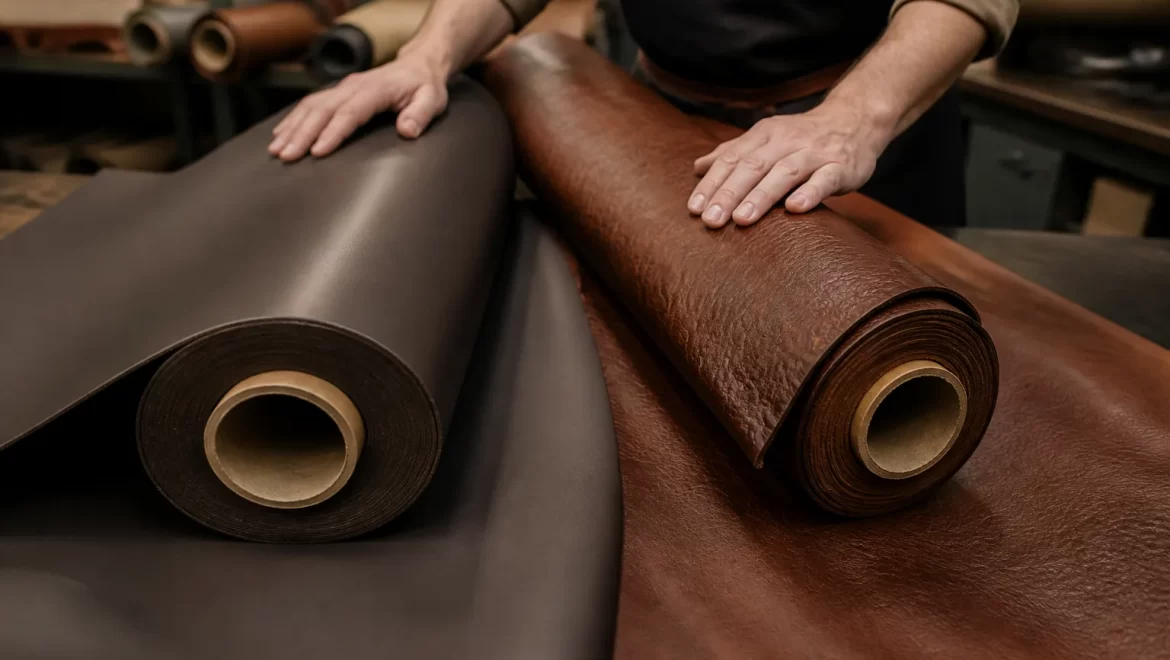
The grades matter enormously. Full-grain leather retains the original grain surface — the strongest, most abrasion-resistant layer. Top-grain is lightly sanded to remove surface imperfections, trading a little strength for a cleaner, more uniform appearance. Split leather comes from the lower layers of the hide after the grain is separated — softer and weaker, often used for linings or suede. Bonded leather is made from leather fibers and adhesive — a composite that is closer to PU in behavior than to full-grain. When comparing "real leather vs PU," the honest comparison is not between one material and another; it is between a specific leather grade and a specific PU construction.
Tanning also shapes the material's properties. Chrome tanning produces supple, water-resistant, colorfast leather — the workhorse of the bag industry. Vegetable tanning produces firmer, more structured leather that develops patina and is more environmentally transparent in its chemistry, but it is less water-resistant and more sensitive to staining. Chrome-free tanning (using synthetic or mineral alternatives) attempts to combine the process benefits of chrome with a cleaner chemical profile. Each choice shifts the leather's behavior in production and in use.
How the Two Are Made: Production Process Comparison
The production processes reveal why the two materials behave so differently — and why their cost structures diverge.
PU leather production is a coating operation, and it is fast, controlled, and repeatable. The process runs on coating lines: a base fabric is unrolled, coated with PU resin (often via transfer coating, where the resin is cast onto release paper embossed with the grain pattern, dried, and bonded to the fabric), finished with a topcoat, and rolled. A single coating line can produce thousands of meters per day. Because the process is industrial and formula-driven, batch-to-batch consistency is excellent: the next roll matches the last roll in color, thickness, and hand feel. This consistency is one of PU's greatest strengths for brands that sell the same SKU for years.
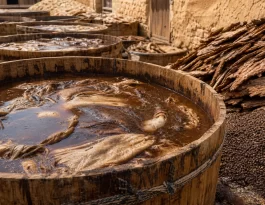
Real leather production is a transformation of a natural raw material, and it is slow, variable, and skilled. The path runs: raw hide → soaking, liming, and fleshing → splitting to thickness → tanning (chrome, vegetable, or chrome-free) → sammying and shaving → retanning, dyeing, and fatliquoring → drying and conditioning → finishing (coating, embossing, buffing) → final grading. Every hide is different — different size, different grain character, different natural markings — and every step requires judgment. A tanner cannot make two hides identical; they can only grade them into consistent lots. This variability is not a defect; it is the nature of a natural material, and it is precisely what gives real leather its perceived value and its "natural character."
The production comparison explains the two materials' market positions. PU is a product of chemistry and process control — consistent, scalable, and predictable. Real leather is a product of biology and craft — variable, limited by hide supply, and inherently unique. Brands choosing between them are really choosing between consistency and character.
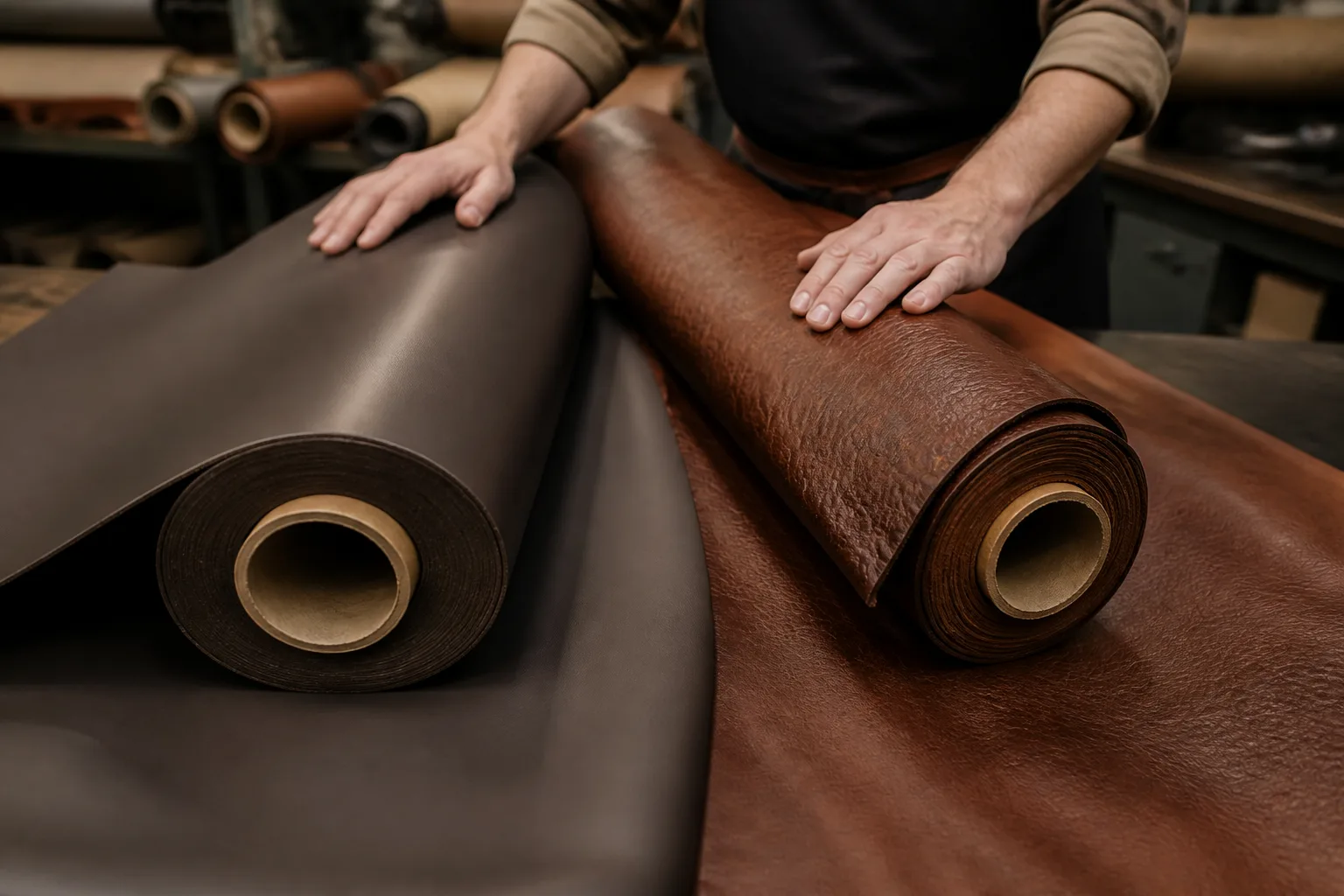
Performance Comparison: Head to Head
When the two materials sit side by side in our lab, the measurable differences fall into a clear pattern. No single metric crowns a winner — each material wins where its construction is strongest.
| Property | PU Leather (standard) | Microfiber PU | Real Leather (top-grain) |
|---|---|---|---|
| Water resistance | Excellent — sealed coating | Good to excellent | Moderate — needs finishing/conditioning |
| Abrasion resistance | Good; coating can scuff | Good | Excellent — dense grain, repairable |
| Tear strength | Depends on base fabric | High | Excellent — fiber network |
| Flex endurance | Good; coating can crack over time | Good | Excellent; leather flexes without cracking |
| Breathability | Poor — sealed surface | Moderate | Excellent — natural pores |
| Color consistency | Perfect batch consistency | Very good | Natural variation between hides |
| Aging behavior | Coating wears, may peel | Coating wears | Patina develops, gains character |
| Temperature behavior | Can stiffen in cold, soften in heat | Stable | Stable across wide range |
| Maintenance | Wipe clean, low effort | Wipe clean | Needs conditioning, more care |
The pattern is consistent across our test data: PU wins on water resistance, consistency, and maintenance simplicity; real leather wins on abrasion, flex endurance, breathability, and — most importantly — on how it ages. The aging difference is the one that matters most to bag longevity. A PU bag's surface wears and eventually degrades; a leather bag's surface changes — it patinas, softens, and gains depth. One is wearing out; the other is developing character.
Durability: Where Each Material Really Fails
Durability claims in marketing copy are usually vague; the factory view is specific. Here is where each material actually fails in the field, based on years of production and after-sales data.
PU leather's failure modes. The dominant failure is coating degradation. Surface cracking appears first at flex points — corners, gussets, and the top line — where the coating is repeatedly bent. Delamination (the coating separating from the base fabric) follows when adhesion is poor or when the material is exposed to heat and humidity cycling. The most serious failure is hydrolysis: in hot, humid climates, the polyurethane chains break down chemically over years, causing the material to become brittle, crumble, or "sweat" a sticky residue. Hydrolysis-resistant PU formulations exist and are the right choice for tropical markets, but standard PU will degrade faster in Singapore than in Stockholm. The practical lesson: PU's lifespan is heavily climate- and formulation-dependent, typically 2–6 years in demanding conditions before visible degradation.
Real leather's failure modes. Leather fails differently. The most common field failures are edge wear (where unfinished edges fray and absorb moisture), stitching failure around stress points (a construction issue more than a material issue), and dry cracking — which is almost always a care failure. Leather that is not conditioned dries out, stiffens, and cracks at flex points. Unlike PU's chemical degradation, leather's damage is usually physical and often recoverable: a cracked surface can be conditioned, edges can be re-finished, and seams can be re-stitched. A well-built leather bag with reasonable care routinely reaches 10–15 years of service. The practical lesson: leather's lifespan is maintenance-dependent, and its failures are typically repairable.
This is the honest durability picture: PU fails chemically and irreversibly on a shorter clock; leather fails physically and repairably on a longer clock. For a brand selling a product meant to be used daily for a decade, that difference is decisive. For a fashion-forward product with a 12-month lifecycle, it is irrelevant.
Cost Structure: What Each Material Really Costs
Cost is where brands make most of their material decisions, and it is also where the most confusion lives. The factory cost of a bag is not just the material price per meter — it is the full cost of sourcing, cutting, sewing, and finishing. The comparison changes shape when you look at total cost.
| Cost driver | PU Leather | Real Leather |
|---|---|---|
| Material price | $3–8 / meter (standard PU), $8–15 (microfiber) | $8–25+ / square foot depending on grade |
| Price stability | Tied to petrochemical feedstock; volatile | Tied to hide supply; volatile in different cycle |
| Cutting yield | Excellent — uniform, defects rare, high utilization | Variable — natural defects, grain direction limits |
| Rejects in production | Low — consistent rolls | Higher — grading errors, marking variations |
| Skill required | Standard sewing skills | Higher skill for matching, handling variation |
| Minimum order | Flexible, any volume | Hide availability and lot sizing constrain orders |
| Per-bag cost example (mid-size tote) | $6–12 material + labor | $18–35 material + labor |
The honest framing: PU is cheaper at every step, and the gap is widest for high-volume, standardized production. But the material cost is a small part of a bag's retail story. A $12 PU tote retails at $40–60; a $28 leather tote retails at $150–300. The margin structure is different because the customer's willingness to pay is driven by perceived value, longevity, and brand positioning — not by the material invoice. PU's real economic role is not "cheap leather"; it is an independent material class that enables price points real leather cannot reach, and margins that work at volume.
Manufacturing Consistency and Efficiency
For a factory, consistency is money. Downstream — cutting, sewing, and QC — every roll of material either behaves predictably or costs time and rejects.
PU leather's consistency is its decisive operational advantage. A single order of PU rolls matches in color and thickness; cutting markers can be planned with high utilization because defects are rare; sewing behaves uniformly because the material's stretch and hand are consistent; and QC rejects stay low. This predictability is why PU is the default for large-scale production — 5,000 identical bags from five coating batches look and feel the same. For retailers with catalog consistency requirements, this is a competitive weapon.
Real leather demands more from every downstream step. Cutting must work around natural markings, scars, and grain variation; panels must be matched for color within a hide lot; thickness variation means adjustments at sewing; and grading errors surface as rejects at QC. None of this is a barrier to producing excellent leather bags — every serious leather factory does it daily — but it costs time, skill, and yield. The operational premium of leather is real: more inspection, more skilled labor, more careful planning.
The efficiency comparison feeds directly into the decision framework. If the product is high-volume, standardized, and price-sensitive, PU's consistency wins. If the product is lower-volume, higher-value, and positioned on craft and natural character, leather's variability is not a cost — it is the product.
Sustainability: The Honest Comparison
Sustainability is the most contested comparison between the two materials, and it is the one where marketing claims run furthest ahead of the data. A factory perspective keeps to what is measurable.
Carbon and resource footprint. Real leather's footprint is dominated by the upstream livestock industry — land, feed, water, and methane — which most leather buyers do not directly control. However, leather is a by-product of the meat industry: the hide exists regardless, and using it for durable goods is a form of waste valorization. PU's footprint is petrochemical — its carbon comes from fossil feedstocks, and its production is energy-intensive, though efficient at scale. Published LCAs generally find that when the livestock system is allocated fully to leather, leather's carbon footprint is higher than PU; when hides are treated as by-products, the comparison narrows dramatically. There is no clean universal answer — the answer depends on allocation assumptions.
End of life. This is where the materials diverge sharply. Real leather is biodegradable in the right conditions, and vegetable-tanned leather nearly so; it can be repaired, reconditioned, and re-sold for decades. PU is a plastic composite — the coating does not biodegrade on useful timescales, it sheds microplastics as it degrades, and it is difficult to recycle because it is bonded to a fabric carrier. A leather bag that lives 15 years and is then composted or upcycled has a very different end-of-life story from a PU bag that lives 4 years and goes to landfill or incineration.
The uncomfortable conclusion. The most sustainable bag is the one that is used the longest. Durability is the master sustainability metric, and it cuts against both materials in different ways: PU bags are cheaper and more accessible (more usage per dollar of carbon) but shorter-lived and non-recyclable; leather bags are longer-lived and repairable but carry a heavier upstream footprint and a higher price that excludes some consumers. There is no guilt-free choice — only an honest trade-off that brands should present to customers as a trade-off, not as a single "eco" badge.
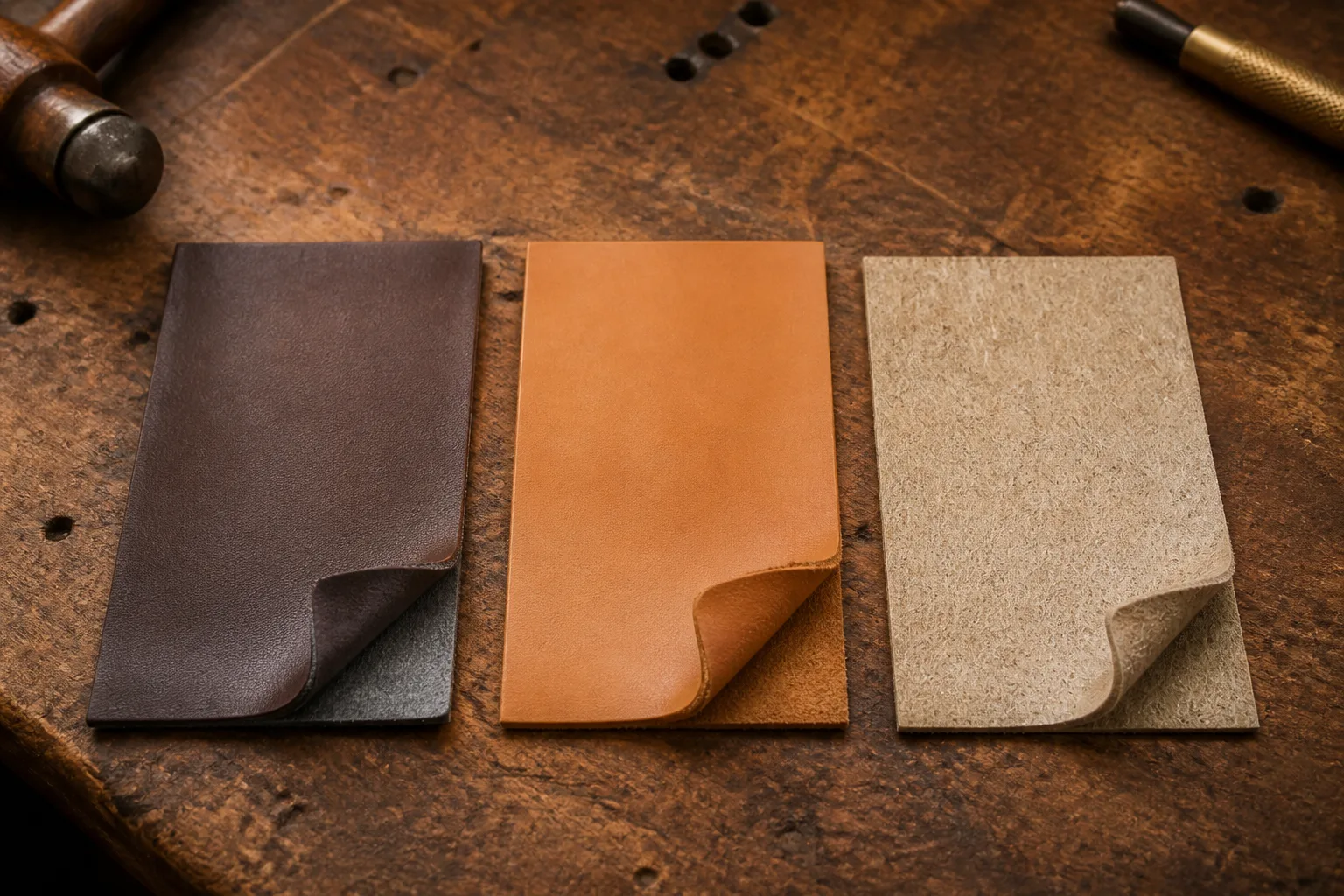
The "Vegan Leather" Label: What It Really Says
The term "vegan leather" deserves a factory-level examination because it is used to describe products with very different realities. In the current market, "vegan leather" usually means PU leather — a petroleum-based coated textile. Calling it "vegan" is accurate in the narrow sense (no animal products), but it implies a sustainability profile the material does not have: PU's feedstocks are fossil-based, and its end of life is plastic waste.
Newer plant-based materials — made from pineapple leaf fiber (Piñatex), cactus, apple pomace, mushroom mycelium, and corn-based biopolymers — are real innovations, but the honest factory view is sobering. Most of these materials are still backed by synthetic coatings or binders (often PU or polyester) to achieve durability and water resistance; their performance data is young; and their scale is small. A brand that specifies "vegan leather" should ask the factory three questions: What is the actual composition (base + coating + binders)? What are the certified performance data (abrasion, flex, hydrolysis)? And what is the end-of-life pathway? If the answer to any of the three is vague, the label is doing marketing work, not material work.
The practical guidance: specify materials by construction and performance, not by label. "PU leather with hydrolysis-resistant formulation" is a spec. "Vegan leather" is a claim. The factory can produce either — but the brand should know which one it is ordering.
When to Choose PU Leather
PU is not a compromise material; it is the right engineering answer for a specific set of product requirements. Choose PU (standard or microfiber) when:
The price point demands it. For retail price points below roughly $60–80, real leather cannot be used profitably at acceptable quality. PU is the material that makes accessible fashion possible — and there is nothing wrong with that. Millions of well-made, well-designed PU bags serve customers who want style and function at an accessible price.
The product is fashion-forward with a short lifecycle. Trend-driven designs that will be replaced in 12–24 months should not carry the cost of a 15-year material. PU lets brands chase trends without carrying leather's cost and care requirements.
Water resistance and low maintenance matter more than aging. Travel bags, diaper bags, beach bags, and gym bags face water, spills, and rough handling. PU's sealed surface shrugs off what leather must be protected from. For these uses, PU's behavior is genuinely superior, not merely cheaper.
Consistency at scale is critical. Catalog products, licensed merchandise, and large retail programs need every unit to match. PU delivers that consistency roll after roll, order after order.
When to Choose Real Leather
Real leather is the right answer for a different set of requirements — and in those segments, no PU formulation fully substitutes for it. Choose real leather when:
The product is positioned on longevity and value. Bags marketed as investment pieces, heirloom items, or "buy it for life" products must be built from a material that ages well and can be repaired. Leather is the only mainstream material that patinas instead of degrades.
The brand identity is built on craft and natural materials. A premium positioning needs a material story that is true. Leather's natural variation, patina development, and repair culture are features that marketing can amplify honestly — and that no synthetic can replicate.
The customer expects care as part of the product. Leather's maintenance requirement is not a burden when the customer is buying into a ritual of ownership. Brands that teach conditioning and offer repair services convert leather's care requirement into loyalty.
The price point supports it. At retail prices above $150–200, customers expect materials that justify the price. Leather is the material that makes a $200+ price credible — and it is the material whose cost structure supports a real margin at that level.
The Decision Matrix
The choice is rarely about one dimension. This matrix summarizes how the decision should be made across the dimensions that matter:
| Decision factor | Choose PU | Choose Real Leather |
|---|---|---|
| Retail price point | Under $60–80 | Above $150–200 |
| Product lifecycle | 1–2 years (trend-driven) | 5–15 years (investment) |
| Use environment | Water, spills, rough handling | Professional, daily carry, formal |
| Brand position | Accessible fashion, consistency | Craft, natural materials, premium |
| Volume and scale | High volume, standardized SKUs | Lower volume, artisanal |
| Customer care expectation | Low maintenance, wipe-clean | Care ritual, conditioning, repair |
| Sustainability story | Accessible price = wider access | Longevity, repairability, biodegradability |
Between $80 and $150, the decision gets genuinely hard, and that is exactly where microfiber PU lives. Microfiber delivers a leather-like hand, strong performance, and consistent supply at a mid-premium price — for many brands, it is the optimal answer for the "quality but not leather" segment. The professional approach is to build the product spec around the target price and use case, then let the material comparison (not the brand's preference) make the final call.
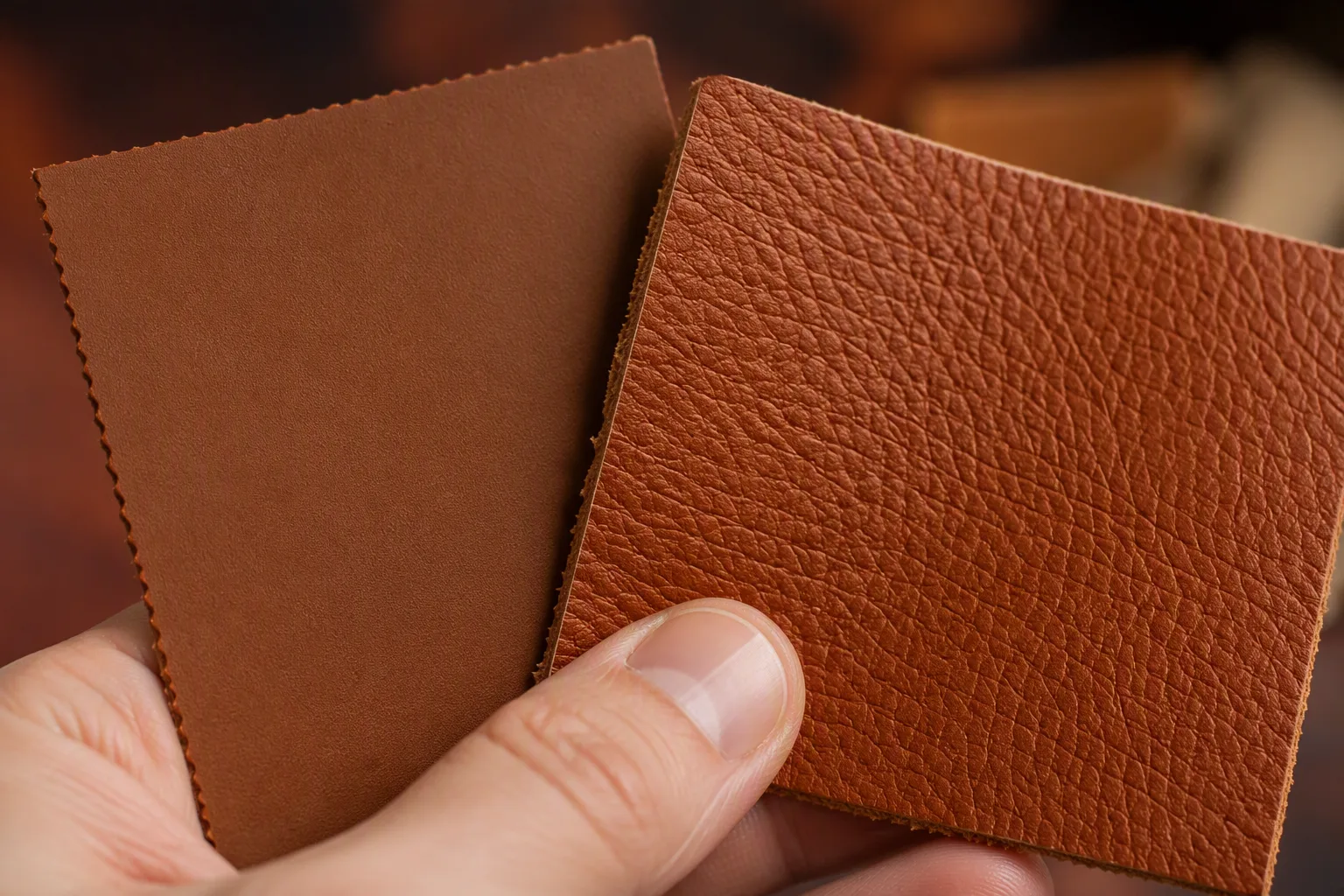
Quality Control: Testing Both Materials
A factory's QC discipline is what turns a material choice into a dependable product. The test protocols differ between the two materials because they fail differently. For brands, knowing these tests matters: it is how you verify that the factory's material is what was specified.
| Test | PU Leather | Real Leather |
|---|---|---|
| Thickness measurement | Verify coating + base total; consistency across roll | Verify shaved thickness; tolerance within lot |
| Abrasion (Martindale/Taber) | Coating wear-through cycles | Surface wear cycles; finish adhesion |
| Flex endurance (Bally flex) | Coating cracking cycles | Surface cracking; finish flex |
| Adhesion (peel strength) | Coating-to-fabric bond strength | Finish-to-leather bond strength |
| Hydrolysis test | Accelerated aging in heat/humidity — critical for tropical markets | Not applicable (leather does not hydrolyze) |
| Tensile and tear strength | Base fabric strength dominates | Fiber network strength; per-direction variance |
| Color fastness | Coating color fastness to light, crocking | Dye fastness to light, crocking, perspiration |
| Water resistance | Coating barrier; spray test | Water beading; absorbency after conditioning |
Two factory rules apply to both. First, test the production material, not the sample — sample rolls and production rolls can differ, and claims should be verified on the batch that ships. Second, match the test to the destination market: a bag sold in Southeast Asia needs hydrolysis data on PU and mold resistance on leather; a bag sold in Scandinavia needs cold-flex data on both. The test plan is part of the material spec — specify it, require the reports, and reject materials that fail the target market's conditions.
Specifying Materials as a Brand: The Technical Checklist
When you brief a factory on material, precision prevents expensive surprises. Here is the checklist we recommend every brand use:
- Name the exact material class, not a label: "microfiber PU with hydrolysis-resistant formulation" or "top-grain cowhide, chrome-free tanned, 1.4 mm shaved."
- Specify the construction: for PU — base fabric type and weight, coating type, total thickness, surface finish (matte/gloss/embossed grain); for leather — source, grade, tanning method, thickness, finish type (aniline, semi-aniline, pigmented).
- Define performance targets: abrasion cycles, flex cycles, tear strength, hydrolysis resistance (PU), water resistance, color fastness — with the test method named.
- Set color and consistency tolerances: acceptable ΔE for color matching; acceptable variation between lots (PU) and between hides (leather).
- Define sustainability documentation: for PU — composition disclosure, VOC content, recycling pathway; for leather — tannery certifications (e.g., LWG rating), chemical compliance (REACH, Proposition 65), chain of custody.
- Require test reports per batch and reserve the right to inspect material at the tannery or coating plant.
This checklist does two things: it makes the material decision auditable, and it aligns the factory's incentives with the brand's claims. When the spec is written this way, "PU leather" and "real leather" stop being slogans and become what they are in the factory: two well-defined engineering materials with known properties, costs, and trade-offs.
FAQ
Is PU leather a type of leather?
A: No. PU leather is a coated textile — a fabric base with a polyurethane coating. It contains no animal hide and, despite the name, is not a "type" of leather. The name is a marketing legacy; the material is a separate class.
Which lasts longer, PU leather or real leather?
A: In demanding daily use, real leather lasts significantly longer — typically 10–15 years with care — because it ages physically and can be repaired. PU typically shows visible coating degradation within 2–6 years, especially in hot, humid climates, and its failure is chemical and irreversible.
Is PU leather waterproof?
A: Generally yes — the sealed PU coating blocks water, which is one of its advantages. Real leather is not inherently waterproof; it needs finishing and conditioning, and should be dried naturally if soaked.
Is PU leather cheaper than real leather?
A: Yes, at every step: material price, cutting yield, production skill, and rejects. A mid-size tote in PU costs roughly $6–12 in material and labor, versus $18–35 in real leather — before considering that leather requires more skilled labor and planning.
Is "vegan leather" the same as PU leather?
A: Usually, yes — most "vegan leather" on the market is PU leather (a petroleum-based coated textile). Plant-based alternatives (pineapple, cactus, mushroom) exist but are typically backed by synthetic coatings or binders and have limited performance data and scale. Specify by construction, not by label.
Can PU leather look as good as real leather?
A: Visually, modern PU can imitate leather convincingly, especially microfiber PU. The difference shows over time: leather develops patina and character; PU coating wears, cracks, and can delaminate. The materials diverge most in aging, not in the showroom.
What is microfiber PU?
A: Microfiber synthetic leather — a fine non-woven base impregnated with polyurethane — with a hand feel, drape, and strength much closer to genuine leather than standard PU. It sits between standard PU and real leather in cost and performance, making it a strong choice for the mid-premium segment.
Which is more sustainable?
A: There is no clean winner. Leather carries a heavier upstream footprint (livestock) but is durable, repairable, and biodegradable. PU is petroleum-based, sheds microplastics, and is hard to recycle, but is cheaper and more accessible. The most sustainable bag is the one used longest — durability is the master metric.
How do I choose between them for my product?
A: Start from price point and use case. Under ~$60–80 retail or for trend-driven, water-exposed products, choose PU (microfiber for the premium feel). Above ~$150–200 retail, or for longevity, craft, and care-ritual positioning, choose real leather. Between those, microfiber PU is often the optimal answer.
Conclusion
PU leather and real leather are not rivals locked in a battle for the same customer; they are two engineering materials serving different jobs. PU is chemistry and process control — consistent, water-resistant, affordable, and ideal for high-volume, fashion-forward, price-sensitive products. Real leather is biology and craft — variable, durable, repairable, and ideal for longevity-driven, premium, character-led products. Each is excellent at its own job, and each is a mistake when used for the other's.
The factory's role is to make the trade-offs visible: the test data, the cost structure, the failure modes, and the sustainability facts. A brand that makes its material decision on those grounds — price point, use case, longevity target, and positioning — builds products that satisfy customers and survive contact with the market. The material is not the brand's identity; the fit between material and product is.
Ready to spec your next bag? Contact our factory — we will walk you through PU, microfiber, and real leather options side by side, share test reports and pricing for each, and help you select the material that fits your price point, positioning, and market. We produce both, and we will tell you which one is right for your product.