How Should Thread Colour Fastness Be Specified for Pet Bags?
- Why Thread Colour Needs Its Own Specification
- The Fastness Properties That Matter
- Rubbing Fastness in Detail
- Wash Fastness and Staining
- Light Fastness
- Perspiration and Saliva
- Thread Types and Their Fastness
- Dye Class and Shade Depth
- Colour Contrast With the Host Material
- Moisture and Humidity
- Cleaning Agents and Chemicals
- Fastness and Abrasion Together
- Writing the Specification
- Sampling and Lot Verification
- Laboratory and Test Conditions
- Common Traps
- Comparing Suppliers
- Cost and Grade
- Substitution and Reordering
- Where Fastness Fails First
- Repair and Rework
- Thread and Lining Interaction
- Documentation and Traceability
- Working With the Mill
- Limits of the Specification
- Thread Size, Twist and Fastness
- Approving a Seasonal Range
- Thread Colour in Sampling and Sales Samples
- Storing Thread on the Floor
- FAQ
Thread is the smallest coloured component in a pet bag and the one most likely to bleed. It sits on the surface, it is washed with the whole bag, and it is pressed against leather that is often a different shade on purpose.
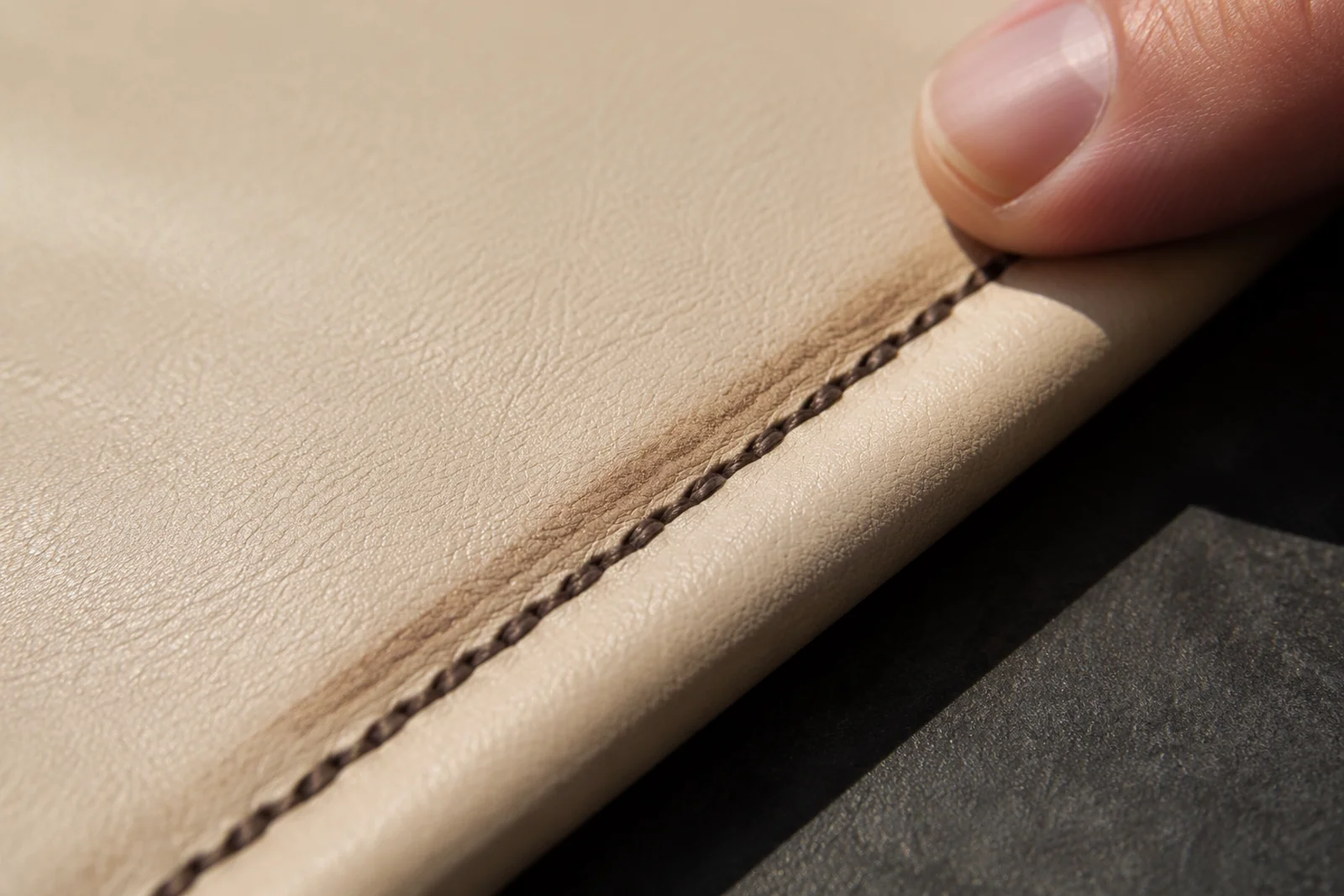
A thread that migrates colour marks the leather beside every seam, and the mark cannot be removed because the dye has entered the hide rather than sitting on it. This guide sets out how a bag manufacturer should specify thread colour fastness: which fastness properties matter, how to test them, how to write the requirement into a purchase order, and where the differences between an adequate thread and a failing one actually appear.
Why Thread Colour Needs Its Own Specification
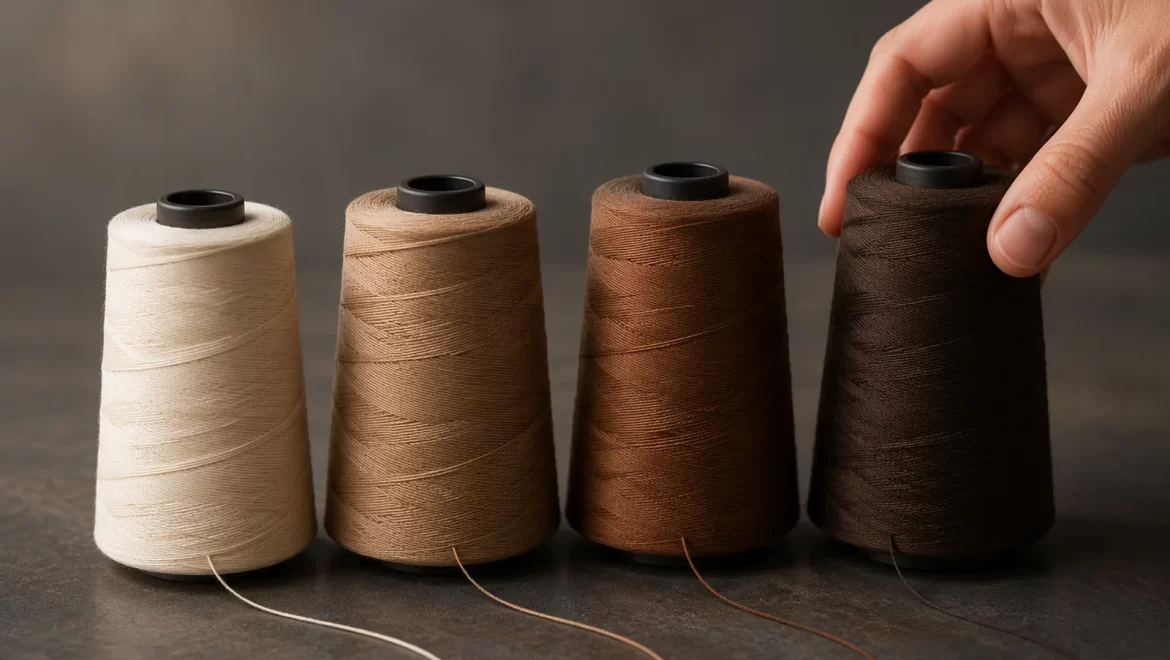
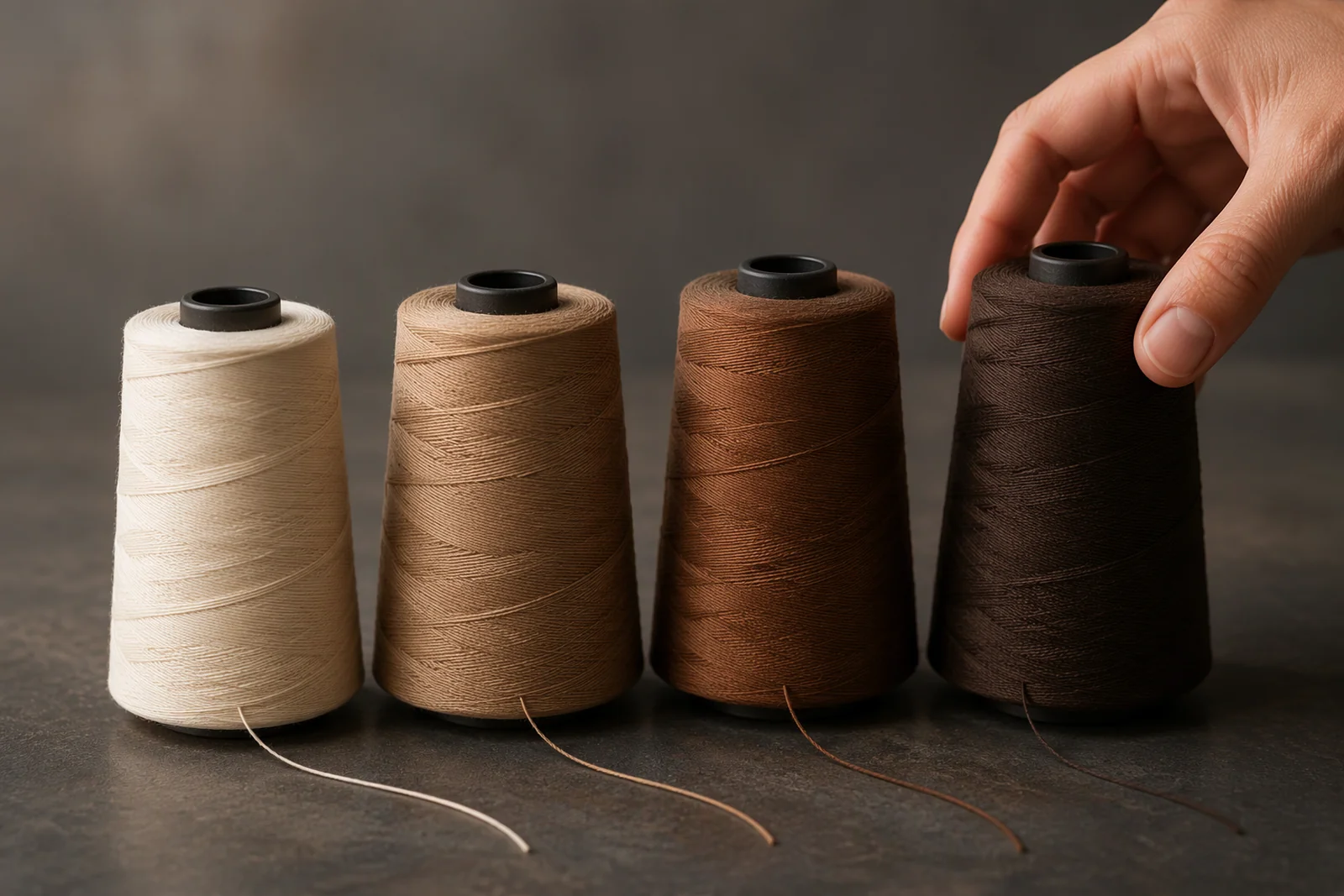
Thread is usually bought by ticket number and shade, and both describe appearance rather than behaviour.
The Smallest Coloured Area
A thread presents a very small surface but a very large length. A single seam contains metres of yarn, and every centimetre is in contact with leather, lining or trim.
The Consequence of Migration
Once a dye transfers into leather it is inside the hide, and no surface cleaning removes it. The defect is permanent and it appears along the most visible line on the bag.
Why Shade Matching Is Not Enough
Two threads can match perfectly under a lamp and behave completely differently when wet. Shade is a visual property; fastness is a chemical one.
The Fastness Properties That Matter
Four properties cover the realistic exposure of a thread in a pet bag, and each one answers a different question.
Rubbing Fastness
How much colour transfers when the thread is rubbed against another surface, dry and wet. This is the property that produces marks on leather.
Wash Fastness
How much colour leaves the thread in water with detergent, and how much it stains adjacent material in the same bath.
Light Exposure
How much the shade changes after prolonged exposure to light. A thread that fades differently from the leather beside it becomes visible as a lighter line.
Saliva and Sweat
How much colour transfers under the salts and proteins found in sweat and in an animal's mouth. This is the property most often left out and most relevant here.
| Property | Exposure in a bag | Visible failure |
|---|---|---|
| Rubbing | Contact with leather and trim | Colour line at the seam |
| Wash | Machine or hand washing | Staining in the bath |
| Light | Window display, use outdoors | Faded seam line |
| Perspiration | Contact with an animal | Discolouration at contact |
Rubbing Fastness in Detail
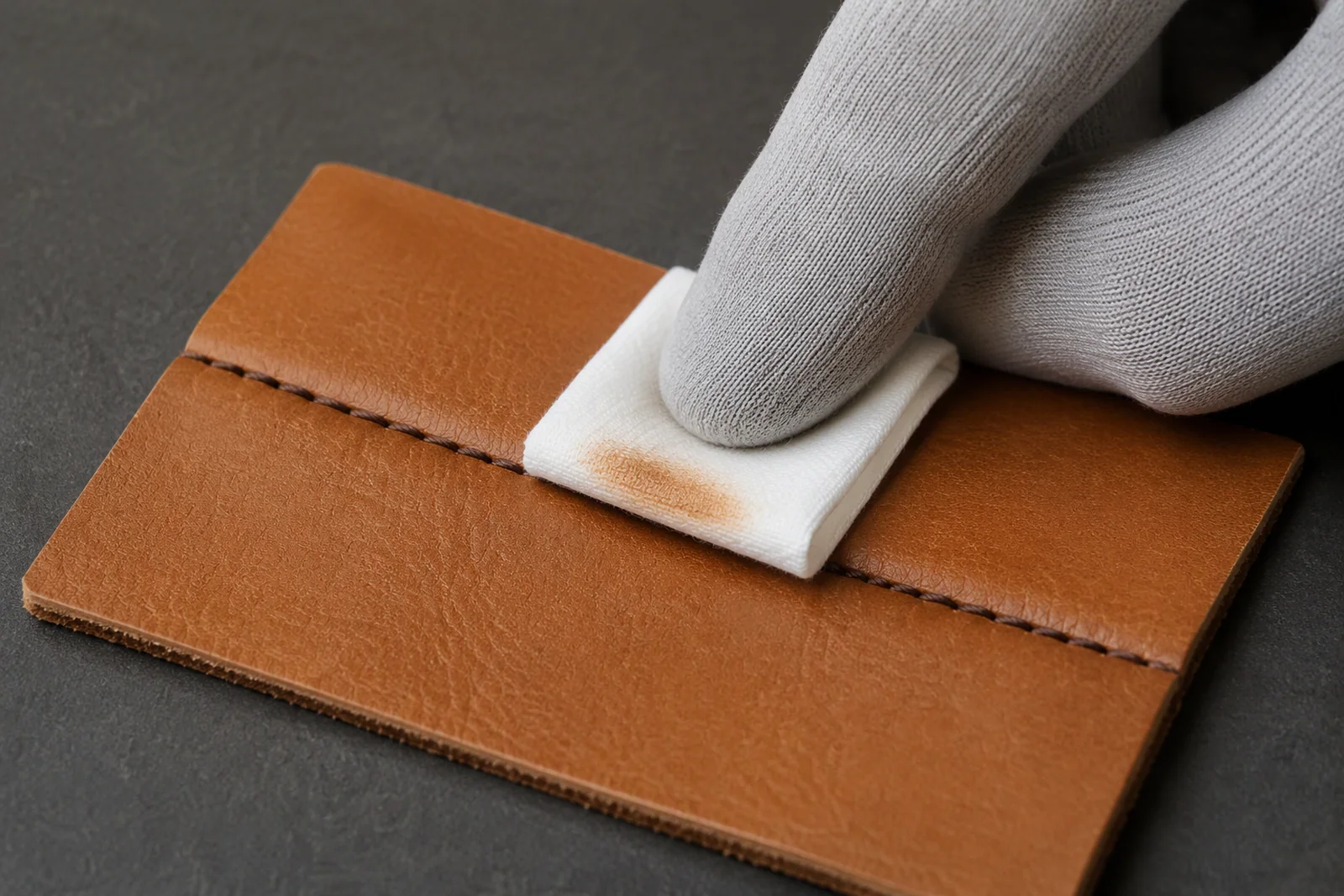
Rubbing fastness is the first property to specify because it produces the defect customers photograph.
Dry Rubbing
The thread is rubbed against a standard white cloth under a fixed load for a fixed number of strokes. The cloth is then assessed against a grey scale.
Wet Rubbing
The same test with a damp cloth. Wet rubbing is always worse than dry, and it is the figure that predicts a humid climate.
The Grey Scale
Results are reported as a grade on a scale from one to five, with half steps. The grade is a visual assessment made under controlled lighting, and it is reproducible when the conditions are fixed.
What a Grade Means in Practice
A high grade means no visible transfer on the cloth. A low grade means the thread has given up dye readily, and a leather panel beside it will take that dye.
Wash Fastness and Staining
Wash fastness measures both the thread's own colour loss and the damage it does to everything around it.
Colour Change
The thread is assessed before and after a wash cycle against a grey scale. This measures how much the thread itself has moved.
Staining of Adjacent Fabric
The thread is washed in contact with a multi-fibre strip, and each fibre band is assessed for staining. This is the measurement that predicts a pink lining after the first wash.
Detergent and Temperature
Both change the result. A thread that passes at a low temperature can fail at a higher one, so the test conditions belong in the specification.
Light Fastness
Light fastness decides whether a seam stays invisible over a season of use, and it is specified separately for a reason.
The Blue Wool Scale
Samples are exposed alongside blue wool references and the change is graded against them. The result describes how long the shade survives exposure.
Contrast With the Host Material
A thread that fades at a different rate from the leather becomes visible even if both are acceptable on their own. The pairing matters more than the individual grade.
Where It Shows
Seams on the outside of a carrier, handle wraps and trim lines are the exposed positions. Interior seams matter far less.
Perspiration and Saliva
An animal's mouth and a warm body create a chemical environment that a standard wash test does not reproduce.
The Alkaline Test
Perspiration is simulated with an alkaline solution, and colour transfer is measured on adjacent fabric. Alkaline conditions move many dyes.
The Acidic Test
An acidic solution is used alongside, because an animal's saliva and skin can present either condition depending on the individual.
Why This Matters for Pet Bags
A thread that passes rubbing and wash can still discolour at a collar edge or a chew point. The test is cheap and it closes that gap.
Thread Types and Their Fastness
Four thread families appear in bag production, and each behaves differently under dye and under abrasion.
Bonded Nylon
Bonded nylon is strong, smooth and takes dye well. Fastness depends on the dyeing and the bonding finish rather than on the polymer.
Polyester
Polyester resists colour loss and is the usual choice where wash fastness matters most. It is stiffer and less forgiving at tight curves.
Cotton
Cotton takes dye readily and releases it readily. It is used for a natural look and needs a higher fastness grade to perform acceptably.
Waxed and Coated Threads
Waxes and coatings can carry dye and transfer it. A coated thread should be assessed with its coating in place, not as a bare yarn.
| Thread | Wash fastness | Rubbing | Note |
|---|---|---|---|
| Bonded nylon | Good | Good | Bonding matters |
| Polyester | Very good | Good | Stiffer |
| Cotton | Moderate | Moderate | Needs higher grade |
| Waxed | Variable | Variable | Test as supplied |
Dye Class and Shade Depth
How a thread holds its colour depends on the dye class and on how deep the shade is, and both are decisions a buyer can influence.
Dye Classes
Different dye classes bond to fibre in different ways, and the bond strength decides how readily colour leaves under water or friction. The class is a supplier detail that a buyer should ask about rather than assume.
Depth of Shade
Deep shades use more dye and leave more unfixed dye on the surface. A dark thread is therefore harder to make fast than a pale one at the same price.
Bright Shades
Bright, saturated colours often need dye chemistry that is less wash fast. A design that calls for a vivid seam carries a fastness risk that should be acknowledged early.
Metallic and Effect Threads
Effect threads carry a film or a coating that can transfer. They need their own assessment and should not inherit the result of the base yarn.
Colour Contrast With the Host Material
A thread that matches the leather hides its own failure, and a thread chosen for contrast makes any transfer visible.
Tone on Tone
A matching thread conceals migration because transfer is invisible. It also conceals poor fastness, which is a risk in the other direction.
Deliberate Contrast
A contrasting thread is a design feature and a fastness requirement at the same time. The higher the contrast, the higher the grade needed.
Dark Thread on Pale Leather
This is the most damaging combination, because migration is at its most visible. It is also the combination that appears most often in pet bag ranges.
Pale Thread on Dark Leather
Migration here reads as a light smudge rather than a dark line. It is less visible but often harder to remove once embedded.
| Combination | Visibility of transfer | Grade needed |
|---|---|---|
| Tone on tone | Very low | Standard |
| Pale on dark | Low to moderate | Moderate |
| Dark on pale | Very high | High |
| Contrasting bright | High | High |
Moisture and Humidity
Water is the transport mechanism for most dye migration, and humidity alone is enough to start it.
Humid Storage
A bag stored in a humid climate keeps its thread slightly damp. Over months, dye migrates into adjacent leather without any washing at all.
Condensation in Transit
A container crossing a temperature boundary condenses water on the interior surfaces. The seam nearest the wall takes the moisture first.
Drying After Wet Use
A wet bag that dries slowly keeps the thread damp for longer. The migration window is the drying time, not the wetting event.
Cleaning Agents and Chemicals
What a customer cleans with can move dye that a wash test never touched, and the care instruction is part of the specification.
Neutral Cleaners
Neutral pH cleaners are the safest choice and should be named on the care label. They leave most dye bonds intact.
Alkaline Detergents
Alkaline conditions open the fibre and release dye. A thread that passes a neutral wash can fail in a household detergent.
Solvents and Spot Cleaners
Solvent spot cleaners can dissolve dye and carry it into leather. A bag cleaned with a solvent is outside any fastness claim.
Disinfectants
Disinfectant products are increasingly used on pet products, and many are alkaline or oxidising. A fastness specification that ignores them is incomplete for this market.
Fastness and Abrasion Together
Colour fastness and abrasion resistance are separate properties, and a thread that satisfies one can fail the other.
Surface Wear
A thread that wears quickly exposes paler fibre beneath the dyed surface. The seam looks faded even though no dye transferred.
Fibrillation
Repeated friction separates the filaments at the thread surface, which scatters light and changes the apparent colour.
Bonding and Finish
A bonded finish reduces fibrillation and improves abrasion performance. It also changes how dye sits on the surface, so the finish should be tested with the thread.
Writing the Specification
A fastness requirement fits in a short block of the thread specification, and each line rules out a specific failure.
State the Grades
Give the required grade and the method for each property that applies: rubbing dry and wet, wash, light and perspiration. A grade without a method cannot be verified.
State the Conditions
Temperature, time, load, number of strokes and the adjacent fabric used. The conditions are what make a result comparable between suppliers.
State the Pairing
Name the leather, lining and trim the thread will sit against. Fastness is judged against a host material, and an unpaired specification is incomplete.
Reference a Sample
Attach a retained thread sample and, where possible, a sewn swatch with the actual leather. The sewn swatch is the only sample that represents the product.
| Specification line | Form | Failure it prevents |
|---|---|---|
| Rubbing grade | Dry and wet figure | Colour line at seam |
| Wash grade | Grade plus staining | Bleeding in the bath |
| Light grade | Figure | Faded seam line |
| Perspiration | Alkaline and acidic | Contact discolouration |
Sampling and Lot Verification
Fastness varies between dye lots, so acceptance has to be tied to the batch rather than to the article.
Lot Testing
Ask for a fastness result per dye lot, not per article. A change of lot is the most common reason a previously acceptable thread starts migrating.
Retained Swatches
Keep a sewn swatch from each accepted lot. Comparing a new lot against a sewn swatch shows a shift that a bare yarn sample hides.
First Delivery Rule
Test the first delivery of any new lot fully. Later deliveries can then be checked against the retained swatch and the original report.
Laboratory and Test Conditions
Where a fastness result comes from decides how much weight it can carry, and the conditions must be written next to the number.
In-House or External
An external laboratory gives a report that will settle a dispute. In-house testing is faster and useful for routine checks, provided the conditions are fixed.
Consistency
The same method under the same conditions produces a comparable grade. A change of operator or lamp is enough to shift a visual assessment.
The Lamp and the Viewing Condition
Grading against a grey scale depends on lighting. Standardised viewing conditions belong in the method, not in a footnote.
| Source | Weight in a dispute | Use |
|---|---|---|
| External laboratory | High | Approval, claims |
| In-house fixed rig | Moderate | Routine checks |
| Supplier report only | Low | Reference |
| Informal visual check | None | Screening |
Common Traps
Six mistakes account for most thread colour problems, and each is preventable at the ordering stage.
Buying by Ticket Number
A ticket number describes size and ply, not dye behaviour. Two threads with the same ticket can differ by two grades on rubbing.
Approving Under Studio Light
A thread approved under a warm lamp can look correct and read differently in daylight. Approval lighting should match the end use.
Testing Bare Yarn Only
A waxed or bonded thread behaves differently with its finish. Testing the bare yarn describes a product that will not be sewn.
Ignoring the Host Material
Fastness is a pairing property. A grade approved against a lining is not evidence for the same thread against a pigmented leather.
Single Lot Approval
One passing lot is not a specification. Without per-lot testing, the next delivery is unverified material.
No Sewn Swatch
A yarn card cannot show how the thread behaves once sewn, pressed and washed. The sewn swatch is the only representative sample.
| Trap | Early signal | Control |
|---|---|---|
| Ticket-only buying | No fastness report | Ask for grades |
| Studio-light approval | Shade shift in daylight | Daylight viewing |
| Bare yarn testing | Failure after coating | Test as supplied |
| Unpaired approval | Transfer on leather | Sewn swatch |
| Single-lot approval | Later lot bleeds | Per-lot testing |
| No sewn swatch | Dispute without evidence | Retain swatches |
Comparing Suppliers
Thread suppliers quote by shade and price, and fastness is where the real difference between them sits.
Same Shade, Different Grade
Two suppliers can match a shade card exactly and differ on rubbing by two grades. The difference is invisible until the bag is washed or worn.
The Comparison Set
Rubbing dry and wet, wash with staining, perspiration and light, all on sewn swatches against the same leather. Anything less compares appearance rather than performance.
Report Quality
A supplier that provides method-referenced grades with conditions is easier to work with than one that offers a single number without a method.
Cost and Grade
Fastness costs money, and the cost is concentrated in dye selection and in the finishing step rather than in the yarn.
Where the Price Rises
Deeper shades, brighter colours and higher fastness grades all raise cost. The increase is modest per spool and significant across a production run.
Where It Saves
A thread that fails costs the leather panel beside it, the labour to remake, and in the worst case a batch of bags. The saving on thread is smaller than any of those.
Choosing Where to Spend
Spend on the seams in contact with pale or untreated leather. A hidden interior seam against a dark lining can carry a lower grade at no visible risk.
| Position | Visibility | Grade priority |
|---|---|---|
| Exterior seam on pale leather | High | Highest |
| Handle wrap | High | High |
| Interior seam on dark lining | Low | Standard |
| Concealed structural seam | None | Standard |
Substitution and Reordering
Thread is one of the easiest components to substitute quietly, because the difference is invisible at the point of receipt.
Silent Substitution
A supplier out of the specified lot may supply a visually identical shade with lower fastness. Without a retained swatch and a lot test, the change passes.
Reordering Across Seasons
A reorder a year later will almost certainly come from a different dyed lot. The shade may match and the fastness may not.
The Control Set
A retained sewn swatch, a recorded set of grades and a per-lot test together make substitution visible. Any one alone is not enough.
| Change | Visible at goods-in | Detected by |
|---|---|---|
| Shade shift | Sometimes | Shade card |
| Fastness drop | No | Lot test |
| Different finish | No | Sewn swatch |
| Different fibre | Rarely | Specification check |
Where Fastness Fails First
Failures cluster in predictable positions, and knowing where allows the highest grade to be used where it earns its cost.
Seams Against Pale Leather
This is the first position to fail because the contrast is highest and the leather takes dye readily. It is also the most photographed part of a bag.
Contact Points
Where an animal rests against a seam, perspiration and friction combine. A collar edge or a chew point shows discolouration before any other area.
Handled Areas
A handle wrap is held with damp hands repeatedly. Wash and rubbing fastness both apply, and the thread is on the outside.
Repair and Rework
Colour migration is not repairable once it has entered the leather, and that changes how a defect should be handled.
What Can Be Removed
Fresh transfer on a sealed, pigmented surface can sometimes be lifted with a cleaner. Once absorbed into an untreated hide, it cannot.
Rework Options
Replacing the affected panel is the only reliable fix. Re-stitching with a different thread does nothing for leather that has already taken the dye.
Claim Evidence
A retained swatch and the original fastness report support a claim against a supplier. Without them the cost sits with the bag maker.
| Defect | Recoverable | Action |
|---|---|---|
| Transfer on sealed surface | Sometimes | Clean and inspect |
| Transfer into untreated hide | No | Replace panel |
| Faded seam | No | Replace or accept |
| Staining after wash | No | Replace panel |
Thread and Lining Interaction
The lining is often the material that shows staining first, because it is pale, absorbent and in contact with every seam.
Pale Linings
A pale synthetic lining shows transferred dye immediately. A lining paired with a high-contrast thread needs its own staining assessment.
Absorbent Linings
Cotton and brushed linings take dye deeply and hold it. The stain is permanent and highly visible in an open carrier.
The Wash Bath
In a wash cycle the thread and the lining share the same water. Staining in the bath is a separate measurement from contact transfer and should be specified that way.
| Lining | Staining visibility | Risk |
|---|---|---|
| Pale synthetic | High | High |
| Pale cotton | High, permanent | High |
| Dark synthetic | Low | Moderate |
| Patterned | Low | Low |
Documentation and Traceability
Fastness is a number that has to travel with the lot, and a thread without its grades cannot be defended or reordered.
On the Specification
Grades, methods and conditions belong in the thread specification and should be referenced from the bag's bill of materials.
On the Lot Record
Record the dye lot and the measured grades for each delivery. A trend across lots shows a supplier drifting before a customer notices.
For a Claim
Keep the retained sewn swatch with the lot record. Together they demonstrate what was approved and what was delivered.
Working With the Mill
The thread supplier and the sewing floor are two parties, and the specification has to survive the handover between them.
What to Send
Shade reference, fibre and ticket, the required grades with methods, and a sewn swatch against the actual leather. That is a complete brief.
What to Ask
Ask which dye class and which finish the supplier proposes for the required grades. The answer shows whether the grade is designed or assumed.
Handling a Failure
Take the sewn swatch and the lot record to the supplier first. A failure demonstrated on a sewn swatch is difficult to dispute.
Limits of the Specification
A fastness specification defines a tested behaviour, and stating its boundaries keeps the claim defensible.
What It Cannot Cover
How a customer washes, which detergent is used, and how long a bag stays damp. Each can produce migration in a thread that passed every test.
What Should Not Be Promised
Colour permanence, no staining under any cleaner, or identical appearance after years of use. The promise should follow the tested grade.
Where the Real Control Sits
Contrast, host material and grade chosen together. A high grade against pale leather is the combination that prevents the defect; a high grade alone does not.
Thread Size, Twist and Fastness
Construction influences dye behaviour, and two threads of the same shade can behave differently because of how they are built.
Ticket and Ply
A thicker ticket or a higher ply puts more fibre in contact with the leather. More surface means more potential transfer at the same grade.
Twist Level
A tightly twisted thread presents a smoother surface and resists abrasion, and it can be harder to dye evenly through the section. Uneven dyeing shows as variation along a seam.
Bonded Finish
Bonding seals the surface and reduces both fibrillation and transfer. On a dark thread against pale leather, bonding is often the difference between a passing and a failing seam.
| Construction | Transfer risk | Note |
|---|---|---|
| Fine ticket, bonded | Low | Default for contrast |
| Fine ticket, unbonded | Moderate | Interior use |
| Heavy ticket, bonded | Moderate | Visibility of any mark |
| Heavy ticket, unbonded | High | Avoid on pale leather |
Approving a Seasonal Range
A range multiplies the fastness problem, because every thread colour meets several leathers and linings in the same collection.
Shared Thread Where Possible
Reducing the number of thread colours reduces the number of approval tests. A range built on three thread shades is far easier to control than one built on nine.
Dark Shades First
Approve the darkest and most saturated thread first. If those pass against the palest leather in the range, the rest of the palette is very likely to pass.
The Approval Matrix
Build a small matrix of thread against host material and test the cells that carry visible seams. The matrix is the document that survives staff changes.
Thread Colour in Sampling and Sales Samples
Sample bags are handled more than production bags and photographed under strong light, so thread behaviour shows up early in the sample room.
Handling Before Delivery
A sample is opened, closed and carried by several people. A thread with weak rubbing fastness will show a colour line before the sample is signed off.
Photography
Studio lighting and close-up photography exaggerate contrast. A seam that reads well in the hand can read as a coloured line in a catalogue image.
Freezing the Sample
Keep the approved sample with its thread lot recorded. A later production run should be compared against it rather than against a description.
Storing Thread on the Floor
Thread waits on a shelf before it is sewn, and how it is stored changes how it behaves when it reaches the machine.
Humidity in the Store
Damp storage starts migration before the thread is used. A cone kept in a humid room can mark the first panel it touches.
Light and Surface Fading
Cones stored near a window fade at the exposed surface. The faded outer layer then runs through a seam for the first metres of a new cone.
Cone Age
Old stock carries the risk of a superseded dye lot. Using cones in delivery order avoids mixing lots within one production run.
| Storage condition | Risk | Control |
|---|---|---|
| Humid room | Pre-migration | Dry store |
| Direct light | Surface fade | Closed cabinet |
| Mixed lots | Shade runs | Delivery order |
| Long standing | Superseded lot | Stock rotation |
FAQ
Why is thread colour fastness specified separately from thread strength?
A: Because they are unrelated properties. A strong thread can release dye readily, and a weak thread can be perfectly fast. Both need their own grade.
Which fastness property matters most in a pet bag?
A: Rubbing, dry and wet. It is the property that produces the colour line along a seam, and it is the defect customers photograph.
What does wet rubbing tell you that dry rubbing does not?
A: It predicts behaviour in a humid climate and after a spill. Wet rubbing is always worse than dry, and a thread that passes dry can fail wet by two grades.
How are fastness results reported?
A: As a grade from one to five with half steps, assessed against a grey scale under fixed lighting. A grade without its method and conditions is not verifiable.
What is staining in a wash test?
A: Colour that leaves the thread and settles on adjacent fabric in the same bath. It is assessed on a multi-fibre strip and predicts a marked lining.
Why does perspiration testing matter for pet products?
A: An animal's skin and mouth present alkaline or acidic conditions that a standard wash test does not reproduce, and many dyes move under them.
Is a matching thread safer than a contrasting one?
A: Safer in appearance, not in behaviour. Matching conceals transfer, which is useful, and it also conceals poor fastness, which is not.
What is the worst colour combination?
A: A dark thread against pale, untreated leather. Contrast is highest and the hide takes dye readily, so any migration is immediately visible.
Does thread construction affect fastness?
A: Yes. Ticket, ply, twist and bonding all change how much fibre is exposed and how evenly the dye penetrates, so construction belongs in the specification.
Should the thread be tested as supplied or as bare yarn?
A: As supplied. Wax and bonding finishes carry and hold dye, so a bare yarn result describes a product that will not be sewn.
How should a lot be verified?
A: Test the first delivery of each dye lot on a sewn swatch against the actual leather, and retain that swatch with the recorded grades.
Why test on a sewn swatch rather than a yarn card?
A: Because a swatch shows the thread after sewing, pressing and washing against the material it will touch. It is the only representative sample.
Can migrated dye be removed from leather?
A: Only from a sealed, pigmented surface and only when fresh. Once absorbed into an untreated hide the mark is permanent and the panel is replaced.
How can fastness cost be controlled?
A: Spend the highest grade where seams meet pale leather and handles, and accept a standard grade on concealed seams against dark linings.
What should a fastness specification avoid promising?
A: Colour permanence, no staining under any cleaner, or unchanged appearance after years of use. The claim should follow the tested grade.
Does the care label belong with the fastness specification?
A: Yes. A neutral cleaner instruction protects the dye bond, and an alkaline detergent can move dye that passed a neutral wash test.
Ready to stop finding dye where the seam meets the leather? Specify rubbing, wash, light and perspiration grades with their methods, test each dye lot on a sewn swatch, and spend the highest grade where dark thread crosses pale hide.