Which Reinforcement Board Belongs in Each Part of a Pet Bag?
- What Reinforcement Actually Does
- Board Materials and How They Behave
- Choosing Thickness and Stiffness
- Reinforcement by Location
- Fixing Methods and Assembly
- Board Shapes, Slots and Folding
- Layering with Lining and Shell
- Balancing Softness and Structure
- Weight and Its Consequences
- Durability, Folding and Fatigue
- Testing and Inspection Points
- Writing the Reinforcement Specification
- Cost, Weight and Recyclability Drivers
- FAQ
Reinforcement is the least visible part of a pet bag and the part that decides whether the bag looks expensive after a month of use. Buyers never see the board, but they feel it every time they lift the bag, close it and set it down.
In pet carriers the requirement is more complex than in a handbag, because the structure has to hold a live weight that shifts. A base that sags, an end panel that folds inward or a handle anchor that pulls out will be read as a quality fault long before any stitching is questioned.
This guide covers what reinforcement actually does, how the common board materials behave, how to choose thickness and stiffness, which board belongs at each location, how boards are shaped and folded, how they are fixed, how they layer with lining and shell, how to balance softness against structure, what extra weight does to the product, how these panels age, what to test, how to write the specification, and what drives cost and recyclability.
What Reinforcement Actually Does
Reinforcement is often described as making a bag firm, which understates the job and leads to over-specified boards.
Load Paths and Shape Control
A board carries load from the handle or strap to the widest part of the bag and spreads it across the panel instead of concentrating it at a few stitch points. It also holds a cross-section against the weight pressing from inside.
Where Structure Fails First
Failures appear at predictable points. The base takes the load, the handle anchors take the tension, and the upper edge takes the folding. An unreinforced base sags in the middle, an unbacked anchor tears, and an over-stiff upper edge cracks at the fold.
What Over-Reinforcement Costs
Too much board adds weight, makes the bag awkward to fold, stiffens the opening, and raises material cost. In pet carriers it also reduces the cushioning that protects the animal over rough ground.
The aim is the least structure that meets the load, not the most board that fits.
| Function | Carrier requirement | Failure if omitted |
|---|---|---|
| Load spread | Handle and strap loads | Tearing at anchors |
| Base rigidity | Stable footprint | Sagging base |
| End panel support | Opening stays open | Panels fold inward |
| Edge control | Clean opening line | Wavy upper edge |
| Hard-point backing | Rivets and fittings | Pull-through |
| Shape retention | Bag keeps its form | Collapse over time |
| Cushioning support | Comfort over rough ground | Pressure points |
| Fold behaviour | Storage and packing | Cracking at folds |
Board Materials and How They Behave
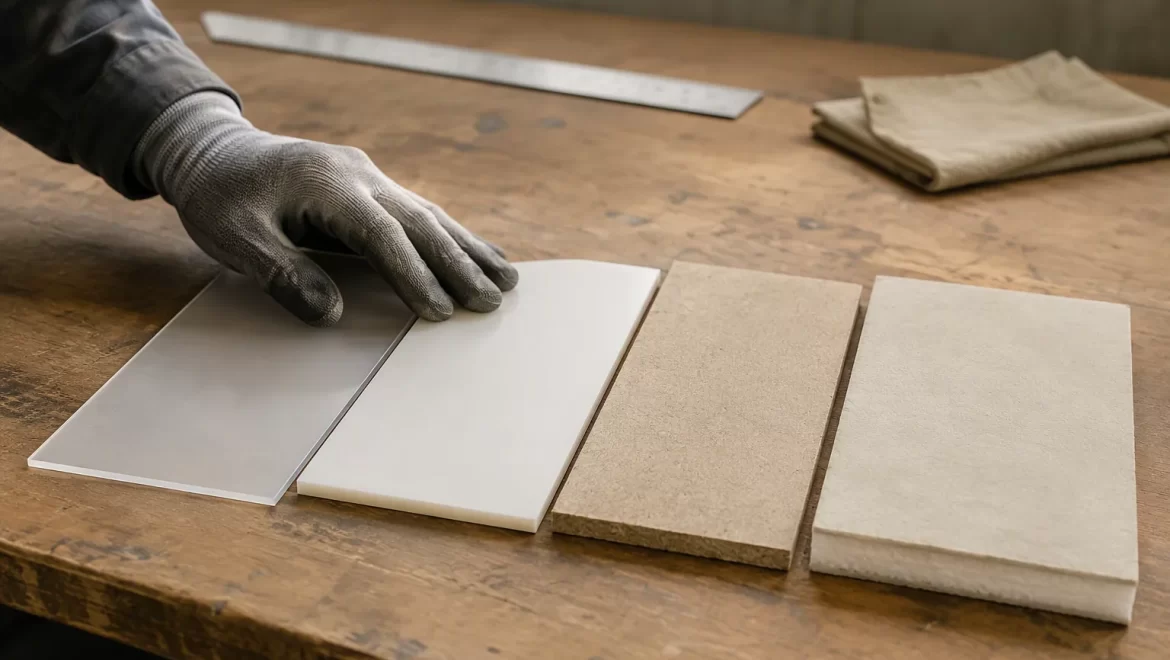
The material choice decides stiffness per gram, how the board behaves when folded and how it reacts to moisture.
Polypropylene and Polyethylene Sheet
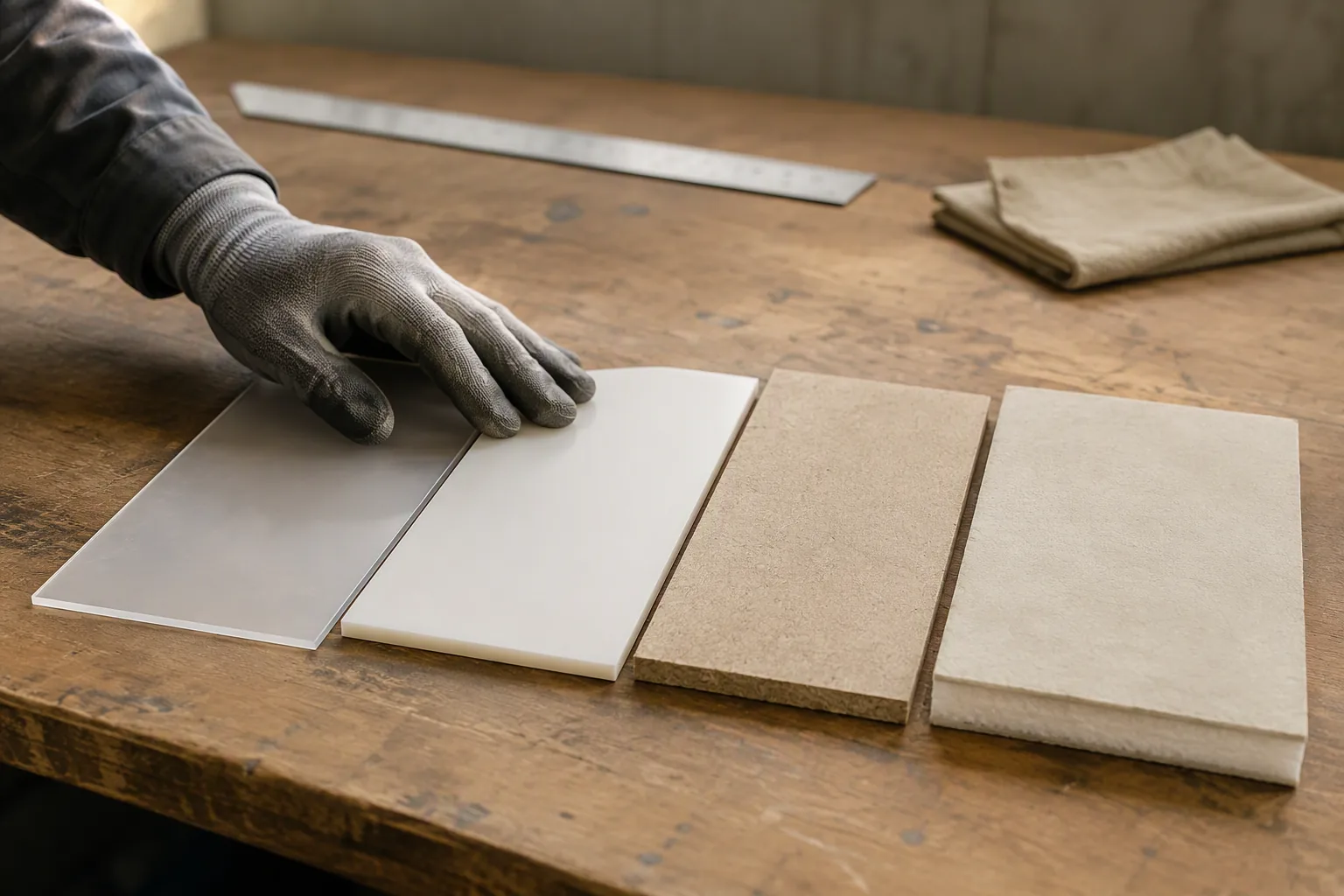
Polypropylene sheet is the common default: it is light, inexpensive, water-resistant and available in a range of thicknesses. It can be scored and folded, which suits base-to-wall transitions.
Polyethylene is softer and more flexible, so it suits applications where the panel must bend rather than hold a line.
PET Sheet and Recycled Board
PET sheet is stiffer for its thickness than polypropylene in many grades and is widely available in recycled form, which supports a recycled-content claim. It is more brittle, however, so cuts and scores must be clean to avoid starting a crack.
Where a buyer asks for recycled content, PET and pulp-based boards are usually the first candidates.
Pulp, Paper and Corrugated Board
Pulp board and corrugated sheet are inexpensive and give a firm, flat result in dry conditions. They lose stiffness when damp and delaminate if they get wet repeatedly, so they suit carriers whose interior stays dry.
Used away from the wet zone they are a legitimate choice, and they are the easiest to recycle.
Foam Laminates and EVA
Foam laminates and EVA give thickness with cushioning rather than stiffness, which suits bases that must protect an animal over uneven ground. They resist compression better than they resist bending.
Where a base needs both, a thin board laminated to foam is usually more effective than a thick foam alone.
| Board material | Stiffness per gram | Moisture behaviour | Folding |
|---|---|---|---|
| Polypropylene sheet | High | Resists moisture | Scores and folds well |
| Polyethylene sheet | Moderate | Resists moisture | Very flexible |
| PET sheet | High | Resists moisture | Needs clean scores |
| Recycled PET sheet | High | Resists moisture | Grain direction matters |
| Pulp board | Moderate | Softens when damp | Creases and cracks |
| Corrugated sheet | Directional | Delaminates when wet | Folds across the flutes |
| EVA sheet | Low | Resists moisture | Compressible |
| Foam laminate | Low | Absorbs slowly | Cushions, does not hold |
| Board and foam combined | High plus soft | Depends on board | Best of both |
| Hardened leather | Moderate | Sensitive to water | Keeps its own shape |
Choosing Thickness and Stiffness
Thickness is the number buyers ask for and stiffness is the property that matters. They are related but not the same, because stiffness rises much faster than thickness.
Relating Thickness to Stiffness
Bending stiffness increases roughly with the cube of thickness, so moving from 0.6 mm to 1.2 mm makes a panel far more than twice as stiff. That is why small thickness changes produce large handling differences.
Matching Stiffness to Span
A wide, unsupported base needs more stiffness than a narrow one, because deflection depends on span as well as material. Short spans can be left thin; long spans either need a thicker board or an additional support line.
Adding a centre support or a shaped base ridge is often lighter than thickening the whole panel.
Weight Consequences per Square Area
Board weight is directly proportional to thickness for a given material, so a stiffness increase obtained through thickness also increases weight across the whole panel. Selecting a stiffer material at a lower thickness can achieve the same rigidity for less weight.
| Panel role | Modest stiffness | Recommended treatment |
|---|---|---|
| Small carrier base | Thin board | Single sheet suffices |
| Large carrier base | Stiffer board | Thicker sheet or support ridge |
| End panels | Low to moderate | Thin board or foam |
| Back panel | Moderate | Thin board, oriented |
| Handle anchors | High locally | Small patch, not a full panel |
| Hardware points | High locally | Local patch or washer |
| Fold lines | Low | Score instead of thicken |
| Cushion layer | None | Foam above the board |
Reinforcement by Location
Each location carries a different load, and treating them as one specification is the most common cause of both excess weight and structural failures.
The Base
The base carries the animal's weight and the loads from lifting, so it needs the greatest stiffness in the panel. It also needs to keep its shape when the bag is set down, which argues for a board that resists bending rather than one that cushions.
Where comfort matters, the cushioning layer belongs above the board rather than instead of it.
End Panels and the Opening
The ends of a soft carrier keep the opening from collapsing and give the bag its depth. They need enough stiffness to hold the shape without making the opening awkward to close.
Over-stiff ends are a common fault in samples, because they make inserting an animal difficult.
Handle and Strap Anchors
Anchors concentrate load, so the reinforcement must be local and continuous with the panel rather than a stiffener sitting beside it. A patch that ends short of the load path simply moves the failure to its edge.
The patch should also be large enough to spread the load beyond the immediate stitching.
Hardware and Frame Points
Rivets, D-rings, snaps and frame ends all create point loads. A small backing layer beneath each point prevents pull-through and keeps the panel face from distorting.
Where several points sit close together, a single continuous strip is usually better than separate patches.
| Location | Load type | Reinforcement response |
|---|---|---|
| Base | Bending and compression | Stiff board plus foam above |
| Ends | Panel buckling | Thin board or firm foam |
| Back | Bending and shape | Thin board aligned to load |
| Opening edge | Flexing | Soft edge, no stiff board |
| Handle anchors | Tension and peel | Continuous local patch |
| D-ring mounts | Point load | Backing layer under hardware |
| Frame ends | Point load | Local pad plus channel |
| Base corner joints | Shear | Overlap or wrapped edge |
Fixing Methods and Assembly
How a board is held in place decides whether it stays where it was designed to be after a season of use.
Insert Pockets and Channels
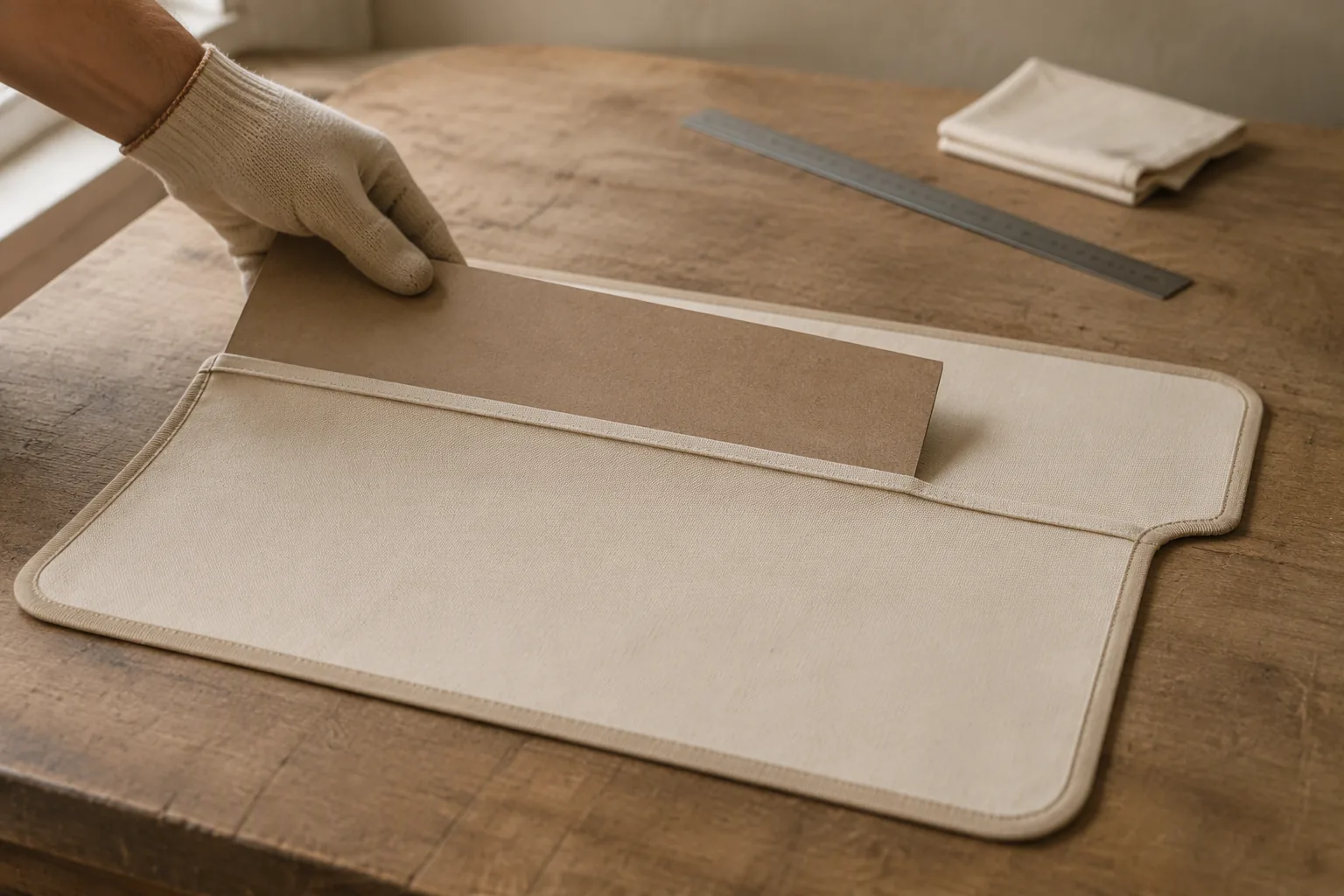
A pocket or channel keeps the board aligned without adhesive and allows it to be removed for cleaning or replacement. It also lets the board move slightly, which reduces the risk of the lining being pulled tight over a rigid edge.
Adhesive Bonding
Adhesive holds a board flat against the shell or the lining and keeps the assembly thin. It is sensitive to the surfaces involved, the amount applied and the cure conditions, so the process should be specified rather than left to the operator.
Heat Pressing and Lamination
Heat pressing laminates a board to a lining or a shell in one operation and produces a clean, thin result. The risk is over-pressing, which flattens the material, and under-pressing, which leaves weak areas that separate later.
Stitching and Riveting Through Boards
Stitching through a board is only practical where the board accepts a needle without cracking, which rules out most stiff sheets at full thickness. Rivets and snaps must be set with a backing layer to avoid crushing the board.
Where stitching is required, a thinner material or a stitched-in pocket is usually the safer route.
| Fixing method | Keeps alignment | Removable | Risk |
|---|---|---|---|
| Insert pocket | Good | Yes | Board escapes if not closed |
| Closed channel | Strong | With effort | Hard to fit correctly |
| Adhesive bonding | Strong | No | Weak zones if uneven |
| Heat lamination | Strong | No | Over or under pressing |
| Stitching through board | Strong | No | Cracking at needle holes |
| Rivets or snaps | Local | No | Crushing without backing |
| Stitched pocket | Good | Yes | Pattern complexity |
| Spot tacking | Adequate | With force | Local pull-through |
Board Shapes, Slots and Folding
A board that fits a flat pattern will not necessarily fit an assembled bag, and the shape is where many sample problems begin.
Turning a Cross-Section into a Shape
The shape has to follow the interior at the level it sits, allowing for the material thickness of the shell and lining and for the radius at the corners. A board cut to the outside footprint will be too large and will push the lining tight.
Because the corners of a soft bag are rounded, the board corners need a radius that matches the finished interior rather than the pattern.
Score Lines and Living Hinges
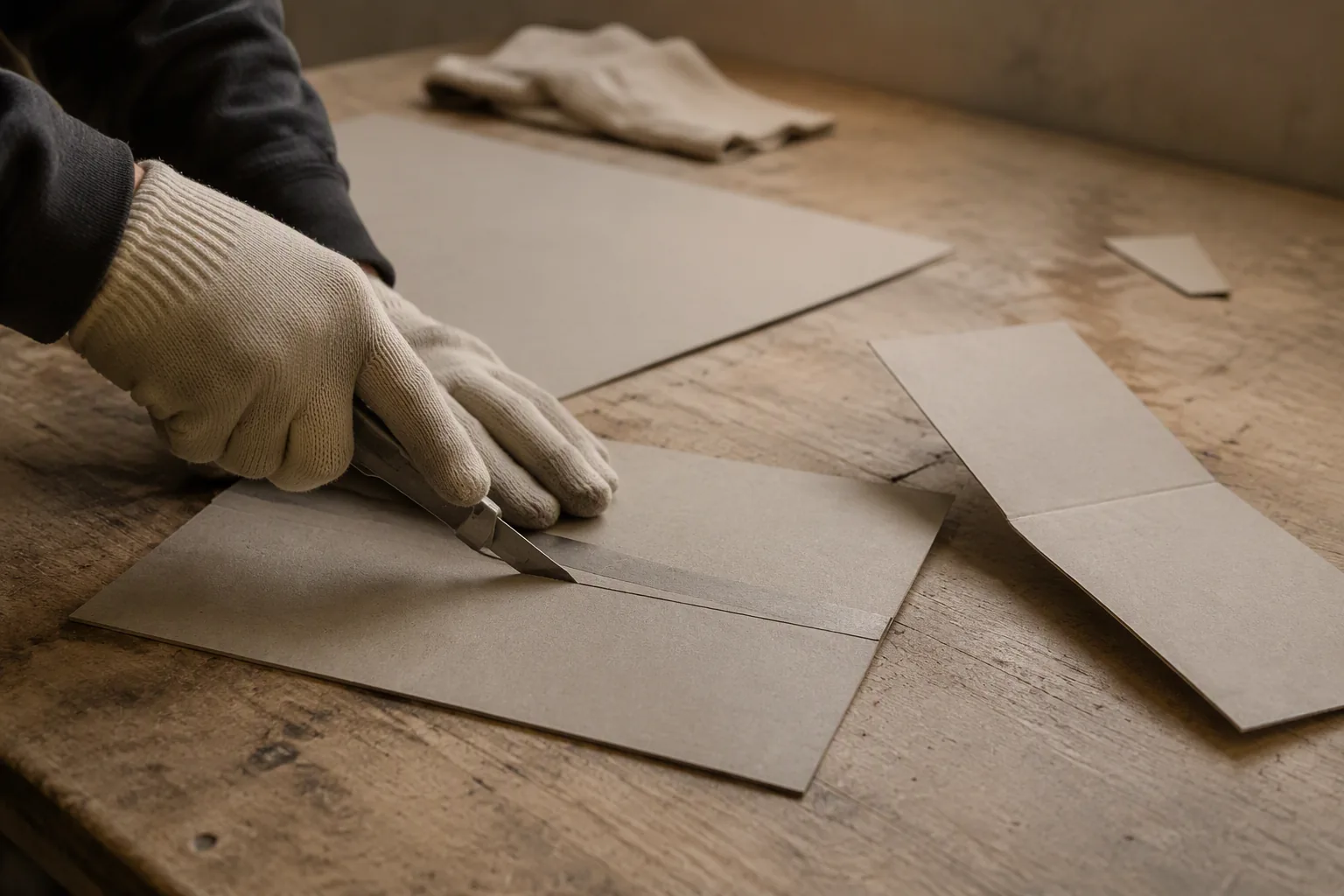
Scoring a board creates a line along which it folds, allowing a base board to continue into the lower walls without a separate piece. The score removes material, so it is also the weakest line, which means it should fall where bending is expected and not where load is carried.
Where a score crosses a load path, a separate piece or an overlapping reinforcement is safer than a single folded sheet.
Clearance, Access and Removal
Boards inserted into pockets need clearance for insertion and for the lining thickness. A board that fits tightly is difficult to assemble and tends to distort the panel once closed.
Where the board is meant to be removable, the opening should be at a place that is accessible after assembly and closable afterwards.
| Shape feature | Purpose | Risk if wrong |
|---|---|---|
| Corner radius | Fits finished interior | Lining squeezed at corners |
| Score line | Folds base into walls | Crack along the fold |
| Insertion clearance | Allows assembly | Distorted panel |
| Pocket opening | Access for removal | Board cannot be replaced |
| Edge chamfer | Reduces abrasion | Lining worn through |
| Cut-out for hardware | Clears fittings | Point load on the board |
| Overlap tab | Continues the load path | Weak seam between boards |
| Alignment marks | Correct orientation | Board fitted reversed |
Layering with Lining and Shell
The board sits between the shell and the lining, and the order of the layers decides how the finished bag feels and how it wears.
Outer Shell, Board, Lining Order
The usual sequence is shell outside, reinforcement next, then lining, so the board is hidden and the lining takes the wear. Where a board is expected to be removed, the lining must form the pocket and the shell must not be bonded to the board.
The layer order should be shown in the specification because reversing it changes both the appearance and the serviceability.
Preventing Read-Through
A rigid edge under a thin lining shows as a line on the interior face, and a sharp corner shows as a mark. Padding the edge, chamfering the board or adding a thin foam layer removes most read-through.
Read-through is easy to miss on a single sample and obvious once the bag is filled, so it should be checked with the bag loaded.
Bonding Versus Floating Layers
A board bonded on both faces becomes part of a rigid sandwich, which is strong but unforgiving and can crack when folded. A board left free between the layers can shift slightly, which protects it but allows movement.
Deciding which layers are bonded and which are free is a design decision that should be stated explicitly.
| Layer arrangement | Result | Suits |
|---|---|---|
| Shell, board, lining | Standard hidden panel | Most carriers |
| Shell, foam, board, lining | Softer inner face | Comfort-led designs |
| Shell, board, foam, lining | Cushioned with firm base | Carriers used over rough ground |
| Shell, board, board, lining | Very firm | Rigid-style carriers |
| Board bonded both faces | Rigid sandwich | Flat panels, no folding |
| Free-floating board | Movement permitted | Removable panels |
| Board in lining pocket | Serviceable | Washable interiors |
| Board outside lining | Not recommended | Wears the animal contact face |
Balancing Softness and Structure
Pet carriers need more softness than handbags, and the balance is where a design either works or feels wrong.
Where Firmness Helps
Firmness helps where the bag must hold its shape: the base, the ends and the area under the handle. These are the points where a soft bag looks collapsed and where an animal's movement is felt most.
Where Softness Helps
Softness helps where the bag meets the animal: the walls, the upper edges and any surface that will be leaned against. A rigid wall transfers every bump on rough ground directly to the animal.
Testing the Balance in Use
The balance can be assessed by loading the sample and carrying it, then opening and closing it repeatedly. A bag that feels correct when empty can be uncomfortable or awkward when loaded.
| Area | Firmness preference | Reason |
|---|---|---|
| Base | Firm | Supports the load |
| End panels | Moderately firm | Holds the opening |
| Side walls | Soft | Cushions the animal |
| Upper edge | Soft | Folds and closes easily |
| Handle area | Firm locally | Carries the load |
| Lining face | Soft | Contact surface |
| Base corners | Reinforced | Resists wear |
| Fold lines | Flexible | Storage and packing |
Weight and Its Consequences
Weight added in the structure is weight the carrier must justify on every journey, and it is normally the first thing a buyer notices.
How Board Weight Accumulates
Board weight is proportional to area and thickness, so a specification that thickens several panels adds weight in several places at once. The base is usually the largest contributor because it is normally the largest panel.
Comparing total structure weight rather than the weight of a single component is the only way to judge the effect on the finished carrier.
Weight Against Carrying Method
A carrier carried by a hand strap tolerates less weight than one carried on the shoulder or the back, and a carrier used in a bike basket tolerates less than a hand-carried one. The acceptable structure weight therefore follows the carrying method rather than a general target.
Where weight is critical, moving stiffness to a local patch instead of a full panel is usually the most effective change.
Reducing Weight Without Losing Rigidity
Options include a stiffer material at lower thickness, a shaped base that gains rigidity from form, local reinforcement instead of full panels, and removing material where no load passes.
Each of these needs a sample to confirm, because the effect on handling is not predictable from a specification sheet.
| Weight lever | Effect on rigidity | Effect on weight |
|---|---|---|
| Thicker board | Much higher | Higher |
| Stiffer material, same thickness | Higher | Similar |
| Stiffer material, lower thickness | Similar | Lower |
| Shaped base with ridges | Higher | Slight increase |
| Local patches instead of panels | Adequate at load points | Lower |
| Removing material outside load paths | Little change | Lower |
| Foam instead of board | Lower rigidity | Lower |
| Board laminated to foam | Higher rigidity plus cushioning | Depends on thickness |
Durability, Folding and Fatigue
Boards fail through fatigue rather than through a single overload, and the failures follow the folding pattern of the carrier.
Flex Fatigue at Fold Lines
Repeated folding along the same line weakens a scored section until it cracks, and the crack then transfers load to the lining. Carriers that are folded flat for storage are most exposed.
Corner and Edge Wear
Corners carry abrasion as the bag is set down, and a board edge pressing through a lining wears it from inside. Chamfering, padding or slightly shrinking the board at the corners removes most of this wear.
Moisture Effects Over Time
Boards that absorb moisture lose stiffness and can delaminate, and the effect is cumulative. Even where the interior stays dry, condensation and cleaning introduce moisture that a water-resistant board tolerates and a pulp board does not.
| Ageing factor | Effect | Mitigation |
|---|---|---|
| Repeated folding | Crack at score lines | Vary fold line |
| Storage flat and compressed | Permanent set | Thin material at folds |
| Corner abrasion | Worn lining from inside | Chamfer and pad |
| Moisture exposure | Loss of stiffness | Water-resistant board |
| Repeated delamination cycles | Separated layers | Sealed edges |
| Point loads | Deformation at fixings | Backing layers |
| Heat exposure | Distortion | Material selection |
| Long-term compression | Permanent sag | Stiffer base or support |
Testing and Inspection Points
Reinforcement is invisible in the finished product, so the checks have to happen during assembly and on the loaded sample.
Checks During Assembly
Confirming the board type, thickness and orientation before closing the panel is the only reliable way to catch a substitution, because a wrong board looks identical once the bag is assembled. Board fit, pocket closure and insertion clearance are checked at the same point.
Loaded and Repeated-Use Checks
Loading the sample with representative weight shows whether the base holds its footprint and whether the anchors carry the load without distortion. Repeated lifting and setting down then reveals whether the structure deforms permanently.
Folding and Moisture Checks
Folding the sample along its intended lines repeatedly tests the score lines, and exposing a board sample to moisture shows whether stiffness survives. Both are quick and both address common field failures.
Where a recycled board is used, its behaviour at the score line is worth checking separately, because grain direction affects crack resistance.
| Check | Stage | Predicts |
|---|---|---|
| Board type and thickness | Incoming | Wrong material |
| Orientation and grain | Assembly | Cracked folds |
| Fit and clearance | Assembly | Distorted panels |
| Pocket closure | Assembly | Board escaping |
| Loaded base test | Sampling | Sagging base |
| Repeat lift test | Sampling | Anchor tear-out |
| Fold cycle test | Sampling | Score line cracking |
| Moisture exposure test | Sampling | Loss of stiffness |
Writing the Reinforcement Specification
A reinforcement specification is short, and its value lies in removing choices that should not be left to the line.
What the Specification Must State
Board material and grade, thickness with a tolerance, panel-by-panel placement, shape and corner radius, score line positions, fixing method, whether the board is bonded or removable, and the layer order are the minimum. Adding the load the panel is designed for explains the intent and prevents a later cost review from removing it.
Where a board is scored, the direction of any grain or flute should be stated, because it decides which way the panel can fold without cracking.
Sealed Samples and Board Records
Keeping a sealed sample of each reinforced panel, with the board identified by supplier and grade, is the only way to confirm a later delivery. Because boards look similar across grades, the record matters more here than for visible materials.
Managing Substitution
Substitution happens when a grade is unavailable, and the risk is that a softer or more brittle board arrives unnoticed. Requiring any alternative to match the stated stiffness and to pass the same fold and load checks keeps the product stable.
| Specification item | Why it matters | Common omission |
|---|---|---|
| Material and grade | Sets stiffness and behaviour | Grade left open |
| Thickness and tolerance | Controls weight | Tolerance omitted |
| Panel placement | Load path integrity | Shown only on sample |
| Corner radius | Prevents read-through | Taken from pattern |
| Score positions | Fold behaviour | Not dimensioned |
| Grain or flute direction | Crack resistance | Not stated |
| Fixing method | Serviceability | Left to operator |
| Bonded or removable | Cleaning and repair | Not decided |
| Layer order | Appearance and wear | Assumed |
Cost, Weight and Recyclability Drivers
The commercial case for reinforcement is easy to make when the cost is attributed to the loads each panel carries.
What Drives the Cost
Board material and thickness are the main material drivers, followed by the operations used to fix the board: pocket sewing, bonding, lamination or hardware backing. Additional panels and cut-outs add labour, and tighter tolerances add inspection.
Reducing board to the panels that carry load, and using local patches at anchors and hardware, is normally the largest available saving.
Weight as a Commercial Factor
Structure weight affects shipping cost, handling and perceived quality, and it accumulates across the panel set. Because stiffness rises faster than thickness, a lighter stiffer material often wins on both weight and total cost once the panel is thin.
Recyclability and End-of-Life
Single-material boards are easier to recycle than laminates, and a board that can be removed from the bag is easier to separate at end of life. Where a laminate is necessary for performance, the design should still allow the board to be separated from the shell and lining.
Recycled-content boards support a recycled claim, but the claim should describe the board rather than the whole carrier, and it should be confirmed with the supplier rather than assumed from the material name.
| Cost driver | Direction | Lever |
|---|---|---|
| Board material | Strong | Match stiffness to load |
| Thickness | Strong | Stiffer grade at lower thickness |
| Fixing operations | Moderate | Choose the simplest that holds |
| Panel count | Moderate | Reinforce only load paths |
| Cut-outs and shapes | Moderate | Simplify where possible |
| Tolerances and inspection | Moderate | Specify what matters |
| Separability for recycling | Administrative | Design for removal |
| Recycled content | Depends on supply | Confirm with supplier |
FAQ
Which board material is best for a pet bag base?
A: Polypropylene sheet is the common default because it is light, water-resistant and easy to score and fold. Where stiffness per thickness matters more, PET sheet performs well,
How thick should a reinforcement board be?
A: Thickness follows the span and the load rather than a general figure. Bending stiffness rises roughly with the cube of thickness, so a small increase changes handling a great deal.
Should the base board be removable?
A: It depends on how the carrier will be cleaned. A removable board allows the interior to be washed and the board to be replaced, but it needs an accessible pocket that can be closed. Where the interior is wiped rather than washed, a fixed board is simpler.
Why does a reinforced base sag even with a board inside?
A: Usually because the span is too long for the board's stiffness, or because the board is scored on a line that carries load. Adding a support ridge or a shaped base is often lighter than thickening the whole panel.
How are reinforcement boards held in place?
A: By insert pocket, closed channel, adhesive, heat lamination, stitching or hardware backing. The choice depends on whether the board must stay removable and on how the assembly is bonded, and it should be written into the specification.
Why does a rigid edge show as a line on the interior?
A: Because the board edge presses through a thin lining, which is called read-through. Chamfering the board edge, adding a thin foam layer or slightly reducing the board size removes most of it, and it should be checked with the bag loaded.
Which is better, a thicker board or a stiffer material?
A: A stiffer material at a lower thickness usually gives similar rigidity for less weight, which matters because structure weight accumulates across panels. The comparison should be made on the assembled carrier rather than on the board alone.
Where should reinforcement be local rather than full panel?
A: At handle and strap anchors and at hardware points, where load is concentrated. A patch must be large enough to spread the load beyond its own stitching and continuous with the load path, otherwise the failure simply moves to the patch edge.
Can reinforcement boards be glued into a pet bag?
A: They can, and bonding keeps the assembly thin, but a bonded board cannot be removed for cleaning or replacement. The adhesive, the amount applied and the cure conditions all affect the result, so the process should be specified rather than left to the operator.
Why do boards crack at fold lines?
A: Because scoring removes material along that line, and repeated folding fatigues it. Score lines should fall where bending is expected, not where load is carried, and carriers that fold flat for storage benefit from varying the fold position.
Does moisture damage a paper or pulp board?
A: It softens the board and can delaminate it over repeated wetting, and the effect is cumulative. Where a panel sits near the wet zone, a water-resistant board is the safer choice even if the carrier is used mainly indoors.
How does recycled PET behave differently?
A: It can be stiff and is widely available in recycled form, but it is more brittle, so scores and cuts need to be clean and the grain direction matters for crack resistance. Its fold behaviour is worth testing separately before bulk.
What should be checked during assembly?
A: Board type, thickness, orientation and grain direction, fit and insertion clearance, and pocket closure.
How can structure weight be reduced without losing rigidity?
A: By using a stiffer material at lower thickness, shaping the base so it gains rigidity from form, reinforcing locally at load points instead of full panels, and removing material outside the load paths. Each change should be confirmed on a sample.
How does reinforcement affect recyclability?
A: Single-material boards separate more easily than laminates, and a board that can be removed from the bag is easier to handle at end of life.
What should the specification include to prevent silent substitution?
A: Board material and grade, thickness with tolerance, panel placement, shape and corner radius, score positions, grain direction, fixing method, bonded or removable status and layer order — plus a rule that any alternative must match the stated stiffness and pass the same checks, and a sealed sample with a retained offcut.
Ready to stop treating structure as an afterthought? List the loads each location carries, choose the least board that meets them, use a stiffer material at lower thickness where weight matters, reinforce locally at anchors and hardware, and check read-through and fold fatigue on the sample. Write the material, thickness tolerance, placement, scoring and fixing method into the specification, then keep a sealed sample with an offcut of the actual board.