How Should Thickness Tolerance Be Set Across a Hide?
- Why Thickness Tolerance Decides Bag Quality
- How Thickness Varies Across One Hide
- The Anatomy of a Hide in Thickness Terms
- What the Buyer Should Specify
- Writing the Tolerance Band
- Where to Measure: Point Maps
- Instruments and Their Resolution
- Measurement Conditions and Moisture
- Sampling a Lot of Hides
- Accept or Reject: The Sorting Decision
- Grading Hides by Thickness
- Thickness Mapping and Cutting Plans
- Matching Panels Within One Bag
- Thin Areas and Structural Risk
- Thick Areas and Assembly Problems
- Skiving and Splitting to Tolerance
- Lining and Reinforcement Thickness
- Thickness and Stitch Performance
- Thickness and Edge Finishing
- Thickness and Moulding or Shaping
- Thickness in Hardware Reinforcement
- Weight, Yield and Cost Effects
- Supplier Agreements and Reject Rules
- Incoming Inspection Setup
- Records and Traceability of Lots
- Multi-Supplier Consistency
- Common Traps in Tolerance Specification
- Working With What Arrives
- What to Audit at the Tannery
- Limits of Thickness Control
- FAQ
A hide is not a sheet of uniform material. It is thick at the spine, thin at the belly, and every panel cut from it inherits whatever that point happened to be. Setting a thickness tolerance is therefore a decision about where to measure as much as how much variation to allow.
For a bag manufacturer, thickness drives stitch performance, edge finishing, moulding, hardware reinforcement and yield. A tolerance written without regard to position on the hide produces arguments at goods-in that no inspection can settle.
Why Thickness Tolerance Decides Bag Quality
Thickness is the least visible specification in a leather order and the one that surfaces first when a bag fails.
The Stitch Problem
A needle and thread tuned for one millimetre behave differently at one point six. Skip stitches, loose loops and cut edges follow, and the operator blames the machine.
The Edge Problem
Edge paint and burnishing depend on a consistent cross-section. A panel that tapers from thick to thin takes paint unevenly and shows a wave along the edge.
The Structural Problem
Thin leather at a handle anchor or a base corner tears earlier, whatever the reinforcement behind it. Thickness is part of the structure, not only the surface.
| Symptom | Thickness cause |
|---|---|
| Skip stitch | Panel too thick |
| Loose loop | Panel too thin |
| Edge wave | Taper |
| Tear at anchor | Local thin |
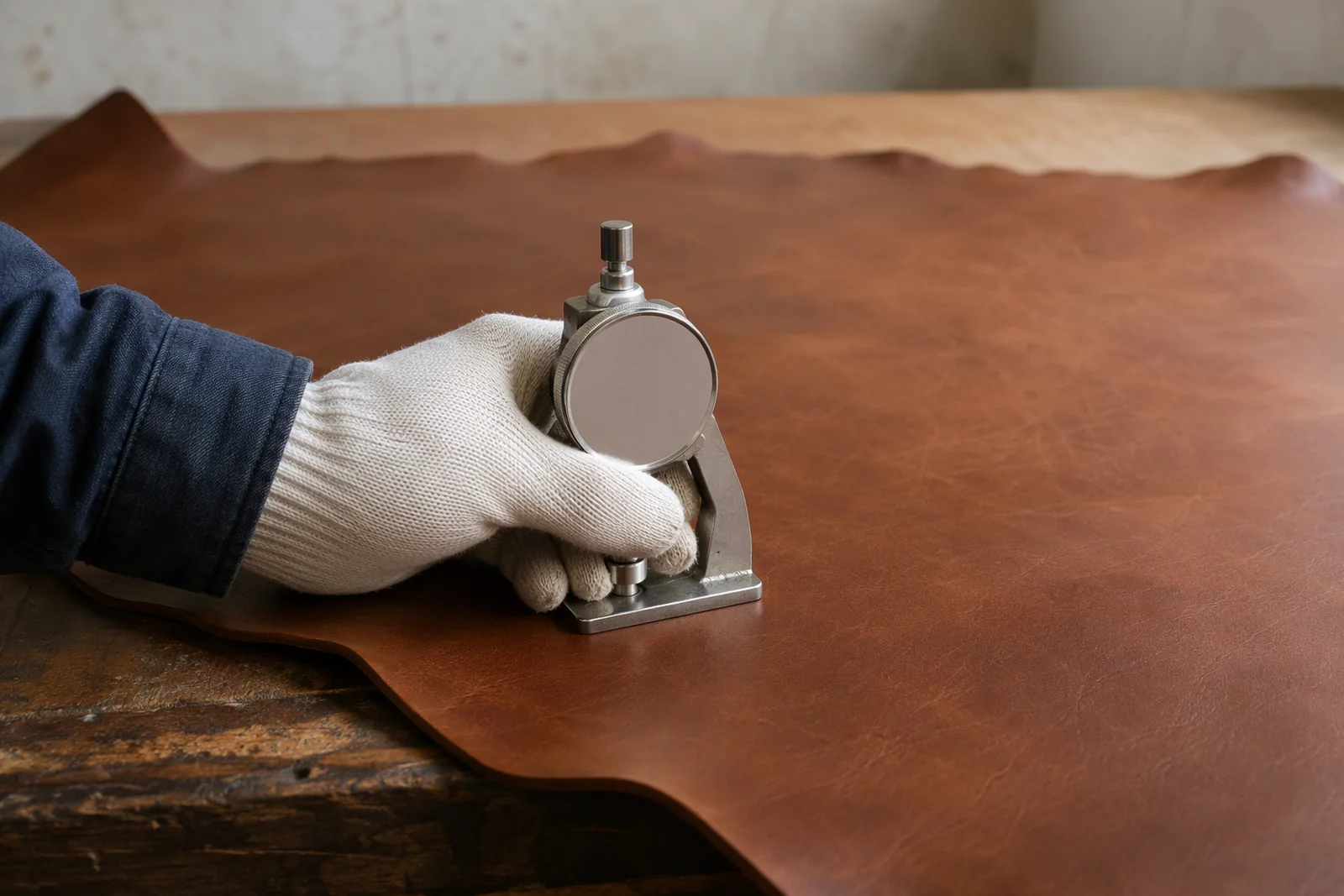
How Thickness Varies Across One Hide
Variation across a single hide is not a defect. It is the anatomy of the animal, and a specification that ignores it cannot be met.
The Spine and the Belly
The spine and rump are dense and thick, while the belly and flank are thin and stretchy. The difference on a bovine hide can exceed half a millimetre before any processing.
Neck and Shoulder
Neck leather is thick and often heavily grained, which makes it useful for structure and awkward for a flat panel that must sit flush.
Legs and Edges
The outer edge of a hide is thin, wrinkled and rarely usable for visible panels. It still counts in the area delivered, which affects apparent yield.
| Zone | Behaviour |
|---|---|
| Spine | Thick, firm |
| Belly | Thin, stretchy |
| Neck | Thick, grained |
| Edge | Thin, wrinkled |
The Anatomy of a Hide in Thickness Terms
Tanners talk in parts, and the parts have consequences for the bag that a single thickness number cannot express.
The Grain Layer
The grain is the dense outer surface that carries the finish. Its integrity matters more than its thickness, and skiving too deep removes the part that takes colour.
The Corium
The corium is the fibrous bulk that gives tear strength. Splitting to a nominal thickness removes corium from the flesh side, and how much is removed decides performance.
The Flesh Side
The flesh side is loose and fibrous, and it is where splits show. A split surface needs finishing or lining, which is a cost the specification should anticipate.
| Layer | Contributes |
|---|---|
| Grain | Finish |
| Corium | Strength |
| Flesh | Split surface |
| Finish | Colour |
What the Buyer Should Specify
A thickness specification has five parts, and leaving any one of them implicit transfers the argument to goods-in.
Nominal and Tolerance
State a nominal figure and a symmetric or asymmetric tolerance around it. A nominal alone invites the reading that any thickness is acceptable.
The Measurement Point
State where on the hide and where on the panel the figure applies. A tolerance without a point map is measured wherever is convenient.
The Reference Standard
State the instrument type and the pressure it applies. Two gauges with different feet give different readings on the same leather.
| Part | Example form |
|---|---|
| Nominal | Stated figure |
| Tolerance | Plus or minus |
| Point | Zone map |
| Instrument | Gauge type |
| Condition | Dry or wet |
Writing the Tolerance Band
The band is a commercial decision that balances the process window against the yield the tannery can deliver.
Narrow Bands Cost Area
A tight tolerance forces the tannery to split conservatively and reject more area. The cost appears in price or in the usable percentage of each hide.
Wide Bands Cost Process
A wide tolerance lets cheap area through and forces sorting, skiving and rework downstream. The cost appears in labour rather than in material.
Asymmetric Bands
Where a process fails only on the thin side, an asymmetric band such as a small minus and a generous plus reflects reality and is easier to supply.
| Band | Cost moves to |
|---|---|
| Narrow | Material |
| Wide | Labour |
| One-sided | Skiving |
| Unstated | Dispute |
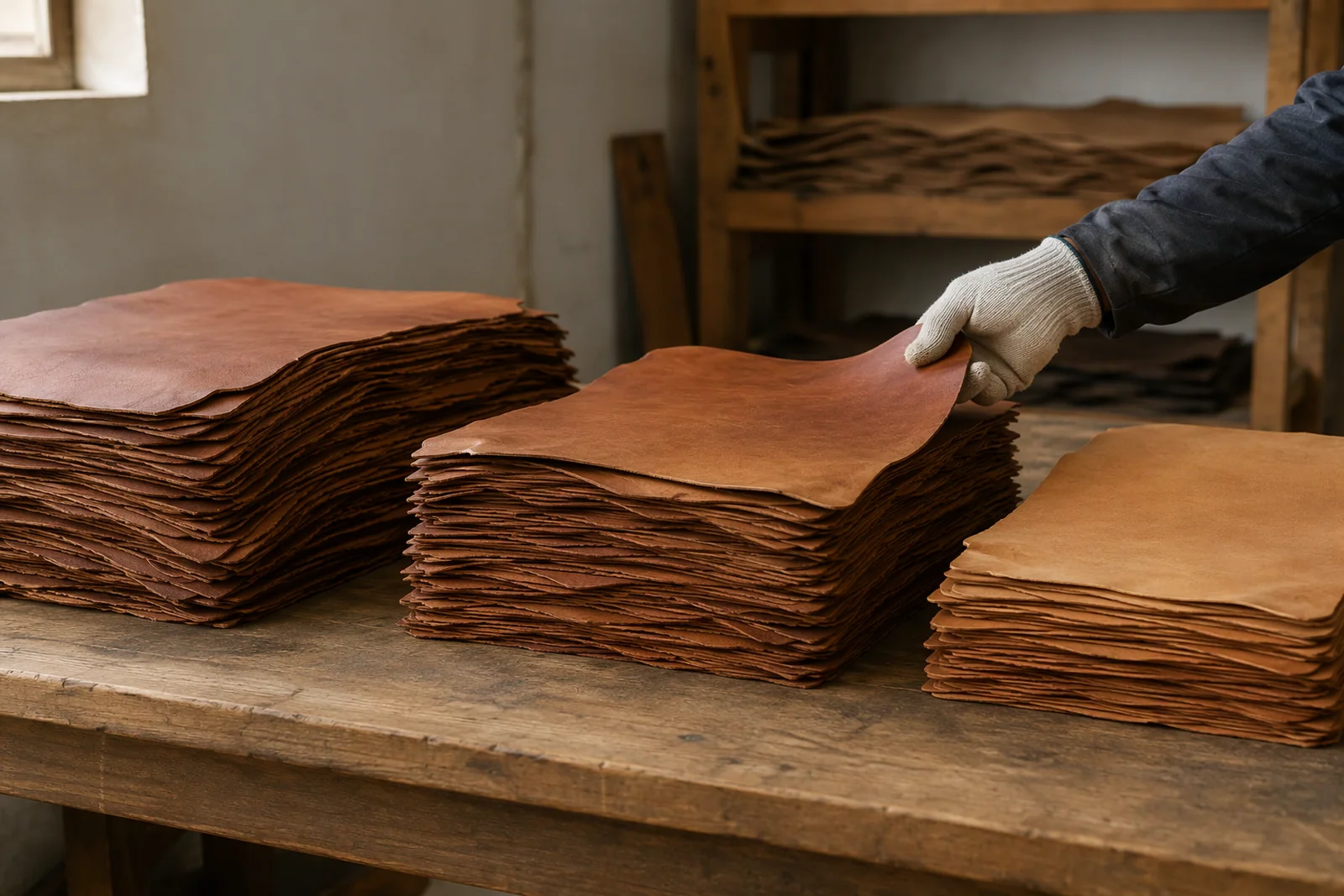
Where to Measure: Point Maps
A point map turns a vague tolerance into a repeatable test, and it is the single most useful page in a leather specification.
Marking Zones on the Hide
Divide the hide into five zones: spine, shoulder, belly, rump and edge. Assign each a nominal and a tolerance based on what it will be cut into.
Marking Points on the Panel
For a finished panel, mark three points: centre, handle anchor and base corner. Those are where thickness affects function rather than appearance.
Consistency Between Parties
The same map must be used by the tannery, the goods-in inspector and the line. Three different maps produce three different verdicts on one delivery.
| Level | Points |
|---|---|
| Hide | Five zones |
| Panel | Three points |
| Line | Anchor |
| Tannery | Same map |
Instruments and Their Resolution
Two people measuring the same leather can disagree by a tenth of a millimetre, and the instrument is usually the reason.
The Dial Gauge
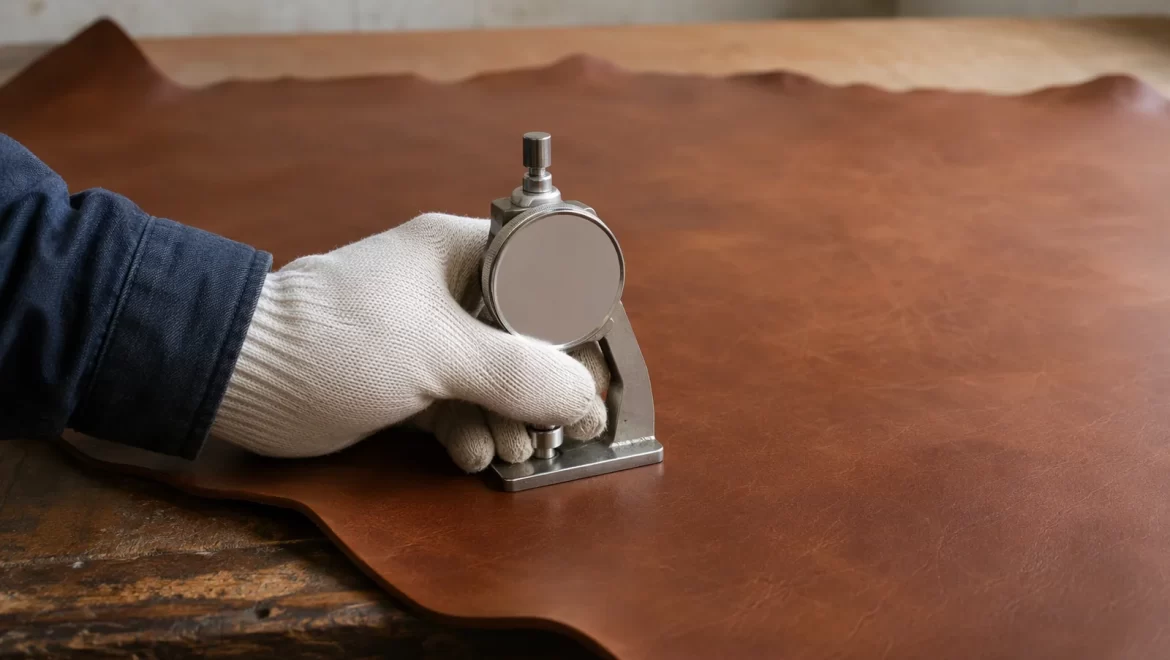
A dial gauge with a flat foot and a consistent spring pressure is the workshop standard. Its resolution should be finer than a tenth of the tolerance band.
The Digital Gauge
Digital gauges read faster but drift with battery and temperature. Calibrate against a known shim at the start of each shift rather than annually.
Pressure and Foot Size
A small foot on soft leather sinks in and reads low. Foot diameter and pressure belong in the specification alongside the tolerance.
| Instrument | Weak point |
|---|---|
| Dial | Spring fatigue |
| Digital | Drift |
| Small foot | Reads low |
| Hand feel | Not a number |
Measurement Conditions and Moisture
Leather thickness is not a constant, because moisture and temperature change how much the fibres compress under a gauge foot.
Dry Versus Conditioned
A hide measured straight from a humid store reads thicker than the same hide after conditioning. Specify the condition and the rest time before measurement.
Temperature Effects
Cold leather is stiffer and resists the foot, reading high. A delivery measured in an unheated warehouse in winter will not match a summer reading.
Softness Interaction
Softer leather compresses more under the gauge, so a softness change looks like a thickness change. Record softness alongside thickness when comparing lots.
| Condition | Reading |
|---|---|
| Humid | Higher |
| Conditioned | Stable |
| Cold | Higher |
| Soft | Lower |
Sampling a Lot of Hides
A lot of hides cannot be measured in full, so the sampling rule decides whether the verdict describes the delivery or describes the sample.
How Many Hides
Measure a percentage of hides chosen across the lot rather than from the top of the stack. The top of a stack is the driest and the most handled.
How Many Points per Hide
Five zones on a sample of hides gives a profile, while one point on many hides gives only an average that hides the thin belly.
Recording the Spread
Record the minimum, the maximum and the share of points outside the band. An average inside tolerance can conceal a tenth of the area outside it.
| Approach | Reveals |
|---|---|
| Few hides, many points | Profile |
| Many hides, one point | Average |
| Spread | Tail risk |
| Map | Zone failure |
Accept or Reject: The Sorting Decision
Most deliveries are neither fully acceptable nor fully rejectable, and the decision rule should be written before the first delivery arrives.
Percentage Outside the Band
Set a limit on the share of measured points outside the tolerance. A rule of a few percent allows normal variation without allowing a systematic miss.
Which Points Matter
Weight the panel-level points more heavily than the hide-level points. A thin belly that will be cut into lining is not the same as a thin handle anchor.
Conditional Acceptance
Where the material is usable with extra sorting, accept conditionally and record the extra cost. Silent acceptance teaches the supplier that the tolerance is nominal.
| Verdict | Basis |
|---|---|
| Accept | In band |
| Conditional | Sort needed |
| Reject | Systematic |
| Record | Cost |
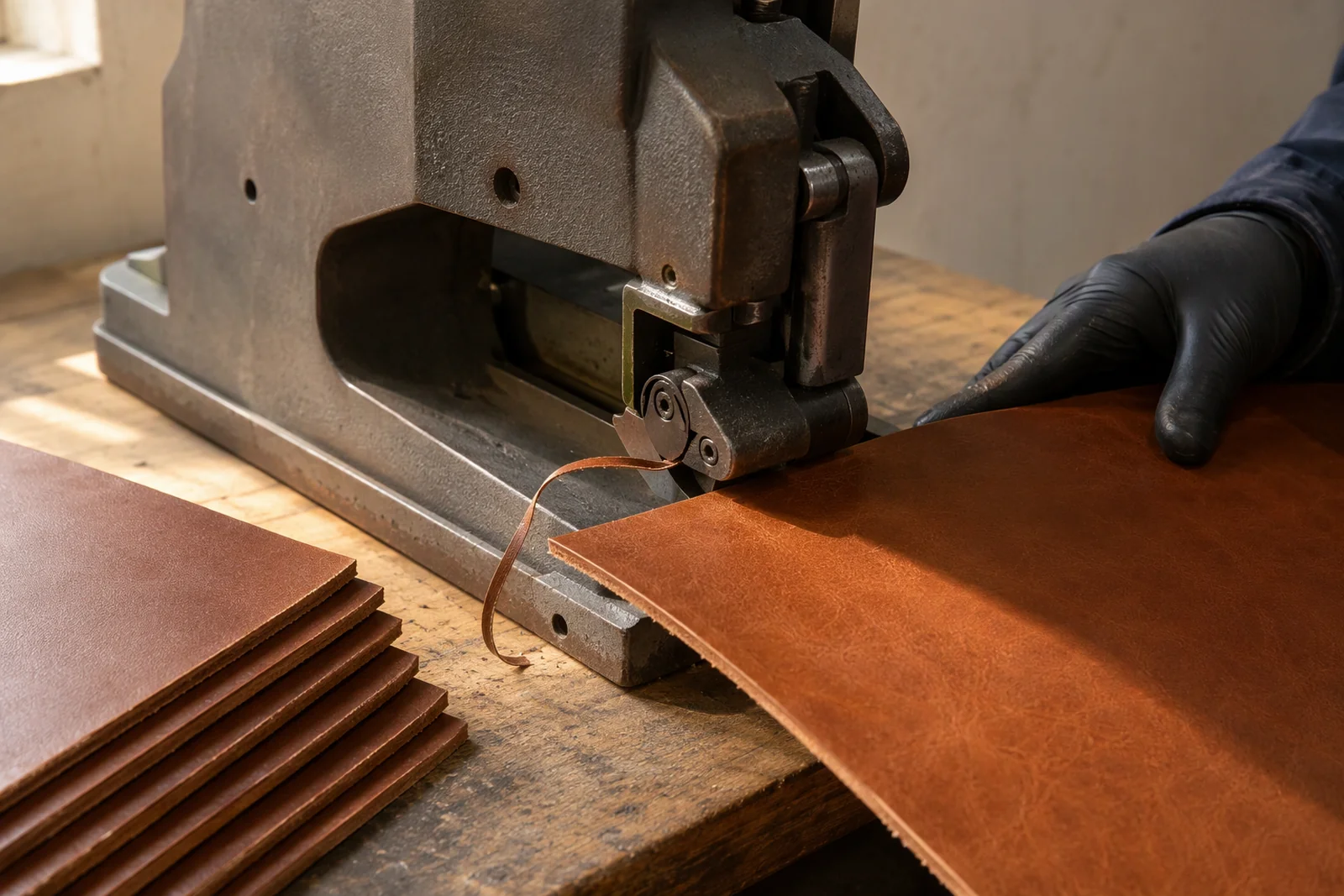
Grading Hides by Thickness
Sorting hides into thickness grades before cutting converts variation into a usable planning tool instead of a production problem.
Three Grades Are Enough
Most bag lines need a thick grade for structure, a standard grade for bodies and a thin grade for lining and small parts. More grades confuse the store.
Sorting at Goods-In
Grade at goods-in while the measuring gauge is already in hand. Sorting later means handling every hide twice and trusting a label instead of a reading.
Grade and Colour Together
A grade without a colour reference is half a decision, because a thick hide in the wrong shade still cannot go into the order.
| Grade | Use |
|---|---|
| Thick | Structure |
| Standard | Body |
| Thin | Lining |
| Colour | Matched |
Thickness Mapping and Cutting Plans
A cutting plan that ignores thickness maps wastes the thick zones on small parts and puts the thin belly where structure is needed.
Placing Patterns by Zone
Put handle anchors, base corners and gussets on the spine and rump. Put small parts, tabs and lining on the belly and shoulder.
Nesting Around Thin Areas
Nesting software optimises for area and not for thickness. Override it to keep structural panels off the thin edge of the hide.
Marker Notes
Mark the hide zone on the cutting marker so the cutter knows which end is belly. Without the note, the pattern lands wherever it fits.
| Zone | Best panel |
|---|---|
| Spine | Handle anchor |
| Rump | Base |
| Belly | Small parts |
| Edge | Avoid |
Matching Panels Within One Bag
A bag is judged as one object, so panels of different thickness in one bag show up as a visible difference even when each panel is in tolerance.
Front and Back Pairs
Cut the front and the back of one bag from the same zone where possible. A front from the spine and a back from the belly look like two different materials.
Handle and Body
A handle noticeably thicker than the body reads as an assembly error. Where the handle needs strength, use reinforcement rather than a thicker panel.
Visible Seams
Two panels joined at a visible seam should differ by less than the tolerance band, or the seam line will bow after skiving.
| Pair | Rule |
|---|---|
| Front and back | Same zone |
| Handle and body | Matched |
| Seam panels | Close |
| Trim | Thin |
Thin Areas and Structural Risk
Thin leather fails at the points that carry load, and the failures appear after the bag has been used rather than at inspection.
Tear at Handle Anchors
A handle anchored into thin leather pulls through, because the load is carried by a small area of fibre. Reinforcement is the fix, and thickness selection delays it.
Base Corner Wear
The base corner takes abrasion and load together. A thin corner wears through faster and cannot be repaired invisibly.
Stitch Pull-Out
Thin leather around a stitch line tears between the holes under load. The margin between the seam and the edge becomes critical at low thickness.
| Risk point | Failure |
|---|---|
| Handle anchor | Tear out |
| Base corner | Wear through |
| Stitch line | Pull out |
| Zip end | Rips |
Thick Areas and Assembly Problems
Thick leather causes a different set of failures, and they appear at the machine rather than at the customer.
Seam Bulk
Four layers of thick leather at a gusset seam exceed what a standard foot can compress. The seam rides, the stitch length varies and the edge will not fold flat.
Fold and Crease Resistance
Thick leather resists folding, so a turned edge springs back and shows a gap. Skiving is the remedy, and it must be planned before cutting.
Needle and Thread Limits
A needle sized for the nominal thickness breaks or deflects on the thick end of the band. The specification should state the maximum the line can sew.
| Point | Failure |
|---|---|
| Gusset | Bulk |
| Edge | Spring back |
| Needle | Break |
| Presser | Marks |
Skiving and Splitting to Tolerance
Skiving is how a factory recovers a usable panel from material outside the band, and it costs labour plus a new risk.
Skiving to a Target
Skive thick areas to the nominal rather than rejecting the hide. The skived face needs finishing, which the cost calculation should include.
Splitting at the Tannery
Splitting is done wet and produces a uniform thickness more reliably than dry skiving. Where tolerance is critical, buy split material rather than whole hides.
Thickness After Skiving
Skiving compresses and thins unevenly, and the result should be measured again. A skived panel that was never re-measured is an assumption.
| Method | Result |
|---|---|
| Tannery split | Uniform |
| Dry skive | Local |
| Re-measure | Required |
| Finish | Cost |
Lining and Reinforcement Thickness
The layers behind the face leather carry load and shape, and their thickness matters more than their appearance.
Board and Sheet Reinforcement
Base boards and handle reinforcements have their own thickness tolerance. A board thicker than the pocket it slides into changes the bag outline.
Foam and Padding
Foam thickness compresses under the face leather and changes how the bag reads. Specify the foam by density and thickness, and check it with a gauge.
Interlining Adhesive
Adhesive film adds a small but inconsistent thickness and stiffens the panel. Its effect on the final measurement should be measured, not estimated.
| Layer | Tolerance need |
|---|---|
| Board | High |
| Foam | Medium |
| Interlining | Low |
| Lining | Medium |
Thickness and Stitch Performance
Stitch quality is a function of thickness, thread size, needle size and pressure, and only one of those is usually specified.
Stitch Length Consistency
Thick material pulls the feed unevenly and stretches the stitch. Recording thickness per bundle lets the mechanic set the machine for the bundle in hand.
Needle Size Selection
Needle size must suit the thickest point in the seam, not the nominal. A needle sized to nominal punches tight leather and cuts the thread.
Thread Tension Windows
Each thickness has a tension window, and a bundle outside the band falls outside it. Tension adjustment by trial is a symptom of unmanaged thickness.
| Variable | Effect |
|---|---|
| Thickness | Feed |
| Needle | Penetration |
| Tension | Loop |
| Foot pressure | Marking |
Thickness and Edge Finishing
Edge work is where an inconsistent cross-section becomes visible to anyone, because paint and burnish follow the geometry they are given.
Burnishing Thick Edges
Thick edges take more friction and more passes, and an under-burnished edge cracks. The process time should be set by the thickest edge in the style.
Painting Thin Edges
Thin edges absorb paint quickly and need more coats, and each coat adds time. A panel that tapers across its length cannot be painted in one pass.
Folded and Bound Edges
A turned edge depends on the panel being thin enough to fold without cracking. Where thickness cannot be reduced, a bound edge replaces the fold.
| Edge | Requirement |
|---|---|
| Burnish | Passes |
| Paint | Coats |
| Fold | Thin |
| Bound | Skive |
Thickness and Moulding or Shaping
Shaped pet carriers rely on leather holding a form, and thickness decides whether the form survives a week of use.
Wet Forming
Wet-formed panels need consistent thickness so the shape dries evenly. A thin zone dries faster and pulls the form out of symmetry.
Pressed and Embossed Panels
Embossing depth is limited by thickness. A panel at the thin end of the band shows a shallow impression that does not match the approved sample.
Shape Memory
Thick leather holds a curve and thin leather relaxes. A carrier of mixed thickness loses its shape where the thin panels sit.
| Process | Sensitivity |
|---|---|
| Wet form | High |
| Emboss | High |
| Shape | Medium |
| Fold | Medium |
Thickness in Hardware Reinforcement
Hardware transfers load into leather, and the leather behind it is the weakest link in the chain.
Rivet and Stud Settling
A rivet set into thin leather compresses the fibres and loosens within weeks. The leather behind a rivet should be at the thick end of the band.
D-Ring Anchor Patches
Anchor patches are usually doubled or reinforced, and their thickness should be specified separately from the panel that carries them.
Zip Tape and Thickness
A zip sewn into thick leather sits proud and the slider rubs. Thickness at the zip line should be reduced by skiving rather than forced.
| Part | Need |
|---|---|
| Rivet | Thick |
| D-ring | Patch |
| Zip line | Skive |
| Clasp | Flat |
Weight, Yield and Cost Effects
Thickness is a cost driver three times over: in material purchased, in area usable and in labour per panel.
Area and Weight
Leather is often traded by area, and thickness is set by splitting rather than by weight. A thicker split reduces the number of hides needed for a given panel set.
Usable Percentage
A tight tolerance rejects more area, so the effective cost per panel rises even when the price per square metre is unchanged.
Labour Per Panel
Sorting, skiving and re-measurement are labour, and they appear in the cost of every panel that needed them. The tolerance decision moves cost between columns.
| Driver | Effect |
|---|---|
| Split | Area |
| Tolerance | Yield |
| Sorting | Labour |
| Rework | Labour |
Supplier Agreements and Reject Rules
The tolerance only has force if the purchase order states it and the rejection rule is agreed before the first shipment.
Stating It on the Order
Put nominal, band, point map and instrument on the purchase order, not only in an email. An order that states a nominal invites a delivery that meets the nominal somewhere.
The Rejection Threshold
Agree the share of points outside the band that triggers rejection, and the remedy. A rule that is silent on remedy becomes a negotiation under pressure.
Claims Evidence
Support a claim with the measurement record, the photographs and the retained swatch. A claim without evidence becomes a discount request.
| Term | Content |
|---|---|
| Nominal | Figure |
| Band | Limit |
| Map | Points |
| Remedy | Action |
Incoming Inspection Setup
Thickness inspection is cheap to run and easy to neglect, because a gauge reading feels less urgent than a shade check.
The Station
A flat table, a gauge, a shim for calibration and a printed point map. Four items make the check repeatable by any inspector.
Time Per Hide
Measuring five zones takes under a minute per hide. A check that takes longer than the packing step will be skipped under pressure.
Trigger Rules
Define which lots are measured in full and which by sample, based on supplier history. Consistent suppliers earn lighter checks and inconsistent ones do not.
| Item | Purpose |
|---|---|
| Gauge | Reading |
| Shim | Calibration |
| Map | Points |
| Record | Evidence |
Records and Traceability of Lots
A thickness reading is only useful if it can be found again when a seam fails six weeks later.
What to Record
Lot number, hide count, zone readings, average, spread and the share outside the band. Six fields convert a gauge reading into evidence.
Linking to the Cutting Batch
Attach the thickness record to the cutting batch, so a fault in one style can be compared with the material that entered it.
Retained Offcut
Keep an offcut from each lot with the record. Measuring a stored offcut settles a dispute that re-measuring the bag cannot.
| Record | Purpose |
|---|---|
| Lot | Identity |
| Spread | Risk |
| Batch | Link |
| Offcut | Proof |
Multi-Supplier Consistency
Running two tanneries on one style is common and quietly converts a thickness specification into a sorting problem.
Different Splitting Practices
Tanneries split with different machines and tolerances, so the same nominal arrives with different spreads. The spread matters more than the average.
Blending in One Order
Material from two tanneries in one order produces bags of two characters. Where blending is unavoidable, blend at panel level rather than at bag level.
Qualifying a Second Source
Qualify a second tannery against the point map before volume, not after a shortage. A qualification run of one lot reveals the spread early.
| Source | Risk |
|---|---|
| One tannery | Availability |
| Two tanneries | Spread |
| Blend | Mismatch |
| Qualify | Early |
Common Traps in Tolerance Specification
Six traps explain most thickness disputes, and each one is cheaper to fix on the drawing than in production.
A Nominal With No Band
A single figure read as a target invites material that meets it in one place. The band is the specification.
No Point Map
Without a stated point, the tannery measures the spine and the factory measures the belly, and both are correct in their own terms.
Tolerance Tighter Than the Process
A band narrower than the tannery can split produces rejections that are really a pricing argument in disguise.
Ignoring the Thick End
Most specifications guard against thin material and forget that thick material breaks needles and bulks seams.
No Instrument Stated
Two gauges disagree, so the specification should name the instrument and the pressure rather than assume agreement.
Measuring Once
A single check at goods-in does not show how thickness behaves after skiving, lining and assembly. Measure again at the panel stage.
| Trap | Cost |
|---|---|
| No band | Dispute |
| No map | Mismeasure |
| Too tight | Rejection |
| Thick end | Machine |
| No gauge | Argument |
| Once | Late |
Working With What Arrives
Factories rarely receive ideal material, so the practical skill is allocating what arrives to what it can actually do.
Re-Plan the Cut
When a lot arrives thin, re-plan the cutting so thin zones carry lining and tabs. Re-planning is cheaper than rejection and faster than reordering.
Adjust the Process
A thicker lot may need a larger needle and a longer stitch. Adjusting the process for the lot in hand is normal practice, not a concession.
Document the Deviation
Record what was changed and why. An undocumented adjustment becomes an unexplained variant the next time the style runs.
| Situation | Response |
|---|---|
| Thin lot | Re-plan |
| Thick lot | Adjust |
| Mixed | Sort |
| Change | Record |
What to Audit at the Tannery
A tannery visit takes an hour and answers the questions a certificate cannot, if it looks at the machines rather than the samples.
The Splitting Machine
Ask for the splitting tolerance the machine is set to and see a hide split during the visit. The setting explains the spread more than the specification does.
Sampling Practice
Ask how many hides are measured before a lot ships and where. A tannery that measures only the spine will pass lots the factory rejects.
Calibration Records
Ask when the gauge was last checked against a shim. An uncalibrated gauge explains a disagreement more often than a process change.
| Check | Reveals |
|---|---|
| Splitter | Spread |
| Sampling | Blind spot |
| Gauge | Drift |
| Records | Discipline |
A record produced at a visit is worth more than a certificate, because it names the machine setting that produced the spread you are measuring. Where a tannery cannot show a split during the visit, treat the tolerance as unverified rather than as agreed, and ask for a supervised split on the next lot before releasing volume.
Limits of Thickness Control
Thickness can be measured, specified and sorted, and it still cannot be made uniform across a hide that nature built unevenly.
Nature Sets the Baseline
Zone variation is anatomy. A specification can select which zone goes into which panel, and cannot remove the difference between spine and belly.
Measurement Is an Estimate
A gauge reads one point under one pressure. The number is a sample of a surface, and treating it as an exact property overstates it.
Tolerance Is a Commercial Trade
Every band chooses between material cost and process cost. The choice is a business decision informed by measurement, not a technical absolute.
| Limit | Reality |
|---|---|
| Uniformity | Impossible |
| Reading | Sample |
| Band | Trade-off |
| Sorting | Labour |
That is why the practical answer is rarely a tighter band. It is a documented band, a stated point map and a sorting habit that puts each zone where it performs best, so the natural variation of the hide becomes part of the plan instead of a surprise at the machine.
FAQ
Why can't one thickness figure cover a whole hide?
A: Because the spine, belly, neck and edge differ by anatomy before any processing. A single figure describes a point, not a hide, and the tolerance has to be positional.
What belongs in a thickness specification?
A: Nominal, tolerance band, a point map for hide zones and panel positions, the instrument and its pressure, and the condition at measurement.
How tight should the tolerance be?
A: Tight enough to protect the process and wide enough for the tannery to split. Setting it tighter than the splitting capability converts a price negotiation into rejections.
Where on the panel should thickness be measured?
A: Centre, handle anchor and base corner. Those three points decide function, while the centre alone decides only appearance.
Does a small gauge foot read high or low?
A: Low on soft leather, because it sinks in. Foot diameter and spring pressure belong in the specification so two parties read the same number.
Should leather be conditioned before measuring?
A: Yes. Humid and cold leather both read thicker, so state a rest period and a condition, then measure consistently.
How many hides should be checked in a lot?
A: A sample spread across the stack, with five zones per hide. Few hides with many points reveal the profile; many hides with one point hide the belly.
What if only part of a delivery is out of band?
A: Accept conditionally, sort, and record the extra cost. Silent acceptance teaches the supplier that the band is advisory.
Why sort hides into grades?
A: Sorting converts natural variation into a planning tool. Three grades, thick for structure and thin for lining, cover most bag lines.
How does thickness affect stitching?
A: It sets needle size, tension window and feed behaviour. A bundle outside the band falls outside the machine setting, and the operator compensates by trial.
Can thick areas simply be skived down?
A: Yes, though the skived face needs finishing and must be re-measured. Tannery splitting is more uniform than dry skiving.
Why do handles pull out of thin leather?
A: Because the load is carried by a small area of fibre. Reinforcement patches and zone selection solve it; a thin panel does not.
What happens when two tanneries supply one style?
A: Their splits differ in spread, so bags acquire two characters. Qualify a second source against the point map before volume, not after a shortage.
Is a thicker hide always better?
A: No. Thick leather bulks seams, resists folding, breaks needles and reads heavier. The thick end of the band has its own failures.
How should thickness be compared between lots?
A: By spread and by the share of points outside the band, not by average. An average inside tolerance can conceal a tenth of the area outside it.
What proves a thickness claim later?
A: The measurement record, the point map, the retained offcut and photographs. A claim without physical evidence becomes a discount request.
Ready to end thickness arguments at goods-in? Draw the point map, state the band and the gauge on the order, sort hides into three grades at receipt, and cut structure from the spine instead of wherever the pattern fits.