How Should Softness and Rebound Be Graded in Bag Leather?
- Why Softness Cannot Stay a Feeling
- What Softness Actually Measures
- Stiffness and Force
- Rebound and Recovery
- Compression Set
- Loose Grain Versus Softness
- Softness and Thickness
- Tannage and Softness
- Fatliquor and Feel
- Milling and Staking
- Moisture and Apparent Softness
- Zone Differences Across a Hide
- Grading a Lot
- Building a Grading Scale
- Reference Samples
- The Fold and Rebound Tests
- Panel to Panel Matching
- Matching Softness to Bag Type
- Softness and Structure
- Softness at Handles and Edges
- Softness and Hardware Loading
- Change Over Time
- Writing the Specification
- Incoming Checks
- Calibrating Graders
- Softness and Stitch Behaviour
- Sampling and Bulk Approval
- Common Traps
- Limits of Softness Grading
- FAQ
Softness is the property buyers describe first and define last. Two people squeeze the same panel, both call it soft, and one means it yields under the thumb while the other means it springs back afterwards. Those are different properties, and a bag needs both in the right proportion.
Grading softness and rebound means turning a hand feel into a decision that survives a change of inspector, a change of lot and a change of season. That is achievable with a scale, a reference and two or three simple tests, and it removes most of the arguments that begin with a sample in one hand and a shipment in the other.
Why Softness Cannot Stay a Feeling
A verbal description of softness fails as soon as it crosses a language, a factory or a season, and the failure is expensive rather than merely awkward.
The Vocabulary Problem
Soft, supple, buttery and mellow are used interchangeably and mean different things to different people. A specification built on them cannot be tested, so it is agreed in conversation and disputed in goods-in.
The Sample Problem
An approved sample feels different after a year of handling. Grading against a worn sample slowly shifts the standard without anyone deciding to change it.
The Cost of Drift
A lot that is one step softer than approved may not open a claim. Three lots later the bag no longer holds its shape and the cause traces back to an undated, unmeasured drift.
What Softness Actually Measures
Softness is not one number. It is a combination of how little force a panel resists, how far it deflects, and how much of that deflection it keeps.
Low Resistance
The first component is the force needed to start a bend. A leather that yields under a light thumb is soft at the surface.
Deflection Range
The second is how far it goes before it firms up. A panel that keeps folding without resistance feels limp rather than soft.
Recovery
The third is what happens when the force is removed. A panel that stays folded is soft and dead, while one that returns has rebound.
| Component | What it describes | How it is judged |
|---|---|---|
| Resistance | Force to start a bend | Thumb pressure at a fixed point |
| Deflection | Travel before firming | Fold angle under own weight |
| Recovery | Return toward flat | Time and degree of spring back |
Stiffness and Force
Stiffness is the measurable partner of softness, and it is easier to grade because it is a force rather than a sensation.
Bending Force
A panel bent over a fixed span resists with a force that can be felt or measured. The same span and the same deflection make results comparable.
Thickness Influence
Bending force rises steeply with thickness, so a thick soft leather can out-resist a thin firm one. Comparing panels of different thickness without noting it is the commonest grading error.
Temperature Influence
Cold leather is stiffer. A lot graded in an unheated store in winter will read firmer than the same lot graded in summer.
Rebound and Recovery
Rebound is the property that keeps a soft bag looking like a bag, and it is the one most often left ungraded.
What Rebound Is
Rebound is the fraction of a deformation that reverses when the load is released. A panel pressed and released either returns, partially returns or stays pressed.
Why It Matters
A carrier with low rebound creases at the opening and sags at the base. The leather is not worn out, it simply has no memory of its own shape.
Grading Rebound
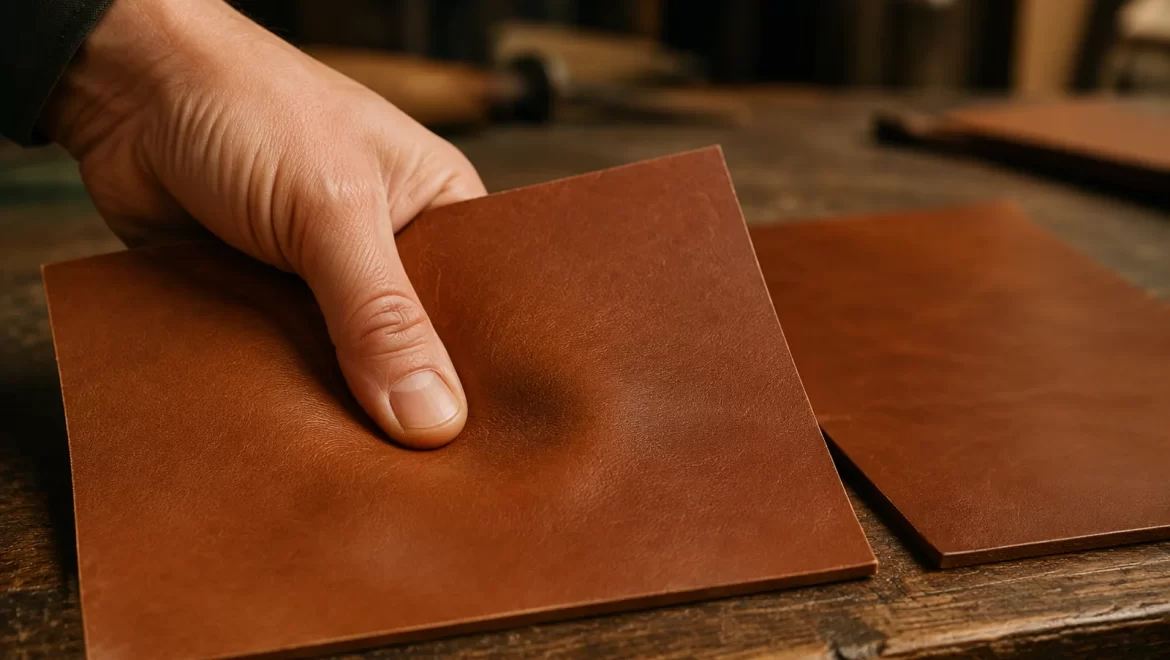
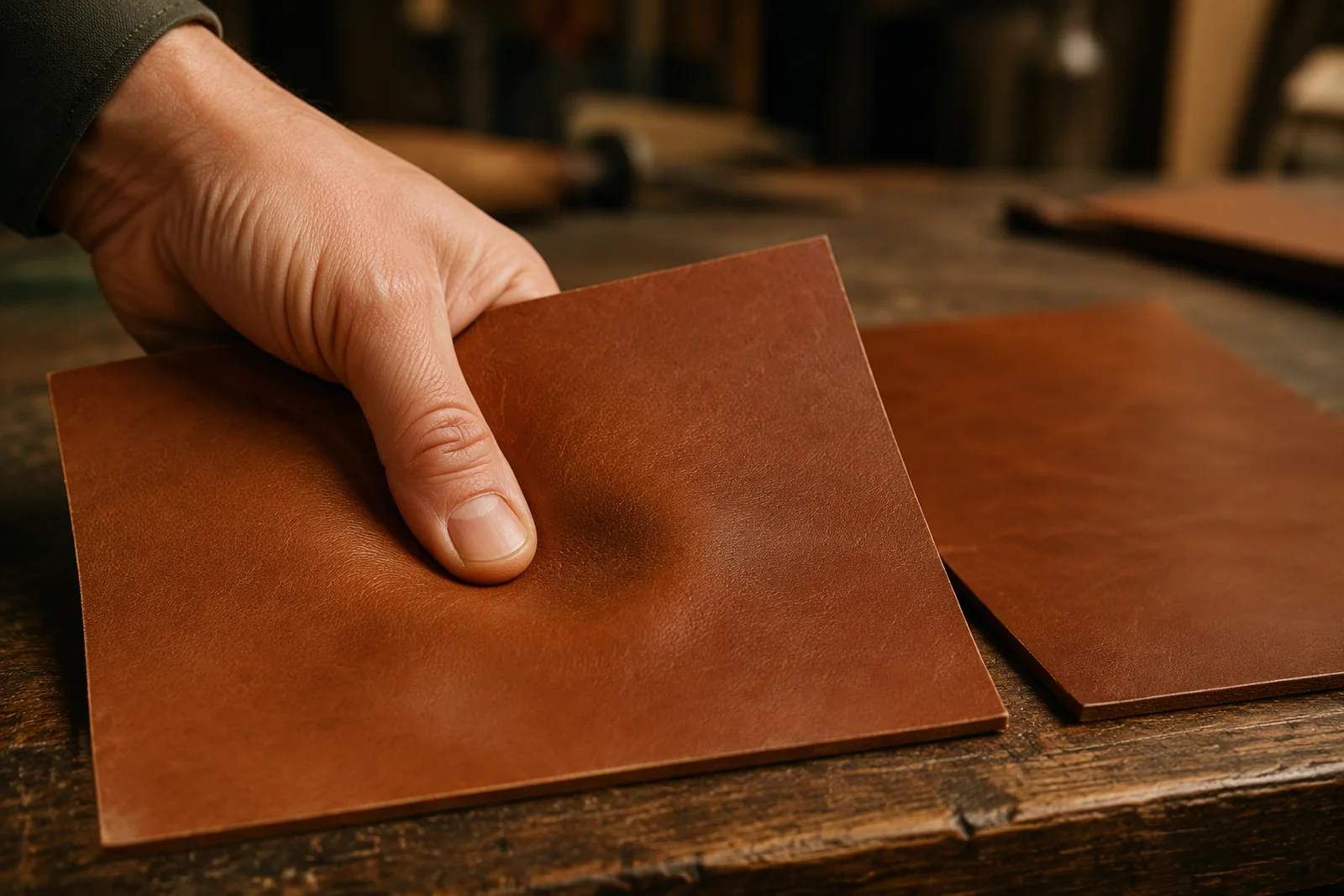
Press a fixed point with a thumb for a counted time, release, and note how much of the depression remains after a further count. A simple ratio separates three useful grades.
| Grade | Behaviour after release | Suitable for |
|---|---|---|
| High | Returns almost fully, quickly | Structured bodies, lids, handles |
| Medium | Returns partly, with a soft memory | General carriers, gussets |
| Low | Mark remains visible | Linings, drop-in pads only |
Compression Set
Compression set is what rebound becomes after repeated load, and it is the reason a soft bag can look tired without being damaged.
Repeated Loading
A panel loaded and released many times accumulates a permanent part of each deformation. What felt soft in the sample becomes flat in the field.
Where It Shows
Base panels, handle attachments and the wall the animal leans against accumulate set first. These are also the places a buyer inspects.
Testing It
Fold a panel under a weight for a set time, release, and measure the residual angle. The test is crude and repeatable, which is exactly what grading needs.
Loose Grain Versus Softness
A soft panel and a loose one feel similar in the hand and behave very differently in a bag, so the two must be separated before grading.
What Loose Means
Loose grain means the surface layer has separated from the corium beneath. It shows as a wrinkle that stays when the panel is folded and released.
Why It Reads as Soft
Loose grain has no resistance at the surface, so a thumb sinks easily. Buyers read that as softness, and the sale is agreed on a defect.
Grading It Out
Fold the panel sharply, release and look for a persistent wrinkle pattern. A loose panel is graded out regardless of how pleasant it feels.
| Observation after release | Reading | Action |
|---|---|---|
| Surface returns flat | Sound | Grade on softness |
| Slight surface memory | Borderline | Check with more folds |
| Wrinkle pattern persists | Loose grain | Reject the panel |
Softness and Thickness
Thickness sets the range of softness available, and a specification that ignores it will demand the impossible from one thickness and waste the other.
Thick Cannot Be as Soft
A three-millimetre panel cannot feel like a one-millimetre one, because bending force rises faster than thickness falls. Asking for it produces either refusal or a crushed, over-staked material.
Thin Cannot Hold Shape
Below a certain thickness a panel cannot hold a wall upright no matter how well it rebounds. Structure has to come from reinforcement rather than from the leather.
Specifying Together
State softness and thickness on the same line. A softness grade without a thickness reference is a moving target, and the tannery will read it as the easiest thing to meet.
Tannage and Softness
The tannage sets the starting point, and no amount of mechanical softening turns one family into another.
Chrome-Tanned
Chrome tanning produces the softest starting point and the widest range. Nearly all soft bag leathers are chrome, and the grading problem is controlling the variation rather than achieving the softness.
Vegetable-Tanned
Vegetable tanning gives a firmer, denser hand that softens with use but rarely reaches chrome softness. Grading it against a chrome standard is a specification error.
Combination Tannages
Combination tannages sit between the two and can be adjusted toward either. They are useful where a bag needs a soft body and a firm edge in the same panel.
| Tannage | Typical hand | Softens further by |
|---|---|---|
| Chrome | Soft to very soft | Milling, staking |
| Vegetable | Firm to medium | Wear, light staking |
| Combination | Medium | Milling, limited staking |
Fatliquor and Feel
Fatliquor is the internal lubricant that makes leather feel soft rather than merely thin, and its level is the most direct lever a tannery has.
Internal Lubrication
Oil between the fibres lets them slide instead of catching. The same fibre structure feels soft with adequate fatliquor and papery without it.
Surface Versus Core
A heavily fatliquored surface feels wonderful and the core can stay dry. The panel softens at the face and cracks through the thickness later.
Migration
Fatliquor migrates toward the surface over time and with heat. A lot graded soon after tanning can feel firmer or softer than the same lot three months later.
Milling and Staking
Mechanical softening is how a tannery turns a standard article into a soft one, and the two main methods produce different kinds of softness.
Milling in the Drum
Tumbling wet leather in a drum breaks fibre bonds evenly through the thickness. It softens the whole panel and slightly loosens the grain, so milling time is a compromise.
Staking
Staking works the leather over a bed of pegs or a blade, softening it mechanically without wetting. It acts more at the surface and gives a supple face over a firmer core.
Reading the Difference
A milled panel feels soft all the way through; a staked one feels soft at the surface and firmer inside. That difference decides which suits a structured bag and which suits a slouchy one.
| Method | Depth of effect | Grain risk | Best for |
|---|---|---|---|
| Milling | Through the panel | Moderate | Soft bodies, gussets |
| Staking | Surface weighted | Low | Structured faces |
| Both | Full and face | Higher | Very soft carriers |
Moisture and Apparent Softness
Water softens leather more than any machine, which makes moisture the largest hidden variable in any hand grading.
Damp Reads Soft
A panel carrying two or three percent extra moisture feels noticeably softer. A lot graded on a humid morning passes, and the same lot feels firm after a dry week.
Conditioning Before Grading
Let samples rest in the grading room long enough to reach the room's humidity. Grading immediately on arrival measures the journey, not the leather.
Recording Conditions
Note temperature and humidity beside the grade. Without them a grade cannot be repeated, and a disagreement cannot be resolved.
Zone Differences Across a Hide
One hide contains soft zones and firm zones, and a grading system that samples only one of them describes the sample rather than the lot.
The Soft Zones
Belly and flank are soft, thin and stretchy. They soften further with milling and lose shape quickly, which suits gussets and drop-in walls.
The Firm Zones
Back and rump are firm and dense. They hold structure and resist rebound loss, and they are the correct source for bases, lids and handle anchors.
Sampling Both
A lot grade should state which zones were judged. A grading result from the belly alone will pass material that fails when the back is used structurally.
| Zone | Hand | Best use |
|---|---|---|
| Belly, flank | Softest | Gussets, soft walls |
| Shoulder | Medium | Bodies, panels |
| Back, rump | Firmest | Bases, lids, anchors |
Grading a Lot
A lot grade is a distribution rather than a single verdict, because a delivery of hides will always contain a spread.
Sampling Rule
Sample hides from across the bundle rather than from the top. The top of a stack is drier and more handled, and reads firmer than the average.
Recording a Spread
Record the share of hides in each grade rather than only the dominant grade. A lot that is seventy percent correct is a different decision from one that is ninety-five percent correct.
Accepting a Spread
Agree a minimum share in the target grade and a maximum share in the adjacent grade. That rule converts a hand feel into a purchasing decision.
Building a Grading Scale
A useful scale has three to five steps, each described by a behaviour rather than an adjective, and each tied to a reference the grader can hold.
Number of Steps
Five steps is the practical maximum before graders disagree. Three steps is enough for most bag programmes and is harder to argue with.
Behaviour Not Adjective
Define each step by what the panel does: folds under its own weight, holds a fold, returns from a press. Behaviour is observable by a second person.
Written Anchors
Write a one-line anchor for each step and pin it to a photograph. The written anchor settles disputes; the photograph makes it credible.
| Step | Anchor | Typical use |
|---|---|---|
| One | Stiff, needs force to fold | Bases, frames |
| Three | Folds under own weight | Bodies, general |
| Five | Limp, drapes over a finger | Gussets, soft panels |
Reference Samples
Reference samples are the physical half of the scale, and they only work if they are protected from the handling that destroys them.
Retained Per Grade
Keep one panel for each step of the scale, labelled and dated. One reference per grade is enough and prevents a false sense of precision.
Storage
Store references flat, dry and dark. A reference left on a bench under a window is not a standard after one season.
Replacement
Replace references on a fixed interval, and record why. A reference changed without a note silently resets the standard for everyone downstream.
The Fold and Rebound Tests
Two hand tests cover most of what a grader needs, provided the fold and the release are done the same way every time.
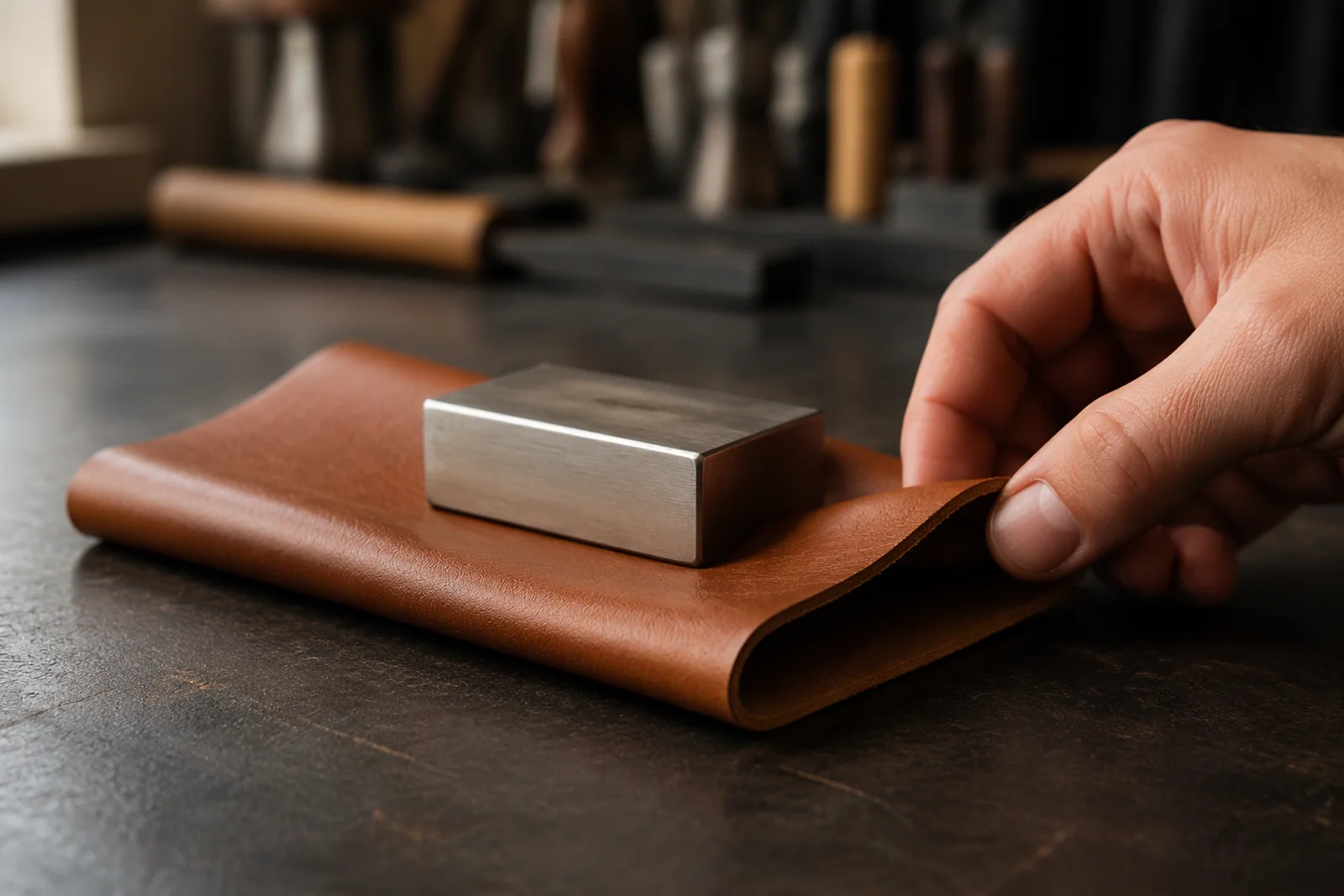
The Fold Test
Fold a panel to a right angle with the grain out, hold for a counted time, release. The angle the panel keeps describes softness and set together.
The Press Test
Press a thumb at a marked point for a counted time and release. Measure how long the depression takes to vanish; that time separates rebound grades.
Consistency Rules
Same point, same count, same room, same hand if possible. Grading is comparative, so consistency inside one session matters more than absolute accuracy.
| Test | Reading | Grade signal |
|---|---|---|
| Fold, 10 s | Angle kept | Softness and set |
| Press, 5 s | Time to vanish | Rebound |
| Fold twice | Wrinkle persists | Loose grain |
Panel to Panel Matching
A bag is judged as one object, so panels from different grades in one bag read as a manufacturing fault even when each is acceptable.
Front and Back
Cut the front and back of one bag from the same grade and, where possible, the same hide. Mismatch between them is the most visible defect in a soft style.
Handle and Body
A handle noticeably firmer than its body looks like a repair. Where strength is needed, keep the grade and add reinforcement instead of changing material.
Batch Consistency
Keep a single grade per style per order. Mixing two grades across one production run produces bags that differ in the hand when a buyer compares two units.
Matching Softness to Bag Type
The correct grade is set by the shape the bag must hold and the way it is carried, not by a preference for soft leather.
Soft Shoulder Carriers
A soft carrier that hangs close to the body works on a soft, high-rebound leather. It needs enough body to avoid folding onto the animal.
Structured Carriers
A structured carrier needs a firm grade for the body and a soft one only at the opening. Using the soft grade throughout produces a bag that collapses when the animal moves.
Mixed Grades by Part
Specify per part rather than per bag: firm for base and ends, medium for walls, soft for the door and internal flaps. The mix is what produces a bag that holds shape and still feels generous.
| Bag part | Grade | Why |
|---|---|---|
| Base, ends | Firm | Carries load, holds outline |
| Walls, body | Medium | Shape with some give |
| Door, flaps | Soft | Comfortable contact |
Softness and Structure
Softness and structure are not opposites; the relationship is about where the structure is placed rather than how much there is.
Internal Reinforcement
A soft panel over a board behaves as a structured panel. Softness becomes a surface property while the board carries the shape.
Interfacing
Fusible interfacing changes the effective grade of a panel after cutting. A soft leather with a heavy interfacing is a medium panel in the finished bag.
Reading Through Layers
Grade the leather alone, then state the construction around it. A grade that is quoted without its reinforcement is only half a specification.
Softness at Handles and Edges
Handles and edges are where a soft grade stops being a virtue, because both are loaded and both show wear first.
Handle Softness
A handle that is too soft rolls and stretches under the weight of an animal. The grade for handles should be one step firmer than the body.
Edge Firmness
Soft edges cannot be painted cleanly or burnished evenly. A soft body with firm, skived edges is easier to finish than a uniformly soft bag.
Turned Edges
Turning a soft panel produces a rounded, generous edge that holds poorly. Adding a stiffener strip inside the turn keeps the line while preserving the soft face.
Softness and Hardware Loading
Hardware transfers load into leather, and a soft grade distributes that load over a larger area rather than resisting it.
Rivet Setting
A rivet set into soft leather compresses locally and loosens. A firm patch behind the hardware keeps the rivet tight without changing the visible grade.
Ring and D-Ring Anchors
Anchor patches should be one grade firmer than the wall. The soft wall then moves with the bag while the anchor stays put.
Zip Stability
A soft panel beside a zip waves along the tape. A firm strip behind the tape keeps the line straight and the slider running freely.
Change Over Time
Softness is not stable, and any grade is a reading at one moment rather than a permanent property of the material.
Ageing in Store
Leather continues to lose and gain moisture in storage, and fatliquor migrates. A lot graded at receipt can read one step softer after three months in a warm store.
Use and Break-In
Use softens a bag at the contact points and flattens the nap where it is carried. The change is expected, and it is the reason a reference sample matters more than a memory.
When Drift Matters
Drift matters when a repeat order must match a previous one. Comparing to the retained reference is the only way to keep a colour-and-hand match across seasons.
| Cause of change | Direction | Control |
|---|---|---|
| Storage humidity | Softer when damp | Dry, stable store |
| Fatliquor migration | Softer at face | Even temperature |
| Use and handling | Softer locally | Reference comparison |
Writing the Specification
A softness specification that a tannery can meet states the grade, the thickness, the test and the reference, and nothing else.
The Four Lines
Grade, thickness, test method, reference number. Four lines remove the ambiguity that adjectives create and fit on a purchase order.
Naming the Test
Name the fold and the press explicitly, with counts and positions. A test that is described loosely will be performed loosely.
Reference Control
State which reference sample the grade refers to and when it was made. A reference without a date is a reference that will be argued about.
Incoming Checks
Grading at receipt takes a few minutes per lot and catches the deliveries that would otherwise fail on the line or in the field.
The Bench Setup
A cleared bench, the reference set, a ruler, a note sheet and the room's humidity reading. Five items make the grade repeatable.
Time Per Lot
Three hides sampled across the bundle, three points on each, under ten minutes. A check that takes longer will be deferred until it is skipped.
Recording the Result
Record grade, zone, conditions and the share of hides outside the target. Six fields turn a hand feel into a record that can be compared next season.
Calibrating Graders
Two graders in one factory will disagree unless they are calibrated against the same references on a schedule.
The Calibration Session
Grade five panels independently, then compare. Differences of one step are normal; differences of two steps mean the anchors are unclear.
Frequency
Once a quarter is enough for a stable programme, and after any new reference is introduced. Calibration is cheap and it prevents a quiet divergence.
Recording Who Graded
Note the grader's initials on the record. A disagreement is resolved faster when the history of who judged what is visible.
| Item | Standard | Why it matters |
|---|---|---|
| Graders | Two or more | Prevents single-person drift |
| Session | Quarterly | Catches divergence early |
| Disagreement | One step max | Two steps means unclear anchors |
Softness and Stitch Behaviour
A soft panel behaves differently under the needle, and a grade that ignores the machine will be blamed for a seam fault it did not cause.
Feed and Compression
Soft leather compresses under the presser foot and feeds unevenly. Stitch length that is correct on a firm panel shortens on a soft one unless foot pressure is reduced.
Seam Support
A soft seam needs support from tape or reinforcement or it stretches open. The grade and the seam construction belong on the same specification line.
Tension Window
Soft panels tolerate a narrower thread tension range before puckering. Machine settings should be quoted per grade rather than per style.
| Grade | Foot pressure | Seam support |
|---|---|---|
| Firm | Standard | Optional |
| Medium | Reduced | Tape at load lines |
| Soft | Light | Tape or interfacing |
Sampling and Bulk Approval
Approval of a soft grade should happen on the material that bulk will use, because a sample panel approved in isolation proves very little.
Approving on a Panel Set
Approve a full panel set for one bag rather than a single swatch. Softness reads differently at a base than at a door, and the set shows the balance.
Grading the Bulk Lot
Grade the bulk lot against the approved set, not against the sample that was hand-carried. Travel and handling change a sample within weeks.
Holding a Reference Pair
Retain one approved panel from the sample and one from the first bulk delivery, side by side. The pair is the fastest answer to a later dispute about hand.
A hand grade is only as good as the panel beside the bench, so the reference set deserves the same care as the specification sheet it supports.
Common Traps
Six traps explain most softness disputes, and each one is cheaper to fix in the specification than in the shipment.
Grading on One Point
A single press at the middle of a hide describes the middle. Zones differ, and a lot judged on one point will fail somewhere else.
Comparing Different Thicknesses
A thin panel always feels softer. Quoting a softness grade beside an unstated thickness guarantees a mismatch at delivery.
Grading Damp Material
Material straight from a humid container reads softer than it is. Resting the sample before grading removes the error.
Confusing Soft with Loose
Loose grain yields under the thumb and never recovers. It passes a softness test and fails in use, so the fold test is not optional.
Ignoring Rebound
A programme that grades only softness will produce bags that feel wonderful and collapse. Rebound is the property that keeps shape.
A Reference Nobody Uses
A reference set locked in an office is a document, not a standard. It has to sit on the bench where grading happens.
Limits of Softness Grading
Grading reduces disagreement and it does not remove judgement, because softness is a property of a material rather than a single number.
Hand Is Comparative
Graders compare panels rather than measure absolutes. That is a strength, and it means a grade is only as good as its references.
Instruments Help at the Margins
Force and deflection can be measured, and the instruments are useful when two graders disagree at a boundary. They do not replace the reference set.
What Grading Does Not Cover
Grading does not predict how a bag feels after a year, and it does not capture the pleasure of a good panel. It captures agreement, which is what a specification needs.
FAQ
Can softness be measured, or is grading just an opinion?
A: It can be graded reproducibly without being reduced to one number. A fold test for resistance and set, a press test for rebound, and a reference panel per grade give two graders a shared basis for agreement.
What is the difference between softness and rebound?
A: Softness is how little force a panel resists; rebound is how much of the deformation reverses. A panel can be very soft and stay folded, and a bag built from it will collapse even though it felt wonderful.
How many grades should a specification use?
A: Three to five. Three is enough for most programmes and is difficult to argue with; beyond five the anchors blur and graders diverge by a step without noticing.
Why does thickness have to be stated with softness?
A: Because bending force rises steeply with thickness. A thick soft panel can resist more than a thin firm one, so a grade quoted alone is not comparable.
Should the sample be conditioned before grading?
A: Yes. Leather carrying a little extra moisture reads noticeably softer, so a lot graded straight from a humid container or on a damp morning will be graded too generously.
How is loose grain distinguished from softness?
A: Fold the panel sharply, hold, then release. A sound panel returns flat; loose grain keeps a wrinkle pattern. Loose grain feels soft and fails in use.
Do all parts of a bag need the same grade?
A: No, and using one grade throughout is a common mistake. Bases and ends want a firmer grade, walls a medium one, and doors or flaps the softest.
How is a whole lot judged from a few hides?
A: Sample across the bundle rather than from the top, grade several points per hide, and record the share in each grade. A distribution is a usable result; a single verdict is not.
Does milling or staking give better softness?
A: They give different softness. Milling softens through the panel and slightly loosens the grain; staking softens the face over a firmer core, which suits structured styles.
How often should references be replaced?
A: On a fixed interval, with the reason recorded. A reference changed silently resets the standard for everyone downstream, which is how drift becomes invisible.
Can reinforcement change the grade a bag needs?
A: Yes. A soft panel over a board behaves as a structured panel, so the construction around the leather must be stated with the grade rather than left implicit.
What causes a soft bag to look tired without damage?
A: Compression set. Repeated loading leaves a permanent share of each deformation, and it shows first at bases, handle anchors and the wall the animal leans on.
Are handles graded with the body?
A: Handles should be one step firmer. A handle as soft as the body rolls and stretches under load, and it reads as a repair rather than as a design choice.
What belongs on the purchase order?
A: Four lines: grade, thickness, test method with counts and positions, and the reference number with its date. Adjectives belong in marketing, not in a specification.
How do two graders stay aligned?
A: Grade five panels independently once a quarter and compare. A one-step difference is normal; two steps means the written anchors need rewriting.
What does grading not solve?
A: It does not predict how a bag will feel after a year, and it does not replace judgement at the margins. It captures agreement, which is what production needs.
Ready to make softness a specification instead of an argument? Write three behaviour-based steps, keep one reference panel per step on the grading bench, state grade and thickness on the same line, and grade per part so the base holds while the door stays generous.