How Should Pet Bag Cartons Be Validated Before Shipping?
- Why the Carton Is a Quality Gate
- What Actually Fails in Transit
- Carton Specification Basics
- Board Grade and Stacking Strength
- Internal Fit and Void Fill
- Cushioning for Leather Goods
- Moisture and Humidity Protection
- Drop Testing a Packed Carton
- Vibration and Abrasion Testing
- Marks, Labels and Their Verification
- Barcodes and Scan Reliability
- Hardware Protection Inside the Carton
- Multi-Pack and Master Cartons
- Palletisation and Unit Loads
- Running a Validation Before Bulk
- Conditioning Before and Between Tests
- Judging Damage Objectively
- Setting Acceptance Criteria
- Carton Cost Versus Damage Cost
- Verifying Packing in Bulk
- Records and Retained Cartons
- Briefing a Supplier on Packing
- Common Traps in Carton Validation
- Reading Inbound Complaints
- Seasonal and Climate Factors
- Reuse, Material Reduction and Trade-Offs
- What Buyers Should Ask For
- Limits of a Carton Validation
- Packing for Retail and E-Commerce
- Freight Mode and Packing Choices
- FAQ
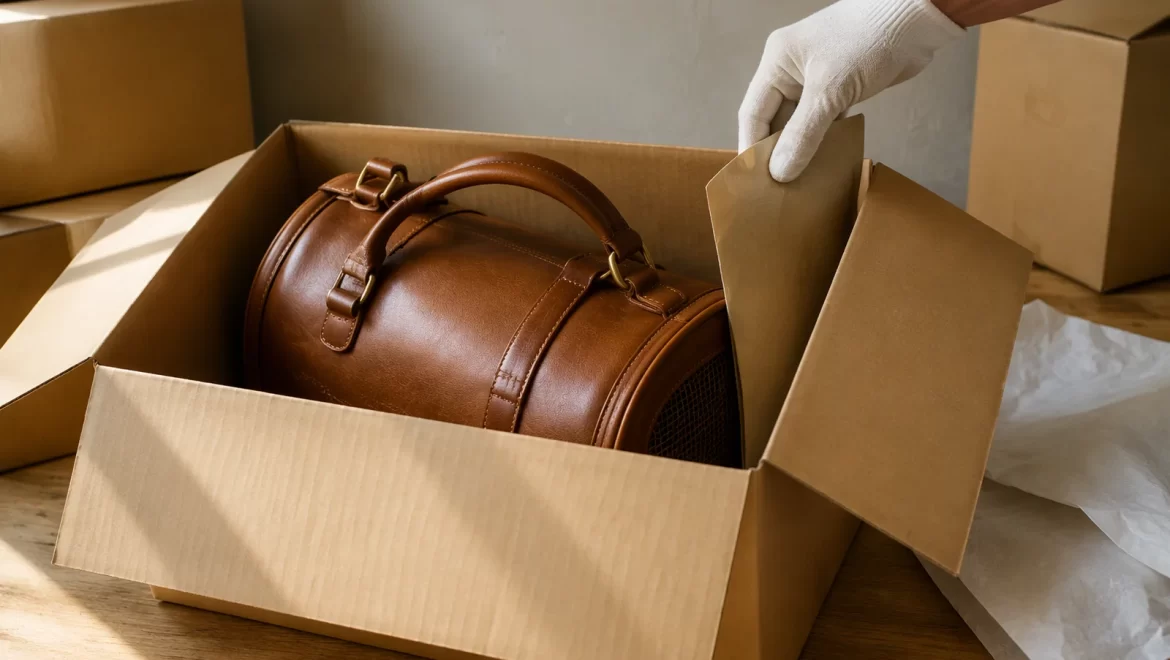
A pet bag leaves the factory perfect and arrives creased, scuffed or damp, and the cause is almost always the carton rather than the bag. Carton validation is the step that finds that out before the container is loaded.
The discipline is unglamorous and highly testable. Board grade, box style, internal fit, cushioning, moisture control, stacking strength and marks all have measurable requirements, and each failure mode has a corresponding check.
Why the Carton Is a Quality Gate
A bag is inspected once at the end of the line and then packed, and from that moment the carton is the only thing protecting it.
The Failure That Arrives Late
Transit damage appears at the customer, not at the factory, so it is invisible in every internal record until the claims arrive. A carton that was never validated produces damage nobody saw coming.
What the Customer Sees
A crushed corner is a damaged bag even when the leather is intact, because the shape is part of the product. Perceived damage drives returns as reliably as real damage.
Why It Belongs in Quality
Packing is often treated as logistics, and it is a quality characteristic with a measurable defect rate. Placing it under quality gives it a specification and an owner.
| Failure | Origin |
|---|---|
| Crush | Stacking |
| Scuff | Movement |
| Damp | Humidity |
| Deform | Fit |
What Actually Fails in Transit
Transit damage is a short list of mechanisms, and each one is reproduced by a different test.
Compression
Cartons stacked in a container or a warehouse carry load for weeks. A box that is strong enough for a pallet load for an hour may creep and collapse over a month.
Impact
Drops at handling points concentrate energy at a corner or an edge. A single corner drop is the most informative test for a rigid bag, because it is where the board fails first.
Vibration
Road and rail transport shakes the load for hours, and vibration causes abrasion between the bag and its packaging rather than structural failure.
| Mechanism | Test |
|---|---|
| Compression | Stack |
| Impact | Drop |
| Vibration | Shake |
| Humidity | Condition |
Carton Specification Basics
A carton specification is three decisions: board grade, box style and internal dimensions, and each one is stated in numbers rather than adjectives.
Internal Dimensions
Internal dimensions must clear the bag with the intended cushioning in place. A box dimensioned to the bag alone leaves no room for protection and compresses the product.
Board Grade
Board is graded by substance and by flute profile, and both affect compression strength. A grade quoted without the flute type is not a specification.
Box Style
A regular slotted carton is cheap and weak at the corners, while a full-overlap or a die-cut box costs more and protects edges better. The choice should follow the product.
| Item | Unit |
|---|---|
| Internal size | mm |
| Board | gsm |
| Flute | profile |
| Style | code |
Board Grade and Stacking Strength
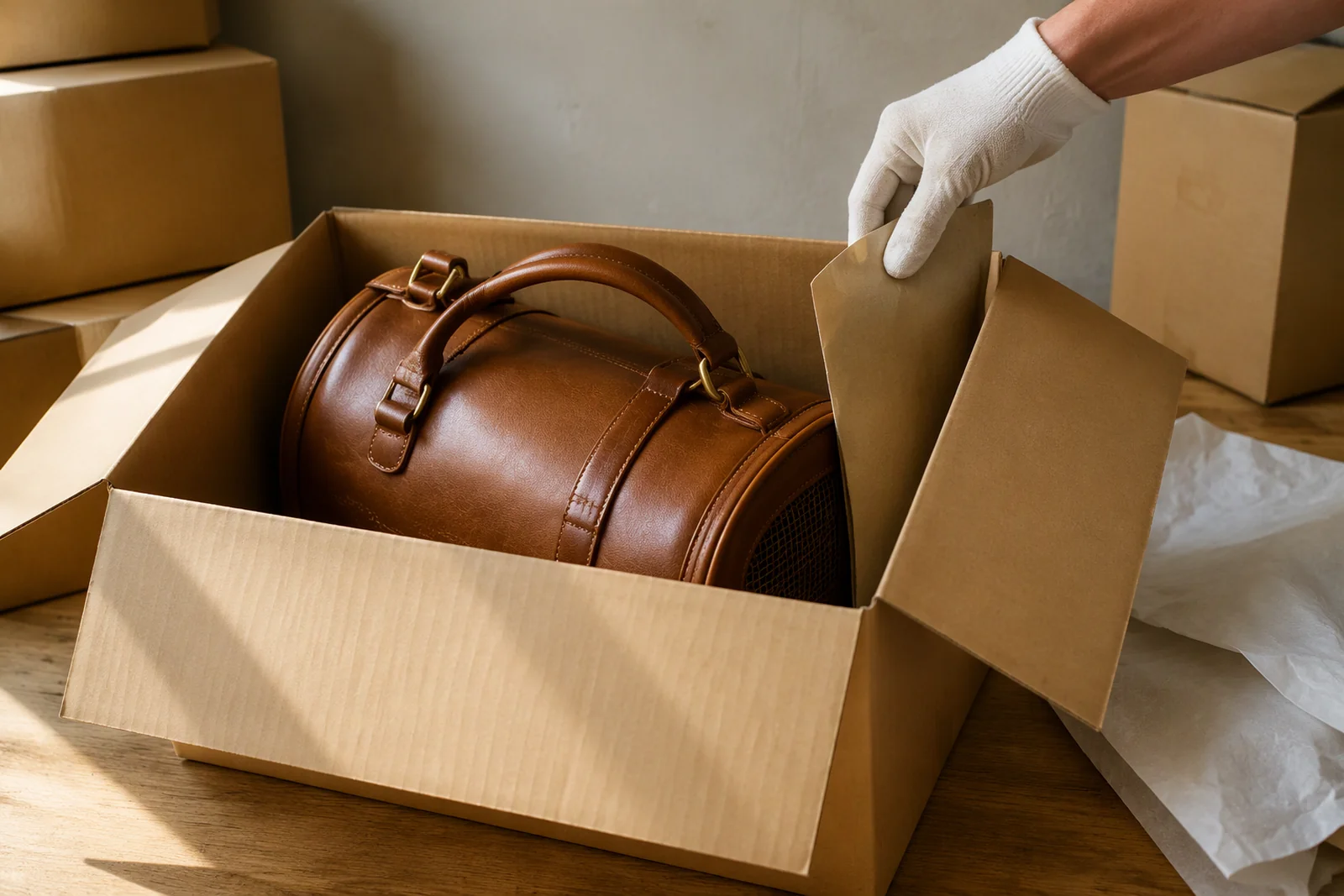
Board grade sets the starting strength, and the box construction decides how much of that strength survives.
The Stacking Load
Calculate the load a bottom carton carries: the weight above it multiplied by the number of layers, plus a safety margin for humidity and time. The figure should be written into the specification.
Humidity Derates Strength
Board loses a large share of its compression strength at high humidity. A box validated in a dry warehouse and shipped in a humid container is a different box.
Time and Creep
Board creeps under sustained load, so a stack that holds for a day can lean in a month. Validation should hold the load for a stated duration rather than a moment.
| Factor | Effect |
|---|---|
| Load | Direct |
| Humidity | Derates |
| Time | Creep |
| Pallet | Spreads |
Internal Fit and Void Fill
A carton that is too large allows the bag to move, and a carton that is too small transfers stacking load directly into the product.
Excessive Void
Void space is the most common packing fault and the cheapest to fix. A bag that can slide inside its carton will scuff itself against the board in transit.
Compression From Fit
A tight carton presses on handles and structure and marks them permanently. The fit should be snug without pressure, measured on the packed bag rather than on the pattern.
Fill Materials
Paper void fill, air cushions and moulded pulp behave differently under load. The fill should hold the bag still without adding a hard interface against the leather.
| Fit | Result |
|---|---|
| Loose | Scuff |
| Snug | Good |
| Tight | Marks |
| Overfilled | Bulge |
Cushioning for Leather Goods
Leather needs protection from abrasion and from pressure, and those two needs point to different materials.
Abrasion Protection
A soft wrap or a fabric bag protects the surface, and it must not shed fibre onto a grained finish. Uncoated tissue is better than a coarse foam sheet.
Pressure Points
Handles, rings and corners concentrate load against the board. A small pad at each contact point costs almost nothing and prevents the marks that arrive as complaints.
Presentation Wrapping
Tissue, dust bag and card are presentation as well as protection, and they should be validated together. A dust bag that sheds lint onto dark leather is a defect.
| Need | Material |
|---|---|
| Abrasion | Tissue |
| Pressure | Pad |
| Dust | Bag |
| Rigidity | Insert |
Moisture and Humidity Protection
Leather is hygroscopic, and a carton crossing a climate zone will see condensation even without a leak.
Desiccant Quantity
Desiccant is specified by weight per carton volume and by the transit duration. A sachet chosen by habit rather than by calculation is decoration.
Barrier Bags
A sealed barrier bag protects only while it is intact, and it also traps any moisture already inside. Sealing a bag that was packed in humid air creates the problem it was meant to prevent.
Container Rain
Condensation inside a container falls onto the top layer of cartons. A liner or a desiccant policy for the container protects the whole load rather than one box.
| Control | Scope |
|---|---|
| Sachet | Carton |
| Barrier bag | Unit |
| Container liner | Load |
| Ventilation | Load |
Drop Testing a Packed Carton
A drop test is the cheapest way to find a packing fault, and it can be done at the factory with a marked height and a hard floor.
Heights and Edges
Drop heights follow the weight of the carton and the handling it will receive. Corner, edge and face drops reveal different weaknesses, and the corner is usually the first to fail.
The Sequence
Drop the same carton through the sequence rather than using a new box for each drop, because damage accumulates as it does in reality.
Judging the Result
Inspect the bag, not only the box. A carton that survives with a crushed corner is a pass for the board and a fail for the product inside.
| Drop | Reveals |
|---|---|
| Corner | Board crush |
| Edge | Closure |
| Face | Cushioning |
| Flat | Contents |
Vibration and Abrasion Testing
Vibration is the test that finds scuffing, and scuffing is the damage customers notice first on a dark leather bag.
The Table Test
A vibrating table at a stated frequency and duration reproduces road transport. Pack the carton exactly as production does, including the dust bag and any card.
Abrasion at Contacts
Movement between the bag and a hard insert polishes or scuffs the finish. Adding a soft interface, or reducing void, removes the movement rather than the symptom.
Duration and Intensity
Duration should reflect the longest leg of the journey, not the average. A short shake proves the carton closes and proves nothing about a two-week sea leg.
| Parameter | Stated |
|---|---|
| Frequency | Hz |
| Duration | Hours |
| Orientation | Vertical |
| Load | Stacked |
Marks, Labels and Their Verification
Marks are the part of the carton that a warehouse reads, and a wrong mark sends a correct carton to the wrong place.
Shipping Marks
The buyer reference, style, colour, size ratio and carton number must match the packing list exactly. Verification is a side-by-side check, not a memory test.
Handling Symbols
Orientation, keep-dry and fragile symbols are only useful if they are printed large enough to be seen on a pallet. A symbol hidden under tape is decoration.
Label Adhesion
Labels applied to a dusty or cold board fall off in transit. Cleaning the board surface and using the correct adhesive is part of the packing specification.
| Mark | Check |
|---|---|
| Reference | Match |
| Ratio | Match |
| Symbols | Visible |
| Adhesion | Holds |
Barcodes and Scan Reliability
A barcode that fails to scan stops a line in a distribution centre, and the cause is usually print quality or placement rather than the data.
Print Quality
Contrast, edge definition and quiet zones decide whether a scanner reads the code first time. A code printed on a dark or glossy area will fail regardless of its data.
Placement
A barcode must sit on a flat face and stay readable after taping and palletising. A code placed where a strap crosses it is unreadable when it matters.
Verification
A verifier gives a grade, and a grade is a specification. Asking a supplier for the grade is more useful than asking whether the code scans.
| Issue | Result |
|---|---|
| Low contrast | Fail scan |
| Small quiet zone | Fail scan |
| Strap crossing | Fail scan |
| Gloss area | Fail scan |
Hardware Protection Inside the Carton
Metal parts damage a bag from inside the carton, and the damage is usually a mark rather than a break.
Rings and Buckles
A ring pressing against leather for a week leaves a permanent dent. A small wrap on each hardware piece costs seconds and removes the risk.
Zips and Sliders
A slider that opens in transit exposes teeth to the board. A tie or a clip keeps the zip closed without marking the tape.
Loose Parts
Detachable straps and pads should be packed separately rather than loose in the void, where they become the abrasive object.
| Part | Protection |
|---|---|
| Ring | Wrap |
| Buckle | Pad |
| Slider | Tie |
| Strap | Separate |
Multi-Pack and Master Cartons
A master carton is a second structure with its own specification, and it is often the part that is never validated.
Inner Cartons
Individual retail cartons stacked inside a master need their own compression strength. A thin retail box crushed inside a strong master is still a damaged product.
Master Carton Strength
The master carries the stack load and the handling, so its board grade should be set from the pallet plan rather than from the retail pack.
Quantity Per Carton
The ratio of units per master affects weight, handling and damage risk. A heavier master is cheaper per unit and more likely to be dropped.
| Level | Specification |
|---|---|
| Unit | Wrap |
| Retail | Board |
| Master | Strength |
| Pallet | Pattern |
Palletisation and Unit Loads
A pallet is the load that actually travels, and a well-made carton on a poor pallet arrives in the same condition as a bad carton.
Overhang
Cartons that overhang the pallet edge lose most of their compression strength at the overhanging corner. The pattern should keep the load inside the pallet footprint.
Column Stacking
Column stacking puts load straight through the corners and is strongest, while interlocking spreads it but crushes edges. The choice follows the board grade.
Strapping and Wrap
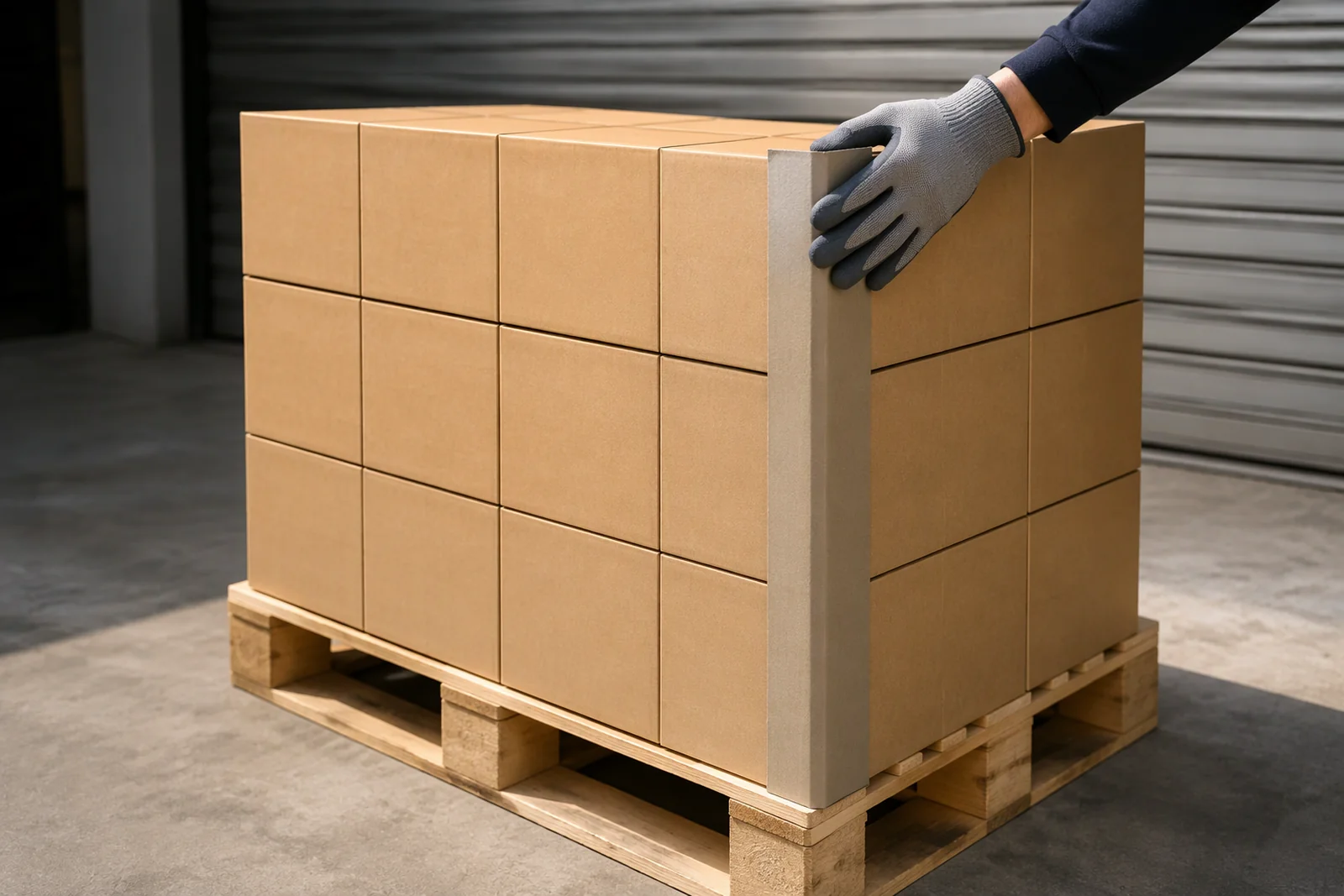
Strapping holds the load together and concentrates pressure where it crosses a carton. Edge protectors spread that pressure over a larger area.
| Issue | Effect |
|---|---|
| Overhang | Strength loss |
| Interlock | Edge crush |
| Strap | Local crush |
| Wrap | Stability |
Running a Validation Before Bulk
Validation is a small, cheap exercise that should happen before the first bulk packing, and it has a fixed sequence.
Build the Real Pack
Pack three cartons exactly as production will, with the intended materials and marks. A validation using a different wrap answers a different question.
Test in Sequence
Condition, then compression, then drop, then vibration, opening and inspecting between stages. A test that skips conditioning overstates the carton.
Record and Judge
Record the result per stage and keep the failed cartons. The physical evidence is what makes the specification credible to a supplier.
| Stage | Purpose |
|---|---|
| Pack | Realism |
| Condition | Humidity |
| Compress | Stack |
| Drop | Impact |
Conditioning Before and Between Tests
A carton tested dry is a carton that does not exist in a container, and conditioning is the step that makes the result meaningful.
Humidity Chamber
Condition the packed carton at a stated humidity and temperature for a stated duration. Board that has absorbed moisture is weaker and more prone to creep.
Time to Equilibrium
Board takes time to reach moisture equilibrium, and a short condition only wets the surface. Duration should be long enough for the board to stabilise.
Reconditioning Between Stages
Where a test damages the carton, opening and closing it changes the result. Choose the sequence deliberately and state it in the record.
| Step | Parameter |
|---|---|
| Humidity | Percent |
| Temperature | Degrees |
| Duration | Hours |
| Sequence | Fixed |

Judging Damage Objectively
Damage needs a scale, or every inspector will have a different threshold and every batch a different verdict.
A Four-Level Scale
None, slight (cosmetic, sellable), visible (mark or crease, discount), and unsellable. Four levels separate a release from a hold and a claim.
Where to Look
Inspect handles, corners, base, hardware and the closing edges. These are the areas that register damage first and the ones a customer notices.
Photograph Standards
Photograph against a plain background at a fixed distance. A damage photograph taken with a thumb in frame cannot be compared with anything.
| Level | Decision |
|---|---|
| None | Release |
| Slight | Release |
| Visible | Hold |
| Unsellable | Reject |
Setting Acceptance Criteria
An acceptance criterion turns a test into a decision, and it should be written before the first carton is tested rather than after.
Per-Stage Criteria
State what passes at each stage: no board failure at compression, no product damage at drop, no finish change at vibration. Stage criteria localise a failure immediately.
The Zero-Damage Rule
For leather goods, product damage at any level is usually a fail, because a mark cannot be repaired. Setting that rule early prevents a debate later.
Board Versus Product
Allow the board to show cosmetic wear while the product stays perfect. Insisting on a perfect carton raises cost without improving the delivered bag.
| Stage | Criterion |
|---|---|
| Compression | No collapse |
| Drop | No damage |
| Vibration | No scuff |
| Marks | Legible |
Carton Cost Versus Damage Cost
Packing is usually optimised on material cost alone, which is the wrong objective when a failure is measured in returned bags.
The Material Saving
Downgrading board or removing a pad saves a small amount per carton and is visible on every invoice. It is easy to justify in a cost review.
The Damage Cost
A single damaged bag costs the product value plus freight both ways plus handling, which is often more than the saving across a whole shipment.
Where to Spend
Spend on the interface between bag and board, and on the master carton that carries the stack. Those are the two places where a small cost prevents a large one.
| Item | Balance |
|---|---|
| Board | Moderate |
| Pad | High value |
| Master | High value |
| Label | Low |
Verifying Packing in Bulk
Once the specification exists, bulk verification is a short check against a retained reference rather than a repeat of the validation.
The First Carton of a Run
Inspect the first packed carton of every run completely, and photograph it. It becomes the reference for that style and that packing configuration.
Sampling Through the Run
Check one carton an hour for packing sequence, void fill and marks. Packing drifts when a new shift takes over or a material runs short.
Watching for Substitution
A thinner board or a smaller pad appears without notice. Comparing against the retained reference catches the change before the shipment does.
| Check | Frequency |
|---|---|
| First carton | Per run |
| Sequence | Hourly |
| Marks | Hourly |
| Reference | Retained |
Records and Retained Cartons
A packing record is short, and its value comes from the retained carton stored beside it.
The Specification Sheet
Internal dimensions, board grade, flute, style, cushioning, desiccant, marks and barcode grade. Eight fields describe a carton completely.
Retaining a Packed Carton
Keep one packed carton from the validated configuration, sealed and labelled. It settles arguments about what was agreed far better than a drawing.
Storage
Store it dry and flat, away from the production floor where it will be reused. A reference carton that has been used for shipping is no longer a reference.
| Record | Purpose |
|---|---|
| Sheet | Agree |
| Carton | Prove |
| Photos | Compare |
| Date | Track |
Briefing a Supplier on Packing
A carton supplier and a bag factory each own part of the packing, and the brief has to make the split explicit.
To the Carton Supplier
Give internal dimensions with tolerance, board grade, flute, style, print and barcode grade. Dimensional tolerance matters most, because a box a few millimetres small marks the product.
To the Packing Line
Give the sequence, the cushioning, the desiccant quantity, the mark layout and the reference carton. A verbal instruction produces four versions across four shifts.
To the Freight Forwarder
State the pallet pattern, the maximum stack height and any handling restriction. The forwarder's plan decides how much load the bottom carton will carry.
| Party | Owns |
|---|---|
| Carton | Board, size |
| Factory | Packing |
| Forwarder | Pallet |
| Buyer | Criteria |
Common Traps in Carton Validation
Five traps explain most programmes that validate a carton and still receive claims.
Testing an Empty Box
Compression tested on an empty carton measures board and nothing else. The product inside changes the load path and the failure mode.
Skipping Conditioning
A dry carton is roughly twice as strong as a damp one. Validation without conditioning describes a warehouse, not a container.
Validating One Style
Each bag shape changes the void, the weight and the load path. A validated tote says little about a rigid carrier.
Ignoring the Master
Retail cartons are validated and the master is bought by habit. The master carries the stack and is where most crush damage originates.
No Reference Kept
Without a retained carton, a later dispute about board grade cannot be settled by anything except opinion.
| Trap | Misses |
|---|---|
| Empty box | Load path |
| No condition | Humidity |
| One style | Variety |
| No master | Stack |
| No reference | Evidence |
Reading Inbound Complaints
An inbound damage report is the final test result, and it is the one most factories never read systematically.
The Photograph
Ask for a photograph of the carton and the bag before anything is unpacked. The carton tells you the mechanism and the bag tells you the consequence.
Mechanism Language
Ask the receiver to describe the mechanism: crushed corner, wet board, scuffed face, opened seam. Mechanism language produces a corrective action, while "damaged" produces a discount.
Grouping by Mechanism
Group claims by mechanism rather than by market. One mechanism recurring across three markets is a packing fault, not three local problems.
| Report | Identifies |
|---|---|
| Photo | Mechanism |
| Corner | Stack |
| Wet board | Humidity |
| Scuff | Movement |
Seasonal and Climate Factors
A packing specification validated in one season can fail in another, because humidity and temperature change the board and the leather.
Summer Humidity
Board strength drops in a humid season and the same stack that held in winter leans. Validating in the humid season gives a specification with margin.
Winter Cold
Cold makes board brittle and coatings stiff, so a drop that was absorbed in summer cracks in winter. Cold conditioning is worth one extra run.
Destination Climate
A dry destination and a tropical one need different desiccant quantities and sometimes different board grades. The destination belongs in the specification.
| Factor | Effect |
|---|---|
| Humidity | Strength |
| Cold | Brittleness |
| Destination | Desiccant |
| Season | Margin |
Reuse, Material Reduction and Trade-Offs
Packing faces pressure to use less material, and every reduction has a measurable effect on protection that should be tested rather than assumed.
Right-Sizing
Reducing a carton to the packed bag removes void and material at the same time. It is the single change that improves cost and protection together.
Recycled Board
Recycled content reduces strength for the same substance, so a switch should be validated as a new board rather than accepted as an equivalent.
Reuse and Returns
A carton designed to be reused for returns needs a closure that survives opening. A taped box that is destroyed on opening cannot be reused whatever the label says.
| Change | Effect |
|---|---|
| Right-size | Better |
| Recycled | Weaker |
| Thinner | Weaker |
| Reusable | Closure |
What Buyers Should Ask For
A buyer can verify a packing programme with four requests, and none of them requires visiting the factory.
The Sheet to Request
Ask for internal dimensions, board grade, flute, style and cushioning in numbers. A sheet with adjectives is not a specification.
The Validation Record
Ask which stages were run, at what humidity and duration, and what the carton looked like afterwards. Photographs make the record checkable.
The Retained Carton
Ask for one packed carton from the validated configuration, sent with the first bulk shipment. It becomes the reference that settles later claims.
The Claim History
Ask how many damage claims last season and what mechanism they shared. A supplier who can answer is reading the data.
| Request | Verifies |
|---|---|
| Sheet | Numbers |
| Record | Testing |
| Carton | Standard |
| Claims | Learning |
Limits of a Carton Validation
Validation is a screen against the mechanisms that are predictable, and it does not reproduce everything a shipment will meet.
Real Handling Is Worse
A validation drop is controlled in height, angle and floor. Real handling includes tumbling, stacking by forklift and rain, none of which is reproduced.
The Unknown Leg
A carton may change hands four times, and each handover adds a handling environment that nobody specified. Validation covers typical handling, not every possibility.
Judgment Remains
The result ranks configurations and reveals the weakest mechanism. Deciding how much margin to carry is a commercial judgement that no test settles.
| Limit | Consequence |
|---|---|
| Controlled drop | Understates |
| No tumble | Misses |
| One route | Partial |
| Margin | Judgement |
Packing for Retail and E-Commerce
A carton that travels to a distribution centre and a parcel that travels to a customer are two different problems, and the second is harsher per unit.
Parcel Networks
A parcel is sorted by machine, dropped onto belts and stacked with unrelated heavy goods. The number of handling events per unit is far higher than in a pallet shipment.
That inner pack also protects the retail presentation, which is what the customer photographs when something arrives wrong. A scuffed retail box turns a perfect bag into a complaint before the bag is out of the tissue.
Individual Protection
An e-commerce pack needs an inner carton or a rigid mailer around the retail box. The retail carton alone is not designed for parcel sorting.
Returns Packaging
A pack that cannot be resealed makes returns harder and increases damage on the way back. A resealable strip is a small cost with a measurable effect.
| Channel | Risk |
|---|---|
| Pallet | Stack |
| Parcel | Handling |
| Retail | Display |
| Return | Reseal |
Freight Mode and Packing Choices
Sea, air and road expose a carton to different durations, humidity and handling, and the packing plan should follow the mode.
Sea Freight
Long duration and high humidity make sea freight the most demanding mode for board strength and desiccant. Container position matters as much as the carton.
Container Position
The top layer of a container takes the condensation and the bottom layer takes the weight, so neither position is neutral. Where a shipment mixes cartons of different strength, the weaker ones belong in the middle of the stack rather than at either extreme.
Air Freight
Short duration and low humidity reduce the moisture risk and increase the handling risk, because air cargo is loaded and unloaded more often per unit.
Road and Rail
Vibration dominates on road and rail, which makes abrasion protection the priority rather than compression strength.
| Mode | Priority |
|---|---|
| Sea | Humidity |
| Air | Handling |
| Road | Vibration |
| Rail | Vibration |
FAQ
Why should a carton be validated rather than just specified?
A: Because board grade and box style describe materials, not performance. A carton can meet its board specification and still crush under a pallet load or scuff a bag in vibration.
What tests should a shipping carton pass?
A: Conditioning at a stated humidity, compression under the calculated stack load, a drop sequence on the packed carton, and a vibration run. Each stage targets a different mechanism.
Should the carton be tested empty or packed?
A: Packed, with the real cushioning and marks. An empty carton measures board strength only and ignores the load path the product creates.
How long should compression load be held?
A: Long enough to show creep, not just resistance. A stack that holds for a minute can lean in a month, so the load is held for a stated duration, often hours.
Why does humidity matter so much?
A: Board loses a large share of its compression strength when it absorbs moisture. A carton validated dry and shipped in a humid container is a weaker carton than the one tested.
What causes scuffing inside a carton?
A: Movement. Void space lets the bag slide against the board for hours of vibration, and every contact point abrades the finish.
Is a crushed corner a carton failure or a product failure?
A: It depends on the bag. Where the product is undamaged, the board has absorbed the energy and done its job. Where a mark or crease appears, the packing has failed.
How much desiccant should a carton contain?
A: It should be calculated from carton volume, transit duration and destination climate. A sachet chosen by habit protects nothing measurable.
Do retail cartons need their own strength test?
A: Yes, when they are stacked inside a master. A thin retail box crushed inside a strong master still delivers a damaged product.
What is the most common packing fault?
A: Excessive void. It is the cheapest to fix and the most frequently missed, because the carton looks full and the bag is still free to move.
How should shipping marks be verified?
A: By side-by-side comparison with the packing list, checking reference, style, ratio and carton numbering. Memory is not a verification method.
What makes a barcode fail to scan?
A: Low contrast, a small quiet zone, printing on a glossy area, or a strap crossing the code. Print quality is verified by grade, not by trying it once.
Which stage should be run first in a validation?
A: Conditioning, because every later result depends on the moisture content of the board. Running compression or drop first overstates the carton.
How many cartons should a validation use?
A: Three packed to the production configuration. One shows a result, three reveal variation in board and packing.
What should be kept after validation?
A: One packed carton from the validated configuration, sealed, labelled and stored dry. It is the physical standard for every later comparison.
Does a lighter carton always reduce cost?
A: It reduces material cost and can raise damage cost. Right-sizing removes material and void together, which is the change that improves both.
Ready to stop paying for damage you never saw in the factory? Pack three cartons to the production configuration, condition them, then compress, drop and vibrate in sequence, and judge the bag rather than the board. Then right-size the carton, pad the hardware, keep one packed reference, and read every inbound claim as a test result.