How Should Hardware Function Be Tested in Bulk Bag Inspections?
- Why Hardware Function Testing Is Different
- The Test List
- Opening Force and Operating Feel
- Closure Security and Release Under Load
- Zip Function and Travel
- Load Tests at Attachment Points
- Fatigue and Cycling
- Fixtures, Gauges and Conditions
- Sampling and Frequency
- Recording Results and Failure Analysis
- Common Hardware Failure Modes
- Verifying Supplier Test Reports
- Bringing Function Testing Into the Order
- FAQ
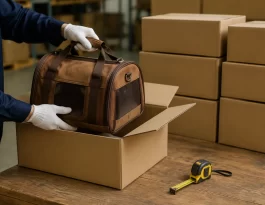
Hardware is the part of a bag that is handled most and inspected least. Appearance checks look at plating colour and surface quality, while the function that matters — does the clasp hold, does the zip run, does the strap stay attached — is often assessed by opening one bag and closing it again.
That single interaction reveals almost nothing. A closure that releases under load feels perfectly normal when the bag is empty, and a zip that fails at the tenth full travel runs smoothly on the first. Function problems are load and cycle problems, and they only appear when load and cycles are applied.
Bulk function testing is the answer, and it does not require a laboratory. It requires a defined list of tests, simple fixtures and gauges, thresholds agreed in advance, and a sampling rule that is actually followed.
This guide covers why function testing differs from appearance inspection, the test list itself, opening force, closure security, zip travel, load at attachment points, fatigue cycling, fixtures and conditions, sampling, recording and failure analysis, the common failure modes, and how to verify a supplier's own test reports.
Why Hardware Function Testing Is Different
Function testing measures behaviour under conditions rather than appearance under light. That difference changes everything about how the test is designed.
Behaviour Under Load
A clasp either holds a defined load or it does not. The question is not how it looks when closed but what happens when the bag is carried with weight in it and the flap is pulled.
That means the test involves applying force, and force requires a fixture, a load and a threshold. None of those can be replaced by a visual check.
Wear Over Cycles
Most hardware failures are wear phenomena: a spring loses tension, a plating edge wears through, a slider loosens, a hinge develops play. These appear over hundreds or thousands of operations rather than on the first.
Cycle testing compresses that wear into a short test, which is why a well-designed cycle test says more about the product life than a large sample of static inspections.
Why One Bag Is Not Enough
Function behaviour varies unit to unit, particularly where hardware is supplied in batches from more than one tool or more than one plating run. Testing one unit samples one unit.
The purpose of testing several units is to catch the outliers: the one closure with a weak spring, the one zip with a stiff slider, the one hook with a plating defect at the pivot.
| Check type | What it measures | Typical equipment |
|---|---|---|
| Appearance | Surface and finish | Light and standard |
| Static function | Opens and closes | Hands |
| Force measurement | Effort to operate | Force gauge |
| Load test | Holds under weight | Fixture and weights |
| Cycle test | Wear over use | Cycling rig or manual count |
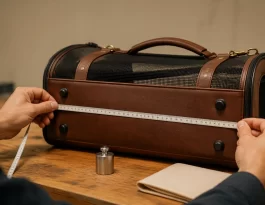
| Dimension check | Fits the assembled bag | Gauge or caliper |
The Test List
A function test list turns an impression into a set of pass-or-fail checks. It should be written for the hardware actually used on the style, not copied from a generic template.
Items That Apply to Most Bags
Most bags use some combination of a closure, a zip, attachment hardware and decorative rivets or studs. Each has a behaviour that can be checked in under a minute with the right fixture.
Items That Apply to Specific Styles
Carriers add handle attachment points and ventilation zips, and travel styles may add a lock or a trolley strap fitting. These should be listed separately rather than folded into the general list.
Defining the Threshold
Each test needs a threshold, written as a value or a range. A closure that needs two hands to open is a defect; the threshold states how much effort is acceptable, and it is what makes the test reproducible.
| Hardware item | Behaviour tested | Threshold expressed as |
|---|---|---|
| Turn lock or clasp | Opens and closes securely | Force to open, holds load |
| Magnetic closure | Holds and releases | Force to separate |
| Zip | Full travel, no snag | Pull force at start and end |
| Swivel hook | Opens, closes, rotates | Force, secure latch |
| Buckle | Prong engages, no slip | Load without slipping |
| D-ring or loop | Retains shape under load | Load without deformation |
| Rivet or stud | No movement | Visual and twist check |
| Strap attachment | Holds under load | Load without stitch failure |
Opening Force and Operating Feel
Opening force is the most under-specified characteristic in bag hardware, and the one customers notice most.
Measuring the Force
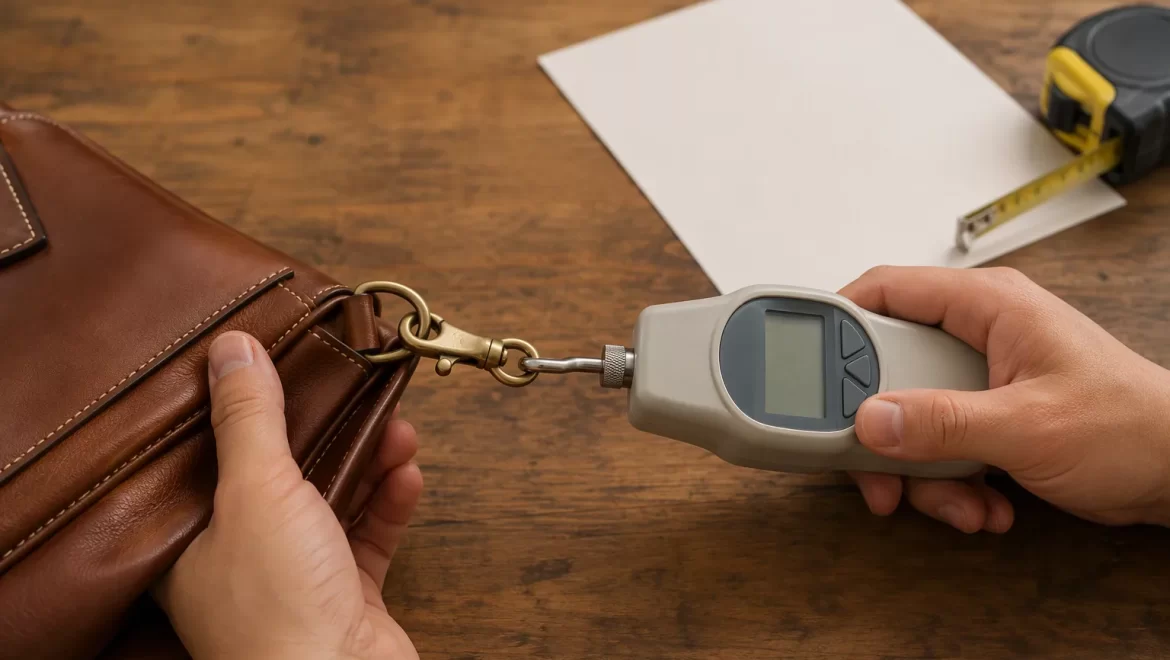
A simple push-pull gauge measures the force needed to open a closure or release a hook. The measurement is taken at a defined point on the hardware and in a defined direction, because force readings vary with both.
Recording the value rather than the impression allows a batch to be compared with the previous one, which is how drift is caught before it becomes a complaint.
Too Stiff and Too Loose
Both extremes are defects. Hardware that is too stiff is difficult for the user and is often a symptom of an oversized spring or a plating build-up at the pivot; hardware that is too loose releases unintentionally, which is a security problem rather than a comfort one.
The acceptable range should be stated as a band, and hardware that sits anywhere outside the band should be a finding regardless of how it feels.
Wear-In and Consistency Across a Batch
Some closures ease after a few operations, others stiffen as plating settles at the bearing surfaces. Testing a closure before and after ten operations shows which behaviour the design has.
Consistency across the batch matters as much as the value itself. Where two units from the same carton differ noticeably in feel, the batch contains a mixed supply, and that is a finding whether or not both units sit inside the band.
| Result | Meaning | Action |
|---|---|---|
| Below the lower limit | Too loose, release risk | Check spring and fit |
| Within the band | Acceptable | Record value |
| Above the upper limit | Too stiff, usability issue | Check pivot and plating |
| Varies after ten cycles | Wear-in behaviour | Record and compare units |
| Wide spread across units | Mixed supply | Investigate tool or batch |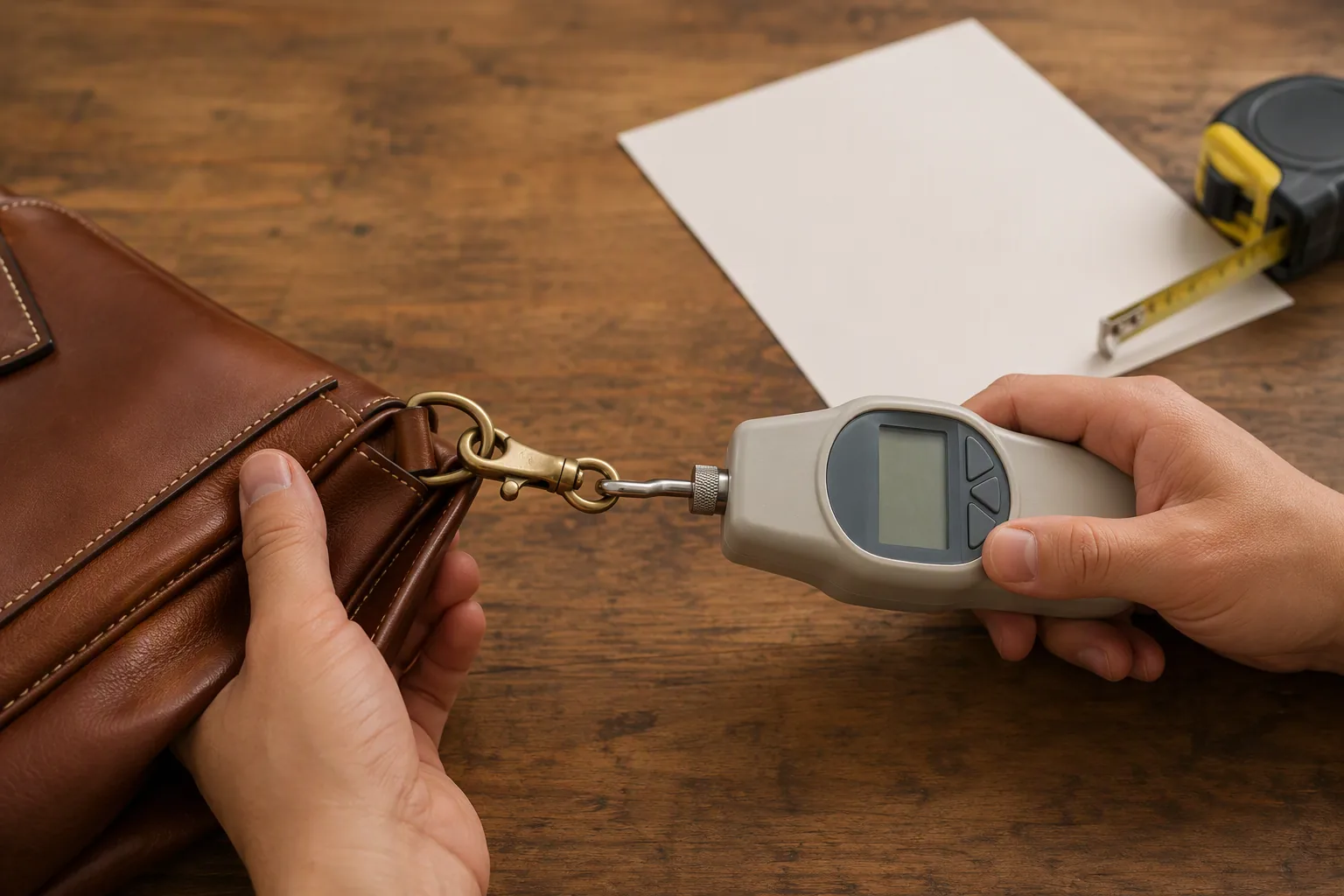
Closure Security and Release Under Load
Security is the property that separates a working closure from a decorative one, and it is invisible when the bag is empty.
Static Load on a Closed Closure
The basic test loads the closed bag and holds it, then attempts to pull the flap open in the direction it would open in use. The closure should hold the load without releasing and without visible deformation at the plate or the post.
Loading is best done with the bag packed to a realistic weight rather than with a bare fixture, because the bag's own structure shares some of the load and changes the failure point.
Unintended Release
A closure that opens when the bag is shaken, dropped or pressed against the body is a defect even if it holds a static load. Shake and drop tests reproduce the conditions under which accidental opening happens.
Where a style is carried against the hip or under the arm, a compression test that presses the flap against the closure is the most relevant version of this check.
Magnetic Closures
Magnetic closures behave differently from mechanical ones. The relevant measures are the force needed to separate the two parts and whether the magnet holds position while the bag is carried.
Strength varies with the magnet grade, the gap between the parts and the thickness of the material covering them, which is why a change of lining thickness can change the closure's behaviour without any change to the magnet.
| Closure type | Security test | Common failure |
|---|---|---|
| Turn lock | Load on the closed flap | Releases under moderate load |
| Magnetic | Separation force measurement | Too weak once lined |
| Snap stud | Pull and shake | Stud pulls through the hole |
| Zip-closed top | Load across the closing | Coil opens under load |
| Buckle and strap | Load without slipping | Prong slips under load |
| Locking clasp | Load and release test | Latch does not engage fully |
Zip Function and Travel
Zips fail in service far more often than they fail in the hand, because in service they are flexed, loaded and partly jammed by fabric.
Full Travel
The first test runs the slider from fully closed to fully open and back, with the bag in the position it will be used in rather than laid flat. Zips that run freely on a bench can bind once the bag is loaded.
The full travel test also exposes a misalignment between the zip tape and the bag's seam, which shows as a stiff segment near a corner or a curve.
Pull Force at the Start and End
The force needed to start the slider is usually higher than the force to keep it moving, and the highest values occur at the ends of travel. Measuring the start force at both ends gives a value that can be compared between batches.
Where a pull has a cord or a leather tab, the test should be performed on the tab, because the tab's angle changes the force the user actually applies.
Flex and Cross-Seam Runs
A zip that crosses a seam or a padded edge passes over a change in thickness with every travel, and that is where coil damage begins. The test should include at least one full travel across the thickest section of the bag.
Where the style has two sliders that meet, the test should confirm that they align and that the meeting point does not open under load.
| Zip check | Method | Finding if failed |
|---|---|---|
| Full travel | Open and close fully, bag loaded | Binding at curves |
| Start force | Gauge at both ends | Excess force to open |
| Slider alignment | Visual and hand check | Slider skews or snags |
| Cross-seam travel | Travel across thickest section | Coil damage at the seam |
| Twin sliders | Meet and hold under load | Opens at the meeting point |
| Self-lock behaviour | Push back on the closed zip | Slider creeps open |
Load Tests at Attachment Points
The attachment points carry the whole weight of the bag, and they are usually the first place a stress-related failure appears.
Where the Load Goes
Load applied to the handle passes through the handle, its attachment, the bag's top edge and the reinforcement behind it. Testing only the handle in isolation misses the interaction that actually fails.
Where possible, the load test should be performed on the assembled bag with the load hanging from the same point a user would hold.
Static Hold and Cycle
A static hold applies a defined load for a defined time and checks that nothing yields. A cycle test applies and releases the load repeatedly, which is what identifies stitch fatigue and hardware wear.
Where a brand specifies a carry weight, the test load is usually set above it, so that the margin between the design load and the test load is stated rather than assumed.
Metal Attachment Points
D-rings, loops and hooks should be checked for deformation, for the security of the joint where they attach, and for movement at the pivot. A ring that opens slightly under load has failed even if it does not break.
Where hardware is attached with a screw or a rivet, the test should confirm that the fixing does not rotate or loosen under load.
| Attachment | Test | Failure mode |
|---|---|---|
| Handle | Static load on assembled bag | Stitch failure at the top edge |
| Shoulder strap | Load and cycle | Hardware wear at the buckle |
| D-ring | Load and twist | Ring deforms or opens |
| Screw fixing | Load and check rotation | Fixing loosens |
| Rivet | Load and visual check | Rivet pulls or deforms |
| Clip-on hook | Load and rotation | Latch opens under load |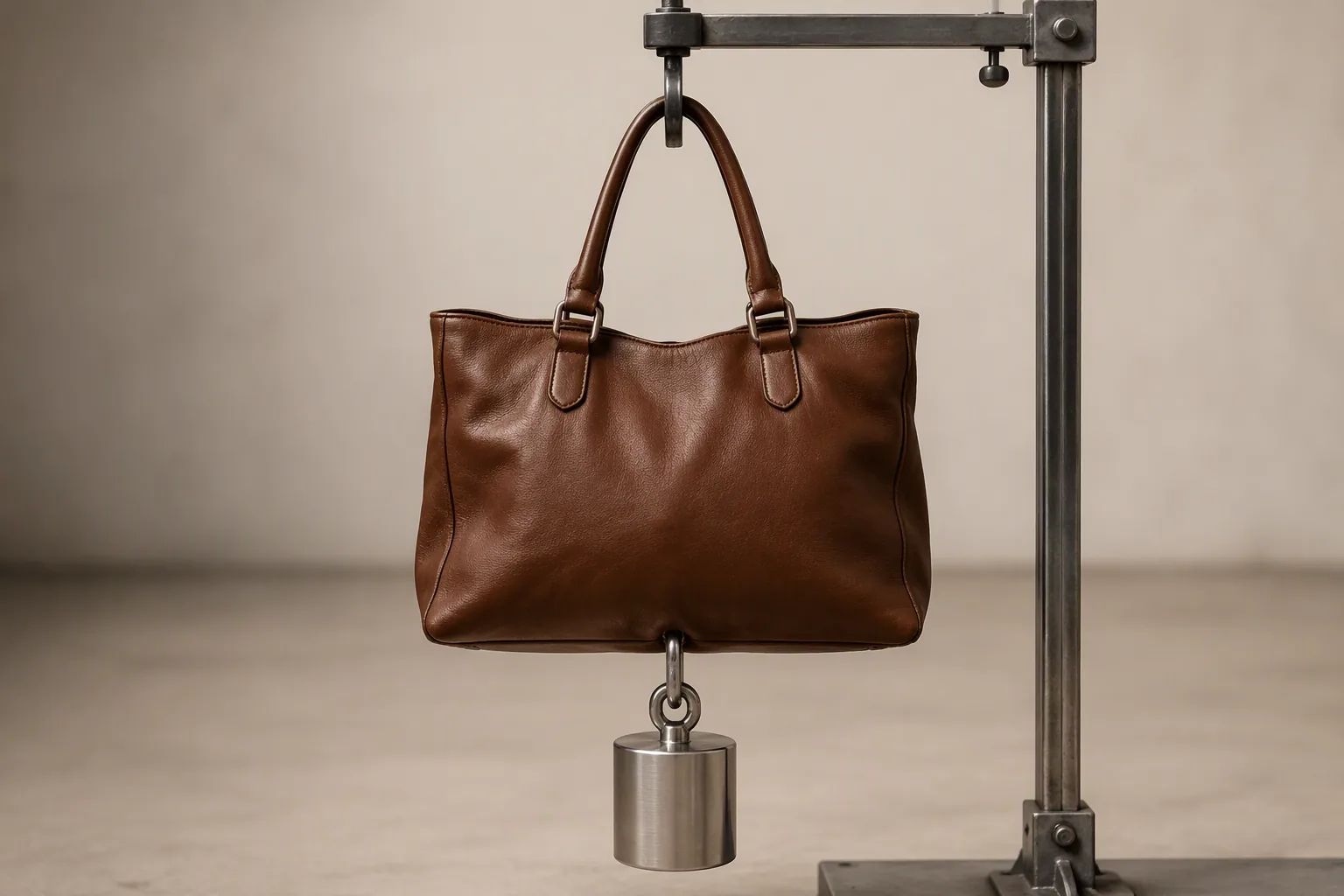
Fatigue and Cycling
Fatigue is where most hardware failures live, and it is the cheapest thing to test because the rig does the work.
What a Cycle Test Shows
A cycle test repeats an operation — opening a closure, running a zip, opening and closing a hook — a defined number of times and then re-checks the properties measured at the start.
What changes is the informative part. A closure that becomes noticeably easier to open has lost spring tension; a zip that needs more force has accumulated wear at the coil or a bend in the tape.
Setting Cycle Counts
Cycle counts should be related to a realistic service life rather than chosen for convenience. A day of moderate use might involve several closure operations, and a product intended for several years implies a large count.
Where a full service-life count is impractical, a shorter count with a stated extrapolation is more useful than no test, provided the extrapolation is written down and treated as an estimate.
Comparing Units Rather Than Absolute Values
Not all cycle tests produce a clean pass or fail. Where that is the case, comparing the behaviour of several units is what reveals a problem: a batch where one unit changes markedly and three do not contains an outlier.
Testing three or five units to the same cycle count and comparing the results is more informative than testing one unit to a much higher count.
| Cycle test | Property re-checked | Useful finding |
|---|---|---|
| Closure open and close | Force to open | Spring fatigue |
| Zip full travel | Start force and travel | Coil or tape wear |
| Hook open and close | Latch security | Latch wear or deformation |
| Buckle engagement | Slip under load | Prong and hole wear |
| Plate or stud press | Retention | Loose fixing |
| Strap adjust | Slipping | Webbing wear in the buckle |
Fixtures, Gauges and Conditions
Function tests only compare between batches if the equipment and conditions stay the same. That is a documentation problem rather than an engineering one.
Simple Fixtures That Work
A push-pull gauge, a set of known weights, a hook or a clamp and a stopwatch cover most of the test list. Where a dedicated rig is not available, a fixed frame that holds the bag and a weight hung at a marked point gives repeatable results.
The fixture does not need to be sophisticated, but it does need to be identified, so that a result can be repeated on the same equipment next season.
Conditions and Pre-Conditioning
Temperature and humidity affect leather, webbing and some plastics, and they change the force needed to operate hardware. Recording the conditions alongside the result is what makes a comparison valid.
Where a market is hot and humid, pre-conditioning the sample before the test approximates the service condition, and the results are usually worse than in a conditioned workshop.
Force Gauge Discipline
The gauge should be read at the same point on the hardware and in the same direction each time, and the reading should be taken as the peak value rather than a settled value. Consistency of technique matters more than gauge precision.
Where two people perform the same test, they should compare results on the same unit before testing production, because technique differences regularly exceed batch differences.
| Element | Requirement | Effect if unrecorded |
|---|---|---|
| Fixture | Identified and unchanged | Results not comparable |
| Load | Known weights, applied at a marked point | Load varies by technician |
| Gauge | Same instrument, same reading point | Technique differences dominate |
| Conditions | Temperature and humidity recorded | Seasonal results not comparable |
| Pre-conditioning | Stated if applied | Hot-climate failures missed |
| Operator | Named | Variation cannot be traced |
Sampling and Frequency
How many units to test is a commercial decision as much as a technical one, and it should be settled before the batch is made rather than during inspection.
Minimum Test Quantities
A practical rule is to test a small number of units per batch for the full function list and a larger number for the quick checks. The full list includes load and cycle tests that take minutes per unit; the quick checks take seconds.
Testing several units rather than one is what allows outliers to appear, and the units should come from different cartons rather than from the same pack.
Frequency Across a Production Run
Where a style runs over several days or several lots, function tests should be performed per lot rather than once for the order, because each lot carries its own hardware batch.
Where hardware arrives in multiple shipments, the arrival of the first batch from a new plating run is a reason to test again, regardless of the schedule.
Recording Results and Failure Analysis
A function test that is not recorded has to be repeated next season. The record is what turns a morning of testing into a baseline.
What the Record Should Hold
The record should state the style, the lot, the cartons sampled, the hardware batch, the test list applied, the values obtained per unit, the conditions and the operator.
Where a value sits close to a threshold, it should be recorded as a value rather than as a pass, because a batch that sits at the edge is a different situation from one at the centre of the band.
Thresholds and Disposition
Each test needs a stated disposition rule: pass, pass with observation, hold for investigation or reject. Where a value falls outside the band on one unit only, the useful next step is to test more units rather than to accept or reject the batch on one reading.
Where a failure is confirmed, the affected cartons should be identified rather than the whole batch treated as suspect, because hardware batches are often packed into a defined part of the shipment.
Photographing Failures
A photograph should show the failed component at a scale that makes the failure visible, including the surrounding material where the failure is at a joint. A loose clasp photographed without the strap tells the reader very little.
Where the failure is a wear pattern, the photograph should be paired with the cycle count so that the wear can be related to use.
| Record element | Purpose | Use later |
|---|---|---|
| Style and lot | Identifies the batch | Trend and comparison |
| Cartons sampled | Allows tracing | Narrowing a problem |
| Hardware batch | Links to the supplier run | Supplier feedback |
| Values per unit | Shows spread and outliers | Baseline for reorders |
| Conditions and operator | Repeatability | Explains a difference |
| Failure photographs | Evidence | Supplier discussion |

Common Hardware Failure Modes
Most hardware failures in service match one of a small number of patterns. Knowing them shortens the diagnosis and points to the right test.
Failures at the Surface
Plating and coating failures appear as discolouration, wear-through at contact points or a change in appearance at the pivot. They are usually a plating or handling issue rather than a design one, and they show up under wear and perspiration.
Testing for them involves cycles plus exposure, because a freshly plated part looks correct until the plating has been worked.
Failures of the Mechanism
Mechanism failures include weak springs, latch wear, deformation and jamming. They change the force measurements and the security of the closure, which is why a force record catches them earlier than a visual check.
Failures at the Joint
Failures at the joint between hardware and material include stitch failure, tearing at the fixing hole and loosening of screws or rivets. These usually trace back to the reinforcement behind the fixing rather than to the hardware itself.
| Symptom | Likely cause | Test that finds it |
|---|---|---|
| Closure opens during use | Weak spring or shallow latch | Load plus shake test |
| Closure became easier over time | Spring fatigue | Cycle test, force re-check |
| Zip binds near a corner | Tape misalignment or seam build-up | Full travel on a loaded bag |
| Plating worn at the pivot | Plating thickness at a contact point | Cycle plus exposure |
| Hook opens under load | Latch wear or deformation | Load test on the hook |
| Strap tears at the ring | Insufficient reinforcement | Load test on assembled bag |
| Screw turns under load | Fixing not locked | Load and rotation check |
| Hardware rattles | Loose fit at the joint | Hand check plus load |
Verifying Supplier Test Reports
Hardware suppliers often provide their own test data. It is useful as a starting point and unreliable as a substitute for the buyer's own checks.
What a Useful Supplier Report Contains
A usable report identifies the part by drawing revision, states the test method, gives the values obtained and the sample size, and names the date and the laboratory or bench that produced it.
Reports that state only a pass result, or that quote values without the sample size, cannot be compared between shipments and cannot be used to support a claim.
Checking Consistency With Your Own Results
The most reliable use of a supplier report is comparison. Where the supplier's opening-force value and the buyer's measured value diverge by a large margin, one of the two is measuring something different.
That divergence usually traces to a difference in method rather than to a difference in the part, which is why the method should be agreed in writing before the first order.
Bringing Function Testing Into the Order
Function testing is cheapest when it is a requirement in the purchase order rather than an activity invented at inspection time.
Writing It Into the Specification
The order should name the tests, the thresholds, the sample quantities, the conditions and the record that must be supplied with each lot. Once those are in the order, the test becomes part of the price rather than an extra.
Where a threshold cannot be agreed, stating the measurement method alone is still valuable, because it allows values to be compared even before limits are set.
Testing at the Right Moment
Function tests belong at two points: on hardware at receipt, before it is assembled, and on the assembled bag before packing. Testing only the finished bag tells you there is a problem; testing at receipt tells you which component caused it.
Where a style runs over several weeks, the assembled test should be repeated per lot rather than once, because hardware can change batch inside a single order.
Closing the Loop With the Hardware Supplier
Results should go back to the hardware supplier in the form they can act on: values, cycle counts and photographs, referenced to the batch. A complaint without values usually produces a replacement rather than a correction.
Where the same failure appears in two consecutive lots, the specification or the supplier's process is the place to act, and the next order should carry the changed requirement.
| Where to test | What it catches | Cost of testing |
|---|---|---|
| Hardware at receipt | Component faults before assembly | Low, fast |
| Assembled bag before packing | Joint and reinforcement faults | Moderate |
| Per lot across a long run | Batch changes inside an order | Moderate |
| Cycle test on sample units | Wear behaviour and fatigue | Higher, slower |
| Repeat order comparison | Drift against the baseline | Low, uses prior records |
FAQ
Why does hardware need function testing separate from appearance inspection?
A: Because function problems are load and cycle problems. A closure that releases under weight and a zip that fails after repeated travel both feel normal in a single empty-handed check.
What does a basic hardware function test include?
A: Opening force measurement, closure security under load, zip travel with the bag loaded, load tests at attachment points, and a cycle count on the components that wear.
How is opening force measured?
A: With a push-pull gauge, read at a defined point on the hardware and in a defined direction, recorded as a peak value so that batches can be compared.
Is a stiff closure a defect?
A: Yes, where it exceeds the agreed band. Both extremes are defects: too stiff is a usability problem, and too loose is a security problem because the closure may release unintentionally.
How is closure security tested?
A: The closed bag is loaded and the flap pulled in the direction it would open in use, followed by shake, drop or compression checks, since a closure can hold statically and still release when the bag is carried.
Why do magnetic closures behave inconsistently?
A: Separation force depends on the magnet grade, the gap between the parts and the thickness of material covering them, so a change of lining thickness changes behaviour with no change to the magnet.
How should a zip be tested?
A: Full travel with the bag loaded rather than laid flat, start force measured at both ends of travel, plus a travel across the thickest section where the coil passes over a seam or a padded edge.
Where should load be applied for attachment tests?
A: On the assembled bag, hanging from the point a user would hold, because the top edge and its reinforcement share the load and testing a handle in isolation misses the interaction.
What does a cycle test reveal?
A: Wear behaviour: spring fatigue, plating wear at contact points, coil or tape wear in a zip and loosening at a fixing. What changes between the first operation and the last is the informative part.
How many cycles should be run?
A: A count related to a realistic service life. Where a full count is impractical, a shorter count with a stated extrapolation is more useful than no test, provided the estimate is written down.
Which hardware batches need re-testing?
A: A new supplier, a new tool, a new plating run, a change of magnet grade or a change of lining thickness, all of which can change function with no change to the written specification.
How many units should be tested per batch?
A: A small number for the full list and a larger number for the quick checks, drawn from different cartons. Testing several units is what allows an outlier to appear.
What should be recorded?
A: Style, lot, cartons sampled, hardware batch, the tests applied, the values per unit, the conditions and the operator, plus photographs of any failure with the cycle count.
What are the most common hardware failures in service?
A: Plating wear at contact points, spring fatigue in closures, coil or tape wear in zips, latch wear in hooks, and reinforcement failures at the joint where hardware meets the material.
Can a supplier's test report replace the buyer's own testing?
A: No. A supplier report describes the parts the supplier selected, and selection is the step that cannot be verified from the report. Its best use is comparison with your own values.
Is a lab needed for function testing?
A: No. A push-pull gauge, known weights, a clamp, a stopwatch and a simple frame cover most of the list, provided the fixture and the conditions are recorded so results stay comparable.
Ready to test hardware properly rather than simply handling it? Write the test list and thresholds before the order starts, measure opening force with a gauge and record the value, load-test closures and attachment points on the assembled bag, run a cycle count that reflects real use, record conditions and operator with every result, and treat a batch that sits at the edge of the band as a reason to test more units rather than to close the file.