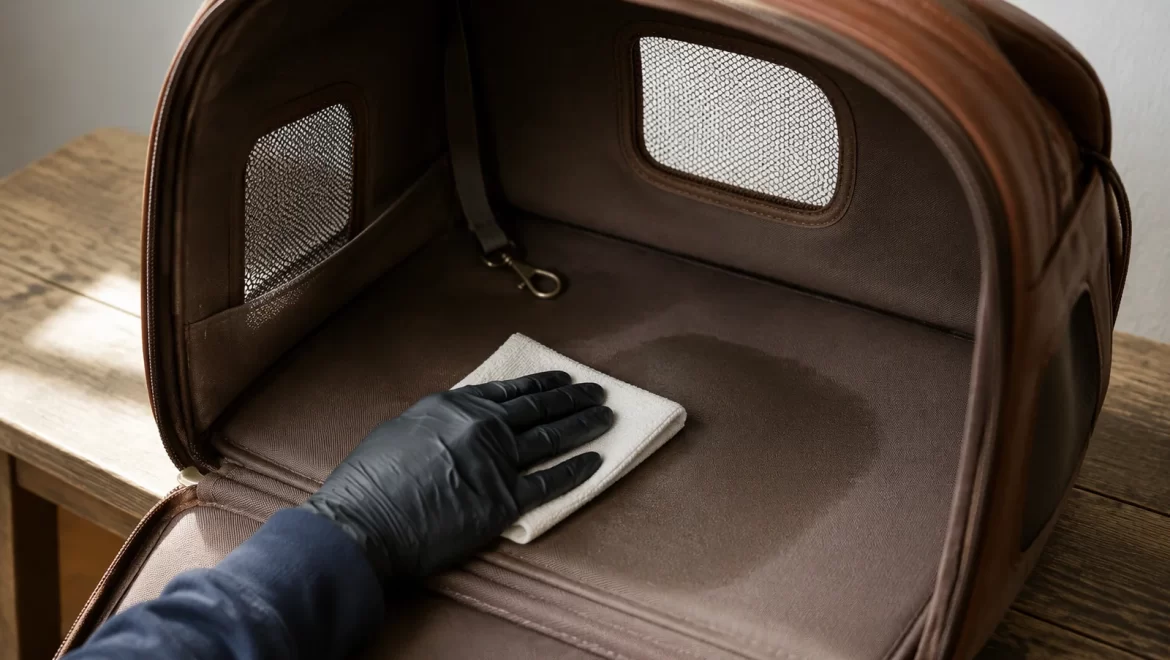
How Do You Verify Cleanability of Pet Bag Interiors in Production?
- Why Interior Cleanability Is a Specification
- What Actually Gets Soiled
- Stains and Their Chemistry
- Lining Materials and Their Response
- Coated Versus Uncoated Linings
- Seams, Binding and Traps
- The Cleaning Methods Owners Actually Use
- Designing a Wipe Test
- Designing an Immersion Test
- Drying Behaviour
- Judging Residue
- Judging Colour Change
- Judging Odour After Cleaning
- Judging Structural Effects
- Setting an Acceptance Level
- Removable Pads and Their Verification
- Reversible and Washable Constructions
- Materials to Avoid in Fixed Interiors
- Sampling at Development
- Sampling in Bulk
- Records and Retained Samples
- The Supplier Declaration
- Linking Cleanability to Complaints
- Common Traps in Cleanability Work
- Cost of a Cleanability Programme
- What Buyers Should Ask For
- A Worked Example on One Carrier
- Where Cleanability Meets Design
- Limits of Any Cleanability Test
- FAQ
A pet bag interior is a small, closed, humid space that an animal sits in for hours, and it will be soiled. Whether it can be brought back to a saleable state is a material decision made long before the first bag is sewn.
Cleanability is rarely written into a specification, because it is not one property but five: stain release, residue, colour stability, drying behaviour and structural tolerance. Each can be tested, and each fails differently in the field.
Why Interior Cleanability Is a Specification
Buyers ask about cleanability in the first conversation and rarely see it in the technical pack, which is where the gap between expectation and product begins.
The Complaint Pattern
Interior complaints arrive as staining, smell and colour transfer rather than as a single failure. They are also the complaints most likely to end in a return rather than a repair.
What the Customer Actually Does
Owners wipe with a damp cloth, use a household spray, and occasionally put a removable pad in a machine. A specification that ignores those three behaviours is a specification for a different product.
Why It Is a B2B Question
A retailer cannot resell a returned bag that smells, and cannot clean one that has absorbed a stain. Cleanability is therefore a revenue question rather than a comfort feature.
| Behaviour | Frequency |
|---|---|
| Damp wipe | Routine |
| Household spray | Occasional |
| Machine wash pad | Occasional |
| Full immersion | Rare |
What Actually Gets Soiled
The soils inside a pet bag are a short list with very different chemistries, and a lining that releases one may hold another permanently.
Mud and Grit
Mud is mineral and organic matter suspended in water. It releases with water and mechanical action, and it collects in seams rather than on flat panels.
Urine and Ammonia
Urine is a strong electrolyte with nitrogen compounds that bind to fibres and continue to smell after drying. It is the soil that most often ends in rejection.
Oils, Saliva and Food
Saliva and food residues are protein and fat, and they need a surfactant rather than water. A lining that beads water will also bead a cleaner and leave the soil behind.
| Soil | Chemistry |
|---|---|
| Mud | Mineral |
| Urine | Electrolyte |
| Saliva | Protein |
| Food fat | Lipid |
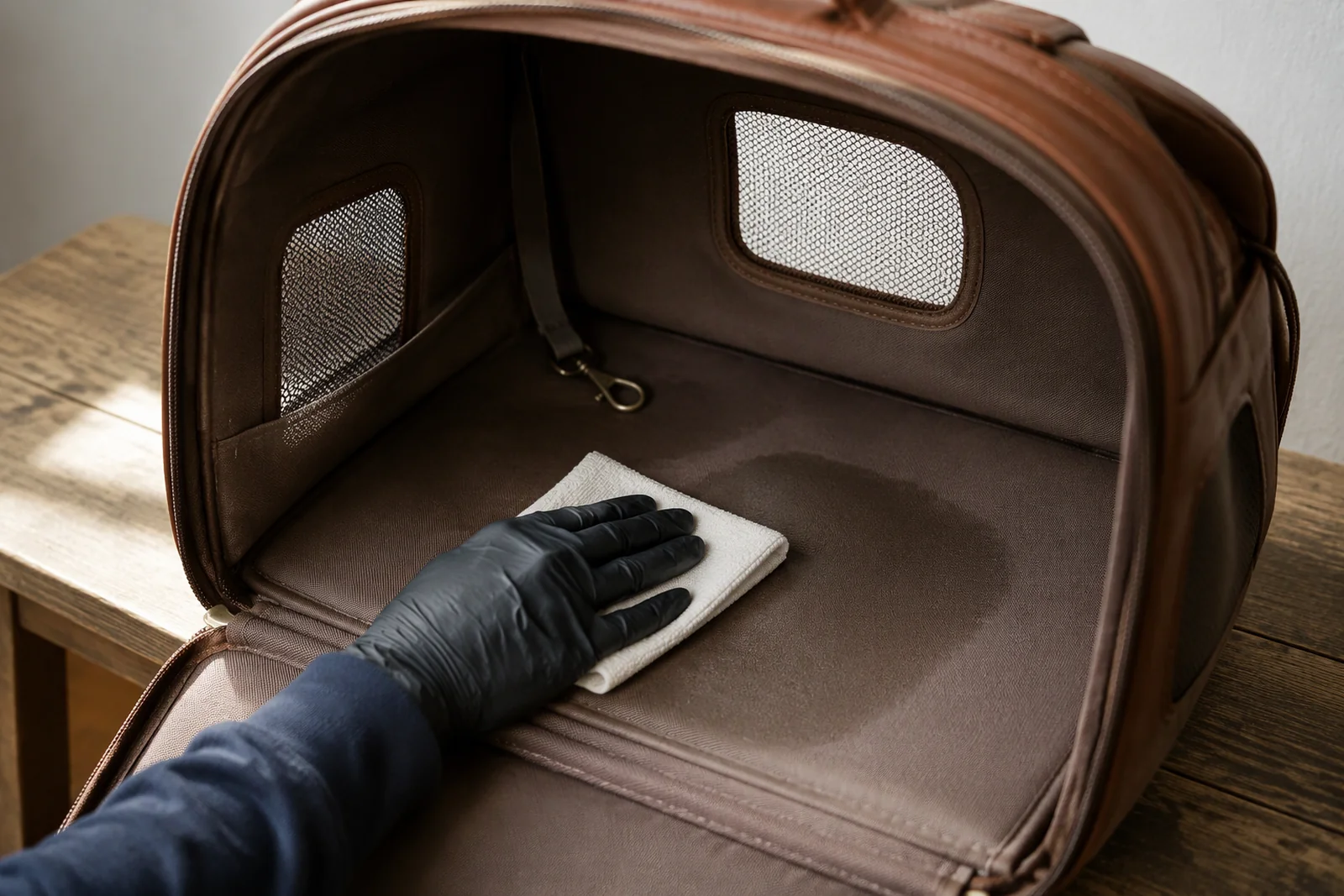
Stains and Their Chemistry
A stain is not a mark on the surface but a substance that has entered the fibre or the coating, and how far it enters decides whether it can leave.
Surface Deposits
Deposits sit on top of a coated lining and lift with a cloth. These are the easy cases, and they are also the ones that make a lining look cleanable when it is not.
Absorbed Stains
A porous or uncoated lining draws the substance into the fibre, where wiping cannot reach it. The stain then becomes a permanent record of one accident.
Tannin and Dye Transfer
Dark soils and some cleaners carry dyes that migrate into pale linings. This is a colour problem rather than a residue problem, and it needs a different test.
| Type | Removable |
|---|---|
| Deposit | Yes |
| Absorbed | Rarely |
| Dye transfer | No |
| Odour bound | Partly |
Lining Materials and Their Response
Four lining families cover most pet bags, and each answers the cleanability question differently.
Coated Woven Linings
A coated lining is a barrier and releases deposits easily. Its weakness is the seam and the stitch holes, where liquid passes behind the coating and stays.
Uncoated Wovens
An uncoated woven breathes and absorbs, which is comfortable for the animal and unforgiving of accidents. It is best used where it can be removed.
Felt and Fleece
Felt holds odour and grit in its structure and releases neither with wiping. It belongs in a removable pad rather than in a fixed interior.
| Lining | Release |
|---|---|
| Coated | Good |
| Uncoated | Poor |
| Felt | Very poor |
| Knit | Moderate |
Coated Versus Uncoated Linings
The single largest cleanability decision is whether the interior has a film on it, and the choice sets what the customer can do about an accident.
The Barrier Effect
A continuous film keeps liquid on the surface, where a cloth can reach it. The film must also be continuous across seams, which is where most coatings are interrupted.
Breathability Trade-Off
An uncoated lining manages humidity and smell better in normal use, and fails badly in an accident. A removable pad lets a design have both.
Coating Durability
A coating that cracks with folding stops being a barrier at the fold. Flexing the sample before the stain test is how that weakness is found.
| Property | Coated | Uncoated |
|---|---|---|
| Stain release | Good | Poor |
| Breathability | Low | Good |
| Durability | Flex-limited | Good |
| Cost | Higher | Lower |
Seams, Binding and Traps
Most failed cleaning happens at a construction detail rather than on a panel, because details collect soil and resist the cloth.
Stitch Holes
Every needle hole through a coated lining is a channel. Where the interior is sewn through all layers, liquid passes into the padding and stays there.
Binding and Piping
Binding creates a groove along an edge where grit collects. A sealed or taped binding removes the groove and the problem with it.
Corners and Gussets
A gusset corner is deep, narrow and hard to reach. Designing the corner with a radius rather than a point is the simplest cleanability improvement available.
| Detail | Risk |
|---|---|
| Stitch holes | Absorption |
| Binding groove | Grit |
| Sharp corner | Inaccessible |
| Zipper end | Trap |
The Cleaning Methods Owners Actually Use
Tests are only meaningful if they reproduce the methods people use, and those methods are less careful than a laboratory protocol.
The Damp Cloth
A damp cloth with mild soap is the reference method. It applies light mechanical action and leaves the surface slightly wet, which is where drying behaviour begins.
Household Sprays
Multi-surface sprays contain surfactants and often alcohol. They clean well and can attack coatings, strip colour or leave a sticky residue that attracts new soil.
Machine Washing a Pad
A removable pad may be machine washed at a stated temperature. A pad that survives hand washing and fails in a machine has been specified for the wrong use.
| Method | Aggression |
|---|---|
| Damp cloth | Low |
| Spray | Moderate |
| Hand wash | Moderate |
| Machine wash | High |
Designing a Wipe Test
The wipe test is the workhorse of cleanability because it is fast, repeatable and close to what owners do.
The Soil Standard
Choose a soil and keep it identical: a suspension of fine mineral matter in water is reproducible, while a real mud sample is not. Record the concentration and the volume applied.
Application and Dwell
Apply a fixed volume over a fixed area and leave it for a stated interval. Dwell time decides the result more than any other variable, so it must be written down.
The Wipe Sequence
A fixed number of strokes with a defined cloth, in one direction, at a stated pressure. Three strokes wet and two dry is a common and workable sequence.
| Parameter | Fixed |
|---|---|
| Soil | Standard |
| Volume | Fixed |
| Dwell | Stated |
| Strokes | Counted |
Designing an Immersion Test
Immersion goes beyond a wipe and answers a different question: what happens when liquid gets behind the coating or into the padding.
Short Immersion
A few minutes of immersion with gentle agitation simulates a spill. It reveals wicking at seams and through stitch holes within one working day.
Long Immersion
A longer soak simulates a pad left wet in a bag. It is the test that finds padding which holds water and turns sour.
Weighing the Specimen
Weighing before and after shows how much liquid the construction absorbed. The figure is more informative than a visual judgement and takes a minute.
| Test | Reveals |
|---|---|
| Short soak | Wicking |
| Long soak | Retention |
| Weighing | Absorption |
| Drying | Recovery |
Drying Behaviour
A bag that cleans well and dries slowly will smell before its next use, so drying belongs in the same test as cleaning.
Drying Time
Record the time to touch-dry in stated conditions. A coated lining dries fast on the surface and holds liquid at the seams, which the surface reading hides.
Residual Moisture in Padding
Padding dries from the outside inwards, and the interior stays damp after the surface feels dry. Cutting the specimen at intervals shows when it is genuinely dry.
Airflow in the Bag
An interior with no airflow stays humid for days. A mesh panel or a vented pad changes the drying curve more than any coating choice.
| Construction | Drying |
|---|---|
| Coated only | Fast surface |
| Padded | Slow core |
| Vented | Faster |
| Removable | Fastest |
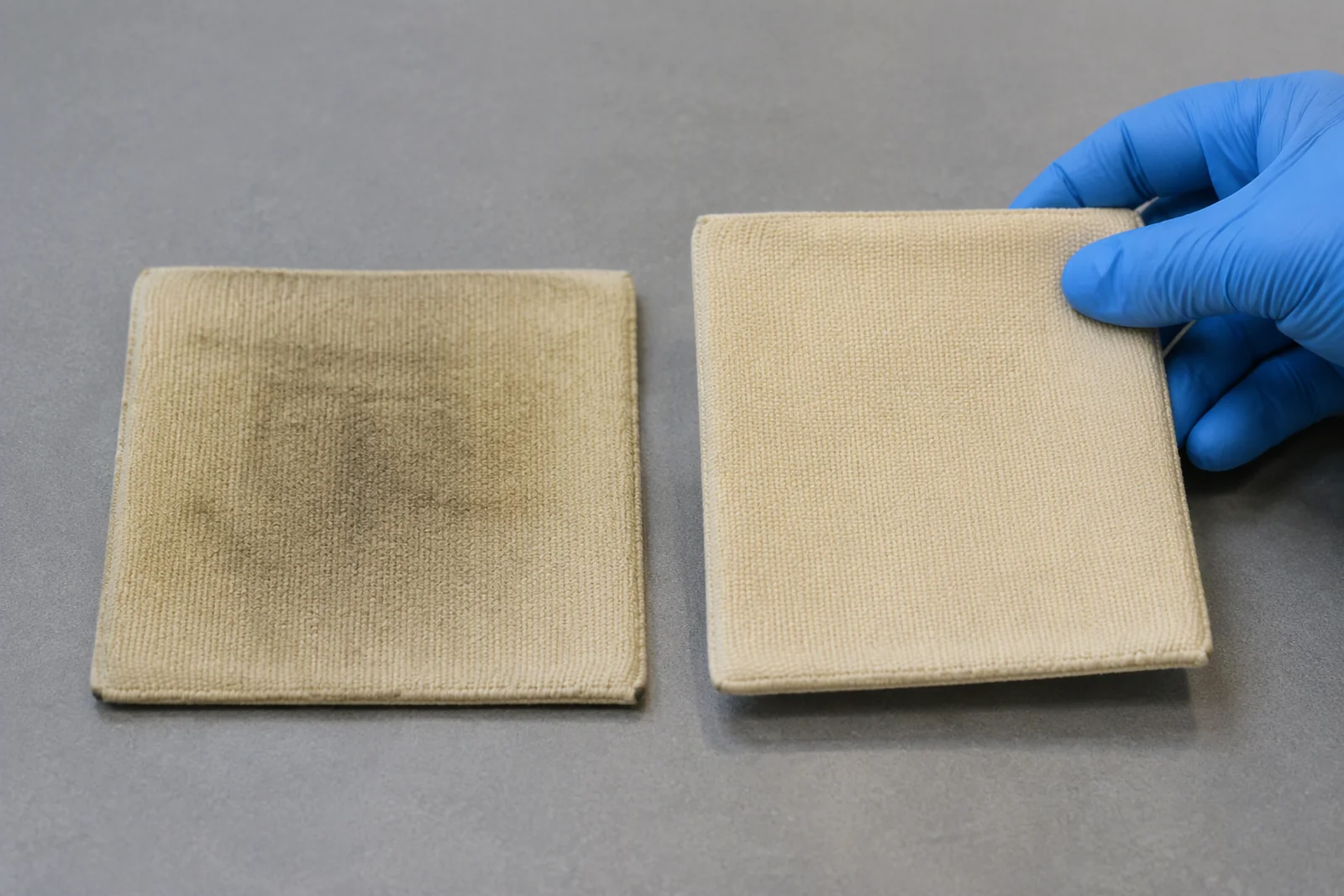
Judging Residue
Residue is what remains after the cloth has passed, and it is judged against a retained clean sample rather than against memory.
Visual Residue
Compare the cleaned area with an uncleaned area of the same specimen under the same light. A slight tonal difference is a residue finding even when no soil is visible.
Tactile Residue
A tacky surface traps new soil and indicates a cleaner that was not removed. Running a gloved finger across the area is a quick and reliable check.
Chemical Residue
Where a spray was used, residue can be detected by a simple water-break test: water should sheet evenly on a clean coated surface and bead on a contaminated one.
| Type | Method |
|---|---|
| Visual | Compare |
| Tactile | Finger |
| Chemical | Water break |
| Odour | Sniff test |
Judging Colour Change
A lining that cleans to a different colour has failed even if every trace of soil has gone, because the change is permanent and visible.
Grey Shift
Repeated wiping leaves a grey bloom on pale linings, caused by fibre disturbance and fine residue. It is the most common appearance complaint after cleaning.
Dye Bleed
A dark lining or a printed pattern can release dye into the cloth, and a pale cloth then carries colour to the next area. Any transfer to the wiping cloth is a finding.
Measuring the Shift
A colour reading before and after gives a defensible number where an eye cannot agree. A simple comparison card under fixed light is the minimum standard.
| Change | Cause |
|---|---|
| Grey bloom | Fibre |
| Bleed | Dye |
| Yellowing | Cleaner |
| Patchiness | Uneven wipe |
Judging Odour After Cleaning
A clean-looking interior that still smells has not been cleaned, and the nose is the instrument that detects what the eye cannot.
The Closed Container Method
Seal the specimen for a stated interval at a stated temperature, then assess on opening. The method is the same one used for production odour, and it should be reused rather than reinvented.
Which Soils Persist
Urine and protein soils persist longest because they bind to the fibre. A surface that releases mud easily may hold urine indefinitely.
After-Cleaning Assessment
Assess before cleaning, immediately after, and after drying. A smell that appears only after drying indicates residue that was spread rather than removed.
| Stage | Meaning |
|---|---|
| Before | Baseline |
| After | Removal |
| After drying | Residue |
| Next day | Binding |
Judging Structural Effects
Cleaning changes the structure as well as the surface, and a lining that survives visually can still be weakened.
Adhesion Loss
Where a lining is bonded to foam, water reaches the bond through stitch holes and lifts it. A delaminated lining cannot be repaired at the customer's end.
Seam Integrity
Repeated wetting and drying relaxes stitches and can shrink the tape. A seam that holds when dry may open when cleaned, so a pull check after drying belongs in the test.
Shape and Stiffness
A board or a stiffener that absorbs water loses shape and may never recover. Measuring the panel after drying shows whether the construction returned.
| Effect | Test |
|---|---|
| Bond | Peel |
| Seam | Pull |
| Shape | Measure |
| Stiffness | Handle |
Setting an Acceptance Level
An acceptance level turns five observations into one decision, and it should be expressed as a grade that an inspector can apply.
Four Grades
No visible residue, slight residue acceptable, visible residue, and failure with colour or odour change. Four grades separate release from hold without a laboratory.
Which Grades Are Failures
Colour shift and persistent odour are failures at any level, because neither can be corrected. Residue grade two is a hold, and grade one is a release.
Writing It Into the Spec
State the soil, the method, the dwell, the grade and the two automatic failures. One line per lining family is enough to make the requirement enforceable.
| Grade | Decision |
|---|---|
| Zero | Release |
| Slight | Release |
| Visible | Hold |
| Change | Reject |
Removable Pads and Their Verification
A removable pad is the most effective cleanability feature available, provided it is verified as a separate product rather than as part of a bag.
Testing the Pad Alone
Wash the pad as the care instruction says, then assess residue, colour, odour and shrinkage. A pad that shrinks by a stated percentage will no longer fit.
Fixing and Fastening
Hook-and-loop, snaps and zips all collect grit. A fastener that clogs after two washes has failed even if the pad is clean.
Reinsertion
A pad that is hard to reinsert will be left out, and the bag returns to being an unlined interior. Time the reinsertion, and treat a slow one as a design fault.
| Test | Criterion |
|---|---|
| Wash | No residue |
| Shrink | Within limit |
| Fastener | Still works |
| Reinsert | Quick |
Reversible and Washable Constructions
Some interiors are designed to be turned inside out or washed whole, and those constructions need their own verification rather than a variation of the pad test.
Turned Interiors
A lining that can be pulled out for cleaning must survive being pulled. Test the turning action several times and inspect the seams at the corners afterwards.
Washable Bags
A bag stated as washable is a stronger claim than a washable pad, because hardware, board and adhesive all go through the cycle. Every component must be verified.
Drying After Washing
A whole bag dries far more slowly than a pad, and the interior stays damp longest. Drying time after washing should be measured rather than estimated.
| Construction | Claim |
|---|---|
| Turned | Access |
| Washable bag | Full wash |
| Washable pad | Pad only |
| Wipe only | Surface |
Materials to Avoid in Fixed Interiors
Some materials are reasonable in a removable part and unsuitable when fixed, and the distinction is worth writing into the brief.
Deep Pile and Fleece
Deep pile traps grit and holds odour, and no cloth reaches its base. In a fixed interior it guarantees a bag that cannot be brought back.
Untreated Suede
Suede absorbs liquid instantly and marks permanently on drying. It is a legitimate design choice for an outer panel and a poor one for an interior floor.
Open-Cell Foam
Open-cell foam holds water and develops a smell within days. Closed-cell foam or a board is the correct choice wherever liquid can reach.
| Material | Fixed use |
|---|---|
| Deep pile | No |
| Untreated suede | No |
| Open-cell foam | No |
| Coated woven | Yes |
Sampling at Development
Development is the only stage where a lining can be replaced without consequence, so the cleanability test belongs in the first sample round.
Test Two Candidates
Test the intended lining against one alternative before approving a sample. The comparison costs a metre of each and prevents a season of returns.
Build the Sample Properly
A sample sewn with the production seam and padding answers the real question. A flat swatch test answers a question nobody asked.
Keep the Reference
Retain the tested specimen, labelled with soil, method and grade. It becomes the physical standard for every later comparison.
| Stage | Action |
|---|---|
| Candidates | Two |
| Sample | As production |
| Specimen | Retained |
| Grade | Recorded |
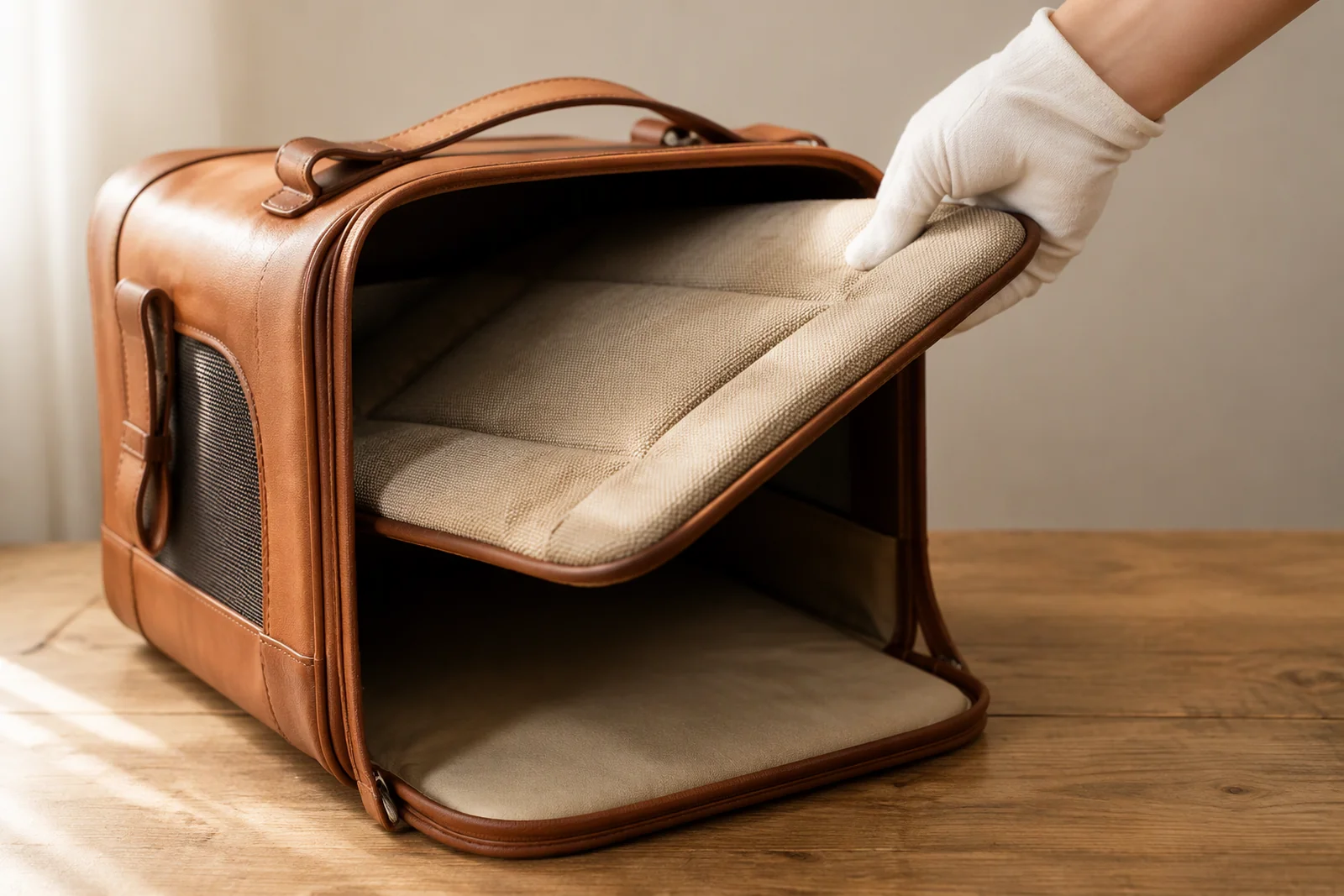
Sampling in Bulk
Bulk verification is a comparison against the retained reference rather than a repetition of the full test, which makes it practical on a line.
Comparing Against the Reference
Wipe a small area of one interior per lot and compare it with the retained specimen under the same light. A visible difference is a reason to hold the lot.
Watching for Substitution
Most cleanability changes arrive as an unannounced lining substitution. A new lot that cleans differently is the first signal that the material changed.
Frequency
One interior per lot for a fixed lining, and one pad per lot when pads are supplied separately. More frequent checks add little once the material is stable.
| Check | Frequency |
|---|---|
| Interior | Per lot |
| Pad | Per lot |
| Full test | Per season |
| Reference | Retained |
Records and Retained Samples
A cleanability record is short, and its value comes from the specimen stored beside it rather than from the paperwork.
What to Record
Lining reference, soil, dwell, wipe sequence, grade and the two automatic failures. Six fields describe a test that anyone can repeat.
Retaining the Specimen
Keep the cleaned specimen sealed and labelled. When a complaint arrives two seasons later, the specimen is the only object that can settle the comparison.
Storage Conditions
Store specimens dry and away from light, in a labelled bag. A specimen that has yellowed in storage proves nothing about the lining.
| Item | Purpose |
|---|---|
| Reference | Repeat |
| Soil | Compare |
| Grade | Decide |
| Specimen | Prove |
The Supplier Declaration
A lining supplier knows which of its articles are coated, how the coating is applied and what it will not survive, and that knowledge should be requested in writing.
What to Ask For
Coating type, application method, recommended cleaning agents and any known sensitivity to solvent. Four answers remove most of the guesswork.
The Care Instruction
The care instruction on the bag is a claim, and the lining supplier should confirm it. A claim written by marketing and never tested by the material is a liability.
Change Notification
Require written notice before a coating or a backing changes. Cleanability problems usually arrive with a substitution that nobody announced.
| Ask | Verifies |
|---|---|
| Coating | Barrier |
| Agents | Compatibility |
| Limits | Failure |
| Change | Continuity |
Linking Cleanability to Complaints
Returns describe cleanability better than any test because they report what actually happened, provided the information is captured in a usable form.
What to Capture
The soil, the product used, the time since the accident and a photograph after cleaning. Four items turn a complaint into evidence about a specific lining.
Grouping by Lining
Group returns by lining reference rather than by style. The same lining used across three styles will show one pattern, and that pattern is the finding.
The Test That Predicted It
Compare the return against the development record. Where the test predicted the failure, the limit was set too loosely; where it did not, the test is missing a soil type.
| Signal | Action |
|---|---|
| Repeat soil | Add test |
| Repeat lining | Change |
| No pattern | Check data |
| Predicted | Tighten |
Common Traps in Cleanability Work
Five traps explain most programmes that test cleanability and still ship interiors that cannot be cleaned.
Testing a Flat Swatch
A flat swatch has no seam, no padding and no corner. The failures happen at those three features, and a swatch test misses all of them.
Using Real Dirt
Real mud varies by day and by source, so a result cannot be repeated. A standardised soil is less realistic and far more useful.
Ignoring Drying
A cleaning test that ends when the cloth is put down answers half the question. Drying behaviour decides whether the bag smells next week.
Grading Only the Surface
The surface is the part that cleans easily. Grading it alone passes a construction that has absorbed liquid into its padding.
No Retained Specimen
Without a specimen, a later complaint cannot be compared with a passing test. The comparison is the only route to a decision.
| Trap | Misses |
|---|---|
| Flat swatch | Seams |
| Real dirt | Repeatability |
| No drying | Odour |
| Surface only | Absorption |
| No specimen | Comparison |
Cost of a Cleanability Programme
The programme costs a metre of lining, a sample and an afternoon, and it replaces a category of return that cannot be repaired.
Development Cost
Two candidates, two sample interiors and one afternoon of testing. The cost is small enough that it is difficult to justify skipping.
Production Cost
One interior per lot, wiped and compared. It adds a few minutes to an inspection that already exists.
The Cost of Getting It Wrong
A returned interior cannot be cleaned and resold, so the loss is the full value of the bag plus freight both ways. One avoided return pays for a season of testing.
| Stage | Cost |
|---|---|
| Development | Low |
| Production | Minutes |
| Return | Full value |
| Reputation | Unquantified |
What Buyers Should Ask For
A buyer can verify a cleanability claim with four requests, and none of them requires a laboratory.
The Method and the Grade
Ask for the soil, the dwell, the wipe sequence and the accepted grade. A supplier who cannot state them has tested nothing repeatable.
The Reference Specimen
Ask for the tested specimen from the approved lining, sealed and labelled. It is the only object that settles a later dispute.
The Care Instruction
Ask what the instruction is based on. A claim that came from a supplier's own recommendation is defensible; one written by marketing is not.
The Return Record
Ask how many interiors came back last season and what they had in common. The answer shows whether anyone is reading the data.
| Request | Verifies |
|---|---|
| Method | Repeatability |
| Specimen | Standard |
| Instruction | Claim |
| Returns | Learning |
A Worked Example on One Carrier
A short sequence shows how the decisions connect, using a lined carrier with a fixed padded floor.
Testing the Floor
The floor is the part that receives accidents, and it is padded. A test on the floor panel alone reveals that liquid passes the coated lining at the stitch line and enters the padding.
Changing the Construction
Sealing the stitch line and using closed-cell padding removes the absorption without changing the surface the customer sees. The same lining now grades zero.
Confirming in Bulk
One interior per lot is wiped and compared with the retained specimen. A lot that cleans differently is held before it is packed, which is the whole point of the programme.
| Step | Finding |
|---|---|
| Floor test | Wicking |
| Construction change | Sealed |
| Retest | Grade zero |
| Bulk check | Comparison |
Where Cleanability Meets Design
Cleanability is often treated as a constraint on design, and it is more useful as a design input that resolves itself early.
The Radius Decision
A gusset corner with a radius instead of a point cleans in a single stroke and costs nothing at the pattern stage. Changing it after tooling is expensive.
The Seam Position
Moving a loaded seam away from the floor puts the stitch line where liquid rarely reaches. The bag looks the same and behaves differently.
The Removable Floor
A floor pad that lifts out turns an unrepairable interior into a washable one. It is the single highest-value cleanability decision in the whole construction.
| Decision | Cost |
|---|---|
| Radius | None |
| Seam move | None |
| Removable pad | Small |
| Coating | Material |
Limits of Any Cleanability Test
The test ranks materials and reveals construction faults, and it does not predict how an owner will treat the bag in a real accident.
One Accident Versus Many
A test applies one soil once. Real interiors receive several soils over months, and the second accident lands on a surface already changed by the first.
Cleaning Behaviour Varies
Owners use different cloths, pressures and products. The test assumes a fixed method, which is the only way to compare materials but not the way bags are treated.
Judgment Remains
The grade settles the routine cases, and the borderline ones still need a person. That is acceptable, provided the person has a specimen to hold against the light.
| Limit | Consequence |
|---|---|
| Single soil | Understates |
| Fixed method | Idealised |
| No ageing | Optimistic |
| Grade alone | Needs judgment |
FAQ
Why is interior cleanability a manufacturing issue rather than a care issue?
A: Because it is decided by the lining, the seams and the padding, all of which are fixed at production. A care instruction cannot correct a construction that absorbs liquid.
Which lining cleans best in a pet bag?
A: A continuous coated woven releases deposits best, provided the coating is unbroken at seams and does not crack when folded. Uncoated wovens and felts absorb and hold soil.
How do you test cleanability without a laboratory?
A: Apply a standardised soil over a fixed area, leave it for a stated dwell, wipe with a counted number of strokes, then grade residue, colour and odour after drying against a retained specimen.
Why does a bag smell after cleaning?
A: Because the soil has entered the padding or the fibre rather than sitting on the surface, or because cleaner residue was spread and left. Drying behaviour reveals which.
What is the most common cleanability failure?
A: Liquid passing through the stitch line into padding at the floor or gusset. The surface looks clean and the interior turns sour within days.
Does a removable pad solve the problem?
A: It solves most of it, provided the pad is verified as a separate product for wash shrinkage, fastener function and reinsertion time. A pad that is hard to refit gets left out.
Can colour change be graded objectively?
A: Yes, by comparing the cleaned area with an uncleaned area of the same specimen under fixed light, or with a colour reading taken before and after.
Are household sprays safe on coated linings?
A: Some are, and alcohol-based products can attack the coating or strip colour. The lining supplier should state which agents the article tolerates.
How long should a specimen be left before judging?
A: Long enough for the soil to enter as it would in use, and then again after drying. Judging only while wet hides both residue and odour.
What should be recorded for each test?
A: Lining reference, soil, dwell, wipe sequence, grade and the automatic failures of colour shift and persistent odour. Six fields make the test repeatable.
Should cleanability be checked on every lot?
A: A comparison against the retained specimen on one interior per lot is enough. The full test is repeated per season or after any material change.
Why is real mud a poor test soil?
A: Because it varies by source and by day, so results cannot be repeated or compared. A standardised mineral suspension is less realistic and far more useful.
What makes felts and deep pile unsuitable for fixed interiors?
A: They trap grit and odour below the reach of a cloth. They belong in a removable pad where they can be washed properly.
How does a washable claim change the requirement?
A: It brings hardware, board and adhesive into the wash cycle, so every component has to be verified rather than only the lining.
What is the most useful thing to retain?
A: The tested specimen from the approved lining, sealed and labelled. It settles later comparisons in a way that a written grade cannot.
When should the test be run?
A: During the first sample round, on a sample built with production seams and padding, comparing the intended lining against one alternative.
Ready to stop shipping interiors that cannot be cleaned? Test a production-built sample with a standardised soil, fix the dwell and the wipe sequence, and grade residue, colour and odour after drying. Then seal the stitch line, use closed-cell padding where liquid can reach, and keep one specimen to compare every future lot against.