Handle and Strap Engineering: Load Tests Buyers Should Know
- Why Handles and Straps Fail First
- Handle Construction Types
- Reinforcement: What Happens Inside the Handle
- Attachment Points: Where Loads Transfer to the Bag
- Load Testing: How Factories Verify Strength
- Weight Ratings: What They Really Mean
- Strap Design: Width, Length and Comfort
- Common Defects and Warning Signs
- Inspecting Handles in Production
- Specifying Handle and Strap Requirements
- Handle Design by Bag Type
- Communicating Handle Quality to Customers
- Handle Quality Tiers and What They Cost
- Reducing Handle Failures Without Raising Cost
- Auditing a Factory's Handle Capability
- FAQ
Nearly every warranty claim on a leather bag traces back to the same two places: the handle and the strap attachments. A bag can use flawless leather, perfect stitching and beautiful hardware, and still come back to the factory because a handle let go after four months of commuting.
The reason is simple physics. A 1.2 kilogram bag carrying 4 kilograms of contents concentrates roughly 5 kilograms of load into two or four small attachment points. Every time the bag is picked up, swung onto a shoulder or set down, those points absorb a concentrated, repeated stress that no other part of the bag experiences.
Building handles that survive that reality is an engineering exercise, and testing them is a discipline. This guide covers how factories construct and reinforce handles, how attachment points transfer load, what load tests actually measure, and what buyers should verify on samples before committing to production.
Why Handles and Straps Fail First
Handles fail before bags do because they carry concentrated loads through a small area, and because users treat them as the primary structure of the product.
Where the Load Actually Goes
Lift a loaded tote by its handles and the forces converge on four small points: two stitched junctions where the handle meets the bag body, and two folds. Each point carries a share of the total weight, multiplied by the swing and acceleration of normal carrying.
At those junctions, the stress is concentrated across the width of the handle and the depth of its attachment. A handle 25 millimeters wide with a 15 millimeter attachment depth concentrates several kilograms of dynamic load into a few square centimeters of leather and thread.
The Failure Sequence
Failures rarely happen instantly. They follow a predictable sequence: the leather at the attachment stretches slightly, the stitch holes enlarge, the thread loosens, moisture and friction wear the fibers, and finally the handle separates or the leather tears.
Understanding this sequence tells factories where to add material and how to design tests that reveal weakness before a customer finds it.
What Failures Cost
A handle failure is not a repair, it is a return. The customer loses confidence in the brand, the retailer absorbs shipping and handling, and the factory spends labor on remaking the bag. On a mid-market bag, a single handle failure can erase the margin on several units.
This economics is why serious factories overbuild handles rather than optimize them down to the theoretical minimum.
Handle Construction Types
Factories build handles in several standard constructions, and each has a different strength profile, cost and visual character.
| Construction | Structure | Strength | Typical use |
|---|---|---|---|
| Folded single-layer | One skived leather strap, edges folded | Moderate | Light handbags, clutches |
| Core-filled laminated | Leather wrapped around a core strip | High | Totes, work bags |
| Rolled / tubular | Leather rolled around a cord or tube | Moderate to high | Soft, rounded handles |
| Webbing-leather hybrid | Webbing core with leather facing | Very high | Heavy utility and travel bags |
| Double-layered stitched | Two leather layers stitched together | High | Premium structured bags |
Folded Single-Layer Handles
The simplest handle is a single strip of leather skived at the edges and folded so the raw cut is hidden. It is elegant and light, and it suits bags that will never carry more than a few kilograms.
Its weakness is that the folded edge carries all the load through one thickness of leather. On a bag intended for daily heavy use, this construction will stretch and eventually fail at the attachment.
Core-Filled Laminated Handles
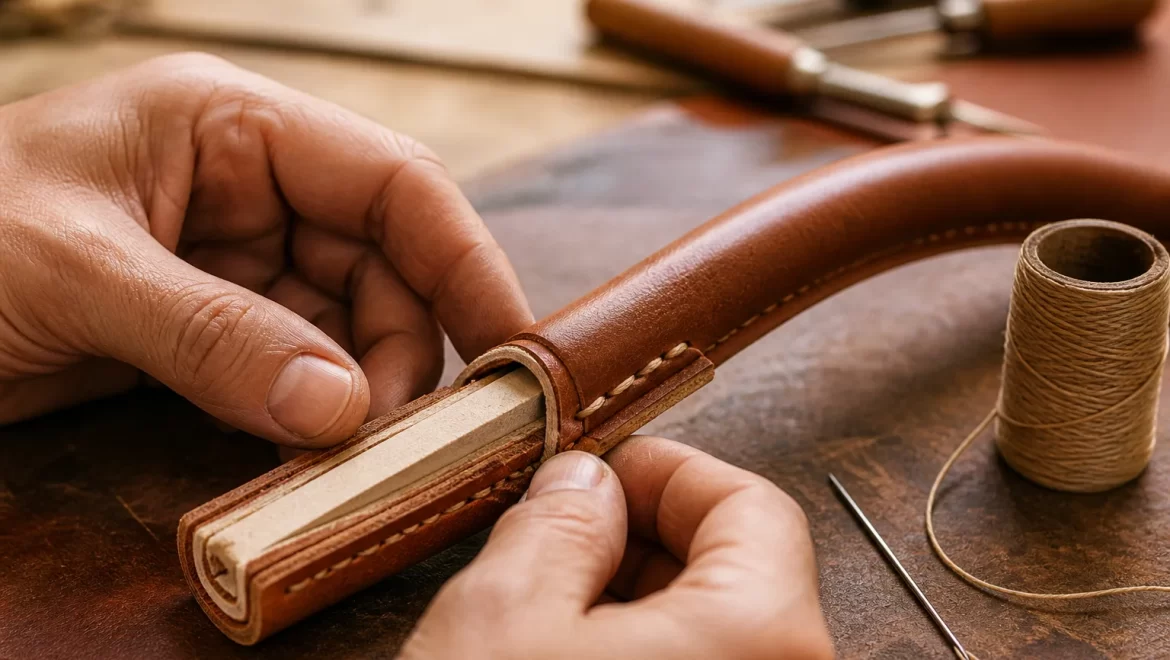
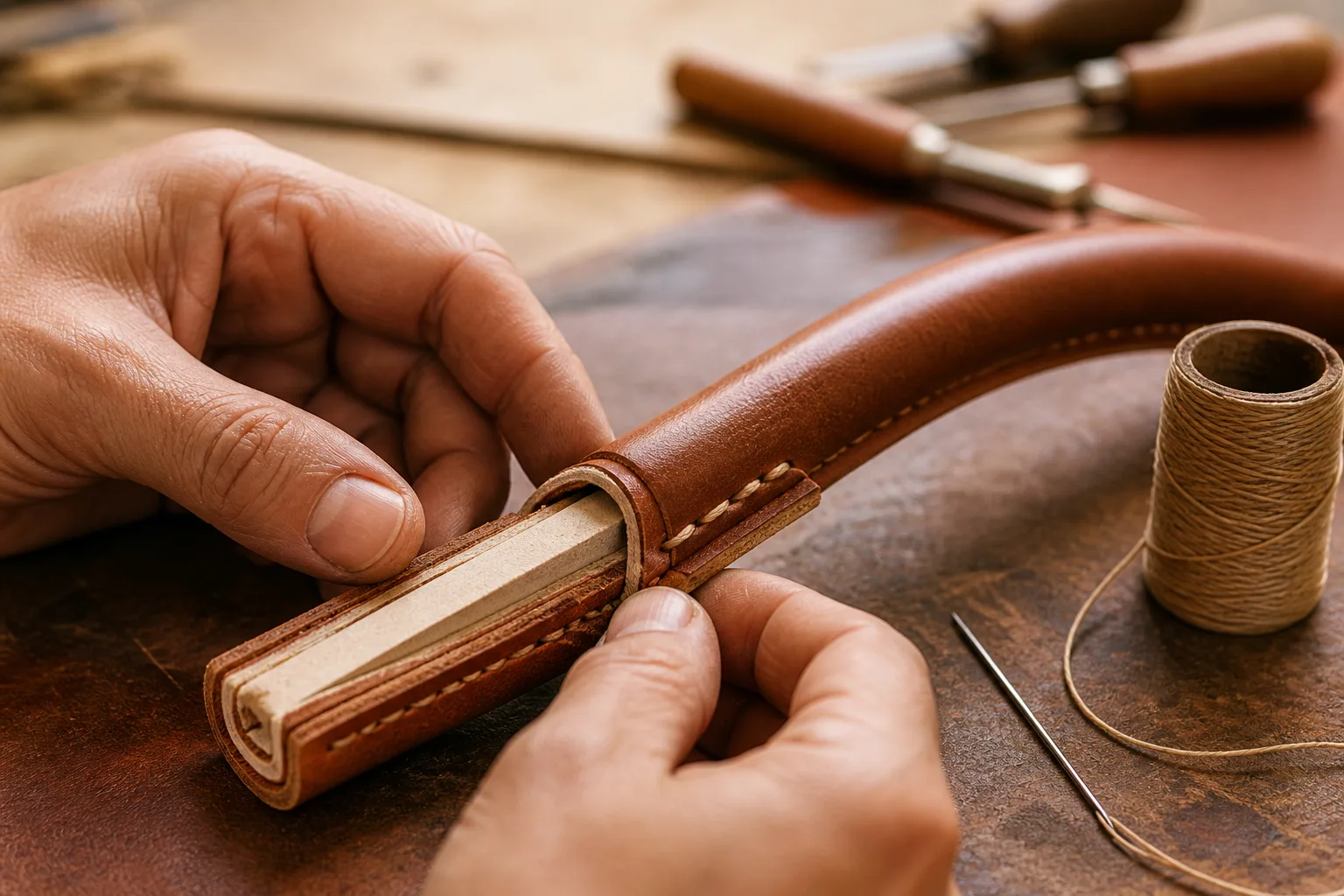
The most common solution for working bags is a laminated handle: leather wrapped around a core of firm leather, nylon or synthetic strip, with the layers glued and stitched together.
The core prevents the handle from stretching under load, which is the single biggest cause of handle failure. It also holds the handle's shape over years of use, keeping it looking new for longer.
Rolled and Tubular Handles
Rolled handles wrap leather around a cord or tube, producing a rounded profile that sits comfortably in the hand. Strength depends on the cord and the quality of the adhesion between leather and core.
If the leather is not bonded consistently, the roll can shift or open over time, which is why this construction demands careful process control rather than just good material.
Webbing-Leather Hybrids
Heavy utility and travel bags often combine a woven webbing core with a leather facing. The webbing carries the load with near-zero stretch, while the leather provides the appearance and hand feel of a premium bag.
This construction offers the highest strength-to-weight ratio and is the standard choice when the handle must survive airport handling and heavy loads.
Reinforcement: What Happens Inside the Handle
Handle strength comes from what is hidden inside the construction. Buyers who understand the internals can ask the right questions and read a sample correctly.
Core Materials
Cores range from a firm leather strip to nylon webbing, polyester tape, or a rigid synthetic insert. The requirement is low stretch under sustained load and enough flexibility to follow the handle's curves.
Nylon and polyester cores are common because they resist stretching far better than leather, while a leather core offers a more natural hand feel and works well with traditional constructions.
| Core material | Stretch resistance | Hand feel | Best for |
|---|---|---|---|
| Firm leather strip | Moderate | Natural, traditional | Premium classic bags |
| Nylon webbing | Excellent | Slightly firm | Totes, daily-use bags |
| Polyester tape | Very good | Firm | Utility and travel bags |
| Rigid synthetic insert | Excellent | Stiff | Structured business bags |
| Cord / tube (rolled) | Good | Rounded, soft | Soft handbags |
Backing Patches and Load Spreading
At each attachment point, factories often add a reinforcement patch behind the leather: an extra layer of firm leather or a bonded reinforcement that spreads the load across a larger area.
The patch is usually stitched and sometimes bonded, and its size and material determine how much stress the bag body can absorb. A larger patch reduces stress per square centimeter, which directly extends the handle's life.
Rivets, Stitching or Both
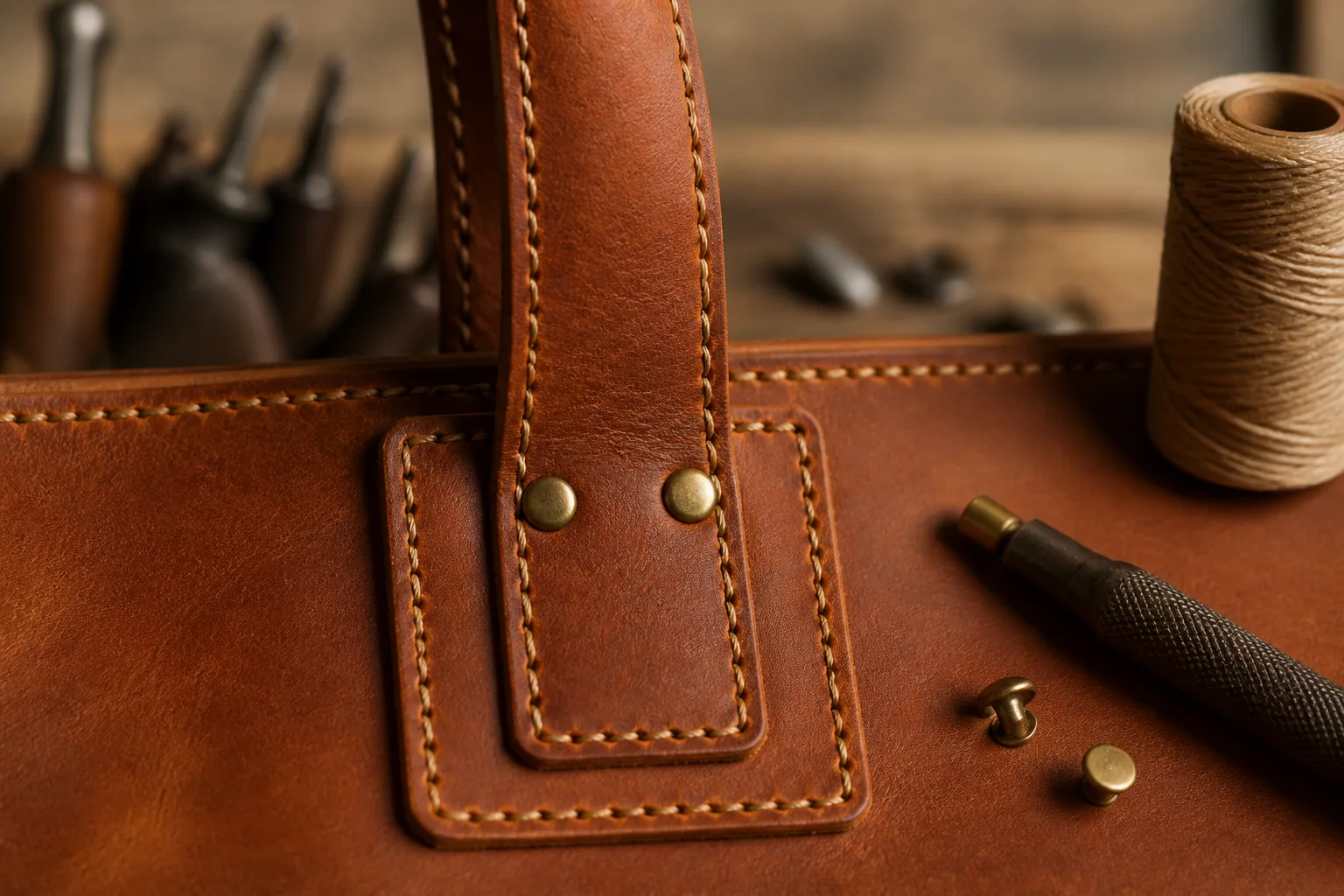
Rivets provide a mechanical connection that does not rely on thread, while stitching distributes load along a line. Used together, they cover different failure modes: rivets hold if a seam fails, and stitching holds if a rivet loosens.
Cheap bags often use rivets alone because they are fast to install. Better bags combine both, and the combination is a reliable indicator of a factory that takes handle engineering seriously.
Attachment Points: Where Loads Transfer to the Bag
The attachment is where the handle meets the bag, and it is the most failure-prone junction in the entire product.
Stitch-Only Attachments
On lighter bags, the handle is simply stitched to the body or to a folded tab. This is clean and inexpensive, and it works when loads are modest and the leather is firm.
The risk is that stitches concentrate stress at each hole. Factories mitigate this with a reinforcement patch, denser stitch spacing, and thread chosen for abrasion resistance rather than appearance alone.
Hardware Attachments
Rings, D-rings and rectangular loops distribute load through metal rather than stitching alone. The handle connects to the hardware, and the hardware connects to the bag through a stitched tab or a reinforced panel.
The hardware itself must be rated for the load: a thin decorative ring will deform long before the leather fails, which transfers the failure to an inconspicuous but critical part.
Recessed and Cut-In Attachments
Some designs recess the handle into the bag body, which looks cleaner but concentrates stress at the edges of the cut. Factories reinforce these openings with bonded patches and sometimes with a shaped insert to prevent the leather from tearing.
Buyers should inspect recessed attachments closely on samples, since the failure mode here is a tear rather than a loosened seam, and tears are not repairable.
Spreading Stress Across the Body
The most effective reinforcement is a plate or panel that spreads handle load across a wide area of the bag body. This is why better totes show a stitched square or rectangle around each handle root: that visible patch is doing structural work.
Load Testing: How Factories Verify Strength
Testing turns handle design from opinion into evidence. Factories use four families of tests, each targeting a different failure mode.
Static Dead Load Testing
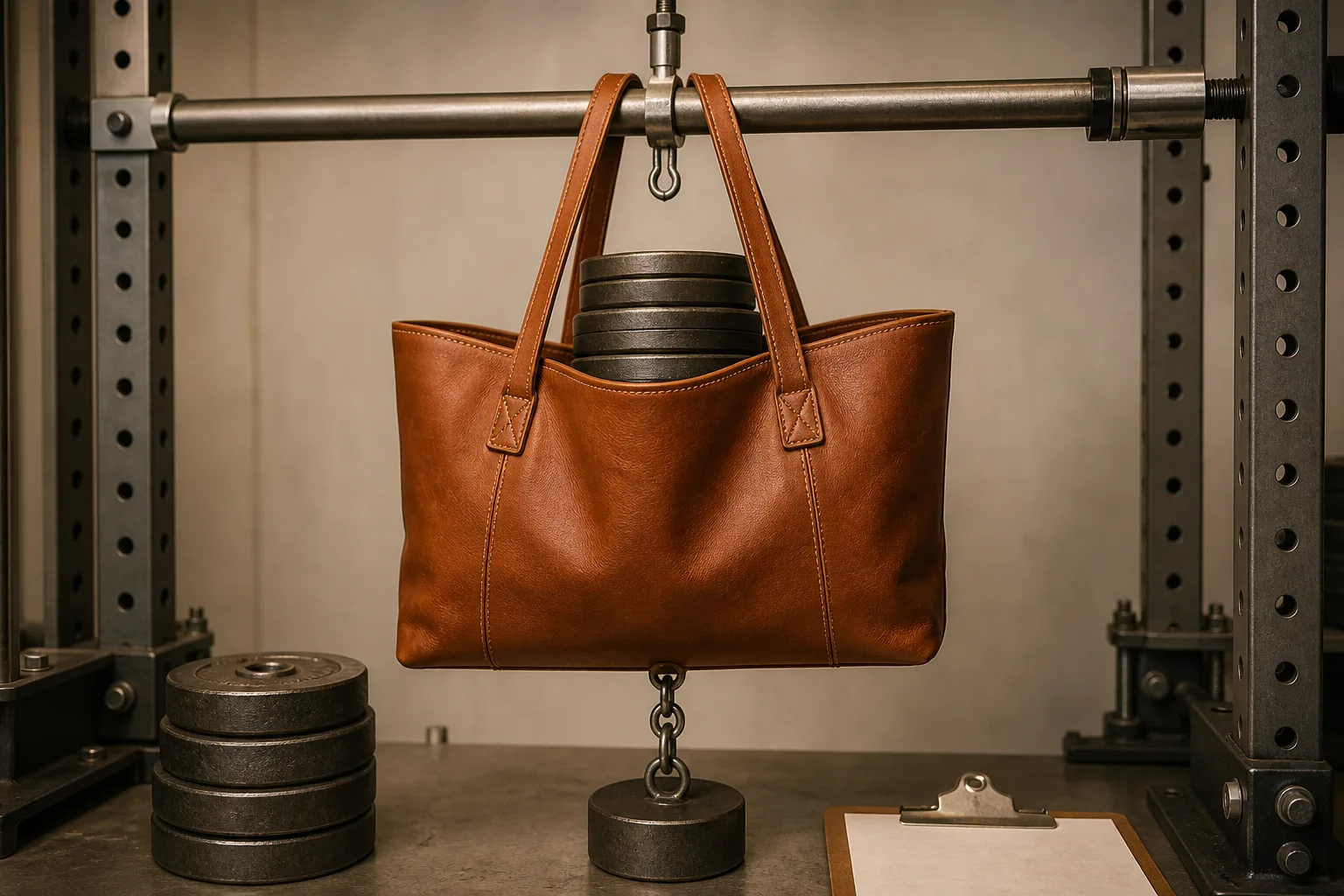
The simplest and most informative test hangs a bag from its handles with a fixed weight and leaves it there. Standard practice is 1.5 to 3 times the rated load, held for 24 to 72 hours.
The test reveals stretch and creep: leather that elongates under sustained load will show it, and attachments that are marginal will begin to separate. A handle that survives static loading without measurable extension is fundamentally sound.
Dynamic Swing and Cyclic Testing
Real use is dynamic. Cyclic testing lifts and lowers the bag, or swings it through a fixed arc, repeating hundreds or thousands of times with the rated load inside.
This test exposes fatigue: thread abrasion, hole enlargement and gradual loosening at attachment points. A handle that passes static testing can still fail cyclic testing if the stitching or the leather at the junction is marginal.
Pull-Off Testing for Hardware and Attachments
Hardware and attachment junctions are tested by pulling the handle away from the bag with a controlled force until either the target load is sustained or failure occurs.
Factories record the failure load and mode. If the hardware deforms before the leather, the hardware is undersized; if the leather tears, the reinforcement patch is too small.
| Test | Method | Typical target | What it reveals |
|---|---|---|---|
| Static dead load | Hang with 1.5–3× rated load, 24–72 h | No extension beyond 2% | Creep and stretch |
| Cyclic swing | Repeat lift/lower 500–5,000 cycles | No loosening or abrasion | Fatigue life |
| Pull-off | Pull handle from body to failure | ≥3× rated load | Attachment strength |
| Hardware deformation | Load D-ring or loop to failure | No deformation at rated load | Hardware sizing |
| Stitch abrasion | Cyclic load on stitched sample | No thread failure | Thread and stitch choice |
Destructive Testing
At development stage, factories deliberately break handles to learn where the limit sits and which component fails first. Destructive testing is the only way to establish a genuine safety margin, and it should be done on every new construction.
The result of a good destructive test is a clear answer: the handle failed at this load, at this point, for this reason. That answer drives the design revision.
Weight Ratings: What They Really Mean
Weight ratings appear in specifications and marketing, but their meaning depends entirely on how the factory derived them.
How Ratings Are Established
A credible rating comes from testing, not from a guess based on bag size. Factories that rate a tote at 10 kilograms generally validated it through repeated loading at and above that weight, on the specific construction going to production.
If a supplier cannot explain how a rating was derived, treat it as a marketing number rather than an engineering limit.
The Safety Factor
Engineering practice applies a safety factor: the bag should survive several times its rated load. For leather goods, a factor of two to three times the rated load is a reasonable expectation for durable constructions.
This margin absorbs the real-world variables that testing cannot fully reproduce: heat, humidity, older leather, an unevenly packed bag and the sudden jerk of a hurried pickup.
| Bag type | Typical rated load | Practical test load | Notes |
|---|---|---|---|
| Clutch / small handbag | 1–2 kg | 3 kg | Light construction acceptable |
| Everyday handbag | 3–5 kg | 8–12 kg | Core reinforcement recommended |
| Work tote | 8–12 kg | 20–30 kg | Core plus reinforcement patches |
| Briefcase | 5–8 kg | 15–20 kg | Depends on hardware attachments |
| Weekender / duffel | 12–20 kg | 30–50 kg | Webbing core recommended |
Why Overloading Damages Permanently
Leather is a natural material with a memory. Load it beyond its elastic limit and the fibers do not fully return to their original length, which is why an overloaded handle looks stretched forever afterward.
Even if the handle does not break, the damage is done. Design and communication should therefore set honest expectations about how much a bag is meant to carry.
Strap Design: Width, Length and Comfort
Straps carry load against the body, so their design balances strength, comfort and adjustability.
Width and Pressure Distribution
A narrow strap concentrates the same load over less area, which increases pressure on the shoulder and accelerates wear on the strap itself. Wide straps distribute load and stay comfortable with heavier contents.
For bags rated above roughly 8 kilograms, a shoulder strap of 30 millimeters or more, ideally with a padded section, is a practical minimum for comfort and durability.
Adjustability and Hardware
Adjustable straps add buckles, sliders or loops, each of which is a potential failure point. Factories select hardware rated above the strap's working load and stitch the mounting tab with reinforcement.
A strap adjustment that slips under load is a common complaint. The fix is friction-correct hardware and a strap material that grips rather than slides.
Removable Straps and Shoulder Pads
Detachable straps use clips or rings, which introduces a new attachment at each end. These junctions deserve the same reinforcement as the handle roots: patches, dense stitching and, ideally, load-rated hardware.
Shoulder pads reduce pressure and protect the strap's edges from abrasion. They also hide a useful reinforcement zone where the strap material can be doubled without appearing bulky.
Common Defects and Warning Signs
Buyers inspecting samples and production should look for specific, observable warning signs rather than relying on overall impressions.
| Defect | Root cause | How to detect it |
|---|---|---|
| Stitch failure at root | Weak thread, no reinforcement patch | Load and inspect stitch line for gaping |
| Leather stretch | No core or wrong core material | Measure handle length before and after load |
| Hardware deformation | Undersized ring, loop or clasp | Load test and check for bending |
| Core shift | Insufficient bonding in laminated handle | Flex and feel for a moving core |
| Tear at recessed attachment | Missing or small reinforcement patch | Inspect cut edges under load |
| Strap slip | Wrong hardware friction or slick strap | Load and check adjustment holds |
Stitch and Thread Failures
Thread fails when it is too fine for the load, when stitch spacing is too sparse, or when the material is not abrasion resistant. Inspecting the root of the handle after a load test reveals gaping stitch lines long before a customer would see them.
Leather Stretch and Deformation
A handle that grows noticeably longer under load lacks an effective core. This defect is easy to measure: mark the handle length, apply the rated load for an hour, and compare.
Hardware and Attachment Defects
Undersized hardware deforms rather than breaks, which is harder to notice and therefore more dangerous. A D-ring that bends under test load will eventually open under real use and drop the bag.
Buyers should require hardware that shows no permanent deformation at three times the rated load, and should test the specific hardware in the specific size being quoted.
Inspecting Handles in Production
Sampling proves a design; production inspection proves consistency. Handle inspection belongs at three stages, and each stage catches a different problem.
Incoming and Cut-Stage Checks
Before assembly begins, inspectors verify the core material, the reinforcement patches and the leather strips that will become handles. Cores must match the approved specification in material and dimensions, and patches must be cut to the correct size.
Cut-stage checks catch substitution early, when correction costs the least. A softer core or a missing patch will not show up until testing, by which time the parts are already assembled.
Assembly-Stage Checks
During assembly, workers verify that patches are positioned correctly, stitching follows the marked line, and hardware is installed with the specified reinforcement.
Factories that produce consistent handles use jigs and marked positions rather than freehand placement. Consistency at this stage determines whether the hundredth bag tests the same as the first.
Final Load Verification
Before packing, a sample of finished bags is loaded to the rated weight and lifted, swung and set down repeatedly. The check is quick and it catches assembly errors that visual inspection alone would miss.
Some factories perform this on every unit; others on a statistical sample. Buyers should confirm which approach applies to their order and whether results are recorded.
Specifying Handle and Strap Requirements
A clear handle specification removes ambiguity from sampling and gives the factory a testable target rather than a subjective impression.
Define Load and Test Requirements
State the rated load for the finished bag, the safety factor you expect, and the tests you want performed with their pass criteria. This is the single most valuable paragraph in a bag specification.
| Spec element | What to write | Why it matters |
|---|---|---|
| Rated load | "Rated 10 kg contents" | Sets the design baseline |
| Safety factor | "Survive 3× rated load without damage" | Prevents marginal design |
| Static test | "30 kg static, 48 hours, ≤2% extension" | Measures creep |
| Cyclic test | "1,000 lift cycles at rated load" | Measures fatigue |
| Hardware | "No permanent deformation at 3× load" | Rules out undersized parts |
| Handles structure | "Core-filled laminated, 4 mm core" | Fixes internal construction |
| Attachment | "Reinforcement patch 60 × 40 mm, stitched and bonded" | Fixes load spreading |
| Report | "Test report with failure load and mode" | Provides evidence |
Specify Construction Internals
Describe the core material and thickness, the number of layers, the patch dimensions, and the stitch specification. When the internals are specified, a factory cannot quietly substitute a lighter construction to hit a price target.
Require Test Documentation
Ask for a written test report on the pre-production sample: device or method used, load applied, duration or cycles, and the result. Documentation is the difference between a claim and a verified capability.
Handle Design by Bag Type
Different bag categories place different demands on handles, and the construction should follow the use case rather than a single house standard.
| Bag type | Handle approach | Rated load | Critical reinforcement |
|---|---|---|---|
| Small handbag | Folded single layer, short drop | 1–2 kg | Small patch, dense stitch |
| Shoulder bag | Core-filled strap, wide pad | 3–5 kg | Patch plus strap doubling |
| Work tote | Laminated core handle, 6 mm core | 8–12 kg | Large patch, rivets plus stitching |
| Briefcase | Laminated handle or top bar | 5–8 kg | Hardware rated to load |
| Backpack | Reinforced webbing and leather | 8–15 kg | Bar-tack plus panel patch |
| Weekender / duffel | Wide rolled or laminated handles | 12–20 kg | Two-layer patch, box-X stitch |
| Laptop bag | Laminated handle with steel insert | 6–10 kg | Rigid bar spreading load |
Totes and Shoulder Bags
Totes concentrate the most demanding daily load pattern: heavy, frequent, and often carried on one handle. A core-filled laminated handle with a generous root patch is the practical baseline.
Briefcases and Business Bags
Business bags often use hardware attachments and a shorter handle drop. The hardware becomes the critical component, so it must be load-rated and verified for deformation rather than appearance alone.
Backpacks and Travel Bags
Backpacks and travel bags spread load across two straps and the body, which lowers stress per point but increases total load and cycle count. Bar-tack reinforcement and wide patches on the attachment panel are standard.
Communicating Handle Quality to Customers
Technical quality only protects a brand if customers use the bag within its design envelope. Clear communication reduces failures that testing cannot prevent.
State the Load Rating Honestly
Publishing a realistic content rating prevents the misuse that causes most handle failures. A bag rated at 8 kilograms should not be marketed with photographs of it stuffed beyond that, because customers will repeat what they see.
Include Simple Care Guidance
Leather handles benefit from straightforward advice: avoid sustained overloading, do not hang a loaded bag by a single handle for long periods, and keep leather conditioned so fibers stay supple rather than dry and brittle.
These notes take one paragraph in a care card and reduce a meaningful share of edge-case failures, especially stretching and stitch abrasion.
Align Warranty Terms With Testing
Warranty language should match the tested capability of the product. If the construction is tested to three times the rated load, the warranty can reasonably cover defects in materials and workmanship while excluding clear misuse.
Making that distinction explicit protects the factory and sets accurate expectations, which is ultimately what reduces disputes on both sides.
Handle Quality Tiers and What They Cost
Handle construction scales with price point, and understanding the tiers helps brands match investment to positioning.
Entry-Tier Construction
Entry-level bags use a folded single-layer handle with a modest reinforcement patch and stitch-only attachments. This is acceptable for light loads and short carry distances, provided the rating is honest.
Mid-Tier Construction
Mid-tier bags add a core, a larger patch, denser stitching and sometimes rivets. This tier survives daily commuting loads and represents the best cost-to-durability ratio for most brands.
Premium Construction
Premium bags combine laminated handles, load-rated hardware, generous reinforcement, multiple stitching rows and documented load testing. The cost increase is real but modest relative to the retail positioning it supports.
Reducing Handle Failures Without Raising Cost
Not every improvement requires more material. Several design decisions reduce failure risk at little or no additional cost.
Match the Construction to the Rated Load
The cheapest way to prevent failures is to stop under-building. A bag rated at 10 kilograms should not use a handle designed for 3, and a factory that understands the rating builds accordingly.
Use Load Spreading Instead of Thicker Leather
A larger reinforcement patch often outperforms a thicker handle, because stress concentration, not material thickness, causes most failures. Spreading load across the bag body is inexpensive and highly effective.
Choose Abrasion-Resistant Thread
Thread that resists abrasion extends handle life at a trivial cost difference. This is a specification choice, not a price choice, and it should be stated explicitly.
Test Early, Test Cheaply
Destructive tests cost one sample. Discovering the same weakness after 2,000 units are in a warehouse costs a recall. Early testing is the cheapest quality investment in the entire development cycle.
Auditing a Factory's Handle Capability
Before placing production, it is worth confirming that a factory can actually build and verify the handle construction the design requires.
Questions That Reveal Capability
Ask how cores are sourced and verified, whether reinforcement patches are cut to a template or improvised, and how stitch density is controlled. Factories with real capability answer in specifics.
Ask also to see a test report from a previous order. A factory that documents load tests as routine practice will produce one without hesitation.
Equipment and Records
A factory serious about handle quality typically has a load testing setup, whether a simple hanging rig with calibrated weights or a dedicated testing frame, plus records of results per construction.
The equipment does not need to be elaborate. What matters is that testing is repeatable and recorded, so that a handle approved on sample can be verified again next season.
Consistency Over Time
Finally, ask how the factory maintains consistency between runs: fixed core suppliers, documented specifications and in-process checks. Handle quality drifts when any of those are left to memory.
FAQ
How much weight should a leather bag handle carry?
A: Ratings depend on construction: light handbags 1 to 2 kilograms, everyday handbags 3 to 5, work totes 8 to 12, and weekenders 12 to 20 kilograms. The rating must match the handle's internal construction.
How do factories test handle strength?
A: They use static dead load tests at 1.5 to 3 times the rated load held for 24 to 72 hours, cyclic lift and swing tests, pull-off tests on attachments, and destructive tests to establish the actual failure point.
What is a safety factor for bag handles?
A: A typical expectation is that a handle survives two to three times its rated load. This margin absorbs humidity, aged leather, uneven packing and the sudden loads of everyday handling.
Why does my handle stretch and stay stretched?
A: The handle lacks an effective low-stretch core, so the leather fibers deform beyond their elastic limit. A laminated construction with a nylon, polyester or firm leather core prevents this.
Are rivets or stitching stronger for handle attachment?
A: Neither alone is best. Stitching spreads load along a line and rivets provide a mechanical backup. Combining both covers different failure modes and is standard on quality bags.
What is a reinforcement patch and why does it matter?
A: A reinforcement patch is an extra layer behind the handle root that spreads load across a larger area of the bag body. It is the single most effective low-cost way to prevent handle failures.
How wide should a shoulder strap be?
A: For bags rated above about 8 kilograms, a strap of 30 millimeters or wider, ideally with a padded section, distributes load comfortably and resists wear better than narrow straps.
How can I tell if hardware is strong enough?
A: Require hardware that shows no permanent deformation at three times the rated load. Undersized rings and clasps bend before they break, which is harder to spot and just as dangerous.
What causes handles to fail at the attachment point?
A: Stress concentration. Load converges at the root, enlarging stitch holes and stretching leather fibers until the seam separates or the leather tears. Patches, denser stitching and correct thread prevent it.
Should handles be tested on every production run?
A: At minimum, test the pre-production sample destructively and verify a sample of finished bags from each production lot. Consistency drifts as workers and materials change between runs.
What does a handle test report contain?
A: A credible report states the test method, applied load, duration or cycle count, result, and the failure load and mode when tested to destruction. Without it, a rating is only a claim.
Can a bag be repaired if a handle fails?
A: A failed seam can often be restitched and reinforced. A torn handle root or a torn recessed attachment usually cannot be restored invisibly, which is why reinforcement matters more than repair.
Does a thicker handle always mean a stronger handle?
A: No. Stress concentration at attachment points causes most failures, so a well-reinforced thinner handle can outperform a thick handle with a small patch and sparse stitching.
How do I specify handle requirements in a tech pack?
A: State the rated load, required safety factor, test methods with pass criteria, core material and thickness, patch dimensions, stitch specification and hardware rating, and request a test report.
Why do cheap bags use rivet-only attachments?
A: Rivets are fast to install and require less skilled labor than reinforced stitching. They work when correctly sized, but without stitching they offer no backup if a rivet loosens or deforms.
What is the best handle construction for a heavy tote?
A: A laminated core-filled handle with a load-spreading patch at each root, dense stitching combined with rivets, and load-tested hardware. That combination handles daily loads of 8 to 12 kilograms reliably.
Ready to make sure your handles never become the weak point of your bag line? Send us your sample or tech pack and we will review the construction, recommend core and reinforcement specifications, and return a documented load test with failure point and mode before production begins.