How Should Metal Hardware Pass Salt Spray Testing on Pet Bags?
- Why Hardware Corrodes in a Pet Bag
- What Salt Spray Actually Tests
- Plating Systems for Bag Hardware
- Substrate Choice Under the Plating
- Hours, Cycles and What They Claim
- Neutral Salt Spray Versus Other Tests
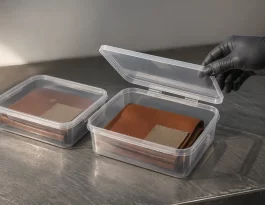
- Specimen Preparation and Handling
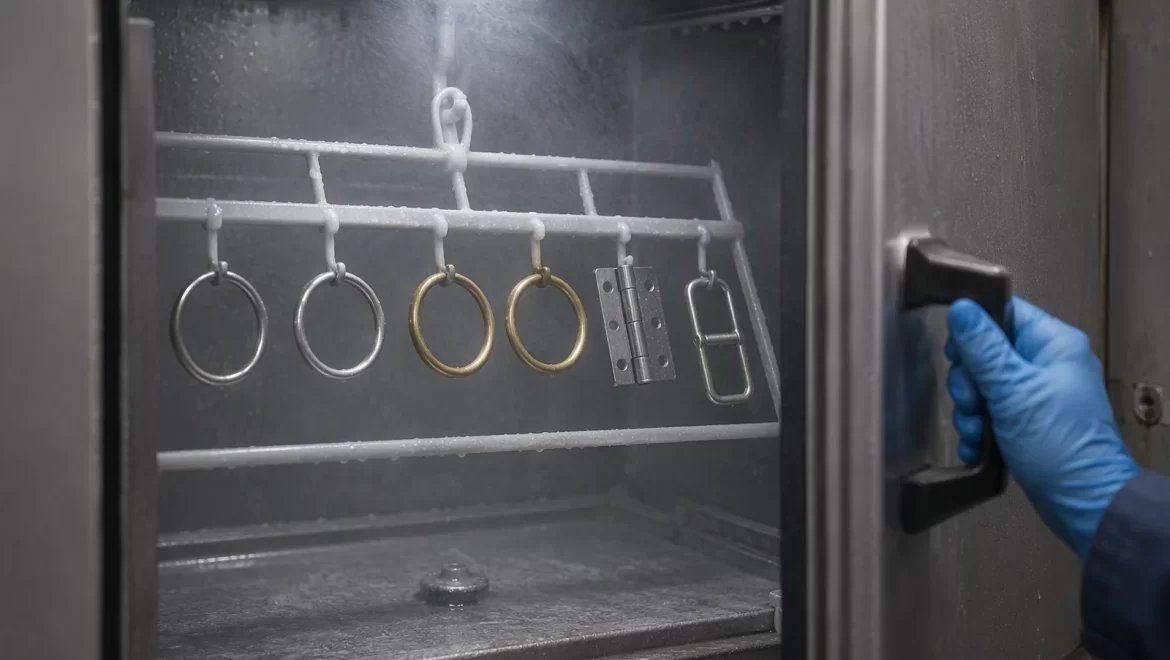
- Orientation and Contact in the Chamber
- Rating Methods for Corrosion
- Reading Blister, White Rust and Red Rust
- Setting an Acceptance Grade
- Hinges, Snaps and Moving Parts
- Rings, D-Rings and Load Points
- Zips and Sliders
- Rivets and Posts
- Hand Contact, Sweat and Urine
- Cleaning Agents and Abrasion
- Sampling Incoming Hardware
- Sampling Finished Bags
- Linking Failures to Plating Batches
- Supplier Declarations and Certificates
- Common Traps in Salt Spray Specifications
- Cost and Laboratory Choice
- What Buyers Should Ask For
- Corrective Action and Resubmission
- A Worked Example Across Three Parts
- Limits of Salt Spray as a Gate
- FAQ
Hardware is the part of a pet bag that shows corrosion first, and it does so on the outside where a customer sees it every day. Salt spray testing is how a factory finds out whether that will happen before the bags ship.
The test itself is simple and highly standardised. What is not standardised is the judgement: how many hours, which grade, which parts of the component are allowed to corrode, and what a passing result actually promises about a bag carried in winter on a salted street.
Why Hardware Corrodes in a Pet Bag
A pet bag exposes metal to a combination that most bag hardware was never specified for: sweat, urine, damp fur, cleaning agents and outdoor salt.
The Contact Chemistry
Human sweat is mildly acidic and contains chloride, and animal urine is worse on both counts. A ring sitting against damp fur sits in a mild electrolyte for hours at a time.
The Galvanic Problem
Where two different metals touch, moisture creates a small cell and the less noble one corrodes faster. A steel rivet in a brass ring is a corrosion pair waiting for a wet day.
The Exposure Pattern
The parts that fail are not evenly distributed. Handle attachment rings, leash clips and base feet take the most contact and the most abrasion, and they fail first.
| Exposure | Severity |
|---|---|
| Sweat contact | High |
| Urine contact | High |
| Damp fur | Moderate |
| Cleaners | Moderate |
What Salt Spray Actually Tests
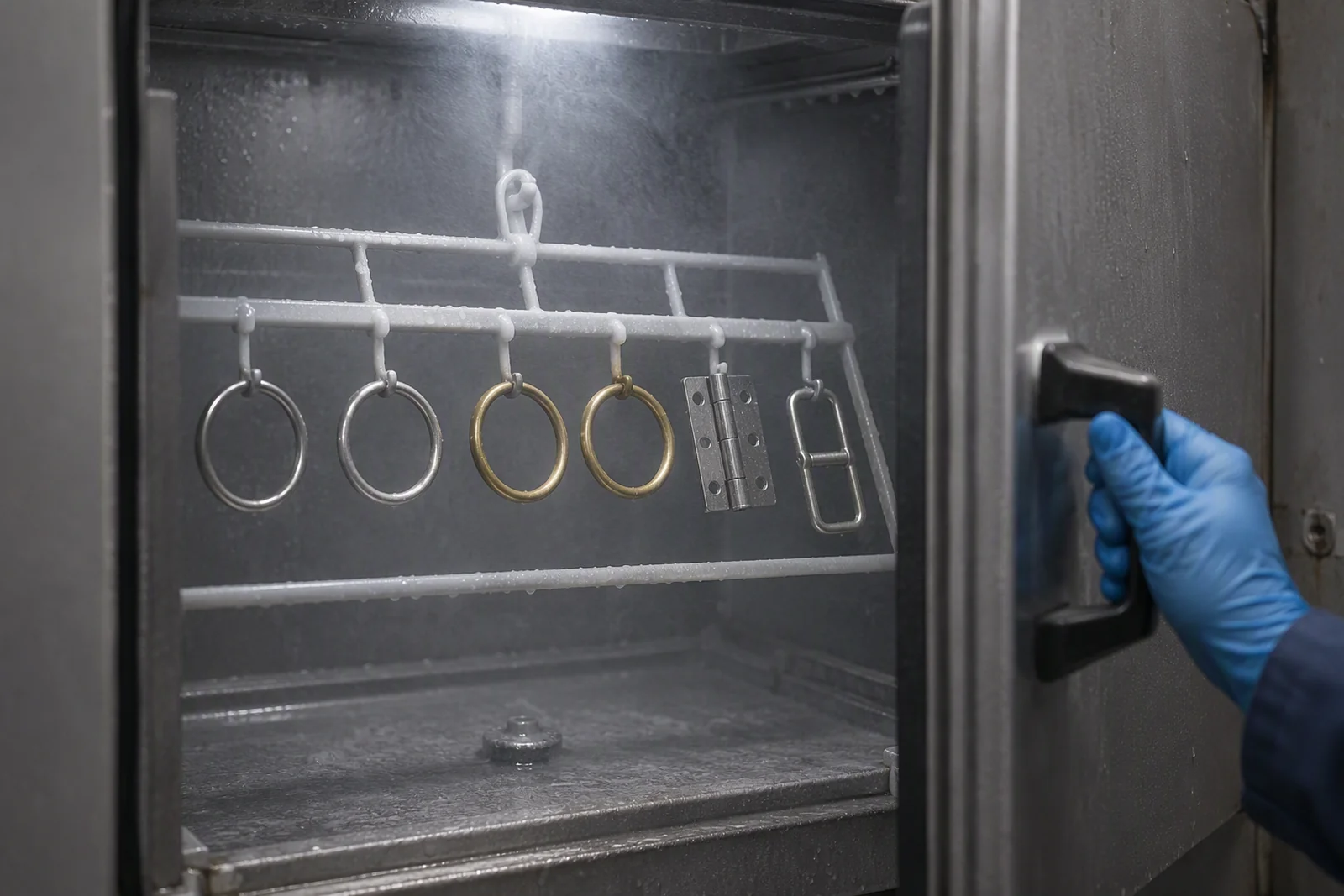
Salt spray is an accelerated corrosion test, and its value depends on understanding what it accelerates and what it does not.
A Continuous Electrolyte
The chamber keeps a fine salt fog on the specimen at a stated temperature, so the surface is wet and conductive continuously. Real life is intermittent, which is the first difference.
Time Compression, Not Prediction
A hundred hours in the chamber is not a hundred hours outdoors multiplied by a factor. The test ranks materials and detects process faults; it does not forecast a service life.
What It Detects Well
Poor coverage, thin plating, contaminated substrate and skipped process steps all show up quickly. Those are process faults, and they are the reason the test earns its place.
| Property | Detected |
|---|---|
| Coverage | Well |
| Thickness | Well |
| Substrate faults | Well |
| Service life | Poorly |
Plating Systems for Bag Hardware
The plating system decides how a component behaves in the chamber, and the same alloy with two finishes can differ by an order of magnitude.
Electroplated Finishes
Electroplating builds a metallic layer on a substrate, and its corrosion resistance depends on thickness and on the absence of porosity. Bright finishes often hide porosity better than matte ones.
Powder Coating and Paint
An organic coating is a barrier rather than a sacrificial layer. It resists salt well until it is scratched, and then corrosion spreads under the film and lifts it.
Antique and Plated Brass Effects
Antique finishes rely on a top coat over a darkened surface, and the coat is the weak point. Where the coat wears at a contact point, the effect disappears and the metal discolours.
| Finish | Behaviour |
|---|---|
| Electroplated | Thickness-led |
| Powder coat | Barrier |
| Antique | Top coat |
| Lacquer | Temporary |
Substrate Choice Under the Plating
Every plated part has a substrate, and the substrate decides what happens when the coating eventually fails.
Zinc Alloy Die Castings
Zinc alloy is the standard for buckles and rings because it casts detail well. It corrodes into white rust, which looks bad but is slow, and its plating adhesion is sensitive to casting quality.
Steel and Iron
Steel is stronger and cheaper and rusts into red oxide, which stains leather and fabric. Where a steel part is used, the plating has to be thicker and better sealed.
Brass and Copper Alloys
Brass offers good corrosion behaviour and a warm colour under worn plating. Its weakness is cost and weight, and its advantage is that wear looks like ageing rather than failure.
| Substrate | Corrosion |
|---|---|
| Zinc alloy | White rust |
| Steel | Red rust |
| Brass | Discolouration |
| Aluminium | Pitting |
Hours, Cycles and What They Claim
A hour figure is only meaningful with the method attached, because the same number under two methods describes two different tests.
The Standard Intervals
Common intervals in bag hardware are stated in tens or hundreds of hours. The interval chosen should follow the exposure of the part rather than the prestige of a larger number.
Why Longer Is Not Always Better
Beyond a point, extending the test rewards a thicker coating that may be brittle or dimensionally wrong. A hinge that no longer moves freely is not an improvement.
Matching Interval to Part
A handle ring needs a longer interval than a decorative stud that never leaves the panel. Applying one interval to every component wastes money and slows development.
| Part | Interval |
|---|---|
| Ring, clip | Long |
| Hinge, snap | Medium |
| Decorative stud | Short |
| Internal part | None |
Neutral Salt Spray Versus Other Tests
The neutral test is the default in the industry, and it is not the only option. Choosing the right one requires knowing what each simulates.
Neutral Salt Spray
A near-neutral salt solution at a stated temperature is the general-purpose test. It is the most comparable across suppliers because it is the most widely used.
Acetic Acid and Copper Accelerated
Acidic variants shorten the time to a result and suit some plating systems. They are harsher and less comparable, so they are usually specified by a plating house rather than a brand.
Cyclic and Prohesion Tests
Cyclic tests alternate wet and dry periods, and they correlate better with outdoor behaviour. They take longer and cost more, which is why they are used for validation rather than per lot.
| Test | Best use |
|---|---|
| Neutral | Routine |
| Acidic | Plating validation |
| Cyclic | Field correlation |
| Immersion | Specific fault |
Specimen Preparation and Handling
Handling before the test changes the outcome, and most of the rules exist because a fingerprint or a scratch accelerates corrosion at exactly that spot.
Degreasing
Parts should be degreased before testing, because handling oils create a local barrier that hides and then concentrates corrosion. A standard degreasing step makes results comparable.
Avoiding Contact Damage
Specimens should be handled with clean gloves and mounted without scratching. A scratch introduced during mounting is indistinguishable in the report from a plating fault.
Number of Specimens
Three parts per batch is the practical minimum, because corrosion is not uniform and one part can mislead in either direction.
| Rule | Reason |
|---|---|
| Degrease | Remove oil |
| Gloves | No prints |
| No scratches | No false fault |
| Three parts | See scatter |
Orientation and Contact in the Chamber
How a part sits in the chamber decides where fog collects, and a part mounted badly can pass or fail for reasons unrelated to plating.
Racking Angle
Specimens are typically mounted at a stated angle so that fog runs off rather than pooling. A flat-mounted ring collects droplets in its inner curve, and that spot corrodes first.
Shielding and Stacking
Parts that touch each other shield the contact area and create crevice corrosion. Spacing them apart gives each one the same exposure and makes the result readable.
Edge Effects
Cut edges and sharp radii attract corrosion because the coating is thinnest there. That is a real weakness, and it should be judged rather than hidden by mounting.
| Mounting | Effect |
|---|---|
| Angled | Realistic |
| Flat | Pooling |
| Stacked | Crevice |
| Edges | Thin coat |
Rating Methods for Corrosion
A rating converts a surface into a number, and the number is only useful when the method behind it is stated.
Percentage Area
The simplest method estimates the percentage of surface affected. It is quick and coarse, and it is adequate for a go or no-go decision.
Reference Standards
Pictorial reference standards remove some subjectivity by matching the specimen to a printed scale. They work best when the assessor is calibrated against them.
Descriptive Grading
A written description of the type and location of corrosion is more useful than a number for a corrective action. It is also the hardest to standardise.
| Method | Strength |
|---|---|
| Area percent | Fast |
| Reference chart | Consistent |
| Description | Actionable |
| Combination | Best |
Reading Blister, White Rust and Red Rust
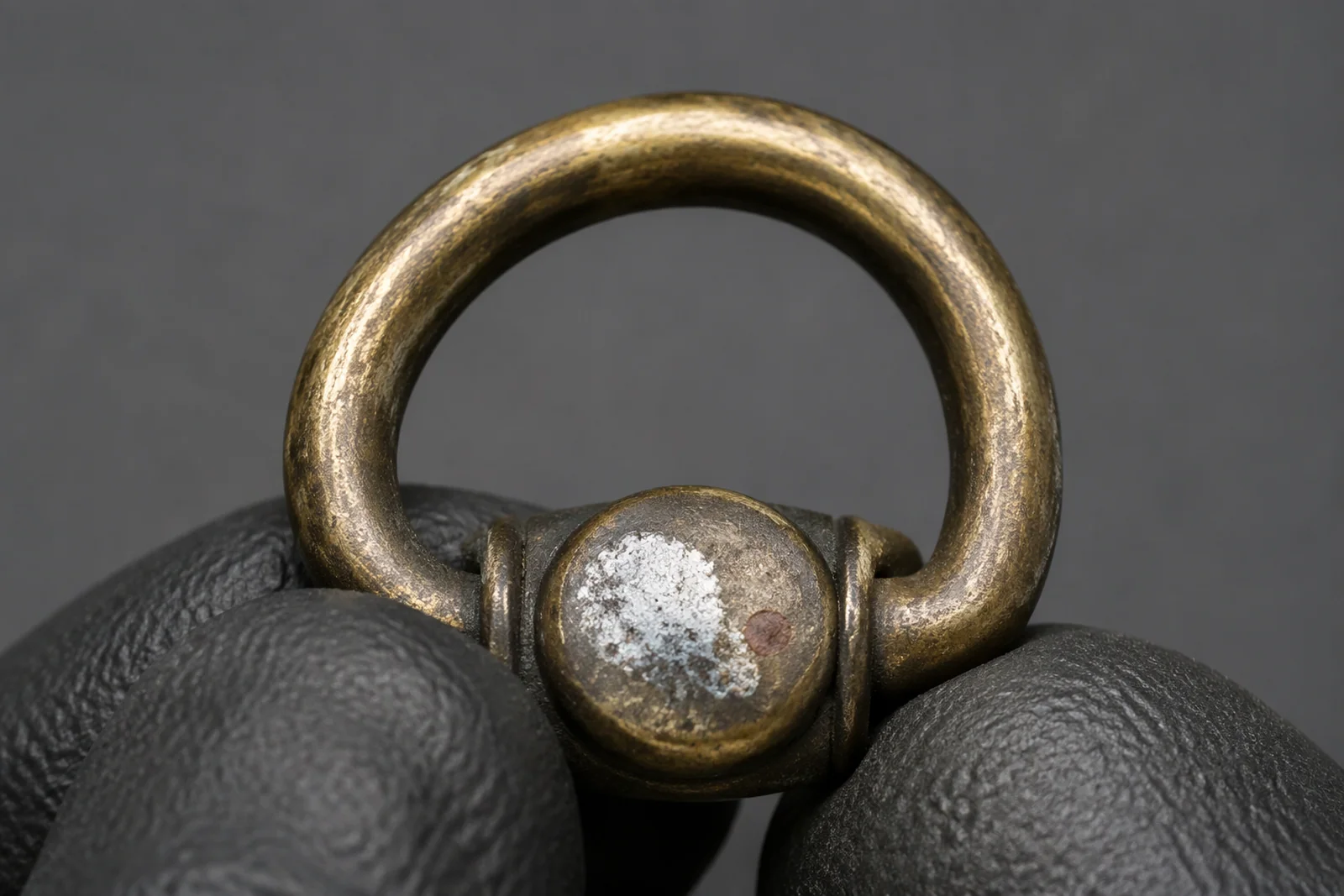
The morphology of corrosion tells you what failed, and each form points to a different point in the plating process.
White Rust
White or grey corrosion products come from zinc. It indicates a coating that is intact but sacrificing itself, which is normal until it becomes visible and powdery.
Red Rust
Red oxide means the substrate has been reached, so the coating has failed locally. A single red spot is a more serious finding than a wide area of white.
Blistering and Lifting
Bubbles or lifting film indicate poor adhesion or contamination before plating. This is a process fault that will spread, and it should be rejected rather than graded.
| Appearance | Meaning |
|---|---|
| White powder | Zinc working |
| Red spot | Substrate exposed |
| Blister | Adhesion fault |
| Lifting | Contamination |
Setting an Acceptance Grade
An acceptance grade should name the part, the interval, the permitted corrosion and the locations where none is permitted.
Functional Versus Visible
A hinge pin can tolerate corrosion internally if it still moves. A ring face cannot, because the customer sees it. The grade should separate the two.
None at Contact Points
Where the part touches leather or fur, corrosion stains the material, and a stain is a defect even when the metal is sound. Contact areas should be graded strictly.
Writing It Down
Grade, interval, method and permitted area, in one line per part. Anything vaguer will be interpreted differently by each inspector.
| Element | Example |
|---|---|
| Part | Handle ring |
| Interval | Stated hours |
| Permitted | No red rust |
| Contact | No staining |
Hinges, Snaps and Moving Parts
Moving hardware fails differently from static hardware, because corrosion in a mechanism stops it working long before it looks bad.
Clearance and Corrosion
A hinge has clearance measured in fractions of a millimetre. A thin corrosion layer fills that clearance, and the hinge stiffens before any visible rust appears.
Lubrication as a Barrier
A light lubricant in a hinge reduces both wear and corrosion. It also attracts dust, so it has to be chosen for the application rather than added by habit.
A hinge that has been in a chamber for a long exposure is often stiff in the hand rather than visibly rusty, and that stiffness is the failure the customer will report. Testing movement costs a few seconds and catches what the photograph hides.
Testing in Motion
A static salt spray test does not exercise a hinge. A simple open-and-close cycle after exposure reveals seizure that the visual grade would miss entirely.
| Part | Failure |
|---|---|
| Hinge | Seizure |
| Snap | Stiff action |
| Swivel | Binding |
| Spring | Loss of travel |
Rings, D-Rings and Load Points
Load-bearing hardware combines corrosion with stress, and the combination is more damaging than either alone.
Stress Corrosion
A ring under load corrodes faster at the point of contact with the strap, because stress and electrolyte act together. That point is also the one hidden from view.
Wear at the Pivot
A D-ring rotates against its loop, and the movement wears the coating away. Once the coating is gone the substrate is exposed exactly where load is applied.
Grading the Contact Zone
The area inside the loop should be graded separately, because it is the first to fail and the least visible to a customer until the ring breaks.
| Zone | Risk |
|---|---|
| Contact with strap | High |
| Pivot | High |
| Outer face | Visible |
| Inner curve | Hidden |
Zips and Sliders
A zip is the one piece of hardware a customer uses every day, and a corroded slider turns a working bag into a returned one.
Slider and Pull
The slider is usually die-cast and the pull is usually stamped, which gives two different corrosion behaviours in one assembly. Both should be graded.
Teeth and Chain
Metal teeth corrode at the gaps between them, and that is where a zip begins to stiffen. Coated or plastic teeth avoid the problem and change the design language.
Testing a Zip Assembled
A zip tested as loose parts misses the effect of being sewn under tension. A short length sewn into a panel, exposed and then cycled, is the realistic version.
| Element | Grade |
|---|---|
| Slider | Strict |
| Pull | Moderate |
| Teeth | Strict |
| Tape | Not metal |
Rivets and Posts
Small parts carry a disproportionate risk, because a single corroded rivet stains a whole panel of leather.
Staining Rather Than Strength
A rivet rarely fails structurally before it fails visually. Rust bleeding into pale leather is irreversible, and it is the complaint that arrives with a photograph.
Plating on Small Parts
Small parts are often plated in bulk, and bulk plating gives uneven thickness. The cheapest rivet in a quotation is frequently the one with the thinnest coating.
Post and Screw Assemblies
A screw post is usually plated steel and the cap is die-cast, so the pair corrodes galvanically. Sealing the joint or matching the metals prevents it.
| Part | Risk |
|---|---|
| Rivet | Staining |
| Post | Galvanic |
| Screw | Crevice |
| Cap | Discolour |
Hand Contact, Sweat and Urine
Salt spray is a proxy, and the real electrolyte on a pet bag is more aggressive in ways the chamber does not reproduce.
Sweat as an Electrolyte
Sweat is warm, mildly acidic and rich in chloride, and it sits on a ring at body temperature. A part that survives neutral salt spray can still discolour at a handle within weeks.
Urine Exposure
Urine is a stronger electrolyte and often more acidic, and it reaches base hardware and zip sliders. Base parts deserve a stricter grade than the specification usually gives them.
An Artificial Sweat Test
An artificial sweat solution applied at body temperature is a practical supplement. It is cheap, quick and far closer to the complaint pattern than salt fog alone.
| Electrolyte | Severity |
|---|---|
| Salt fog | Baseline |
| Sweat | Higher |
| Urine | Higher still |
| Cleaners | Variable |
Cleaning Agents and Abrasion
A coated part that survives corrosion can still be destroyed by the cleaner a customer uses, and the two effects compound.
Solvent Attack
Alcohol-based cleaners soften lacquer and attack antique top coats. A part that passes salt spray and fails a wipe test has a specification gap, not a plating fault.
Abrasion Breaks the Barrier
Coating damage is the starting point for most corrosion on coated parts. A simple abrasion step before exposure shows how the part behaves after a season of use.
The order matters as much as the steps. Abrading after exposure removes the corrosion products and hides what the test found, so any sequence should be fixed in writing before it is first run.
Combined Sequences
Abrasion, then sweat, then salt spray is closer to service than any single test. It is also the sequence that explains most field failures.
| Sequence | Value |
|---|---|
| Salt only | Screening |
| Wipe only | Coating |
| Abrade then salt | Realistic |
| All three | Best |
Sampling Incoming Hardware
The cheapest place to reject a plated component is at goods inward, before it is sewn onto a panel that cannot be saved.
A Lot Definition
A lot is one plating batch, not one shipment. A shipment may mix two batches, and averaging them hides the one that will fail.
What to Test On Receipt
Three parts per lot, tested or sent for test, with the result recorded against the lot. The cost is trivial relative to the bag it protects.
A held lot delays the line, and the delay is usually smaller than the cost of the alternative. Where the schedule cannot absorb a hold, release against a retained part from the last passing batch and record the decision with a name against it.
Quarantine Until Result
Hold the lot until the result is known, or release against the previous batch's result with a documented risk. Holding is cheaper than a recall.
| Point | Action |
|---|---|
| Lot | Define by batch |
| Specimens | Three |
| Hold | Until result |
| Record | Per lot |
Sampling Finished Bags
Testing a finished bag is a different question from testing a component, and it answers whether assembly damaged the coating.
Handling Damage
Assembly involves pliers, hammers and setting tools, and each of them can chip a coating. A bag that fails where a rivet was set has an assembly fault, not a plating fault.
Access for Inspection
Base feet and inner rings are hard to see once the bag is closed. A mirror and a light are part of the inspection equipment, not an optional extra.
Frequency
Finished bag checks are periodic rather than per unit, because the question is whether the process is stable rather than whether this bag is good.
| Question | Test |
|---|---|
| Coating quality | Component |
| Assembly damage | Finished bag |
| Frequency | Periodic |
| Tools | Mirror, light |

Linking Failures to Plating Batches
A corrosion complaint is only actionable if it can be tied to a batch, and the link is usually lost at the plating house rather than at the bag factory.
Batch Identification
Ask the plating supplier to mark batches and to record the date and line. Without it, a failure identifies a period rather than a cause.
Comparing Batches
Where one lot fails and another passes, keeping a retained part from each makes the comparison physical rather than verbal. It is the fastest route to a root cause.
Feed Back to the Plater
Send the failed specimen back to the plater with the batch reference. Platers can read their own process from a specimen in a way a bag factory cannot.
| Step | Purpose |
|---|---|
| Batch mark | Trace |
| Retained part | Compare |
| Return specimen | Diagnosis |
| Written result | Record |
Supplier Declarations and Certificates
Paperwork does not prove corrosion resistance, but it does show whether the supplier knows what it is making.
What a Declaration Should State
Plating type, nominal thickness, substrate alloy and the test result with its method. Four items make a declaration checkable.
Why Thickness Matters Most
For electroplated parts, thickness is the strongest single predictor of hours to failure. A declaration without a thickness figure is a statement of intent.
Certificates and Their Limits
A certificate for a batch is not a certificate for the next one. It should be reissued per batch, or it becomes a historical document rather than a control.
| Document | Value |
|---|---|
| Plating type | Basic |
| Thickness | Predictive |
| Test result | Evidence |
| Per batch | Control |
Common Traps in Salt Spray Specifications
Five traps explain most of the specifications that pass in the laboratory and fail in the market.
Hours Without a Method
A hundred hours means nothing without the solution, temperature and mounting. Two laboratories can produce very different results from the same number.
Grading Only the Visible Face
The face a customer sees is the least exposed area. Grading it alone passes parts that are already failing at the pivot and the contact zone.
One Grade for Every Part
Applying a ring standard to a decorative stud over-specifies the stud and slows development without improving the bag.
Testing Loose Parts Only
Assembly damages coatings, and a loose-part result says nothing about the bag. At least one finished check belongs in every programme.
No Retained Specimens
Without retained parts, a complaint cannot be compared with a passing lot. The comparison is the only route to a cause.
| Trap | Consequence |
|---|---|
| No method | Incomparable |
| Visible only | Hidden failure |
| One grade | Waste |
| Loose only | Missed damage |
| No retention | No diagnosis |
Cost and Laboratory Choice
A salt spray programme is inexpensive per test and expensive per programme, and the balance depends on how many parts are covered.
Per Test Versus Per Batch
A chamber run costs about the same whether it holds three parts or thirty. Batching several components into one run is the single largest saving available.
In-House Versus Outsourced
A factory running many styles will justify a small chamber. A brand with two styles will not, and a service laboratory is the better arrangement.
Choosing a Laboratory
Choose one that reports the method, the mounting and the grade, and that will return the specimens. A report with a number and no method cannot be defended.
| Arrangement | Best for |
|---|---|
| Batched run | Most |
| In-house | Many styles |
| Outsourced | Few styles |
| Combined | Practical |
What Buyers Should Ask For
A buyer can verify a hardware programme with four requests, and none of them requires owning a chamber.
The Specification Line
Ask for one line per part: substrate, plating, thickness, interval and grade. A supplier who cannot write it has not specified the part.
The Report
Ask for a report that states the method and the mounting, not only the hours. The method is what makes the result comparable between suppliers.
The Retained Part
Ask for a retained part from the approved batch to keep as a reference. It becomes the physical standard for every complaint about corrosion.
The Correction Record
Ask what changed after the last failure. A programme without a correction history is a programme that has never acted on its own data.
| Request | Verifies |
|---|---|
| Spec line | Intent |
| Report | Method |
| Retained part | Standard |
| Correction | Action |
Corrective Action and Resubmission
A failed lot needs a path, and the path differs depending on whether the cause is at the plater or at the bag factory.
Plating Fault
Thin or porous plating is corrected at the plater by thickness control and bath maintenance. Resubmission should include the process change, not only a new result.
Assembly Fault
Chipped coatings and galvanic pairs are corrected at the bag factory by tooling, sealing and metal matching. A new plating batch will not fix them.
Resubmission Rules
Resubmit the same part, same method and same grade, from the corrected process. A resubmission that changes the method is a new test rather than a correction.
| Cause | Owner |
|---|---|
| Thin plating | Plater |
| Porosity | Plater |
| Chipping | Assembly |
| Galvanic pair | Design |
A Worked Example Across Three Parts
A short comparison shows how the decisions connect, using three components of the same carrier.
Setting the Grades
The handle ring takes the longest interval and a no-red-rust grade. The hinge takes a shorter interval and a function grade. The decorative stud takes a short interval and a visual grade only.
Running the Batch
All three go into one chamber run at a stated method, mounted at an angle and spaced apart. One report covers the set, which is the practical economy of the approach.
Reading the Outcome
If the ring passes and the hinge seizes, the problem is at the mechanism rather than the plating. If the stud blisters, the plater has a contamination problem that affects small parts first.
| Part | Grade | Likely fault |
|---|---|---|
| Ring | No red rust | Plating thickness |
| Hinge | Function | Clearance |
| Stud | Visual | Contamination |
Limits of Salt Spray as a Gate
The test is a screen rather than a guarantee, and treating it as a guarantee is how a specification ends up trusted more than it deserves.
Continuous Versus Intermittent
Service is wet and dry by turns, and drying concentrates salts in a way the chamber never does. A part can pass continuously and fail in a cycle it never saw.
No Mechanical Load
The chamber applies no load and no movement. Rings under tension and hinges in motion see conditions the test does not reproduce.
Ranking, Not Prediction
The most defensible use of the test is to rank two candidates or to detect a process change. Any statement about years of service goes beyond what the method supports.
| Use | Defensible |
|---|---|
| Ranking | Yes |
| Process change | Yes |
| Comparison | Yes |
| Service life | No |
FAQ
How many hours of salt spray should bag hardware pass?
A: There is no universal figure. Handle rings and leash clips need the longest interval, hinges a shorter one, and decorative studs a short visual check. The interval should follow exposure rather than prestige.
What is the difference between white rust and red rust?
A: White or grey products come from a zinc coating sacrificing itself, which is normal until it becomes powdery. Red rust means the substrate has been reached, so the coating has failed at that point.
Why does hardware corrode faster on a pet bag than on a handbag?
A: Because it meets sweat, urine, damp fur and cleaning agents rather than occasional hand contact. Those electrolytes are more aggressive than the neutral salt fog used in most tests.
Should the whole part be graded the same way?
A: No. The contact zone inside a ring and the pivot of a hinge fail first and are hidden, so they should be graded separately from the visible face.
Does plating thickness matter more than plating type?
A: For electroplated parts, thickness is the strongest single predictor of hours to failure. Type matters too, but a thin coating of a good type still fails early.
Why do small parts like rivets fail first?
A: Small parts are often plated in bulk, which gives uneven thickness, and their edges are thin. A corroded rivet also stains leather, so it fails visually before it fails structurally.
Can a coated part pass salt spray and still fail in use?
A: Yes. Powder coating and lacquer resist salt until they are scratched or wiped with solvent, and then corrosion spreads under the film. Abrasion before exposure shows this.
Is neutral salt spray the only option?
A: No. Acidic variants give faster results and suit plating validation, and cyclic tests correlate better with outdoor behaviour. Neutral remains the most comparable across suppliers.
What causes blistering in the chamber?
A: Poor adhesion or contamination before plating. It is a process fault that spreads, so a blistered part should be rejected rather than graded.
How many specimens per batch?
A: Three is the practical minimum, because corrosion is not uniform and a single part can mislead in either direction.
Should a zip be tested assembled or as loose parts?
A: Assembled. A zip tested loose misses the effect of being sewn under tension and cycled, which is where a corroded slider actually fails.
What is the most common specification mistake?
A: Quoting hours without a method. The same number under two mounting conditions or two solutions describes two different tests and cannot be compared.
Does assembly damage hardware coatings?
A: Yes. Setting tools, pliers and hammers chip coatings, and a failure at a rivet seat is an assembly fault rather than a plating fault.
What should be retained after approval?
A: One part from the approved batch, labelled with the batch reference. It becomes the physical standard for every later comparison and complaint.
How should a failure be handled?
A: Identify whether the cause sits with the plater or with assembly, correct that process, then resubmit the same part under the same method and grade.
Can salt spray results predict years of service?
A: No. The test ranks candidates and detects process change. Any claim about service life goes beyond what the method supports.
Ready to stop guessing which hardware will bleed rust onto pale leather? Write one specification line per part with substrate, plating, thickness, interval and grade, grade the contact zone and the pivot as well as the face, and test both loose parts and one finished bag. Then keep a retained part from the approved batch and let it settle every later argument.