Which Criteria Matter Most When Choosing Leather for Pet Carriers?
- Framing the Selection Problem
- Criterion One: Temper and Structure
- Criterion Two: Thickness and Substance
- Criterion Three: Scratch and Bite Resistance
- Criterion Four: Cleanability
- Criterion Five: Colour Fastness to Moisture and Rubbing
- Criterion Six: Weight and Area Yield
- Criterion Seven: Availability and Repeatability
- Grading the Hide Without Being Misled
- Matching Leather to the Part of the Bag
- Evaluating a Sample Properly
- Putting the Criteria Together
- Questions to Ask the Tannery
- Writing the Leather Specification
- Cost Against Durability
- Common Selection Mistakes
- FAQ
Leather selection for pet carriers is usually argued on appearance, and then settled on price. Both are poor proxies for what the product needs, because the failures that matter appear months later at the corners, the base and the opening.
The useful approach is to score a candidate hide against a small set of criteria that reflect how the carrier is used, then let price decide between options that already pass. What follows sets out those criteria, the order to apply them in, and how to test each one on a sample rather than on a description.
Framing the Selection Problem
A pet carrier is a bag with a live load inside it, and that changes what the leather has to do.
Loads the Leather Carries
The leather carries the animal's weight through the base and the end panels, carries the bag's own weight at the handle anchors, and carries repeated local pressure wherever hardware, straps or a harness rub against it.
Those loads are modest individually and cumulative in effect. A hide that is soft enough to look appealing in a showroom may be too soft to hold a base flat after a season of use.
Conditions the Leather Meets
Moisture arrives from three directions: weather outside, spills and accidents inside, and cleaning between them. Add abrasion from claws and grit, and the leather is being asked to tolerate a harsher regime than a handbag of the same construction.
Selecting on the expectation of a handbag is therefore the first mistake, and it is usually made before any sample is cut.
Why a Criteria List Beats a Preference
A list makes disagreement resolvable, because two people can compare scores instead of tastes. It also makes substitutions visible: when a lower-cost hide replaces a specified one, the criteria show what was given up.
The list below is ordered by consequence rather than by cost. Temper and thickness decide whether the bag functions; appearance decides whether it sells.
| Criterion | What it decides | Order of application |
|---|---|---|
| Temper and structure | Whether the bag holds shape | First |
| Thickness and substance | Load capacity and durability | First |
| Scratch and bite resistance | Survival in use | Second |
| Cleanability | Odour and hygiene | Second |
| Colour fastness | Appearance after moisture | Third |
| Weight and area yield | Carrying comfort and cost | Third |
| Availability and repeatability | Whether the range can be repeated | Third |
Criterion One: Temper and Structure
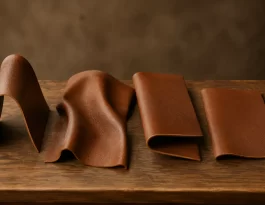
Temper describes how a leather behaves when it is handled: how it bends, whether it holds a fold, and how much it springs back.
Reading Temper on a Sample
Press a sample between thumb and forefinger and watch what happens when the pressure is released. A leather with good temper returns without leaving a crease; a soft leather stays creased where it was pinched.
Bend the sample across the grain and then along it. A hide that bends easily one way and resists the other will fight the pattern, and the difference shows up as puckering at the seams.
Temper for Structure
Panels that must hold a shape want a firmer temper, especially the base and the ends. Panels that must fold or gather want a softer one, which is why a single temper rarely suits a whole carrier.
Rather than compromise, most programmes use two leathers: a firmer article for structure and a softer one for the parts that move. The cost of splitting the buy is usually smaller than the cost of a bag that neither holds shape nor closes comfortably.
Temper After Wear
Temper changes with use. Leather softens where it is handled, and the areas around the handle and the opening soften first. A hide that starts at the correct firmness will loosen over a season, which is why the sample should be assessed as slightly firmer than the finished bag needs to be.
| Temper | Typical use | Risk if wrong |
|---|---|---|
| Firm, springy | Base, ends, structural panels | Cracking at folds if too firm |
| Medium | Body panels, gussets | Sagging over time |
| Soft, draping | Gathered sections, trim | Collapse at the base |
| Very soft | Decorative folds only | Loss of shape at load |
Criterion Two: Thickness and Substance
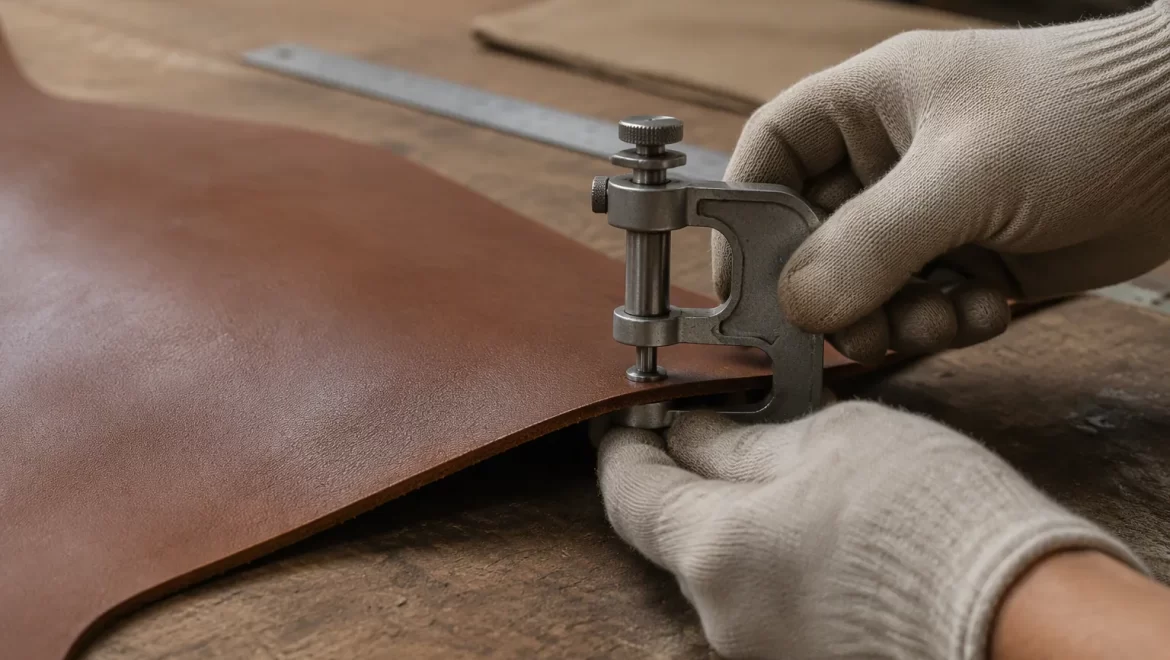
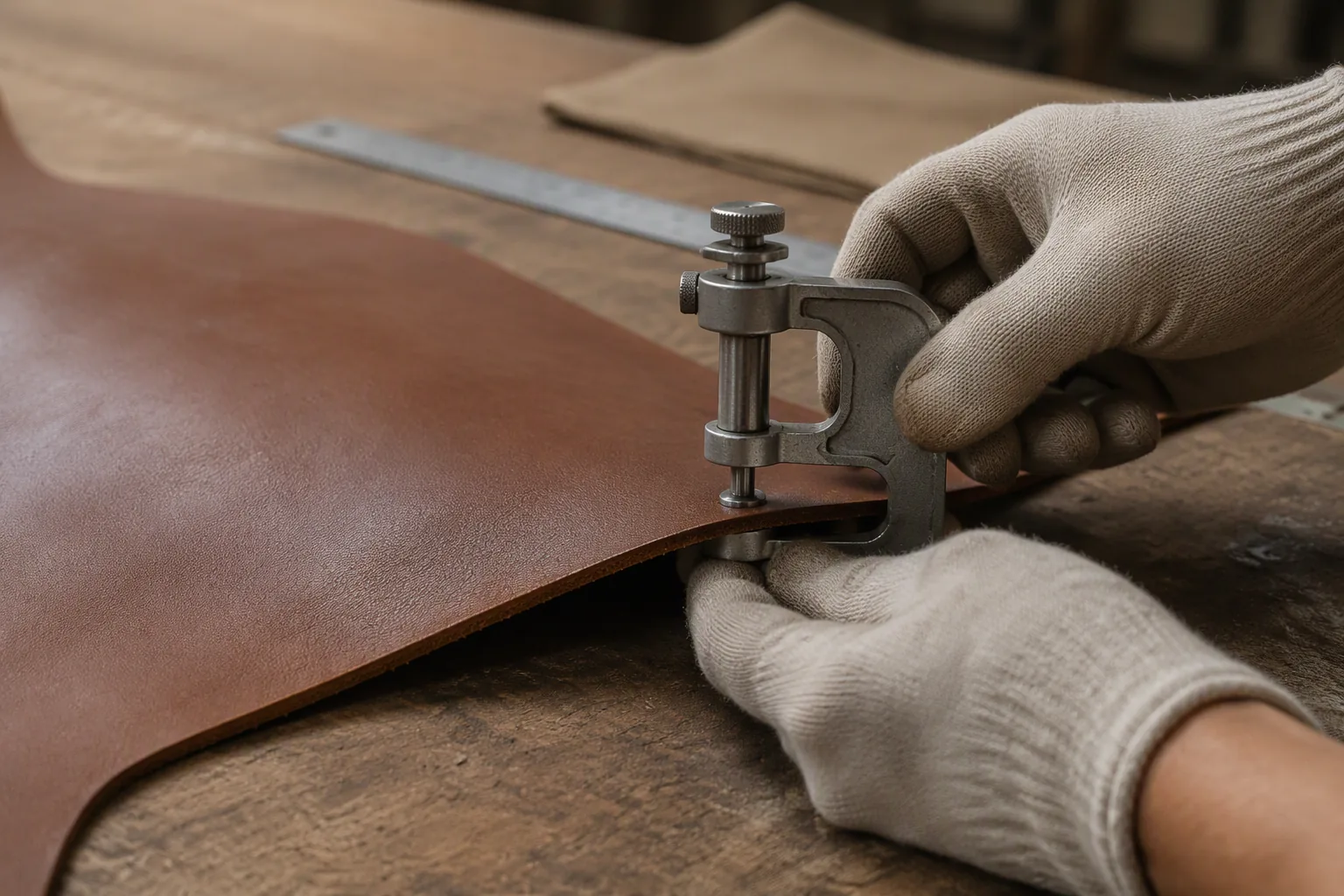
Thickness is quoted more often than it is understood, and two hides of the same thickness can behave very differently.
Thickness Versus Substance
Thickness is a measurement; substance is what that measurement delivers in a given hide. A densely structured hide at a lower thickness can be firmer and stronger than a loose hide at a higher one.
Buying on the number alone therefore rewards the wrong hide. The number should be treated as a tolerance to be met, while substance is judged on the sample.
Choosing Thickness by Part
A base needs enough thickness to resist local pressure from the animal's weight and from the hardware above it. Body panels can be thinner, because they carry less and benefit from lighter weight.
A practical sequence is to set the base first, then work outward. Setting the body first and then trying to find a base in the same article usually ends in a compromise at the base, which is the worst place to compromise.
Tolerances That Hold
A thickness tolerance narrower than the tannery can hold will be met on paper and missed in the goods. The tolerance should reflect what the supplier can control across a run, and the specification should say what happens outside it.
Where thickness varies within a hide, the thicker area should be reserved for the parts that need it rather than averaged across the cut.
A Working Thickness Guide
The figures below are starting points rather than rules, and they assume a hide of reasonable density. A denser article can go thinner; a looser one needs more substance to deliver the same firmness.
| Part | Starting substance | Adjust when |
|---|---|---|
| Base | Medium to firm | Animal weight is high |
| Ends | Medium firm | Opening must stay open |
| Body | Medium | Panel span is long |
| Handles | Firm, dense | Load is carried one-handed |
| Facings | Medium, closed surface | Cleaning is frequent |
Where a tannery cannot hold the guide across a hide, the thicker area should be reserved for the base rather than averaged across every panel.
Criterion Three: Scratch and Bite Resistance
Claws and teeth act on leather differently from abrasion, and a hide that resists rubbing can still mark badly under a claw.
What Claws Do
A claw concentrates force on a small area and drags. The damage is usually a shallow score rather than material removal, and it shows most on smooth, evenly coloured surfaces where any break in the surface catches the light.
Where the animal is likely to scrabble at the opening, that area deserves a firmer and more closed surface than the body panels.
What Teeth Do
Teeth compress rather than drag, and the risk is perforation or a crushed grain that later cracks. No standard leather resists a determined bite, so the design answer is to keep the leather away from where the animal can reach rather than to specify a tougher hide.
Where a chew-resistant zone is required, a reinforced or faced panel is more reliable than a thicker leather alone.
Judging Resistance on a Sample
A simple test with a blunt point drawn across the surface at modest pressure shows how a hide marks and whether the mark recovers. Comparing candidates on the same test, with the same pressure, is more useful than any single number.
The result should be recorded with the finish that will be applied, because the surface system contributes as much as the hide.
| Exposure | Where it occurs | Mitigation |
|---|---|---|
| Claw scrabble | Opening, door panel, lower body | Firmer, closed surface |
| Incidental scratch | Whole exterior | Grain that hides marks |
| Bite or chew | Zip pull, edges, straps | Keep out of reach, reinforce |
| Hardware rub | Anchor points | Local reinforcement |
Criterion Four: Cleanability
Cleanability is a selection criterion rather than an aftercare detail, because the interior of a pet carrier is cleaned far more often than a handbag.
Surfaces That Release Soil
A closed, smooth surface releases soil with a wipe; an open grain holds it. The difference is visible after two or three cleaning cycles, which is why a sample should be soiled and cleaned rather than merely inspected.
Where the design calls for a natural grain, the grain depth matters more than the finish name, because deep grain traps residue in the valleys.
Cleaning Cycles and Wear
Every cleaning cycle is also a wear event. A surface that needs aggressive cleaning to look acceptable will age faster than one that wipes clean, so the two criteria interact.
The practical question is not how the leather looks new, but how it looks after the cleaning regime the product will actually receive.
Edges and Seams
Soil collects at edges, seams and stitch lines regardless of the surface. Edge treatment and seam construction therefore belong in the cleanability assessment, not only in the appearance assessment.
A leather that wipes clean on a flat sample may still hold residue along a raw edge, and the edge is where odour begins.
Cleaning Regimes That Reveal Weakness
Cleanability is easier to judge by simulating the cleaning the product will receive than by inspecting a clean sample. Three passes are usually enough to separate candidates.
| Regime | Method | What it reveals |
|---|---|---|
| Wipe | Damp cloth, light pressure | Surface residue release |
| Wash | Mild soap, wipe and dry | Water fastness, tide marks |
| Scrub | Soft brush at the seam | Edge and stitch soiling |
| Repeat | Three cycles, same area | Cumulative wear |
| Dry | Air dry, no heat | Stiffening and colour shift |
A hide that only looks acceptable after a scrub is telling you how it will age in a household that cleans often, which is the norm for a pet carrier.
Criterion Five: Colour Fastness to Moisture and Rubbing
Colour failure in a pet product usually appears as transfer to the animal's coat or as a change where the bag has been wet, and both are selection problems.
Fastness to Water and Saliva
Water fastness describes whether colour moves when the leather is wetted. Saliva is a harsher test than clean water because it contains salts and enzymes, and a hide that passes one may fail the other.
For carriers used with animals that mouth the edges, the distinction matters and should be tested rather than assumed.
Fastness to Rubbing
Rubbing fastness is tested with a dry cloth and a damp cloth, and the results often differ. A hide can be dry-fast and damp-poor, which shows up as colour on a light cloth during cleaning.
Where the interior is light, transfer becomes visible quickly, and the complaint arrives early.
Colour Consistency Across a Run
Consistency is a separate question from fastness: whether two panels from different hides match under the same light. Variation is normal in natural material, and the specification should say what variation is acceptable.
Assessing consistency requires a light source that matches the point of sale; daylight and warm workshop light disagree, and the disagreement causes disputes.
| Test | Condition | What it predicts |
|---|---|---|
| Water spot | Wetted patch, dried | Tide marks after cleaning |
| Saliva contact | Warm saline solution | Edge colour loss |
| Dry rub | White cloth, pressure | Transfer to coat |
| Damp rub | Damp cloth, pressure | Colour on cleaning cloth |
Criterion Six: Weight and Area Yield
Leather is bought by area and consumed by the pattern, and the second number decides the real cost.
Weight in the Finished Bag
Weight is felt at the handle and is one of the first judgements a buyer makes. A leather that meets every other criterion but adds noticeable weight to an empty carrier will be criticised in use.
Because carriers are carried rather than wheeled, weight deserves more attention here than in a comparable handbag.
Yield and Cutting Loss
Yield describes how much usable area comes from a hide after defects and shape are accounted for. A cheaper hide with low yield can cost more per finished panel than a better hide with high yield.
Yield should be measured on the actual pattern, not estimated from the hide's nominal area, because the pattern's shape determines how much of the hide is usable.
Thickness and Weight Together
Thickness drives weight, so the two criteria have to be traded consciously. Where a hide is dense enough to deliver firmness at lower thickness, both weight and yield usually improve.
That trade is one of the few in leather selection that improves several criteria at once, which is why density is worth asking about directly.
Criterion Seven: Availability and Repeatability
A leather that cannot be bought again is a single-season material, and most ranges are intended to run longer than that.
Stock and Replenishment
Tannery stock levels differ from a stock held by a distributor, and a hide available in sample quantity may not be available in production quantity three months later.
The question to ask is not whether the article exists, but how much of it exists and how often it is run.
Consistency Between Lots
Repeatability covers colour, temper and thickness between lots. A tannery that runs an article continuously has more practice at matching it than one that runs it occasionally.
Where a range depends on a specific shade, the supplier should be able to show how previous lots were matched and what tolerance was held.
Second Sources
A second source protects the range but rarely matches exactly. Qualifying one deliberately, with a written tolerance, is better than discovering the need during a shortage.
| Availability question | Why it matters |
|---|---|
| Current stock in production quantity | Prevents a mid-season change |
| Typical reorder lead time | Sets the planning window |
| Lot-to-lot colour tolerance | Protects range consistency |
| Whether a second source is qualified | Reduces single-source risk |
Grading the Hide Without Being Misled
Hide grades are useful shorthand and poor specifications, because the terms describe area and defect count rather than the properties a carrier needs.
What Grades Describe
Grades generally describe how much of a hide is usable and how defects are distributed. They say little about temper, density or fastness, so two hides of the same grade can differ in the ways that matter here.
A high grade with the wrong temper is still the wrong leather.
Defects That Matter for a Carrier
Some defects are cosmetic and can be cut around; others affect strength. A healed scar on a body panel is a cosmetic decision, while a loose or thin area on a base panel is a structural one.
Mapping defects to pattern pieces is therefore more useful than counting them across the hide.
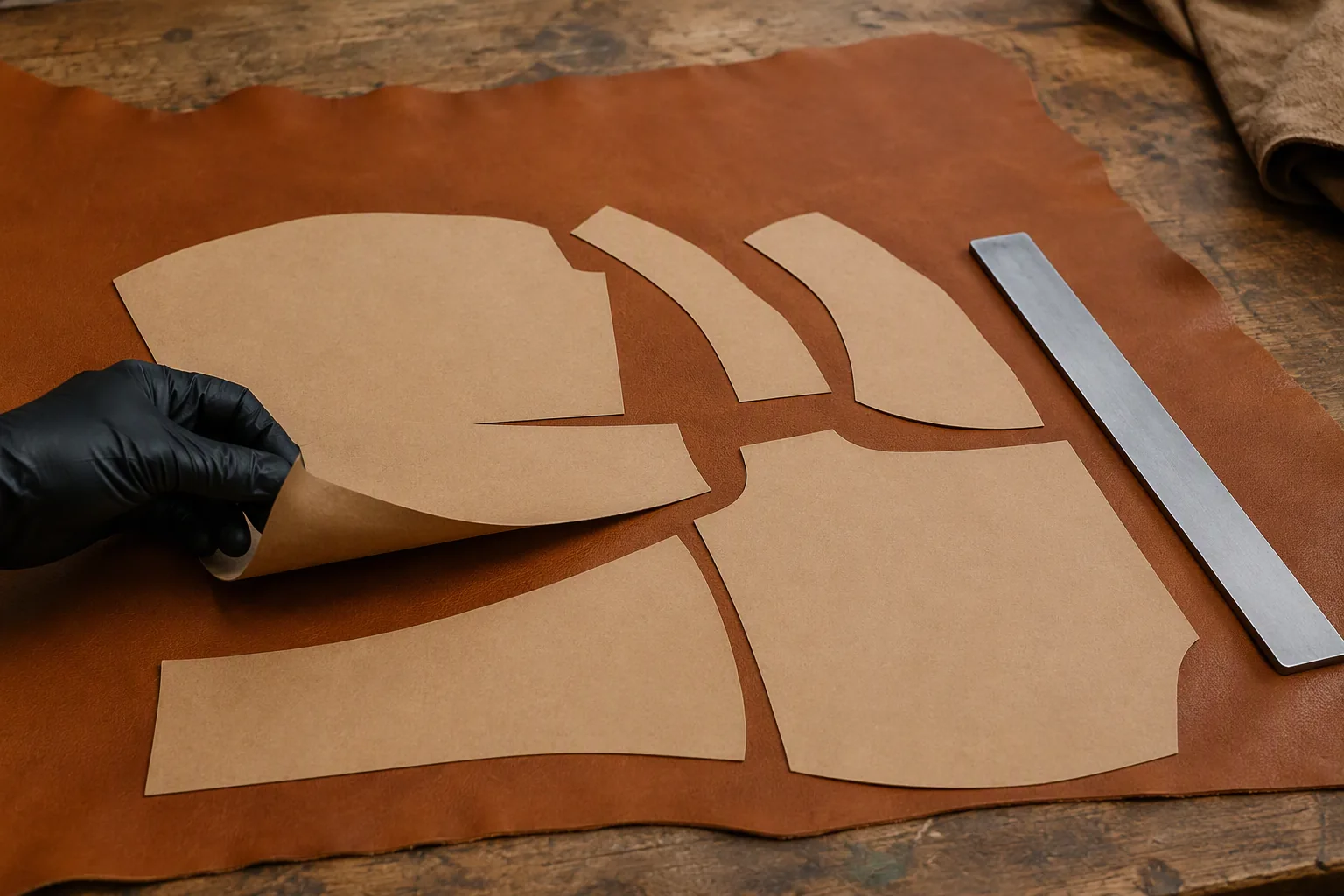
Reading a Hide Against the Pattern
The practical exercise is to lay the pattern on the hide and see where the structural pieces fall. A hide that yields clean bases and clean ends is worth more to this product than one with a higher grade and a shape that forces joins at the base.
Matching Leather to the Part of the Bag
The most common selection error is to buy one leather for the whole carrier. Splitting the buy by part usually costs less than the compromise.
Base and Lower Body
The base carries the animal and the hardware above it, so it wants firmness, thickness and abrasion tolerance. A firm, dense hide is the right default here, and it is the last place to accept a substitute.
Body and Gussets
Body panels carry less and are seen more. They can be lighter and softer, provided the temper still resists sagging across the unsupported span.
Handles, Anchors and Trim
Handles and anchors take concentrated load and repeated handling. A dense, firm leather with tight fibre structure holds stitches better than a soft one, and the difference appears as elongation rather than as a break.
Interior Facings and Edges
Facings around the opening are handled constantly and soiled first. A closed surface here improves both appearance and cleanability, even where the exterior is more natural.
| Part | Priority property | Acceptable compromise |
|---|---|---|
| Base | Firmness and density | Colour variation |
| Ends | Firmness with flex tolerance | Slight thickness variance |
| Body | Appearance and weight | Some firmness loss |
| Handles | Density and stitch holding | Softer hand feel |
| Facings | Cleanability | Less natural appearance |
Evaluating a Sample Properly
A sample assessed on a table answers fewer questions than one assessed as a partly made bag, and the difference decides whether the selection holds.
Handling and Loading
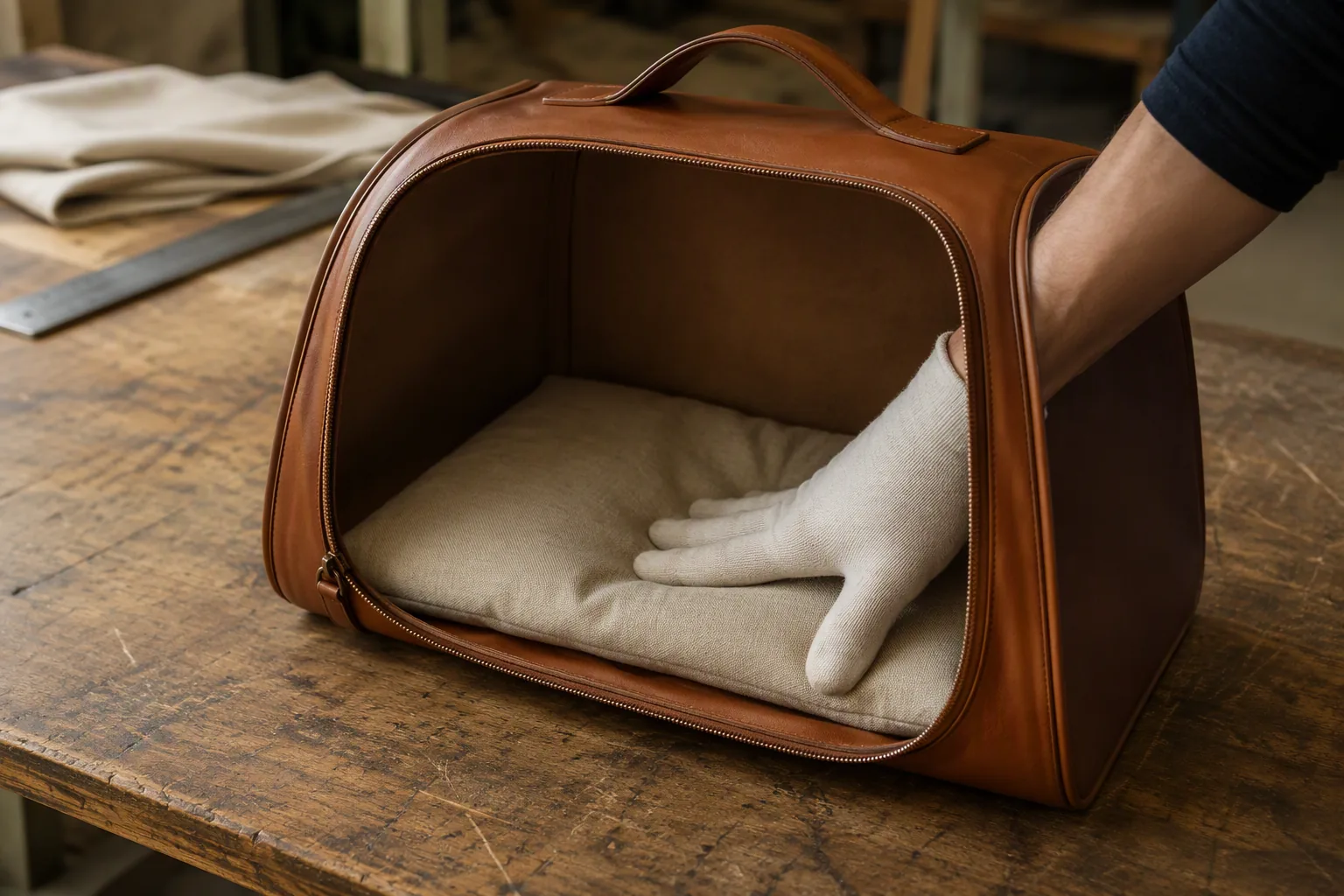
Fill the sample carrier with a representative weight and lift it by the handle. Watch the base and the anchor points for deflection and for the first signs of strain.
This takes minutes and predicts the complaints that arrive after a month of use.
Wet and Soiled Conditions
Wet a cloth and wipe a panel, then let it dry and compare against an untouched area. Repeat with a mild soil. The marks that remain are the ones the buyer will see.
Assessing only the dry, clean sample answers the easiest question.
Recording the Result
Score each candidate against the criteria on the same sheet, with the same tests and the same light. A written comparison is what allows a decision to survive a change of personnel or a cost review.
The record should include the hide reference, the finish applied, and the tests performed.
A comparison sheet kept with the sealed sample is more useful than a folder of photographs, because it records why a candidate was accepted as well as what it looked like. Six months later, that reasoning is the part that cannot be reconstructed from memory.
Putting the Criteria Together
Individually the criteria are easy to satisfy; the difficulty is that several of them pull against each other.
Where Criteria Conflict
Firmness and light weight conflict, because firmness usually comes from thickness or density. Cleanability and natural appearance conflict, because a closed surface looks less like leather. Colour consistency and yield conflict, because selecting for exact shade reduces what can be used.
Naming the conflict at the start prevents a review from resolving it accidentally in favour of the cheapest option.
Which Criteria Can Bend
Appearance and colour consistency can usually be relaxed before structure and cleanability, because the first two affect how the bag sells and the second two affect whether it can be used.
Where a range is under cost pressure, the order of concession should be agreed in advance rather than during a meeting about margin.
Deciding Between Two Acceptable Hides
When both candidates pass, price and availability decide. That is the correct place for the commercial argument: after the technical floor has been met, not instead of it.
| Conflict | Resolution |
|---|---|
| Firmness against weight | Choose density over thickness |
| Cleanability against natural look | Close the interior-facing surfaces only |
| Consistency against yield | Set a tolerance rather than a single shade |
| Cost against durability | Protect the base and anchors first |
Questions to Ask the Tannery
The answers to a short set of questions separate an article that suits pet products from one that merely looks suitable.
About the Hide
Ask for the raw material origin, the temper range the article is designed to hold, the thickness tolerance the tannery can actually maintain, and how density varies across the hide.
These answers are specific and checkable, and vague replies are informative in themselves.
About Repeatability
Ask how often the article is run, what lot-to-lot colour tolerance is normal, and what lead time applies to a repeat order of production quantity.
An article that is run twice a year is a different proposition from one that is run monthly.
About the Finish Relationship
Ask which finishes the tannery recommends for the article, and whether the finish is applied in-house or by a third party. Responsibility for a finish failure depends on that answer.
Where the finish is applied elsewhere, the two suppliers should agree the reference sample together rather than through the buyer.
Writing the Leather Specification
A leather specification for pet carriers is short, and its value lies in naming the properties that a photograph cannot show.
What the Specification Must State
Article reference, raw material origin, temper range, thickness with tolerance, density or firmness requirement, colour reference with tolerance, fastness requirements, finish and where it is applied, and the parts each article is used for are the minimum.
Naming the parts is what stops a substitution from being applied to the base because it was acceptable on a body panel.
What to Leave to the Supplier
The tannery knows its process better than the buyer does, so the method should be left open while the result is fixed. Specifying a particular drum or a particular finish line reduces the supplier's ability to meet the requirement.
The exception is where a property depends on a specific process, and then it should be stated as a reason rather than as a recipe.
Reference Samples and Offcuts
A sealed sample of the finished leather, with an offcut retained, is the only reliable reference after a season has passed. Photographs fade in usefulness faster than leather does.
Cost Against Durability
Cost enters the decision legitimately, once the technical floor has been set, and the useful question is which cost is being bought.
Where the Money Goes
Raw material selection, thickness, finish type and yield are the main drivers, followed by order quantity and the number of colours in the range. A small colour range concentrates buying and usually improves both price and consistency.
What Cheapness Costs Later
A lower-cost hide usually gives up one of four things: temper, density, fastness or yield. Which one it gives up determines where the failure will appear, so the substitution should be assessed against the part it will be used in.
A cheaper body panel is a commercial decision; a cheaper base is a warranty decision.
The Case for Spending on the Base
Money spent on the base and the anchors protects the parts that carry load and are hardest to repair. Money spent on the body is more visible and less structural, which makes it the right place to economise when the range needs a lower entry price.
| Cost lever | Effect on the product |
|---|---|
| Lower thickness at the base | Faster deflection under load |
| Softer temper throughout | Loss of shape, creasing |
| Fewer colours | Better price and consistency |
| Lower grade with good mapping | Acceptable if defects miss structure |
Common Selection Mistakes
Most selection failures repeat, and each one is avoidable with a check that takes less time than the correction.
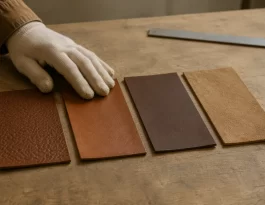
Judging on a Swatch
A swatch shows colour and surface and hides temper, density and yield. Decisions taken on swatches alone are decisions taken on the least informative part of the hide.
Buying One Article for Everything
A single article simplifies purchasing and compromises the base or the trim. Splitting the buy by part is usually the cheaper route once failures are counted.
Ignoring the Pattern
Yield and defect mapping only mean something against the actual pattern. A hide assessed without the pattern cannot be assessed for cost at all.
Accepting a Substitution Silently
Substitutions are normal and should be documented with the criteria they affect. An undocumented substitution turns a commercial decision into an unexplained failure later.
FAQ
Which leather is best for a pet carrier?
A: There is no single best article. A firm, dense leather for the base and ends, with a lighter article for the body, covers most carrier designs better than one leather used throughout.
How thick should carrier leather be?
A: Thickness should be set by part and by load. The base needs enough substance to resist deflection under the animal's weight, while body panels can be thinner. Density often matters more than the thickness number.
Does full-grain leather make a better pet carrier?
A: Full grain usually gives better strength and a more natural surface, but it also shows scratches and holds soil in the grain. Where cleanability is the priority, a corrected or coated surface may serve the product better.
Is soft leather unsuitable for carriers?
A: Soft leather suits gathered sections and trim, but a base or end panel in a soft temper will lose shape under load. The problem is using one temper for parts with different jobs.
How do I test scratch resistance?
A: Draw a blunt point across the surface at controlled pressure and compare how the mark looks and whether it recovers. Test the same way across candidates, with the finish that will be applied.
Can leather resist a dog chewing it?
A: No standard leather resists a determined bite. The design answer is to keep leather out of reach where chewing is likely, and to reinforce or face the areas that cannot be moved.
Why does colour transfer to a pet's coat?
A: Transfer usually indicates poor rubbing fastness, often made worse by moisture. Testing with both a dry and a damp cloth shows which condition is responsible.
What causes tide marks after cleaning?
A: Water fastness problems and residues drawn to the drying edge. A hide with poor water fastness will mark wherever it has been wetted and left to dry unevenly.
What does yield mean in leather buying?
A: Yield is the usable area left after defects and pattern shape are accounted for. It is measured on the actual pattern, because a hide that suits one shape may waste heavily on another.
Is a higher hide grade always better?
A: Grades describe usable area and defect count, not temper, density or fastness. A high-grade hide with the wrong temper is still the wrong leather for a structural panel.
Should the interior be the same leather as the exterior?
A: Usually not. Interior facings are handled and soiled first, so a closed, cleanable surface serves better there even where the exterior is more natural.
How many leathers should a carrier range use?
A: Two is common: one firmer article for structure and one softer article for body and trim. More than two multiplies buying complexity without improving the product much.
How do I compare two hides that both pass?
A: Compare price and availability, having already established that both meet the technical floor. That keeps the commercial argument in its proper place.
What should be kept as a reference?
A: A sealed sample of the finished leather plus an offcut. It allows a later delivery to be judged against the original decision rather than against memory.
How often should selection be reviewed?
A: Whenever the article, the tannery or the finish changes, and at least once a season for a running range. Reviewing only at the start of a programme allows drift to go unnoticed.
Can a cheaper hide be used on visible panels?
A: Often yes, provided the criteria it gives up are appearance-related rather than structural. The base and anchors are the wrong places to economise.
Ready to choose leather on evidence rather than on swatches? Score candidate hides on temper, thickness, scratch resistance, cleanability, fastness, weight and availability, then decide price between the ones that pass. Split the buy by part, test a loaded sample rather than a flat one, and keep a sealed reference with an offcut so the next delivery is judged against the same standard.