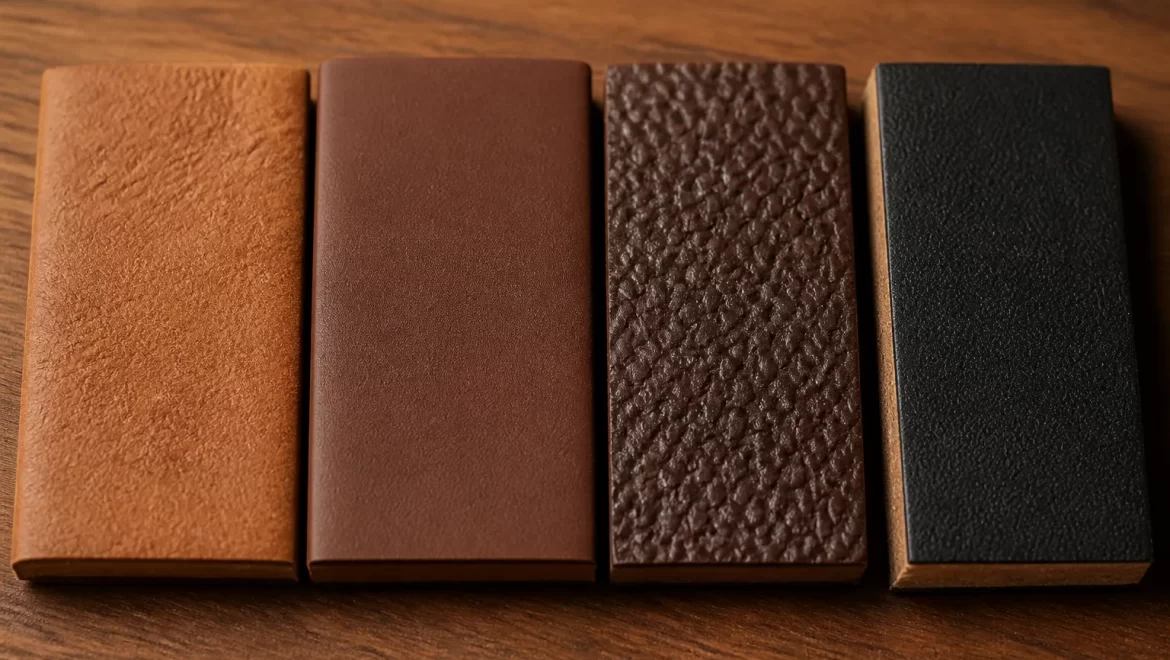
Bonded and Genuine Leather Explained: What Bag Buyers Should Know
Walk through any marketplace and you will find "genuine leather" bags at $30 and at $300, both claiming to be real leather. Somewhere between them sits "bonded leather," a material that is partly leather and partly plastic, wearing a label that sounds more authentic than it is. The vocabulary of the leather trade is confusing on purpose — and for bag buyers, understanding what these terms actually mean is the difference between a bargain and a bad decision.
This guide is written from inside the industry, where these labels are manufactured, applied, and — all too often — stretched. We will explain what "genuine leather" and "bonded leather" really are, how they compare with full-grain and top-grain leather, how long they last, how to identify what you are actually buying, and how to label your own products honestly. Whether you are sourcing for a retail line, buying for yourself, or building a brand that must be credible to its customers, this is the terminology you need to master.
The Leather Grade Confusion Problem
The root of the confusion is that the leather industry uses words that sound like grades but are not graded at all. "Genuine," "top-grain," "full-grain," and "bonded" come from different historical traditions, and their meanings have been diluted, twisted, and repurposed by marketing for decades.
The honest industry hierarchy, from best to most economical, looks like this:
| Material | What it is | Typical construction |
|---|---|---|
| Full-grain leather | Highest grade; natural grain untouched | Top layer of the hide, unaltered |
| Top-grain leather | High grade; grain sanded and finished | Top layer, corrected surface |
| Split leather | Middle layer of the hide after splitting | Corium layer, often embossed or coated |
| "Genuine leather" | Marketing label, no fixed grade | Usually corrected-grain or split, often coated |
| Bonded leather | Leather fibers + polyurethane binder | Ground fibers pressed into sheets |
Two rules to internalize. First, "genuine leather" is not a grade — it is a claim that the material contains some animal hide, and in practice it usually signals the lower end of the market. Second, "bonded leather" is a composite material, not leather in any traditional sense — and some regulators require it to be labeled as such precisely because consumers assume otherwise.
"Genuine Leather" — The Most Misunderstood Label
Here is the uncomfortable truth about "genuine leather": the term has no agreed technical definition. In the mid-20th century it was used to distinguish real animal leather from synthetic materials; today it is applied to everything from decent corrected-grain leather to heavily coated split leather. On a $40 bag, "genuine leather" almost always means the cheapest real-hide product the factory could source.
What you are usually getting is one of two things. Corrected-grain leather: the top grain has been sanded to remove defects, then embossed with a fake grain texture and covered with a pigmented coating — real hide, but its natural surface is gone. Or split leather: the corium layer left after the top grain is split off, which is porous and weak on its own, so it is coated, embossed, or laminated to look like leather. Both are genuine animal hide. Neither is the quality the word "genuine" implies.
There is nothing wrong with these materials if they are priced and labeled honestly. The problem is expectation: a customer who buys a "genuine leather" bag expecting it to age like full-grain leather is being set up for disappointment, and a brand that relies on the label is building its reputation on a misunderstanding.
Bonded Leather — What It Really Is
Bonded leather is the most misunderstood material in the market, so let us be precise about what it is. Bonded leather (also called reconstituted, blended, or fiber leather) is made by grinding leather scraps and leather fibers — leftovers from cutting and manufacturing — mixing them with a polyurethane (PU) or latex binder in a ratio of roughly 10–20% leather fiber to 80–90% binder and filler, then pressing the mixture into sheets. The sheet is then embossed with a leather-like grain texture and coated with a PU finish.
The result looks like leather in a product photo and can feel like plastic in the hand. Its performance characteristics are determined by the binder, not the leather: it does not develop a patina, it does not breathe, and its surface will eventually crack and peel as the PU coating breaks down — typically within two to five years depending on quality and use. Bonded leather has legitimate uses: automotive seating, upholstery, and budget products where cost dominates. It is not a material for quality bags, and it should never be sold as "leather" without qualification.
Note the naming trap: bonded leather is sometimes marketed as "leather," "genuine leather," or even "recycled leather" — the last term playing on sustainability while obscuring the binder content. "Recycled leather" with 20% leather fiber is a very different material from "recycled leather" that is actually repurposed full hides, and the labels rarely explain the difference.
Composition and Performance: Head-to-Head
| Attribute | Full-grain | Top-grain | Split ("genuine" typical) | Bonded |
|---|---|---|---|---|
| Hide content | 100% top grain | 100% top grain (corrected) | 100% corium | 10–20% fibers + binder |
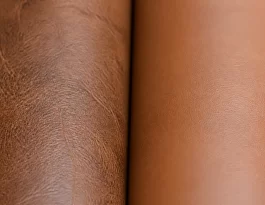
| Natural grain | Intact | Sanded/replaced | Gone (embossed) | Printed/embossed |
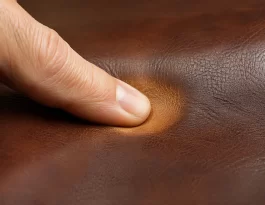
| Patina | Yes | Limited | No | No |
| Breathing | Yes | Reduced | No | No |
| Typical lifespan (bag) | 10+ years | 7–10 years | 3–6 years | 2–5 years |
| Surface failure mode | Wear/burnish | Scuff/finish wear | Finish peeling | Coating cracking/peeling |
| Repairable | Yes | Partially | Limited | No |
| Relative price | $$$$ | $$$ | $$ | $ |
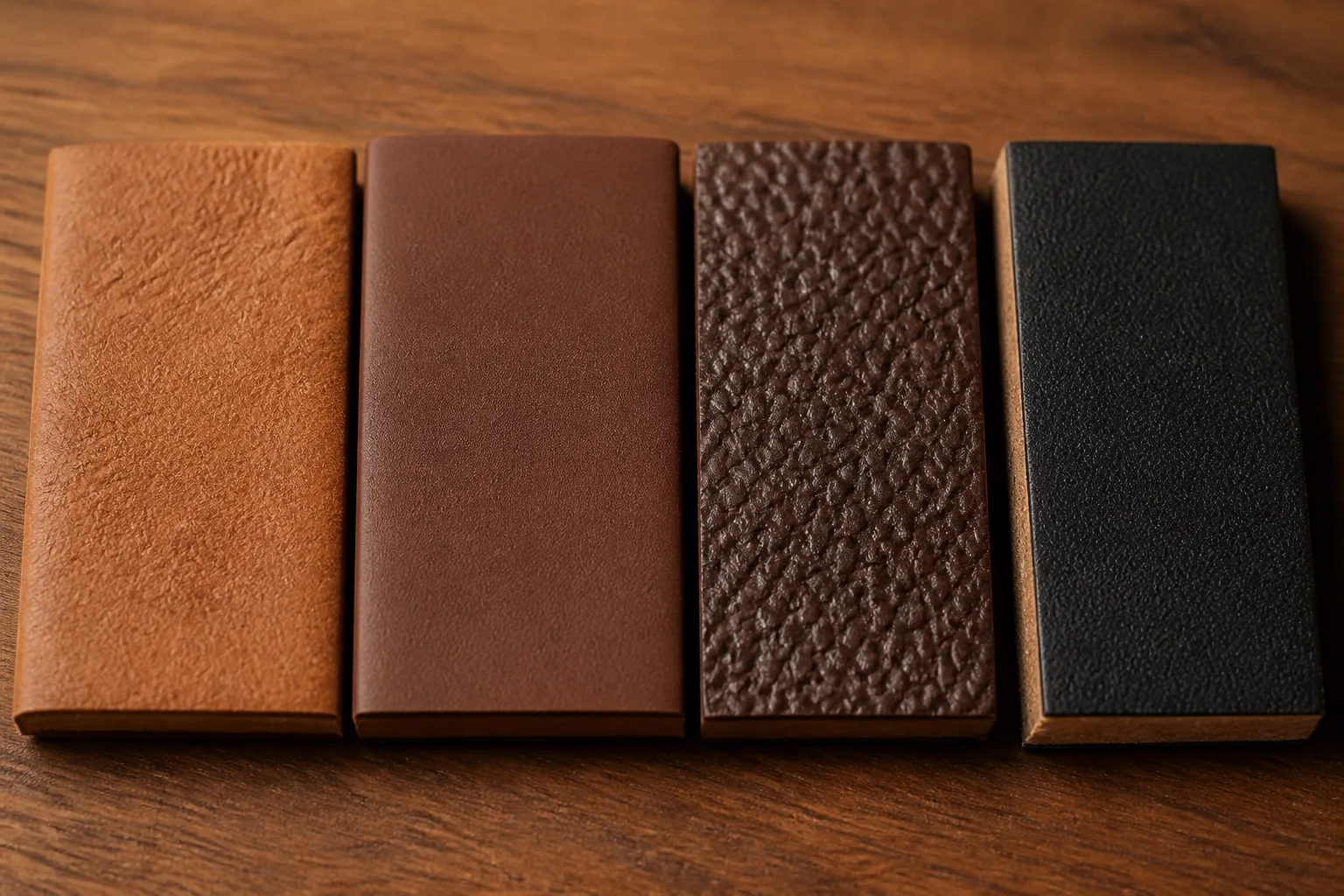
The table compresses the whole argument: as you move down the hierarchy, the leather content and the performance drop together. The one constant is that every material in the table can legally be described as "leather" by someone — which is why the label alone tells you almost nothing.
Lifespan and Real-World Wear
What does the difference mean in years and in the hands of a real user? Let us be concrete.
Full-grain leather bags are the heirlooms: ten years is a normal expectation, twenty is not unusual, and the bag looks better with age — the patina is the reward for maintenance. Scratches are character; they can be conditioned or lightly burnished away.
Top-grain leather bags typically last seven to ten years of normal use. The finish protects the surface, but eventually the coating can show scuffs and edge wear, especially on lighter colors. The leather underneath remains sound; a professional reconditioning can extend the life.
Split leather bags (the typical "genuine leather" product) last three to six years. The embossed surface and pigmented coating wear at stress points — corners, edges, handles — and when the coating goes, the porous split shows through. At $50–$120 retail, this lifespan is defensible; the problem is only when it is sold as a premium material.
Bonded leather bags last two to five years, and their failure is the ugliest: the PU surface cracks and peels in sheets, revealing the fiber-board underneath. Bonded leather cannot be repaired or reconditioned — once the coating goes, the bag is finished. For a bag that will be carried daily, bonded leather is a poor value at almost any price.
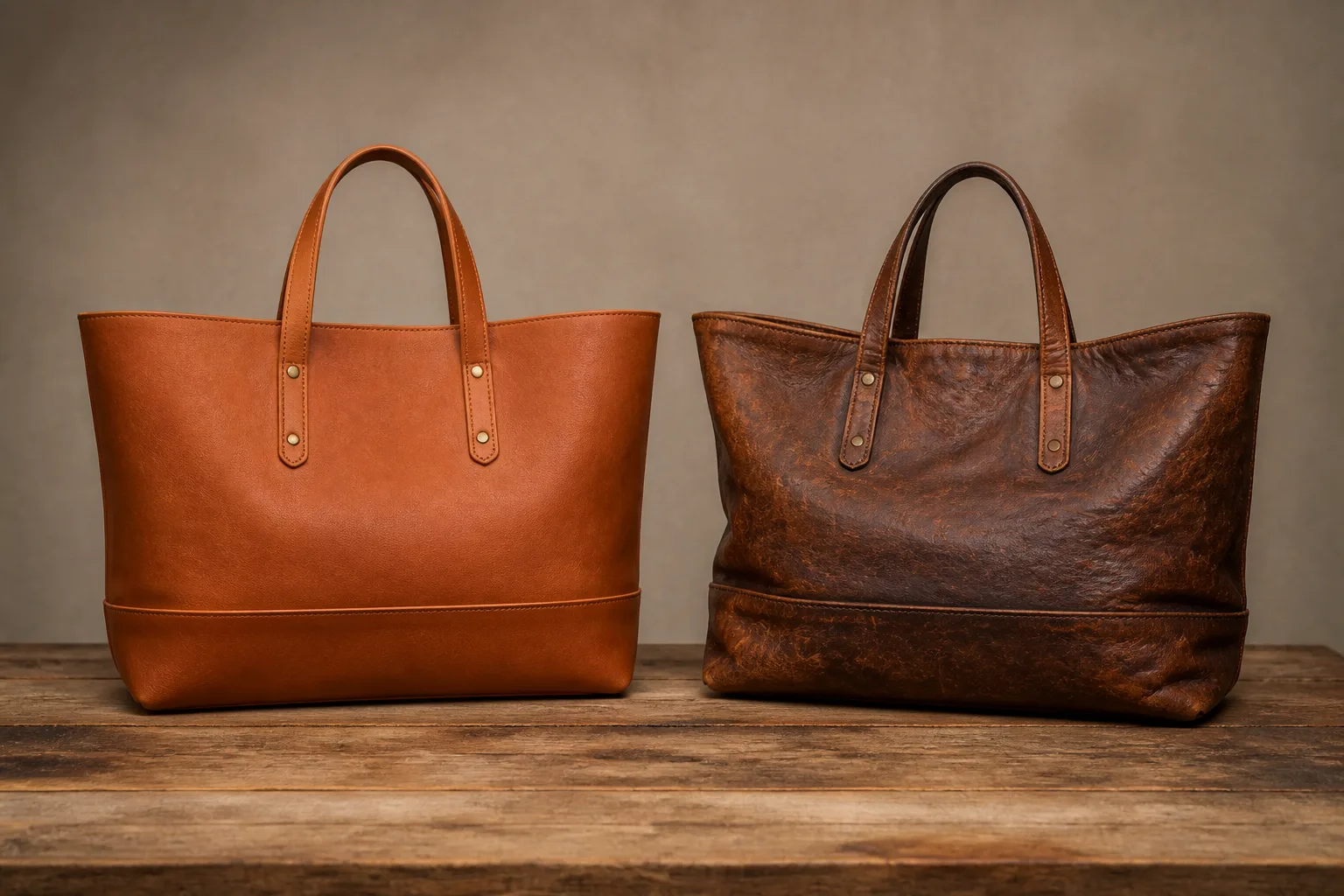
The honest framing for buyers: leather grade is the single best predictor of bag lifespan, and the four tiers above differ by roughly a factor of two in expected life at each step.
Where Bonded and Low-Grade Leathers Are Used
Low-grade materials are not inherently dishonest — they occupy a real market niche. Knowing where each material appears helps you interpret what you see on shelves and in listings.
Bonded leather shows up in: budget bags and accessories sold at impulse prices, "leather" trims on non-leather products, book covers, electronic cases, and automotive upholstery. When a $25–$45 "leather" bag is sold online with stock photos, bonded leather is a likely candidate — the price is the tell.
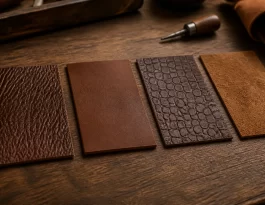
Split leather appears in: mid-market bags labeled "genuine leather," belts, wallets, and luggage where a leather look is wanted at moderate cost. The embossed grain is usually a giveaway: real hide has irregular, natural texture; embossed split has a repeating, too-uniform pattern.
Corrected top-grain appears in: most "leather" products at the $100–$250 level, where the factory has sanded and refinished a real top grain. This is legitimate, durable leather — the key is that the coating is quality and the price is fair.
The pattern to understand: the same bag silhouette can be produced in any of these materials, and the retail price range is the most reliable indicator of what is inside. A factory quoting the "same" design at $8, $18, or $40 FOB is quoting bonded, split, and top-grain versions respectively.
The Cost Structure of Each Grade
Price is where the grade hierarchy becomes concrete, and understanding the cost structure explains why labels are so often stretched. Here is where the money goes at each level:
| Grade | Typical FOB (per bag, mid-size) | Material share | What you pay for |
|---|---|---|---|
| Bonded | $8–$18 | Low | Binder, coating, cheap hardware |
| Split ("genuine") | $15–$30 | Low-moderate | Coated split, embossed grain |
| Top-grain (corrected) | $22–$45 | Moderate | Real top grain, quality finish |
| Full-grain | $35–$80+ | High | Premium hide, craft labor, QC |
The material share tells the story: in a bonded bag, the "leather" is a minor cost line, and the bag's price goes into molding, coating, and marketing. In a full-grain bag, the hide and the skilled labor around it dominate. When a factory quotes a design at $12 versus $40, it is not the same bag with a different logo — it is a different material, a different construction, and a different lifespan, and the buyer who compares only the price is comparing apples to oranges.
There is also a retail markup trap to understand. Because bonded leather is cheap, brands can mark it up 5–10x and still sell "leather" at $50–$100, where the profit margin is excellent. Full-grain, by contrast, is expensive before marketing begins, so margins are thinner at comparable retail prices. This is why mislabeling is so common in the mid-market: the profit incentive runs in exactly the wrong direction. The buyer's protection is not the label — it is verification.
Marketplace Red Flags: Spotting Misleading Listings
Whether you are buying online or sourcing wholesale, certain patterns should raise your guard immediately:
- Vague material claims. "Genuine leather," "leather," "top-grade leather," or "premium leather" without a specific grade, tannery, or spec is a red flag. Full-grain and top-grain sellers say so explicitly.
- Stock photos with impossibly low prices. A $35 "leather" bag photographed on a white background with generic marketing copy is very likely bonded or split material. Price is the most honest label.
- No cross-section or edge photos. Legitimate sellers of real leather rarely show the edge, but they will answer if you ask. Sellers of bonded material avoid the question — the cross-section gives it away.
- "Recycled" or "eco" leather without composition data. If the listing says "recycled leather" but will not state the fiber percentage and binder content, treat it as bonded leather until proven otherwise.
- Pressure to decide quickly. "Limited stock, final sale, no returns" language on a material-claim product is a warning: the seller may not want the bag returned once it is in hand.
None of these red flags proves dishonesty by itself, but each is a question you should ask before money changes hands: What grade is this? Which tannery? Can I see a cross-section? Can I order a sample? The sellers with honest material answer immediately; the rest go quiet.
Honest Labeling and Compliance
If you are a brand, labeling is not just ethics — it is law, and the rules are tightening. The EU Textile Regulation and various consumer-protection directives require that "leather" claims be accurate, and several regulators (notably in the EU and parts of Asia) have moved toward requiring "bonded leather" or "genuine leather" to carry explicit composition disclosure. The US FTC's Guides for the Leather Industry prohibit misleading use of "leather," "genuine leather," and related terms; a material that is not genuine animal hide may not be described as leather, and terms like "bonded" must be clear.
Practical labeling rules for your own products:
- Do not call bonded leather "leather" — use "bonded leather" or "leather fiber material" and disclose the binder content on request.
- Do not use "genuine leather" as your only claim — if you must use it, be ready to state the actual grade (corrected grain, split) and back it with a spec sheet.
- State the grade on the spec — full-grain, top-grain, split, or bonded — and put it in the contract with your factory, so everyone is measuring the same thing.
- Keep the documentation — tannery grade certificates, composition data, and test reports protect you in disputes with suppliers, customs, and regulators.
Honest labeling is also a marketing asset. In an era of informed consumers and review culture, a brand that says "full-grain, tanned in an LWG-certified tannery" and proves it is building trust; a brand that says "genuine leather" and hopes nobody asks is one bad review away from a reputation problem.
How to Identify What You're Buying
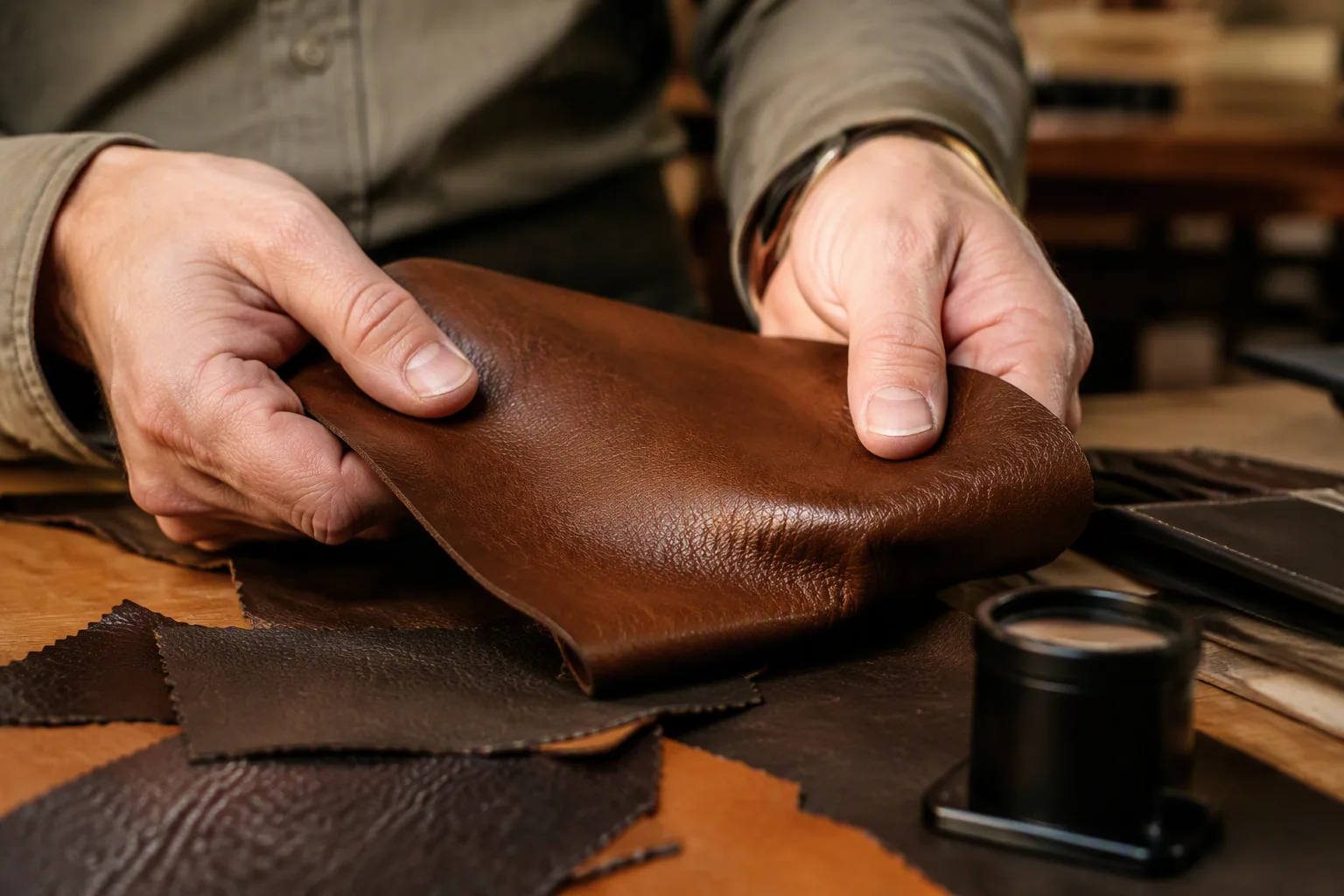
You do not need a lab to identify leather grades — you need a few simple tests and a clear head. Here is what works on a sample or a finished bag:
Cross-section inspection. Cut or unzip and look at the edge of the material. Real full-grain and top-grain have a dense, fibrous layer with visible structure. Split leather looks looser and more porous. Bonded leather shows a pressed, board-like cross-section with no fiber structure — it looks like thick paper or compressed fiberboard with a coating on top.
Water test. Place a drop of water on the surface. Full-grain aniline absorbs slowly and darkens; finished top-grain and split bead or sit on the surface; bonded leather repels water completely — the drop just sits there, because the surface is plastic.
Flex test. Bend the material firmly. Real leather wrinkles and creases naturally along the surface. Bonded leather and heavy coated materials crack or show a stiff, unnatural crease — and if you hear a slight crackle, the coating is already stressed.
Smell. Real leather has a distinctive, natural smell. Bonded leather smells faintly of plastic or glue. The smell test is not scientific, but it is a reliable tripwire for bonded material.
Price and provenance. This is the bluntest tool: full-grain bags are rarely below $150 retail, top-grain rarely below $80, split "genuine" products cluster at $40–$120, and bonded leather lives below $50. A $30 "full-grain leather" bag is not a bargain; it is a mislabeled product. Ask for the tannery name and grade spec — a real supplier has both; a labeler does not.
FAQ
Is "genuine leather" real leather?
A: Yes — it contains real animal hide. But it is a marketing term, not a grade, and it usually indicates corrected-grain or split leather at the lower end of quality. It is real leather; it is rarely premium leather.
What is bonded leather made of?
A: Ground leather fibers (typically 10–20%) mixed with a polyurethane or latex binder (80–90%) and pressed into sheets, then embossed and coated to look like leather. It is a composite, not leather in the traditional sense.
How long does bonded leather last?
A: Typically two to five years of normal use. Its PU coating eventually cracks and peels, and bonded leather cannot be repaired or reconditioned.
Why do brands use "genuine leather" instead of a grade?
A: Because the label is vague enough to cover whatever material they actually used. A brand with full-grain leather says "full-grain"; a brand with split leather says "genuine." The vagueness is the point.
Can bonded leather be called "recycled leather"?
A: Technically it contains recycled leather fibers, but "recycled leather" without disclosure hides the binder content and the composite nature. Regulators increasingly require the term "bonded" or equivalent disclosure.
Is bonded leather good for bags?
A: Not for bags that will be carried regularly. It fails by surface peeling, cannot be repaired, and offers poor value even at low prices. It is acceptable for occasional-use or disposable-price products.
How can I tell split leather from top-grain?
A: Look at the grain: top-grain has a corrected but natural texture; split leather is usually embossed with a repeating pattern. A cross-section also helps — split is looser and more porous.
What should I write on my own product labels?
A: The honest grade: full-grain, top-grain, split, or bonded — plus tannery certification when you have it. If you cannot state the grade, you do not know what you are selling, and you should find out before you label anything.
What This Means for Your Bag Line
For brands, the lesson of the leather hierarchy is a positioning decision. The grade you choose sets your price, your lifespan promise, and your customer's lifetime value:
| Positioning | Suggested grade | Retail range |
|---|---|---|
| Entry / impulse | Bonded or split, clearly labeled | < $50 |
| Mid-market value | Top-grain (corrected) | $80–$200 |
| Premium / heritage | Full-grain | $200–$800+ |
Three practical rules. First, never let your factory decide the grade — specify it in the tech pack and verify incoming material against it; the material you get is the material you will be accountable for. Second, label what you sell — honest grading converts educated customers into loyal ones and immunizes you against claims. Third, price the grade honestly — a full-grain bag at $90 is either a loss for you or a mislabeled product, and customers eventually figure out which.
Conclusion
"Genuine leather" and "bonded leather" are the two most misleading labels in the bag industry — one because it means nothing specific, the other because it sounds like more than it is. Understanding the real hierarchy — full-grain, top-grain, split, bonded — turns you from a passive buyer of labels into an active buyer of material. The lifespan, the feel, the patina, the repairability, and the price all trace back to that single classification.
For buyers, the takeaway is: verify the grade, run the simple tests, and let price guide your expectations. For brands, it is: choose the grade deliberately, label it honestly, and let your documentation prove your claims. The market is full of "genuine leather" bags; the brands that thrive are the ones that say exactly what their leather is — and make customers believe them because it is true.
Sourcing leather bags and want certainty about the material? Contact our factory — we will send you samples of each grade with the tannery spec sheet, so you can compare bonded, split, top-grain, and full-grain in your own hands before you decide.