How Should Leather Finishing Be Chosen for Pet Product Ranges?
- What Pet Products Ask of a Finish
- Finishing Systems and What They Change
- Wear: Abrasion, Scuffing and Flex
- Odour: How Finishes Trap or Release It
- Surface Texture and Soil Release
- Colour, Crocking and Transfer
- Water and Cleaning Behaviour
- Finishing Versus Tanning: Where Properties Come From
- Hardware Points and Wear Concentrations
- Testing Wear and Odour
- Repair, Refinishing and Aftercare
- Writing the Finishing Specification
- Cost and Process Drivers
- FAQ
Leather finishing decides how a pet product ages. The same hide, tanned the same way, can end up looking better after a year or failing at the corners within months, and the difference is usually the surface system rather than the leather itself.
Pet products punish a finish in specific ways. Claws scuff, harness hardware rubs, salivation and accidents sit on the surface, and odour is judged long after the bag has been cleaned. A finish chosen for showroom appearance alone tends to fail all three.
What Pet Products Ask of a Finish
The requirements are narrow but unusually demanding, because they combine abrasion, moisture and odour in one surface.
Abrasion at Contact Points
Wear concentrates where the animal enters and exits, where harness straps pass, and where the bag rests on the ground. A finish that resists general rubbing can still fail at these points because the load is repeated in the same small area.
The specification should name the contact points rather than assume uniform wear across the panel.
Soiling and Cleanability
Pet soil is a mixture of oils, proteins and grit, and it behaves differently from dust. A finish that is smooth and closed releases it with a wipe, while an open or heavily textured finish holds it in the grain.
Cleanability is therefore a surface property, and it should be judged on a soiled sample rather than on a clean one.
Odour and Moisture
Odour is held by residues rather than by leather itself, so a surface that traps residue keeps smelling after cleaning. Moisture accelerates the problem by carrying material into the grain.
A finish that closes the surface reduces what enters, and a finish that can be wiped removes what remains.
| Requirement | Where it shows | Finish property that answers it |
|---|---|---|
| Abrasion | Entry, corners, base | Binder toughness |
| Scuffing | Edges, hardware contact | Surface slip and colour depth |
| Soiling | Base, interior contact | Closed, smooth surface |
| Odour | Whole surface | Low residue retention |
| Moisture | Base, openings | Reduced absorption |
| Cleaning | Repeated cycles | Film integrity |
| Flex | Gussets, folds | Elastic binder |
| Colour stability | Exposed panels | Lightfast pigments |
Finishing Systems and What They Change
Finishing systems differ in how much of the grain they cover, and that coverage decides most of the performance.
Full Aniline and Semi-Aniline
Full aniline leaves the grain essentially uncovered, so the leather keeps its natural look and feel. It shows scuffs and stains readily and offers little protection against liquid, which makes it a poor default for a pet product unless the animal is calm and the bag is lightly used.
Semi-aniline adds a thin coat that improves resistance while keeping much of the grain visible. It is a reasonable middle position where appearance matters and wear is moderate.
Pigmented and Corrected Finishes
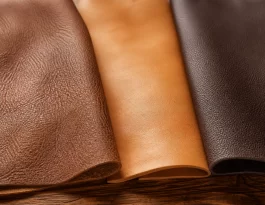
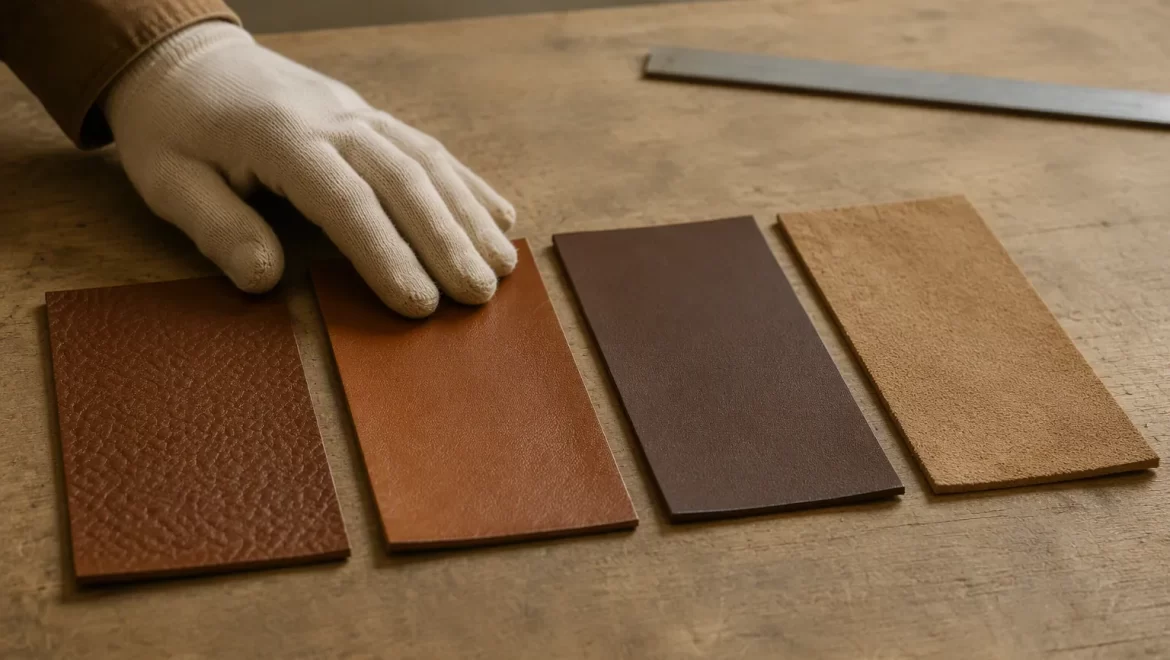
A pigmented finish covers the grain with a binder and pigment layer, which gives even colour, good abrasion resistance and easier cleaning. It hides grain defects, which is why it is common in volume production.
The trade is a more uniform, less natural look and a surface that can crack if the binder is too rigid for the fold it covers.
Waxed, Oiled and Pull-Up Leathers
Waxed and oiled finishes leave the surface open and supple, and they develop a patina with use. They resist flexing well but hold soil in the grain and are difficult to clean without stripping the finish.
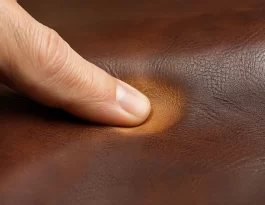
Pull-up leathers lighten where they are stretched, which looks attractive on a sample and uneven on a bag that is handled daily.
Coated and Suede Surfaces
A polymer coating gives the highest resistance to liquid and soiling, at the cost of a more synthetic hand and a surface that can delaminate at edges. Suede and nubuck are the opposite case: soft and quiet, but the most soil-retentive option on the list.
Where a pet product uses suede, it usually belongs on a panel that does not contact the animal or the ground.
| System | Grain coverage | Abrasion | Soil release |
|---|---|---|---|
| Full aniline | None | Low | Low |
| Semi-aniline | Thin | Moderate | Moderate |
| Pigmented | Full | High | High |
| Corrected grain | Full plus emboss | High | High |
| Waxed or oiled | None | Moderate | Low |
| Pull-up | None | Moderate | Low |
| Polymer coated | Full film | Very high | Very high |
| Suede or nubuck | Napped | Low | Very low |
Wear: Abrasion, Scuffing and Flex
Wear is not one phenomenon, and a finish that resists one form can fail another.
Abrasion Resistance
Abrasion removes material gradually, and the rate depends on the binder, the pigment loading and the surface texture. A finish with a tough binder and fine texture wears evenly, while a heavily embossed surface wears first on the raised areas.
Testing on a flat sample understates the problem, because the real wear happens on a curved, loaded surface.
Scuffing and Colour Loss
Scuffing is a local event: something sharp or rough removes the top layer and reveals a lighter core. A pigmented finish with good colour penetration through the coat hides a scuff better than a thin coat over a pale crust.
Where scuffing is expected, the finish colour should sit close to the crust colour rather than contrast with it.
Flex and Cracking
Flexing opens and closes the surface thousands of times at a gusset or a fold, and a rigid film eventually cracks along the line. Cracking starts at the fold and spreads, and it is usually first visible as a pale line.
Elastic binders and a thinner coat extend flex life, and the fold should be tested on the finished assembly rather than on flat leather.
| Wear type | Mechanism | Finish response |
|---|---|---|
| Abrasion | Gradual material loss | Tough binder |
| Scuffing | Local material removal | Deep colour |
| Flex cracking | Film fatigue | Elastic binder |
| Edge wear | Rubbing at cut edges | Edge finishing |
| Hardware rub | Point contact | Local reinforcement |
| Creep | Slow deformation | Correct temper |
| Peeling | Poor adhesion | Surface preparation |
| Emboss loss | Flattened texture | Shallower emboss |
Odour: How Finishes Trap or Release It
Odour in a pet product is a surface problem before it is a leather problem, and the finish decides how much material stays behind.
What Holds Odour
Odour-causing residues are held in pores, in the nap of a suede, and in the texture of an embossed surface. A closed, smooth finish holds very little because there is nowhere for the residue to sit.
This is why two bags with the same leather can smell very differently after a year, and why odour should be specified as a surface property.
Sealing Versus Breathing
A fully sealed surface reduces what enters but also reduces what can escape, so any material that does get in stays longer. A slightly open surface allows some exchange but lets more in.
The better answer for most pet products is a closed surface that can be wiped, rather than a sealed surface that cannot be cleaned.
Linings and Interiors
Odour migrates to the lining, and a leather finish cannot compensate for an interior that holds residue. The interior and the exterior should be specified together, with the lining treated as the absorbent side.
Where the interior is detachable, the odour problem is halved because the absorbent part can be washed.
Cleaning and Residual Odour
Cleaning removes residue from the surface, but material that has entered the grain stays. Repeated cleaning of an open finish gradually darkens it and can strip wax or oil.
The care instruction should match the finish, and it should state what the surface can tolerate rather than assume a general leather cleaner.
| Odour factor | Contribution | Finish response |
|---|---|---|
| Open grain | High | Closed surface |
| Nap or suede | Very high | Avoid at contact points |
| Deep emboss | Moderate | Shallow texture |
| Sealed film | Low intake, low release | Wipeable, not sealed |
| Lining absorbency | High | Detachable lining |
| Cleaning method | Moderate | Finish-specific care |
| Moisture retention | High | Reduced absorption |
| Residue in seams | Moderate | Sealed seam edges |
Surface Texture and Soil Release
Texture is a design decision with a cleaning consequence, and the two should be chosen together.
Smooth Versus Grained
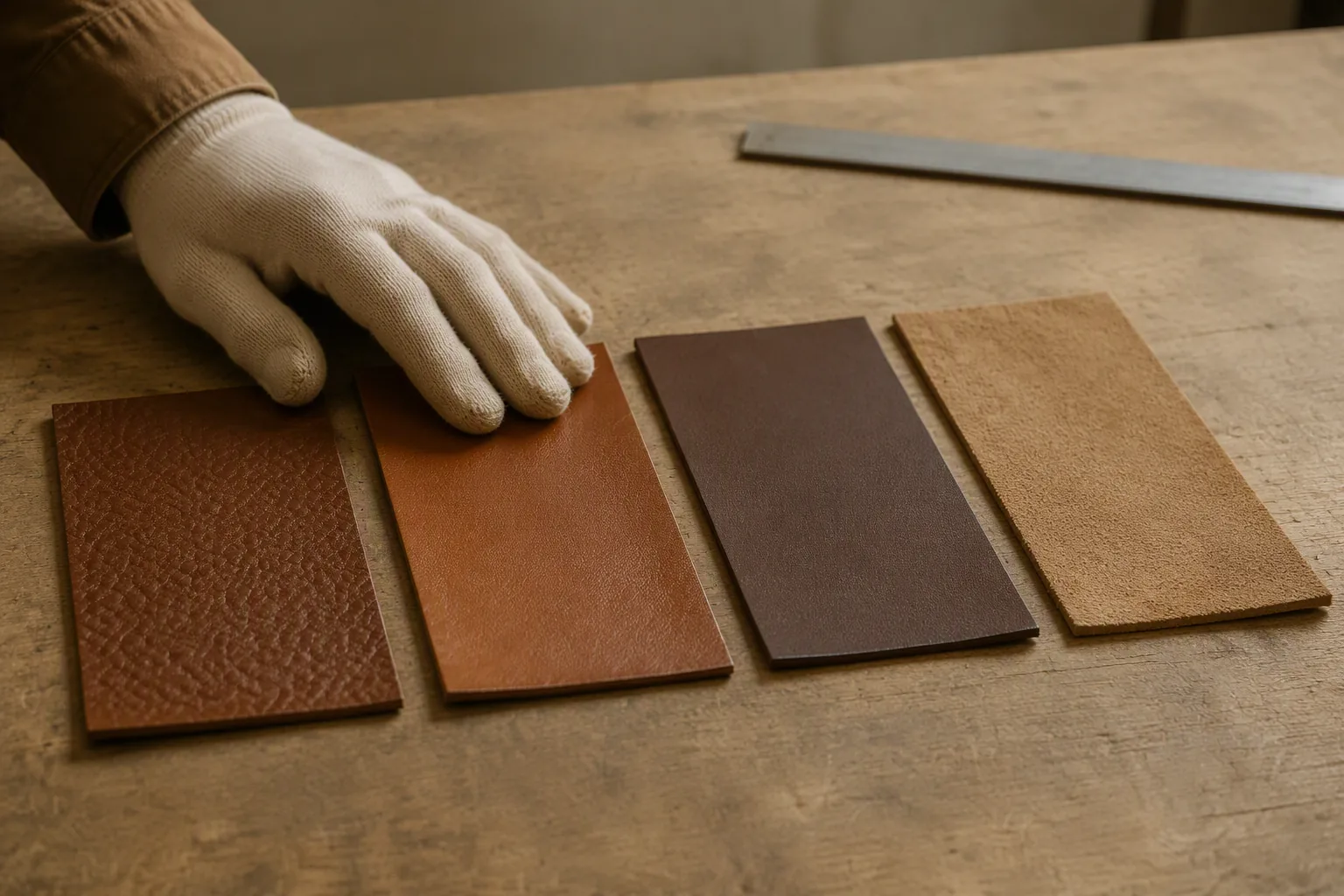
A smooth surface releases soil with a single wipe, while a pronounced grain holds material in the valleys. The difference is small on a clean sample and large after a month of use.
Where a grain is wanted for appearance, a finer grain keeps most of the look with less retention.
Emboss Depth and Pattern
Deep embossing adds visual interest and hides defects, but the raised areas wear first and the valleys collect soil. Shallow embossing keeps the pattern readable while reducing both problems.
Pattern scale also matters: a large pattern has fewer valleys per unit area, which is easier to clean than a fine, dense one.
Perforations and Open Structures
Perforated or woven leathers are attractive and unsuitable for contact areas in a pet product, because the openings collect material that cannot be reached.
Where perforation is used, it belongs on a panel away from the animal and away from the base.
| Texture | Soil retention | Wear pattern |
|---|---|---|
| Smooth | Very low | Even |
| Fine grain | Low | Even |
| Deep grain | High | Raised areas |
| Shallow emboss | Moderate | Even |
| Deep emboss | High | Raised areas |
| Perforated | Very high | Edges of holes |
| Hair-on | Very high | Matting |
| Napped | Very high | Flattening |
Colour, Crocking and Transfer
Colour is judged on the shelf and tested after use, and the two judgements often disagree.
Crocking and Rub Transfer
Crocking is colour transferred by rubbing, and it shows on a light cloth or on the animal's coat. It is worse on heavily pigmented finishes with insufficient binder, and worse again in humid conditions.
Testing with a dry cloth and a damp cloth separately shows which condition is the problem.
Lightfastness
Lightfastness describes how much colour fades under exposure, and it matters for a product that travels in a car or sits near a window. Pigment selection drives it, and some bright colours are inherently less stable.
Where the range includes saturated colours, the lightfastness of each should be confirmed rather than assumed from the base colour.
Colour Depth and Coverage
A thin coat over a pale crust shows wear as a colour change, while a deeper coat keeps the colour through more of the wear. Depth costs material and adds stiffness, so it should be specified where the part actually wears.
Seams and edges need the same consideration, because they wear before the panel does.
| Colour property | Test | Risk if weak |
|---|---|---|
| Dry crocking | Dry cloth rub | Transfer to coat |
| Wet crocking | Damp cloth rub | Transfer when wet |
| Lightfastness | Exposure | Fading |
| Colour depth | Wear through | Pale scuff lines |
| Edge colour | Edge abrasion | Light edges |
| Seam colour | Fold wear | Pale fold lines |
| Finish adhesion | Tape or flex | Peeling |
| Batch variation | Shade cards | Panel mismatch |
Water and Cleaning Behaviour
Water resistance on a leather surface is a finish property, and it is easy to overstate.
Drop Absorption
A drop placed on the surface either beads or spreads, and the time it takes to darken the leather is a useful indicator. A finished surface should resist long enough for a spill to be wiped, not indefinitely.
Testing at the same temperature and angle makes the comparison meaningful between finishes.
Cleaning Without Damage
Repeated cleaning removes surface treatments before it removes the leather, so a finish that tolerates wiping without dulling is worth more than one that resists water but marks when cleaned.
The care instruction should name the method the finish tolerates, and it should warn against the methods that strip it.
Drying and Re-soiling
Leather that has absorbed liquid dries slowly and can re-soil faster afterwards, because the surface is temporarily more open. Drying away from direct heat preserves the finish and avoids hardening.
A finish that reduces absorption also reduces the re-soiling cycle.
| Water behaviour | Indicator | Practical meaning |
|---|---|---|
| Beading | Drops stay raised | Spill can be wiped |
| Slow wetting | Gradual darkening | Time to react |
| Rapid wetting | Immediate darkening | Poor protection |
| Recovery | Returns to colour | Finish intact |
| Dulling | Loss of sheen | Cleaning too harsh |
| Staining | Ring marks | Residue left |
| Hardening | Stiff after drying | Heat damage |
| Re-soiling | Faster soiling | Surface opened |
Finishing Versus Tanning: Where Properties Come From
Buyers often attribute finishing problems to the tannery, and the distinction matters because it decides who fixes what.
What Tanning Decides
Tanning decides how the hide behaves as a material: its temper, its resistance to heat and moisture, its tendency to shrink and its base colour. These properties set the limits within which a finish can work.
A finish applied to an unsuitable crust will fail regardless of how well it is applied.
What Finishing Decides
Finishing decides appearance, surface resistance and wear behaviour. It cannot make a soft, stretchy hide stiff, and it cannot make an open crust waterproof.
Where a requirement is really about material behaviour, no finish will deliver it, and the specification should address the crust instead.
Where Responsibility Sits
If a finish peels, the cause is usually preparation or adhesion, which is the finisher's scope. If a bag stretches and the finish cracks with it, the cause is often the crust, which is the tannery's scope.
Recording the crust and the finish separately makes the conversation possible when a complaint arrives.
| Property | Decided by | Can finishing change it |
|---|---|---|
| Temper and softness | Tanning | Barely |
| Stretch | Tanning and structure | No |
| Heat resistance | Tanning | Slightly |
| Base colour | Tanning | Overlaid only |
| Surface abrasion | Finishing | Yes |
| Soil release | Finishing | Yes |
| Water beading | Finishing | Yes |
| Colour uniformity | Finishing | Yes |
Hardware Points and Wear Concentrations
Hardware creates small, hard contacts that wear a finish faster than any flat area.
Rings, Clips and D-Rings
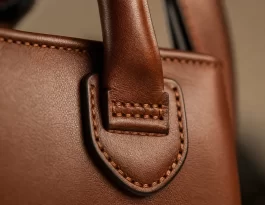
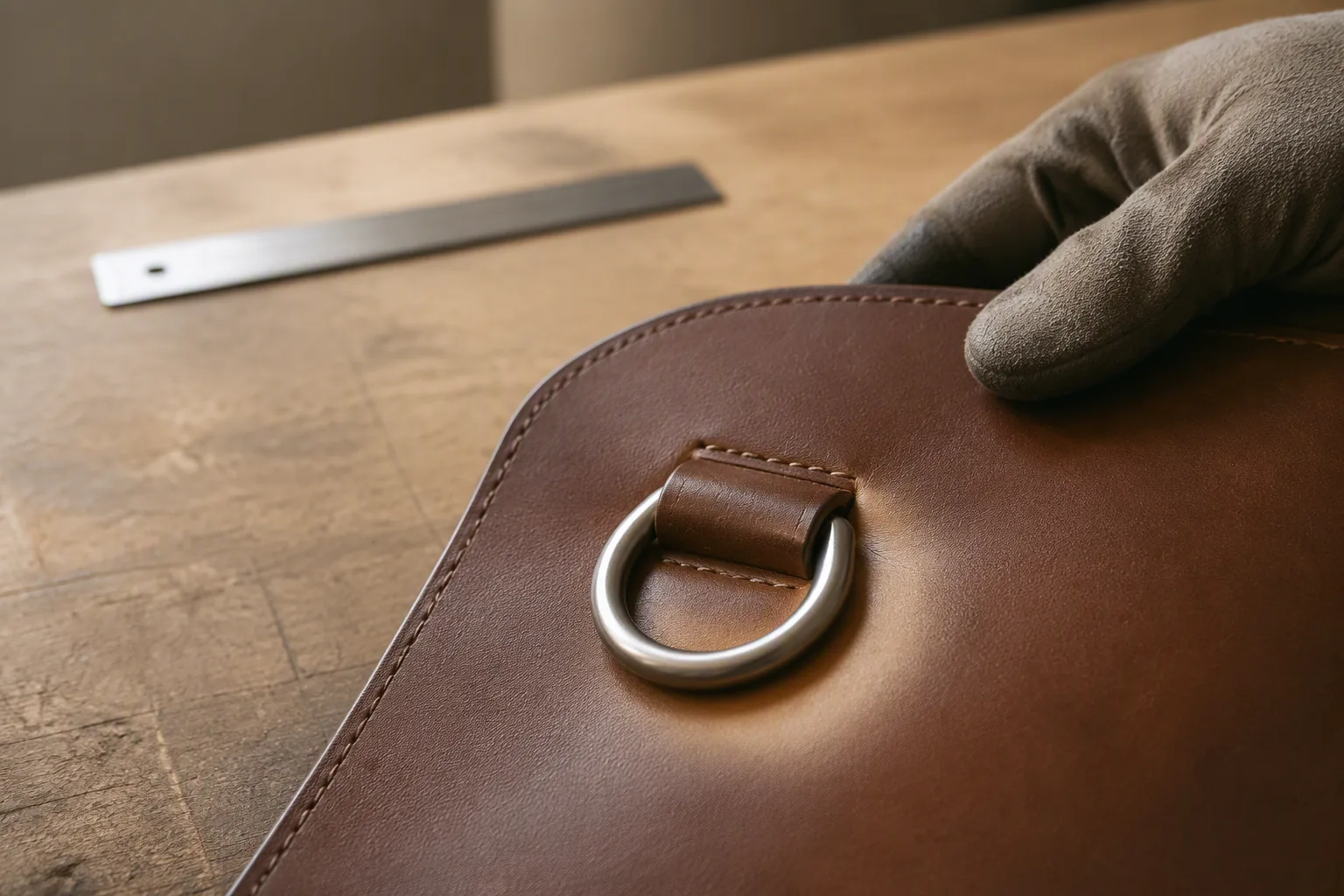
A ring or clip moves against the leather every time the bag is carried, polishing the finish and eventually cutting into it. The wear appears as a bright patch beside the hardware rather than under it.
A reinforcing patch or a folded tab spreads the contact and delays the failure.
Handle Attachments and Strap Ends
Handle attachments carry the full weight of the bag and move slightly with every step. The finish at the attachment wears through to the crust, and the stitching then becomes the visible wear point.
Local reinforcement and a finish with deeper colour both help, and the attachment should be sampled under load rather than judged by eye.
Feet, Bases and Ground Contact
Feet protect the base but concentrate load at small points, and the finish around a foot abrades as the bag is set down and dragged. A base without feet wears across the whole panel instead, which is sometimes the better trade for a soft carrier.
Where feet are used, the finish around them should be specified for abrasion rather than appearance.
| Contact point | Wear mechanism | Response |
|---|---|---|
| D-ring | Rubbing and polishing | Reinforcing patch |
| Clip | Point contact | Folded tab |
| Handle base | Load plus movement | Local reinforcement |
| Strap end | Flex and rub | Deeper colour |
| Foot | Ground contact | Abrasion-resistant finish |
| Base panel | Dragging | Textured, closed surface |
| Zip ends | Repeated handling | Edge finishing |
| Corner | Impact and rub | Reinforced corner |
Ventilation and Drying Between Uses
A carrier that dries between uses smells less than one that stays damp, and no finish compensates for a sealed interior. Ventilation panels and a surface that releases moisture shorten the damp period after a wet walk, which is when most residual odour is established.
Where the finish is closed, moisture stays on the surface and can be wiped away; where it is open, moisture enters the grain and must dry through the leather, which takes far longer and carries residue deeper with it.
Design choices that let the interior air, such as a wide opening, a raised base and a removable pad, reduce residual odour more than any treatment applied to the surface. The finish and the airflow should therefore be specified together rather than judged as separate features.
Testing Wear and Odour
Most finishing complaints could be predicted by four tests run on the assembled product rather than on a swatch.
Abrasion and Scuff Testing
An abrasion test measures material loss under controlled rubbing, and a scuff test measures how visible the damage is. Both should be run on the finished surface of the real leather, because a swatch of a different crust tells you little.
Comparing two finishes on the same crust is the useful test, and it should be repeated at the contact points identified in the design.
Flex and Fold Testing
Flexing the finished assembly at the gusset and the fold shows whether the film cracks before the leather does. A simple repeated fold by hand is enough to separate a rigid finish from an elastic one, and it costs minutes.
The test should be run cold as well as at room temperature, because cold reduces flexibility.
Crocking and Cleaning Tests
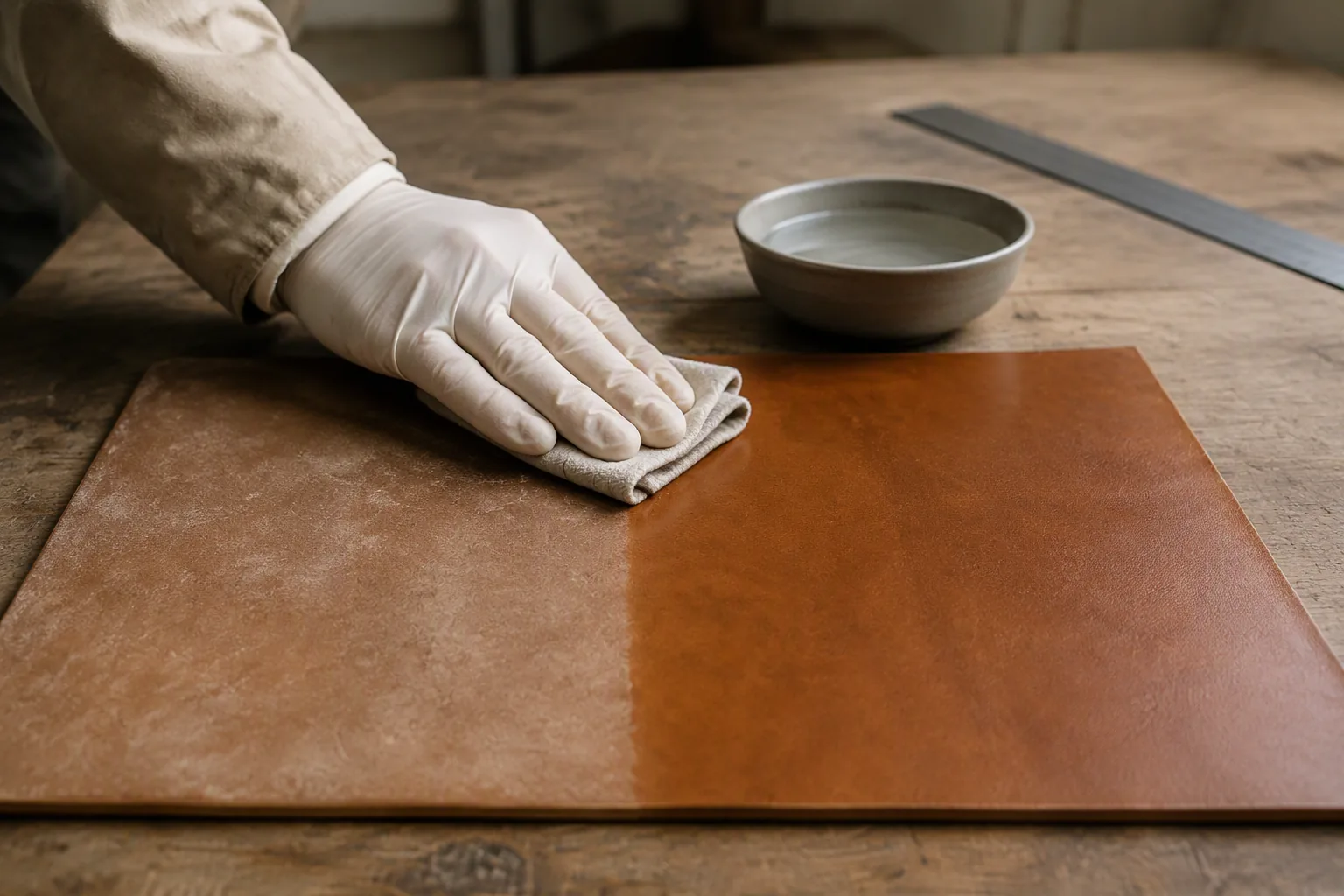
Rubbing with a dry cloth and with a damp cloth shows colour transfer under both conditions, and wiping with the intended cleaner shows whether the surface dulls or softens.
Running the cleaning test repeatedly is more informative than a single wipe, because damage accumulates.
Odour Assessment
Odour is assessed by soiling a sample with a representative residue, cleaning it as the care instruction specifies, and then judging the residual smell after drying. Doing this on two finishes side by side shows the difference that the specification is meant to capture.
Judgement should be made after the sample has dried, since a wet sample masks residual odour.
| Test | Sample state | What it predicts |
|---|---|---|
| Abrasion | Finished leather | Surface life |
| Scuff visibility | Finished leather | Appearance after knocks |
| Flex at fold | Assembled part | Cracking at gussets |
| Cold flex | Assembled part | Winter behaviour |
| Dry crock | Finished leather | Colour transfer |
| Wet crock | Finished leather | Transfer when damp |
| Repeated cleaning | Finished leather | Dulling and softening |
| Residual odour | Soiled then cleaned | Smell after use |
Repair, Refinishing and Aftercare
A finish that can be maintained extends the life of the product, and the instruction is part of the specification rather than an afterthought.
What Can Be Refinished
Pigmented and coated finishes can often be cleaned and re-coloured, because the surface is a film that can be prepared and renewed. Aniline and waxed finishes are harder to repair invisibly, because the grain is exposed and colour sits in the material.
Where a range is sold with a care programme, the finish should be chosen with repair in mind.
Care Instructions That Match the Finish
A general leather cleaner applied to a waxed finish strips the wax, and a conditioner applied to a coated finish leaves a film that attracts soil. The instruction should name what the finish tolerates and what it does not.
Naming the finish in the care text also helps the owner describe a problem accurately.
When Replacement Is the Right Answer
Where wear has reached the crust at a structural point, refinishing restores appearance but not strength. At that stage, replacement of the part or the product is honest, and the care guidance should say so rather than imply endless repair.
| Aftercare action | Suitable finishes | Avoid on |
|---|---|---|
| Damp wipe | Pigmented, coated | Aniline, suede |
| pH-neutral leather cleaner | Most finished leathers | Suede, nubuck |
| Conditioning | Aniline, waxed, oiled | Coated films |
| Re-colouring | Pigmented, corrected | Aniline, suede |
| Water repellent spray | Most, with testing | Silicone-sensitive finishes |
| Brushing | Suede, nubuck | Smooth finished |
| Professional clean | All | None |
| Replacement | Worn through to crust | Not applicable |
Writing the Finishing Specification
A finishing specification is a short document, and its value lies in naming the properties that cannot be seen on a sample.
What the Specification Must State
The finishing system, the crust it sits on, the colour reference, the texture and emboss depth, the abrasion and crock requirements, the care method, and the panels where the finish differs are the minimum. Naming the contact points makes the intent explicit and stops a cost review from flattening the range to one finish.
Where a panel must be softer or more natural, that should be stated per panel rather than applied to the whole bag.
Approved Samples and Crust Records
A sealed finished sample, with the crust identified and the finish named, is the only reliable reference for a later delivery. Colour cards alone do not describe texture, and a swatch alone does not describe the crust.
Keeping a small offcut of the finished leather allows abrasion and crock results to be re-checked years later.
Managing Substitution
Substitution happens when a colour or a finish is unavailable, and the risk is that a different system arrives with the same colour reference. The specification should require any alternative to match the system and to pass the same wear, crock and odour checks.
Each accepted substitution should be recorded with its reason and result.
| Specification item | Why it matters | Common omission |
|---|---|---|
| Finishing system | Wear and soiling | Named loosely |
| Crust reference | Underlying behaviour | Not recorded |
| Colour reference | Match across batches | Card only |
| Texture and emboss | Soil release | Not dimensioned |
| Abrasion requirement | Surface life | Not stated |
| Crock requirement | Colour transfer | Dry only |
| Care method | Maintainability | Generic text |
| Panel exceptions | Where softer is needed | Uniform finish |
Cost and Process Drivers
Finishing cost is driven by the number of passes and the yield, and the drivers are easier to manage than the total.
What Moves the Cost
Coating passes, embossing plates, colour changes and the defect rate drive cost, followed by the size of the lot and the number of colours in the range. A corrected-grain finish that covers defects costs less in material selection but more in processing.
Reducing the number of finishes across a range is usually the largest saving, because it reduces setup, colour changes and inventory.
Where Cutting Cost Is Reasonable
Using one finish family across a range, limiting colours, and keeping emboss depth consistent all reduce cost without weakening the surface. These choices also simplify the care instruction.
Reducing coat depth, skipping a top coat, or omitting edge finishing weakens the parts that wear first, and the saving is usually smaller than the complaint risk.
Cost Against Wear Life
The relevant comparison is finish cost against the cost of premature wear: a replacement, a return, or a complaint about colour transfer onto an animal. Where the finish sits at a contact point, the deeper coat pays for itself.
| Cost driver | Direction | Lever |
|---|---|---|
| Coating passes | Strong | Single system per range |
| Emboss plates | Moderate | Reuse across styles |
| Colour changes | Strong | Limit colours |
| Defect rate | Strong | Crust selection |
| Lot size | Moderate | Plan across styles |
| Edge finishing | Moderate | Standardise method |
| Top coat | Moderate | Only where wear demands |
| Inventory | Administrative | One system family |
FAQ
Which leather finish is best for pet products?
A: A pigmented or coated finish is the usual default, because it resists abrasion, releases soil with a wipe and holds little odour. Semi-aniline is a reasonable compromise where a more natural look is required and wear is moderate.
Does a finished leather still absorb odour?
A: The finish reduces what enters the grain, but residues held at seams, edges and the lining still carry smell. Odour is best controlled by a closed, wipeable surface combined with a lining that can be removed and washed.
Is full aniline suitable for a pet carrier?
A: It is rarely the best choice. Full aniline leaves the grain exposed, so it stains, scuffs and absorbs liquid readily. It suits calm animals and light use, not daily contact with claws and accidents.
Why does the finish crack at the gusset?
A: Because the film is less elastic than the leather beneath it, and repeated folding fatigues it. A more elastic binder, a thinner coat and a softer crust extend flex life, and the fold should be tested on the assembled part.
What causes colour to rub off onto an animal?
A: Crocking, usually from a heavily pigmented finish with insufficient binder or from moisture. Dry and wet crock tests separately identify which condition is responsible, and the finish should be adjusted rather than the care text.
How is abrasion resistance tested?
A: By rubbing the finished surface under controlled pressure and measuring material loss or visible damage. The test should use the actual finished leather from the production crust, because a swatch from another crust predicts little.
Should the base of a pet carrier use the same finish as the body?
A: Not necessarily. The base contacts the ground and soils heavily, so it usually needs a tougher, more closed finish. Naming per-panel finishes is normal practice and avoids over-specifying the whole bag.
Does a coated finish look artificial?
A: A heavy coating does change the hand and the look, which is why coated finishes are often used on panels that wear rather than across the whole product. A light pigmented finish keeps more of the grain visible.
How should a finished leather pet product be cleaned?
A: Follow the finish rather than a general leather rule: damp wiping suits pigmented and coated surfaces, while aniline, waxed and suede surfaces need different treatment. The care text should name the finish and the method it tolerates.
Can a worn finish be repaired?
A: Pigmented and coated finishes can often be cleaned and re-coloured, because the surface is a film. Aniline and waxed finishes are harder to repair invisibly. Where wear has reached the crust at a structural point, replacement is the honest answer.
Why does wear appear beside the hardware rather than under it?
A: Because a ring or clip moves against the leather as the bag is carried, polishing and then cutting the finish at the edge of the contact. A reinforcing patch or folded tab spreads that contact.
Does embossing make leather harder to clean?
A: Yes, because soil collects in the valleys between raised areas, and the raised areas wear first. Shallow embossing keeps the pattern readable with less retention than a deep pattern.
Is suede acceptable anywhere on a pet product?
A: It is soft and quiet, but it is the most soil-retentive surface available and difficult to clean. Where it is used, it belongs on a panel that does not contact the animal or the ground.
How quickly should a finished surface resist a water drop?
A: Long enough for a spill to be noticed and wiped, not indefinitely. Testing at a consistent temperature and angle makes comparisons between finishes meaningful, and the result should be described as reduced absorption.
Does the finish or the tanning decide how the bag ages?
A: Both, in different ways: tanning sets temper, stretch and heat behaviour, while finishing sets appearance, abrasion and soil release. A finish cannot correct a crust that is unsuitable for the product.
What should be checked when finished leather arrives at the factory?
A: The system, crust, colour, texture and emboss against the approved sample, plus abrasion, crock and a cleaning check. Sewing a small sample and flexing it at the fold then shows how the finish behaves in the actual construction.
Ready to specify a finish that survives the animal rather than the showroom? Name the system and the crust, set abrasion, crock and odour requirements per panel, choose closed surfaces at contact points, and test wear, flex and residual smell on the assembled bag. Then write the care method the finish actually tolerates, and keep a sealed reference with an offcut so the next delivery can be judged against it.