Factory Stock Designs vs Fully Custom Bags: How to Choose
- The Two Sourcing Paths Defined
- What Each Path Actually Involves
- Cost Structures Compared
- MOQ and Lead Time Implications
- Exclusivity and Brand Risk
- Design Control and Product Fit
- Technical Requirements for Each Path
- Choosing by Brand Stage
- Hybrid Approaches That Outperform Both Extremes
- Working With a Factory on Either Path
- When to Move From Stock to Custom
- Talking About Price on Each Path
- How Material and Hardware Choices Interact With the Path
- How the Path Affects Quality Control
- Common Misconceptions
- FAQ
Every brand eventually faces a fork in sourcing: adopt a design the factory already makes, or develop one from scratch. The choice looks like a simple trade-off between speed and originality. In practice it determines development cost, minimum order quantity, lead time, exclusivity and how much control the brand has over the product that carries its name.
Factories rarely frame it as a binary. Most production sits somewhere on a spectrum between a catalogue style and a fully new pattern, and understanding that spectrum is what allows a brand to choose deliberately rather than by default. A young label may need a stock design to test the market; an established one may need full custom development to defend its position.
This guide breaks down both paths: what each involves operationally, how their cost structures differ, what they mean for MOQ and lead time, how exclusivity and design control work, what technical preparation each requires, how the decision changes with brand stage, and how hybrid approaches often outperform either extreme.
The Two Sourcing Paths Defined
The industry vocabulary is loose, which is why so many buyers end up confused about what they are actually ordering.
Factory Stock Designs
A stock design is a pattern and construction the factory already produces. Tooling exists, materials are already sourced, the assembly sequence is proven and cutting dies are on the shelf.
The buyer selects from what is available, confirms a leather and hardware option within the factory's existing range, and places an order. The factory's role is production, not development.
Modified Stock Designs
A modified stock design starts from an existing pattern but changes defined elements: leather type or color, hardware style, dimensions, pocket configuration, lining or strap details.
The construction logic stays the same, which keeps tooling and assembly largely intact. This middle path is the most common in practice and is where most brands actually operate.
Fully Custom Development
Full custom means a new pattern developed for the buyer: new dimensions, new panel geometry, new construction, new hardware, new internal layout. The factory creates the pattern, builds prototypes and goes through a sampling cycle before production.
Every element is specified by the buyer and verified through samples, so development effort is proportional to how far the design departs from anything the factory already makes.
Why the Spectrum Matters
Treating the choice as binary produces two common errors: paying for full custom development when a modified stock design would have met the brief, or accepting a stock design and then discovering that customization requests have quietly pushed the project into development territory.
The practical question is not "stock or custom" but "how much development is this product actually worth."
| Path | Development effort | Tooling | Buyer control | Typical use |
|---|---|---|---|---|
| Stock design | None | Existing | Selection only | Market testing |
| Light modification | Minimal | Mostly existing | Materials and details | Fast differentiation |
| Heavy modification | Moderate | Partial rework | Multiple attributes | Range building |
| Full custom | High | New | Complete | Core product lines |
What Each Path Actually Involves
The operational differences are clearer when each path is laid out step by step.
Placing a Stock Design Order
Stock orders move quickly. The buyer reviews available styles, confirms availability of the leather and hardware options, agrees the price and MOQ for that style, and places the order.
Sampling may be limited to a pre-production sample to confirm materials, because the construction is already proven.
Running a Modification
Modification introduces a confirmation step: the buyer specifies exactly what changes and the factory confirms what stays fixed. The critical discipline is documenting the unchanged elements, since unstated assumptions are where modifications go wrong.
A modification project typically needs a sample to verify that the change did not disturb the construction: a heavier leather on a pattern designed for a softer one can alter how the bag folds and how the edges finish.
Developing a Custom Pattern
Custom development runs through defined stages: brief, pattern making, prototype, sample review, corrections, approval, then production tooling. Each stage has outputs, and each consumes calendar time.
The most expensive mistake is approving a sample without checking the details that are hard to change later: construction method, hardware placement, internal dimensions and edge treatment.
| Stage | Stock | Modified | Full custom |
|---|---|---|---|
| Brief and selection | Days | Days | Weeks |
| Pattern development | None | Minor | Full |
| Prototype | Not needed | Sometimes | Required |
| Sample rounds | One | One to two | Two to four |
| Tooling | Existing | Partial | New dies |
| Approval gate | Materials | Changes | Construction |
Cost Structures Compared
Cost differences come from development effort, material efficiency and tooling, not from a single line item.
Development Costs
Stock designs carry no development cost. Modified designs carry the cost of pattern adjustment and an extra sample round. Full custom carries pattern making, multiple prototypes, correction rounds and new tooling.
Development cost is one-time and largely independent of order quantity, which means it weighs heavily on small first orders and lightly on large repeat programs.
Unit Cost Drivers
Per-unit cost depends on material consumption, assembly time and yield. A stock pattern has been optimized over many production runs, so cutting yield is known and assembly time is stable.
A custom pattern is less efficient at first: nesting may waste more leather, and assemblers need time to reach the standard time. Over repeat orders, custom designs converge toward stock efficiency.
Hidden Costs
The costs that surprise buyers are rarely the quoted ones. Custom development consumes buyer time in sampling reviews, corrections and internal approvals. It also carries risk: a design that underperforms in the market means the development spend produced no revenue.
Modified stock designs carry a different hidden cost: the risk that the change disturbs a proven construction in a way that shows up as a defect.
| Cost element | Stock | Modified | Full custom |
|---|---|---|---|
| Pattern development | None | Low | High |
| Tooling | None | Partial | Full |
| Sampling rounds | One | One to two | Two to four |
| Material yield | Optimized | Good | Improving over time |
| Assembly time | Standard | Near standard | Above standard initially |
| Buyer time | Low | Moderate | High |
| Market risk | Shared | Shared | Concentrated |
MOQ and Lead Time Implications
MOQ and lead time follow directly from development and tooling, and both are usually more favorable on the stock path.
Why Stock Designs Have Lower Minimums
A stock design already has tooling and materials in the factory's system, and other buyers may also be ordering it. The factory can absorb a smaller order without a dedicated setup, which lowers the entry point.
This is why stock designs are often the only realistic option for a brand's first order.
Why Custom Development Raises Both
Custom work requires new dies, dedicated material purchasing and dedicated production time. Factories amortize that setup across the order, so small quantities produce high unit cost, which pushes the effective minimum upward.
Lead time extends as well: development and sampling precede production, and first production runs typically take longer because operators are learning the pattern.
Where Modification Sits
Modification usually raises MOQ modestly and extends lead time by the duration of the additional sampling and material sourcing. When the modification is limited to materials within the factory's existing range, the impact is small.
When the modification requires new hardware tooling or a new leather from a different supplier, the impact approaches full custom.
| Factor | Stock | Modified | Full custom |
|---|---|---|---|
| Entry quantity | Lowest | Moderate | Highest |
| Tooling lead time | None | Short | Significant |
| Sampling before production | Minimal | Short | Extended |
| First production run | Fast | Moderate | Slowest |
| Repeat orders | Fast | Fast | Fast and efficient |
| Total time to market | Shortest | Moderate | Longest |
Exclusivity and Brand Risk
Exclusivity is the strongest argument for moving along the spectrum, and it deserves a clear-eyed assessment.
The Shared-Design Risk
A stock design may be sold to other buyers, including ones selling into the same channels. Two brands can end up with near-identical products, differing only in the label.
For a brand building an identity, that outcome undermines pricing and positioning. For a brand testing whether a category works, it may be an acceptable trade.
What Exclusivity Agreements Actually Cover
Exclusivity can be negotiated in several dimensions: a specific market or territory, a channel, a time period, or a modification threshold that makes the version sufficiently different. Factories vary in what they will agree to and at what order volume.
The practical approach is to define exclusivity precisely in writing: what is exclusive, where, for how long, under what volume commitment, and what happens if the commitment is not met.
Using Modification to Reduce Risk
A meaningful modification can create practical differentiation even without formal exclusivity: a distinctive leather, a changed proportion, a different hardware family or an added functional feature.
The stronger the modification, the more the product reads as the brand's own. This is often a better use of budget than paying a premium for exclusivity on a recognizable stock style.
| Exclusivity route | Protection level | Cost implication | Best suited to |
|---|---|---|---|
| None | Low | Lowest | Testing a category |
| Territory exclusivity | Moderate | Volume commitment | Regional brands |
| Channel exclusivity | Moderate | Negotiated terms | Brands with clear channels |
| Modified design | Moderate to high | Development cost | Range differentiation |
| Full custom pattern | Highest | Development and tooling | Core brand products |
Design Control and Product Fit
Control is not only about exclusivity. It is about whether the product matches what the customer actually needs.
Where Stock Designs Compromise
Stock styles exist because they sell broadly. That breadth means compromises: proportions that suit a general buyer, pocket layouts that fit common uses, hardware families that are widely available.
A brand whose value proposition rests on a specific use case, such as a work bag with defined internal organization, will find that a stock design rarely fits exactly.
Where Custom Development Pays Off
Custom development is justified when a specific functional requirement cannot be met by modification: a particular opening mechanism, a defined internal layout, a durability standard tied to construction, or a silhouette that carries the brand's identity.
In those cases the development investment buys something a stock design cannot provide at any volume.
Iteration Speed
Stock designs allow fast iteration: order, sell, observe, reorder. Custom programs iterate more slowly because each change runs through sampling.
For categories where consumer preference is uncertain, the faster loop may be more valuable than the more precise product.
Technical Requirements for Each Path
The preparation a brand needs differs sharply between paths, and shortfalls here cause most of the friction.
| Requirement | Stock | Modified | Full custom |
|---|---|---|---|
| Reference sample | Selection from range | Base style identified | Design brief |
| Specification document | Minimal | Change list plus fixed spec | Full tech pack |
| Material decisions | Choose from range | Specify materials | Specify and source |
| Hardware decisions | Choose from range | Specify | Specify and develop |
| Measurement spec | Factory standard | Unchanged plus revised | Complete |
| Approval discipline | Materials only | Changes and interactions | Construction and all details |
What a Modification Brief Must Contain
A modification brief should state the base style, the exact changes, the elements that must not change, and the reference sample used for comparison. Ambiguity about what stays fixed is the most common source of disputes.
What a Custom Tech Pack Must Contain
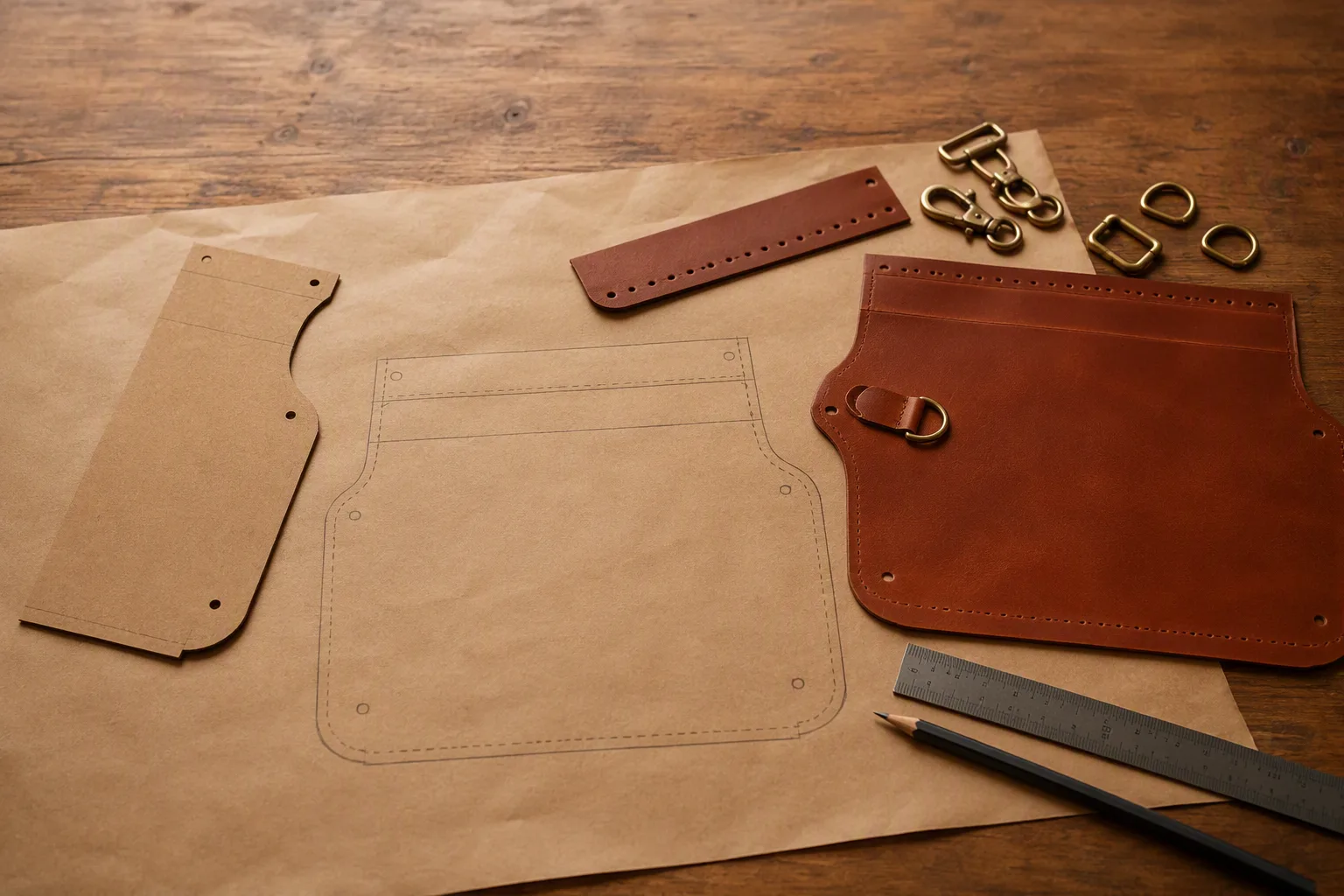
A custom development needs a complete specification: dimensions and tolerances, construction method, materials down to the lining and reinforcement, hardware with finishes, stitch specifications, edge treatment and labeling. The more complete the pack, the fewer sample rounds are needed.
The Cost of Insufficient Preparation
Underprepared projects do not fail loudly; they consume sample rounds. Each round costs calendar time and often money, and several avoidable rounds can consume the entire advantage a cheaper path was supposed to deliver.
Choosing by Brand Stage
The right path usually depends less on preference than on where the brand is in its development.
Early Stage: Establish Demand
Early brands need proof that anyone will buy the product before spending on development. A stock design or light modification gets product to market fastest and cheapest, and the feedback is real rather than projected.
The risk to manage is channel conflict and the temptation to treat a stock style as the brand's identity.
Growth Stage: Differentiate
Once demand is established, differentiation starts to pay. Modification is usually the most efficient instrument: it changes what the customer sees and feels without the cost of full development.
This is also the stage where exclusivity terms become worth negotiating, because volume can support them.
Established Stage: Own the Core
A mature brand with predictable volumes can justify full custom development for its core products, where exclusivity, fit and construction control support premium positioning.
Custom development for every style is rarely necessary. Most successful ranges combine custom core products with modified or stock adjacent items.
| Brand stage | Primary objective | Recommended path | Watch out for |
|---|---|---|---|
| Launch | Validate demand | Stock or light modification | Channel conflict |
| Early growth | Build identity | Modification | Under-specifying changes |
| Scaling | Expand range efficiently | Mix of modified and custom | Spreading development thin |
| Established | Defend position | Custom core plus modified | Over-customizing low-volume styles |
| Mature global | Segment by market | Custom core, tiered by market | Complexity in supply chain |
Hybrid Approaches That Outperform Both Extremes
Most mature ranges are hybrids, and the hybrids follow recognizable patterns.
Start Stock, Then Customize
A brand launches with a stock design, observes what customers ask for, and then develops a modified or custom version based on that feedback. The first order pays for market research rather than development.
Custom Core, Stock Support
A brand develops custom versions of its hero products and fills the rest of the range with stock or lightly modified styles. Development budget concentrates where it changes the customer's decision.
Test, Then Scale
A modification is produced in a small quantity through an existing pattern, and only successful styles proceed to full custom development. This sequencing avoids paying development cost for products that will not be reordered.
Sectioning the Range
Some brands allocate by price tier: custom construction at premium tiers, modification at mid tiers and stock at entry tiers. The construction matches what each price point can support.
| Hybrid pattern | Development spend | Speed to market | Risk profile |
|---|---|---|---|
| Stock first, then customize | Deferred | Fastest | Lowest |
| Custom core plus stock support | Concentrated | Moderate | Balanced |
| Test then scale | Staged | Progressive | Controlled |
| Tiered by price point | Allocated | Moderate | Diversified |
Working With a Factory on Either Path
The relationship mechanics differ between a stock order and a development project, and the same behavior that serves one can damage the other.
Managing a Stock Relationship
Stock orders run on predictability: confirm availability, confirm material and hardware options, place orders on a regular rhythm. Buyers who order consistently receive better allocation when capacity tightens.
The main discipline is resisting the temptation to request small changes informally. Verbal changes to a stock design create ambiguity about what is being produced.
Managing a Development Project
Development runs on milestones: brief approved, pattern confirmed, prototype reviewed, corrections closed, production sample approved, tooling released. Each milestone should be signed off in writing.
Factories perform better when feedback is consolidated. Sending corrections in batches, with clear priorities and photographs, shortens the cycle compared with a stream of individual comments.
Intellectual Property and Confidentiality
Custom designs, patterns and tooling represent real value, and ownership should be defined in the agreement: who owns the pattern, whether it can be used for other buyers, and what happens if the relationship ends.
Where a brand develops a distinctive product, a confidentiality agreement and a clear statement of design ownership are standard practice.
Documentation That Prevents Disputes
Approved samples are the reference for production. Keeping the approved sample, the specification it was built to, and the sign-off record together creates an unambiguous standard that both sides can check against.
| Activity | Stock order | Development project |
|---|---|---|
| Communication rhythm | Order cycle | Milestone based |
| Change mechanism | Formal only | Batched corrections |
| Reference standard | Factory specification | Approved sample plus spec |
| Ownership questions | Rarely relevant | Must be defined |
| Documentation | Order and shipment records | Full development file |
When to Move From Stock to Custom
The decision to develop a custom pattern is best made on evidence rather than ambition. Several signals indicate the moment has arrived.
Signals From Sales Data
Repeat orders are the clearest signal. When a stock style reorders consistently, the volume exists to justify development, and the pattern will be used often enough to earn back its cost.
Returns and complaints carry the same message in negative form: if customers repeatedly return a product for the same functional reason, the stock construction is not meeting the requirement.
Signals From the Market
Seeing a near-identical product under another label in the same channels is a strong prompt to differentiate. So is price competition on a style that few customers can distinguish from a competitor's version.
Retailer requirements can also force the move: some channels require exclusive or own-brand product, which stock designs cannot satisfy.
Signals From Operations
Operational frictions accumulate quietly. If the available material range limits what the product can promise, if the factory cannot hit the required quality standard on a specific detail, or if MOQ terms on stock styles block the sizes the range needs, custom development solves problems that modification cannot.
| Signal | What it indicates | Recommended action |
|---|---|---|
| Consistent reorders | Volume supports development | Plan a custom version |
| Repeated functional returns | Construction mismatch | Redesign the affected detail |
| Same product under other labels | Differentiation pressure | Modify or develop |
| Price-only competition | No perceived difference | Add distinctive elements |
| Channel requires exclusivity | Access requirement | Negotiate or develop |
| Material range too narrow | Product ceiling reached | Source materials directly |
Talking About Price on Each Path
Development costs and unit costs move differently, and comparing them carelessly produces the wrong conclusion.
Comparing on the Same Basis
Unit prices are only comparable when quantity, specification, trade term, packaging and payment terms match. A stock quote at one quantity and a custom quote at another are not comparable figures.
The fair comparison is landed cost per unit at the same quantity, with development and tooling added for the custom option and amortized over the expected volume.
Amortizing Development
Development and tooling charges are sometimes credited against production when the order reaches a defined volume. Where that is not offered, the brand should calculate the amortized cost per unit at realistic volumes rather than at the first order alone.
A development charge spread across a full season of production often looks very different from the same charge applied to a single test order.
Where Buyers Misjudge
The common error is comparing a stock unit price with a custom unit price and concluding that custom is expensive, without accounting for the fact that the stock product is not differentiated and may not support the intended price point.
The reverse error also occurs: assuming a custom product justifies a premium in the market automatically. Development buys control, not demand.
| Comparison element | Why it matters |
|---|---|
| Quantity tier | Price breaks differ sharply |
| Specification | Materials and construction define cost |
| Trade term | Responsibility shifts cost |
| Packaging | Retail packaging adds cost |
| Payment terms | Financing cost sits in the price |
| Development charges | One-time and amortizable |
| Expected volume | Determines real per-unit development cost |
How Material and Hardware Choices Interact With the Path
The path chosen also determines which materials and components are realistically available.
Freedom Inside a Stock Pattern
A stock pattern typically comes with a defined range of leathers and a hardware family used across the factory's styles. Selection within that range is quick and rarely affects MOQ.
Stepping outside the range is possible but moves the project toward modification, because new materials require new sourcing, new cutting behavior and often new testing.
What Custom Unlocks
Custom development removes the constraint of an existing range. The brand can specify a leather chosen for its temper and finish, hardware developed to its own design, and linings selected for durability rather than availability.
Exotic or specialty materials become viable at this stage, since the pattern is being built around them rather than adapted to them.
The Cost of Non-Standard Choices
Non-standard materials carry their own MOQ, lead time and yield consequences, which add to the cost of the path itself. A specialty leather may need to be ordered in a full lot, extend the material lead time and produce a lower cutting yield than the factory's standard material.
These costs belong in the path decision, not in a later surprise.
| Element | Stock path | Custom path |
|---|---|---|
| Leather choice | Factory range | Open specification |
| Hardware | Existing family | Developed to design |
| Lining | Standard options | Specified |
| Material MOQ | Already stocked | May require full lot |
| Material lead time | Short | Longer |
| Cutting yield | Known and optimized | Estimated until proven |
How the Path Affects Quality Control
Quality behaves differently on each path, and inspection priorities should follow.
Stock Designs: Stable and Known
A stock design has been produced many times, so variance is understood. The factory knows which operations drift and which materials run consistently, and defect patterns are familiar.
Inspection on stock orders concentrates on material consistency, color matching between lots and the details that customers handle: edges, hardware function and stitch appearance.
Custom Designs: First Runs Carry More Risk
A first production run introduces variables: operators are learning the pattern, cutting yield is being proven, and hardware placement may need adjustment. Variance is higher, and so is the value of inspecting early.
The practical approach is to inspect the first output of each operation rather than only the finished goods, so deviations are caught before a full batch is built to a wrong standard.
Setting the Reference Standard
On both paths, the approved sample plus the written specification is the reference. On custom programs the specification does more work, because there is no factory history to fall back on when a question arises.
What to Inspect and When
| Path | First-run risk | Inspection focus | Timing |
|---|---|---|---|
| Stock | Low | Materials and color lots | Incoming and finished |
| Light modification | Low to moderate | Changed details | First output of changed operations |
| Heavy modification | Moderate | Interaction of changes with construction | Early in production |
| Full custom | High | Each new operation | First piece of each operation |
Learning From the First Order
The first order on a custom design produces information: actual yield, real assembly time, defect patterns. Capturing that information and updating the specification prevents the same issues from recurring on the second order.
Common Misconceptions
Several assumptions push buyers toward the wrong path.
"Custom Always Costs More"
Custom costs more in development but not necessarily in unit cost, and it can be cheaper per unit at volume once the pattern is optimized. What custom always costs is time.
"Stock Designs Cannot Be Differentiated"
Differentiation comes from materials, hardware, proportions and details, not only from a new pattern. A well-chosen modification can produce a product that customers cannot buy elsewhere.
"Modification Is Basically Custom"
Modification retains the construction and much of the tooling, which is why it is faster and cheaper. Treating it as full custom overstates the cost; treating it as stock understates the work.
"Exclusivity Is Only About the Design"
Exclusivity also concerns materials, hardware and colorways. A competitor can produce a near-identical product from a different pattern using the same materials if those are not part of the agreement.
FAQ
How do I know whether a stock design will be sold to competitors?
A: Ask directly and put the answer in writing. Factories can confirm which styles are open, which are tied to exclusivity arrangements and which channels they already supply.
Can a modification be exclusive?
A: Often yes, particularly where the change is substantial or the volume commitment is meaningful. The scope, territory and duration should be defined in writing.
What is the minimum information I need before ordering a stock design?
A: The style reference, the leather and hardware options selected, quantity tiers, labeling requirements and the target delivery date. Everything else follows the factory's standard.
How many sample rounds does full custom development usually need?
A: Two to four rounds is typical for a new pattern, depending on how far the design departs from the factory's existing constructions and how complete the tech pack is.
Does a modified design keep the factory's original specifications?
A: The unchanged elements should stay exactly as the base style. Documenting what stays fixed is as important as documenting what changes.
Can I move a custom design to another factory later?
A: That depends on who owns the pattern and the tooling, which is why ownership should be defined in the agreement. Without clarity, moving production means developing the pattern again.
Is a stock design ever the right long-term choice?
A: Yes, for categories where the product is not the brand's differentiator and where supply reliability matters more than exclusivity.
How much does development add to lead time?
A: Development and sampling precede production, so the addition is proportional to the number of sample rounds and correction cycles. Sequencing the sampling early keeps the impact contained.
What should I check on a modification sample?
A: The intended changes, plus how they interact with unchanged construction: edge finishing, folding behavior, hardware seating and interior dimensions.
Do factories charge for development separately?
A: Typically yes, as pattern making, sample and tooling charges, which may be credited against production depending on the agreement.
Can exclusivity be granted without a large order?
A: It is negotiable, but factories generally tie exclusivity to volume commitments because exclusivity has a cost to them.
How do I compare quotes between a stock and a custom option fairly?
A: Compare landed cost per unit at the same quantity and specification, add development and tooling, and account for the different lead times.
What happens if a custom design does not sell?
A: The development spend is sunk, though the pattern remains available for future use. This is why staged development, testing a modification before committing to a full pattern, reduces exposure.
Should the tech pack be written before approaching a factory?
A: A complete tech pack shortens sample rounds, but an initial conversation can help shape it. What should be settled before development starts is the construction logic and the critical dimensions.
How does exclusivity interact with material choices?
A: If materials are not included in the exclusivity scope, a competitor can build a similar product from the same leather. Defining materials in the agreement closes that gap.
Can I order a stock design and modify it later in the same order?
A: Changes agreed after sampling and before production are normally possible, but they reset sample approval for the affected parts. It is cheaper to decide the modification before the order is confirmed.
Ready to decide between a stock design and a custom development for your next leather bag line? Share your target market, volume expectations and timeline, and we will help you match the path to the stage of your brand: stock or modified styles where speed matters, full custom development where exclusivity and construction control justify the investment.