Factory Audits for Leather Bag Suppliers: What Inspectors Check
- What a Factory Audit Is and Why Buyers Commission One
- Documentation Review
- Workshop Inspection: What Inspectors Look At
- Quality Control Systems
- Worker Conditions and Labor Practices
- Capacity Verification
- Questions That Reveal Real Capability
- Red Flags to Watch
- Preparing an Audit Checklist
- After the Audit: Scoring and Follow-Up
- Sequencing Audits With Sampling and Pilot Runs
- Common Misconceptions About Audits
- Working With Third-Party Audits
- Typical Audit Findings by Supplier Type
- FAQ
Every brand that sources leather bags eventually faces the same question: is this factory actually able to build what it has quoted, at the quality and volume promised? A brochure answers none of it. A sample room answers part of it. A factory audit answers most of it.
An audit is a structured visit that examines how a factory operates rather than what it says. Inspectors review documents, walk the workshop, trace production records, interview supervisors and verify capacity claims against evidence. Done properly, it converts a supplier relationship from trust into something more durable: verified capability.
This guide describes what a competent audit covers, why each section matters for leather bags specifically, what documentary and physical evidence inspectors look for, and the red flags that predict production problems long before an order ships.
What a Factory Audit Is and Why Buyers Commission One
An audit is not an inspection. Inspection verifies a batch of product; audit verifies a system. Buyers commission audits for four reasons, and the reason shapes the scope.
Verifying Capability Before Committing
The most common motivation is a new supplier or a new product category. A brand may have a sample that looks excellent and no evidence that the factory can reproduce it at volume, month after month, with consistent materials.
An audit establishes whether the process exists to sustain quality, not merely to produce a good first sample.
Identifying Risk Before It Reaches Production
Production failures seldom appear suddenly. They are usually visible earlier as weak incoming inspection, unstable material supply, overloaded capacity or undocumented changes.
An audit surfaces those conditions while there is still time to address them or to choose differently.
Meeting Compliance Requirements
Brands selling into regulated markets may need social compliance, environmental compliance or traceability evidence. Many retailers require an audit report from a recognized standard before listing a supplier.
Establishing a Baseline for Improvement
Even when a supplier is acceptable, an audit creates a documented baseline: what processes exist, what records are kept, where gaps sit. Future audits measure movement against it.
| Audit type | What it covers | Typical use |
|---|---|---|
| Desktop review | Documents only, no site visit | First screening |
| On-site capability audit | Documents plus workshop walk | New supplier approval |
| Social compliance audit | Labor, safety, environment | Retailer requirements |
| Process audit | Specific production line or product | Quality troubleshooting |
| Follow-up audit | Closure of previous findings | Verification of corrective action |
Audit versus Inspection
Inspectors examine the goods; auditors examine the system that produces them. A factory can pass an inspection with a lucky batch and still fail an audit because the process that produced it is unstable.
Documentation Review
Documentation review is where the audit begins, because it establishes what the factory claims. The workshop walk then tests whether those claims match reality.
Legal Registration and Business Scope
Inspectors verify the business license, the registered name, the legal address and the scope of business. A mismatch between the trading entity that quoted and the factory that will produce is a significant finding.
They also check whether export rights, if claimed, are held by the same entity. When they are not, the buyer is relying on a third party for a critical step.
Quality Management System Documents
Factories with a functioning system can produce documents without preparation: process flow charts, work instructions, inspection standards, defect classification, and procedures for handling non-conforming product.
The value is not in the certificates but in the records. Inspectors look for evidence the system is used: completed inspection forms, signed corrective actions, dated revisions.
Material Traceability and Test Reports
For leather goods, traceability is a recurring theme. Inspectors look for tannery documents, material specifications, batch records and test reports for restricted substances, colorfastness or physical performance where applicable.
A factory unable to state where its leather comes from cannot support a brand's compliance claims.
Environmental and Labor Records
Where compliance is in scope, inspectors review waste handling, chemical storage and disposal, wastewater arrangements, working hours, wage records and age verification.
| Document category | Evidence sought | Common gap |
|---|---|---|
| Business registration | License, scope, export rights | Trading entity mismatch |
| Quality system | Flow charts, work instructions, standards | Documents exist but unused |
| Material traceability | Tannery records, batch traceability | Leather origin unknown |
| Test reports | Substance and performance tests | Reports from other orders |
| Labor records | Hours, wages, age verification | Incomplete timekeeping |
| Environmental | Chemical storage, waste handling | No disposal documentation |
| Equipment records | Maintenance logs, calibration | No logs maintained |
Reading a Document Set Critically
Exceptionally clean documentation on a first visit deserves attention. Auditors look for documents that are used: worn edges, handwritten entries, dated revisions, signatures. Pristine binders with no working copies suggest preparation rather than practice.
Workshop Inspection: What Inspectors Look At
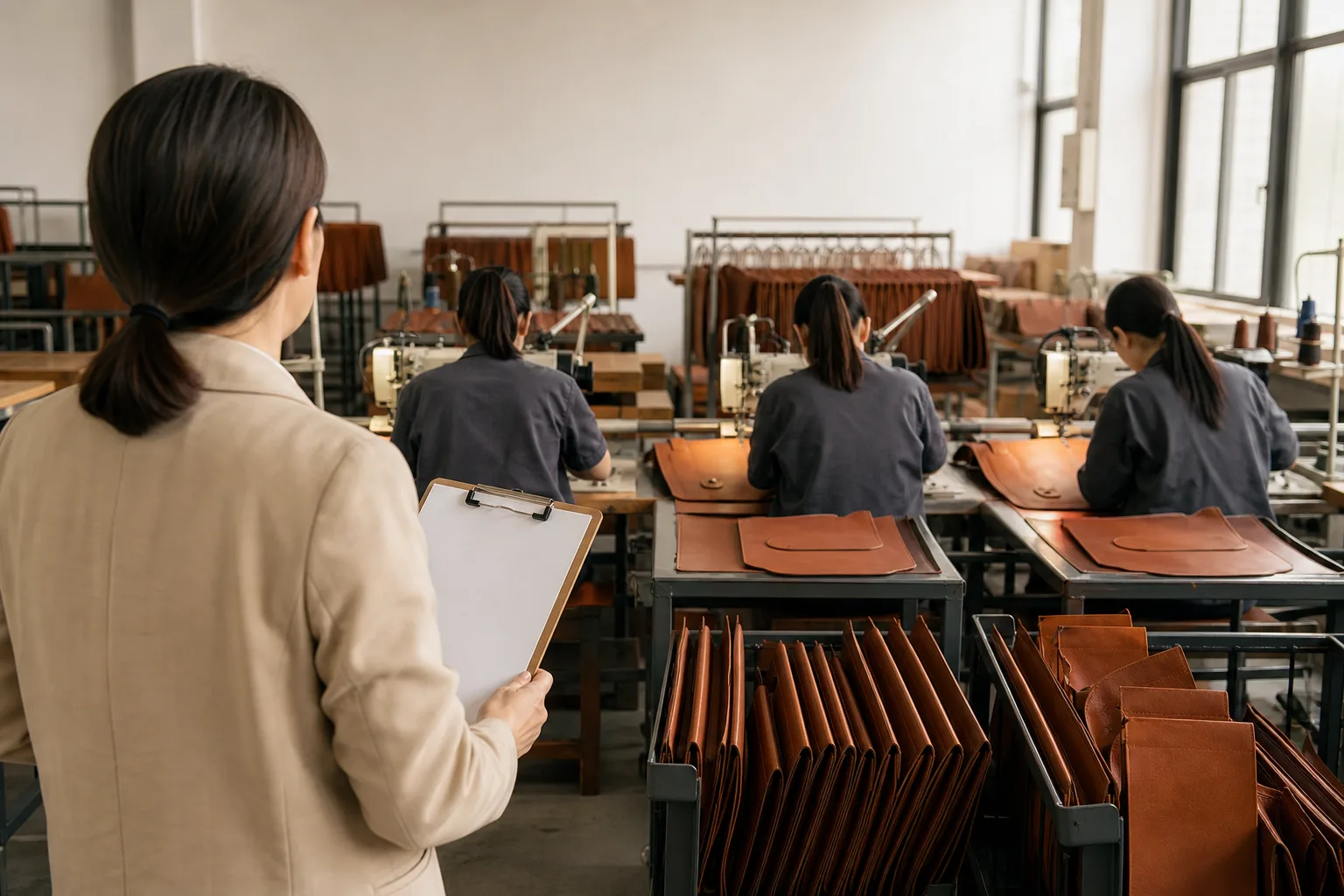
The workshop walk tests the documents. Inspectors follow the production flow from material receipt to packing, and they observe conditions rather than explanations.
Leather Storage and Cutting
Leather storage reveals how seriously a factory treats material. Inspectors check for protection from light, moisture and dust, racking that prevents creasing, and separation of incoming material from approved stock.
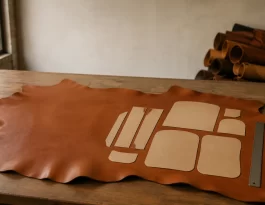
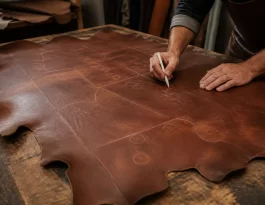
In the cutting area they look for die storage and maintenance, nesting practice, and how defects in the hide are identified and marked before cutting.
Sewing Line Organization
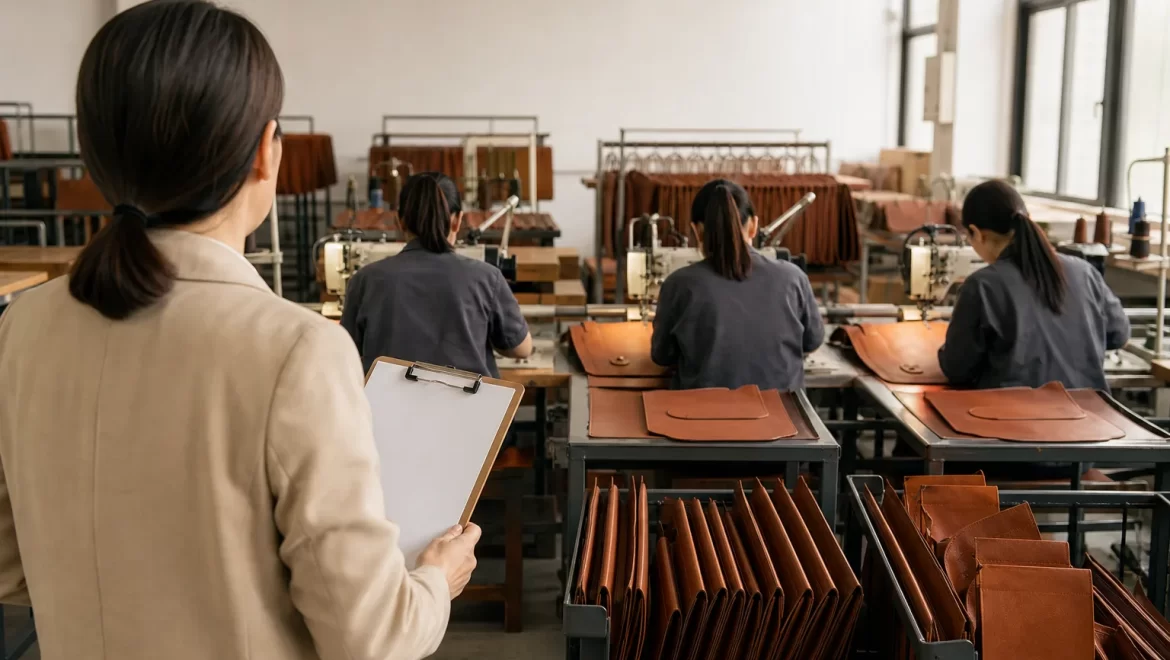
The sewing line shows how work is sequenced and controlled. Inspectors look for clear separation of operations, work-in-progress containers with identification, sample references posted at stations, and whether finished panels are inspected before assembly.
They also examine the machine setup: needle and thread specifications posted, tension standards, and whether setup is documented or left to the operator.
Equipment and Maintenance
Equipment condition indicates maintenance discipline. Inspectors check maintenance logs against the machine's visible condition, and look for spare parts, calibration records for measuring equipment, and a functioning process for reporting breakdowns.
Work in Progress and Identification
Unidentified work in progress is a quality risk. Inspectors check whether materials, panels and partially assembled bags carry traveler documents or labels that connect them to a production order, a color lot and a customer.
Housekeeping and Safety
Housekeeping is a reliable indicator of discipline and safety. Inspectors look for clear aisles, adequate lighting, organized tools, guarded machines, and accessible first aid and fire equipment.
| Area | What inspectors check | Why it matters |
|---|---|---|
| Leather storage | Protection, racking, separation | Material damage and mixing |
| Cutting | Die maintenance, nesting, defect marking | Yield and consistency |
| Sewing line | Operation sequence, setup, WIP control | Reproducibility |
| Machine maintenance | Logs versus condition | Stability over time |
| WIP identification | Travelers, labels, lot marking | Traceability |
| Housekeeping | Aisles, lighting, safety equipment | Discipline and safety |
Quality Control Systems
A factory without inspection points is dependent on operators noticing their own mistakes, a condition that reliably produces escapes.
Incoming Material Inspection
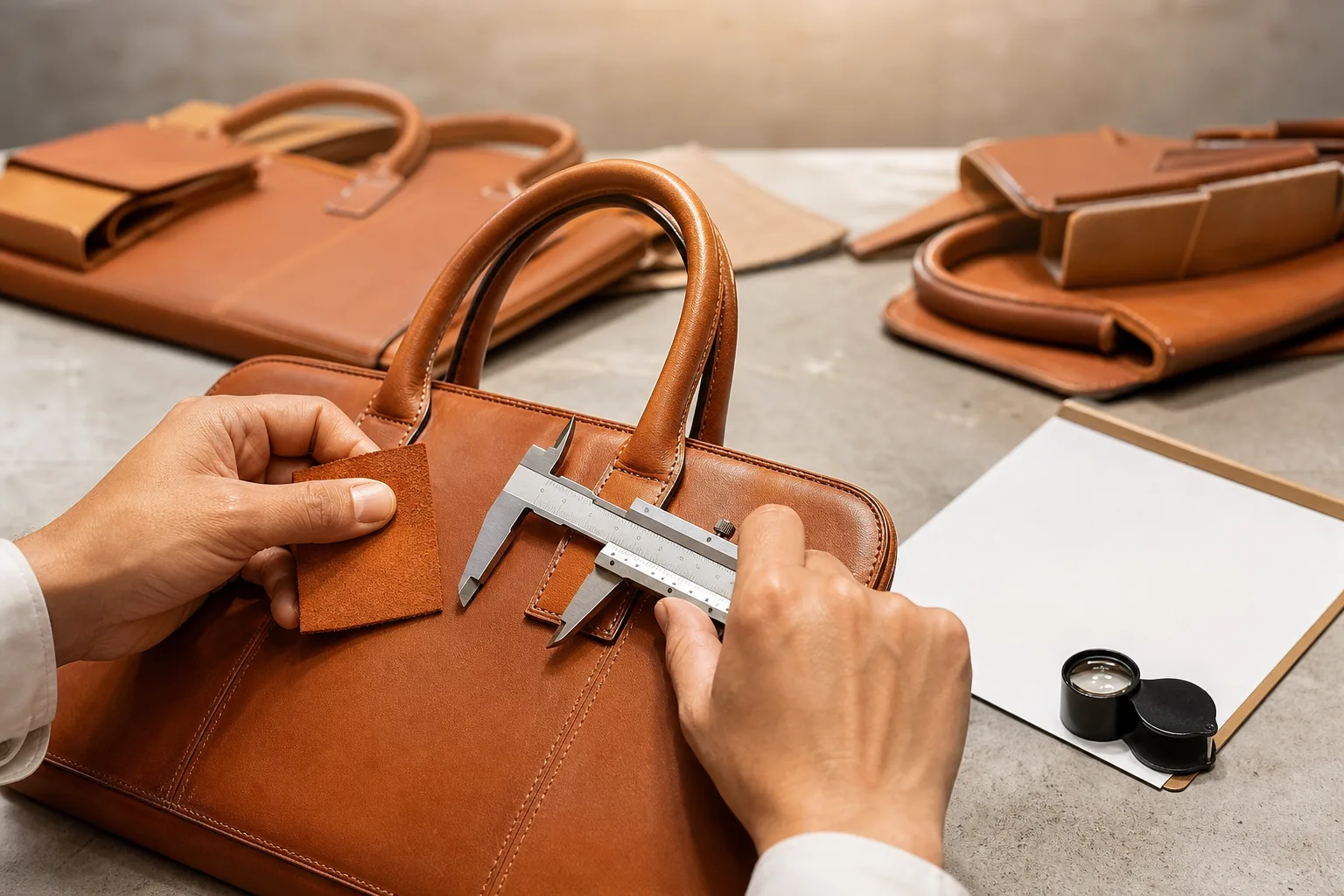
Incoming inspection is the first control point and the most commonly under-resourced. Inspectors check whether leather is measured for thickness, examined for defects and grain consistency, and compared against an approved standard swatch.
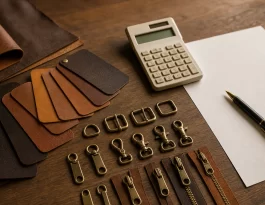
For hardware, they check plating color consistency, function of zippers and buckles, and consistency against the approved sample. Hardware variation is a frequent source of customer complaints that factories fail to detect.
In-Process Inspection
In-process inspection catches defects while they are still correctable. Inspectors look for inspection stations with defined checks and recorded results, rather than operators checking their own work informally.
The critical detail is whether records exist. A factory that claims in-process inspection but cannot show a completed form is not performing it in a controlled way.
Final Inspection and Sampling Standards
Final inspection determines what leaves the factory. Inspectors examine the sampling plan, the acceptance criteria, and whether the factory has a defined defect classification: critical, major and minor.
Where a buyer specifies a sampling standard, such as an AQL-based plan with defined acceptance and rejection numbers, the audit checks whether the factory understands it and can apply it consistently.
Records and Traceability
Records connect everything. Inspectors verify that inspection results are recorded against production orders, that defects are logged with disposition, and that rework is documented rather than absorbed silently.
| QC stage | What is verified | Evidence required |
|---|---|---|
| Incoming | Material versus approved standard | Inspection records, standards |
| In-process | Checks at defined stations | Completed forms |
| Final | Sampling plan application | Records, defect classification |
| Pre-shipment | Conformity to specification | Inspection report |
| Traceability | Order-to-material linkage | Lot records, travelers |
Why QC Systems Matter More for Leather
Leather is a natural material with inherent variation. Unlike molded components, hide quality differs across a batch, and defects such as scars, growth marks, looser grain or thickness variation are normal.
A factory's QC system is what converts that variation into a consistent product. Without incoming standards and in-process control, the finished bag inherits every irregularity of the raw material.
Worker Conditions and Labor Practices
Labor practices are not only a compliance question. Stable, fairly treated workers produce consistent quality, while high turnover destroys the tacit skills that leather manufacturing depends on.
Working Hours and Wage Records
Inspectors review timekeeping records, overtime patterns and wage payments. They compare recorded hours with actual attendance and check whether overtime is voluntary and compensated.
Excessive overtime is a leading indicator of capacity misjudgment. A factory accepting orders beyond its sustainable capacity will eventually miss delivery dates regardless of skill.
Age Verification and Employment Documentation
Auditors verify that employment records exist for workers present in the workshop, and that age documentation is retained. Gaps in personnel records create both compliance and quality risk.
Safety and Chemical Handling
In leather goods production, the main hazards are cutting machines, sewing needles, adhesives and finishes. Inspectors check for machine guards, needle guards, ventilation in gluing and finishing areas, and proper storage of adhesives and solvents.
Facility Conditions
Where a factory provides dormitories or canteens, inspectors review those areas too: space per person, ventilation, sanitation, and food handling. Facility conditions correlate strongly with worker retention.
| Area | What is verified | Risk if inadequate |
|---|---|---|
| Hours and wages | Timekeeping versus records | Fatigue, quality drift |
| Age documentation | Employment files | Compliance violation |
| Machine safety | Guards, needle protection | Injury, turnover |
| Chemical handling | Storage, ventilation | Health, compliance |
| Facility conditions | Dormitory, canteen | Retention, discipline |
Capacity Verification
Capacity claims are the easiest thing for a factory to overstate and the most damaging to get wrong. Auditors estimate capacity from evidence rather than from the response to a direct question.
Estimating Real Output
The standard method combines headcount with bottleneck operations. Inspectors count workstations, check operation cycle times on the floor, and calculate realistic daily output based on effective working hours after breaks and maintenance.
For leather bags, the binding constraint is often a specific machine operation or a skilled hand operation rather than total headcount. A factory with ample sewers but limited cutting capacity may not deliver faster with a larger stitching team.
Current Load and Buying Calendar
Capacity that exists is not capacity that is available. Inspectors check what orders are currently in production, what the line is committed to in coming weeks, and how the factory allocates capacity among customers.
The most useful question concerns the peak season: what happens when every buyer wants delivery at the same time.
Subcontracting and Its Risks
Many factories outsource portions of production. Inspectors look for evidence of external processing: goods moving in and out, separate records, or a production flow that cannot be completed on site.
Subcontracting is not automatically disqualifying, but undisclosed subcontracting is a serious finding. It removes the buyer's ability to verify conditions, materials and quality at the point of production.
| Verification point | Method | Red flag |
|---|---|---|
| Daily output | Station count times cycle time | Claim far above calculation |
| Available capacity | Current order load review | Fully booked in peak season |
| Bottleneck operation | Identify slowest process | No clear bottleneck identified |
| Subcontracting | Movement records, on-site flow | Undisclosed outsourcing |
| Peak season behavior | Order calendar | No visibility into load |
Calculating Capacity From the Floor
An auditor who is shown a spotless sample line but cannot see the production floor for current orders has learned something important. Capacity verification depends on access to real production, not to a presentation.
Questions That Reveal Real Capability
Answers to prepared questions are less informative than the way a factory describes its own operation. Experienced auditors ask questions whose answers expose process maturity.
Who Are Your Main Customers?
Factories that serve demanding customers describe specific requirements: packaging protocols, inspection standards, documentation. Factories that name only generic categories usually do not carry that discipline.
This question also reveals whether the buyer's expected order size is meaningful to the factory. A very small order at a factory serving large retail customers will receive a small share of attention.
How Do You Handle a Defect?
The answer reveals whether the factory has a non-conforming material process. Strong answers describe detection, segregation, disposition, root cause analysis and prevention. Weak answers describe rework.
How Do You Read a Technical Pack?
A capable factory restates the specification, identifies missing information, and asks specific questions. A factory that says it can make anything without questions is not engaging with the design.
What Would You Change About This Design for Production?
This question is among the most revealing. Factories with engineering capability offer manufacturability suggestions: a seam that is difficult at volume, a hardware choice with a long lead time, a construction that requires a change in sequence.
| Question | Strong answer | Weak answer |
|---|---|---|
| Main customers | Named requirements and standards | Vague categories |
| Defect handling | Root cause, prevention, records | Rework only |
| Technical pack | Restates spec, asks questions | Accepts everything |
| Design feedback | Manufacturability suggestions | No opinions |
| Peak season | Capacity planning described | Denial of constraints |
Red Flags to Watch
Red flags are rarely dramatic. They are inconsistencies, and they matter because they predict where the buyer will be exposed later.
| Red flag | What it suggests | Buyer action |
|---|---|---|
| Records and floor disagree | Documentation prepared for audit | Audit deeper, sample records |
| Restricted areas | Undisclosed subcontracting | Require disclosure |
| Substitution of materials | Cost-driven quality risk | Lock specification |
| Bottleneck denied | No capacity understanding | Verify with order calendar |
| No incoming standards | Material variability unmanaged | Require standards setup |
| Heavy outsourcing | Quality and compliance risk | Verify scope in writing |
| Exceptional documents, weak floor | Audit preparation, not system | Focus on records in use |
Documentation That Does Not Match the Floor
When documents describe processes the floor does not follow, the factory has a documentation system rather than a management system. The practical risk is that production quality depends on individual operators rather than controlled process.
Restricted Access
A factory that restricts access to part of its operation is usually concealing something: outsourcing, unsanctioned processes, or working conditions that would not pass review. Buyers should treat access denial as a finding.
Substitution Pressure
A factory that proposes material substitutions before production begins will propose them during production. Establishing substitution approval as a written requirement protects the buyer in both cases.
Capacity Claims Without Evidence
When a factory claims output far above what station counts and cycle times suggest, the likely source is a plan to outsource or to overload. Both create delivery and quality risk.
Preparing an Audit Checklist
A checklist keeps an audit comparable across suppliers and prevents the most common failure, which is spending the day on rapport rather than evidence.
Structure of a Working Checklist
A practical checklist organizes findings by the sections above, with space for observed evidence rather than only pass or fail. Noting what was seen, where, and who confirmed it makes follow-up possible.
| Checklist section | Key items | Evidence to record |
|---|---|---|
| Company and scope | Legal entity, export rights | Document reference |
| Quality system | Procedures, records in use | Sample record |
| Incoming control | Standards, test equipment | Swatch, gauge caliber |
| Process control | Stations, standards posted | Photo reference |
| Final inspection | Sampling plan, records | Report sample |
| Traceability | Lot control, travelers | Order sample |
| Labor | Hours, wages, safety | Records review |
| Capacity | Stations, cycle time, load | Calculation note |
| Subcontracting | Flow, movement records | Disclosure statement |
Tying the Checklist to Product Risk
For leather bags, weight the checklist toward the risks that matter most: leather variability, hardware consistency, structural construction and edge finishing. A generic checklist without product-specific weighting produces a generic conclusion.
After the Audit: Scoring and Follow-Up
An audit without scoring and corrective action is a conversation. Structure determines whether it changes anything.
Scoring Dimensions
Scoring typically covers quality system, process control, capacity, labor practices, facility conditions and traceability. Weights should reflect the buyer's priorities: a brand selling into regulated markets weights compliance higher, while a fast-moving brand weights capacity and flexibility.
Corrective Action Closure
Findings should be converted into corrective actions with owners, deadlines and evidence requirements. Critical findings should block production until closed; minor findings can be scheduled.
The audit's value comes from the closure process, not the report. Buyers who never follow up teach suppliers that findings have no consequences.
Re-Audit Timing
Re-audits verify that corrective actions are sustained rather than performed. A short-interval follow-up on critical findings, plus an annual review, keeps the system honest.
| Finding class | Typical response | Verification |
|---|---|---|
| Critical | Blocks production | On-site verification |
| Major | Corrective plan with deadline | Evidence submission |
| Minor | Scheduled improvement | Next audit |
| Observation | Noted for improvement | Not verified |
Sequencing Audits With Sampling and Pilot Runs
An audit answers whether a factory can produce; sampling answers whether it can produce your product. The two work best in sequence, with clear gates between them.
| Stage | Purpose | Output |
|---|---|---|
| Desk screening | Rule out basic mismatches | Shortlist of factories |
| On-site audit | Verify systems and capacity | Approved supplier list |
| Prototype sample | Confirm design interpretation | Approved construction |
| Pilot run | Verify volume reproducibility | Production readiness |
| First order with supervision | Confirm stability at scale | Ongoing relationship |
Audit Before Sampling Where Possible
Auditing first prevents the common waste of developing samples with a factory that cannot sustain quality or volume. When timing forces sampling first, treat the audit as a condition of the production order rather than an optional step.
What a Pilot Run Reveals That a Sample Cannot
A single sample proves the design can be built once. A pilot run of a small production quantity reveals setup behavior, consistency across operators, inspection effectiveness and how the factory handles the first defects.
For leather bags, the pilot run is where color lot control, panel matching and hardware consistency show up or fail.
Supervising the First Order
Buyers with limited experience benefit most from inspection during first production rather than after it. Once a product has run once with verified results, supervision can be reduced.
Gates Between Stages
Define what must be true before moving to the next stage: audit findings closed before sampling, sample approved before pilot, pilot results reviewed before volume. Without gates, problems discovered late cannot be corrected economically.
Common Misconceptions About Audits
Several assumptions about audits cause buyers to rely on them more or less than they should.
"Passing an Audit Means the Factory Is Fine"
An audit describes conditions on the day of the visit. It cannot guarantee future performance, particularly if the factory's customer mix or load changes.
"Certificates Prove Capability"
Certificates show that a system was assessed at some point. They do not show whether the system is currently used, and leather-specific capability is rarely captured by a general certificate.
"Audits Are Just a Formality for Large Buyers"
Audits are most valuable precisely for small and mid-size buyers, who have less commercial leverage and less ability to absorb a failed order.
"One Audit Is Enough for a Long-Term Relationship"
Factories change: staff turn over, customers shift, capacity fills. Periodic re-audit, combined with ongoing inspection data, keeps the picture current.
"A Spotless Factory Is the Best Sign"
Spotlessness matters less than how work is controlled. A clean shop with no inspection records is more worrying than a busy shop where every panel carries a traveler and every station has a posted standard.

Working With Third-Party Audits
Many brands use external audit firms rather than visiting themselves. Third-party audits add comparability, but the report is only as useful as the scope behind it.
Choosing the Right Standard
Common frameworks cover social compliance, quality management and environmental practice. They differ in what they examine and who recognizes them, so the right choice depends on the market and the retailer requirements the brand must satisfy.
For leather bag suppliers specifically, a general quality certificate says little about incoming leather control, hardware consistency or edge finishing. Those need product-specific questions in the audit scope.
| Standard family | Focus | Typical use |
|---|---|---|
| Social compliance | Labor, safety, environment | Retailer listing |
| Quality management | Process control, records | Supplier approval |
| Environmental | Chemical and waste handling | Compliance claims |
| Buyer-specific protocol | Product and process requirements | Brand programs |
Reading an Audit Report Critically
A report should state the scope, the sampling method, the findings with evidence, and the closure requirements. Reports that summarize without evidence are difficult to act on.
Check whether findings are graded, whether corrective deadlines are specified, and whether the auditor observed production in progress or arrived during a quiet period.
Combining Audits With Your Own Visit
Even with a professional audit report, a brand's own visit adds a dimension no report captures: how the factory responds to questions, how the team engages with the design, and whether the working atmosphere suggests stability.
Typical Audit Findings by Supplier Type
The findings that appear in an audit follow the supplier's size and business model. Knowing the pattern helps a buyer interpret what they see.
| Supplier type | Common strength | Common weakness |
|---|---|---|
| Trading company | Communication and export handling | No direct production control |
| Small workshop | Craft and flexibility | Weak records and QC systems |
| Mid-size factory | Balanced capability and control | Capacity limits in peak season |
| Large factory | Systems and capacity | Limited attention to small orders |
| Specialized factory | Deep product knowledge | Narrow material and process options |
Trading Companies
Trading companies often quote work produced elsewhere, which means the audit should be conducted at the production site, not the office. A trading partner can add genuine value, but only when the underlying factory is verified.
Small Workshops
Small workshops frequently produce excellent hand work and respond quickly to design changes, while lacking documented control. Buyers working with them should expect to supply more of the quality system themselves: standards, sampling plans and inspection criteria.
Large Factories
Large factories bring documented systems, capacity and compliance evidence, but their attention is allocated commercially. A buyer whose order is small relative to the factory's main customers should plan for less flexibility and longer response times.
Specialized Manufacturers
Factories focused on leather bags tend to understand construction and material behavior deeply. Their limitation is often breadth: fewer hardware suppliers, fewer leather options, and less familiarity with adjacent product types.
FAQ
What is the difference between a factory audit and a product inspection?
A: An audit evaluates the factory's systems and capability, including documents, workshop practices, quality control and worker conditions. An inspection evaluates a specific batch of finished goods against a specification.
What documents should I review in a factory audit?
A: Business registration with scope and export rights, quality system procedures and records, material traceability including tannery documents, test reports, labor and timekeeping records, environmental documentation and equipment maintenance logs.
What does an inspector look for in a leather storage area?
A: Protection from light, moisture and dust, racking that prevents creasing, separation of incoming from approved material, and a system that prevents mixing hides of different colors, lots or thicknesses.
How is factory capacity actually verified?
A: By counting workstations, measuring operation cycle times on the floor, and calculating realistic daily output, then comparing the result against current order load and the buyer's delivery window.
Why is subcontracting a red flag?
A: Undisclosed subcontracting means production may happen outside the audited facility, removing the buyer's ability to verify materials, working conditions and quality control at the actual point of production.
Is a clean, modern factory automatically a better supplier?
A: Not necessarily. What matters is whether work is controlled: incoming standards, in-process checks, records, traceability. A spotless shop without inspection records is riskier than a busy shop with documented control.
How much overtime is a warning sign?
A: Sustained excessive overtime suggests capacity is being oversold. It raises injury risk, increases turnover among skilled workers and usually precedes delivery delays or quality drift.
What should I do if the factory restricts access to part of the workshop?
A: Treat it as a finding and require disclosure. Restricted areas commonly indicate undisclosed outsourcing, informal processing or conditions that would not pass review.
Do certificates replace an audit?
A: No. Certificates record that a system was assessed at a point in time. They do not show current practice, and general certificates rarely cover leather-specific capability such as incoming hide control.
How should audit findings be prioritized?
A: Grade findings critical, major or minor. Critical findings should block production until closed with evidence; major findings need a corrective plan and deadline; minor findings can be scheduled for the next review.
How often should a factory be re-audited?
A: Critical findings should be verified quickly after closure, and full re-audits annually or whenever there is a significant change in staffing, customer mix, capacity or ownership.
What questions reveal whether a factory understands quality control?
A: Ask how defects are handled. Strong answers describe detection, segregation, root cause analysis and prevention with records. Weak answers describe rework without analysis.
Should I audit a trading company or the factory behind it?
A: Audit the production site. A trading partner may handle export and communication well, but capability, capacity and conditions can only be verified where production actually happens.
What leather-specific checks should be added to a standard audit?
A: Incoming thickness and defect standards with an approved swatch, hardware consistency checks, color lot control, interlining specifications, edge finishing standards and inspection records tied to production orders.
How do I verify worker conditions without disrupting production?
A: Review timekeeping, wage and age records off the floor, observe safety practices during a normal walk-through, and check ventilation and chemical storage in gluing and finishing areas.
What is the most common weak point in leather bag factories?
A: Incoming material control. Many factories inspect finished bags carefully while accepting leather without measuring thickness, comparing grain and color against a standard, or recording what was received.
Ready to buy from a factory you have actually verified rather than one that presented well? Share your target product and order size and we will walk you through our documentation, incoming material control, in-process and final inspection records, capacity calculations, subcontracting disclosure and labor practices, and welcome whichever audit protocol your brand requires.