Setting MOQ and Lead Times with a Leather Bag Manufacturer
- Why Leather Bag Factories Set MOQs in the First Place
- How a Factory Actually Calculates Your MOQ
- Typical MOQ Ranges by Bag Type and Construction
- Lead Times in Leather Bag Manufacturing: A Stage-by-Stage Breakdown
- What Quietly Stretches Your Lead Time
- Negotiating MOQ Without Sacrificing Quality
- MOQ Strategies for New and Small Brands
- Compressing Lead Times: What Actually Works
- When Faster Delivery Backfires
- Planning Backward from Your Launch Date
- Red Flags in Quotations
- Building a Long-Term MOQ and Lead Time Partnership
- Agreeing on MOQ and Lead Time in Your Contract
- FAQ
Every brand that moves from "I like that sample" to "I need 800 units" hits the same wall: the factory quotes a minimum order quantity you did not expect and a delivery date that misses your launch window. Neither number is arbitrary, and both are more negotiable than most buyers believe once you understand what sits behind them.
MOQ and lead time are two sides of the same production system. MOQ exists because leather is a natural material with fixed roll sizes, cutting losses and setup costs. Lead time exists because hides must be sourced, cut, stitched and finished in sequence, and most steps simply cannot be rushed without visible quality loss.
This guide explains how a leather bag factory actually arrives at those numbers, using the same logic we apply on our own production floor. You will learn where minimums come from, how delivery dates are built stage by stage, and which negotiation moves protect both your margins and your quality.
Why Leather Bag Factories Set MOQs in the First Place
Many buyers assume MOQ is a sales tactic. In reality, it is an accounting necessity driven by three hard costs that do not shrink when order size shrinks.
Fixed Costs Per Order
Every order, no matter how small, consumes the same setup work: pattern grading, marker making, sample approval, thread color matching, hardware selection and a production trial run. A factory spends roughly the same planning hours on a 100-piece order as on a 1,000-piece order.
When those hours are divided across only a few units, the per-bag cost climbs fast. This is why very small orders look disproportionately expensive per piece, and why factories prefer to amortize setup across larger runs.
Natural Material Constraints
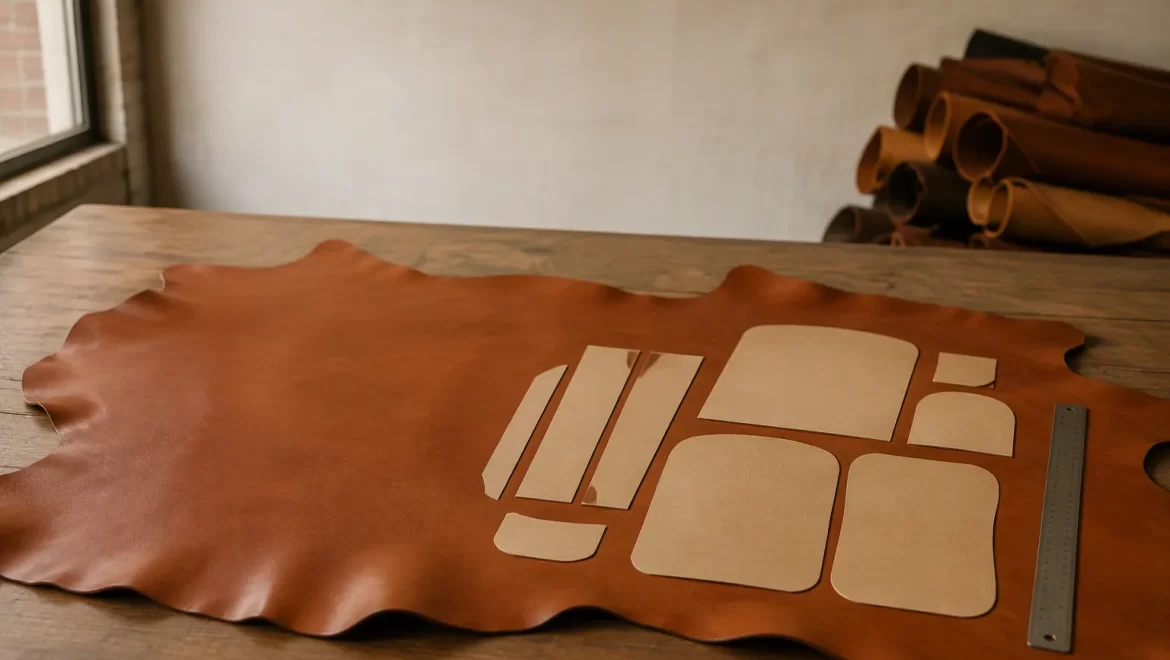
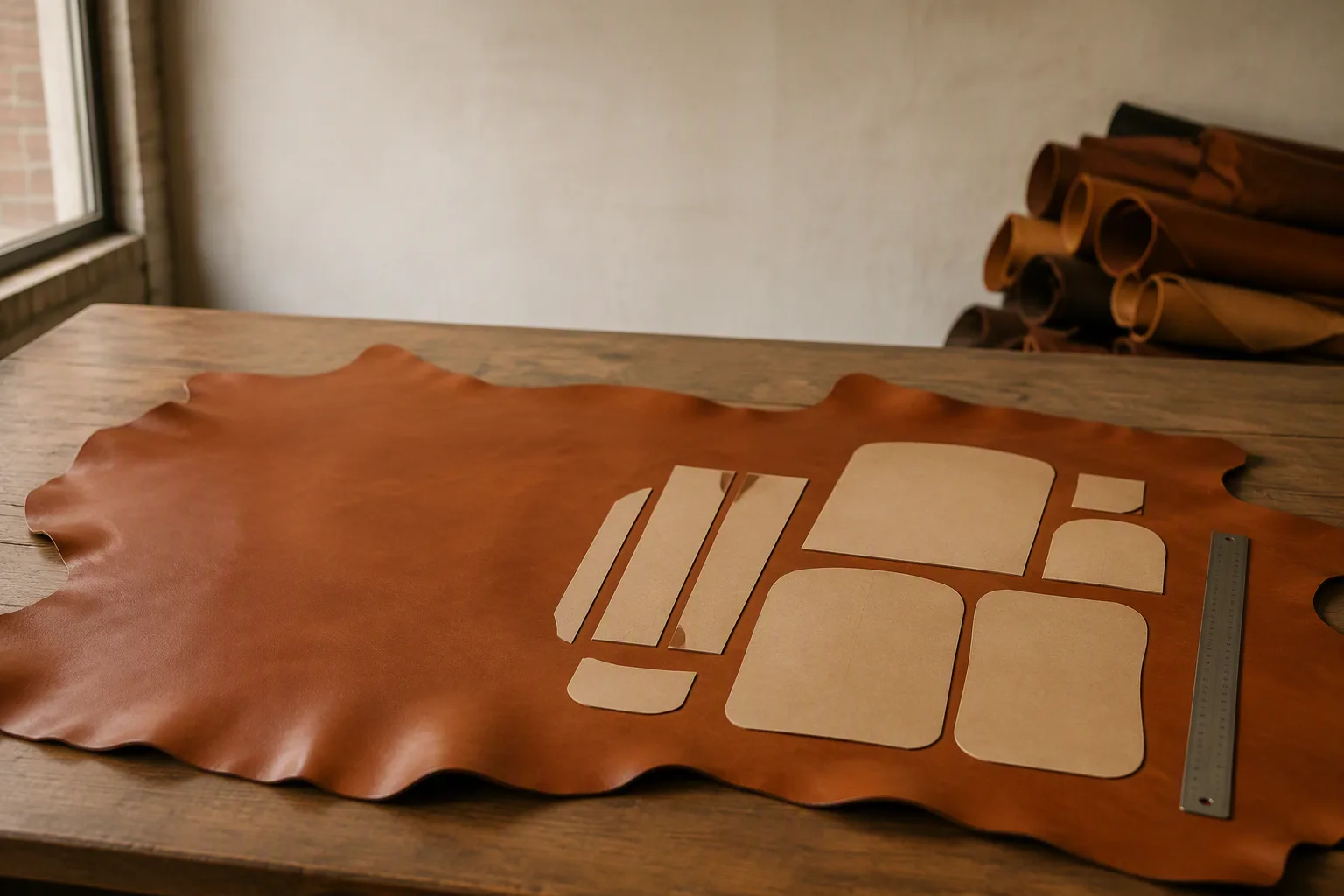
Leather is sold as whole hides, not as cut-to-size panels. A standard cowhide offers a usable area of roughly 45 to 55 square feet, and a bag pattern rarely uses more than 60 to 70 percent of that area after nesting.
If your order only consumes half a hide, the factory still buys the full hide, and the remaining half sits in inventory waiting for a future order that may never come. Tannery minimums, color lot consistency and storage costs all push factories toward quantities that consume hides efficiently.
Production Line Switching Costs
Switching a production line from one style to another costs real time: thread changes, machine tension adjustments, edge paint color cleanup and operator retraining. Frequent small switches can cut a workshop's effective output by 15 to 20 percent.
Factories therefore batch orders by style and material. A realistic MOQ ensures each line change is justified by enough pieces to keep the workshop profitable.
How a Factory Actually Calculates Your MOQ
The calculation is not a random number pulled from a pricing sheet. It follows a logic chain that starts with your pattern and ends with a figure that covers the factory's costs while staying close to market rates.
Step One: Leather Consumption Per Bag
The starting point is the pattern area. Our team digitizes every panel of your design and calculates the total square footage per bag, including flaps, gussets, handles and hidden reinforcement pieces.
A small crossbody might consume 2.5 to 3 square feet, while a structured tote with a separate lining pattern and handle wrap can consume 5 to 7 square feet. The consumption figure drives everything else in the quote.
Step Two: Cutting Yield and Loss Allowance
No hide is perfect. Grain marks, healed scratches, neck wrinkles and belly stretch force the cutter to work around flaws, and the usable yield depends heavily on panel size and shape.
Large one-piece panels waste more leather because they cannot be nested around defects. Small panels can be placed into the gaps. Factories typically apply a 15 to 25 percent loss factor on top of the theoretical consumption.
Step Three: Whole-Hide Economics
Once consumption per bag is known, the factory checks how many bags can be cut from a single hide, then rounds up to a quantity that uses hides cleanly.
A style consuming 3 square feet with a 20 percent loss factor needs roughly 3.75 square feet per bag, so one 50-square-foot hide yields about 13 bags. An MOQ of 50 pieces then demands roughly four hides, which is practical; an MOQ of 20 pieces would strand most of a fifth hide.
Step Four: Components and Hardware
Leather is only part of the minimum. Zippers are ordered by the reel, buckles are die-cast in batches, and custom metal logo plates require mold tooling that costs several hundred dollars regardless of quantity.
When a factory sets a combined MOQ, it is balancing leather consumption, hardware batch sizes and tooling amortization into one number that keeps the unit price sane.
Typical MOQ Ranges by Bag Type and Construction
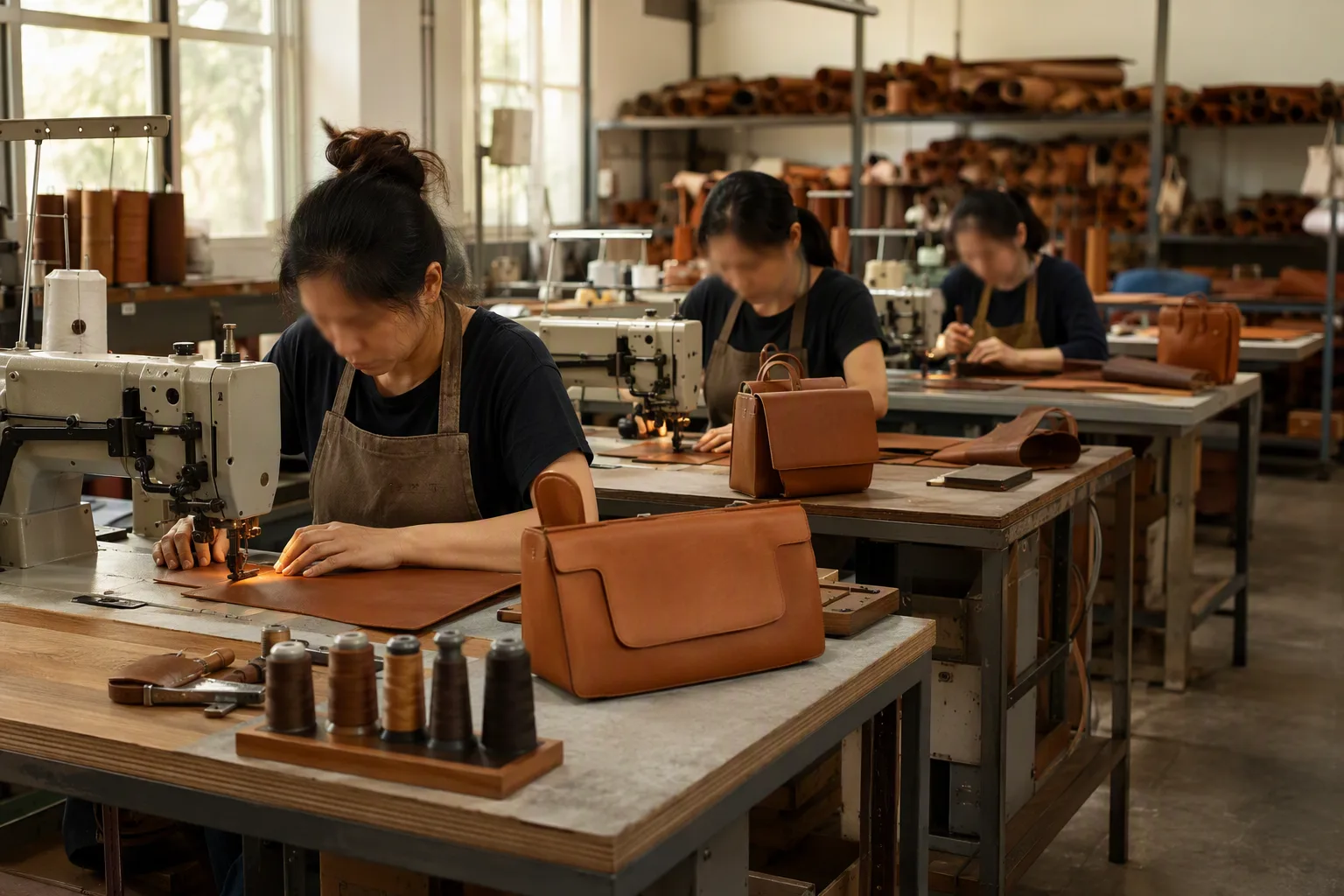
Minimums vary far more by construction than by bag category. A simple unlined tote and a fully structured handbag with a frame, piping and interior organization sit at opposite ends of the production spectrum.
| Bag type | Typical leather consumption | Typical factory MOQ | Main cost driver |
|---|---|---|---|
| Simple unlined tote | 2.5–3.5 sq ft | 100–200 pcs | Cutting + basic stitching |
| Everyday lined handbag | 3–5 sq ft | 200–300 pcs | Pattern complexity, pockets |
| Structured bag with frame | 4–6 sq ft | 300–500 pcs | Frame setting, edge work |
| Travel or weekend bag | 5–8 sq ft | 200–400 pcs | Heavy leather, large panels |
| Exotic or specialty leather | 3–5 sq ft | 50–100 pcs | Material cost, limited supply |
Simple Constructions Attract Lower Minimums
Unlined totes and simple crossbodies use fewer components, cut faster and have shorter sewing cycles. Factories can accept lower minimums because the per-unit setup cost is genuinely small.
If your first order is a simple shape, expect a friendlier MOQ. This is the fastest way for a new brand to enter production with a factory that later grows with you.
Complex Constructions Raise Every Threshold
Piping, gusset pleats, multiple compartments, bound edges and frame closures all multiply sewing steps and increase defect risk during early runs. Each added step also raises the loss allowance, which pushes consumption up and the practical minimum with it.
Plan for a higher MOQ on your hero structured bag, and consider launching with a simpler silhouette to validate the factory relationship first.
ODM and Existing Styles Offer a Shorter Path
When you choose an existing factory design rather than a fully custom pattern, the tooling already exists and the cutting markers are proven. ODM minimums often drop to 100 pieces or fewer per color.
The trade-off is exclusivity. Most factories will not grant exclusive rights on an ODM style below a much larger commitment, typically 500 to 1,000 pieces.
Lead Times in Leather Bag Manufacturing: A Stage-by-Stage Breakdown
Delivery dates are not one number but a chain of stages, each with its own duration and risk. Understanding the chain lets you see which link is actually driving your date.
| Production stage | Typical duration | What happens | Main variables |
|---|---|---|---|
| Sampling and approval | 10–20 days | Pattern, proto, revisions, sign-off | Your feedback speed |
| Material sourcing | 10–25 days | Leather, lining, hardware orders | Stock vs custom tannage |
| Pre-production | 3–7 days | Marker, trial run, QC setup | Style complexity |
| Cutting | 3–7 days | Hide inspection, cutting, skiving | Panel count, yield |
| Stitching and assembly | 10–25 days | Sewing, edge work, hardware setting | Bag complexity, line capacity |
| Finishing and QC | 5–10 days | Edge painting, cleaning, inspection | Finish type, AQL level |
| Packing and shipment | 3–7 days | Poly bagging, cartons, export docs | Destination, transport mode |
Sampling and Approval: The Stage You Control
The single largest controllable variable is how quickly you review and approve samples. A factory can finish a development sample in 10 to 12 days, but if your team sits on the photos for a week, that week is simply added to your lead time.
Set an internal rule: every sample review is answered within 48 hours. This one habit removes more days from your calendar than any factory-side improvement.
Material Sourcing: Stock Leather versus Custom Tannage
Stock leather that the factory keeps in inventory can enter cutting within days. Custom tannage, meaning a color or finish the tannery produces specifically for you, adds two to four weeks at the tannery before the hide even reaches the factory.
If your launch date is fixed, choose colors from the factory's available stock for the first run. Reserve custom colors for reorders, when the timeline is more flexible.
Production Proper: Where the Days Add Up
Cutting, stitching and finishing are sequential and mostly manual. A medium-complexity handbag spends roughly 45 to 90 minutes of direct labor in the workshop, and a workshop of 30 operators produces somewhere between 150 and 300 pieces per day depending on style.
Your order size therefore interacts directly with capacity. A 300-piece order may need only a few extra days over a 150-piece order, because both fit within one production slot.
What Quietly Stretches Your Lead Time
The quoted lead time assumes ideal conditions. Several recurring factors push real delivery dates past the quote, and most of them are preventable on the buyer's side.
Tannery Schedules and Seasonal Supply
Tanneries work on their own cycles, and popular colors sell out. If your chosen hide must be re-ordered from the tannery during a busy quarter, expect a two- to four-week delay before the material arrives.
Ask the factory which materials are in stock before you confirm the order. A color that is physically in the warehouse is worth more than a slightly more perfect color that must be made to order.
Production Slots and Seasonal Peaks
Leather bag factories run at 80 to 100 percent capacity in the months before major retail seasons. If your order arrives during a peak, it queues behind committed programs rather than starting immediately.
Ask for a production slot estimate before you send the PO. Factories are usually honest about whether they can start in two weeks or six, and that answer should shape your launch plan.
Unclear Approvals and Late Changes
Every change after sampling resets part of the chain. A new leather choice reopens material sourcing. A handle length change after cutting begins can scrap an entire batch of panels.
Consolidate all changes into one revision round, approve it in writing, and freeze the spec after the pre-production sample. Discipline here is worth weeks.
Holidays, Inspections and Shipping Windows
Chinese New Year, national holidays and factory annual shutdowns can add two to four weeks at predictable points in the calendar. Third-party inspections, if required, usually need five to seven days of notice.
Count backward from your in-store date, including buffer for customs and transit, and confirm whether your production window overlaps any factory closure.
Negotiating MOQ Without Sacrificing Quality
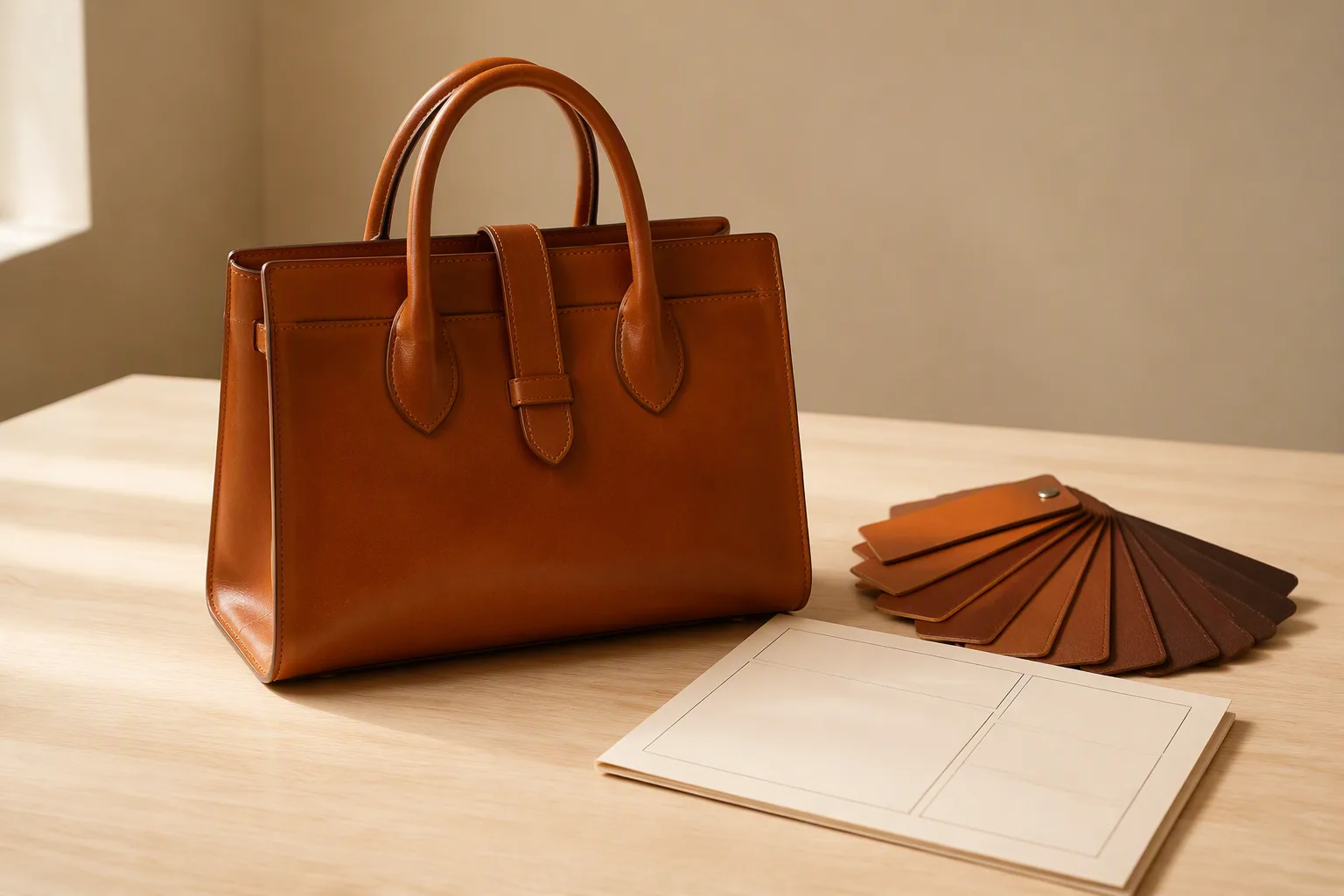
A lower MOQ is not impossible; it just needs to stop being the factory's problem and become a shared solution. These approaches consistently work without degrading your product.
Combine Styles into One Order
Factories set minimums per style and per color, but many will accept a lower minimum per style when several styles share the same leather and hardware family.
One combined program of 400 pieces across three styles can satisfy the same economics as a single 400-piece order, while letting you test more designs with your market.
Standardize Dimensions and Components
Every custom dimension is a new pattern and often a new cutting marker. Every custom buckle is a new mold. Both raise the effective minimum because their setup cost must be spread across your units.
Where possible, build your first collection around standard hardware from the factory catalog and pattern sizes close to their proven markers. You retain design identity through leather, color and proportions, not through custom molds.
Offer a Deposition and a Rolling Schedule
Factories worry most about buying materials for an order that gets cancelled. A 30 to 50 percent deposit signals commitment and gives the factory confidence to purchase hides and reserve line time.
A rolling schedule, where you commit to a yearly volume and release monthly orders against it, often unlocks the lowest minimums and the most stable pricing over time.
| Negotiation lever | What you give | What you gain |
|---|---|---|
| Combine styles | Larger total commitment | Lower per-style MOQ |
| Standard hardware | Less custom identity | Lower minimum, faster sourcing |
| Deposit upfront | Cash earlier | Factory confidence, lower MOQ |
| Rolling yearly volume | Volume commitment | Best pricing and priority |
MOQ Strategies for New and Small Brands
Not every buyer starts with a 300-piece order, and factories know it. The question is how a small brand reaches a workable minimum without overcommitting inventory it cannot yet sell.
Start with a Pre-Production Quantity, Then Scale
Instead of asking for one giant first order, negotiate a two-phase structure: a smaller initial production run at a slightly higher unit price, followed by a committed reorder at the standard MOQ once sell-through data arrives.
Most factories accept this when the total yearly volume is clear. You test the market with real units, and the factory earns the larger second order with predictable timing.
Share Hides and Colors Across Your Range
A brand that orders three colors of the same style creates three separate minimums. A brand that orders one production run with two colors and one neutral that can be re-dyed later creates fewer hurdles.
Ask your factory which colors can be combined into a single leather purchase. When several styles share one hide family, the consumption can be pooled and the effective minimum per style drops noticeably.
Use Factory Stock Programs for First Runs
Many leather bag factories carry a stock program of popular styles and colors ready for quick production. These programs operate at lower minimums because the patterns, hardware and leather are already proven.
Launching with one stock-program style alongside your hero custom piece gives you cash flow and customer feedback while the custom minimum stays manageable.
Consider Pre-Orders and Made-to-Order Models
If your brand sells direct to consumers, a pre-order campaign can fund a production run before you commit to inventory. The MOQ then becomes a target you sell toward rather than a barrier.
Factories routinely support this model with a deposit and a defined production window. Just be honest about the lead time on your product page, because made-to-order leather goods need six to eight weeks.
Compressing Lead Times: What Actually Works
When your launch date is fixed and the calendar is short, these four moves compress the chain without cutting quality corners.
Lock Materials Before You Lock the Order
The longest lead time item is usually the leather. If you identify your material in the sampling phase and have the factory reserve it on your behalf, cutting can begin the day the PO arrives.
Many factories will hold material for a serious buyer on a deposit. This single step can remove two to four weeks from the timeline.
Compress the Sampling Loop
Ask for a development sample and a pre-production sample plan in the same email. Approve both against the same checklist: dimensions, stitching density, edge finish, hardware placement and interior detailing.
The fewer round trips between factory and buyer, the faster the program moves. One thorough review is worth more than three rushed ones.
Run Cutting and Component Prep in Parallel
Cutting of panels, preparation of linings and pre-assembly of hardware components can overlap when the style is confirmed. A well-managed workshop does not wait for all panels to be cut before starting skiving and edge preparation.
Ask your factory which of these steps they can parallelize. Experienced teams already do, and the answer tells you a lot about their production planning.
Plan Around, Not Against, Peak Seasons
If your program can move by six weeks, it may step out of the peak entirely and land a faster start slot. Flexibility on timing is often worth more than urgency expressed in emails.
When Faster Delivery Backfires
Speed has a price, and in leather goods that price is usually paid in quality. Some production steps need time that no amount of scheduling can remove.
Processes That Cannot Be Rushed
Leather that is cut too soon after conditioning can shift dimensions during sewing. Edge paint needs drying time between coats, and rushing it produces edges that crack within months. Glued reinforcements need full cure time before stitching or the layers delaminate under stress.
A factory that promises an impossibly tight date is either planning to skip these steps or already overbooked and hoping you will not track the delay. Both outcomes hurt you more than a realistic date ever would.
The Real Cost of a Rushed Run
When a workshop rushes, the first casualties are the invisible details: thread tension settings, skiving consistency, edge sanding smoothness and final inspection thoroughness. These are exactly the attributes your customers judge within the first weeks of use.
Compare the cost of a two-week delay against the cost of a quality claim wave from early customers. For most brands, the delay is cheaper.
How to Tell an Honest Date from an Optimistic One
Ask the factory to break the date into the same stages listed in this guide and explain each one. An honest team can name the tannery, the cutting week and the stitching slot. An optimistic team gives you one round number and changes it later.
Trust the factory that pushes back on your requested date with reasoning over the one that agrees to everything. The first is protecting your brand; the second is protecting the sale.
Planning Backward from Your Launch Date
The most reliable way to avoid lead time surprises is to start with the date your product must be in hand and build the schedule backward, stage by stage.
| Milestone | Working days before launch | Typical date example |
|---|---|---|
| Final sample approved | 70+ days | Day 1 |
| PO confirmed with deposit | 60 days | Day 10 |
| Materials confirmed and reserved | 55 days | Day 15 |
| Production complete and QC passed | 20 days | Day 50 |
| Packed and shipped from factory | 15 days | Day 55 |
| Arrival at port / warehouse | 0 days | Day 70+ |
Build in Buffer at Every Stage
Each stage in the table carries uncertainty, so layer a buffer on the total: one week for sample revisions, one week for material delays and one week for QC surprises. A comfortable plan is rarely a wasted plan.
Set Internal Deadlines Earlier Than the Real Ones
Tell your factory your launch date is ten days earlier than the true date. This is not deception; it is standard procurement practice that absorbs the small slippages every production run experiences.
Keep the real date to yourself, review progress against the earlier internal date, and you will rarely need to invoke the buffer at all.
Red Flags in Quotations
An unusually low MOQ or an impossibly short lead time deserves scrutiny, because both can signal a factory that plans to cut corners later.
Minimums That Ignore Material Reality
If a factory quotes a 50-piece MOQ on a fully custom, structured bag with custom-tanned leather, ask how they handle hide waste and color continuity. Some workshops simply produce from lower-grade hides to make small runs work.
The result is color variation between bags that you will discover only when the cartons arrive. Verify which leather grade is included in that small-run price.
Lead Times That Ignore Tannery Time
A factory that promises 25 days total on a custom tannage color is either holding the leather already or planning to substitute a stock color that does not match your sample.
Put the material specification in the PO, and require the factory to confirm the tannery name and lot before production starts. Written clarity prevents silent substitution.
Quotes That Change After Sampling
Beware the pattern where the sample is beautiful and the production quote quietly rises, justified by "the actual consumption was higher." Real factories confirm consumption estimates during sampling, not after your PO is placed.
Ask for the consumption calculation in writing at the sample stage, including the loss allowance. Then the production price has no room to drift.
Building a Long-Term MOQ and Lead Time Partnership
The best numbers come not from a single negotiation but from a relationship where both sides understand each other's constraints. Factories remember buyers who approve on time, pay on schedule and grow their orders.
Share Your Forecast Early
Tell your factory what your next three seasons look like, even if details are still rough. This lets them reserve tannery capacity and plan line slots, which improves your lead time reliability more than any discount request.
A buyer who communicates early becomes a priority buyer when capacity tightens. That priority is worth more than a small MOQ concession.
Review Actuals After Every Order
After each delivery, compare quoted lead time against the real timeline and note where days were lost. Share that review with the factory and agree on one improvement for the next order.
This practice builds trust and steadily shortens your real, not theoretical, lead times. Over four or five orders, most brands see their actual delivery performance tighten by one to two weeks.
Agreeing on MOQ and Lead Time in Your Contract
Every number discussed in this guide belongs in the purchase contract, not in a chat thread. Written terms protect both sides when expectations drift.
Define Milestones, Not Just a Final Date
A contract that says only "delivery in 60 days" leaves every stage unmanaged. Define the milestones that matter: material confirmation date, cutting start date, QC completion date and shipment date.
Each milestone gives you a checkpoint to monitor progress and a clear signal early, rather than discovering a delay two days before your launch.
Agree on Delay Consequences in Advance
Write down what happens if the factory misses the date: who covers expedited freight, what penalty applies and how force majeure is treated. Factories with confident planning sign these terms easily; factories running on hope resist them.
The same clarity protects the factory when you delay approvals. If you sit on a sample for two weeks, the lead time should shift by two weeks, and the contract should say so.
Specify the MOQ Formula, Not Just the Number
Include the agreed consumption estimate, the loss allowance and the leather grade in the contract appendix. When the number is tied to a formula, both sides share the same definition of what the MOQ actually buys.
This also prevents the common dispute where the factory claims higher consumption after production starts. The estimate was signed, so the price holds.
FAQ
What is a typical MOQ for custom leather bags?
A: For a custom leather bag with standard hardware, most factories quote between 200 and 300 pieces per style and color. Simple unlined constructions can drop to 100 to 150 pieces, while structured or exotic-leather styles may rise to 300 to 500 pieces.
Can I order fewer pieces than the MOQ on my first order?
A: Yes, on certain terms. Many factories accept a first-order exception at a higher unit price, or when you combine several styles into one program. A deposit and a commitment to reorder at standard MOQ later also help.
Why is my MOQ higher than the quote from another factory?
A: Differences usually come from leather grade, stitching density, hardware quality and the loss allowance applied. A lower MOQ elsewhere often means lower-grade materials or thinner construction, so compare the full specification rather than the number alone.
How long does it take to make a leather bag sample?
A: A development sample typically takes 10 to 15 days from approved tech pack and material selection. Revisions add 5 to 10 days per round, so finalizing feedback quickly shortens the whole sampling phase.
What is the normal lead time for a leather bag order?
A: For a mid-complexity custom bag with stock leather, plan on 45 to 60 days from PO confirmation to shipment. Custom tannage colors add two to four weeks, and peak season slots can stretch the total further.
Does the lead time include sea freight?
A: Usually not. Factory lead times end at shipment from the warehouse. Sea freight to the US or Europe typically adds 25 to 40 days, so count backward from your in-store date including transit and customs.
How can I reduce the MOQ for my first order?
A: Combine styles into one program, choose stock leather and standard hardware, and offer a deposit. These three moves lower the factory's risk enough that most will flex the minimum for a committed new partner.
What is the difference between stock leather and custom tannage lead time?
A: Stock leather that is physically in the factory warehouse can enter cutting within days. Custom tannage adds roughly two to four weeks at the tannery before the hides arrive, plus higher minimums because tanneries dye by the drum lot.
Will a smaller order mean worse quality?
A: Not automatically, but small orders can tempt factories to use lower hide grades to protect margins. Confirm the leather grade and loss allowance in writing, and the quality stays comparable regardless of order size.
Why do factories charge more per piece on small orders?
A: Setup costs, pattern work, thread and color changes and line switching are fixed per order. Spread across fewer pieces, each unit must carry a larger share, which is why per-piece price falls as quantity rises.
How far in advance should I place my order for a holiday launch?
A: For a typical holiday launch, place the PO at least 90 to 120 days before your in-store date. This leaves room for sampling, production, transit, customs and a buffer for the delays that always appear somewhere.
Can I lock in a production slot before my samples are final?
A: Yes. Factories can reserve tentative line time based on your projected volume and season, often with a soft deposit. This protects your slot while you finish sampling, and it is a common practice with returning buyers.
What happens if my order is delayed by the factory?
A: Reputable factories communicate delays early, state the reason and give a revised date in writing. Your contract should define a late-delivery process, including who absorbs expedited freight costs if the delay is the factory's fault.
Do factories offer lower MOQs on repeat orders?
A: Often yes. Once a style is proven and materials are known, setup time drops and the factory can accept smaller reorders, sometimes 50 to 60 percent of the original MOQ, especially for colors held in stock.
What happens if my order quantity is between two hide quantities?
A: The factory usually rounds up to the nearest practical hide count and may offer the surplus leather as spare panels for warranty repairs. Ask whether the extra consumption is charged or absorbed, because this changes your effective unit cost.
Can a factory hold my chosen leather before I place the order?
A: Most factories will reserve stock material on a soft deposit or a written commitment. Custom tannage normally requires a firm order because the tannery dyes to your specification, and cancelled custom colors cannot be sold to another buyer.
Why does my second order sometimes ship faster than the first?
A: The first order carries sampling, pattern grading and learning time. Reorders reuse approved patterns, proven markers and stocked materials, so the chain shortens by one to two weeks even when the MOQ and style are identical.
Ready to plan your first production run? Send us your tech pack or target bag style and we will prepare a clear MOQ breakdown, a stage-by-stage lead time and a consumption calculation in writing, so you can launch with numbers you can build a business on.