Structured Bags 101: Stiffeners, Interlinings and How Shape Is Built
- What Makes a Bag Hold Its Shape
- Stiffener Materials Compared
- Interlining and Lining Systems
- How a Structured Bag Is Built: Factory Sequence
- Shape by Bag Type
- Preventing Sag: Where Structure Fails
- Common Defects in Structured Construction
- Testing Structured Construction
- Working With Different Leathers
- Specifying Structure in a Tech Pack
- Sampling and Approving a Structured Bag
- Cost and Weight Trade-offs
- Common Misconceptions About Structured Bags
- FAQ
A structured bag looks effortless on a shelf. It stands, it holds a clean line, and it keeps that line after a year of use. None of that happens by accident, and very little of it comes from the leather.
Shape is engineered inside the bag. Stiffener boards, interlining layers, adhesive systems and a specific assembly sequence work together to turn flat panels into a three-dimensional form that resists gravity. When one element is missing or misplaced, the bag sags, bulges, or collapses at the top.
This guide covers how structured bags are actually built: which stiffener materials factories use and why, how interlinings differ from stiffeners, the production sequence that creates form, where structure fails, and how buyers can specify and test shape retention before committing to volume.
What Makes a Bag Hold Its Shape
Shape comes from three sources working together. Understanding which source carries the load in a given design is the first step toward specifying it correctly.
Leather Temper
Leather has its own stiffness, described as temper or hand. Vegetable-tanned hides are typically firm; chrome-tanned hides are softer and more variable. A firm leather contributes meaningful support on its own, particularly on small panels with short spans. A soft leather contributes almost none.
Factories assess temper when selecting a hide for a structured design. Using a soft, drapey leather on a panel that must stand upright guarantees either a floppy bag or a heavily built-up interior.
The Role of Stiffeners
A stiffener is a rigid insert that resists bending. It is what allows a soft leather panel to stand flat and what keeps the base of a tote from curving inward as it carries weight.
Stiffeners are placed where the load path requires rigidity: front and back panels, the base, and sometimes the frame of the opening. They are not added everywhere, because excess stiffening makes a bag heavy and unnatural.
The Role of Interlining
Interlining is the softer partner. It adds body, prevents stretching, smooths the surface and gives the leather a fuller hand without making it rigid. Most structured bags use both: stiffeners for form and interlining for body.
Confusing the two leads to specifications that ask for stiffness where flexibility is needed, or softness where structure is essential.
The Weight and Feel Trade-off
Every gram of stiffener adds weight, and every rigid layer changes how the bag feels when carried. Structured bags already weigh more than soft ones; over-specifying stiffeners turns a functional bag into a heavy one.
The goal is the minimum structure that achieves the target shape through the expected service life, not maximum rigidity.
Stiffener Materials Compared
Factories choose stiffener materials by stiffness, weight, cost, durability and how the material ages inside a bag. The table below summarizes the practical options.
| Material | Stiffness | Weight | Cost | Typical use |
|---|---|---|---|---|
| Polypropylene board (PP) | Moderate to high | Light | Low | Panels, bases, dividers |
| Fiberboard | Very high | Heavier | Low | Rigid cases, trunk-style bags |
| Bonded leather board | Moderate | Medium | Medium | Premium structured panels |
| Salpa / regenerated board | Moderate | Light | Low–medium | Handles, edge reinforcement |
| PE sheet | High | Light | Low | Bases, structural inserts |
| Jute with adhesive | High | Medium | Low | Bases and frames |
| Needle-punched felt | Low | Light | Low | Padding, soft body |
Polypropylene Board
PP board is the most common modern stiffener. It is light, waterproof, inexpensive and available in a range of thicknesses, typically from 0.3 to 1.2 millimeters. It resists bending and does not degrade from humidity.
Its limitation is feel and disposal. PP is a plastic, which matters for brands with natural-material positioning, and thin PP can telegraph a hard edge through soft leather if the panel is not padded.
Fiberboard
Fiberboard is stiff and cheap, used where maximum rigidity is required: rigid cases, structured trunks and base panels under heavy loads. It is also the heaviest common option and can soften or swell if moisture penetrates the lining.
Because it cannot flex, fiberboard demands accurate cutting and careful placement. A slightly oversized board creates visible edges through the leather.
Bonded Leather Board and Salpa
Bonded leather board and salpa are made from leather fiber with a binder. They feel more natural than plastic, bond well with leather adhesives and are common in handles, edge reinforcement and premium structured panels.
They are less stiff than fiberboard and more expensive than PP, so they are chosen for feel and compatibility rather than maximum rigidity.
Foam, Felt and Soft Reinforcement
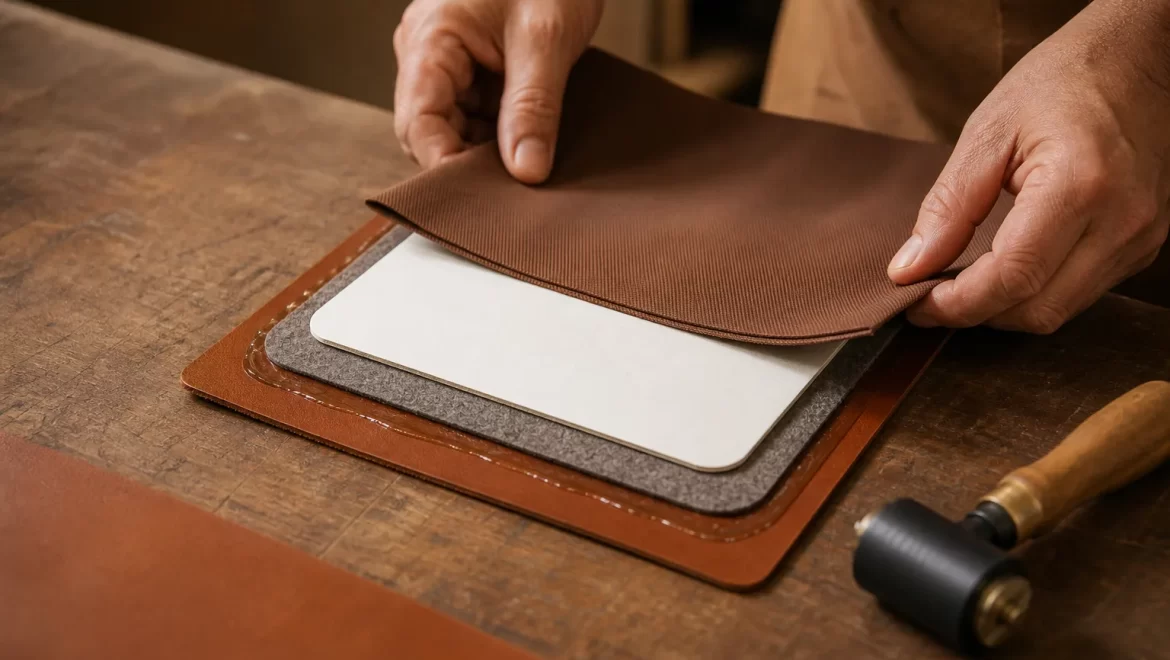
Not every structural need requires a rigid board. Needle-punched felt and thin foam add body, smooth surface irregularities and provide cushioning without making a panel rigid. They are used under soft leather on semi-structured designs.
They are also used as the padding layer between a stiffener and the leather surface, which prevents the board from printing through the face.
Interlining and Lining Systems
Interlining sits between the leather and the bag's interior. Its job is to stabilize the leather, control stretch and shape the hand of the finished panel.
Nonwoven Interlining
Nonwoven interlinings are the industry default for volume production. They are inexpensive, consistent, easy to fuse or bond, and available in a range of weights from light stabilization to firm body.
Fusible nonwovens are heat-activated and bonded to the leather's underside. They are fast to apply but require controlled temperature and pressure, and the fusible dots can show through very thin leathers.
Woven and Knitted Interlining
Woven interlinings behave more like fabric: they follow the leather's movement, resist distortion and give a natural hand. Knitted versions are stretchable and suit panels that must flex.
They cost more and are slower to apply, which is why they appear in higher-priced programs where hand feel is part of the value proposition.
Foam and Padding Layers
Foam layers add volume and cushioning. Closed-cell foams are stable and do not absorb moisture; open-cell foams feel softer but can hold humidity, which is a concern in humid climates.
Padding is also used functionally: a thin foam or felt layer between stiffener and leather prevents the stiffener from creating visible hard edges on the face.
| Interlining type | Function | Application | Notes |
|---|---|---|---|
| Fusible nonwoven | Stabilize, add body | Heat press | Fast, may telegraph on thin leather |
| Non-fusible nonwoven | Add body | Adhesive bonding | Softer edge, requires adhesive |
| Woven | Natural hand, stability | Bond or sew | Premium feel, higher cost |
| Knitted | Stretch control | Bond | Suits flexible panels |
| Closed-cell foam | Volume, protection | Bond | Moisture resistant |
| Open-cell foam | Soft volume | Bond | Absorbs moisture |
| Needle felt | Padding, anti-telegraph | Bond | Prevents board printing |
Matching Interlining to Leather
Interlining choice follows leather behavior. Soft, stretchy leather needs stabilization to prevent distortion; firm leather needs less and may only need surface smoothing.
Over-interlining a firm leather makes the panel unpleasantly rigid and can cause the leather to crack at fold lines over time, because the fused layer prevents natural movement.
How a Structured Bag Is Built: Factory Sequence
Structure is created through a sequence, and the order matters as much as the materials. Skipping or reordering steps produces defects that cannot be corrected later.
Cutting and Thickness Preparation
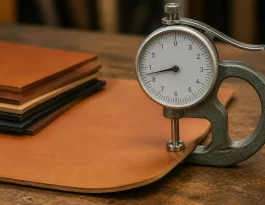
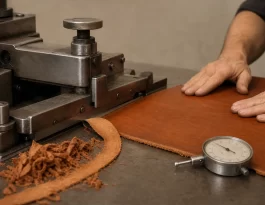
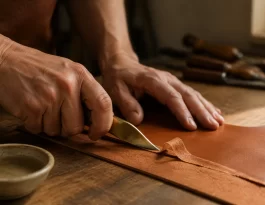
Panels, stiffeners and interlinings are cut to matching dimensions, with the stiffener usually slightly smaller than the panel so it does not print through at the edge. Panels that will fold are split or skived so the fold line can accommodate the added layers.
Factories that cut stiffeners from digital files keep them accurately nested. Hand-cut stiffeners are cheaper but introduce dimensional variation that shows in the finished bag.
Bonding and Assembly
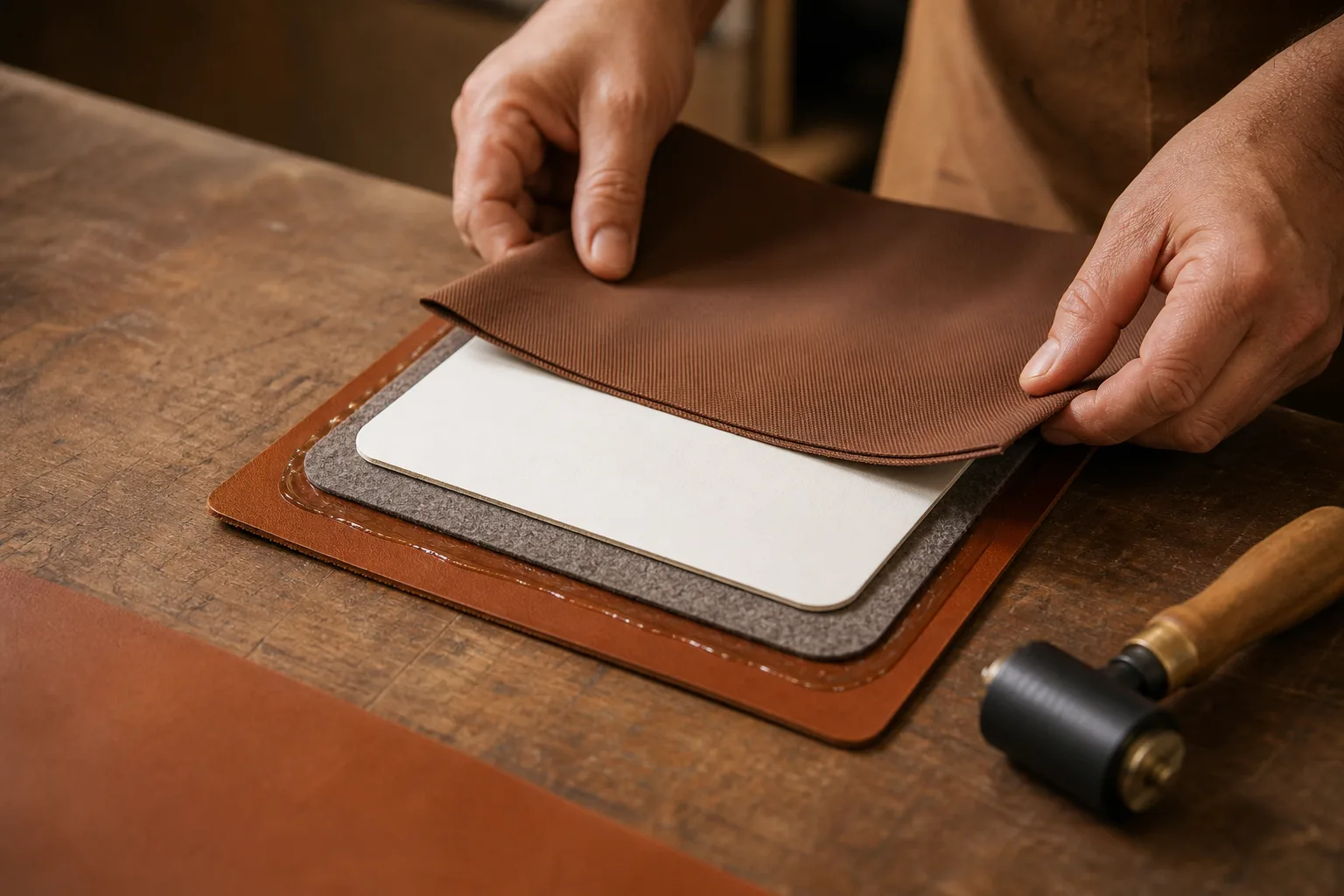
Stiffener and interlining layers are bonded to the leather or the lining, depending on whether the leather should stay soft on the face or be held rigid. Adhesive weight and pressing parameters determine whether the bond holds over time.
Where the design calls for the leather to move naturally, the stiffener is bonded to the lining rather than to the face, leaving the leather free.
Forming and Pressing
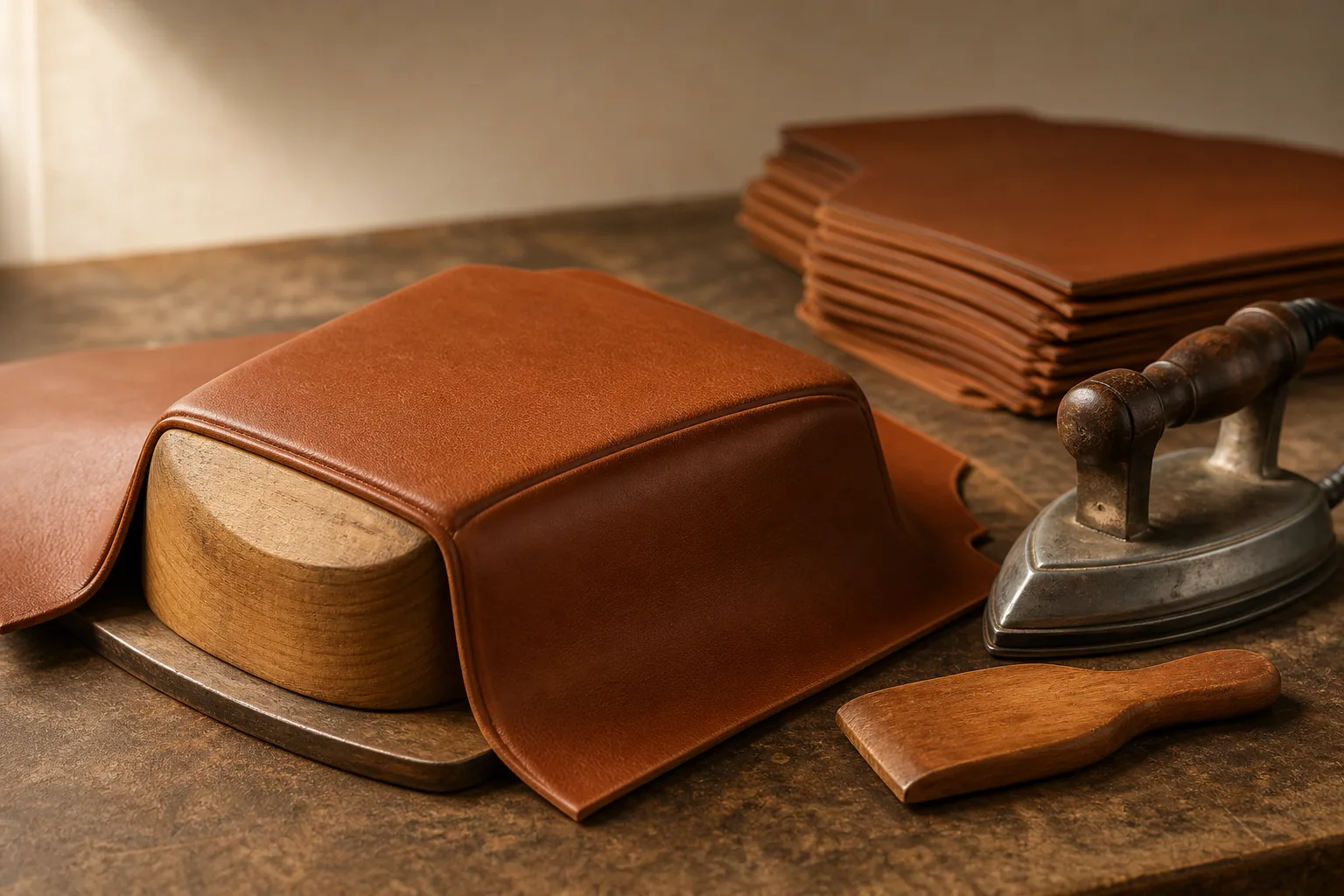
After bonding, panels are formed into shape and pressed. Pressing flattens adhesive, sets fold lines and removes the material memory that would otherwise pull the panel back toward flat.
Forming tools — wooden lasts, moulds or shaped pressing forms — give the bag its three-dimensional geometry. This is the step where a well-cut set of panels becomes an actual bag shape.
Assembly and Corner Construction
The bag is assembled from the bottom up, with corners joined in a sequence that keeps the base square and the sides vertical. Corners are the highest-stress area of any structured bag, so they receive reinforcement and careful stitch placement.
Final Pressing and Setting
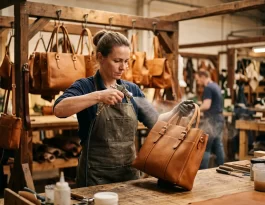
The finished bag is pressed again, filled or supported to hold its shape while it cools and settles. Bags that skip this step retain wrinkles and subtle distortions that persist in the finished product.
| Stage | Key parameter | Failure if wrong |
|---|---|---|
| Cutting | Stiffener 2–3 mm smaller than panel | Board prints through edge |
| Bonding | Adhesive weight, even coverage | Bubbling, delamination |
| Forming | Form tooling matches final shape | Twisted or asymmetric bag |
| Pressing | Temperature, pressure, dwell | Wrinkles, poor fold lines |
| Corner assembly | Reinforcement, stitch density | Corner failure under load |
| Final setting | Support form, cooling time | Retained distortion |
Shape by Bag Type
Different categories require different structural systems. The table below maps common bag types to their typical construction.
| Bag type | Structural system | Key element |
|---|---|---|
| Structured tote | Front/back stiffener plus base board | Base resists sag |
| Briefcase | Frame or full panel stiffener | Opening holds shape |
| Doctor bag | Rigid frame with hinge | Frame carries load |
| Semi-structured bag | Interlining only | Soft body with definition |
| Soft hobo | Minimal interlining | Drape is the design |
| Business backpack | Panel stiffeners and padded back | Structure plus comfort |
Structured Totes
The tote's challenge is the base, which bows downward and inward under load. A base stiffener plus firm front and back panels keeps the bag square and upright, while the sides remain relatively soft for access.
Briefcases and Business Bags
These designs need the opening to hold its shape and the panels to stay flat even when the bag is nearly empty. Full-panel stiffening, sometimes with a partial frame, delivers that rigidity.
Frames and Rigid Closures
Frame bags carry load through the frame itself, so the leather is less structural. The frame must be precisely formed and firmly attached, because a twisted frame makes an unusable bag.
Semi-Structured and Soft Bags
Not every bag should be rigid. Semi-structured designs use interlining to define form while allowing the leather to drape, and soft bags deliberately omit structure so the leather's natural behavior becomes the design feature.
Preventing Sag: Where Structure Fails
Sag is not a single problem. It appears in specific locations, each with its own cause and its own fix.
Base Sag
The base is where gravity and load converge. A tote carrying a laptop pushes downward on a base panel that is often only supported at its edges.
A base stiffener spanning the full footprint, bonded to the lining so the interior stays smooth, stops most base sag. Where loads are heavy, the stiffener is combined with corner reinforcement and a structural base seam.
Panel Bulge
Panels bulge outward when the lining or interlining is not bonded across the full surface, or when the bag is packed against a flexible panel. Sides are especially prone because they carry outward pressure with little support.
Full-surface bonding of interlining to the panel, plus a side panel stiffener on structured designs, keeps the profile clean.
Top Collapse
An opening collapses inward when the top edge has no support. This is the most visible failure in structured bags, because it changes the bag's silhouette even when empty.
Support comes from a stiffened top edge, a partial frame, or a firm gusset mouth. Zipper tapes and bindings contribute little structural support on their own.
Hardware Pull and Local Deformation
Handles, D-rings and straps transfer load into the panel at small points. Without local reinforcement behind each attachment, the leather stretches and the panel deforms permanently.
Reinforcement patches bonded behind attachments distribute the load across a wider area, which is why they appear on nearly every well-built structured bag.
Common Defects in Structured Construction
Structure-related defects are subtle at first and obvious later. Inspecting for them at the panel stage is far cheaper than discovering them after delivery.
| Defect | Cause | Prevention |
|---|---|---|
| Board telegraphing | Stiffener too large or too close to surface | Reduce board size, add padding |
| Bubbling | Uneven adhesive, trapped air | Control adhesive weight and pressing |
| Delamination | Contamination, insufficient cure | Clean surfaces, full cure time |
| Twisted shape | Misaligned panels or form tooling | Verify alignment before pressing |
| Stiff, dead hand | Over-interlining | Match interlining to leather temper |
| Edge cracking | Rigid interlining at fold line | Keep fold zones free of interlining |
| Uneven base | Stiffener cut by hand, off-square | Digital cutting, corner checks |
Board Telegraphing
When a stiffener sits too close to the leather surface or is cut slightly too large, its edge prints through the face. The bag looks fine when new and develops visible lines after use as the leather settles.
A padding layer of thin felt or foam between board and leather, plus a stiffener slightly smaller than the panel, prevents this defect.
Bubbling and Delamination
Both come from an incomplete bond: too much adhesive, too little pressure, contamination on the surface, or processing before the adhesive cured. The defect may appear weeks after production.
Consistent parameters and lot-level peel testing are the only reliable defenses.
Stiffness and Hand Feel Problems
A bag can be structurally correct and still feel wrong. Excessive interlining makes leather feel plastic and can crack at fold lines over time, because the fused layer prevents the natural movement of the fibers.
The remedy is specification discipline: choose the lightest interlining that achieves the required body for that specific leather.
Dimensional and Symmetry Defects
Structured bags are dimensionally demanding. A stiffener cut two millimeters over, a panel bonded slightly off-center, or a form tool that is not symmetric all produce a bag that looks subtly wrong without an obvious defect.
Checking symmetry at the panel stage, with templates and measurement, catches these before assembly makes them permanent.
Testing Structured Construction
Structure claims need evidence. Four practical tests verify that a design will hold its shape in real use.
| Test | Method | Pass criterion |
|---|---|---|
| Shape retention | Stand empty or with rated load for 72 h | Silhouette unchanged |
| Load sag test | Add 2× rated load, measure base drop | Within specified limit |
| Humidity cycle | 48 h at 40 °C / 85% RH, inspect | No bubbling, no warping |
| Hand assessment | Compress panel, feel resistance | Matches approved sample |
Shape Retention Testing
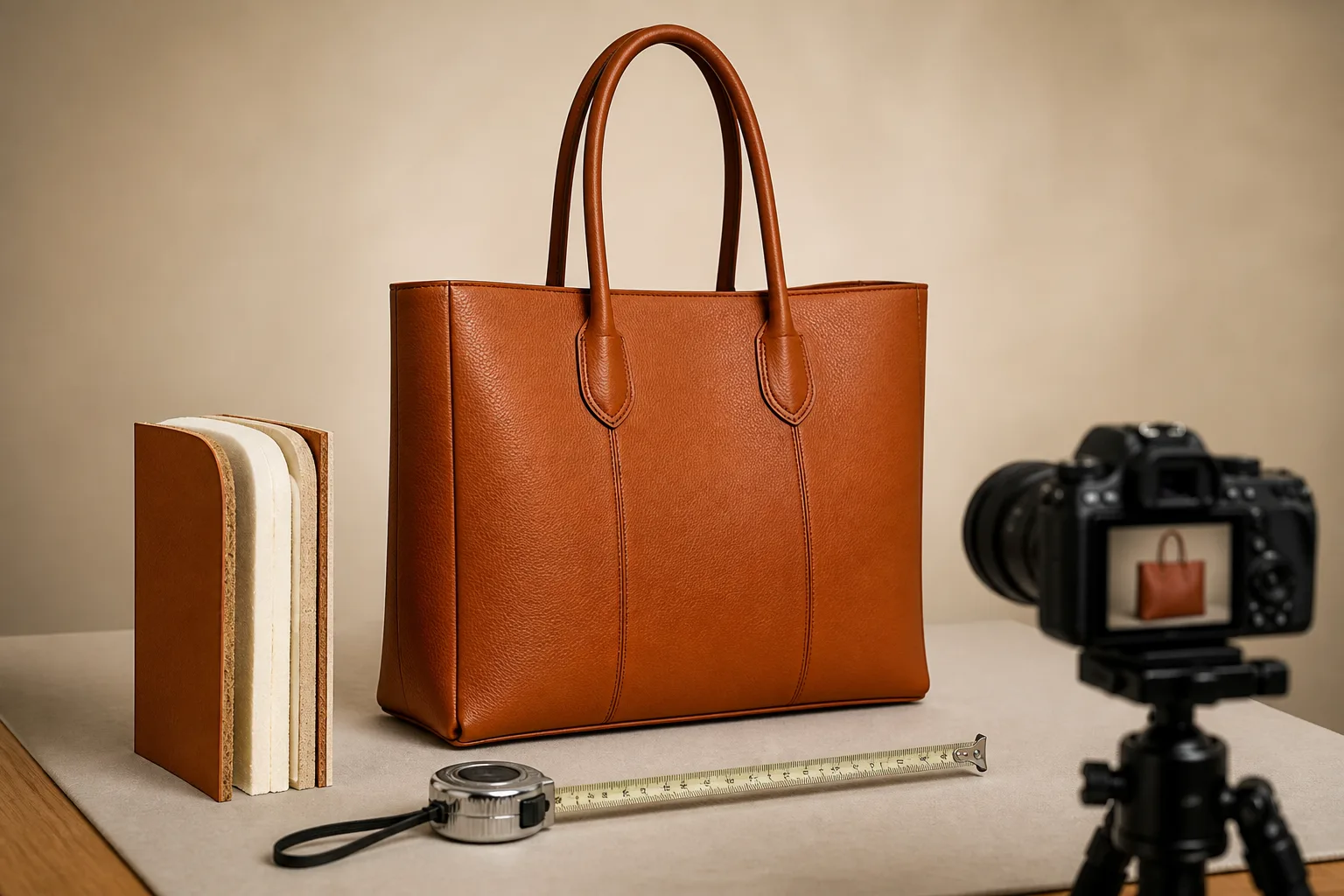
The simplest and most revealing test: stand the bag, empty or with a standard load, for 72 hours and photograph the silhouette at the start and end. Measurable change in the top edge or base line indicates insufficient structure.
This test is worth running on every new structured design before production, because the fix is often a small change in stiffener thickness rather than a redesign.
Load and Sag Measurement
Loading the bag at twice its rated capacity and measuring how far the base drops quantifies structural performance. It also tests the corners and base seams, which are the first areas to fail under real weight.
Humidity and Temperature Cycling
Structured bags ship to humid and hot climates, where adhesives soften and stiffeners can warp. A short accelerated cycle reveals problems that would otherwise appear in the market.
Hand and Feel Assessment
Compressing and flexing the finished panel confirms that the structure matches the approved sample. This is a subjective check, which is exactly why it should be performed against a physical reference sample rather than from memory.
Working With Different Leathers
The same structural system behaves differently across leathers. Factories adjust the build to the material rather than applying one formula.
Soft and Stretchy Leathers
Soft leathers with high stretch need stabilization before anything else. Interlining bonded across the panel prevents the leather from growing under load, and stiffeners must be paired with padding to avoid printing through the soft surface.
Delicate leathers also need gentler adhesive systems and lower pressing temperatures, which slows production and should be reflected in the quoted cost.
Firm and Dense Leathers
Firm leathers contribute their own structure. On these, factories reduce interlining and sometimes omit the stiffener on smaller panels, relying on the leather itself.
Over-building a firm leather wastes money and produces a bag that feels rigid and unnatural, and it increases the risk of fold-line cracking.
Suede, Nubuck and Coated Leathers
Suede and nubuck have a soft surface that shows structure decisions immediately: any board edge beneath will create a visible ridge. These leathers require padding and careful bonding.
Coated and patent leathers cannot be pressed at high temperature without damaging the finish, which changes the structural options. Designs must either accept less heat-based forming or use adhesive and mechanical shaping instead.
Specifying Structure in a Tech Pack
Structure specifications are routinely underspecified, and the result is a sampling round spent discovering basic misunderstandings. A clear structure section prevents that.
| Spec element | What to write | Why it matters |
|---|---|---|
| Stiffener material | "PP board 0.8 mm, front and back panels" | Removes material ambiguity |
| Stiffener size | "3 mm smaller than panel on all sides" | Prevents edge printing |
| Interlining | "Light fusible nonwoven, full surface" | Controls body and hand |
| Bonding method | "Adhesive bond to lining, 24 h cure" | Ensures load behavior |
| Padding | "2 mm felt between board and leather" | Prevents telegraphing |
| Base construction | "Full base board, corner reinforcement" | Prevents base sag |
| Shape test | "72 h retention test, silhouette photo" | Creates a pass/fail criterion |
| Reference sample | "Approved sample defines hand and shape" | Settles subjective disputes |
Specify Materials With Dimensions
Naming a material without a thickness leaves the factory to choose, and it will choose what it runs most often. Give material, thickness and panel coverage explicitly.
Define Coverage, Not Just Presence
Where a stiffener starts and stops matters as much as whether it exists. A board that extends into a fold zone creates cracking, while a board that stops short of a corner allows sag.
Require a Shape Retention Test With Photos
A 72-hour retention test with before-and-after photographs takes little effort and produces objective evidence. It is the single most useful structural test a buyer can request.
Sampling and Approving a Structured Bag
Structured bags are harder to approve than soft ones, because their quality lives in internal layers that cannot be seen from outside. The sampling stage is where that is resolved.
What a Structure Sample Should Include
Ask for the sample to be built with the production materials and the production sequence, not a simplified version. A sample made with hand-cut boards and light interlining proves nothing about the production build.
Ask also for a cut-open sample or a cross-section photograph showing the layer stack: leather, padding, stiffener, interlining and lining in their specified order.
What to Assess on the Sample
Assess four things: the silhouette when empty, the silhouette under load, the hand feel of the panels, and the symmetry of the form. Each corresponds to a different structural decision, so a failure points to a specific fix.
Measure the bag filled with the intended contents rather than judging it empty. A tote that stands perfectly empty can still bow under a laptop and a water bottle.
Aligning Production With the Approved Sample
Once approved, keep the sample at the factory and reference it in the purchase order. Structured bags drift when parameter control slips, and a physical reference sample is the fastest way to settle any dispute about whether a production bag matches.
| Approval check | Method | Record kept |
|---|---|---|
| Silhouette empty | Photo, front and side | Reference photo set |
| Silhouette loaded | Photo with rated load | Reference photo set |
| Hand feel | Compress panels, compare | Physical sample |
| Layer stack | Cross-section photo | Cross-section reference |
| Symmetry | Measurement of key dimensions | Dimension sheet |
| Shape retention | 72 h stand test | Before/after photos |
Keeping a Physical Reference
Photographs document appearance, but they cannot convey stiffness or weight. Retaining a physical approved sample at the factory, ideally one per structural configuration, prevents the drift that repeated photographic approval allows.
Cost and Weight Trade-offs
Structure has a price, both in money and in grams, and both should be understood before the design is locked.
Material Cost
Stiffeners and interlinings are inexpensive individually and meaningful in aggregate. A structured bag may use several boards, multiple interlining layers and a lining system, adding up to a noticeable share of material cost.
Board thickness is the biggest lever. Moving from 0.6 to 1.0 millimeter PP increases stiffness and cost, and the question is whether the design actually needs it.
Labor and Pressing Cost
Every structural layer adds a bonding step, a pressing step and inspection time. On complex structured bags, labor can exceed the cost of the structural materials themselves.
Weight and Shipping
Structure adds weight, which affects both customer perception and freight cost. A structured bag that feels heavy in hand may be judged as lower quality by customers who equate weight with clumsiness rather than durability.
Balancing stiffness against weight is a design decision, not a manufacturing detail, and it is worth stating in the development brief.
Common Misconceptions About Structured Bags
Several assumptions regularly lead buyers to specify structure that works against their own goals.
"Stiffer Always Means Better Quality"
Rigidity is a design choice, not a quality grade. Many premium bags are deliberately soft, and over-stiffened bags feel artificial and crack at fold lines.
"Interlining and Stiffeners Are the Same Thing"
They serve different purposes: stiffeners resist bending, interlining adds body and stability. A specification that treats them as interchangeable produces bags that are either floppy or unnaturally hard.
"Structure Can Fix Any Shape Problem"
Structure supports a well-designed panel; it cannot compensate for a pattern that is dimensionally wrong or a leather that is unsuitable. Design problems solved with more board become heavy, expensive problems.
"Structure Is Only for Cheap Bags"
The opposite is often true. Premium structured bags use refined systems — natural leather board, felt padding, careful press work — that cost more than the basic plastic inserts used in mass-market products.
"A Bag That Stands Up When New Will Always Stand Up"
Shape retention is a service-life question. A design should be tested under load and in humidity, because many structural failures appear only after months of use.
FAQ
What is the difference between a stiffener and interlining?
A: A stiffener is a rigid insert that resists bending, such as polypropylene board or fiberboard. Interlining is a softer layer of nonwoven, woven fabric or foam that adds body, prevents stretching and improves hand feel.
What material is used to stiffen leather bags?
A: Common options are polypropylene board, fiberboard, PE sheet, bonded leather board, salpa and jute. Choice depends on required rigidity, weight, cost and how natural the material needs to feel.
Why does my structured bag sag at the bottom?
A: Usually because the base lacks a full-footprint stiffener, or the stiffener is unsupported at the corners. A base board combined with corner reinforcement and a structural base seam solves most base sag.
Can a soft leather bag be made structured?
A: It can be given structure with stiffeners and interlining, but soft leathers need more stabilization and padding, and the result will always feel softer than a bag built from firm leather.
What causes a stiffener to show through the leather?
A: A board that is cut too large, placed too close to the surface, or unsupported by padding. Cutting the stiffener slightly smaller than the panel and adding a felt or foam layer prevents it.
How thick should a bag stiffener be?
A: Common ranges are 0.6 to 1.0 millimeters for polypropylene on panels and 1.0 to 1.5 millimeters for bases, adjusted by bag size, load and leather temper rather than applied as a fixed rule.
Why do structured bags bubble after a few weeks?
A: Bubbling indicates an incomplete bond: uneven or excessive adhesive, insufficient press pressure, contaminated surfaces, or processing before the adhesive fully cured.
Should the stiffener be bonded to the leather or the lining?
A: Bonding to the lining leaves the face leather soft and natural, while bonding to the leather stiffens the visible surface. The choice depends on whether the design should preserve a natural hand.
How do I test whether a structured bag will hold its shape?
A: Stand it empty or with a rated load for 72 hours and compare silhouette photographs. Add a load test at twice rated capacity to check base drop and corner strength.
Does interlining make leather crack?
A: Excessively stiff interlining can restrict natural movement and contribute to cracking at fold lines. Keep fold zones free of interlining and match interlining weight to the leather's temper.
Why does the top of my tote collapse?
A: The opening lacks support. Solutions include a stiffened top edge, a partial frame, or a firmer gusset mouth. Zipper tape and binding alone add little structural rigidity.
Is fiberboard suitable for leather bags?
A: Fiberboard is extremely rigid and inexpensive, used for rigid cases and trunk-style bags. It is also heavy and susceptible to moisture, so it suits designs where maximum stiffness matters more than weight.
How long does a structured bag take to produce?
A: Structured construction adds bonding, forming, pressing and setting steps, so lead times are typically longer than for soft bags with the same panel count. Curing time for adhesives is usually the largest addition.
Can structure be added after sampling?
A: It can be adjusted, but structural changes usually require re-patterning and often new form tooling. Specifying structure before the first sample is far cheaper than adding it later.
What is salpa used for in bag making?
A: Salpa, a regenerated leather board, is used for handles, edge reinforcement and structured panels where a natural material with moderate stiffness is preferred over plastic board.
How do factories keep structured bags symmetric?
A: By digitally cutting stiffeners to exact dimensions, verifying panel alignment before pressing, using symmetric form tooling, and inspecting symmetry at the panel stage rather than after assembly.
Ready to build structure into your next bag line with confidence? Send us your designs and we will specify the stiffener, interlining and assembly sequence for each panel, produce a structured sample, and run shape retention and load testing so the silhouette you approve is the silhouette your customers receive.