Leather Splitting and Bonding: When Two Layers Beat One
- Splitting Leather to Precise Thickness
- Why Factories Bond Layers Together
- Adhesives Used in Leather Bonding
- Bonding Process Step by Step
- Bonding for Structure: Reinforcement Options
- Bonded Panels and Edge Treatment
- Common Defects in Split and Bonded Panels
- Testing Bonded Construction
- Splitting and Bonding by Bag Type
- Cost Impact: Where Splitting and Bonding Save Money
- Quality Control for Bonded Panels
- Working With Split Leather Suppliers
- Common Misconceptions About Splitting and Bonding
- Specifying Split Thickness and Bonding
- FAQ
A single piece of leather rarely arrives at the right thickness for a finished bag panel. It may be too thick for a folded edge, too soft to hold a structured shape, or too expensive to use in the quantity a design requires. Factories solve this with two operations that almost never appear in product descriptions: splitting and bonding.
Splitting reduces leather to a precise, uniform thickness. Bonding joins that split leather to another layer to create a panel with properties neither layer has alone. Together they let a factory build a firm, lightweight, cost-controlled panel from materials that would otherwise be unusable.
This guide explains both operations in factory terms: how thickness is controlled, which adhesives are used and why, how layers are pressed and cured, what reinforcement options exist, and how buyers can specify and verify bonded construction.
Splitting Leather to Precise Thickness
Splitting is not the same as skiving, and confusing the two leads to specification errors. Skiving thins an edge so it can be folded; splitting reduces an entire panel to a target thickness.
Why Factories Split Leather
Consistency is the primary reason. Natural hides vary in thickness across the back, belly and neck, and even a well-sorted batch may range by half a millimeter or more from piece to piece.
Splitting brings panels into a controlled range so that folding, edge finishing, stitching and lining all behave predictably. It also allows a factory to buy a heavier, more economical hide and split it into the exact gauge a design requires.
Splitting Equipment
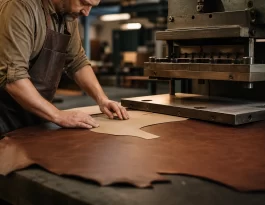
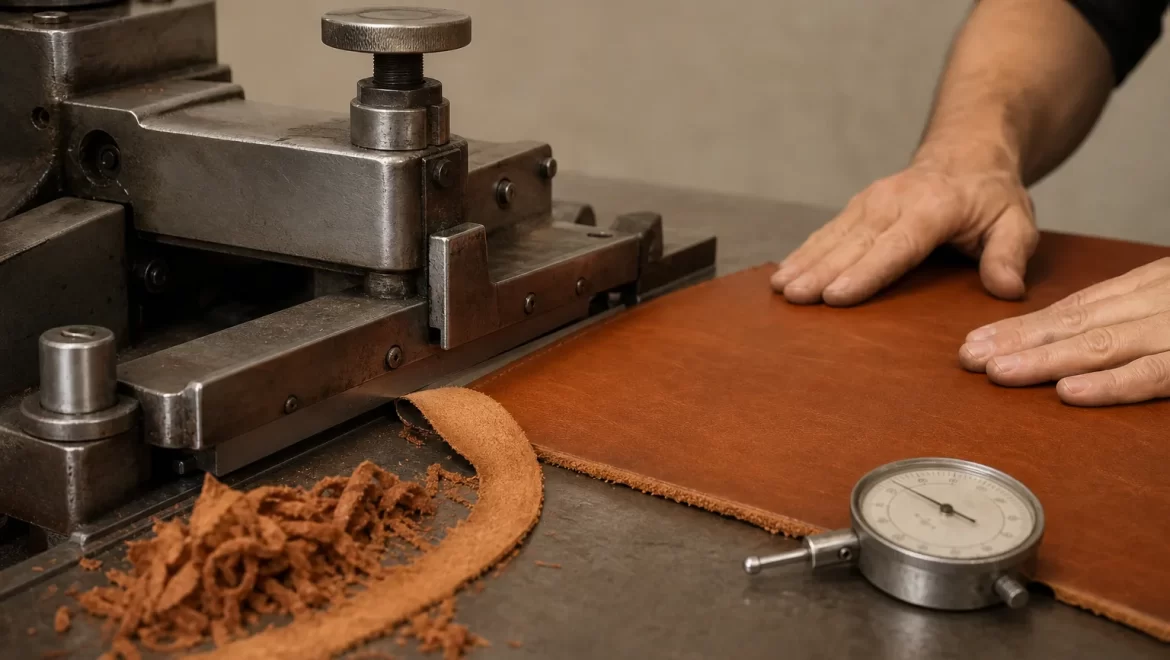
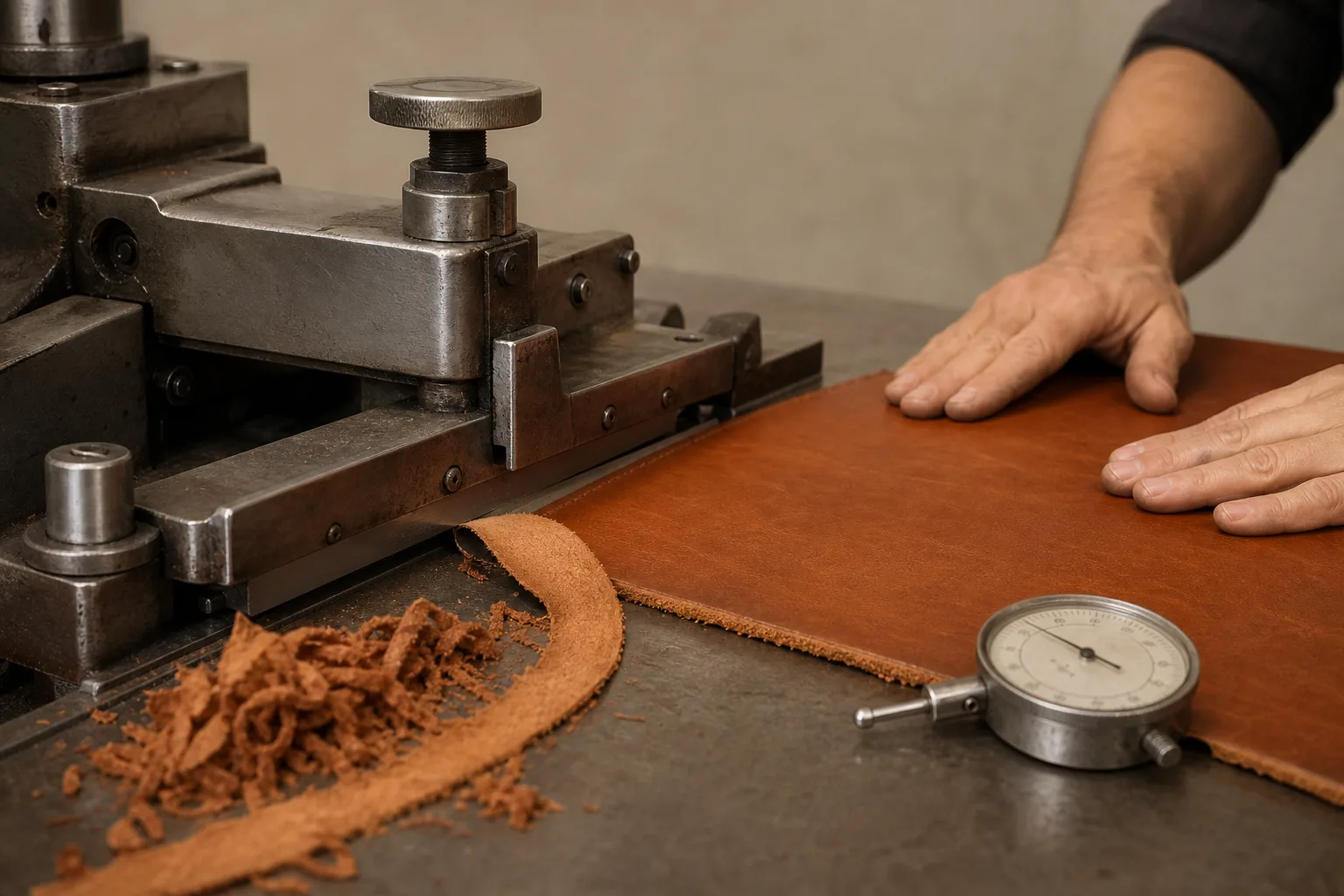
The workhorse is a band knife splitting machine, which passes the leather over a horizontal blade and removes material from the flesh side at an adjustable setting. Thickness is set mechanically and monitored with a gauge.
For smaller or more delicate work, factories use circular splitting machines or hand-held splitters. Modern CNC splitting equipment adds digital thickness control, which matters for high-consistency programs.
Thickness Tolerance and Measurement
Splitting accuracy is usually expressed as a tolerance around the target thickness, commonly plus or minus 0.2 millimeters on production splitting. Tighter tolerances are possible but add cost and slow the operation.
Factories measure at several points across each panel, because splitting can drift along the length of a hide. A panel that passes at the center and fails at the edge will still cause assembly problems.
| Purpose | Typical target thickness | Tolerance | Notes |
|---|---|---|---|
| Folded edge panels | 0.8–1.0 mm | ±0.2 mm | Must fold without bulk |
| Main body panels | 1.2–1.6 mm | ±0.2 mm | Balances structure and weight |
| Structured panels | 1.4–1.8 mm | ±0.2 mm | Often bonded to reinforcement |
| Linings and small goods | 0.6–1.0 mm | ±0.2 mm | Softness prioritized |
| Straps and handles | 1.6–2.4 mm | ±0.2 mm | Often built from bonded layers |
What Splitting Cannot Fix
Splitting removes material but cannot improve fiber quality. Splitting a loose, stretched hide produces a thinner loose hide, and a panel split too thin loses tear strength and can crack at fold lines.
This is why a good factory resists requests to split below a leather's practical minimum, even when a thinner panel would save weight or cost.
Why Factories Bond Layers Together
Once leather is split to a controlled thickness, bonding becomes a design tool rather than a repair. Two layers, chosen for different properties, produce a panel that outperforms either one.
Common Layer Combinations
The most frequent construction pairs a quality face leather with a lower-cost split layer on the back, bonded and sometimes stitched. The face provides appearance and hand feel; the backing provides body, thickness and stability.
Other combinations include face leather bonded to a reinforcement fabric, split leather bonded to a stiffener for structured bags, and two split layers bonded to build a synthetic-equivalent thickness from economical material.
Structural Benefits
Bonding increases stiffness without adding a visible insert, controls thickness precisely, reduces stretch under load and improves resistance to sagging in large panels. It also allows a design to use a soft, beautiful leather on the face while still achieving structure.
Cost and Material Benefits
Splitting and bonding let factories use a single premium hide more efficiently. Thin face layers bonded to economical backing use less of the expensive material while maintaining the appearance the brand is selling.
The saving is real, but it is not free: bonding adds adhesive cost, labor, press time and curing time. The economics only work when material savings exceed the added process cost, which is a calculation worth making explicitly.
Adhesives Used in Leather Bonding
Adhesive choice determines whether a bonded panel survives years of flexing or delaminates in a customer's hands. Factories select adhesives on four criteria: flexibility, heat resistance, application behavior and odor.
Main Adhesive Families
Neoprene contact adhesives are the traditional choice for leather, offering strong initial bond and good flexibility. Water-based polyurethane adhesives are increasingly common for their lower solvent content and cleaner working conditions.
Hot-melt adhesive films are used where a dry, controlled bond is needed, particularly with heat presses and thin panels. Each family behaves differently and suits different leathers and processes.
| Adhesive | Bond strength | Flexibility | Heat resistance | Typical use |
|---|---|---|---|---|
| Neoprene contact | Very high | Very good | Good | General panel bonding |
| Water-based PU | High | Very good | Moderate | Low-VOC programs |
| Hot-melt film | High | Good | Moderate | Heat press, thin layers |
| Spray adhesive | Moderate | Good | Low | Temporary positioning only |
| Latex-based | Moderate | Very good | Low | Soft, flexible laminations |
Selection Criteria
Flexibility matters most where the panel will fold, since a brittle adhesive cracks along the fold line. Heat resistance matters for bags shipped or stored in hot climates, where softening adhesive allows layers to shift.
Application behavior matters on the factory floor: some adhesives demand precise open times, while others tolerate variation. Odor and VOC content matter increasingly for brands with environmental commitments and for products used close to the body.
Application Methods
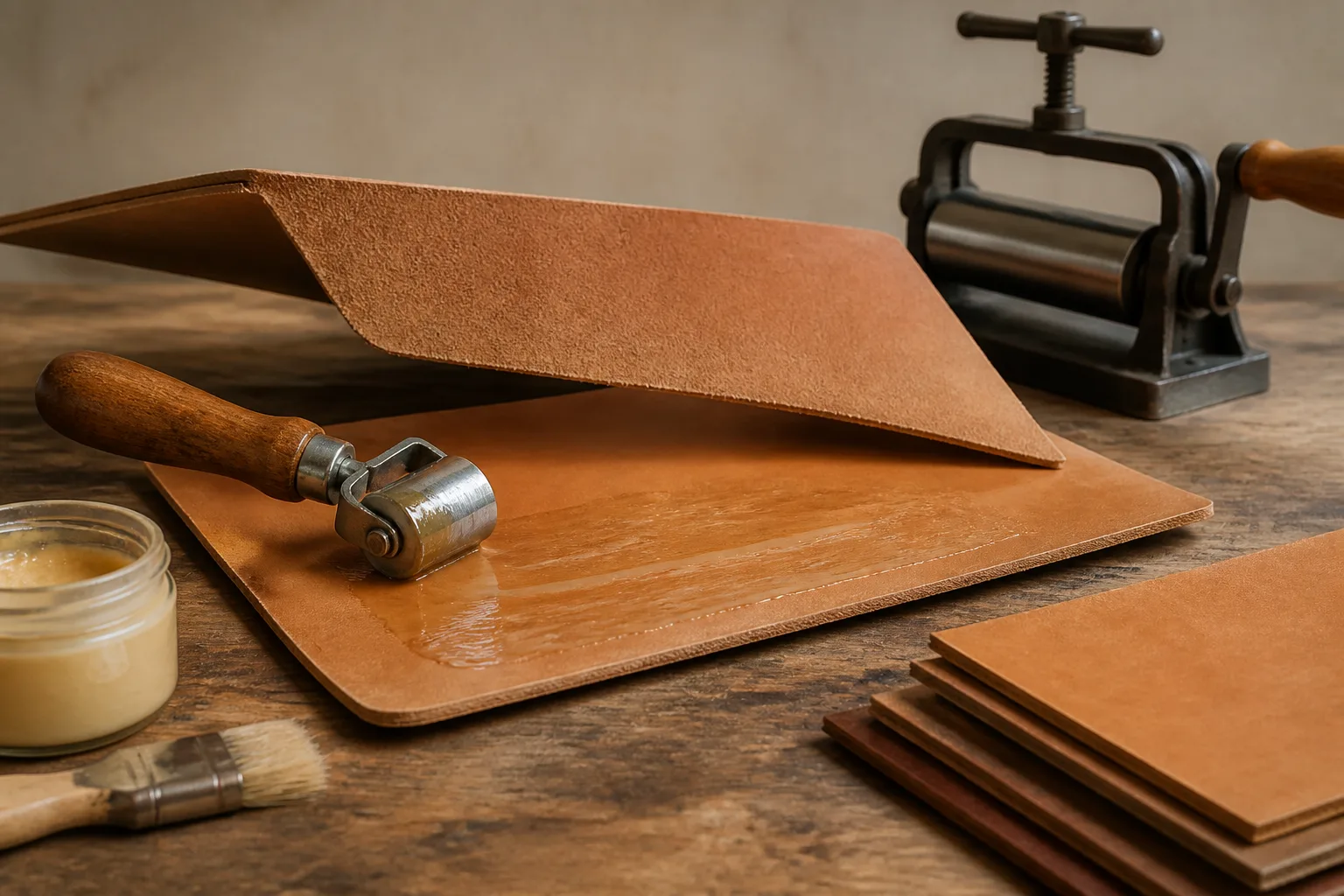
Contact adhesives are typically sprayed or rolled onto both surfaces and allowed to dry before joining. Hot-melt films are positioned between layers and activated by heat and pressure. Water-based adhesives require controlled drying before pressing so residual moisture does not become trapped.
The method must match the adhesive and the leather. A water-based adhesive applied too heavily on a dense leather may never fully dry, which shows up later as bubbling.
Bonding Process Step by Step
A consistent bonded panel is the product of several controlled steps, and skipping any one of them produces defects that appear weeks later.
Surface Preparation
Bonding begins with clean surfaces. Factories remove dust, loose fiber and any surface finish that would prevent adhesion, and on some leathers they lightly abrade the bonding side to open the fiber structure.
Contamination is the most common hidden cause of delamination. Dust from splitting, oil from handling and residual finishing agents all weaken the bond, so preparation is a controlled step rather than an afterthought.
Adhesive Application and Open Time
Adhesive is applied at a specified weight per area, using a roller, spray gun or template. Too little adhesive leaves dry spots; too much traps solvent or moisture and creates soft, bubbly areas.
After application, contact adhesives require an open time for solvents to flash off. The window is specific: join too early and the adhesive is still wet; wait too long and the surfaces will not bond.
Pressing and Pressure
Layers are joined under pressure using rollers or a flat-bed press. Roller pressing suits long, flat panels; flat pressing suits shaped parts and provides even pressure across the full area.
Pressure and dwell time are recorded parameters in a well-run factory. Insufficient pressure leaves air pockets, which are the seed of future bubbling.
| Process step | Typical parameter | Common failure if wrong |
|---|---|---|
| Surface prep | Clean, lightly abraded | Delamination from contamination |
| Adhesive weight | 80–150 g/m²depending on adhesive | Too little: dry spots; too much: bubbles |
| Open time | Follow adhesive specification | Weak or no bond |
| Press pressure | 2–5 bar on flat press | Trapped air, bubbling |
| Dwell time | 10–30 seconds | Incomplete contact |
| Curing | 24 hours before further processing | Delamination in finishing |
Curing Before Further Processing
Bonded panels need time to reach full strength, commonly around 24 hours before folding, skiving or edge finishing. Panels that move to the next operation too quickly can shift or separate under the stress of later steps.
Curing also allows any residual solvent or moisture to escape. This is why rushing the schedule is one of the most reliable ways to generate a delamination problem.
Bonding for Structure: Reinforcement Options
The backing layer is where structural intent is expressed. Factories match backing materials to the load and shape the panel must carry.
Leather Backing
A split leather backing is the traditional choice: it behaves like the face leather, ages similarly, and takes edge finishing consistently. It adds moderate stiffness and thickness without introducing a foreign material.
Its limitation is cost and weight. Split leather backing is heavier than fabric alternatives and depends on the quality of the split layer, which can be variable.
Fabric and Nonwoven Backings
Woven cotton, polyester and nonwoven reinforcements offer high strength-to-weight ratios and excellent dimensional stability. They are common in panels that must resist stretching while staying light.
Nonwovens also bond predictably, which makes them suitable for high-volume production where consistency matters more than a premium hand feel on the interior.
Board and Foam Reinforcements
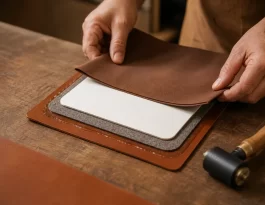
Rigid boards, such as thin fiberboard or polypropylene sheet, are bonded between leather and lining to build structured panels that hold their shape. Foam layers add volume and a soft, cushioned feel rather than stiffness.
Both are usually inserted rather than fully bonded across the surface, allowing the leather to move slightly while the stiffener holds the form.
| Backing material | Stiffness | Weight | Best for |
|---|---|---|---|
| Split leather | Moderate | Heavier | Premium classic bags |
| Woven fabric | Moderate | Light | Body panels, pocket linings |
| Nonwoven | Moderate to high | Light | Volume production, stable panels |
| Polypropylene board | High | Light | Structured bag fronts, bases |
| Fiberboard | Very high | Heavier | Rigid cases and trunks |
| Foam | Low | Very light | Soft volume, padded panels |
Where the Reinforcement Sits
A backing bonded directly behind the face leather stiffens the visible layer and influences how the panel creases. A stiffener placed behind the lining keeps the face leather soft and untouched, which preserves a natural hand feel.
The choice changes how the bag ages. Bonded facing stiffens permanently, while separated layers allow the outer leather to soften independently, which many premium designs prefer.
Bonded Panels and Edge Treatment
Bonding changes how edges are prepared, and the two operations must be planned together rather than sequentially.
Thickness at Fold Lines
A bonded panel is thicker than its face leather alone, so fold lines must be split or skived to compensate. If the edge is not reduced, the fold becomes bulky and the final edge line thick and imprecise.
Factories typically split the bonded panel's edge zone after bonding, then skive to the fold specification. Planning this saves a rejected batch later.
Edge Paint and Bonded Layers
Edge paint must cover all visible layers without telegraphing the bond line beneath. If the layers are not perfectly aligned, or if adhesive has migrated to the edge, the edge finish will show an uneven line.
Sand, align and clean before edge finishing on any bonded construction. This step is where bonded panels most often reveal whether the earlier steps were done correctly.
Aligning Layers
Layers must be aligned within a small tolerance, typically under a millimeter, before the bond sets. Misalignment cannot be corrected after curing, and it forces the factory to trim the panel smaller, losing material and dimension.
Common Defects in Split and Bonded Panels
Defects in bonding are rarely visible at the moment of production. They appear after finishing, after shipping, or after months of use, which makes them expensive.
| Defect | Cause | Prevention |
|---|---|---|
| Delamination | Contamination, wrong adhesive, short open time | Controlled prep and process parameters |
| Bubbling | Excess adhesive, trapped solvent or air | Correct adhesive weight and pressing |
| Uneven thickness | Splitting drift, uneven adhesive | Multi-point gauging, roller settings |
| Adhesive bleed at edge | Excess adhesive, pressure too high | Weight control, edge wipe before finishing |
| Panel distortion | Adhesive shrinkage, no relaxation | Cure before cutting, stable adhesive |
| Cracking at fold | Split too thin, brittle adhesive | Minimum thickness limits, flexible adhesive |
Delamination and Bubbling
Delamination and bubbling share a root cause family: the bond never fully formed. Contaminated surfaces, incorrect open times or trapped air all produce the same symptom months later.
The warning sign during production is softness or a change in sound when the panel is tapped. A dense, well-bonded panel sounds and feels different from one with an incomplete bond.
Thickness and Alignment Defects
Uneven splitting shows as a panel that measures correctly in the center and out of tolerance at the edges. Because bonded panels hide the internal layers, a mis-split backing is easy to miss without gauging.
Alignment errors are caught by measuring layer offset before pressing, which is why factories that produce consistent bonded panels use guides and markers rather than eye positioning.
Adhesive Bleed and Staining
Excess adhesive squeezed toward the panel edge leaves a visible line that resists finishing and can stain light-colored lining. Weight-controlled application and a quick edge wipe solve most cases.
Distortion After Bonding
Adhesives shrink slightly as they cure, which can pull a panel out of shape if the layers are bonded under tension. Allowing panels to relax and cure before cutting to final size prevents most distortion.
Testing Bonded Construction
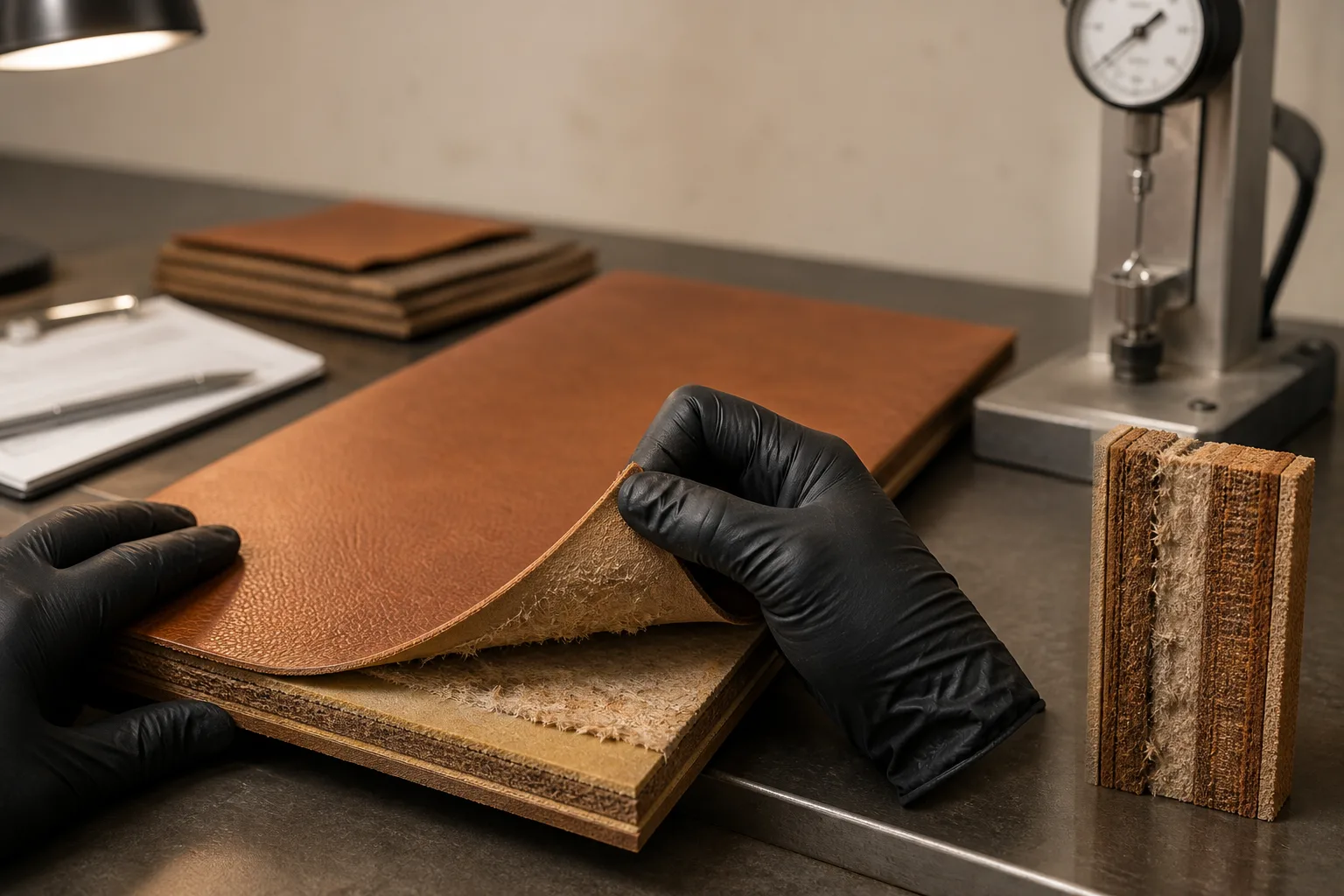
Testing is how a factory proves that a bonded panel will survive handling, climate and years of use. Four tests cover the realistic failure modes.
Peel Testing
Peel testing pulls the bonded layers apart at a controlled rate and records the force required. The result should show fiber tear rather than clean separation: if the leather fibers come away with the adhesive, the bond is stronger than the material.
Anything below the specified peel strength, or any clean separation, is a failure that will repeat in production unless the process is corrected.
Heat and Humidity Ageing
Bonded panels are exposed to elevated temperature and humidity for a defined period, then inspected for bubbling, edge lifting and softening. This test reveals adhesives that will fail in a hot car or a humid warehouse.
Flex and Fatigue Testing
Repeated flexing along the fold line stresses the bond exactly where it will be stressed in use. Fatigue testing catches brittle adhesives and over-thinned panels before thousands of units are produced.
Dimensional Stability Checks
Measuring panels before and after bonding and curing reveals adhesive shrinkage and any dimensional movement. Panels intended for precise assembly need this check, particularly on high-volume programs.
| Test | Method | Pass criterion | Reveals |
|---|---|---|---|
| Peel test | Pull layers apart at constant rate | Fiber tear, meets minimum force | Bond quality |
| Heat/humidity ageing | Exposure cycle then inspect | No bubbling or lifting | Climate resistance |
| Flex fatigue | Repeated folding cycles | No cracking or separation | Fold-line durability |
| Dimensional check | Measure before/after cure | Within specified tolerance | Distortion risk |
Splitting and Bonding by Bag Type
The right construction depends on the bag's job, its price point and the leather available.
| Bag type | Typical construction | Reason |
|---|---|---|
| Soft tote | Face leather bonded to nonwoven | Light, stable, resists stretch |
| Structured briefcase | Face, board stiffener, lining | Holds shape under load |
| Premium handbag | Quality face with minimal bonding | Preserves natural leather character |
| Small leather goods | Split to 0.8 mm, thinned edges | Folded edges without bulk |
| Laptop bag | Face bonded to reinforcement | Protects against panel stretch |
| Travel bag | Split leather backing | Durability with reasonable weight |
Soft Totes and Everyday Bags
These bags need panels that stay flat, resist stretching and keep costs reasonable. A thin face leather bonded to a lightweight nonwoven achieves all three, and it explains why this construction dominates volume production.
Structured Briefcases and Business Bags
Structure comes from a stiffener layer between face and lining. Bonding is used selectively: the face stays soft where it should, while the board provides the framework.
Small Leather Goods
Wallets, cardholders and pouches depend on precise splitting. Panels are reduced to under a millimeter so folded edges stay thin, and bonding is used sparingly to avoid bulk.
Premium Handbags
At the top of the market, less bonding is often better. High-quality full hides are used whole where possible, with bonding limited to internal stiffening that does not alter the leather's natural surface or aging.
Cost Impact: Where Splitting and Bonding Save Money
Splitting and bonding add process cost. Whether they save money depends on how they change material consumption and quality outcomes.
Material Savings
Using premium face leather at reduced thickness and backing it with economical material can cut the cost of the most expensive input substantially. On expensive hides, the saving often exceeds the cost of the added process.
Added Process Costs
Splitting machine time, adhesive, labor, press time and curing space all add cost. Curing also lengthens the production timeline, which matters when a launch date is fixed.
When Bonding Is the Wrong Answer
Bonding is the wrong choice when the material cost is already low, when the design calls for maximum natural leather character, or when the schedule cannot absorb curing time. On inexpensive leathers, bonding may add cost without changing the outcome.
Quality Control for Bonded Panels
Bonded defects appear after finishing or after shipping, so quality control must catch them at the panel stage. The checks below are quick, and each targets a specific failure mode.
| Check | Method | Frequency | Catches |
|---|---|---|---|
| Thickness gauge | Measure at 5 points per panel | Every panel at startup, then sampling | Splitting drift |
| Layer alignment | Visual and measurement before press | Every panel | Offset layers |
| Bond sound test | Tap and listen for softness | Sampling per lot | Incomplete bonding |
| Peel test | Destructive pull to fiber tear | Per production lot | Adhesive failure |
| Edge inspection | Check for adhesive bleed | Every panel after press | Finishing problems |
| Cure time log | Record time before next operation | Every lot | Premature processing |
Panel-Stage Checks
Thickness gauging and alignment verification happen before the bond sets, when problems can still be fixed. Once the adhesive cures, a mis-split panel is scrap.
Lot-Level Testing
Peel testing is destructive, so it is done on samples rather than on every panel. One test per production lot confirms that materials and process parameters have not drifted.
Recording Cure and Parameters
A simple log of adhesive batch, press pressure, dwell time and curing hours gives the factory traceability if a defect appears later. Factories without records cannot diagnose their own problems.
Working With Split Leather Suppliers
The quality of a split panel depends on the quality of the leather being split, so supplier selection matters more than machine settings.
Where Split Leather Comes From
Split leather is a byproduct of splitting a thicker hide: the top layer keeps the grain, while the split layer from the flesh side has a suede-like surface. Its quality varies with the hide and with how the split was made.
Assessing Supplier Capability
Ask how thickness is controlled and verified, whether splitting is done in-house or subcontracted, and what thickness tolerance the supplier guarantees. Factories that split in-house have far more control over consistency.
| Question | Strong answer |
|---|---|
| Where is splitting done? | In-house with documented settings |
| What tolerance is guaranteed? | States a number, e.g. ±0.2 mm |
| How is thickness verified? | Multi-point gauging with records |
| Can you provide test panels? | Yes, split to specified target |
| What leather grades are split? | Specific origins and tannages named |
Consistency Between Batches
Because leather varies, a supplier that records settings per hide delivers more consistent split material across orders. Ask for the last three thickness reports on comparable leather.
Common Misconceptions About Splitting and Bonding
Several assumptions about these processes lead buyers to make specification decisions that work against their own quality goals.
"Bonded Construction Means Lower Quality"
Bonding is a construction technique, not a grade. Premium bags use bonded reinforcement internally while leaving the face leather natural. Quality depends on materials, adhesive and process control, not on the presence of a bond.
"Thinner Panels Are Always Better"
Thinner panels reduce weight and cost but lose tear strength and fold durability. Splitting below a leather's practical minimum creates bags that crack at fold lines within the first year.
"More Adhesive Makes a Stronger Bond"
Excess adhesive traps solvent, creates soft spots and bleeds at the edges. Bond strength comes from correct application weight, proper open time and adequate pressure.
"Bonded Panels Can Be Used Immediately"
Adhesive needs curing time to reach strength. Panels processed immediately after bonding shift, bubble or delaminate under the stress of folding and skiving.
"Skiving and Splitting Are the Same Thing"
They control thickness at different scales, and a specification that confuses them produces either bulky fold edges or panels that are too thin overall.
Specifying Split Thickness and Bonding
A short, precise specification prevents most disagreements over bonded panels, because it defines what the factory must achieve rather than how it should work.
| Spec element | What to write | Why it matters |
|---|---|---|
| Target thickness | "Body panels split to 1.4 mm ±0.2" | Sets measurable outcome |
| Measurement points | "Gauge at 5 points per panel" | Catches splitting drift |
| Adhesive | "Water-based PU, flexible grade" | Fixes climate and VOC behavior |
| Bond strength | "Peel test: fiber tear, min 3 N/cm" | Creates a pass/fail criterion |
| Press parameters | "Roller press, 3 bar, 35 °C" | Ensures repeatability |
| Curing | "24 h before folding or skiving" | Prevents delamination |
| Edge handling | "Edge zone split after bonding" | Avoids bulky folds |
| Documentation | "Test report per production lot" | Provides evidence |
Define the Outcome, Not Just the Process
Specify target thickness with tolerance and the peel strength requirement, then let the factory choose the process it runs best. Over-specifying process details without measurable outcomes helps neither side.
Require Multi-Point Measurement
Because splitting drifts across a hide, require thickness measurement at several points per panel. A single center reading hides exactly the variation that causes assembly problems.
Insist on Bond Testing Before Production
A peel test on the pre-production bonded panel, run and documented by the factory, is the cheapest assurance available. It converts an assumption about adhesive quality into evidence.
FAQ
What is the difference between splitting and skiving leather?
A: Splitting reduces an entire panel to a uniform thickness using a band knife machine. Skiving thins only the edge, usually so a panel can be folded without bulk. Both control thickness, but at different scopes.
Why do leather bag factories split leather?
A: Natural hides vary in thickness across the surface. Splitting creates a consistent gauge so folding, edge finishing, stitching and lining behave predictably, and it lets factories buy thicker hides and reduce them to the needed thickness.
What thickness tolerance is normal for split leather?
A: Around plus or minus 0.2 millimeters for production splitting. Tighter tolerances are achievable but slow production and add cost, and they are rarely necessary for bag panels.
Why do factories bond two layers of leather together?
A: Bonding combines properties: a premium face leather for appearance with a split or fabric backing for body, thickness and stability. It also uses expensive hides more efficiently and controls panel stretch.
What adhesive is used for bonding leather panels?
A: Neoprene contact adhesives are traditional and very flexible. Water-based polyurethane adhesives are common for lower solvent content, and hot-melt films suit heat-press processes with thin layers.
Why do bonded panels bubble or delaminate?
A: Usually from contamination on the bonding surface, excess adhesive trapping solvent or air, incorrect open time, or insufficient press pressure. Curing too quickly before further processing is another common cause.
How long should bonded panels cure before processing?
A: Typically about 24 hours before folding, skiving or edge finishing. Curing allows the adhesive to reach strength and lets residual solvent or moisture escape.
Can bonded leather panels be skived and folded?
A: Yes, but the edge zone needs splitting or skiving to compensate for the extra thickness of the bonded layers. Planning edge treatment together with bonding prevents bulky, imprecise folds.
What is a peel test for bonded leather?
A: A controlled test that pulls the bonded layers apart and measures the force required. A good result shows fiber tear, meaning the adhesive is stronger than the leather itself.
Is bonded leather the same as bonded-leather upholstery?
A: No. This article discusses bonding two layers of leather or leather and reinforcement. Bonded-leather upholstery is a different material made from shredded leather fiber with a binder.
Does bonding make leather bags less durable?
A: A correctly bonded and cured panel is durable and stable. Problems come from poor surface preparation, wrong adhesive, insufficient curing or splitting too thin, not from bonding as a technique.
Which reinforcement is best for a structured panel?
A: Polypropylene board suits light, stiff structured panels; fiberboard gives maximum rigidity for cases; nonwoven reinforcement adds stability at minimal weight for flat body panels.
Can splitting make leather too thin?
A: Yes. Below a leather's practical minimum, tear strength drops and panels crack at fold lines. Factories should refuse splits that compromise structural integrity.
How many layers can a bag panel have?
A: Typical constructions have two to four: face leather, optional reinforcement, optional foam and lining. More layers increase stiffness, weight and process cost, and make edge treatment harder.
How can I verify bonded quality as a buyer?
A: Require a peel test report per production lot, multi-point thickness measurements, and documentation of adhesive type and curing time. Inspect the pre-production sample for edge paint and alignment.
Does bonding affect how a bag ages?
A: It can. Fully bonded facings stiffen permanently, while panels with the stiffener placed behind the lining let the outer leather soften naturally. The construction choice shapes how the bag looks after a few years.
Ready to specify splitting and bonding correctly for your next collection? Send us your panel requirements and we will recommend target thickness, adhesive and reinforcement for each part, run peel and ageing tests on a pre-production panel, and document the parameters your production order will follow.