Laser Cutting vs Die Cutting: Which Works for Leather Bags?
- The Two Cutting Methods Explained
- Edge Quality: The Biggest Practical Difference
- Accuracy, Repeatability and Design Freedom
- Cost Structure: Where the Money Goes
- Production Speed and Capacity
- Material Yield and Nesting
- Which Method for Which Bag
- Common Defects and Quality Checks
- Specifying Cutting Requirements in a Tech Pack
- Sustainability and Compliance Considerations
- Cutting and Downstream Processes
- Working With Cutting Partners
- Practical Decision Framework
- Common Misconceptions About Cutting Methods
- FAQ
Cutting is the first operation in bag production and the one that decides almost everything downstream. A panel cut with the wrong method will fight the assembler, show a rough edge after edge painting, and quietly cost the brand money in yield, rework and rejected samples.
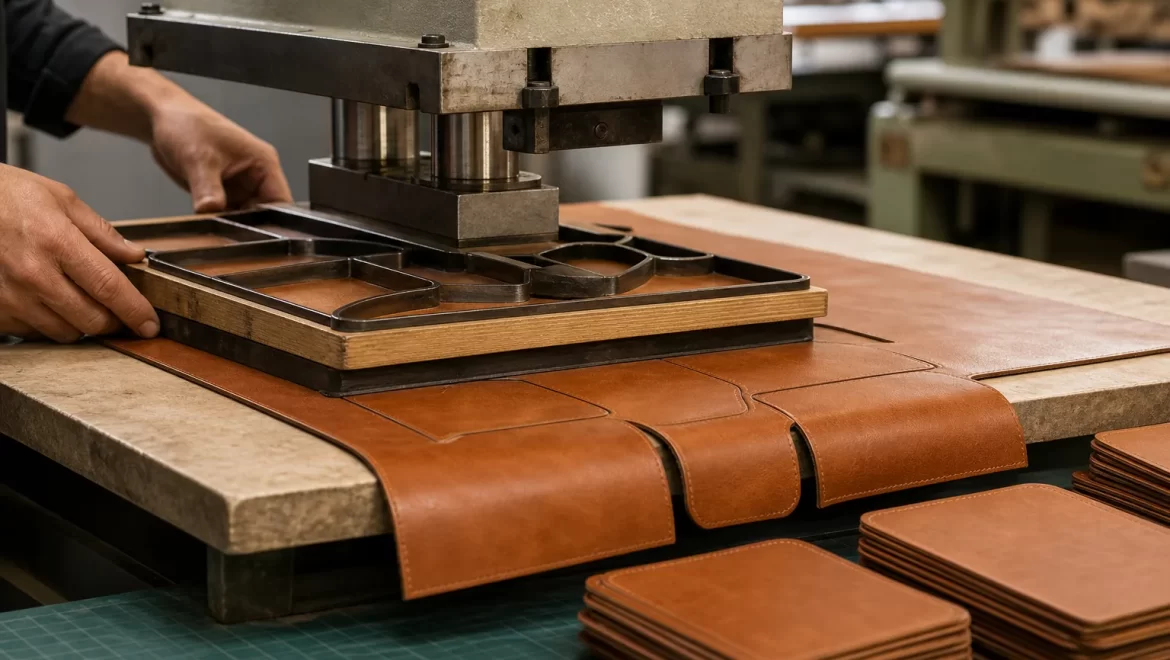
Factories have two main options for production cutting: die cutting, where a steel rule die presses shapes out of the leather, and laser cutting, where a focused beam traces each part. Both produce accurate panels. They produce very different edges, different cost curves and different constraints.
The right choice depends on batch size, leather type, panel geometry and the level of edge finish the design requires. This guide compares both methods from the factory floor, with the numbers that actually decide the question.
The Two Cutting Methods Explained
Understanding what each machine actually does to leather is the foundation for every comparison that follows.
How Die Cutting Works
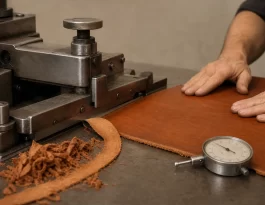
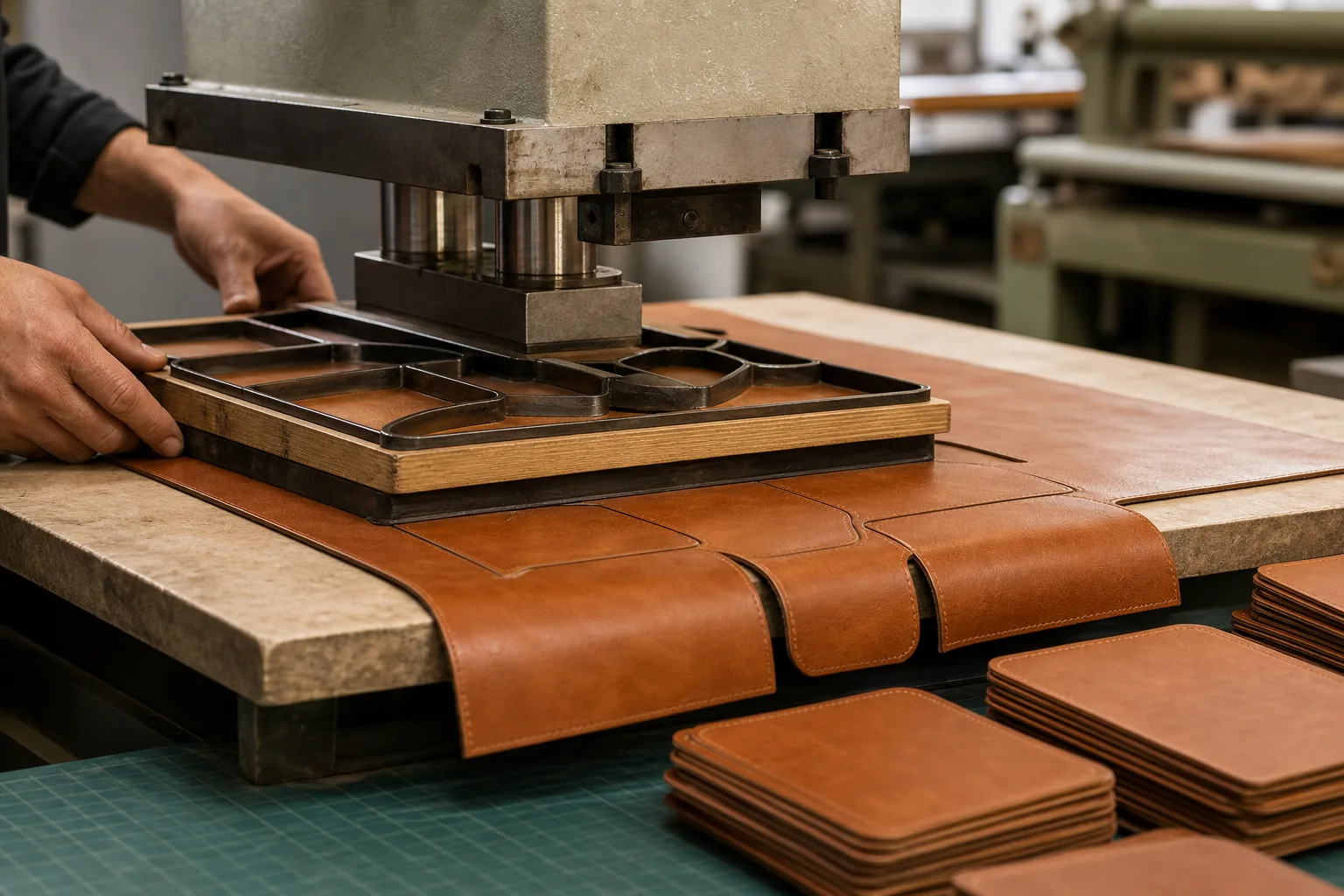
A die is a wooden board carrying shaped steel blades, bent to match each panel. The die is placed on the leather, a hydraulic or mechanical press drives it down, and the blades cut through the material in one stroke.
The method is fast, produces consistent panels, and works with almost any leather thickness. Its limitation is economic rather than technical: each new design requires a new die.
How Laser Cutting Works
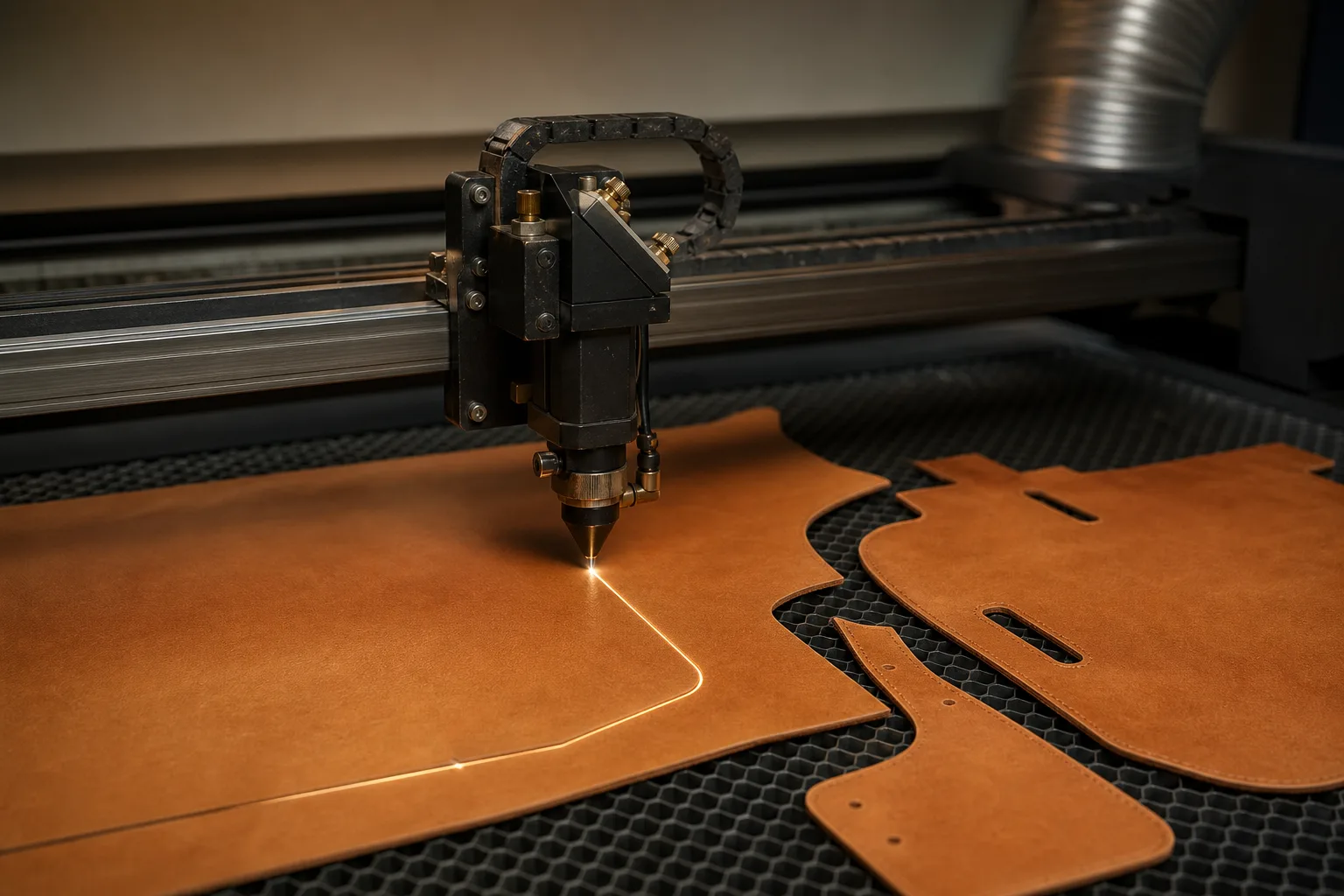
A laser cutter follows a digital path and cuts each panel individually. The beam vaporizes the material along the line, leaving a sealed, singed edge as it moves.
Laser cutting requires no tooling, so a new design can go from file to cut panels within hours. The trade-off is speed per piece and the thermal effect on the cut edge.
Other Cutting Methods in the Same Workshop
Most factories use additional methods alongside these two, and knowing them prevents a false binary choice.
| Method | Speed | Tooling cost | Best suited to |
|---|---|---|---|
| Die cutting | Very high | High per design | Volume production of set designs |
| Laser cutting | Moderate | None | Prototypes, small batches, complex shapes |
| CNC knife cutting | Moderate | Low | Sampling, medium batches, soft leathers |
| Hand cutting (knife) | Low | None | One-off samples, exotics, delicate hides |
| Waterjet | Low | Very low | Rare; specialist technical materials |
Where Each Method Sits in the Workflow
In practice, factories mix methods within a single program. A design is usually validated with laser or CNC cut samples, then moved to die cutting once volumes justify tooling.
Buyers who understand this sequence can plan their development budget: pay for tooling once the design is locked, not before.
Edge Quality: The Biggest Practical Difference
Edge quality is the most visible difference between the two methods, and the one that most often drives a decision.
The Die-Cut Edge
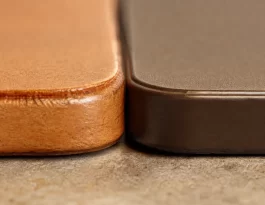
Die cutting compresses the leather as it cuts. The resulting edge is compact, slightly burnished and dimensionally stable, with fibers pushed together rather than opened.
This compressed edge takes edge paint well and holds a clean line through folding. On firm leathers, a die-cut edge often needs only light preparation before finishing.
The Laser-Cut Edge
Laser cutting leaves a heat-affected edge. The leather at the cut line is singed, sometimes darkened, and firmer than the surrounding material; the degree depends on leather type, thickness and laser settings.
For some designs this sealed edge is an advantage, because it resists fraying. For others it is a problem, because the darkened line shows under light edge paint and can read as a defect to a customer.
How Leather Type Changes the Result
Vegetable-tanned leather singes visibly and holds a brown-to-black cut line, while chrome-tanned leathers react more subtly. Coated and corrected-grain leathers can show a visible melt line where the finish layer reacts before the fiber layer.
Suede and nubuck behave differently again: the cut edge looks clean, but the singed surface fibers can feel stiff and may need brushing or light sanding before assembly.
| Leather type | Die-cut edge | Laser-cut edge | Notes |
|---|---|---|---|
| Vegetable-tanned | Compact, clean | Dark singe line | Sanding needed for light colors |
| Chrome-tanned | Clean, stable | Slight darkening | Usually acceptable |
| Coated / corrected grain | Clean | Visible melt line | Risk on light finishes |
| Suede / nubuck | Clean, fluffy | Sealed, stiff | Brush or sand after cutting |
| PU / synthetic | Clean | Melting, fume risk | Die cutting strongly preferred |
| Patent / glossy | Clean | Risk of scorch marks | Test before committing |
Post-Processing Requirements
Die-cut panels generally move straight to skiving and folding. Laser-cut panels often need an additional step: light sanding, brushing or wiping to remove the singed layer before edge paint or folding.
That extra step costs labor and introduces a handling risk. It should be included in the costing comparison rather than treated as a free consequence of the machine.
Accuracy, Repeatability and Design Freedom
Both methods are accurate, but they are accurate in different ways and for different reasons.
Dimensional Accuracy
Die cutting repeats the same shape thousands of times with excellent consistency, provided the die stays sharp and the press is maintained. Typical tolerances sit around plus or minus 0.5 millimeters for leather panels.
Laser cutting follows a digital file, so accuracy depends on the machine and the material's behavior rather than on a physical tool. Tolerances of plus or minus 0.1 to 0.3 millimeters are achievable, though leather can shrink slightly along the heat-affected line.
Complex Geometry
This is where laser cutting wins clearly. Internal cutouts, narrow slots, fine notches and tight radii that would be expensive or impossible to build into a steel die are trivial for a laser path.
Designs with multiple small apertures, decorative perforations or intricate strap slots are far more economical to laser cut than to die cut, because the die would need dozens of tiny blades.
Repeatability Over a Production Run
Die cutters can drift as blades dull, which shifts the panel slightly and requires die maintenance or replacement. Laser cutters do not wear in the same way, so the thousandth panel matches the first.
For a long production run of the same design, dies are periodically maintained; lasers need calibration and lens cleaning but hold their geometry.
| Factor | Die cutting | Laser cutting |
|---|---|---|
| Typical tolerance | ±0.5 mm | ±0.1–0.3 mm |
| Complex internal cutouts | Expensive tooling | Easily done |
| Wear over a run | Blade dulling, drift | No tool wear |
| Shape change cost | New die | New file only |
| Nested layout changes | Fixed by die | Adjustable per run |
When Design Freedom Is Worth the Slowdown
If a design uses intricate geometry, laser cutting may be the only practical option even at high volume. If it uses simple, large panels, die cutting wins on speed and edge quality.
The deciding question is usually geometry, not volume: dies handle simple shapes at scale, lasers handle complex shapes at any scale.
Cost Structure: Where the Money Goes
Cutting cost comes from tooling, machine time, labor and yield. The two methods distribute those costs very differently.
Die Fabrication Cost
A die for a bag's full panel set is a real investment: steel rule, laser-cut plywood backing, bending, rubbering and fitting. Costs vary with complexity, but a typical multi-panel bag die runs into several hundred dollars and takes days to produce.
The die is amortized across the order. At 200 units, the per-unit burden is significant; at 5,000 units, it nearly disappears.
Laser Machine Cost
Laser cutting has no tooling, but its machine time is more expensive than a press stroke. Energy, optics maintenance, fume extraction and, on some machines, assist gas all contribute to a higher hourly rate.
Per panel, laser cutting is usually more expensive than die cutting at volume, but it requires no upfront investment and no storage or maintenance of tooling.
| Cost element | Die cutting | Laser cutting |
|---|---|---|
| Tooling | Several hundred USD per design | None |
| Machine time per panel | Very low | Higher |
| Labor | Low, press operator | Low, machine operator |
| Post-processing | Minimal | Sanding/wiping often needed |
| Break-even volume | Around 300–800 units per design | Any volume |
The Break-Even Volume
The practical rule most factories apply: laser cut prototypes and small batches, die cut once the design is stable and volumes exceed roughly 300 to 800 units per design, depending on panel complexity and leather cost.
Below that threshold, tooling dominates the cost. Above it, machine time dominates, and the die pays for itself quickly.
Hidden Costs on Both Sides
Die cutting hides cost in die storage, maintenance and replacement. Laser cutting hides cost in post-processing labor, lower throughput and the risk of edge-quality rejection on light-colored or coated leathers.
A fair comparison puts both sets of hidden costs on the table before deciding.
Production Speed and Capacity
Speed determines how a cutting method fits into a production schedule, particularly when a launch date is fixed.
Die Press Throughput
A press cuts a full layer of leather in seconds. Depending on press size and die layout, a factory can cut multiple panels per stroke or stack thin layers for even higher output.
This throughput is why die cutting dominates volume manufacturing: a single press can feed a large assembly line all day with minimal operator involvement.
Laser Throughput
A laser cuts one panel at a time, tracing the full perimeter plus any internal detail. Cutting a complete bag's panel set may take several minutes of machine time per bag, and that time cannot be parallelized by stacking.
For small batches this is irrelevant. For thousands of units, laser cutting becomes a capacity bottleneck unless several machines run in parallel.
Matching Method to Schedule
When a design is complex but volumes are high, factories sometimes split the work: laser cut the intricate parts and die cut the large simple panels. This hybrid approach keeps the schedule and the quality target within reach.
| Scenario | Die cutting | Laser cutting | Preferred |
|---|---|---|---|
| 50-unit trial run | Die cost dominates | Fast to start | Laser |
| 500-unit first production | Marginal | Slower but flexible | Either, check geometry |
| 5,000-unit production | Very fast, cheap per unit | Capacity bottleneck | Die |
| Intricate cutout design | Expensive tooling | Natural fit | Laser |
| Mixed complex and simple panels | Die for simple panels | Laser for intricate parts | Hybrid |
Material Yield and Nesting
Leather is expensive and irregular, so how a method places panels on the hide directly affects cost.
The Nesting Problem
A hide is not a rectangle. It has edges, neck and belly areas of different density, and flaws that must be avoided. Placing panels to minimize waste while avoiding defects is a skill that determines real material cost.
Die Cutting's Fixed Layout
A die defines one arrangement of panels. If the arrangement does not fit the hide efficiently, or if a flaw appears in a critical position, the cutter must reposition the die and lose material around it.
Experienced cutters can sometimes rotate or offset a die, but the layout is fundamentally constrained by the physical tool.
Laser Cutting's Flexible Nesting
A laser can place panels anywhere on the hide, because the layout is software-driven. Software can account for flaws marked by the cutter and re-nest in real time, which typically improves yield on irregular hides.
This advantage is largest on large panels and on expensive leathers where a few percent of yield is worth real money. It often closes part of the cost gap that laser cutting otherwise carries.
| Yield factor | Die cutting | Laser cutting |
|---|---|---|
| Layout flexibility | Fixed by die | Fully software-driven |
| Flaw avoidance | Manual repositioning | Digital re-nesting |
| Typical yield advantage | Baseline | Often 3–8% better on large panels |
| Impact on expensive hides | Significant | Significant, in laser's favor |
When Yield Outweighs Machine Cost
On a high-cost hide, a few percentage points of yield can exceed the entire cost difference between the two cutting methods. This is why laser cutting is common on premium ranges even at moderate volumes.
For inexpensive leathers and simple panels, the yield advantage narrows and die cutting's speed advantage dominates again.
Which Method for Which Bag
The answer is rarely absolute. It depends on the design, the volume and the leather, and it changes as a product line matures.
| Bag type / situation | Recommended method | Reason |
|---|---|---|
| New design validation | Laser or CNC | No tooling, fast iteration |
| Small-batch premium line | Laser | Yield plus complex shapes |
| Simple tote at volume | Die | Speed and edge quality |
| Bag with perforations or cutouts | Laser | Die tooling impractical |
| Coated leather in light color | Die | Laser scorch marks unacceptable |
| Two-tone panel assembly | Either, test first | Color bleed risk at the cut line |
| High-cost exotic hides | Laser | Yield protection |
Prototypes and Small Batches
Laser cutting is the practical choice for design development, because a revised shape costs nothing beyond a new file. Factories typically validate fit and finish with laser or CNC panels before any tooling is ordered.
Volume Production of Stable Designs
Once a design is locked and volumes are meaningful, die cutting usually wins on speed, edge quality and per-unit cost. The tooling investment is recovered quickly and the compressed edge takes finishing well.
Complex Geometry at Any Volume
For cutouts, slots and fine details, laser cutting is often the only economical route. A die with dozens of small blades is expensive to build and fragile in use.
Leather-Specific Constraints
Coated, glossy and light-colored leathers should be test cut with the laser before any commitment, since scorching and finish melting may be visible. Synthetic materials generally belong on a die press or CNC knife, not under a laser.
Common Defects and Quality Checks
Each cutting method produces characteristic defects, and inspectors know exactly what to look for.
| Defect | Method | Cause | Check |
|---|---|---|---|
| Ragged or fuzzy edge | Die | Dull blade, wrong press pressure | Visual and finger test |
| Oversized panel | Die | Worn die, material compression | Measure against template |
| Dark singe line | Laser | Incorrect power or speed | Visual under bright light |
| Hardened brittle edge | Laser | Excess heat input | Flex the edge, check cracking |
| Scorch mark on surface | Laser | Reflected beam or wrong focus | Visual inspection of face |
| Burn smell in material | Laser | Incomplete fume extraction | Olfactory check before assembly |
| Edge melting on coating | Laser | Coating reacts faster than fiber | Test cut on light colors |
Die Cutting Defects
Dull blades produce fuzzy edges and slightly oversized panels, because the leather compresses before it separates. Press pressure and die condition must be monitored through the run, not just at the start.
Laser Cutting Defects
The characteristic risks are thermal: a dark line, a hardened edge that cracks when folded, scorch marks on the face, and a burned smell that can persist into the finished bag. Fume extraction and correct parameters are not optional.
Inspection That Actually Catches Problems
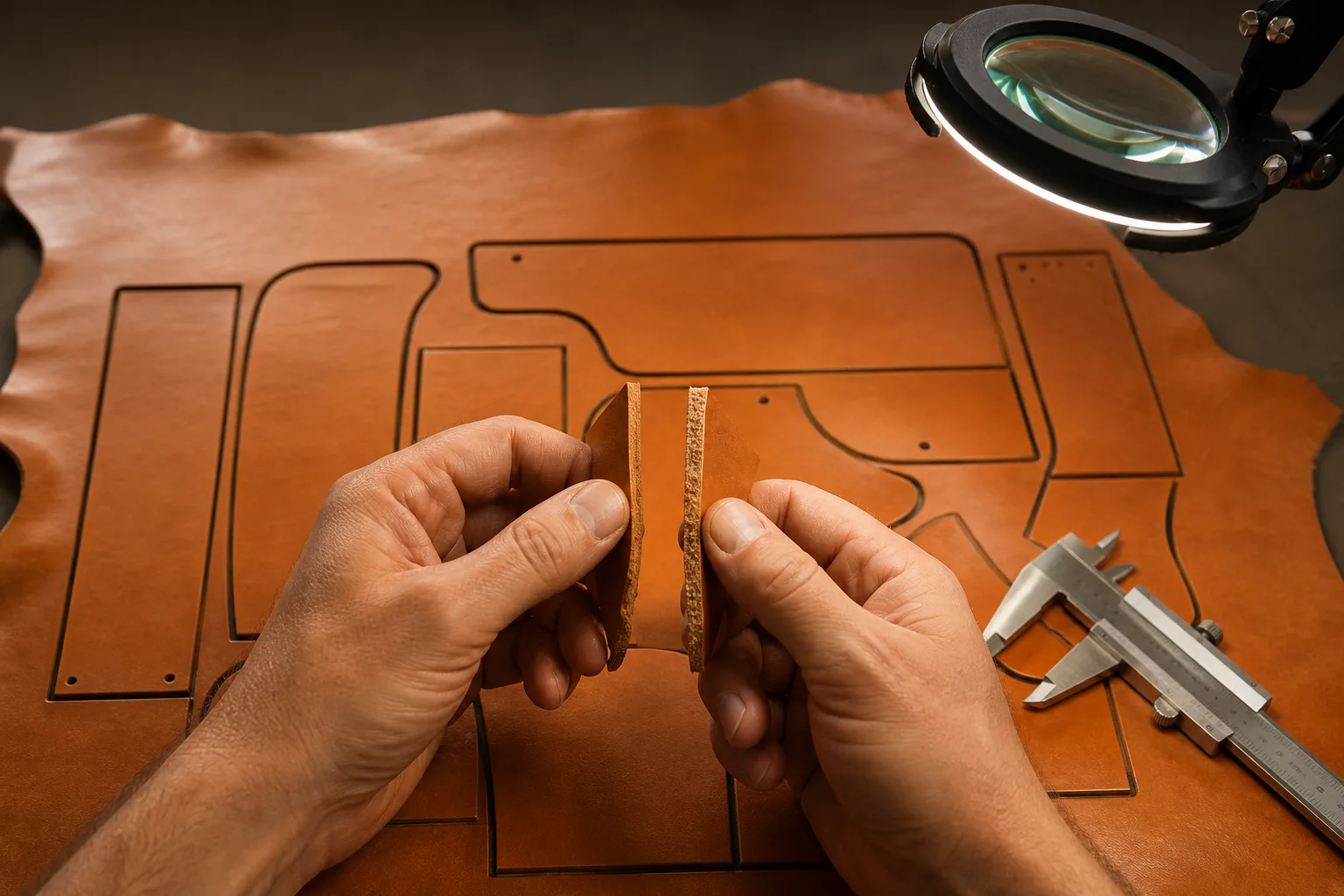
Edge inspection should happen at the cutting stage, before panels enter assembly, because defects discovered after folding and stitching cost far more to correct. A simple routine works: visual check under bright light, dimensional check against the template, and a flex test on any laser-cut edge that will be folded.
Specifying Cutting Requirements in a Tech Pack
Cutting requirements are often left implicit, and that omission produces disputes later. A short cutting specification prevents most of them.
State the Method and Its Consequences
Write down which method applies to which panel, and acknowledge the consequences: laser cutting requires post-processing on visible edges, die cutting requires tooling amortization. Both belong in the cost and process notes.
Define Tolerance and Edge Requirements
Give a tolerance for panel dimensions, and specify acceptable edge condition: whether a singed line is permitted, whether sanding is required, and how edges will be finished before assembly.
| Spec element | What to write | Why it matters |
|---|---|---|
| Cutting method | "Die cut all main panels; laser cut perforated panel" | Prevents silent substitution |
| Tolerance | "±0.5 mm on all panel outlines" | Keeps assembly aligned |
| Edge condition | "No visible singe line on face leather" | Protects finished appearance |
| Post-processing | "Sanded and sealed before folding" | Fixes responsibility for the step |
| Tooling | "Die cost amortized over first order" | Makes the economics explicit |
| Sample approval | "Cut sample approved before tooling" | Avoids lock-in on a wrong design |
Require a Cut Sample Before Tooling
Approving a cut sample before a die is fabricated is the cheapest insurance in bag development. Once tooling exists, changing the design means paying for it twice.
Confirm Post-Processing Responsibility
Clarify whether the factory or the brand pays for sanding, wiping and sealing on laser-cut edges. It is a small line item individually and a significant one across a large order.
Sustainability and Compliance Considerations
Cutting method has environmental and compliance implications that buyers increasingly need to document.
Laser Fume Management
Laser cutting produces fumes from vaporized leather, finishes and adhesives. Factories cutting leather with lasers need effective extraction and filtration, both for worker safety and for the smell of the finished part.
Buyers sourcing laser-cut work should confirm the extraction setup, because poor fume management shows up as odor in the finished product, not only as a workplace issue.
Die Cutting Waste
Die cutting generates offcuts that are typically sold to smaller workshops or recycled for small goods. Die storage and eventual disposal of worn tooling are minor but real considerations.
Material and Process Documentation
Some markets now ask brands to document process inputs, including whether thermal processes are used on natural materials. A factory that records cutting parameters and post-processing steps can support that documentation; one that does not will struggle later.
Cutting and Downstream Processes
Cutting is not an isolated operation. The method chosen influences every process that follows, and those effects need to be costed along with the cutting itself.
Effects on Skiving and Folding
A die-cut edge is compressed and stable, so skiving and folding proceed predictably. A laser-cut edge is firmer at the cut line, which changes how the blade behaves and how the fold sets.
Factories often increase sanding before folding on laser-cut panels, and sometimes reduce skiving depth because the edge is already thinner and harder.
Effects on Edge Finishing
Edge paint bonds best to an open, slightly roughened edge. Die cutting produces that naturally; laser cutting produces a sealed surface that must be opened by sanding to accept paint.
This is the most common source of visible quality differences between the two methods on light-colored bags, where insufficient preparation shows as a dark line under a pale edge color.
Effects on Stitching Alignment
Panel dimensions drive assembly alignment. Looser die tolerances can accumulate across several panels and shift stitch lines; tighter laser tolerances reduce that drift but require consistent heat behavior across the hide.
Factories manage both cases the same way: measure the first assembled unit carefully and adjust the process before running the order.
Working With Cutting Partners
Many brands buy cutting as a separate service, and assessing that partner is as important as choosing the method. The questions below separate capable suppliers from those that simply own a machine.
| Question | What a strong answer looks like |
|---|---|
| What equipment do you run? | Names machine types, power ratings, press tonnage |
| How do you maintain dies or optics? | Documented schedule, records of blade or lens condition |
| What tolerance do you guarantee? | States numbers by method and material |
| How do you handle hide flaws? | Marking and re-nesting process described |
| Post-processing included? | Clearly states sanding, wiping, sealing responsibilities |
| Can you provide a cut sample? | Yes, with test cut on the actual leather |
Capability, Not Just Equipment
A laser cutter and a factory that can control laser cutting are different things. The difference shows in parameter libraries for specific leathers, in test cuts before production and in how they respond to an edge-quality complaint.
Sample Cuts Before Commitment
Always request a cut sample on the exact leather to be used. A method that works beautifully on a firm vegetable-tanned hide can produce an unacceptable edge on a coated, light-colored one.
Documented Parameters
Ask whether the factory records cutting parameters for repeat orders. Documented parameters mean the second order matches the first; undocumented ones mean starting over each season.
Practical Decision Framework
Bringing the factors together, a simple sequence resolves most cutting decisions without extended debate.
Step One: Check Geometry
If the design contains internal cutouts, narrow slots or fine perforations, the question is largely settled in favor of laser cutting, regardless of volume.
Step Two: Check the Leather
Coated, glossy, light-colored or synthetic materials should be test cut before committing to laser. If the test edge is not acceptable after post-processing, the die press is the answer.
Step Three: Check Volume Against Break-Even
Compare expected volume against the tooling break-even, typically 300 to 800 units per design. Below it, laser cutting avoids an investment the design may not repay.
Step Four: Run the Numbers With Yield Included
On expensive hides, laser nesting gains can offset the machine-time disadvantage. Recalculate the comparison with realistic yield for the specific hide and panel mix rather than a generic assumption.
Step Five: Decide Before Tooling, Not After
The expensive mistake is ordering dies for a design that then changes. Lock the design with a cut sample, then invest in tooling once geometry and volumes are firm.
Common Misconceptions About Cutting Methods
Several beliefs about cutting circulate among buyers, and most of them are half true at best. Clarifying them prevents expensive assumptions.
"Laser Cutting Is Faster Because There Is No Tooling"
Laser cutting is faster to start, not faster to produce. Setup takes hours instead of days, but per panel the press is far quicker. Confusing startup speed with throughput leads to capacity surprises at volume.
"Die Cutting Is Always Cheaper at Volume"
Usually true for simple panels on moderate-cost leather. It stops being true when laser nesting gains several percent of yield on expensive hides, or when geometry demands tooling that is costly to build and fragile to run.
"Laser Edges Are Always a Defect"
A singed edge is a process characteristic, not automatically a fault. Many designs accept it, and some even use it as a design feature on natural leather. The question is whether the edge matches the specification after post-processing.
"Post-Processing Is a Minor Detail"
Sanding and sealing every laser-cut edge on a large order is real labor. Treating it as negligible understates the landed cost of laser cutting and distorts the comparison against a die.
"Any Factory With a Laser Can Cut Leather Well"
Leather is a variable material, and cutting it well requires tested parameters per hide and color. A machine without a parameter library produces inconsistent edges across a production run.
"The Method Can Be Decided Later"
By the time panels are cut, the decision is already made and paid for. Method selection belongs in development, before tooling and before sampling schedules are set.
FAQ
Is laser cutting better than die cutting for leather bags?
A: Neither is universally better. Laser cutting suits prototypes, small batches and complex shapes without tooling; die cutting offers higher speed, a compressed cleaner edge and lower per-unit cost at volume.
Does laser cutting damage leather edges?
A: It causes a heat-affected edge: singed, slightly darker and firmer than the surrounding material. Whether that is acceptable depends on leather type, color and how the edge will be finished.
Why do laser-cut edges turn dark?
A: The beam vaporizes material along the cut line and the heat chars the leather locally. Vegetable-tanned and natural leathers show this most visibly, especially in light colors.
Can you edge paint a laser-cut edge?
A: Yes, but the singed layer should be sanded or brushed first so the paint adheres evenly. Skipping this step often produces a visible dark line under the paint.
What is the break-even volume for a cutting die?
A: Typically 300 to 800 units per design, depending on panel complexity and leather cost. Below that range, laser or CNC cutting usually costs less overall.
How much does a bag cutting die cost?
A: A full die set for a multi-panel bag typically costs several hundred US dollars and takes several days to produce. Complex shapes and multiple small panels push the cost higher.
Which method gives better dimensional accuracy?
A: Laser cutting is generally more accurate, typically within ±0.1 to 0.3 millimeters, while die cutting holds around ±0.5 millimeters but can drift as blades dull.
Can laser cutting improve material yield?
A: Yes. Because the layout is software-driven, laser cutting can re-nest around flaws and fit panels into irregular hide areas, often improving yield by several percentage points on large panels.
Is laser cutting suitable for PU or synthetic leather?
A: Generally no. Synthetics melt and can release problematic fumes. Die cutting or CNC knife cutting is the usual choice for PU and coated synthetic materials.
Why does my laser-cut bag smell burnt?
A: Incomplete fume extraction leaves odor in the material. Ask the factory to verify extraction and airflow, and check a cut sample for smell before approving production.
How fast is die cutting compared with laser cutting?
A: A press cuts a full layer in seconds, while a laser traces each panel individually over minutes. Die cutting is significantly faster at volume; laser speed advantage lies in setup, not throughput.
Can a factory use both methods for one bag?
A: Yes, and many do. A common hybrid cuts large simple panels with a die and intricate parts with a laser, capturing both speed and design freedom.
What tolerance should I specify for cut panels?
A: For most bag panels, ±0.5 millimeters is practical and achievable with both methods. Tighter tolerances are possible with laser cutting but add cost for little assembly benefit.
Do laser-cut edges crack when folded?
A: They can. Excessive heat hardens the edge, so folding a heavily singed edge may crack it. Correct laser parameters and light sanding before folding prevent most cases.
Is die cutting cheaper for small orders?
A: No. Tooling is the dominant cost at small volumes. Die cutting becomes cheaper than laser cutting only after the tooling cost is spread across a substantial order.
How do I decide which cutting method to use?
A: Check geometry first, then leather type, then volume against the tooling break-even, and finally yield on the specific hide. Confirm with a cut sample before ordering any tooling.
Ready to cut your next bag line the right way? Send us your design files or samples and we will recommend the cutting method for each panel, quote tooling and post-processing accurately, and deliver a cut sample you can test before committing to production.