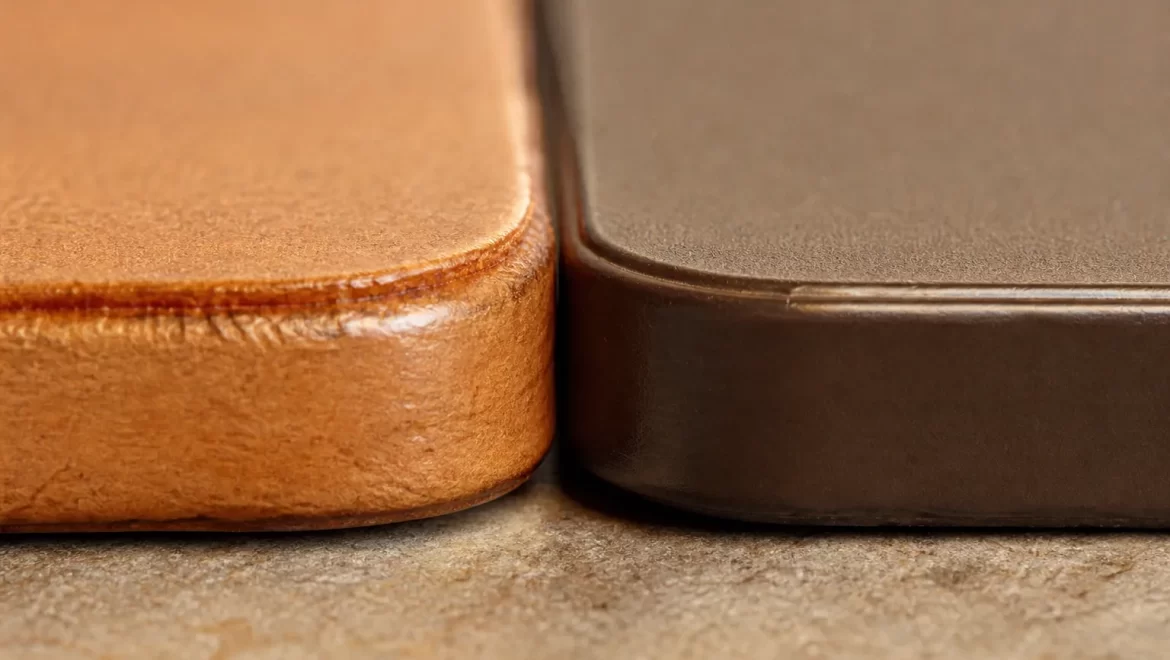
Edge Painting vs Burnished Edges: Finishing Techniques That Define Quality
Run your finger along the edge of a leather bag — the thin line where the front panel meets the back. On a cheap bag it feels rough, sharp, or slightly sticky. On a great bag it feels smooth, rounded, and solid, like the edge is part of the leather itself. That thin line is the product of one of the most labor-intensive steps in bag manufacturing, and it is the single fastest way to tell a quality bag from a mediocre one without opening your wallet.
Two techniques dominate edge finishing: edge painting and edge burnishing. They produce different looks, use different materials, suit different leathers, and cost different amounts — yet most buyers cannot tell them apart, and most brands never think to specify which one they want. This guide explains both methods from the factory floor: how each is done, how they compare in durability and cost, how to judge edge quality on a sample, and how to write edge specifications that protect your brand's quality. By the end, you will understand why the edge is the most underrated quality signal in leather goods — and how to use it.
Why Edges Matter More Than Most Buyers Realize
The edge of a leather bag is where every quality decision in manufacturing becomes visible. It is the place where the leather's density meets the cutter's skill, where the finisher's patience shows, and where shortcuts are impossible to hide for long.
There are three reasons edges carry so much information. First, edges are touched constantly. Every time a hand reaches into a bag, opens a flap, or sets it down, fingers find the edges. A rough or cracking edge is felt before it is seen, and tactile quality is the strongest driver of "this feels expensive" impressions. Second, edges wear first. The edge is the most exposed part of the bag — it rubs against surfaces, absorbs impact at corners, and flexes with every opening. If a bag is going to fail cosmetically, it almost always fails at the edge first. Third, edges cannot be hidden. Unlike a seam that can be tucked or a lining that covers the interior, the edge of a flap or the top line of a bag is fully visible in every product photo and in every customer's hand.
This is why edge finishing is where factories either invest or cut corners. A bag with a $30 factory cost can have $1 or $6 spent on its edges depending on the process and the skill applied — and that five-dollar difference is visible to every customer who ever touches the product. For a brand, edge quality is not a detail; it is a positioning decision expressed in millimeters.
The Two Schools of Edge Finishing
Edge finishing exists because a cut leather edge is a rough, fibrous cross-section — the exposed interior of the hide, which looks unfinished and absorbs moisture. The finished edge must seal that cross-section, protect it from wear and water, and look clean. Two fundamentally different approaches achieve this:
Edge painting builds a new surface on the edge. A flexible paint (typically a polyurethane or acrylic edge paint) is applied in multiple layers directly to the cut edge, building up a smooth, colored, protective coating. The paint is flexible enough to bend with the leather, and the finished edge can be matched exactly to the leather color or even contrast with it. Edge painting is the dominant method in modern bag production, especially for chrome-tanned and finished leathers.
Edge burnishing transforms the edge itself. The cut edge is wetted or treated with a gum/wax compound, then rubbed vigorously with a wooden, stone, or linen tool until friction melts and compresses the leather fibers into a hard, smooth, sealed surface. No coating is added — the edge becomes its own finish. Burnishing works best on vegetable-tanned leather, whose dense fibers compress beautifully, and produces the classic "natural edge" look prized in heritage and craft bags.
The choice between them is driven by the leather. Chrome-tanned leather has soft, porous edges that do not burnish well — the fibers crush rather than seal — so chrome leather is almost always edge-painted. Vegetable-tanned leather, with its firm, dense fibers, burnishes to a beautiful sealed edge — but it can also be painted, and many premium bags use a combination. Understanding which method your leather demands is the first step in specifying edges correctly.
Burnished Edges Explained
Burnishing is the older craft, and it is a pure skill operation. The process, as practiced in a quality workshop, runs through several stages:
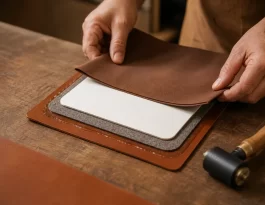
1. Skiving the edge. Before burnishing, the edge is skived — thinned at an angle — so that when panels are joined, the edge seam sits flat rather than bulging. Skiving also exposes clean fibers for the burnish to act on.
2. Sanding. The cut edge is sanded smooth with fine grit, removing roughness and fuzz. This prepares a uniform surface; a well-sanded edge is the foundation of a well-burnished one.
3. Applying the burnish compound. A small amount of edge gum (a water-based resin or wax compound) or plain water is applied to the edge. The compound lubricates the fibers and provides the medium that friction will transform.
4. Rubbing and compressing. The finisher rubs the edge with a wooden edge slicker or a stone tool in a rapid back-and-forth or circular motion. The friction heats the edge, the moisture evaporates, and the fibers compress and fuse into a hard, glossy surface. This step is repeated — typically three to five passes, re-wetting and re-slicking between passes — until the edge is fully sealed.
5. Final finish. A light coat of wax or edge oil is often applied to seal and protect the burnished surface, giving it the deep, natural sheen that customers associate with craft quality.
The result is an edge that is literally part of the leather — no coating to chip, no paint to peel. The color is the leather's own color, deepened by the wax. Burnished edges age beautifully: with use they develop a richer, darker sheen that matches the patina of the leather itself.
The limitations are equally clear. Burnishing requires dense, well-finished leather — vegetable tanning's domain — and skilled hands. It is slow work, and the edge color is constrained to the leather's natural tones (you cannot paint a burnished edge a contrasting color). For a factory, burnishing is the premium, low-volume option: the edge that says "craft."
Edge Painting Explained
Edge painting is the industrial workhorse of edge finishing, and when done well it is indistinguishable from magic: a perfectly smooth, perfectly colored line that follows every curve of the bag. The process is methodical and layered:
1. Edge preparation. As with burnishing, the edge is skived and sanded first. For painted edges, preparation also includes applying a base coat or primer that bonds the paint to the leather fibers.
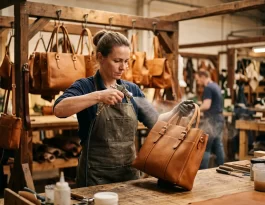
2. First paint coat. A thin coat of edge paint — colored polyurethane or acrylic — is applied with a brush or a heated edge-painting machine. Thin is the key word: a thick first coat cracks later. Quality factories apply thin coats, let each dry, and build the edge in layers.
3. Sanding between coats. After each coat dries, the edge is sanded lightly with fine grit to remove drips, bumps, and the paint ridge where coats overlap. Sanding between coats is the step that separates a professional edge from a lumpy amateur one.
4. Multiple coats. Quality edges receive three to six coats, each sanded. The number of coats determines the edge's depth, smoothness, and durability. A premium edge might have five coats and be sanded four times; a budget edge might have one thick coat and be sanded never.
5. Final finishing. The last coat is polished with a finishing compound or a light heat treatment to produce a smooth, slightly glossy seal. The edge is then inspected: it must be even in width, free of drips, and seamlessly continuous around curves and corners.
The advantages are obvious: edge paint comes in any color, works on any leather (especially chrome-tanned), can be matched exactly to the bag or used as a deliberate contrast accent, and is faster per edge than burnishing once the process is established. The risks are also real: a cheap painted edge — one thick coat, no sanding — cracks, chips, and peels within months, because thick paint is inflexible and poorly bonded.
The skill in edge painting is patience: coats, drying, sanding, repeat. The visible result is a clean, colored, protective line. The invisible result is whether that line survives a year of daily use or fails in the first month.
Head-to-Head Comparison
| Attribute | Burnished edge | Painted edge |
|---|---|---|
| Best leather | Vegetable-tanned, dense fibers | Chrome-tanned, finished leathers |
| Process | Friction-seal the leather fibers | Build a layered paint coating |
| Appearance | Natural leather color, waxed sheen | Any color, smooth and even |
| Durability | Excellent; wears in, ages well | Good; depends on coats and sanding |
| Failure mode | Fuzz or dry edges with neglect | Cracking, chipping, peeling |
| Repair | Re-burnish at workshop | Touch-up paint; re-coat |
| Production speed | Slow, skilled | Faster per edge at scale |
| Labor cost | High | Moderate |
| Relative cost per bag edge | $2.50–$6.00 | $1.50–$4.00 |
| Best positioning | Heritage, craft, premium | Fashion, modern, volume |
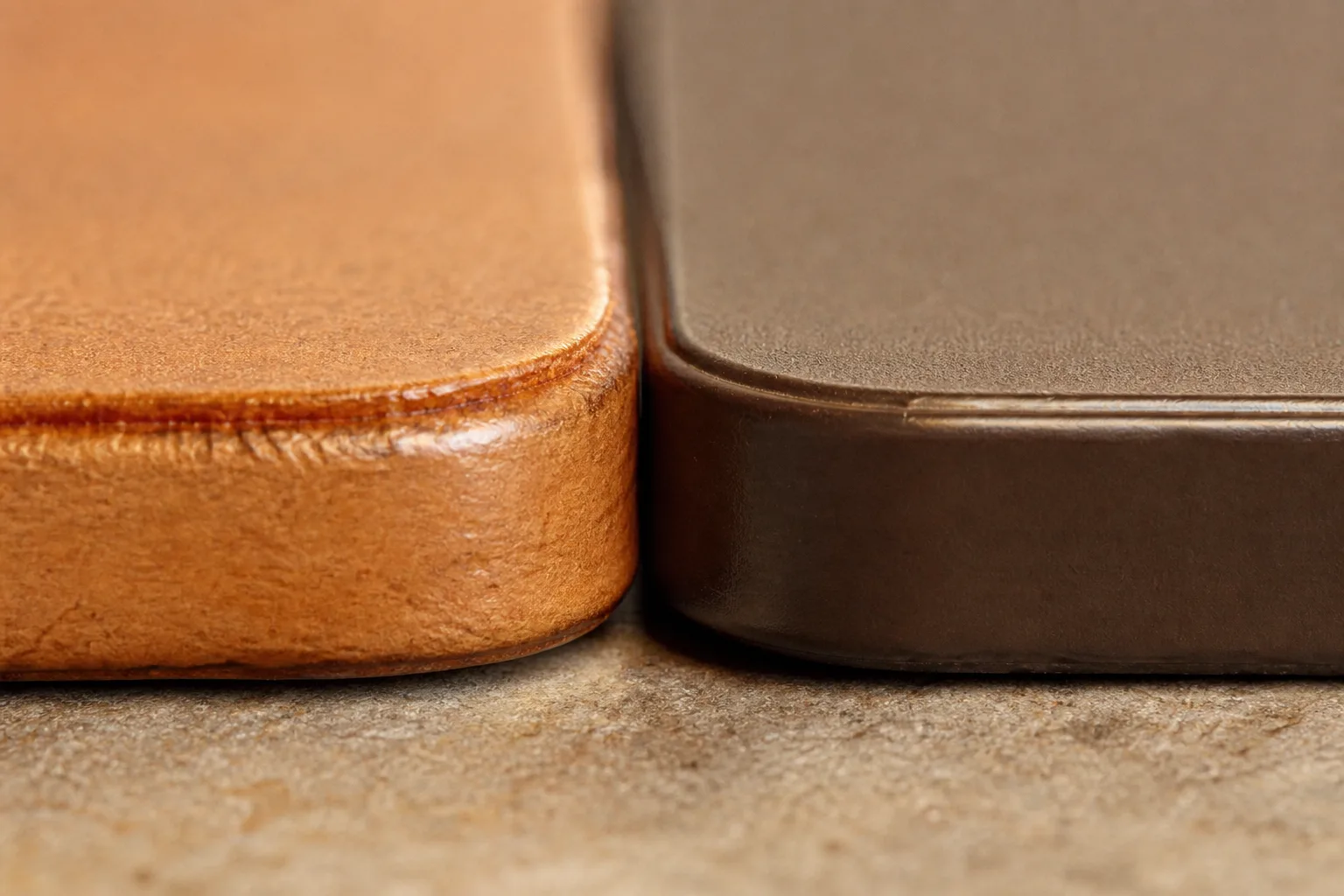
The table shows the two methods as complementary rather than competing: burnishing is the craft edge for natural materials; painting is the versatile edge for modern production. The best factories are fluent in both and choose by design, not by habit.
Durability: Which Finish Survives Daily Use
Durability is where the two methods reveal their true characters — and where buyers should look hardest.
Burnished edges age in. A properly burnished edge is compressed leather fiber, sealed by friction. Under daily use it does not crack or peel — there is nothing to crack or peel. Instead, it gradually darkens and glosses, developing a sheen that matches the leather's patina. The failure mode is neglect: if the leather dries out (no conditioning, harsh sun), the burnished edge can fuzz or lose its seal. With basic care, a burnished edge lasts as long as the bag — ten years and more.
Painted edges age out. A quality painted edge (multiple thin coats, sanded) performs excellently for years, but it is a coating, and coatings have a lifespan. The flexing of the edge — every time the bag opens and closes — stresses the paint at fold lines. Over time, a painted edge can develop hairline cracks at high-flex points, and on cheaper edges, chips and flakes. The durability of a painted edge is directly proportional to the number of coats and the sanding between them: a five-coat edge may outlive the bag; a one-coat edge fails within months.
Three real-world tests settle the question. The flex test: repeatedly open and close the flap or bend the edge; quality painted edges show no cracking, cheap ones develop lines within dozens of cycles. The corner test: corners are the stress concentrators — run your thumbnail along a corner; a quality edge is smooth and continuous, a failing edge flakes or catches. The time test: a one-year-old bag that has been carried daily — does the edge still look clean? Burnished edges usually do; painted edges reveal their coat count.
The honest conclusion: for longevity, burnished edges have the structural advantage, but a high-quality painted edge is fully adequate for normal bag life. The durability difference is really between quality and cheap execution — which is why buyers must learn to judge the execution, not just the method.
Labor and Cost Structure
Edge finishing is one of the most labor-intensive steps in bag making, and its cost structure explains a lot about factory pricing. Here is what the work actually costs:
| Cost component | Burnished edge | Painted edge (quality) |
|---|---|---|
| Skiving and sanding prep | $0.60–$1.20 | $0.60–$1.20 |
| Compound/wax material | $0.15–$0.40 | — |
| Paint material (3–6 coats) | — | $0.30–$0.80 |
| Burnish passes (3–5) | $1.50–$3.50 | — |
| Paint application + drying time | — | $0.80–$2.20 |
| Sanding between coats | — | $0.40–$1.00 |
| Final seal/finish | $0.25–$0.50 | $0.15–$0.30 |
| Total per bag (typical) | $2.50–$6.00 | $1.50–$4.00 |
Three observations. First, both methods are real costs — a factory that charges the same for a bag regardless of edge finish is almost certainly applying the cheapest edge it can. Second, the drying time is the hidden schedule cost — painted edges need drying between coats, which stretches production lead time; burnishing needs no drying but consumes skilled labor hours. Third, the skill premium is real — a finisher who can produce a flawless edge in both methods earns 30–50% more than an average machine operator, and that cost appears in the quote.
For buyers, the practical question is not "which method is cheaper" but "what edge quality am I paying for?" Ask the factory for the edge spec: how many coats, how many sanding passes, which method, and what the edge labor line is in the quote. A factory that cannot tell you its edge spec is a factory whose edge quality is whatever the operator decides on the day — and that is a risk you should not accept.
How to Judge Edge Quality on a Sample
You do not need to be a finisher to evaluate edge quality — you need to know what to look for and touch. Here is the inspection routine we teach buyers:
1. The finger test. Run your finger slowly along the edge. Quality: smooth, rounded, continuous, slightly firm. Red flags: rough, sharp, sticky, or wavy.
2. The magnifier test. Use a 10x loupe (or a phone macro lens) on the edge. Quality painted edge: even width, no drips, no bubbles, clean transition at curves. Quality burnished edge: uniform, glossy, no fuzz. Red flags: lumpy paint, visible sanding scratches, dry patches.
3. The flex test. Bend the edge at a fold point several times. Quality: no cracking, no color change at the bend. Red flags: hairline cracks, whitening (stress marks) at flex points.
4. The corner test. Corners are where edges fail first. Run your thumbnail along a corner and inspect under magnification. Quality: continuous, smooth curve. Red flags: flakes, chips, gaps, or a "flat spot" where the finish broke.
5. The look test. Check edge color consistency along the whole bag. Painted edges should match the leather (or be deliberately contrasting) with no variation. Burnished edges should be even in sheen with no blotchy dry areas.
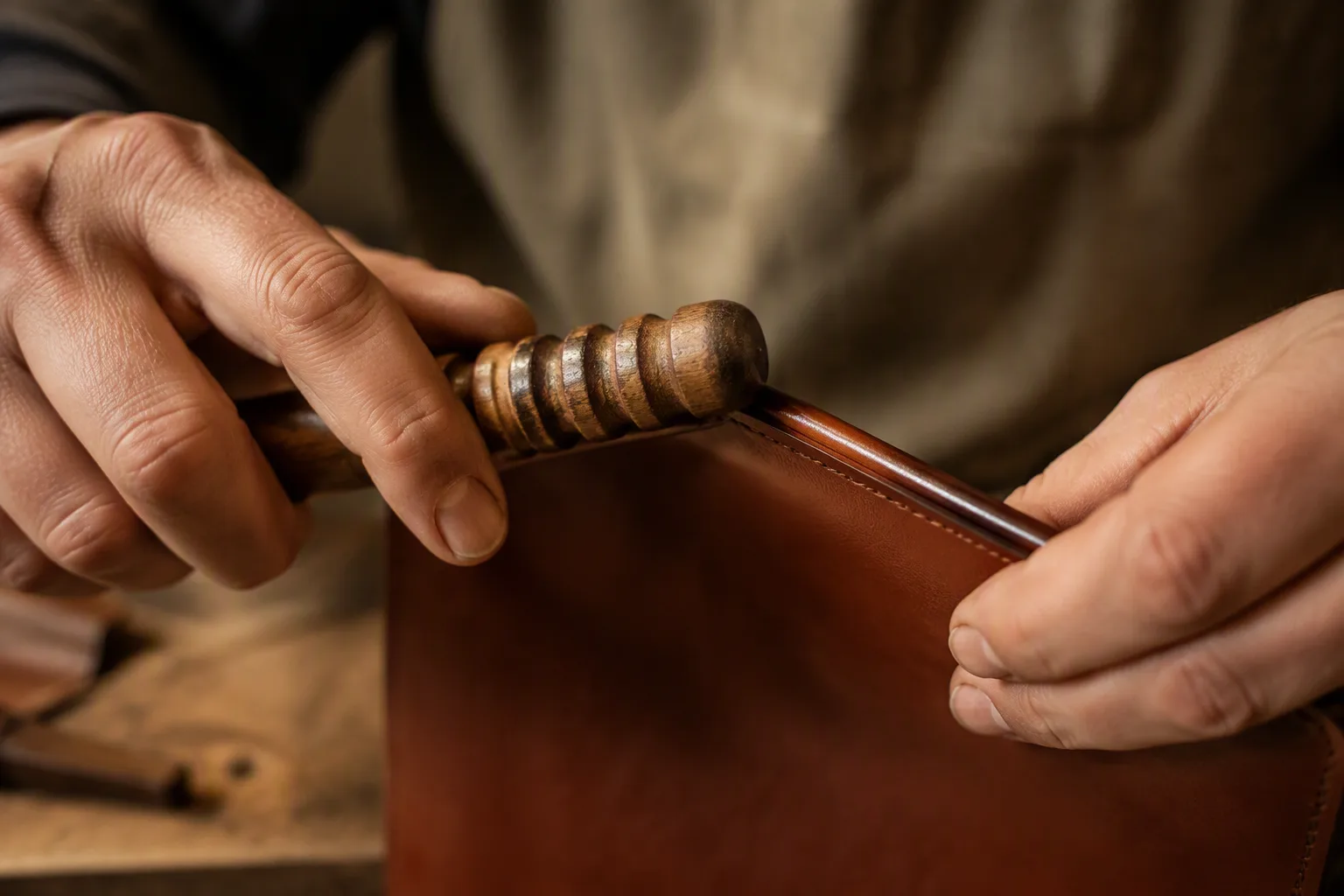
One professional tip: judge the inside edges too. The visible outer edges get the factory's best work; the interior edges (inside the flap, around interior pockets) reveal the standard that the factory applies when it thinks nobody is looking. A bag whose interior edges are finished as carefully as its exterior is a bag from a factory that takes the whole product seriously — and that is the factory you want.
Common Edge Defects and Their Causes
Knowing the defect is knowing the cause — and knowing the cause tells you which factory process to question. Here is the defect map our QC team uses for edge finishing:
| Defect | What it looks like | Root cause |
|---|---|---|
| Cracking at folds | Hairline or visible cracks at flex points | Too few coats / thick paint / no flex agent |
| Chipping | Paint flakes off at corners or edges | Poor bonding, no primer, rough prep |
| Sticky or tacky edge | Edge feels soft, grabs fingers | Paint not fully cured (drying skipped) |
| Lumpy or wavy edge | Uneven width, drips, bumps | Thick coats, no sanding between coats |
| Fuzzing (burnished) | Soft fiber pile on the edge | Insufficient burnish passes / leather too soft |
| Blotchy burnish | Uneven sheen, dry patches | Uneven compound application, rushed passes |
| Color mismatch | Edge color ≠ leather color | Wrong paint batch, poor matching |
The pattern is consistent: almost every edge defect traces to rushing — fewer coats, skipped drying, skipped sanding, fewer burnish passes. Edge finishing is the step where time is literally quality, and the factory that schedules edge work properly is the factory that delivers edges that last. When you see a recurring edge defect in a batch, do not ask for more QC — ask for more time in the edge process.
Choosing the Right Edge for Your Bag Style
The edge method should follow the design, not the other way around. Here is the decision matrix we use with clients:
| Bag style | Recommended edge | Why |
|---|---|---|
| Heritage tote (veg-tan) | Burnished | Natural patina, craft story, ages well |
| Classic briefcase | Burnished | Structured, traditional, elegant |
| Luxury handbag (veg-tan) | Burnished | Premium feel, one-of-one character |
| Fashion handbag (chrome-tan) | Painted | Color matching, modern look, volume |
| Everyday crossbody | Painted | Durability at cost, consistent finish |
| Color-block / contrast bags | Painted | Edge as a design accent |
| Kids' and family bags | Painted | Robust coating, easy care |
| Capsule "forever" collection | Burnished | The edge that ages with the product |
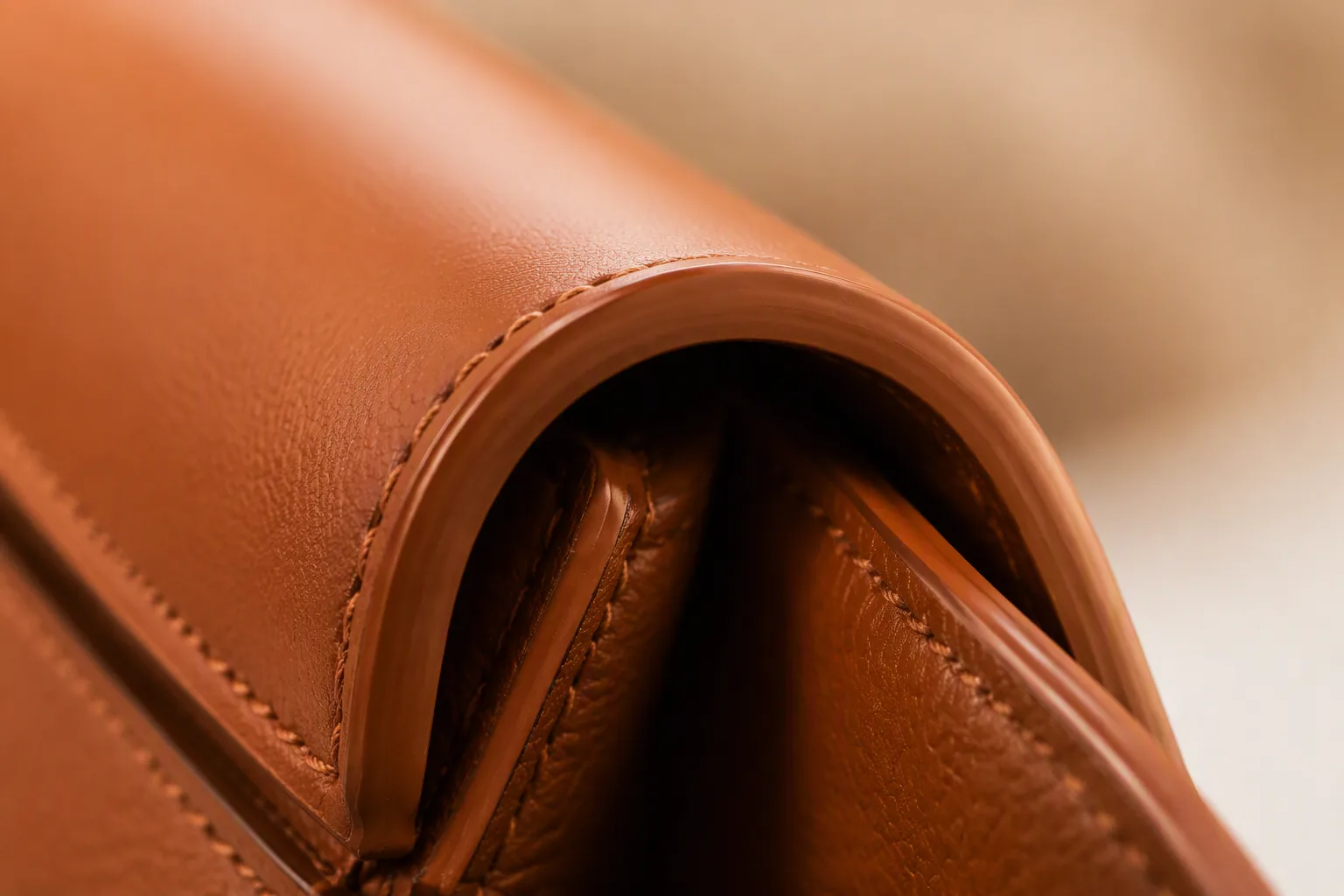
Two rules of thumb. First, let the leather decide: vegetable-tanned leather rewards burnishing; chrome-tanned leather demands painting. Trying to force the wrong method on a leather produces a mediocre edge of either kind. Second, match the edge to the brand story: if your brand sells "craft and natural materials," a painted edge on a veg-tan bag undercuts the story; if your brand sells "modern and precise," a burnished edge may look unfinished next to your clean design language. The edge is a brand decision worn on the product's surface.
The Edge in Different Bag Components
Not every edge on a bag is the same, and a professional edge spec treats each component according to its stress and visibility. Understanding the component map helps you know where to look for quality — and where factories quietly save money.
| Component | Stress level | Visibility | Typical treatment |
|---|---|---|---|
| Top line (opening) | High flex | Very high | Painted (multi-coat) or burnished |
| Flap edges | High flex | High | Multi-coat paint or burnish |
| Handle edges | High abrasion | Medium | Painted, reinforced |
| Gusset edges | Medium | Medium | Standard paint or burnish |
| Interior pocket edges | Low | Low | Single coat or folded |
| Trim edges | Low | Low | Any economical finish |
The pattern is instructive: the edges customers see and touch most — top lines and flaps — get the premium treatment, while interior and trim edges get the economical one. That is legitimate cost engineering, up to a point. The line is crossed when the factory treats visible edges as economically as hidden ones, which is exactly why the interior-edge inspection in the previous section is so valuable: it reveals whether the factory's quality standard is uniform or applied only where customers look.
Two component-specific notes. First, handle edges deserve special attention because handles are both highly visible and highly stressed — they flex, rub against shoulders, and carry the bag's weight. A handle edge that is thinly painted will crack within months. Premium factories reinforce handle edges with additional coats or a burnished-painted hybrid. Second, top-line edges on bags with no closure flap (open totes) are the single most important edge on the product: they are touched every time the bag opens, and they carry the bag's structural opening stress. If a factory cuts corners anywhere, it is least likely to cut them here — and most likely to charge for the premium here too.
Edge Color and Design Language
Edge color is a design tool that most brands never use — and the ones that do create an immediately recognizable language. Understanding the options turns the edge from a technical detail into a brand element.
Matched edges — the default — use paint that matches the leather color exactly. The edge disappears into the product, reading as "clean and premium." Matching is the safe choice, and the skill is in the match: a mismatched edge paint is worse than none, because it reads as a manufacturing error rather than a design choice. This is why quality factories maintain dye-matching records per production run, not just per color name.
Contrast edges — a deliberate different color, often darker, lighter, or a complementary tone — turn the edge into a visible design line. Contrast edges are common in fashion and color-block designs, where the edge acts like piping on clothing: it outlines the silhouette and adds definition. A dark contrast edge on a light bag reads as modern and graphic; a tonal (slightly darker) edge reads as refined and understated.
Natural edges — burnished, or painted in a translucent tone — celebrate the leather itself. On vegetable-tanned bags, the natural burnished edge is the design statement: it proves the material is real, natural, and crafted. Translucent edge paint achieves a similar effect on chrome leather, letting the leather's own color show through a protective film.
Whichever language you choose, the rule is the same as for any brand element: specify it, sample it, and approve it before production. An edge language is part of your visual identity, and like every part of identity, it is built by repetition across the line — the customer who sees the same edge treatment on every bag begins to recognize your brand by its edges alone.
Repair and Aftercare
Edge finishes age differently, and so do their repair paths — a difference your care documentation should reflect.
Burnished edges are repairable by any workshop: the edge can be re-wetted, re-gummed, and re-slicked to restore the seal, and light conditioning keeps the edge supple. For the customer, the care routine is the leather's normal care: condition every few months, avoid soaking, and the edge takes care of itself. A burnished edge that has dried out can often be revived with a little edge wax and elbow grease — a genuine DIY repair.
Painted edges are more complex. Minor scuffs can be touched up with matching edge paint (available from the factory or specialist suppliers), but re-coating an edge properly means stripping the old paint, re-priming, and re-building the coats — a workshop job. For the customer, the care message is protection: avoid sharp impacts at corners, keep the bag away from abrasive surfaces, and treat chips early before moisture gets under the paint.
Write these differences into your care cards honestly. A burnished-edge bag sold with "condition monthly" instructions matches its material; a painted-edge bag sold with "avoid impacts and treat chips early" matches its construction. The customers who know what they own become the customers who keep it — and who buy the next one.
FAQ
What is the difference between edge painting and burnishing?
A: Edge painting builds a layered colored coating on the cut edge; edge burnishing compresses and seals the leather's own fibers with friction. Painting suits chrome-tanned leather; burnishing suits vegetable-tanned.
Which edge finish lasts longer?
A: A quality burnished edge generally lasts longer — there is no coating to crack or peel, and it ages with the leather. A quality painted edge (3–6 coats, sanded) is fully adequate for normal bag life; cheap painted edges fail quickly.
Can chrome-tanned leather be burnished?
A: Poorly. Chrome leather's fibers are soft and porous, so they crush rather than seal. Chrome-tanned leather is almost always edge-painted, which is why painting dominates modern production.
How can I tell if an edge is quality?
A: Run your finger along it (smooth, rounded, continuous), check with a 10x loupe (even width, no drips), flex it (no cracking), and inspect the corners (no flakes). Check the interior edges too — they reveal the factory's real standard.
Why do painted edges crack?
A: Too few coats, thick application, or skipped sanding between coats. Cracking is almost always a rushed process, not a material failure.
Is a burnished edge more expensive?
A: Typically yes — it requires skilled labor and multiple passes. Budget for roughly $2.50–$6.00 per bag edge for quality burnishing versus $1.50–$4.00 for quality painting.
Can a painted edge be repaired?
A: Minor scuffs can be touched up with matching paint; proper re-coating is a workshop job (strip, prime, rebuild coats). Burnished edges can be re-burnished by any workshop and even revived at home with edge wax.
What should I write in my tech pack about edges?
A: The method (paint or burnish), the coat count and sanding passes (for paint), the burnish passes (for burnish), the edge color matching requirement, and the sample approval gate for edges. Ambiguity in the edge spec is an invitation to shortcut.
Writing Edge Specs in Your Tech Pack
A professional edge spec removes all ambiguity. Here is the template we use:
- Method: Edge painted — polyurethane edge paint, color matched to leather (Pantone/pelts reference provided)
- Coats: 4 minimum (premium: 5), each coat sanded with 400-grit between applications
- Prep: edges skived and sanded smooth before first coat
- Finish: final coat polished to matte-satin; no drips, bubbles, or color variation
- Flex requirement: no cracking after 100 flex cycles at fold points (tested on production sample)
- Inspection: edge quality checked at final QC and on the production-level sample before approval
For burnished edges:
- Method: Burnished natural edge — edge gum + wooden slicker, minimum 4 passes
- Prep: edges skived and sanded smooth
- Finish: light wax seal; uniform sheen, no fuzz or dry patches
- Aging requirement: edge must remain sealed after conditioning and flex testing
Add one sentence to your contract: "No change to edge method, coats, or materials without written approval." That sentence prevents the quiet downgrade from a 5-coat painted edge to a 1-coat job — the most common edge shortcut in the industry.
Conclusion
The edge is the smallest visible surface on a leather bag and the loudest quality signal it carries. Edge painting and burnishing are two different philosophies — one builds a surface, the other transforms the material — and each has its leather, its look, its cost, and its lifespan. The professional approach is not to prefer one method blindly, but to match the method to the leather, the design, and the brand story, and then to specify it precisely, sample it rigorously, and inspect it every time.
For buyers, the takeaway is practical: touch the edge, flex it, magnify it, and check the inside edges that the factory thought you would never see. For brands, the lesson is strategic: the edge is where craft becomes visible, and edge quality is one of the cheapest ways to justify a premium price — or the fastest way to undermine one. A bag whose edges are finished with the same care as its leather is a bag that tells the same story from every angle, and that is the story customers remember.
Sourcing leather bags and want to compare edge quality for yourself? Contact our factory — we will send you samples with both burnished and painted edges on the same design, show you our edge spec sheets, and walk you through the flex tests so you can judge the difference in your own hands before you commit.