How Do You Audit a Bag Supplier's Capability Before Ordering?
- What the Audit Is For
- Starting From the Product, Not the Factory
- Machinery and Process Match
- The Sample Room as Evidence
- Line Capacity and Real Output
- Sub-Supplier Reliance
- Quality Systems in Practice
- Materials Traceability
- Workforce and Skills
- Verifying Claims With Evidence
- The Walk-Through Sequence
- Scoring and Decision Rules
- Common Audit Traps
- Reporting What Was Found
- Auditing Again After the First Order
- FAQ
A capability audit is not a tour with a clipboard. It is a short, structured attempt to answer one question: can this factory make my product, at my volume, to my standard, without depending on something it has not declared?
Most sourcing failures are not failures of price or effort. They are mismatches that were visible on the floor and not looked for: a machine absent, a process outsourced, a sample room stronger than the line, or a capacity claim measured on one shift in a quiet month.
What the Audit Is For
A capability audit predicts delivery, not virtue. It should produce evidence for three decisions: whether the supplier can make the product, whether it can make the volume, and what to write into the order to protect against the gaps found.
Three Questions, Not a Scorecard
Every observation should map to one of the three: process match, capacity, or control. A finding that maps to none of them is conversation rather than audit evidence.
Write each finding against one of the three, and note the source: observed, documented, sampled or stated. Findings that cannot be attributed to a question are the ones that make a report long and a decision unclear.
What It Cannot Tell You
An audit cannot confirm future behaviour, and it cannot substitute for a trial order. It shortens the list and prices risk; the trial order confirms it.
What an audit does well is remove suppliers that cannot make the product at all, and make the remaining risks explicit before money is committed. What it cannot do is guarantee that the fourth week of a production run looks like the day of the visit, when the line is under different pressure and the sample is no longer on the table.
The Output
The deliverable is a short report with the gaps named, the evidence attached and a decision: proceed, proceed with conditions, or stop. A report that says only "capable" has not been written yet.
A useful report answers the question the buyer actually asked: should we place this order, and what has to be true before we do. That structure forces the gaps into the open, because a condition cannot be written without naming what is missing and who will check it.
| Question | What it decides |
|---|---|
| Process match | Can they make it at all |
| Capacity | Can they make it on time |
| Control | Will each unit match |
Starting From the Product, Not the Factory
The audit begins before the visit, with a list of the operations your product actually requires.
Building the Operation List
Write the route: cutting, skiving, edge folding, reinforcing, zip setting, lining assembly, top stitching, edge finishing, hardware setting, final inspection. Against each, note the machine type, the skill level and the tolerance that matters.
That list becomes the audit checklist, and it is specific to your product rather than to the industry in general.
The list also changes as the range changes, so it should be rewritten when a new construction is added rather than reused from the previous product. A checklist carried forward unchanged gradually stops describing what is being made.
Marking the Critical Operations
Two or three operations usually decide whether the bag looks right: the top stitch line, the edge finish, the zip curve. Those deserve direct observation rather than a verbal confirmation.
For a top stitch, that means counting stitches and watching the guide being used; for an edge, watching the sequence from skiving to painting; for a zip, watching the curve being sewn and the slider being tested. Each takes a few minutes and replaces an hour of discussion.
What to Ask Before the Visit
Ask for the process route, the machine list for that route and the names of any operations that are outsourced.
Read the machine list against the route rather than on its own: every operation should map to a machine that exists, and every machine should belong to an operation you actually need. Machines that appear on the list but nowhere in the route describe a capability the factory has, not a capability it will use for you. The answers frame the visit and often reveal the gap before the first photograph.
A pre-visit request also tests responsiveness. A factory that sends a clear route and machine list within a day is usually organised enough to answer questions on site, while vagueness at this stage tends to repeat itself later.
| Stage | Evidence to request |
|---|---|
| Route | Written process list |
| Machines | Inventory for that route |
| Outsourcing | Declared list of sub-processes |
Machinery and Process Match
Machines are the easiest claim to check and the most common place for a mismatch to hide.
Count, Condition and Age
Count the machines that perform the critical operations, not the total on the floor. Note the condition and the age, because a machine that is present but unreliable is a delay waiting to happen.
Ask which machines are dedicated to which lines, since a shared machine is a shared bottleneck.
Ask how the machine is scheduled when two orders need it in the same week, and who decides priority. The answer shows whether your lead time depends on your order or on someone else's.
Attachments and Tooling
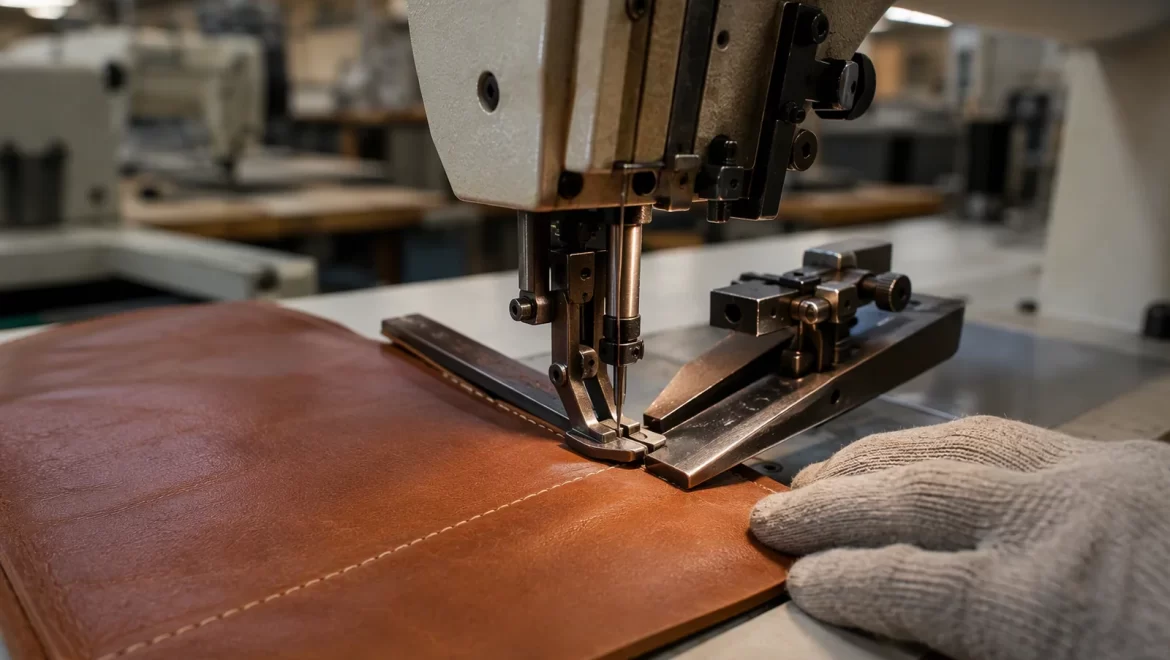
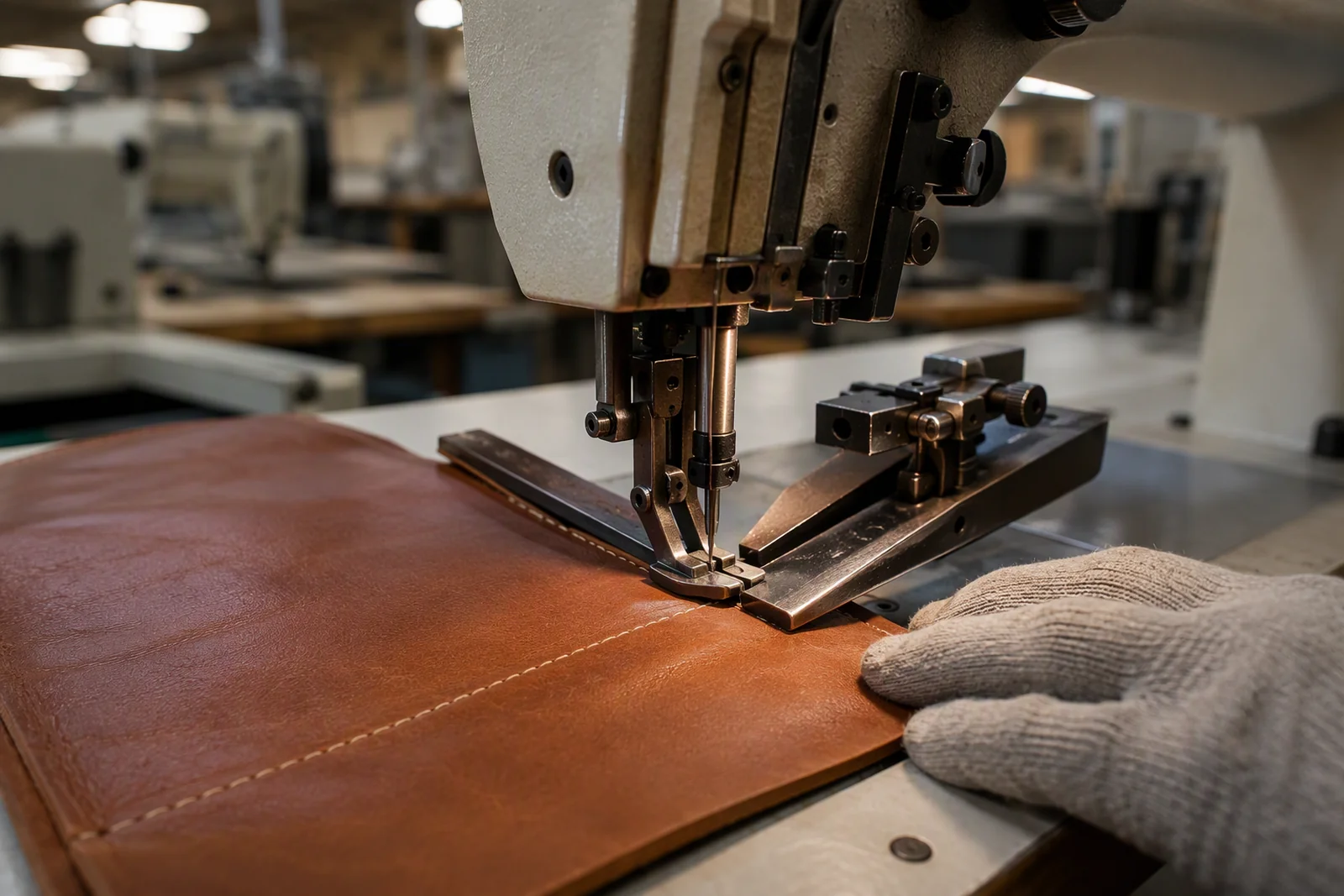
The difference between an acceptable and a good top stitch is often a folder, a guide or a specialised foot. Look for the tooling, not only the machine.
A factory that improvises guides for every new style has not standardised, which shows in consistency rather than in samples.
Maintenance and Spares
Ask how machines are maintained and whether critical spares are held.
A maintenance board with dated entries is more convincing than a policy, and a shelf of used needles, plates and feet for the critical machines shows what the factory actually expects to replace. A single needle plate can stop a line for a week if it has to be imported.
The Honest Limits
No factory has every machine, and outsourcing one operation is normal. The audit question is whether the outsourced operation is declared, controlled and costed, not whether it exists.
Cost visibility matters as much as quality here. A sub-process that appears in the quotation but not in the route hides both a lead time and a margin, and it surfaces as an unexplained delay rather than as a decision.
| Check | What it reveals |
|---|---|
| Critical machine count | Real capacity |
| Condition and age | Reliability |
| Tooling and guides | Consistency |
| Maintenance practice | Downtime risk |
The Sample Room as Evidence
The sample room is where a factory shows its best work, which makes it evidence about capability and not about production.
What a Strong Sample Room Shows
A strong sample room holds patterns, materials and a working library of past constructions. Ask to see the pattern files for a comparable product, and ask who maintains them.
Reading the Gap
Compare the sample room to the line: the same seam, the same edge, the same zip setting.
Do this at three points rather than one, because a single comparison can be explained away. Two or three matching comparisons tell you whether the gap is a habit or an exception, and that distinction decides how much weight the finding carries. A large gap means the sample was made by different hands under different pressure, and the bulk will show the line rather than the room.
The Pattern and Spec Handover
Ask how the specification reaches the line: a printed sheet, a digital file, a sample on the table. Factories that rely on the sample alone drift as the sample is handled.
Ask to see the sheet at the station and compare it with the current specification. Where the sheet is a photocopy of an earlier version, the change never reached the line, and the bulk will follow the sheet rather than the agreement.
| Sample room | Line | Meaning |
|---|---|---|
| Clean, exact | Similar | Genuine capability |
| Clean, exact | Rougher | Sample-only capability |
| Weak | Similar | Honest, limited range |
Line Capacity and Real Output
Capacity claims are usually arithmetic: machines multiplied by hours. The number that matters is what the line actually completes in a normal week.
Ask for last month's output on a comparable style, then check whether it matches the arithmetic. A factory that cannot produce a recent figure is either not measuring or not willing to share, and both answers are useful.
Counting the Line, Not the Factory
Count the people on the line that would make your product, and the stations in the sequence. A factory with two hundred workers may have twelve on the line your order needs.
Cycle Time at the Bottleneck
Ask for the cycle time of the slowest operation in the route, because that is what sets output.
Then check the figure against the bundle size and the number of stations feeding it. A quoted cycle time that produces more bags per hour than the line can physically move is a calculation, not an observation. A line that can cut quickly but sets zips slowly produces at the zip station's pace.
Learning Curve and Ramp-Up
A new style runs slower for the first weeks. Ask how the factory plans the ramp: extra hours, a pilot batch, a separate cell. Factories that answer vaguely are planning to absorb it with overtime.
A credible answer names the pilot quantity, the people who will run it, the point at which the output is reviewed and what happens if the review fails. Overtime is a legitimate tool, but it is a plan, not an answer.
Seasonality and Shared Orders
Ask what else is running in the same period and which customers take priority.
Priority is usually decided by relationship and by payment terms, not by promise. Knowing where a new order sits in that order of precedence is more useful than knowing the factory's total capacity. A factory that is quiet in your audit month may be full in your production month.
Ask when the order would be booked and what the line looks like in that window, rather than what it looks like today. Seasonal peaks are predictable, and a supplier who names them is easier to plan with.
| Capacity measure | Why it matters |
|---|---|
| Line headcount | Real labour available |
| Bottleneck cycle | True output |
| Ramp-up plan | Delivery risk |
| Concurrent orders | Priority risk |
Sub-Supplier Reliance
Almost every factory outsources something, and the audit question is not whether it happens but whether it is visible and controlled.
Which Operations Are Commonly Outsourced
Edge finishing, printing, hardware plating, embroidery and sometimes cutting are the usual candidates. Each carries its own lead time and its own quality signature.
Ask for the list, then ask what happens when the sub-supplier misses.
Lead time for outsourced work should include the buffer, and the buffer should be visible in the quotation rather than discovered in the delay. A sub-process quoted at the same lead time as an in-house one is a risk waiting for its first busy month. A factory that has never had a problem has either a very good sub-supplier or no record of one.
How to Detect Undeclared Work
Undeclared work shows in mismatched quality between areas, in goods arriving and leaving without matching paperwork, and in operations missing from the route while present in the product.
Walking the route in order, rather than jumping to the areas of interest, exposes the gap: a panel that appears finished without passing a station had to be finished elsewhere.
Control Over the Sub-Supplier
Where work is outsourced, the factory should hold the specification, inspect on return and own the relationship. A factory that cannot describe its sub-supplier's process is not controlling that process.
Second-tier risk is the part of the chain that appears only when something goes wrong: a plating bath changed, a print screen remade, an edge paint substituted. Ask when the sub-supplier was last visited, and by whom.
| Outsourced work | What to verify |
|---|---|
| Edge finishing | Inspection on return |
| Printing | Colour control method |
| Plating | Batch traceability |
| Cutting | Tolerance and nesting |
Quality Systems in Practice
Quality systems are the easiest thing to document and the hardest to verify, because the paperwork exists whether or not the practice does.
Inline Checks That Exist
Ask to see the inline check being performed, not the form that records it. If a check is real, the person doing it can explain what they are looking for and what they do when they find it.
A form with every box ticked and no rejects recorded is evidence of a form, not of a check.
A working check produces rejects, and the rejects are visible somewhere: a bin, a tagged trolley, a rework bench. If the check produces nothing, either the process is unusually capable or the check is not being performed as written.
Records That Match Reality
Compare the reject rate in the records with the reject pile or the rework bench. Factories that report near-zero defects while maintaining a rework area are recording what is expected rather than what happened.
Corrective Action in Use
Ask for the last internal corrective action and how it was closed.
Look for the change that followed: a new guide, a modified check, a different supplier. A corrective action that ends with a signature and no change in method is a record of intent rather than of correction. A factory that produces one quickly, with a cause and a change, has a working loop; one that produces a template has a document.
Inspection Authority
Ask who can stop a line, and whether they have done so.
Then ask what happens to the operator whose work caused the stop. Where the answer is blame, stops become rare and defects travel to the end of the line; where the answer is a fix, the information arrives early enough to be useful. Authority that has never been exercised is nominal, and the person holding it usually knows.
Ask for the last time a line was stopped and what happened afterwards. The answer shows whether stopping is acceptable behaviour or a career risk, which decides whether the authority is real.
| System element | Evidence to look for |
|---|---|
| Inline checks | Observer at the station |
| Records | Match with physical rejects |
| Corrective action | A recent real case |
| Stop authority | Named person, used before |
Materials Traceability
Traceability decides whether a quality problem can be contained, and it is usually weaker than the factory believes.
From Delivery to Cut
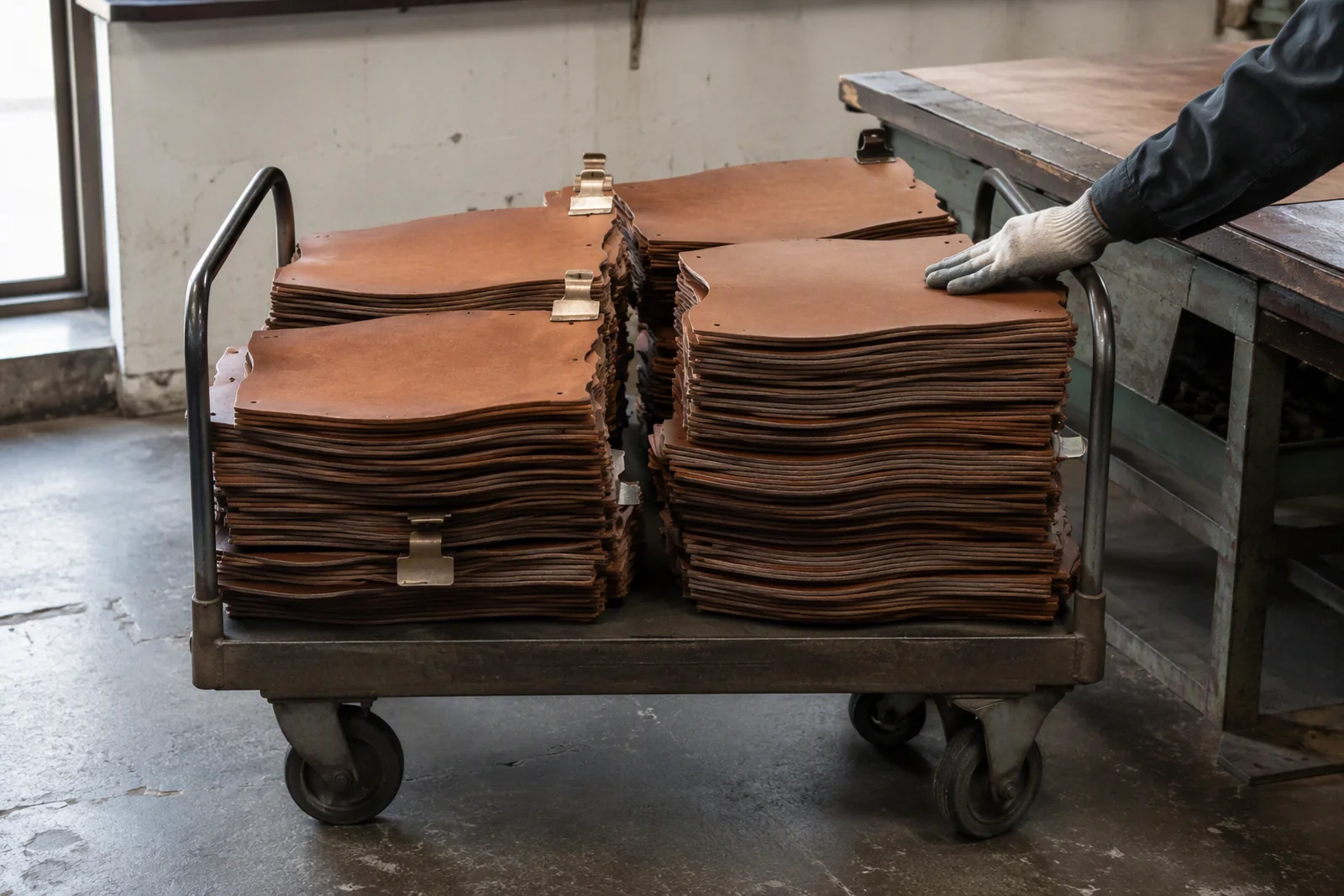
Ask to follow one delivery of leather from the goods-in area to the cutting table: how it is labelled, how it is stored, how the shade is matched, and how the remainder is returned.
Where the path cannot be followed, ask for the batch number on the cut panel and trace it backwards. A factory that can produce the number but not the record has labelling without traceability.
A factory that cannot show this path cannot isolate a faulty batch, and every complaint becomes a whole-order discussion.
Storage and Condition
Leather stored against a wall, in damp air or in direct sun arrives at the table already changed. Look at the storage as material evidence rather than as housekeeping.
Heat, humidity and direct light change leather before it is cut. A storage area that is dry, shaded and off the floor protects the material; one that is not will produce variation that appears later as a shading complaint.
Batch Separation
Ask how two shades of the same article are kept apart on the floor.
Trolley tags, marked shelf positions and a cutting plan that groups by shade are the practical controls. Where separation depends on the memory of one person, it holds until that person is on leave. Mixing is common and shows up as a bag with a mismatched panel rather than as a documented defect.
Shade cards kept at the cutting table, with a physical reference rather than a screen, are the practical control. Where the reference is a photograph on a phone, the judgement changes with the screen and the light.
| Traceability step | Evidence |
|---|---|
| Goods-in | Batch label and date |
| Storage | Condition and separation |
| Cutting | Shade matching record |
| Remainder | Return to stock |
Workforce and Skills
The people on the line determine whether the sample can be repeated, and skilled hands are the hardest asset to count.
Who Makes the Sample
Ask which operators made the sample and whether those same people will work on the bulk. When the sample comes from a technical team and the bulk from a production line, the gap is structural.
Skill Distribution
Ask how many operators can perform the critical operations, not only how many are on the line. A single person able to set a zip neatly is a bottleneck and a risk.
Training and Turnover
Ask how new operators are trained and how long they stay.
A simple question about the average tenure on the line is often more revealing than a training manual. Long tenure with light training usually produces consistency; short tenure with heavy training rarely does. High turnover combined with short training produces variation that no inspection can remove.
Ask how a new operator's first week is supervised and who signs off their work before it enters the line. Training that ends with a demonstration rather than a checked output leaves the variation in the product.
Supervision Ratio
Look at how many stations one supervisor covers. A ratio that spreads a supervisor too thin means the checks happen at the end rather than in the line.
| Question | What it predicts |
|---|---|
| Sample maker | Repeatability of the sample |
| Skill depth | Bottleneck risk |
| Training and turnover | Consistency drift |
| Supervision ratio | Where defects are caught |

Verifying Claims With Evidence
Every claim in the audit should be traceable to something seen, counted or tested during the visit.
Claims That Need Documents
Certificates, test reports and customer references are documents, and documents should be current and specific to the product. A certificate covering a different material proves nothing about yours.
Check the scope: the material, the process and the date. A report issued for a different thickness or a different finish describes a product that is not the one being bought, however current it is.
Claims That Need Observation
Capacity, skill and process control need observation. Asking a manager how many bags the line makes produces an estimate; watching the bottleneck for an hour produces a number.
Claims That Need a Sample
Handling behaviour, stitch quality and edge finish need a sample in hand. Where the sample is unavailable, the claim stays open rather than assumed.
Recording the Source
For each finding, note whether it was observed, documented, sampled or stated. The distinction changes how much weight the finding can carry in the decision.
| Claim | Best evidence |
|---|---|
| Certification | Current report, same material |
| Capacity | Timed observation |
| Skill | Sample plus operator |
| Quality level | Records matched to rejects |
The Walk-Through Sequence
The order of the walk matters, because following the route exposes gaps that jumping between departments conceals.
Follow the Product
Start at goods-in and follow one order through the route in sequence. Where the product jumps without a station, something happened elsewhere.
Stop at the Critical Operations
At each critical operation, stop and watch for several minutes. Ask the operator what they check and what they reject, which is a different question from what the manager reports.
End at Packing
Finish at packing and inspection, then walk back through the same route quickly. The second pass shows what changed when attention moved on.
Walking back quickly is the cheapest test of whether the first pass was representative: stations that were busy and orderly on the way in are sometimes idle and untidy ten minutes later, once the escort has moved on.
| Leg | What to look for |
|---|---|
| Goods-in | Batch labelling and condition |
| Cutting | Shade matching and tolerance |
| Assembly | Tooling and consistency |
| Packing | Final check and records |
Scoring and Decision Rules
A score is useful only if it changes a decision, and most audits would be better with three thresholds than with a percentage.
Must-Pass Items
Some findings are disqualifying: a missing critical machine, no traceability, or a sub-supplier the factory cannot describe. Those should be listed as must-pass rather than averaged into a score.
Weighting the Rest
Where scoring is used, weight by consequence: a 5-point scale applied to a critical operation should outweigh a 5-point scale applied to floor appearance.
Decision Bands
Set the bands before the visit: proceed, proceed with conditions, or stop.
Setting the bands in advance prevents the common drift towards a middle score, where every supplier is acceptable and no condition is ever written. A must-pass failure should end the discussion regardless of how good the rest looked. Conditions should be specific and verifiable, such as a pilot batch or a second sample from the production line.
Conditions Worth Writing
The most useful conditions address the gap found: a specified machine, a nominated sub-supplier, a training step, a traceability record. Vague conditions produce a second audit rather than a solution.
| Band | Typical finding |
|---|---|
| Proceed | Must-pass clear, gaps minor |
| Conditional | Gaps fixable before or during pilot |
| Stop | Must-pass failed |
Common Audit Traps
The traps are predictable, and each one has a counter-move that costs little.
The Guided Tour
A route chosen by the host shows the best areas in the best order. Counter it by naming the areas you want to see and following the product rather than the plan.
The Sample Room Impression
A polished sample room answers a question you did not ask. Counter it by comparing the same operation on the line, in the same visit.
The Paperwork Substitute
Documents are convenient evidence and easy to over-weight. Counter it by asking for the physical reject that corresponds to the record.
The Single Contact
An audit conducted with one manager reflects that manager's understanding. Counter it by speaking to an operator and an inspector without the manager translating.
| Trap | Counter |
|---|---|
| Guided tour | Follow the product |
| Sample room | Compare with the line |
| Paperwork | Match records to rejects |
| Single contact | Talk to operators |
Reporting What Was Found
An audit report is read by people who were not there, so it has to separate what was seen from what was said.
Structure That Works
One page of findings, one page of evidence, one page of decision and conditions. Anyone who reads only the first page should still know whether to proceed.
Language That Survives Review
Describe the observation rather than the impression: "two of four zip stations had no guide fitted" rather than "tooling is weak". Observations can be checked later; impressions cannot.
Attaching the Evidence
Photographs, counts and sample references belong with the finding they support. A photograph without a caption is a mood, not evidence.
| Section | Content |
|---|---|
| Findings | Numbered, observed facts |
| Evidence | Photos, counts, samples |
| Decision | Proceed, conditional, stop |
| Conditions | Specific and verifiable |
Auditing Again After the First Order
The second audit is more useful than the first, because it can be compared against a real delivery.
What Changes After Production
Capacity estimates can be replaced with actual output, and quality claims with the defects that appeared. The second visit tests predictions rather than statements.
Watching the Same Stations
Return to the operations that mattered, and compare the tooling, the operators and the checks against the first visit. Consistency between visits is itself evidence.
When to Stop Auditing
Once two orders have run without a capability surprise, the audit can move to a lighter annual form. Continuing a full audit every order adds cost without adding information.
FAQ
What is a supplier capability audit?
A: A structured visit that tests whether a factory can make your product, at your volume, to your standard. It produces evidence for three decisions: process match, capacity and control.
What should be verified first?
A: The operations your product requires. List the route, then check that each critical operation has the machine, the tooling and the skill on the line that would run your order.
How long should an audit take?
A: A focused audit of one product family takes half a day to a day on site, plus preparation. Longer visits add depth in proportion to how much of the route you can follow.
Should the audit be announced?
A: Yes, because you need access to records and people. Announcing the scope rather than the route keeps some of the benefit of surprise while making the visit workable.
How do you check capacity claims?
A: Time the bottleneck operation and count the people on the line assigned to your product. Capacity is the bottleneck's output, not the factory's total machine count.
What if the factory outsources an operation?
A: Outsourcing is normal. Verify that it is declared, that the factory holds the specification, inspects on return and can describe the sub-supplier's process.
How do you spot undeclared outsourcing?
A: Follow the product in route order. A panel that appears finished without passing a station was finished somewhere else, and the paperwork usually stops matching at that point.
What quality records should be checked?
A: Inline checks, reject rates and the last internal corrective action. Compare the records with the physical rework bench; a near-zero reject rate beside a busy rework area is a recording problem.
How do you verify skill?
A: Ask who made the sample and who will make the bulk, and how many operators can perform the critical operations. A single skilled operator on a critical step is a bottleneck.
What is a must-pass item?
A: A finding that disqualifies the supplier regardless of the rest: a missing critical machine, no traceability, or a sub-supplier the factory cannot describe.
Can an audit replace a trial order?
A: No. An audit shortens the list and prices risk; a trial order confirms that the factory can repeat what it showed.
How should findings be written?
A: As observations rather than impressions, with counts, photographs and samples attached. "Two of four stations had no guide fitted" can be checked later; "tooling is weak" cannot.
What conditions are worth attaching?
A: Conditions that address the specific gap: a nominated machine, a declared sub-supplier, a pilot batch, a traceability record, a training step. Vague conditions produce a second audit.
How often should a supplier be re-audited?
A: After the first order, to compare predictions with results, then annually once two orders have run without a capability surprise.
Does a certificate prove capability?
A: No. A certificate shows that a system was described at a point in time. It does not show that the line can make your product, and it may cover a different material.
What is the most common audit mistake?
A: Accepting the host's route. Following the product through the route, including the areas that were not offered, is what exposes the gaps.
Ready to audit capability instead of collecting impressions? List the operations your product needs, follow the route in order, count the bottleneck, compare the sample room with the line, and ask for the physical reject behind every record. Then write the gaps as conditions, not as concerns, and confirm them on a trial order before the volume arrives.