Colour and Shade Verification in Bulk Inspection
- Why Shade Verification Fails in Practice
- Setting and Keeping the Master Standard
- Viewing Conditions
- Metamerism and Why Matches Fail Later
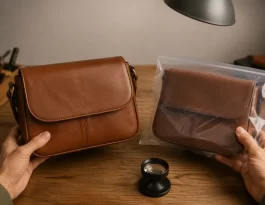
- Assessing a Bag and a Batch
- Panel-to-Panel Shading in Production
- Shade Across the Batch
- Cross-Material Comparison
- Setting Tolerances and Writing Them Down
- Sampling for Shade Checks
- Handling Borderline Shades
- Recording Findings and Trending
- FAQ
Shade is the quality characteristic that produces the most arguments and the fewest facts. Two people can look at the same bag, disagree about the colour, and both be describing what they see.
The reason is that shade judgement depends on conditions rather than on eyesight. The same panel looks different under a workshop lamp, in daylight and under a shop's lighting, and a person comparing colours from memory is comparing an impression rather than a measurement.
Bulk shade verification is therefore less about colour vision than about method: a sealed standard, controlled viewing conditions, a stated band of acceptable variation, and a way of recording what was seen.
This guide covers why shade disputes happen, how to set and store a master standard, how to control viewing conditions, what metamerism does to a match, how to assess panel-to-panel and batch-wide shading, how cross-material comparison works, how to set tolerances and run sampling, how to handle borderline shades, and how to keep records that reduce the argument next time.
Why Shade Verification Fails in Practice
Shade inspections usually fail for reasons that have nothing to do with the leather. They fail because the conditions were not controlled and the standard was not present.
The Conditions Problem
Workshop lighting is chosen for visibility, not for colour work. Fluorescent and mixed lighting shift how a warm brown reads, and a mark that is obvious under the bench lamp may disappear in daylight.
Where both parties judge under different lights, the disagreement is about the lighting rather than about the goods.
The Standard Problem
Comparing against memory is the most common failure. Without the sealed standard on the table, the reference in the inspector's mind is influenced by the last bag inspected and by the surrounding colour.
Standards that have faded, been handled for months or been replaced informally make the comparison unreliable in a way that is hard to detect.
The Cost of Getting It Wrong
A shade dispute usually appears after the goods have shipped, when the customer opens the carton and compares the bag with the one received in an earlier delivery.
At that point, the options are a discount, a replacement batch or a return, and all three cost more than the panel-level sorting that would have prevented it.
| Failure | Mechanism | Consequence |
|---|---|---|
| Different lighting | Each party judges under local light | Dispute about the light, not the goods |
| Memory comparison | Reference impression drifts | Judgement varies within the day |
| Missing standard | No physical reference on site | Findings contested |
| Fatigue | Colour judgement degrades over hours | Later units judged more loosely |
| Mixed surroundings | Background colour influences perception | Neutral judgement lost |
| No written band | Every shade is arguable | Sorting decisions inconsistent |
Setting and Keeping the Master Standard
A shade standard is an object, and like any object it has a life. Managing that life is what keeps a colour programme stable.
Sealing and Labelling the Standard
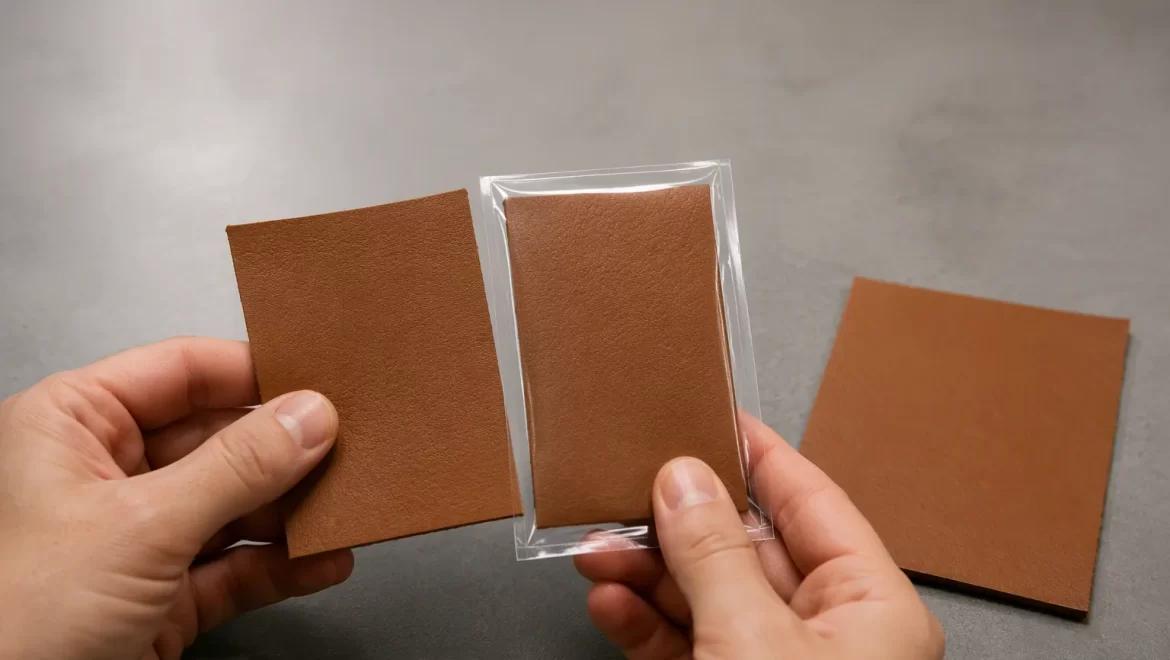
The approved standard should be physically sealed, labelled with the order or season, the colour name and the date, and signed by both parties. A loose swatch with no record of what it represents will be replaced informally within a season.
Where a colour runs across several seasons, the standard should be identified by a code that survives the season, so that the third order can be compared with the first.
Storage Conditions
Leather standards change with light, heat and handling. They should be stored in darkness, in a stable environment and away from the bench, and handled by the edge where possible.
Where a standard has been used for months, replacing it should be done by comparing the new candidate against the old one under controlled light, not by ordering a fresh batch and assuming it matches.
Copies and Distribution
Most programmes need at least three standards: one held by the buyer, one by the factory and one at the tannery. Where the tannery and the factory each hold their own and the two drift, the drift is invisible until the goods reach the buyer.
Each copy should carry the same code and date, and refreshment should be coordinated so that all three are replaced together.
| Standard practice | Purpose | Common failure |
|---|---|---|
| Sealed and signed | Fixes the reference | Loose swatch in a drawer |
| Dated and coded | Survives seasons | Colour named only |
| Stored in darkness | Slows change | Kept on a sunny bench |
| Handled by the edge | Limits contamination | Passed around by hand |
| Multiple copies | Buyer, factory, tannery | Only the factory holds one |
| Coordinated refresh | Keeps copies aligned | Replaced separately |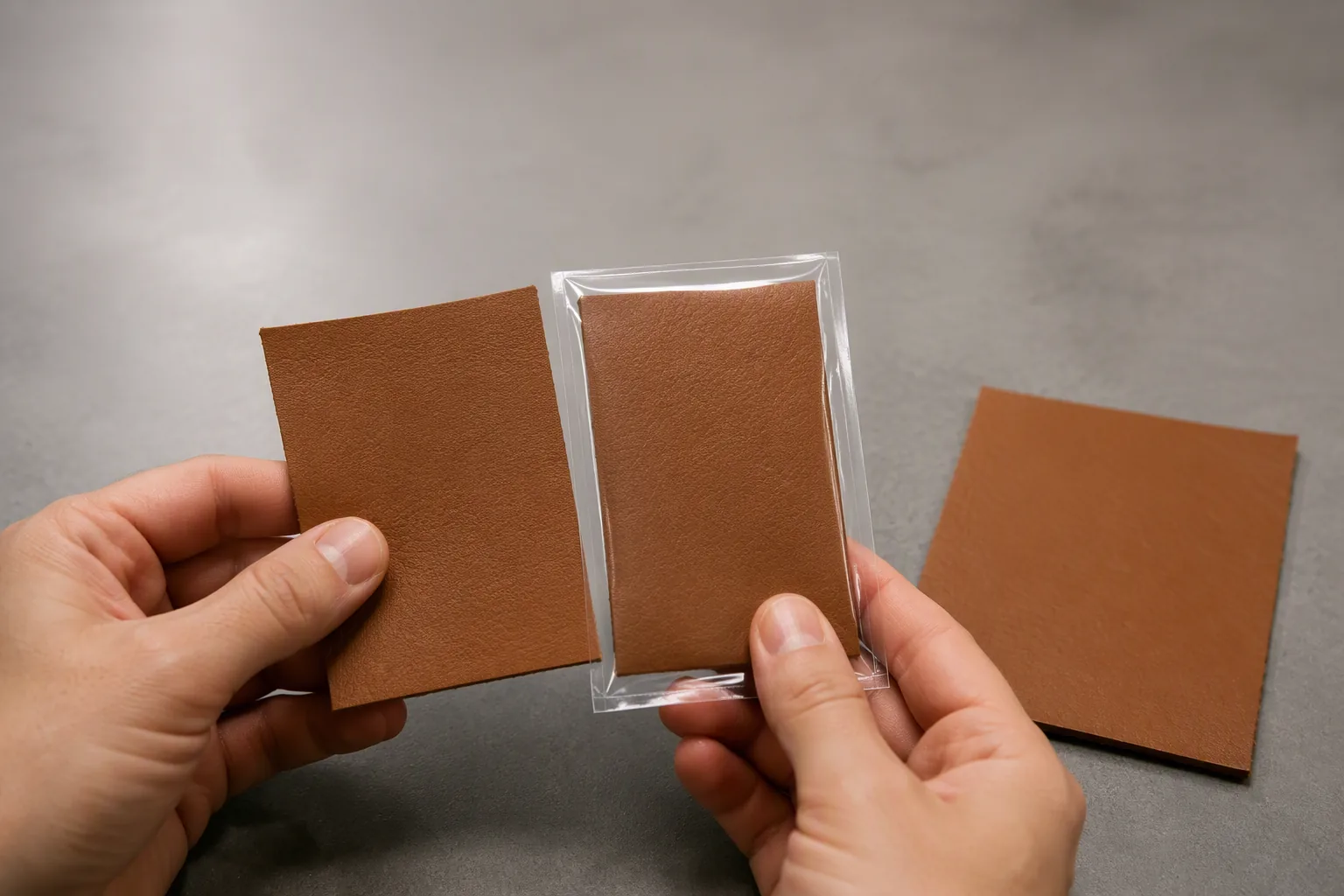
Viewing Conditions
Colour assessment is a physical comparison, and the physical conditions have to be controlled before the comparison means anything.
Light Source
The light used for assessment should be the same on both sides of the order, and it should be stated in the specification. Daylight-equivalent light with a neutral character is the usual choice, because it is the condition under which the customer will eventually see the product.
Where the market is known, the assessment light can also be chosen to approximate it. A product sold in stores with warm lighting should be assessed in that light as well as under neutral light, because a match under one light is not always a match under the other.
Surroundings and Background
Surrounding colour influences perception. Judging a brown panel against a bright wall, a red bench or a coloured cloth shifts how the brown reads, and the effect is larger than most people expect.
A neutral grey or white background should be used for assessment, with the standard and the sample placed side by side rather than in sequence. Side-by-side viewing is what allows a difference to be seen at all.
Angle and Distance
Colour should be judged from a consistent angle and distance. A common practice is to view the panel roughly at right angles to the light source rather than directly in the reflection.
Distance matters for another reason: at close range the eye resolves surface texture, and at a distance it blends. Panels should be judged at the distance from which the customer will see the product.
| Condition | Requirement | Effect if uncontrolled |
|---|---|---|
| Light source | Stated and matched | Disagreement about the light |
| Colour character | Neutral, daylight-equivalent | Warm or green cast shifts shade |
| Background | Neutral grey or white | Surroundings tint the judgement |
| Arrangement | Side by side, touching | Differences seen one at a time |
| Angle | Consistent, away from direct reflection | Gloss mistaken for a shade difference |
| Distance | Typical viewing distance | Texture judged instead of colour |
Metamerism and Why Matches Fail Later
Two materials can match under one light and differ under another. This is a property of colour, not a fault in either material.
What Causes It
Metamerism occurs when two surfaces produce the same colour impression using different spectral compositions. They match under the light in which they were compared and diverge under a light with a different distribution.
It is common between leather and textile, and between dyed leather and a pigmented coating, because the colour is produced by different mechanisms in each.
Where It Appears in Bags
The classic case is a set of components matched in the factory's inspection light and re-examined at retail under a different light: the lining, the thread, an edge-painted panel or a textile strap shows a shift the leather does not.
Metamerism is also why a colour approved from a digital file often disappoints. The screen's light and the store's light are rarely the same, and the substrate behaviour differs as well.
Managing It
The practical answer is to assess critical combinations under at least two light sources: the neutral one used for approval and the one closest to the retail environment.
Where a pair is metameric, the pairing itself may be the problem. Choosing a thread or lining closer in mechanism to the leather, rather than matching only under one light, produces a more stable result.
| Pairing | Tendency to shift | Approach |
|---|---|---|
| Leather to leather, same tannage | Low | Compare under the standard light |
| Leather to pigmented coating | Moderate | Check under two lights |
| Leather to textile | High | Check under retail-like light |
| Leather to thread | Moderate | Prefer similar colour chemistry |
| Leather to metal hardware | Not comparable | Judge as contrast, not match |
Assessing a Bag and a Batch
Assessment happens at two scales: within a single bag, where panels must work together, and across the batch, where units must be consistent with each other.
Bag to Standard
The primary check compares a unit against the sealed standard under controlled conditions. This establishes whether the batch sits within the agreed envelope.
The check should be applied to units from different cartons rather than to a single presentation piece, so that the sample reflects range rather than the best example.
Panel to Panel Within a Bag
The second check compares panels within one bag. A bag whose front panel and flap differ noticeably from each other is a defect even if both panels sit within the batch envelope, because the customer sees them together.
This is the check most often skipped and the one that produces the most complaints, since the difference is visible every time the product is used.
A Grading Scale That Everyone Uses
Shade grading works best with a small, defined scale rather than a description. A five-point scale, from an exact match to a clearly different shade, gives both parties something to record and compare.
The value of the scale is in the middle: the point at which a shade is still acceptable. Writing that point into the specification, with a photograph, converts a judgement into a rule.
| Assessment | Question asked | Applied to |
|---|---|---|
| Bag to standard | Does the unit sit within the envelope | Sample units across cartons |
| Panel to panel | Do panels within one bag work together | Front, flap, gusset, base |
| Within batch | Are units consistent with each other | Units across the batch |
| Cross-material | Do leather and other components agree | Lining, thread, edge paint |
| Over time | Has the batch drifted from the previous one | Against the last accepted lot |
Panel-to-Panel Shading in Production
Within-bag shading is usually a cutting decision rather than a dyeing problem, which is why it can be controlled without changing the material.
Cutting From One Lot
Panels that meet on the finished bag should be cut from the same hide or, at minimum, from the same dye lot. Mixing lots within one bag is the most common cause of a visible difference between the front and the flap.
Where a bag needs more panels than one hide can supply, the cutting plan should group panels by hide and keep within-hide continuity for the panels that touch.
Direction and Nap
Panels cut in different directions relative to the material's grain or nap reflect light differently even when the colour is identical. On suede and nubuck the effect is large; on smooth leather it is smaller but still visible.
Cutting all panels for one side of the bag in the same direction is a simple rule that removes a class of complaints without any change to the material specification.
Assembly and Light
Panels that matched on the bench can appear to differ once assembled, because the assembled bag presents the panels at different angles to the light. Handling that means assessing partly assembled units, not only flat panels.
This is also where a lighting problem in the workshop hides a shading problem. A bag assembled in dim light may look uniform on the line and uneven in daylight.
| Within-bag issue | Cause | Control |
|---|---|---|
| Front and flap differ | Panels from different hides | Cut to one hide or lot |
| One panel reads darker | Direction of cut relative to nap | Cut in one direction per side |
| Shade appears after assembly | Panels at different angles | Assess partly assembled |
| Difference hidden in the workshop | Poor lighting on the line | Check in daylight |
| Base darker than body | Base cut from the belly | Allocate panels by position |

Shade Across the Batch
Batch-level shade is a material property, and the practical question is how much variation is acceptable before sorting is required.
Dye Lot Variation
Leather is dyed in lots, and lots vary. The variation between two adjacent lots can be small enough to mix without complaint or large enough to require separation, and this is not predictable from the lot number alone.
Where a batch is drawn from two lots, the first action should be a comparison of panels from each under controlled light, before any cutting begins.
Sorting and Batching Plans
Where variation exceeds the accepted band, the goods can be sorted into shade groups and shipped as consistent groups within a single delivery. Sorting at the cutting stage is far cheaper than sorting finished bags.
Where mixing cannot be avoided, the mixed lots should be allocated to the panels that do not meet on the same unit, so that the customer never sees the two together.
Pre-Sorting at the Tannery
The most effective control sits upstream. Where the tannery can sort by shade before shipping and label those groups, the factory receives material it can use without a cutting-floor sorting step.
That arrangement has to be requested and paid for in the order, and it is far cheaper than sorting finished bags or replacing a shipment.
| Variation level | Practical response | Where action happens |
|---|---|---|
| Within the band | Proceed without sorting | None required |
| Slightly outside | Sort into groups, ship single groups together | Cutting floor |
| Clearly outside | Allocate to non-mating panels | Cutting plan |
| Large but usable | Sort and offer as graded lots | Cutting floor, with buyer |
| Unusable | Reject the lot, source again | Tannery and buyer |
Cross-Material Comparison
A bag is not one colour, it is several materials that must read as one. Each material behaves differently, and the limits of matching should be understood before the order is placed.
Which Components Can Match
Leather and lining can be matched closely where both are dyed rather than coated, and both are assessed under the same light. Thread can be matched to a close degree but rarely exactly, because it is a different substrate with a different sheen.
Edge paint sits between them: it can be matched to the leather closely in tone, and it will always read slightly differently because it is a smooth, glossier surface.
Which Components Should Contrast
Metal hardware cannot be matched to leather in any meaningful way, because it reflects rather than absorbs light. It should be chosen as a deliberate contrast, warm with warm and cool with cool.
Judging hardware against leather as though it were a shade match produces findings that no supplier can satisfy, because the physics do not allow it.
Documenting the Intent
The specification should state, for each component, whether it is intended to match or to contrast, and under which light the match was approved. Without that statement, an inspector has no basis for comparing a lining with a leather panel.
Where a component is intended to match, the approved pairing should be sealed together, so that the relationship is preserved and not only the individual colour.
| Component | Can it match leather | Basis of judgement |
|---|---|---|
| Lining, dyed | Closely | Compared under the same light |
| Lining, coated | Moderately | Check under two lights |
| Thread | Approximately | Accept a small difference |
| Edge paint | Closely in tone | Account for gloss difference |
| Textile panels | Rarely | Check under retail light |
| Metal hardware | Not applicable | Judge as contrast |
Setting Tolerances and Writing Them Down
A tolerance turns a colour into a specification. Without one, every shade is arguable, and the party with the stronger commercial position wins by default.
Expressing the Tolerance
Tolerances can be expressed in three ways: by a graded scale with defined anchors, by an instrument reading with a permitted difference, or by reference to a physical pair of limit swatches.
The graded scale is the most practical for hand-finished goods, because it can be applied at the bench by an inspector. Instrument readings are useful for records and for the tannery, but they measure a surface rather than an impression.
Where the Tolerance Applies
The tolerance should state where it applies: to the leather, to the lining, to the thread and to edge paint separately, because each has a different achievable precision.
It should also state whether the tolerance applies within a bag, across a batch, or both. A programme that tolerates variation across a batch but not within a bag is common and entirely reasonable, and it must be written down.
The Limit Swatches
Where a tolerance is expressed as a limit pair, the two swatches should be sealed with the standard and labelled as acceptable limits, not as targets. Inspectors compare the candidate against both, and anything beyond either limit is a finding.
Keeping the limits with the standard is what stops the limits being renegotiated each season.
| Tolerance expressed as | Best suited to | Limitation |
|---|---|---|
| Graded scale with anchors | Bench inspection | Requires training |
| Instrument reading | Records and tannery feedback | Measures surface, not impression |
| Limit swatch pair | Hand-finished goods | Requires sealed swatches |
| Written description only | Nothing | Not reproducible |
Training the Assessors
Shade judgement improves with practice and with feedback. Where assessors are shown examples at the limit and told which ones were accepted, their judgement converges on the written scale.
New assessors should be tested against a set of graded panels before they judge production, because untrained judgement is the most variable input in the whole check.
Sampling for Shade Checks
Shade cannot be checked once at the end. The decisions that create shade differences happen during cutting, so the checks have to happen there.
Cutting-Stage Checks
A comparison should be made each time a new hide or a new lot reaches the cutting table, before panels are cut for a unit. This is a ten-second check that prevents a finished bag being built from mismatched panels.
Where the factory runs several lots at once, the check should confirm that the tables are not running mixed material.
Final Inspection Sampling
At final inspection, shade is assessed on units drawn across cartons and across variants, under the controlled light, using the standard and the limit swatches. The result is recorded by grade rather than as a pass or fail.
Where a batch is graded, the report should state the distribution, because a batch that is mostly at the limit is a different commercial situation from a batch that is mostly at the centre.
Frequency and Responsibility
The check frequency should be stated: per lot at cutting, per carton at final, and per batch for the record. Responsibility should be named, because shade checks assigned to nobody are performed by nobody.
Where an order is delivered over several shipments, each shipment should be compared with the last accepted one, not only with the standard, so that drift is visible.
| Checkpoint | Frequency | Carried out by |
|---|---|---|
| Lot arrival at cutting | Each new hide or lot | Cutting supervisor |
| Through cutting | Each table change | Cutting supervisor |
| In-line at assembly | Each shift on partly assembled units | Line inspector |
| Final inspection | Units across cartons and variants | Inspector |
| Shipment to shipment | Each delivery | Inspector, against previous lot |
| Batch record | Per batch | Quality lead |
Handling Borderline Shades
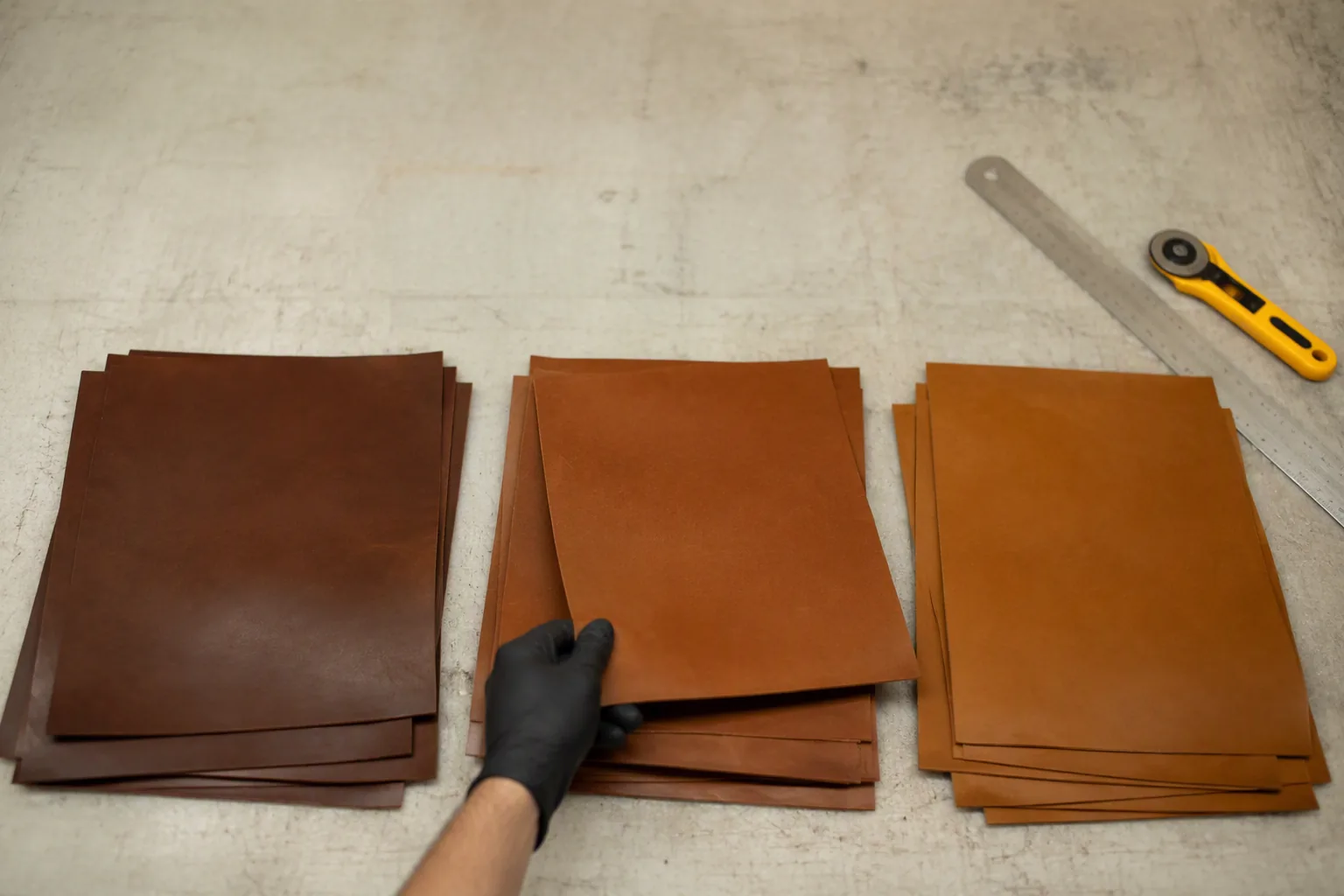
Most real decisions happen at the edge of the tolerance, where the material is neither clearly acceptable nor clearly rejectable.
Sorting Versus Rejecting
Sorting keeps usable material in the order. Where a lot is slightly outside the band, it can be graded and allocated so that the units within a delivery are consistent with each other, even if they differ slightly from the standard.
Rejection is the right answer when the variation is visible on the shelf or would be noticed against a previous delivery. Between those two positions sits most of the practical work.
Graded Lots and Disclosure
Where goods are shipped as graded lots, the buyer should know in advance. Shipping graded material without saying so converts a managed difference into a complaint when the customer compares two cartons.
Disclosure also changes the commercial terms. Graded material is usually offered at a different price, and the price should be agreed before the goods are packed rather than after.
Concession Pricing
Where a batch is accepted with a shade difference, the concession should be priced and recorded. A verbal acceptance leaves the commercial question open and tends to reappear at the next delivery.
A written concession with the grade distribution, the photographs and the agreed value protects both sides and sets the reference for the next batch.
| Situation | Best response | Risk if mishandled |
|---|---|---|
| Slightly outside the band | Sort into groups, ship single groups | Mixed cartons cause complaints |
| Outside on one component | Replace the affected panels | Whole units rejected at retail |
| Graded lots offered | Disclose and price in advance | Complaint on the second carton |
| Visible against previous delivery | Treat as a commercial complaint | Loss of trust in the programme |
| Acceptable but at the limit | Record the grade, note the trend | Drift continues unnoticed |
Comparing Shipment to Shipment
Each shipment should be compared with the last accepted one as well as with the standard. Standards are refreshed, but the customer compares the new bag with the one already owned.
Where the drift is small and consistent in one direction, it is worth recording, because a drift of half a step per season reaches a full step within two years.
Recording Findings and Trending
Shade findings are cheap to record and expensive to reconstruct. A photograph taken under the stated light is the difference between a fact and an opinion.
Photographing Shade
Photographs must be taken under the same controlled light, with the standard and the sample in the same frame, and with the camera at a fixed distance. A photograph taken under workshop lighting records the lighting, not the shade.
Where an assessment is borderline, the photograph should include both the standard and the limit swatch, so a reader can see where the unit sits between them.
Records That Survive Seasons
The record for each batch should carry the grade distribution, the standard code and date, the light used and the person who assessed it. That combination allows a batch to be compared with one received a year earlier.
Where a colour runs across seasons, the records become the only documentation of drift, particularly if the standard has been refreshed in the meantime.
Feeding Back to the Tannery
Shade findings are most useful to the tannery, which can adjust before the next lot is dyed. Feeding back the grade distribution per lot, rather than a single complaint, gives the tannery something actionable.
Where the same drift appears in three consecutive lots, the cause is usually in the process rather than in the raw material, and the conversation should move to the recipe.
| Record element | Purpose | Value over time |
|---|---|---|
| Grade distribution per batch | Describes the shipment | Shows drift across seasons |
| Standard code and date | Identifies the reference | Clarifies which standard applied |
| Light condition used | Repeatability | Prevents lighting disputes |
| Photograph with standard | Evidence | Settles disputes after shipment |
| Assessor name | Accountability | Allows training to be targeted |
| Lot-level feedback | Tannery adjustment | Reduces variation at source |
FAQ
Why do shade disputes happen so often in leather goods?
A: Because shade judgement depends on conditions rather than on eyesight. Different lighting, a standard that is not present and comparison from memory all produce disagreement between people looking at the same bag.
What light should be used to assess leather shade?
A: The same light on both sides of the order, stated in the specification, usually a neutral daylight-equivalent source, with a neutral grey or white background and the standard placed beside the sample.
Should shade be judged under retail lighting as well?
A: For critical pairings, yes. A match under one light is not always a match under another, so combinations that are prone to shifting should be checked under two sources.
What is metamerism?
A: Two surfaces that produce the same colour impression by different means match under one light and diverge under another. It is common between leather and textile and between dyed leather and a pigmented coating.
Can a lining be matched exactly to the leather?
A: A dyed lining can be matched closely, and a coated lining only moderately. Thread can be matched approximately, and textile panels rarely at all.
Should hardware be colour matched to the leather?
A: No. Metal reflects rather than absorbs light, so it cannot be matched in a meaningful sense. It should be chosen as a deliberate contrast, warm with warm and cool with cool.
Why do panels within one bag sometimes differ?
A: Usually because they were cut from different hides or lots, or cut in different directions relative to the nap. Keeping one bag to a single hide and one cutting direction removes most of it.
Can a shade difference appear only after assembly?
A: Yes. Assembled panels present at different angles to the light, so partly assembled units should be assessed rather than flat panels only.
How should a shade tolerance be written?
A: As a small graded scale with defined anchors and sealed limit swatches, applied separately to leather, lining, thread and edge paint, and stating whether it applies within a bag, across a batch, or both.
Are instrument readings useful for shade verification?
A: They are useful for records and tannery feedback, but they measure a surface rather than a colour impression, so they support the graded scale rather than replacing it.
When should shade be checked?
A: At the cutting table each time a new hide or lot arrives, in line on partly assembled units, and at final inspection across cartons and variants, with a comparison against the previous accepted shipment.
How many units are checked for shade?
A: Units drawn across cartons and across variants, rather than a single presentation piece, so that the sample reflects the range of the batch rather than its best example.
What is the difference between sorting and rejecting?
A: Sorting keeps usable material in the order by grading it and shipping consistent groups. Rejection is appropriate when the variation would be visible on the shelf or against a previous delivery.
Should graded lots be disclosed to the buyer?
A: Yes, in advance. Shipping graded material without saying so turns a managed difference into a complaint as soon as the customer compares two cartons.
How should shade findings be photographed?
A: Under the same controlled light, with the standard and the sample in one frame at a fixed distance, and with the limit swatch included for borderline assessments.
What should the batch record contain for shade?
A: The grade distribution, the standard code and date, the light used and the assessor. Together they allow a batch to be compared with one received a season earlier.
Ready to take the argument out of shade? Seal and date the standard before the order starts, state the light and the background used for judgement, assess partly assembled units as well as flat panels, hold panels for one bag to a single hide or lot, write the tolerance as a graded scale with limit swatches, and check shade at the cutting table rather than only at the end.