Skiving and Folding: Precision Steps Behind Clean Leather Edges
- What Skiving Is and Why It Matters
- The Skiving Bench: Tools and Machines
- Skiving Widths and Thicknesses: Reading the Specs
- Folding Techniques in Leather Bag Making
- Where Skiving and Folding Matter Most: Bag Applications
- Skiving and Folding versus Edge Painting Alone
- Common Skiving and Folding Defects
- How Factories Inspect Skived and Folded Parts
- Writing Skiving and Folding Specs in Your Tech Pack
- When Skiving Adds Cost and When It Saves It
- Choosing the Right Edge Strategy for Your Bag Line
- Skiving and Folding in Different Leather Types
- Skiving, Folding and Your Factory Relationship
- FAQ
Ask most bag buyers what separates a premium handbag from a mid-range one and they will point to the leather or the stitching. Ask the craftspeople who build those bags and they will point to the edges. An edge that is thin, smooth, perfectly folded and sealed is the quiet signature of a factory that cares about details nobody photographs but everyone feels.
Two steps make that possible. Skiving thins the leather from the flesh side so edges can bend, fold and stack without bulging. Folding then turns that thinned edge inward, creating a clean, finished boundary that resists wear far longer than a raw cut edge ever could.
This guide explains both processes from the factory floor: the tools, the numbers, the bag parts where they matter most, and the defects to catch before they reach your customers.
What Skiving Is and Why It Matters
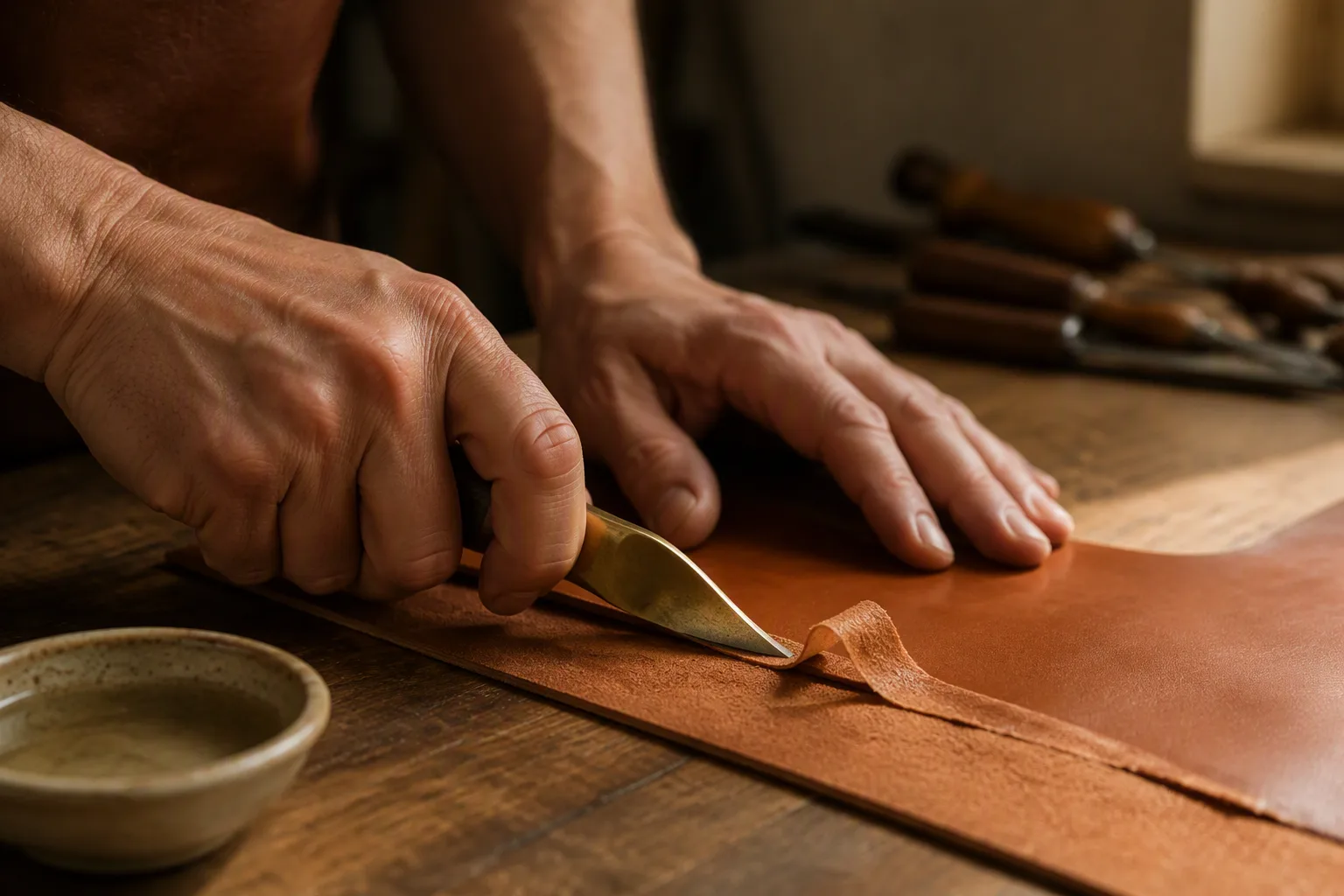
Skiving is the controlled removal of leather from the flesh side of a panel, usually along the edges but sometimes across the whole piece. The grain side, the visible face of the leather, is never touched.
The Problem Skiving Solves
A full-thickness leather panel is stiff and thick, typically 1.2 to 1.6 millimeters for bag leather. Fold that edge in half and you create a doubled section that is 2.4 to 3.2 millimeters thick, hard to stitch, bulky at corners and prone to an uneven, lumpy outline.
Skive the edge down to half its thickness first, and the fold becomes a graceful curve instead of a ridge. The seam sits flatter, the handle feels better in the hand, and the silhouette stays crisp where it should be crisp.
Where the Thinning Happens
The skilled skiver works in a band along the edge, usually 8 to 25 millimeters wide depending on the construction. The remaining leather at the very edge is typically 0.4 to 0.7 millimeters, thin enough to fold cleanly but thick enough to keep structural strength.
A less common technique is full-panel skiving, where an entire panel is taken down from 1.4 millimeters to 1.0 millimeter. This is used for soft, unstructured bags where the design calls for a lighter drape, and for leathers that must be laminated to other materials without adding bulk.
Why Buyers Should Care
Edge quality is one of the first things a customer notices, even unconsciously. Bulky, uneven edges read as cheap regardless of how expensive the hide was. Clean, folded edges read as considered and premium.
Skiving also affects durability. A fold that is properly thinned and glued distributes stress across a wider area instead of concentrating it at a sharp crease, which is why well-skived bags develop fewer cracks along openings and handles over years of use.
The Skiving Bench: Tools and Machines
Factories use several approaches to skive leather, from pure handwork to heavy machinery. Each has a place, and the method used tells you a lot about the factory's price point and quality ceiling.
| Method | Typical use | Edge control | Speed | Labor skill |
|---|---|---|---|---|
| Hand head knife | Corners, curved edges, fine adjustments | Excellent | Slow | Very high |
| Bell skiver machine | Straight and gently curved edges | Very good | Medium | High |
| Band knife splitting | Full panels, uniform thickness | Good | Fast | Medium |
| Laser / CNC skiving | Complex shapes, repeatable runs | Excellent | Fast | Low once programmed |
Hand Skiving with the Head Knife
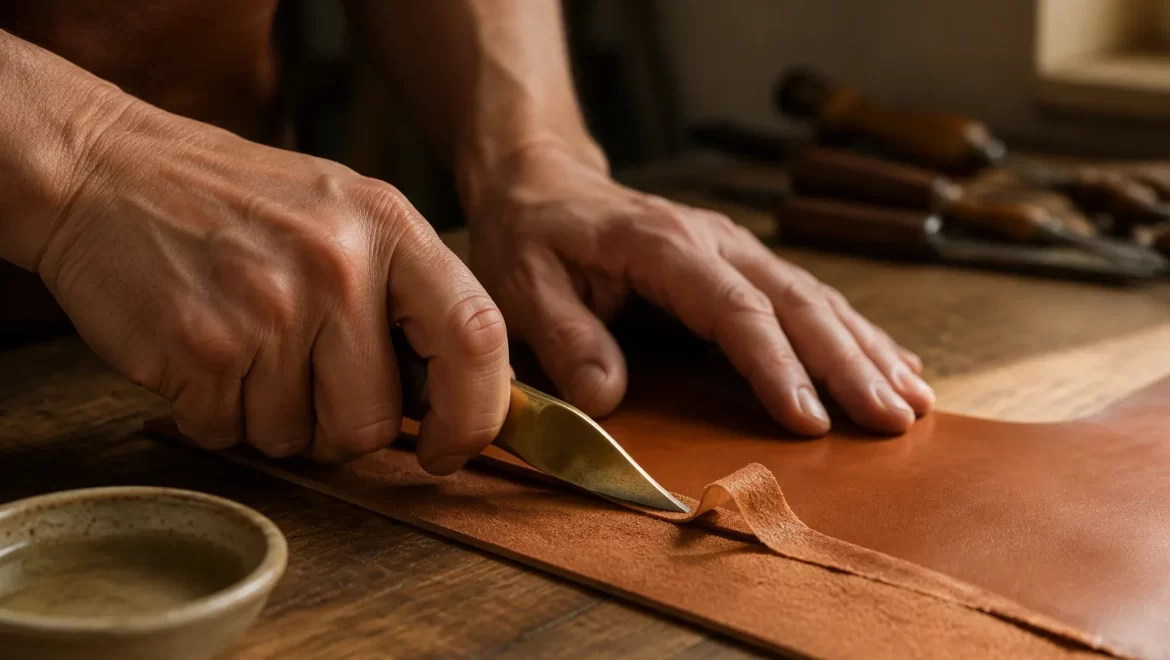
The head knife is a wide, curved blade sharpened on a stone. Skilled hands guide it along the leather in a smooth, sweeping motion, feathering the edge to the exact taper the pattern calls for.
Hand skiving excels at corners and curves where machines struggle. A handbag opening corner or a curved flap edge often gets a hand-finished taper even in otherwise machine-driven factories. This is where years of practice show in the finished product.
The Bell Skiver
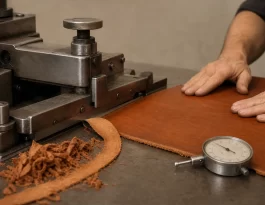
The bell skiver feeds leather between a circular blade and a shaped shoe that controls the depth and width of the cut. It is the workhorse of the sample room and the small production line.
Operators adjust the shoe to remove a set thickness, usually 0.5 to 0.8 millimeters, across a set width. The machine leaves a clean, even taper for straight runs and gentle curves, and it is far more consistent than handwork over a long edge.
Band Knife Splitting
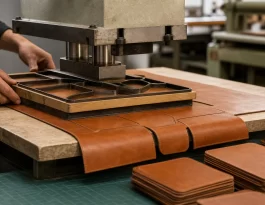
For full-panel thinning, factories use a band knife splitting machine. A continuous loop blade runs between rollers, and the leather passes through at a precisely controlled height.
This machine takes an entire panel down to a uniform thickness, which is essential when leather will be laminated to a backing or when a bag design demands thin, supple panels throughout. It is fast but cannot create a feathered taper along just one edge.
Laser and CNC Skiving
Modern factories increasingly use laser or CNC-controlled skiving for complex, repeatable parts. The machine follows a digital pattern, removing material with consistent depth across every piece in the run.
The advantages are repeatability and the ability to handle intricate shapes. The limitation is that lasering leather can harden the cut edge if settings are aggressive, so many factories still finish critical edges by hand.
Skiving Widths and Thicknesses: Reading the Specs
A skiving specification has three numbers: the starting thickness of the leather, the remaining thickness at the edge, and the width of the skived band. Understanding them lets you compare factory proposals on a like-for-like basis.
| Construction | Leather thickness | Remaining edge thickness | Skive width |
|---|---|---|---|
| Folded top edge of a tote | 1.4–1.6 mm | 0.5–0.6 mm | 10–14 mm |
| Turned edge on a flap | 1.2–1.4 mm | 0.4–0.6 mm | 8–12 mm |
| Handle wrap | 1.4–1.8 mm | 0.6–0.8 mm | 15–20 mm |
| Lapped seam reinforcement | 1.2–1.4 mm | 0.6–0.8 mm | 15–25 mm |
| Full-panel soft body | 1.4 mm | 0.9–1.1 mm | Whole panel |
Feathering, Not Stair-Stepping
Good skiving feathers the edge to zero or near-zero in a smooth taper. Poor skiving leaves a visible step where the thin band meets the full thickness, which can telegraph through the surface after folding and pressing.
When you examine a sample, run your thumb across the folded edge from the body toward the fold line. A smooth, gradual transition indicates skilled work; a hard ridge or visible line suggests shortcuts.
Matching Skive to Leather
Soft, stretchy leathers such as lambskin skive easily but need a wider skive band to avoid tearing at the fold. Firm, dense leathers such as vegetable-tanned cowhide hold a crisp fold with a narrower band but resist aggressive thinning.
Chrome-tanned leathers generally skive more cleanly than stiff vegetable-tanned leathers, which is one reason high-volume bag production favors chrome or combination tannage for folded-edge styles.
Folding Techniques in Leather Bag Making
Once the edge is skived, the fold itself becomes the next act of precision. Folding turns the raw edge inward, where it is hidden and protected, and creates the finished boundary customers see.
The Basic Fold
The skived edge is coated with a thin layer of adhesive, folded over to the desired width, and pressed or hammered flat. A properly executed fold is sharp along its outer line and completely smooth on the visible face.
Fold width depends on the part. A tote opening may fold 8 to 12 millimeters, while a handle wrap folds wider to enclose the strap core. The folded edge is often stitched through, adding a decorative line that also locks the fold in place.
Corners and Curves
Corners are where folding gets difficult. A square corner requires the excess leather at the fold to be notched or mitered so the layers do not bunch. A curved edge needs the leather eased around the arc, which is why curved flaps are among the hardest parts to make well.
Skilled workers cut relief notches at precise angles, fold the main edges, then fold and glue the notched sections. Done poorly, corners show lumps or gaps; done well, they are indistinguishable from a single molded piece.
Folding and Edge Painting Together
Many premium bags combine folding with edge painting. The folded edge is first pressed, then sanded lightly to even the surface, then sealed with multiple coats of edge paint that are sanded between applications.
The result is an edge that is thin, flexible and color-sealed, able to flex with the leather without cracking. This combination is the industry standard for structured bags and handles that take daily stress.
Where Skiving and Folding Matter Most: Bag Applications
Not every part of a bag needs skiving and folding, but the parts that do are exactly the ones your customers handle and stress every day.
| Bag part | Why it needs skiving | Typical treatment |
|---|---|---|
| Top opening / rim | Fold must be thin and uniform | Skive + fold + stitch |
| Flaps and closures | Sharp, clean folding line | Skive + fold + edge paint |
| Handles and straps | Comfort and flex under load | Skive + fold around core |
| Interior pockets | Flat seams, no bulk | Skive + fold or bind |
| Gussets and bellows | Repeated flexing | Skive at fold points |
| Structural frames | Clean attachment lines | Skive + bond |
Handles and Straps
A handle made from full-thickness leather folded around a core would be stiff, bulky and uncomfortable. Skiving the edges before folding lets the handle wrap tightly and sit flat against the bag body.
Handles also flex constantly, so the skive-to-fold ratio must leave enough fiber strength to avoid tears at the fold line. This is one area where an experienced factory earns its reputation.
Flaps and Openings
Flaps close repeatedly and their edges are always in view. A clean skive-and-fold produces a flat flap with a crisp edge line that aligns perfectly with the bag body when closed.
The top opening of a tote or handbag receives similar treatment, because it is the most visible edge on the entire product and the one customers touch first.
Pockets and Gussets
Interior pockets with folded edges lie flat against the lining and do not create bulky ridges that steal space. Gussets and bellows, which flex thousands of times over a bag's life, benefit from skiving at the fold points so the leather bends rather than creases.
Each of these applications adds a few minutes of skilled labor per bag, which is part of why well-constructed bags cost what they cost.
Skiving and Folding versus Edge Painting Alone
A factory can finish a raw cut edge with paint alone, and many budget lines do exactly that. Understanding the difference helps you judge whether a quoted price is realistic for the quality you expect.
What Edge Paint Alone Can and Cannot Do
Edge paint on a raw cut edge seals the exposed fibers and looks neat when new. The problem is structural: the edge remains full thickness, stiff and prone to chipping where it flexes.
Over months of use, especially on handles and openings, painted raw edges crack along the flex line. The paint separates from the leather, and there is no folded structure underneath to hold the edge together.
Why the Folded Version Wins
A folded edge has no exposed cut fibers at all. The leather's own surface forms the boundary, and edge paint becomes a seal rather than a structural element.
When a painted folded edge finally wears, the fold and its stitching continue to hold the construction together. This is why well-made bags keep their edges looking clean for years while cheaper counterparts develop those telltale white cracks along every opening.
The Cost Difference
Skiving plus folding adds roughly 5 to 15 minutes of labor per bag depending on the number of folded edges, plus material for adhesive and edge paint. At typical factory labor rates, that is a real but bounded cost.
For a mid-market brand selling at retail, that investment is recovered many times over in reduced returns, fewer quality complaints and a perceptibly more premium product.
Common Skiving and Folding Defects
Even experienced workshops produce defects, which is why inspection matters. Knowing what can go wrong lets you check samples and production intelligently.
| Defect | Root cause | How factories prevent it |
|---|---|---|
| Skived through / hole | Too-deep cut, weak hide spot | Blade calibration, leather inspection |
| Uneven taper | Machine shoe wear, hand fatigue | Tool maintenance, skill checks |
| Folded edge wrinkles | Adhesive too wet, leather stretched | Correct glue, even pressure |
| Miter gap at corners | Poor relief cutting | Corner templates, trained workers |
| Fold line cracks | Over-thinned edge, dry leather | Thickness specs, conditioning |
| Edge paint peeling | Paint on raw fiber, no fold | Fold-first construction, flexible paint |
Skiving Too Deep
An over-aggressive skive removes so much fiber that the edge becomes weak, prone to tearing at the fold or stretching out of shape during sewing. The defect often appears only after the bag is assembled and stressed.
Factories control this with blade setup, regular thickness checks and by matching the skive specification to the leather's natural density. A good factory also refuses to skive a hide that is too thin in the first place.
Wrinkled or Misshapen Folds
Folds wrinkle when the adhesive is applied unevenly or when the leather is stretched while being folded. Soft leathers are especially prone because they stretch before they fold.
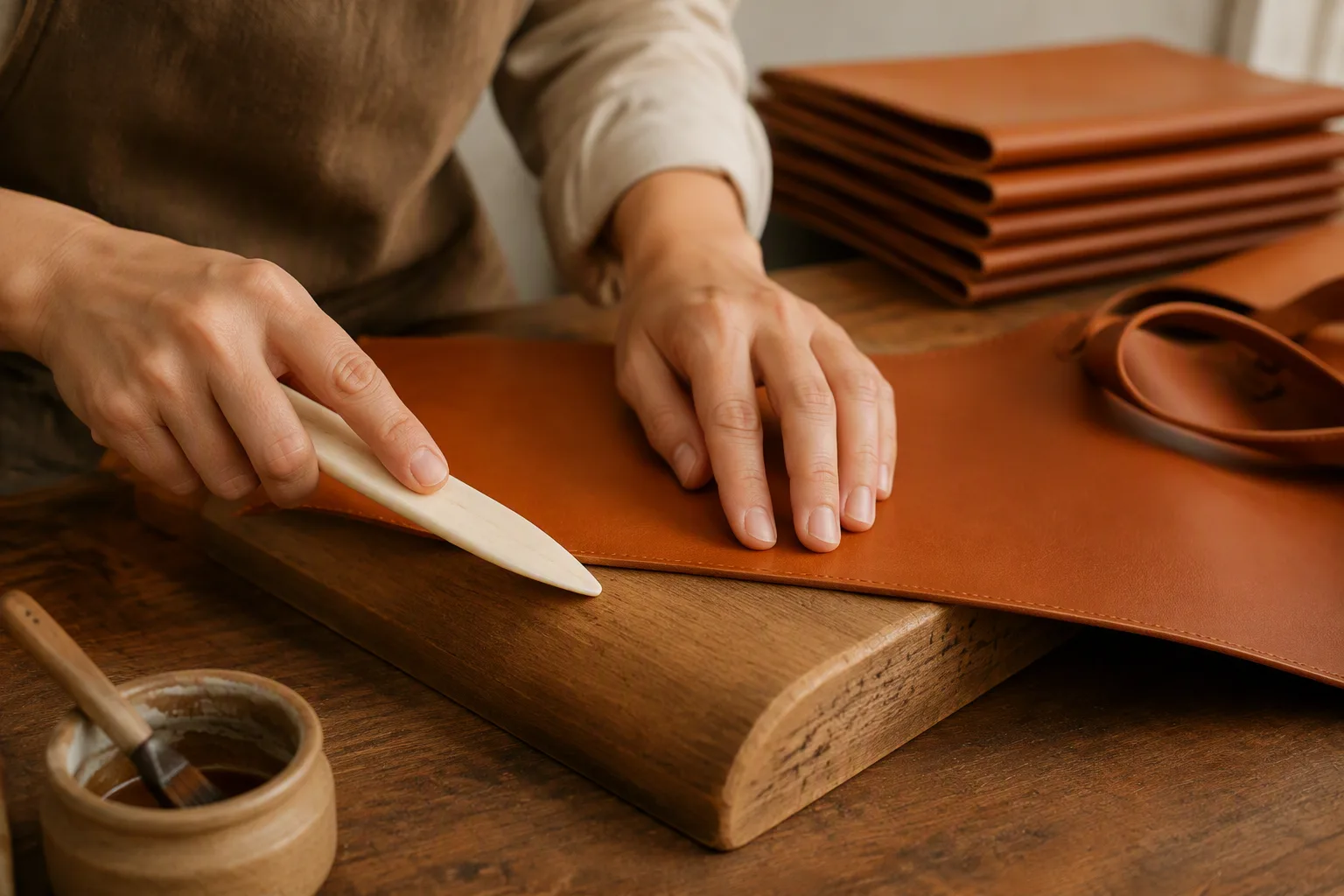
Prevention is a matter of technique: correct adhesive viscosity, even brush application, and letting the glue flash off before folding. Pressing with a bone folder or hammer then sets the fold permanently.
Cracks Along the Fold Line
Cracks appear when the skived edge is too thin for the leather's fiber structure, or when the leather was too dry during folding. They often surface weeks after production as the bag flexes in use.
The fix starts in material selection and conditioning. Leather that will be folded should be conditioned to the right moisture level, and the remaining edge thickness must respect the tannage's limits.
How Factories Inspect Skived and Folded Parts
Quality control for skiving and folding happens at three moments: before assembly, during assembly and on the finished bag. Each catches a different class of defect.
Checking the Skived Blank
Before any folding begins, the skived panel is checked for consistency. The inspector runs a finger along the taper, looks for steps or tears, and measures the remaining thickness with a gauge at several points along the edge.
Thickness readings that swing by more than roughly 0.1 to 0.15 millimeters across a straight edge trigger a machine adjustment. Panels that were skived through, meaning the blade broke through to the grain side, are rejected and re-cut.
Checking the Fold During Assembly
The folding station inspects every piece as it is pressed: the fold line must be straight, the corners must close without gaps, and the adhesive must not bleed beyond the fold onto the visible face.
Workers also test the fold by flexing it gently. A fold that creaks, separates or shows fiber lifting is returned before it can be built into a bag, where it would be far more expensive to correct.
Checking the Finished Edge
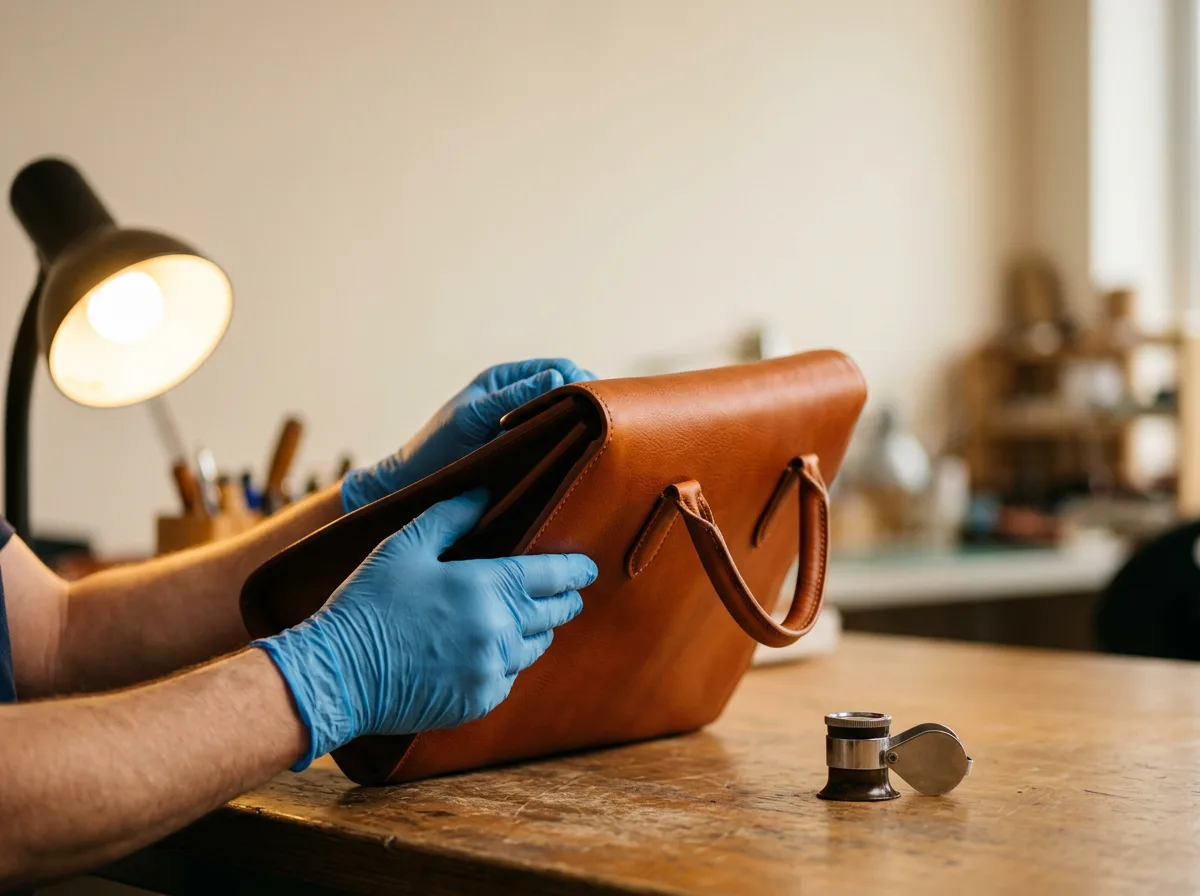
On the finished bag, inspectors look at the edge from a customer's eye level: even line, sealed paint, no visible glue, no lump at corners. They also flex the opening and handles to confirm the edge moves with the leather.
Flex testing matters because some defects only appear under movement. A bag that looks perfect on the bench can still fail at the fold line after twenty flexes if the skive was too deep or the adhesive too brittle.
Writing Skiving and Folding Specs in Your Tech Pack
Buyers who specify skiving and folding clearly get better samples on the first round. Vague instructions such as "neatly finished edges" leave too much room for interpretation.
Specify the Method and the Remaining Thickness
Write the skiving requirement in numbers. State the starting leather thickness, the remaining edge thickness and the skive width, and note whether the edge is feathered or stepped.
For example: "Skive all folded edges: remaining thickness 0.5 to 0.6 mm, skive width 12 mm, feathered taper." A factory can execute that instruction without guessing, and you can verify it on the sample with a thickness gauge.
Specify the Fold and the Finish
Define the fold width, whether corners are mitered, and whether the fold is stitched through or left plain. Then state the edge finish: painted, burnished or left natural.
| Spec element | What to write | Why it matters |
|---|---|---|
| Starting thickness | "1.4 mm chrome-tanned cowhide" | Sets the material baseline |
| Remaining thickness | "0.5–0.6 mm at folded edge" | Prevents weak or bulky folds |
| Skive width | "12 mm along folded edges" | Determines fold appearance |
| Fold width | "8 mm top opening fold" | Sets the finished look |
| Corner treatment | "Mitered, no visible gaps" | Prevents corner defects |
| Edge finish | "Fold + 2 coats edge paint" | Sets durability and look |
Approve a Fold Sample Early
Ask for a small fold sample, literally a skived and folded corner or handle piece, before the full development sample is made. It takes hours instead of days and reveals the factory's edge standard immediately.
Compare the fold sample against the reference you want, adjust the numbers once, and then let production proceed without repeated edge-related surprises.
When Skiving Adds Cost and When It Saves It
Skiving and folding are sometimes framed as pure cost adders. In practice they add labor but can reduce material and structural costs elsewhere, and the balance depends on the design.
The Labor Reality
Skiving and folding are skilled hand operations. A factory pays a premium for the workers who do them well, and that cost lands in the unit price of bags that use the techniques extensively.
A simple tote with one folded top edge might carry only a few minutes of edge labor. A structured bag with folded flaps, wrapped handles and folded pocket openings carries noticeably more. This is legitimate pricing, not padding, and it tracks directly with quality.
The Material Savings
Folded-edge construction can reduce material usage because panels can be cut smaller when edges are folded instead of left raw and trimmed. It can also allow a factory to use a slightly thinner, less expensive leather where structure comes from the fold and the reinforcement rather than from sheer thickness.
For some styles, those savings offset a meaningful share of the added labor. The net cost of good edgework is therefore smaller than the sticker price of the technique suggests.
The Quality Payback
The largest saving is indirect: fewer returns, fewer complaints and fewer replacements. Edge failures are among the most common quality complaints on leather goods, and they are almost always edge-finishing failures.
A brand that pays for proper skiving and folding reduces its defect rate on edges dramatically. Over a full production year, that payback usually exceeds the labor cost several times over.
Choosing the Right Edge Strategy for Your Bag Line
Different bags call for different edge strategies, and matching the strategy to the style keeps quality high without overbuilding every product.
Minimal Edgework for Simple, Casual Styles
An unlined, soft tote in thick, rustic leather can look excellent with raw or burnished edges. The aesthetic is rugged, and the thick leather does not need folding to hold its shape.
Specifying full skive-and-fold on such a bag would add cost without visible benefit. Match the technique to the style, and let the leather do the talking.
Full Edgework for Structured and Premium Styles
Structured bags, framed silhouettes and any style meant to read as refined benefit from the full treatment: skive, fold, stitch, seal. The crisp edges are the visual proof of the price point.
This is also where buyers can most easily spot quality differences between factories. Put two similar structured bags side by side and compare the edges; the difference is rarely subtle.
A Middle Path for Everyday Handbags
Most everyday handbags sit in between: folded and sealed on visible edges such as the top opening, flap and handles, with simpler finishing on interior and unseen seams.
This targeted approach keeps cost controlled while protecting exactly the edges customers see and stress. It is the strategy most mid-market factories recommend, and for most brands it is the right balance.
Skiving and Folding in Different Leather Types
The same fold looks and behaves differently across leather types, and factories adjust their approach to the material. Knowing these differences helps you choose leathers that match your edge ambitions.
Vegetable-Tanned Leather
Vegetable-tanned leather is firm and dense, which makes it excellent for crisp, structural edges but demanding to skive. The blade meets more resistance, and the fold needs careful conditioning to avoid cracking.
Skived veg-tan edges hold a sharp fold line beautifully, which is why high-end structured bags favor it. Factories allow the leather to rest and recondition after skiving so the fibers relax before folding.
Chrome-Tanned Leather
Chrome-tanned leather is softer and more supple, so it skives easily and folds with little resistance. The trade-off is a less defined fold line and a greater tendency to stretch during folding.
For everyday handbags this is usually an advantage, because the softer fold sits comfortably against the body. Factories watch stretch carefully, letting glued folds set before stitching so the seam does not pucker.
Suede and Nubuck
Suede and nubuck have napped surfaces that change the rules. The flesh side that is normally skived is often the visible side on suede, so skiving must happen on the grain side or the panel is skived before the nap is raised.
Folding suede requires care with adhesive, because the nap wicks glue and can show darkened, stiff lines along the fold. Factories use low-penetration adhesives and press folds quickly to keep the surface clean.
Exotic and Coated Leathers
Exotic skins such as alligator or ostrich are expensive and irregular, so skiving is done by hand with extreme caution and hides are mapped for thickness before cutting. One mistake can waste a panel worth more than a whole bag in standard leather.
Coated leathers, including those with a thick finish layer, can crack at the fold if the finish is stiffer than the leather beneath. Factories test fold flexibility before production and may skive wider bands to spread the bend over more surface.
Skiving, Folding and Your Factory Relationship
Edge quality is not a checklist item you can verify once and forget. It depends on skilled individuals, maintained tools and a factory culture that values invisible details, all of which take time to assess.
Ask How Edges Are Made, Not Just Whether
When you visit a factory or interview a prospective partner, ask to see the skiving bench and the folding station. Watch how workers handle corners and how inspectors check tapers. The answers tell you more than any certificate.
A factory that can talk about remaining thicknesses, feathering and adhesive flash-off times understands its craft. One that answers "we just finish the edges" is telling you exactly how much to worry.
Verify on Every Production Round
Edge standards can drift between production runs as workers change and machines wear. Check the edges on the pre-production sample and on random pieces from each production lot, not just on the first shipment.
Flex the openings, inspect the handle folds and look at the corners under good light. Five minutes of edge inspection per lot will save you from discovering a quality regression after your customers do.
FAQ
What is skiving in leather bag making?
A: Skiving is thinning leather from the flesh side, usually along panel edges, so the leather can be folded or joined without creating bulky, lumpy seams. The visible grain side is never touched.
Why do leather bags need skived edges?
A: Full-thickness leather is too stiff to fold cleanly. Skiving removes excess fiber so edges fold into thin, uniform curves that sit flat, stitch neatly and resist cracking through years of use.
What is the difference between skiving and splitting?
A: Skiving removes material along an edge or band to create a feathered taper, while splitting reduces an entire panel to a uniform thickness. Factories use skiving for folds and seams, and splitting for full-panel thinning.
How thin should a leather edge be skived for folding?
A: For most bag leathers of 1.2 to 1.6 millimeters, the remaining edge thickness after skiving should be about 0.4 to 0.7 millimeters. Going thinner risks tearing; staying thicker creates a bulky fold.
What tools do factories use to skive leather?
A: Hand head knives for corners and curves, bell skivers for straight edges, band knife splitters for full panels, and increasingly laser or CNC machines for complex repeatable parts.
What is a folded edge on a bag?
A: A folded edge is a skived panel edge that is glued and pressed inward, hiding the raw cut and creating a clean, sealed boundary. It is often stitched and then sealed with edge paint.
Is a folded edge stronger than an edge with only paint?
A: Yes. A folded edge has no exposed cut fibers, so it resists chipping and cracking far better than a painted raw edge. The fold and stitching continue to hold the construction even as the surface wears.
Which parts of a bag need skiving and folding most?
A: The parts customers handle and stress daily: top openings, flaps, handles and straps, interior pockets and gussets. These are also the first places where poor edgework shows.
How much does skiving and folding add to the cost of a bag?
A: Skilled edgework typically adds 5 to 15 minutes of labor per bag depending on the number of folded edges. The cost is modest against the reduction in returns and quality complaints.
Can I specify skiving and folding in my tech pack?
A: Yes. State the starting thickness, remaining edge thickness, skive width, fold width and edge finish in numbers, and ask for a small fold sample before the full development sample.
What defects should I check for on folded edges?
A: Look for uneven tapers, wrinkles along the fold, gaps at mitered corners, glue bleeding onto the visible face, and any sign of cracking when the edge is flexed.
Why do some cheap bags show white cracks along the edges?
A: Those bags use painted raw edges without folding. The paint chips and separates where the leather flexes, exposing light-colored fibers. Folded and sealed edges avoid this failure mode.
Does skiving weaken the leather?
A: Only if done badly. A correct skive leaves enough fiber for strength while removing bulk, and the fold redistributes stress across a wider area. Over-aggressive skiving is a defect, not a feature.
How do I compare edge quality between factories?
A: Put two samples side by side and examine the openings, flaps and handles. Flex the edges and feel for smooth tapers. Ask each factory to explain its skive specifications and inspection process.
Do laser-cut edges need skiving too?
A: Edges that will be folded still need skiving, whether cut by laser or die. Laser cutting can harden the cut edge, so factories often finish critical folded edges by hand regardless of how the panel was cut.
Can folding be applied to all leather types?
A: Most leathers can be folded, but soft stretchy leathers need wider skive bands and firmer leathers fold more crisply. Very thin or loosely finished leathers may require a bonded backing before folding.
Ready to put cleaner edges on your next bag line? Send us your tech pack or a sample bag and we will prepare a detailed edge specification, with skive numbers, fold widths and a physical fold sample, so your production starts with the details that define quality.