How Should Design Changes Be Controlled After Sampling?
- Why Post-Sampling Changes Cost Ten Times More Than Pre-Sampling Ones
- What "Approved" Actually Means: Three Reference Objects
- Classify the Change Before You Control It
- The Change Order: Minimum Data Set
- Sample Version Control in Practice
- Impact Assessment, Part One: Materials
- Impact Assessment, Part Two: Patterns, Dies and Tooling
- Impact Assessment, Part Three: Cost
- Impact Assessment, Part Four: Lead Time
- Impact Assessment, Part Five: Compliance and Testing
- The Re-Sample Decision: When a Photograph Is Enough
- Authority: Who May Approve What
- Change Freeze: Cut-Off Points Tied to Production Milestones
- Changes During Pilot Run Versus Bulk: Two Different Regimes
- Buyer-Initiated Versus Factory-Initiated Changes
- The Documentation Trail That Survives a Dispute
- A One-Page Procedure You Can Attach to the Purchase Order
- Failure Modes and Their Fixes
- What Change Control Looks Like When It Works
- Implementation Questions Buyers Ask
The most expensive sentence in bag development is not a design error. It is a short email that arrives after the sample has been approved: "small change — can we widen the front pocket by 10 mm?" It looks like a request. In production terms it is a sequence of consequences — a pattern card to be redrawn, a cutting die that may no longer fit, a material consumption figure that shifts, a cost agreed on a different construction, a lead time promised against a different operation sequence, and an approved sample that no longer matches what the factory is about to build.
None of those consequences is unusual. What is unusual is a programme in which they are visible before they happen. In most buyer–factory relationships, post-sampling changes are handled informally: a message, a verbal agreement, a revised photo, an assumption that everyone understood the same instruction. That path works most of the time, which is why it persists. The remainder produces the disputes that occupy the rest of the relationship — the carton with a pocket in the wrong position, the invoice with an unexplained tooling charge, the shipment that slips two weeks because a hardware change forced a re-sample nobody scheduled.
Change control is not bureaucracy imposed on creativity. It is the mechanism that keeps a bag programme cheap, fast, and defensible while the design keeps moving. This article sets out how a manufacturer should run it: how to classify a change before reacting to it, what a change order must contain to be actionable, how to assess material, tooling, cost, and lead time impacts in one document, when a re-sample is mandatory and when a photograph is enough, where freeze points sit relative to production milestones, and what evidence a buyer should be able to demand when a dispute surfaces six months later.
Why Post-Sampling Changes Cost Ten Times More Than Pre-Sampling Ones
Before sampling, the design exists as intent: a drawing, a specification, a reference bag. Changing intent is cheap because nothing physical has been committed. After sampling, the design exists as a solved construction — pattern geometry that closes correctly, seam allowances that fit the machine, a material yield calculated on real width, a timed operation sequence, a quoted labour cost, and an approved object that is now the definition of "as specified."
Each of those is a derived artefact, and derived artefacts do not update themselves. A 10 mm pocket adjustment can absorb forty engineering minutes, a new pattern card, a re-cut die, a revised consumption figure, a re-quoted labour minute, and a fresh approval cycle. The same 10 mm, decided at concept stage, absorbs none of them.
There is a second cost that is harder to see: the loss of a single source of truth. Once two versions circulate — the approved sample and the change agreed by email — the floor must choose which to build, and different operators choose differently. The resulting defect pattern looks like a quality problem but is a documentation problem, and tighter inspection will not fix it.
| Stage of the change | Artefacts to redo | Re-approval | Typical exposure |
|---|---|---|---|
| Concept / draft tech pack | None | Internal | Negligible |
| During first sampling | Pattern in progress | Revised sample round | One sample cycle |
| After approval, before pilot | Pattern, dies, templates, BOM, costing | New sealed sample | Two to four weeks |
| After pilot, before cutting | Above plus purchased material | New sample plus stock disposition | Four to eight weeks |
| After cutting has started | Above plus work-in-progress | Concession or rebuild | Programme-level loss |
What "Approved" Actually Means: Three Reference Objects
A change can only be controlled against a defined baseline, and an approved sample alone is a weak baseline: it defines appearance and hand-feel but not the inputs that produced them. Robust control freezes three objects together, under one revision number.
The sealed sample
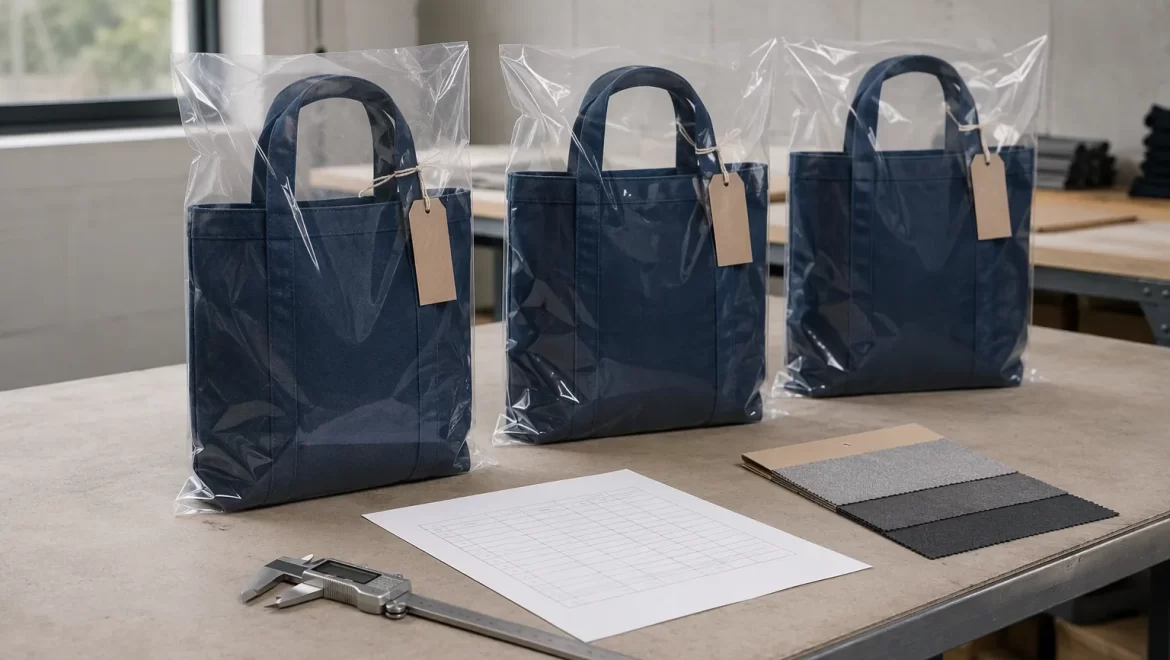
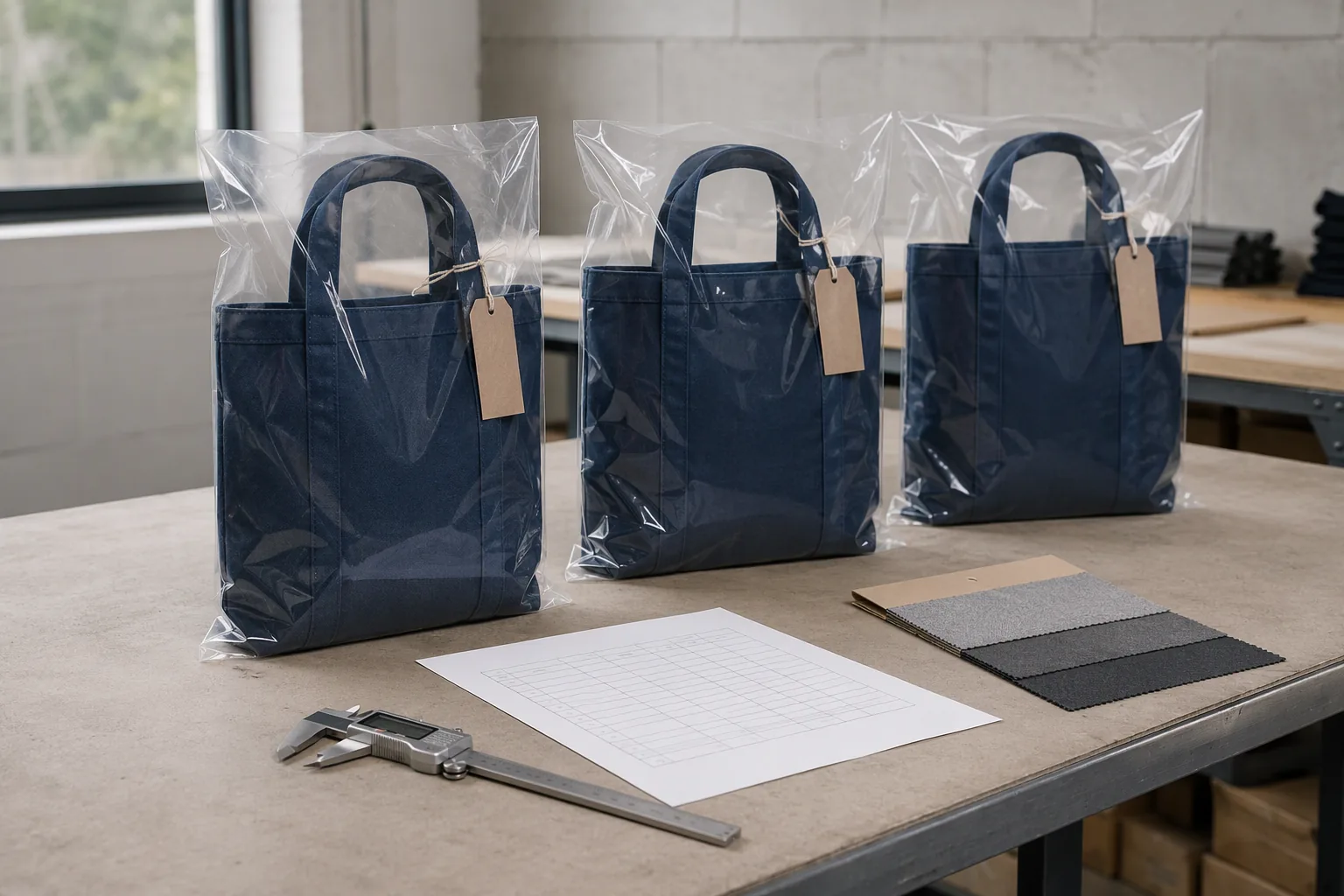
The sealed sample is the specific unit, not a type of bag. It carries a label with programme code, revision, approval date, approver, and the quantity it represents; it is sealed so that silent alteration is obvious; it lives in a locked cabinet rather than on the bench. Copies issued to the line are stamped "reference copy, not the standard," because a sample handled for three weeks is no longer a reference — its hardware has dulled, its edges softened, its shape relaxed.
The bill of materials at the matching revision
The BOM must be frozen at the revision that produced the sealed sample. This sounds obvious and is often violated: a lining substituted for availability, a thread changed because the colour was discontinued, a zipper pulled from a second supplier because the first was late. Each drift may be reasonable; together they mean the BOM no longer describes the approved bag. Freezing does not mean the BOM never changes — it means every change creates a new revision linked to a change order, so "is this the same bag?" is answered by revision numbers rather than by photographs.
The specification file
The tech pack, construction sheet, measurement chart, colour standard, and packaging instruction allow a new operator or a second factory to reproduce the bag without access to the people who developed it. Its critical sections for change control are the measurement points and tolerances, because that is where silent changes hide: a construction change that moves a measurement point is caught only if the chart is a controlled document rather than a spreadsheet each merchandiser edits privately.
| Reference object | Owner | Control mechanism | Failure mode if unmanaged |
|---|---|---|---|
| Sealed sample | Quality manager | Physical label, seal, register entry | Bulk matches "a sample", not the approved one |
| Bill of materials | Merchandiser | Revision number plus change order | Silent substitutions and cost drift |
| Specification file | Engineering | Version-controlled document | Measurement disputes, unreproducible construction |
| Colour standards | Quality manager | Dated physical swatch set | Shade drift across dye lots |
| Packaging instruction | Merchandiser | Versioned artwork file | Label and carton errors at the last minute |
Classify the Change Before You Control It
Treating a label typo with the same weight as a material substitution creates so much friction that people route around the system, which is the worst outcome. A three-class taxonomy, agreed with the buyer at kickoff and written into the purchase order, solves this.
| Class | Definition | Examples | Approval | Re-sample |
|---|---|---|---|---|
| 1 — Cosmetic | No effect on pattern, materials, tooling, function, compliance | Artwork copy, label position in tolerance, thread colour in standard | Merchandiser plus buyer contact, written | No; photographic |
| 2 — Structural | Alters pattern, material, hardware, dimensions, operation sequence | Pocket dimension, lining substitution, same-type zipper brand change | Engineering assessment, costing, buyer sign-off | Yes |
| 3 — Functional or capital | Alters function, safety, regulated claims, tooling investment, programme economics | New mould, primary material change, load-path construction, test basis | Change board, full assessment, revised PO | Yes, plus retest |
Classification must be assigned by the factory's engineering function, not by the buyer and not by the salesperson who benefits from a fast answer. The factory publishes the class with a one-line justification; the buyer may escalate upward at any time; downgrading requires engineering sign-off. For the first two change orders of a new programme, assign every change one class higher than instinct suggests and observe whether the rigour was wasted. It rarely is: the first changes reveal which parts of the specification were underspecified.
The Change Order: Minimum Data Set
A change order is a document with a fixed data set, and the data set is what makes it possible to price, schedule, and audit a change without holding a meeting.
| Field | Content | Why it matters |
|---|---|---|
| Number, date raised, effective date | Sequential, programme-prefixed, never reused | Single identity; establishes freeze position |
| Raised by, approved by | Named people with roles | Accountability and escalation |
| Current state | What the approved revision says, quoted | Prevents change defined by memory |
| Required state | Dimensions with units | Removes ambiguity |
| Reason code | Cost, function, compliance, availability, error | Enables trend analysis |
| Class | 1, 2, or 3 with justification | Sets the approval route |
| Affected documents | Tech pack sections, patterns, BOM lines, artwork | Ensures derived artefacts update |
| Material impact | Part numbers, consumption, MOQ, lead time | Feeds costing and purchasing |
| Tooling impact | Dies, templates, moulds, one-off cost | Feeds the capital decision |
| Cost impact | Per-unit delta, one-off delta, programme delta | Feeds commercial approval |
| Lead time impact | Days added, revised key dates | Feeds the delivery commitment |
| Compliance impact | Tests required, claim status | Prevents shipping a non-conforming claim |
| Stock disposition | Material, WIP, finished goods | Prevents late discovery of dead stock |
| Verification | Sample required, type, due date | Defines the proof step |
Free text fails because it carries the requested state and omits the current state, the affected documents, the material consequence, and the stock question. The factory fills those gaps with assumptions optimised for speed. In one inherited programme, a lining change arrived eleven days before cutting: the factory assumed the old lining would be consumed first because it was in stock, the buyer assumed the new one would be used from the first cut because the change was "effective immediately." Both assumptions were reasonable; the first container was half old and half new, and the buyer rejected the mixed cartons not because either lining was wrong but because the two could not be sold as one SKU. A structured field asking "what happens to existing stock?" would have caught it before cutting.
Sample Version Control in Practice
A six-week-old programme typically holds a prototype, a revised prototype, a sales sample, a pre-production sample, a golden sample, a photo sample, and two units sent to the buyer and never dispositioned. Without a numbering scheme, "the sample" becomes a shared fiction.
| Component | Format | Rule |
|---|---|---|
| Programme code | Buyer plus factory code, e.g. PB-2408 / F-1182 | Assigned once, never changes |
| Revision | Two digits, e.g. R03 | Increments only through a change order |
| Round | Two digits, e.g. S02 | Increments on every physical build, including no-change rebuilds |
| Purpose | SS, PP, GS | Golden sample issued once per revision |
| Date | ISO date of build | Build date, not dispatch date |
Two rules make the scheme stick. A sample without a label is not a sample but scrap, and may not be used for approval. Photographs are filed under the same string in a fixed set — front, back, left, right, interior, construction detail, plus one scale reference — so that "was the pocket 130 or 135 mm?" is answered by an image in ten seconds rather than by the memory of whoever decided.
The golden sample deserves separate mention because it is the reference against which bulk is judged. Build it with production tooling, ideally on the production line, seal it immediately, and attach its measurement report. A golden sample made in the sample room from a hand-cut pattern is a design object, not a quality standard, and using it as the acceptance criterion guarantees rejections the line cannot prevent.
Impact Assessment, Part One: Materials
Material impact is the assessment most often reduced to "same material, different colour," and that reduction is almost always wrong. Bags are assemblies of sheet goods, and sheet goods carry industrial constraints designers rarely see: roll width, minimum order quantity, dye-lot behaviour, backing and lamination availability, and the commercial fact that a mill will not open a run for two hundred metres.
| Material change | Hidden consequence | Assessment question |
|---|---|---|
| Colour on same article | New dye lot, shade variance, MOQ per colour | Is the colour stocked, or must the mill run it? |
| Base cloth weight | Stiffness, needle and thread compatibility, cutting behaviour | Does the seam still close; can the machine handle it? |
| Coating or film change | Flex resistance, cold crack, cut edge quality | Does the end use require flex or cold testing? |
| Lining substitution | Hand-feel, sewing tension, show-through | Is it an approved equivalent or a new material? |
| Hardware of same function | Plating thickness, salt spray, mould ownership | Are plating spec and finish family identical? |
| Reinforcement change | Structure retention, fold behaviour | Does the bag hold shape after pack-out? |
| Thread change | Tenacity, UV stability, colour match | Same ticket, equal or higher tenacity? |
| Foam or padding change | Density, compression set, recovery | Does protection still meet the drop requirement? |
The material window
Every material has a purchasing window shorter than the change approval cycle. A coated fabric in a non-stock colour may need eight to twelve weeks from order to delivery; a custom hardware pull may need six weeks for sampling plus four for production. Approving a change in week two of a ten-week lead time does not bring the material in week three; it brings it in week thirty.
The instrument that fixes this is a material window table agreed at kickoff: for each critical article, the part number, stock status, mill lead time, MOQ, and the last date on which a change can be made without moving delivery. That converts "we need to know soon" into a dated instruction and lets the buyer choose knowingly between a compromise and a delay.
Impact Assessment, Part Two: Patterns, Dies and Tooling
Tooling is where post-sampling changes become capital decisions. Buyers treat tooling as a one-off line in the quotation; in practice it is a set of assets with different lifetimes, owners, and sensitivities to change.
Cutting dies and pattern cards
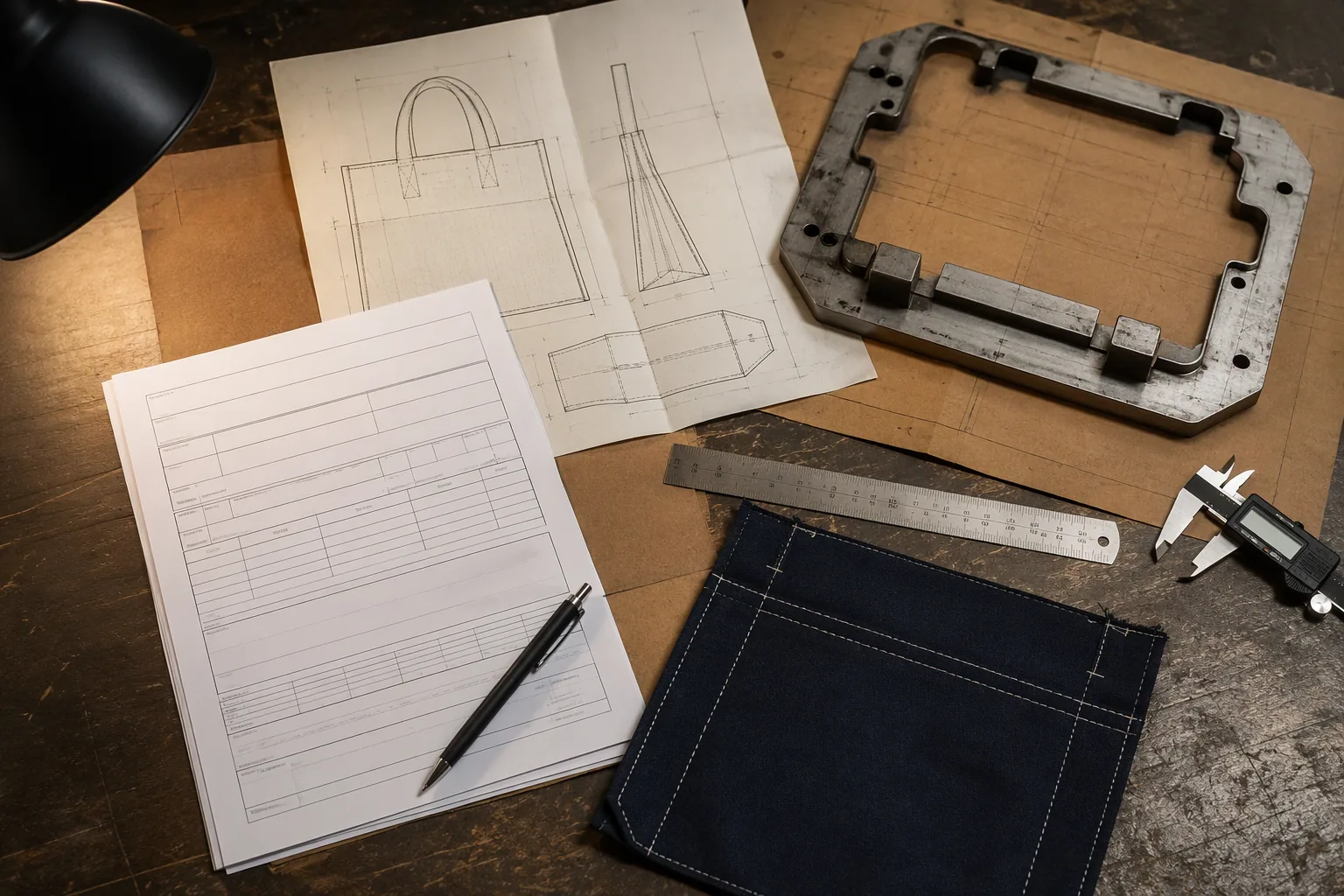
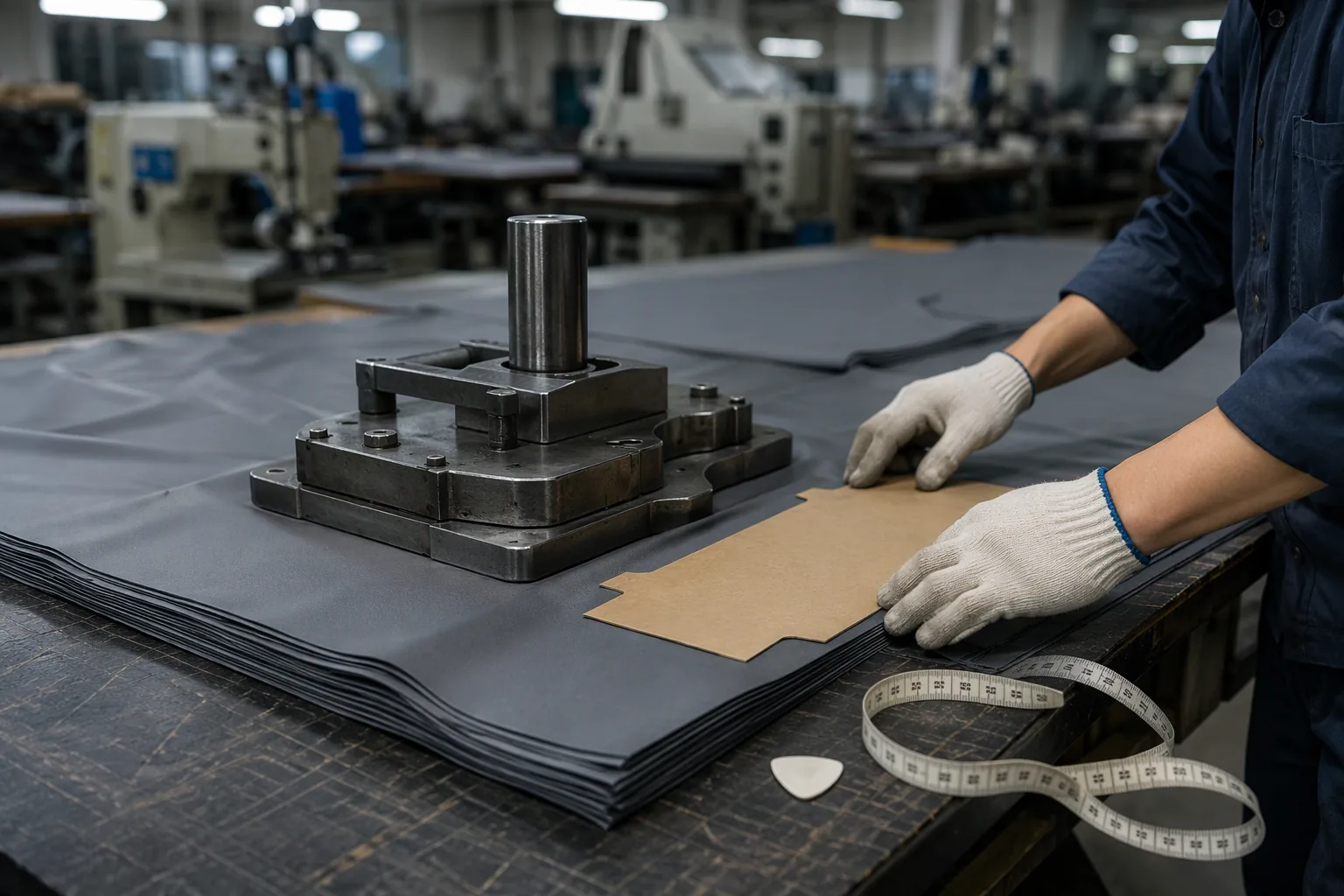
A die is cut to the pattern and the pattern is cut to the design. A 10 mm change on a curved edge is not a 10 mm change to the die; it is a new die, because dies are routed from the pattern file and cannot be bent. Factories with an in-house die shop re-cut in days; factories that outsource add a week and a purchase order.
The assessment question is not "does the die still work?" but "does the die still produce the approved part?" A die that is 5 mm short produces a part that is 5 mm short; if the seam allowance absorbs it, the bag still closes but the finished dimension falls outside tolerance. That is the origin of many measurement disputes that look like sewing errors.
Sewing jigs, templates and folder feet
Sewing aids are cheap individually and expensive collectively. A pocket position change invalidates the template, the chalk mark, the folder foot setting, and the operator's learned rhythm. Time standards built on the old operation become fiction, and the labour minute in the quotation drifts. Always ask whether the change touches the bottleneck: the same change on a bottleneck operation costs roughly five times as much, because it reduces daily output directly.
Moulds for hardware and injected parts
Moulds are the least forgiving tooling. A modification means removing the tool from production, shipping it to the tool room, welding or EDM machining, re-polishing, and re-trialing — three to six weeks is normal, and cost can exceed the entire tooling budget of a small programme. Hardware changes after sampling should therefore be Class 3 by default. The exception is a change between two parts that share a mould — same body, different plating or insert colour — and even then the plating thickness and salt spray performance must be verified, because a decorative finish is not automatically a functional equivalent.
| Tooling item | Cost band | Lead time if changed | Reusable |
|---|---|---|---|
| Cutting die set | Hundreds to low thousands USD | 3 to 10 days | No |
| Pattern card and marker | Low hundreds USD | 1 to 3 days | Partially |
| Sewing templates and jigs | Tens to low hundreds USD | 1 to 5 days | Partially |
| Print screens or heat transfers | Low hundreds USD per colour | 3 to 7 days | No |
| Hardware mould | Thousands to tens of thousands USD | 3 to 6 weeks | With modification |
| Die-cut foam insert tool | Hundreds to low thousands USD | 5 to 10 days | No |
Impact Assessment, Part Three: Cost
Cost impact has two components that are constantly confused: the per-unit delta and the one-off delta. The per-unit delta is the change in material, labour, and overhead per bag. The one-off delta is the cost of making the change — new dies, extra samples, engineering time, obsolete stock, expedited freight.
Buyers negotiate the per-unit delta and forget the one-off, which is why tooling charges appear as surprises on invoices. Factories quote the one-off and underestimate the per-unit, which is why the first production invoice is short. Both errors disappear when the change order carries both columns.
| Cost line | Typical magnitude | Who bears it by default |
|---|---|---|
| Material consumption or price | Cents to low dollars per unit | Buyer |
| Labour minutes | Cents per unit; larger at the bottleneck | Buyer, unless factory-initiated |
| Tooling | Hundreds to thousands USD, one-off | Negotiated ownership clause |
| Extra sample rounds and testing | Hundreds USD per round | Party initiating the change |
| Obsolete stock | Full value of material or WIP | Party approving after the relevant freeze point |
| Expediting | Percentage of freight | Party who caused the delay |
The ownership clause deserves negotiation before the programme starts, not during a dispute. A fair default: the initiating party bears one-off costs, the buyer bears per-unit changes, and obsolete stock sits with whoever approved the change after the freeze point for that material. A factory that accepts unlimited exposure to buyer-initiated changes will price that risk into every quotation, so an unfair clause is not free.
One costing subtlety separates experienced buyers from inexperienced ones: a change that lowers unit cost can still raise programme cost. Removing a reinforcing layer saves forty cents a bag and introduces two defect modes that generate a three percent rejection rate, which costs far more than forty cents. Assessment therefore needs a quality-risk line, not only a cost line.
Impact Assessment, Part Four: Lead Time
Lead time impact is calculated from the critical path, not from the sum of activities. A change adds time only if it lands on the longest remaining chain of dependent work. A die cut in parallel with material purchasing adds nothing; a re-sample that must be approved before cutting adds the full sample cycle, the buyer's approval queue, and the re-planning of a cutting slot that may already be committed.
| Activity | Duration | Can it run in parallel? |
|---|---|---|
| Engineering assessment | 1 to 3 days | Partially |
| Material re-sourcing | 3 days to 12 weeks | Yes, alongside die work |
| Pattern and die revision | 3 to 10 days | Yes, with material |
| Re-sample build | 5 to 12 days | No |
| Courier transit | 3 to 6 days | No |
| Buyer review and approval | 2 to 10 days | No — the variable nobody plans |
| Testing and report | 5 to 15 days | Partially |
| Cutting slot re-plan | 0 to 10 days | No |
Two conclusions follow. The buyer's own approval queue is often the largest single item and the one the factory cannot control, so a 48-hour internal approval commitment recovers more schedule than pressure on the factory. And the cutting-slot re-plan is where informal change control does its real damage: the change is approved, the factory says "no problem," and the problem appears three weeks later when the cutting room has been reallocated and cannot be recovered without displacing another programme.
Communicate lead time impact as a revised date with a named dependency: "cutting cannot start until the new die arrives, so ex-works moves from 12 to 19 December and the container booking must be re-confirmed." "Slight delay" invites the buyer to assume two days when the truth is two weeks.
Impact Assessment, Part Five: Compliance and Testing
Compliance is the assessment most often skipped and the one that can stop a shipment at destination. A bag carries claims — material content, restricted substances, colour fastness, load capacity — and a change can invalidate any of them without appearing to touch function.
| Change | Test basis affected | Action |
|---|---|---|
| New material article or supplier | Restricted substances, fastness, physical performance | Full or reduced panel on the new article |
| New dye or colour | Fastness to rubbing, water, light | Fastness tests on the new lot |
| New hardware supplier | Nickel release, corrosion, sharp edges | Component test plus inspection |
| New adhesive or lamination | VOC, bond strength, cold resistance | Bond and environment tests |
| Closure type change | Cycle life, load capacity | Cycle and load test |
| Strap attachment change | Load capacity of the assembly | Static and dynamic load test |
| Label or care copy change | Legal accuracy | Compliance review, not a lab test |
The rule that prevents most incidents is easy to state: a change is not approved until the compliance owner signs either "no test impact" or "test impact as follows." That must be a person, not a checkbox, because the judgement requires knowing what the claim says and how the lab plan was built. There is also a timing trap: a change needing a fifteen-day test cycle, approved ten days before shipment, cannot ship on the original date no matter how fast the factory works. Test lead time belongs inside the freeze calculation, not inside the discovery.
The Re-Sample Decision: When a Photograph Is Enough
Unnecessary re-sampling is as damaging as skipped re-sampling, because it teaches people to treat every change as a crisis. The decision should follow the type of uncertainty the change creates.
| Nature of change | Uncertainty | Verification |
|---|---|---|
| Artwork copy or label position in tolerance | Text accuracy | Photograph plus proofread sign-off |
| Thread colour within standard | Shade | Physical swatch under the light booth |
| Packaging text or carton marking | Text and layout | Artwork proof, no physical sample |
| Pocket position or dimension | Pattern geometry | Sample with measured report |
| Material substitution, same construction | Hand-feel, drape, sewing behaviour | Sample plus material test report |
| Hardware change | Fit, finish, function | Sample plus cycle or load test |
| Load-path construction change | Strength, durability | Sample plus load test |
| Change affecting a claim | Compliance validity | Sample plus full retest |
Require every re-sample to answer a stated question. "Make a sample" is an instruction without a purpose; "build one at revision 03, report the six critical dimensions, and photograph the interior seam" can be accepted or rejected on evidence. When the question is stated, the round becomes fast and the approval becomes objective.
Authority: Who May Approve What
Change control fails fastest when authority is ambiguous: the buyer's merchandiser approves verbally, the factory's salesperson accepts, engineering discovers it at pre-production review, and the change is either reversed or absorbed silently. Both outcomes damage trust.
| Class | Factory authority | Buyer authority | Documentation |
|---|---|---|---|
| 1 | Merchandiser plus QC supervisor | Buyer merchandiser | Written confirmation, photograph |
| 2 | Engineering manager plus merchandiser | Buyer merchandiser plus technical or QA | Signed order, new sample approval |
| 3 | Factory change board | Buyer decision maker plus commercial owner | Full assessment, revised PO, retest |
| Post-freeze | Above plus production planning | Above plus delivery update | Concession or revised schedule |
Two rules make this workable. Publish a named deputy for every approver at programme start, because week-long approval delays are usually caused by one person's holiday. And hold a standing weekly change review — thirty minutes, fixed agenda, all open change orders — so approval never depends on someone noticing an email. In our own programmes this reduced average approval time from nine days to two, entirely by removing queue time rather than by working faster.
Change Freeze: Cut-Off Points Tied to Production Milestones
A freeze is not a date on a calendar. It is a relationship between a change and a production commitment, and the right way to define it is a set of cut-off points, each tied to a milestone, each with a stated consequence.
| Milestone | Freeze rule | Consequence of a late change |
|---|---|---|
| Material PO released | No change to ordered material | Full material exposure carried |
| Cutting die ordered | No dimensional change to cut parts | New die plus schedule re-plan |
| Pre-production sample approved | No Class 2 or 3 change without a new sample | Ex-works moves by the sample cycle |
| Bulk cutting started | No change to cut components | Concession or rebuild |
| Sewing started | No construction or hardware change | Rework with measured cost |
| Packing started | No label, carton, or assortment change | Mixed cartons, quarantine |
A hard cut-off for label and packaging copy
Artwork is the exception that needs its own rule, because it is cheap to fix and expensive to get wrong. A label can be reprinted in days; a carton cannot be reprinted after it has been filled. Apply a hard cut-off at packing start, and review every label, carton, hangtag and insert file at the pre-production sample stage — proofread by two people, one of whom is not the author. Almost every packaging incident we have seen recently was a text error that existed before the freeze and was never proofread, not a change made after it.
Changes During Pilot Run Versus Bulk: Two Different Regimes
A pilot run is a controlled experiment and changes inside it should be expected. Bulk is a commitment and changes inside it should be exceptional. Applying one process to both either over-controls the pilot or under-controls bulk.
During a pilot, the useful instrument is a build log rather than a change order. Every deviation — a seam that pulls, a panel that will not sit flat, a hardware that resists insertion — is recorded with a photograph, a station number, and a proposed fix. At the end of the pilot the fixes are consolidated into one batched change order, classified and assessed together. This avoids the pilot spiral in which each unit is built differently because five changes were absorbed one at a time.
During bulk, the useful instrument is a concession. When a deviation appears in work-in-progress, the question is not "what change shall we make?" but "is this unit acceptable, and if not, what is the disposition?" A concession needs three elements: the deviation described in measurable terms, the acceptance decision with the approver's name, and the commercial treatment. Concessions without a commercial treatment become free rework, and free rework becomes next season's price increase.
Buyer-Initiated Versus Factory-Initiated Changes
Buyers initiate most changes and bear the cost. Factories initiate fewer and often fail to disclose them. Both patterns need managing explicitly.
A factory-initiated change is any deviation from the approved specification that the factory proposes or performs — substitutions for availability, construction improvements, an alternative component from the same supplier family. The disclosure obligation belongs in the purchase order, with three requirements: written disclosure before implementation, a proposed classification, and no assumption that the buyer's silence is consent. The most common undisclosed change is the material substitution made because the specified article was unavailable, and it is the most damaging because it stays invisible until the batch fails inspection or the market rejects the shade. A factory with a standing rule — no substitution without a written change order, no exception for "equivalent" material — is easier to work with than one that improvises thoughtfully, because the buyer can rely on the specification.
There is also a legitimate category that should not go through change control at all, and routing it there wastes everyone's time: mill shade variation within the approved tolerance, plating differences within the finish standard, lot-to-lot foam density inside the specified range, thread shade within the approved family. These are covered by tolerances, and tolerances exist so that production variance does not require approval. The distinction is that a tolerance is defined in advance with limits; a change alters the limits. A programme that never defines tolerances turns every natural variance into a change request, and the system collapses under routine noise.
The Documentation Trail That Survives a Dispute
Disputes rarely happen during the programme. They happen ninety days later, when a retailer rejects a batch and both parties must reconstruct what was agreed. At that point change control is worth exactly one thing: the ability to prove the approved state from documents neither party could edit unilaterally.
| Evidence | Proves | Common gap |
|---|---|---|
| Sealed sample with revision label | The approved physical reference | Sample unsealed, label lost |
| Signed change orders with assessment | What was agreed, when, by whom, at what cost | Approval by message only |
| Version-controlled tech pack and BOM | Specification in force at each date | Multiple local copies |
| Measurement reports per round | Objective dimensional history | Reports lost between rounds |
| Test reports linked to revision | Which revision the certificate covers | Test predates the change |
| Photograph sets with scale reference | Visual state of each revision | Images without revision codes |
| Concessions and dispositions | Acceptance of specific deviations | Verbal acceptance |
Two practices make the trail usable. Revision history must be append-only: nothing is deleted when a change is reversed, because the reversal is itself a change and explains why bulk may match an older revision. And the approver must be a person, not a department — "approved by QA" is unusable in a dispute, while "approved by the quality manager on 14 November" is evidence.
A One-Page Procedure You Can Attach to the Purchase Order
- Baseline. At sample approval, seal one sample, freeze the BOM revision, freeze the tech pack version, register the revision. Owner: quality manager.
- Single channel. All requests arrive through one address in one form; requests elsewhere are returned. Owner: merchandising.
- Classification. Engineering assigns Class 1, 2, or 3 within one working day with a one-line justification. Owner: engineering.
- Assessment. Material, tooling, cost, lead time, compliance, and stock disposition each addressed, with "none, because" where there is no impact. Owner: cross-functional.
- Commercial decision. One-off and per-unit deltas presented together, with the bearing party for each. Owner: commercial owners.
- Freeze check. The change is tested against the freeze table, and any post-cut-off consequence is stated before approval. Owner: production planning.
- Document update. Only after approval: tech pack, BOM, pattern, artwork, measurement chart reissued under the new revision. Owner: engineering.
- Verification. A sample or photographic proof is executed per the verification table against the stated question. Owner: sample room.
- Seal and supersede. The new sample is approved in writing, sealed, labelled, registered; the previous revision is marked superseded but retained. Owner: quality manager.
- Line communication. The line is briefed at shift start and the old working sample is removed from the floor. Owner: production supervisor.
- Stock disposition. Material, WIP, and finished goods dispositioned in writing: use, rework, hold, or scrap. Owner: planning.
- Close-out. The order closes only when all eleven prior outputs exist. Owner: merchandising.
The procedure fits on one page because it contains no philosophy — only sequence, owners, and outputs, which are the three things that survive contact with a busy factory.
Failure Modes and Their Fixes
| Failure mode | Looks like | Root cause | Fix |
|---|---|---|---|
| Verbal approval | "The buyer said it was fine on the call" | No single channel | One intake form, written acceptance |
| Drifting BOM | Materials differ from the approved sample | No BOM revision control | Freeze at approval, link to change order |
| Working sample as standard | Bulk judged against a worn floor sample | No sealed reference | Sealed sample plus marked copies |
| Parallel change | Five small changes absorbed one at a time | No batching in pilot | Build log, batched orders |
| Invisible tooling charge | Invoice above quotation | One-off costs not itemised | One-off column mandatory |
| Optimistic date | "Slight delay" becoming three weeks | Activity list instead of critical path | Critical-path assessment with named dependency |
| Late compliance discovery | Test report predates the change | Compliance outside the assessment | Named compliance sign-off |
| Mixed shipment | Half old revision, half new | Stock disposition omitted | Disposition field before approval |
| Retroactive change | Change dated after cutting began | Freeze not tied to milestones | Freeze table in the purchase order |
| Lost evidence | Nobody can prove what was approved | Messages and unsealed samples | Append-only register, sealed archive |
Only two of the ten are technical. The rest are documentation and governance failures, which corrects the common assumption that change control is an engineering problem. Engineering supplies the assessment; governance supplies the discipline that makes it stick.
What Change Control Looks Like When It Works
A controlled programme does not feel bureaucratic. It feels fast, because the cost of any change is known within a day. The buyer requests a pocket adjustment on Monday, receives a change order on Tuesday showing a six-cent per-unit increase, a three-day die re-cut, no material impact, and a revised ex-works date, and approves it the same afternoon. The sample arrives eight days later with a measurement report. Nobody argues, because nobody had to guess.
The uncontrolled version of the same request consumes three weeks of messages, produces a bag that is almost right, generates a tooling charge that is disputed, and leaves both parties less willing to cooperate next time. The difference is not effort. It is a structure that converts an instruction into a priced, scheduled, documented decision.
Three principles summarise it. Freeze three reference objects together — sample, BOM, specification — and control them by revision number, because a change can only be measured against a baseline. Price every change in six dimensions — material, tooling, cost, lead time, compliance, stock disposition — because a change assessed in one dimension fails in another. And tie the freeze to production milestones rather than dates, because a date is an opinion and a milestone is a fact.
Implementation Questions Buyers Ask
How much engineering time should a Class 2 change consume?
Half a day to two days of cross-functional effort, depending on whether it touches a bottleneck or a long-lead purchased material. If a Class 2 change is consuming five days, the programme lacks a measurement baseline and the assessment is being done by re-measuring the sample instead of consulting the controlled chart.
Should the factory charge for assessing a change?
Assessment is normally absorbed as service, and it is cheap compared with assessing badly. What should not be absorbed is execution: new tooling, extra sample rounds, expedited material, and obsolete stock. Separating assessment from execution keeps buyers willing to ask questions.
What happens when buyer and factory disagree on the class?
Engineering sets the initial class and the buyer may escalate. Escalated changes are processed at the higher class and the disagreement is recorded rather than settled by seniority. This is the only arrangement we have seen work, because it removes the incentive to downgrade in order to appear responsive.
Is a photograph ever acceptable proof of a dimension?
Only when the dimension is not a controlled measurement point, and only with a scale reference in frame. A photograph can prove a pocket exists in a location; it cannot prove the pocket is 132 mm wide.
A factory that can show you its revision register, its sealed samples, and a change order with six assessed dimensions is not slowing the programme down. It is demonstrating that the next change can be decided in a day rather than discovered in a container — which is the only basis on which a bag programme can be developed quickly and still be built exactly as approved.