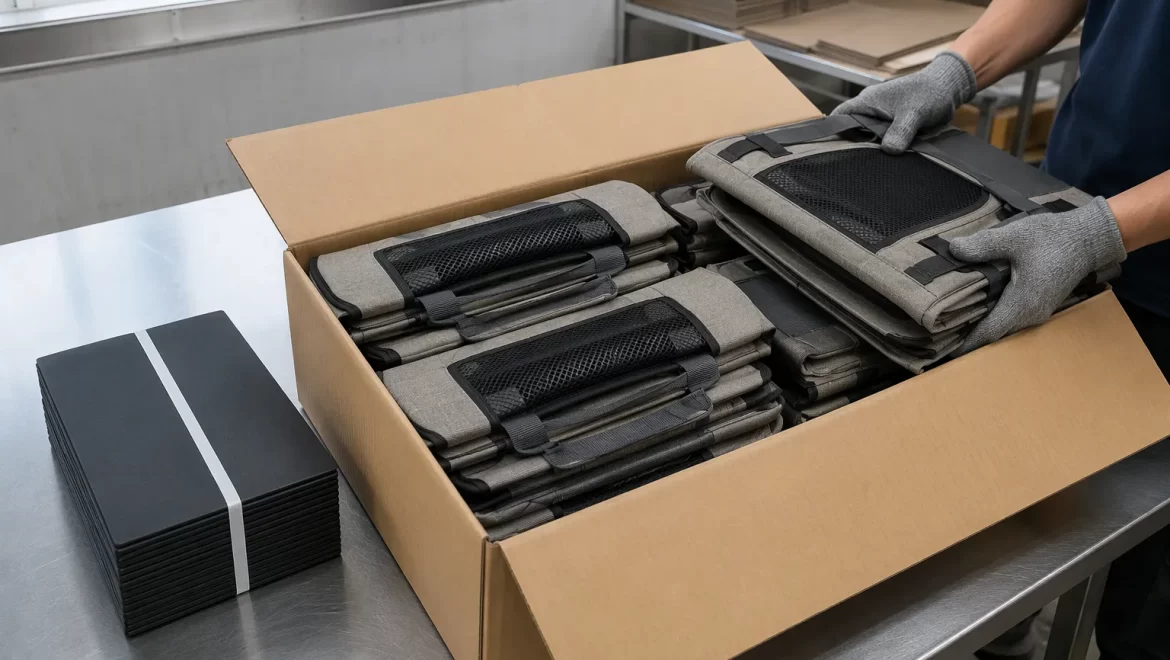
How Should Pet Bag Packing Volume Be Cut for Freight?
- Why Packing Volume Deserves a Specification Line
- How Freight Actually Charges for Space
- Measure the Bag Before You Cut Anything
- Collapsible Versus Rigid: Decide the Structure by Volume Economics
- Compression Levers Inside the Bag
- Carton-Level Geometry: Where the Real Multiplier Sits
- The Volumetric Penalty in Numbers
- What Cannot Be Compressed
- Recovery at Destination: The Standard That Makes Compression Acceptable
- Writing It Into the Purchase Order
- Validating the Change Before It Ships
- Building the Freight-per-Unit Model
- Decision Rules by Bag Type
- Ten Failure Modes That Recur
- Running the Programme: Sequence and Gates
- Frequently Asked Questions
- Conclusion
A pet carrier that measures 480 × 300 × 300 mm looks compact on a spec sheet. Packed for export, the same carrier can consume 0.062 m³ of container space, and once the master carton, void fill, and pallet overhang are counted, a 500-piece order may book 34 m³ instead of 22 m³. On an ocean LCL shipment billed per cubic metre, that difference is not a rounding error. It is a five-figure line item that nobody negotiated, because nobody treated packing as a design decision.
Packing volume is usually handled at the end of a bag programme, by whoever happens to be standing near the packing table. The bag is designed, sampled, approved, and then a carton is chosen from whatever the factory already stocks. That sequence guarantees that volume is a residual — the space left over after every other decision has been made. Manufacturers who run volume-driven programmes do the opposite. They set a volumetric target at the specification stage, treat it as a constraint alongside weight, cost, and test requirements, and then design structure, hardware, and carton geometry to hit it.
This article sets out how a bag manufacturer should cut packing volume for freight without destroying the product: how chargeable weight is actually calculated, what to measure before changing anything, which structural levers genuinely compress a bag and which merely move air around, how carton and pallet geometry interact with freight rates, what must never be compressed, and how to prove that a collapsed bag still arrives as the product the buyer approved.
Why Packing Volume Deserves a Specification Line
Freight is quoted per chargeable unit, not per bag. For ocean LCL, the chargeable unit is the revenue ton — one cubic metre or one metric tonne, whichever yields the higher charge. For air freight and express, it is the greater of actual weight and volumetric weight, calculated with a dimensional divisor. In both cases, the number that reaches the invoice is a function of the space the shipment occupies, and space is determined at the packing table, months after the commercial terms were agreed.
The consequence is asymmetric. A 12% reduction in packed volume is a 12% reduction in ocean freight for a light, bulky product, and the saving repeats on every shipment for the life of the programme. A 12% reduction achieved by removing a structural board is a product that sags in the retailer's display, and that cost also repeats, but it surfaces as returns and chargebacks rather than a freight invoice. Volume reduction is therefore an engineering trade, not an optimisation. The manufacturer's job is to identify where compression is free, where it costs a small structural change, and where it is simply not available.
There is a second, less obvious reason to treat volume as a specification item. Packed volume governs how many units fit a container, and container utilisation governs whether a mixed order is viable at all. A buyer who wants four SKUs in one 40HQ needs a carton plan that fills the box, not four independent carton sizes that leave a metre of dead space at the doors. Volume discipline at the unit level is what makes a consolidated shipment possible at the container level.
How Freight Actually Charges for Space
Before cutting anything, agree on the arithmetic with the buyer and the forwarder, because the same carton can be charged three different ways depending on the mode.
Ocean FCL. The container is paid for, not the cargo. A 40HQ holds roughly 68 m³ of usable space and 76 m³ of nominal space; what matters is whether the carton plan can load the usable envelope. Volume reduction increases units per container, which lowers freight per unit — but only if the carton dimensions divide cleanly into the container's internal geometry.
Ocean LCL. Charged per cubic metre or per tonne, whichever is greater, usually with a minimum. Here packed volume is charged directly, so every cubic centimetre removed from a carton is money, subject to the forwarder's rounding rules (often to the nearest 0.1 m³ per shipment or per house bill).
Air freight. Charged on chargeable weight: the greater of actual gross weight and volumetric weight, where volumetric weight in kilograms equals cubic centimetres divided by a dimensional divisor. The divisor varies by carrier and by commodity — commonly 6,000 for general air cargo and 5,000 for express and some consolidations. A light bag is almost always charged volumetrically.
Express courier. Also volumetric, usually with the same 5,000 divisor, and often with the additional penalty that each parcel is rounded up to the next half-kilogram or kilogram.
The practical lesson is that the divisor determines how aggressively volume must be attacked. With a 6,000 divisor, one cubic metre of cargo must weigh more than about 167 kg before actual weight governs the charge. With a 5,000 divisor, the threshold is 200 kg per cubic metre. A pet bag programme rarely approaches those densities — a packed carrier typically runs 90–140 kg/m³ — so the shipment is volumetric in every mode, and volume reduction converts almost one-for-one into freight reduction.
| Mode | Chargeable basis | Divisor / rule | Implication for a light, bulky bag |
|---|---|---|---|
| Ocean FCL | Container, not cargo | Usable envelope ≈ 68 m³ (40HQ) | Reduce carton size to raise units per container and fill the envelope |
| Ocean LCL | W/M — 1 m³ or 1,000 kg | Greater of the two, forwarder rounding | Every cubic centimetre is charged; volume reduction is direct savings |
| Air freight | Chargeable weight | Cm³ ÷ 6,000 (general cargo) | Dilutes below ~167 kg/m³ is fully volumetric |
| Express | Chargeable weight | Cm³ ÷ 5,000, rounded per parcel | Most punitive for bulky light goods; parcel rounding compounds it |
Measure the Bag Before You Cut Anything
Volume programmes fail when they start with a solution. Start with a measurement that reflects what the forwarder will actually see: the closed, packed, master-carton unit, not the bag on a table.
Record at least the following for each SKU, at three stages — the bag itself, the inner pack, and the master carton:
- Bag external dimensions in the filled, closed state, including handles that protrude and hardware that stands proud of the surface.
- Nested or collapsed dimensions, measured after the intended compression method, not after a hopeful hand press.
- Unit packed volume, including any polybag, hangtag, desiccant, and protective wrap.
- Master carton internal and external dimensions, plus the number of units per carton.
- Carton gross weight and the resulting density in kg/m³.
- Pallet footprint and stack height, including any overhang or slip sheet.
- Void ratio inside the carton: the share of internal volume not occupied by product or designed cushioning.
Two derived numbers do most of the diagnostic work. The first is cube utilisation — the sum of unit packed volumes divided by the carton's internal volume. Anything below about 78% indicates that the carton is larger than the product needs, usually because the carton was chosen from stock rather than made to measure. The second is compression headroom — the ratio of the bag's filled height to its collapsed height. A headroom of 1.0 means the bag has no compressible structure and volume work must shift to carton geometry. A headroom of 2.0 or more means the structure is already collapsible and the gain is available for free.
A third measurement is frequently skipped and frequently decisive: the hard-point envelope. Every bag has features that cannot be compressed — a moulded base, a wheel housing, a rigid handle bridge, a sewn-in frame, a hard-shell top panel. The hard-point envelope sets the floor for carton depth. No amount of clever folding will reduce a carton below the height of the tallest incompressible feature plus its cushioning allowance. Measure those features individually and record them; they are the boundary conditions of the entire exercise.
Collapsible Versus Rigid: Decide the Structure by Volume Economics
The single largest lever on packed volume is whether the bag is designed to collapse. That is a structural decision, and it should be made early, because retrofitting collapsibility into an approved pattern is expensive and often compromises the product.
There are four practical positions on the spectrum, and each has a distinct freight and product profile.
Fully rigid. A moulded or framed carrier that holds its shape under load. Packed volume equals product volume plus cushioning. Nothing compresses, so the only available levers are carton fit and pallet geometry. This is the correct choice when the product's value proposition is structural — hard-sided airline carriers, crash-tested travel crates, rigid-shell carriers with ventilation systems — and the freight penalty is accepted as part of the product.
Semi-rigid with a removable base. The bag body is soft, but a PE or EVA board in the base holds the floor flat in use. Pulling the board allows the bag to fold flat; the board itself stacks in a separate bundle. Compression headroom is typically 2.5–3.5×. Recovery depends on the board being reinsertable without tools and on the fabric not taking a permanent fold memory — a point that must be tested, not assumed.
Knock-down flat-pack. The bag is designed with a zip-out or hook-and-loop frame so that panels separate and nest. This achieves the highest compression ratios, commonly 4× or more, but it moves assembly to the customer's side, which is only acceptable for products sold direct to consumers who expect some setup — not for retail shelf presentation where the bag must be merchandised ready to use.
Roll-fold or sleeve. Soft carriers with no base board are rolled or sleeved, which trades volume for crease risk. A rolled bag occupies far less space but may hold a visible roll set in coated fabric, especially in PVC-backed or heavily laminated materials. The acceptance standard for residual creasing must be agreed in writing before the packing method is locked.
| Structure | Typical headroom | Freight effect | Product risk | Best fit |
|---|---|---|---|---|
| Fully rigid | 1.0–1.1× | None from structure | Low | Hard-shell, crash-tested, ventilated carriers |
| Removable base board | 2.5–3.5× | Large, if the board is bundled separately | Fold memory in coated fabric | Most soft-sided carriers and travel bags |
| Knock-down flat-pack | 4.0×+ | Very large | Customer assembly, hardware losses | DTC-only products |
| Roll-fold sleeve | 3.0–5.0× | Large | Crease set, handle deformation | Low-cost soft carriers, promotional lines |
The decision rule is straightforward. If the product's benefit does not depend on rigidity in transit, design for collapsibility at the pattern stage and treat the base board as a separate packed component. If the benefit does depend on rigidity, do not spend the programme trying to compress the bag — spend it on carton and pallet geometry, which is where the remaining gains live.
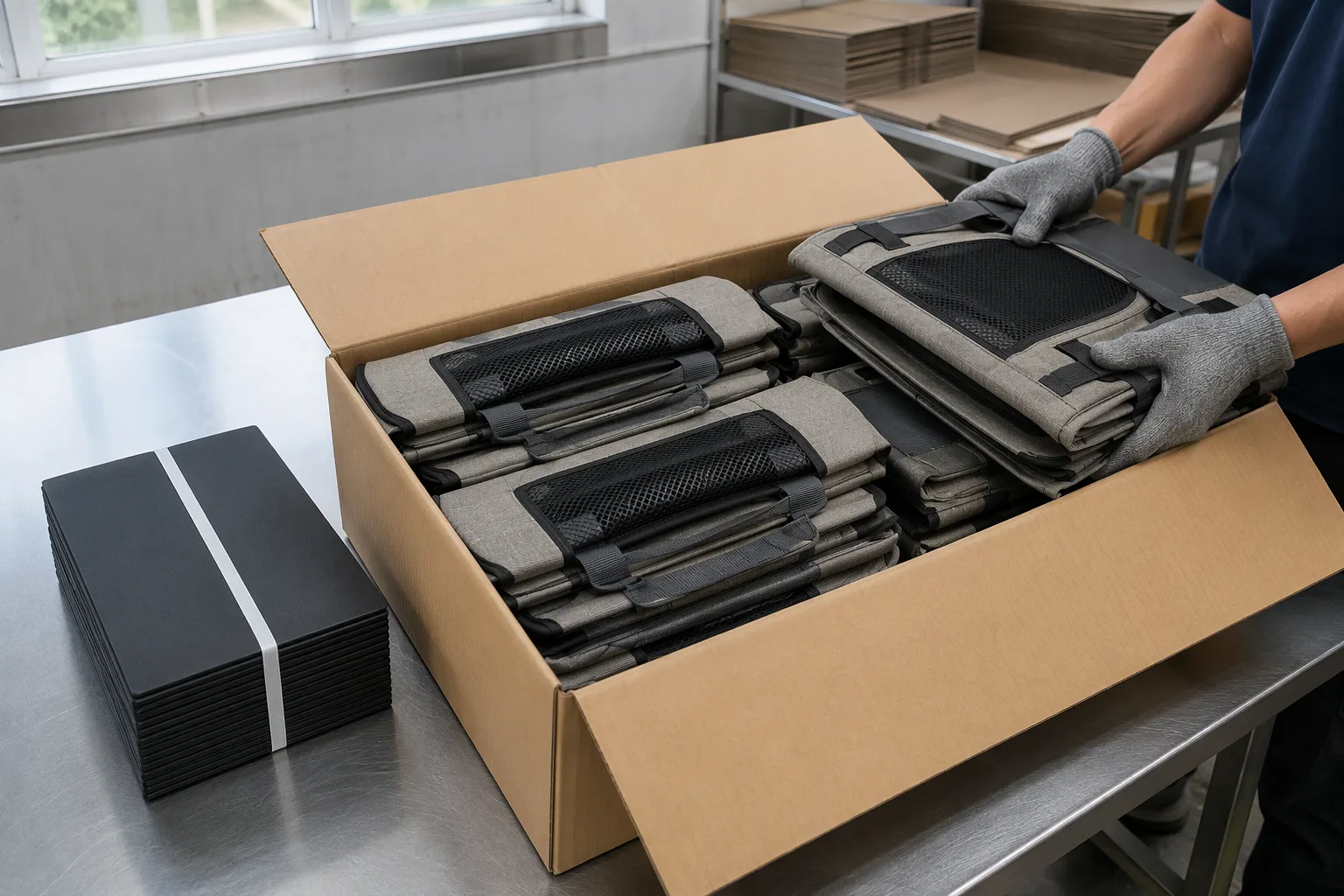
Compression Levers Inside the Bag
Once the structural position is set, volume is removed through a sequence of smaller decisions. These are the levers that a manufacturer can pull without changing the product's specification, and they should be applied in order of cost.
Nesting. Carriers nest well when their side walls are soft and their end profiles taper. Nesting two or three units reduces the stack height per unit by 25–40% compared with cartons of single units, and it costs nothing but a nesting instruction. The constraint is compression load: nested bags bear weight on each other's hardware, so zip pulls, D-rings, and mesh panels need to be oriented to avoid point loading.
Base board removal. Removing and bundling base boards is the most reliable single lever. Boards should be packed in bundles of 20–50, edge-aligned, in their own sleeve, and labelled per master carton so that the receiving warehouse can match boards to bags without opening every carton. A missing board bundle turns a freight saving into a customer complaint.
Handle and strap folding. Handles, shoulder straps, and webbing loops are the features most often responsible for a carton being 30 mm taller than the bag. Folding webbing flat against the panel, and orienting padded handles along the bag's long axis, typically recovers the difference. Where a handle cannot be folded — a rigid bridge on a wheeled carrier — the carton depth must accommodate it, and the carton geometry should be designed around that dimension rather than around the bag body.
Hardware orientation. Buckles, wheels, feet, and frame ends must be positioned so that they sit in the void between adjacent units rather than on top of each other. A simple packing diagram, photographed at the pilot run, prevents the drift that occurs when a line is re-staffed.
Air evacuation from inflatable or padded elements. Some carriers include inflatable bolsters, air-filled lumbar cushions, or sealed padded chambers. Shipping them inflated wastes volume; shipping them deflated requires a valve design that allows re-inflation without a pump. Where deflation is used, the valve and the re-inflation instruction become part of the specification.
Compression straps and vacuum-assisted packing. A compression strap around a folded bag can remove another 10–15% of volume, and vacuum-assisted packing can remove more, but both increase crease risk and both require a recovery standard. Vacuum packing in particular changes the bag's presentation on arrival and should be reserved for products where the buyer has accepted a recovery process.
Carton-Level Geometry: Where the Real Multiplier Sits
Unit-level gains are capped by the product. Carton-level gains are capped only by arithmetic, and this is where most programmes leave money on the floor.
A carton should be designed to the packed unit, not selected from a catalogue. Three numbers determine the design: the unit's packed length, width, and height; the number of units per carton; and the pallet and container dimensions the carton must divide into.
Start with the unit and work outward. If a collapsed carrier packs to 340 × 260 × 55 mm, a 6-unit carton at 2 × 3 nesting occupies roughly 340 × 520 × 165 mm internally. Adding 5 mm wall and a 10 mm cushioning allowance gives an external carton near 360 × 540 × 185 mm, or 0.036 m³. Compare that with a stock carton of 400 × 600 × 300 mm at 0.072 m³ holding the same six units: identical product, double the freight. The stock carton is not a neutral default. It is a 100% volumetric penalty applied for convenience.
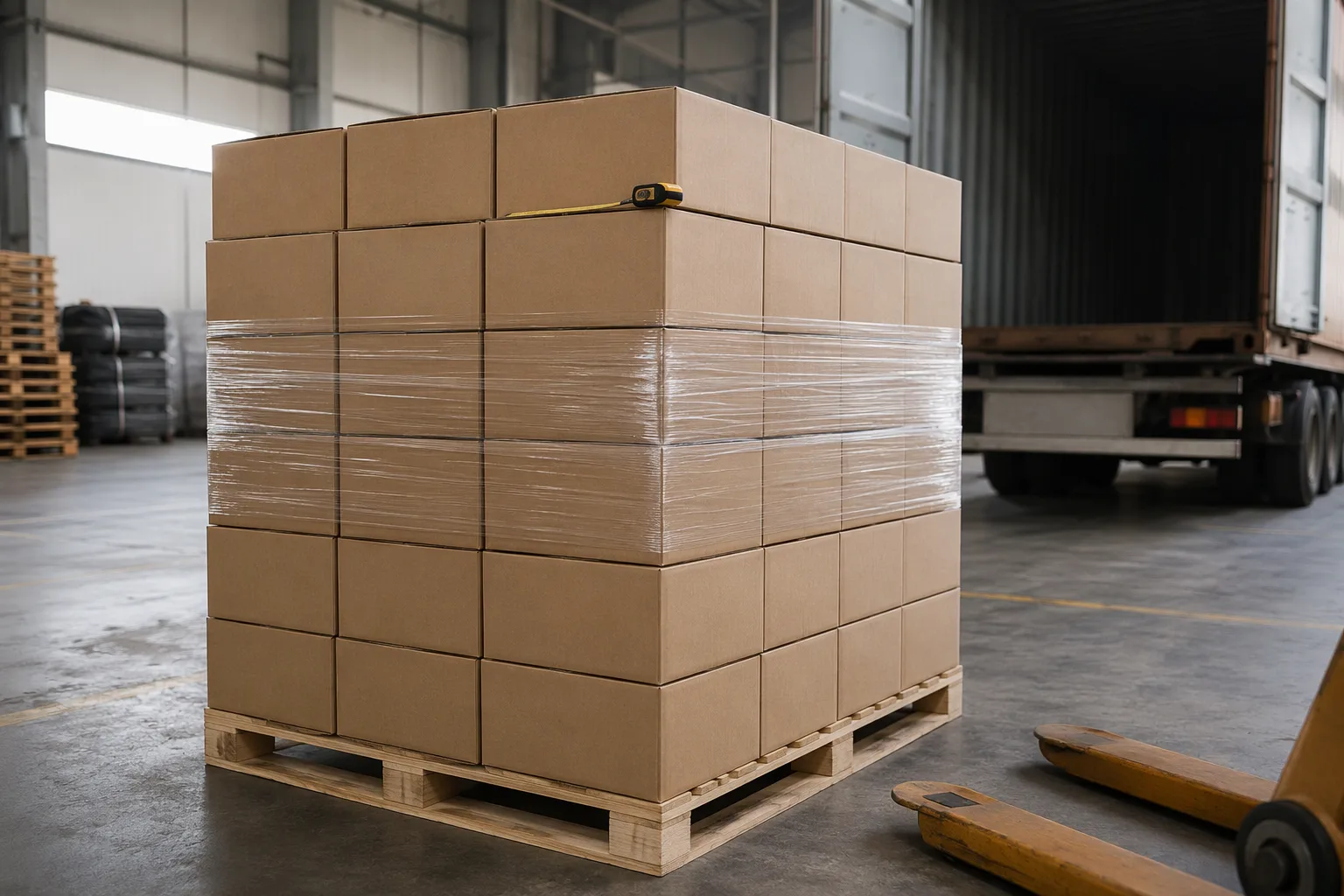
Then check the carton against the pallet. Standard pallets are 1,200 × 1,000 mm (industrial) and 1,200 × 800 mm (Euro). A 360 × 540 mm carton fits 6 per layer on a 1,200 × 1,000 pallet with 1,056 mm of the 1,200 mm length used and 1,080 mm of the 1,000 mm width used — clean, with minimal overhang. A 400 × 600 mm carton fits 5 per layer with 200 mm of length wasted, which is a 17% loss on every layer of every pallet.
Finally check the pallet against the container. A 40HQ's internal width is about 2,350 mm, which accepts two 1,200 mm pallets side by side with a small tolerance. A pallet plan that exceeds that width by 20 mm ships as a single row, halving container utilisation. The rule is to design carton dimensions backward from the container, through the pallet, to the unit — not forward from the unit and hope.
| Carton plan | Units per carton | External volume | Units per m³ | Note |
|---|---|---|---|---|
| Stock carton 400 × 600 × 300 | 6 | 0.072 m³ | 83 | 2× the necessary volume, 5 per pallet layer |
| Designed carton 360 × 540 × 185 | 6 | 0.036 m³ | 167 | Fits 6 per pallet layer, no overhang |
| Designed carton, 12 units, two-tier | 12 | 0.070 m³ | 171 | Fewer cartons to handle, higher stack load |
Board grade follows from the stack. A carton that will be stacked six high in a container must survive the compression load of the five above it, plus humidity derating for a 30–40 day ocean transit. A common failure mode in volume-reduction programmes is shrinking the carton while keeping the board grade, which improves the cube and destroys the stack. If the carton gets smaller, the load per unit area usually rises, so the board grade often needs to go up rather than stay flat. Use a compression (BCT) calculation with a safety factor of at least 3 for ocean freight and verify with a box compression test on the pilot run.
The Volumetric Penalty in Numbers
A worked example makes the trade visible. Assume a soft-sided pet carrier at a packed volume of 0.062 m³ per unit in its original packing, 500 units, and a shipped density of 110 kg/m³. The shipment books 31 m³.
Now assume a redesign that removes the base board, flattens the handles, and re-cuts the carton: packed volume per unit falls to 0.031 m³. The same order books 15.5 m³. At an illustrative ocean LCL rate of USD 55 per cubic metre, the saving is USD 852 on one shipment — and the same saving repeats on every subsequent order without further engineering cost. On air freight at an illustrative USD 4.20 per chargeable kilogram, the volumetric weight of the original shipment is 31,000,000 ÷ 6,000 ≈ 5,167 kg against an actual weight of about 3,410 kg; the redesigned shipment is roughly 2,583 kg volumetric against 3,410 kg actual, at which point actual weight governs and the freight falls by around 44%.
The pattern is consistent: below a certain density, volume reduction is the only freight lever that matters; above it, weight becomes the constraint and further compression buys nothing. That threshold should be calculated per SKU before any engineering time is spent.
What Cannot Be Compressed
Volume programmes acquire a reputation for damaging products because someone always tries to compress the wrong thing. The following must be treated as fixed unless the buyer formally accepts a product change.
- Structural boards and frames that carry the load of the animal and the bag's own rigidity in use.
- Wheel housings and axle mounts, which are hard points and cannot be deformed without affecting rolling performance.
- Ventilation panels and mesh whose apertures must remain open and undistorted.
- Zipper coil and sliders — a coil that is compressed into a tight radius takes a set and can fail to run smoothly at the curve.
- Padded handles and shoulder straps whose foam loses loft when stored under sustained compression.
- Certified safety features — restraint straps, seat-belt loops, locking mechanisms — where any deformation invalidates the test basis.
- Coated and laminated fabrics at fold lines, where a sharp crease can crack the coating and create a leak path.
The engineering response is to compress around these features rather than through them: orient hard points into voids, keep fold lines away from coating stress points, and design cushioning so that protection is provided by the carton structure rather than by dead space.
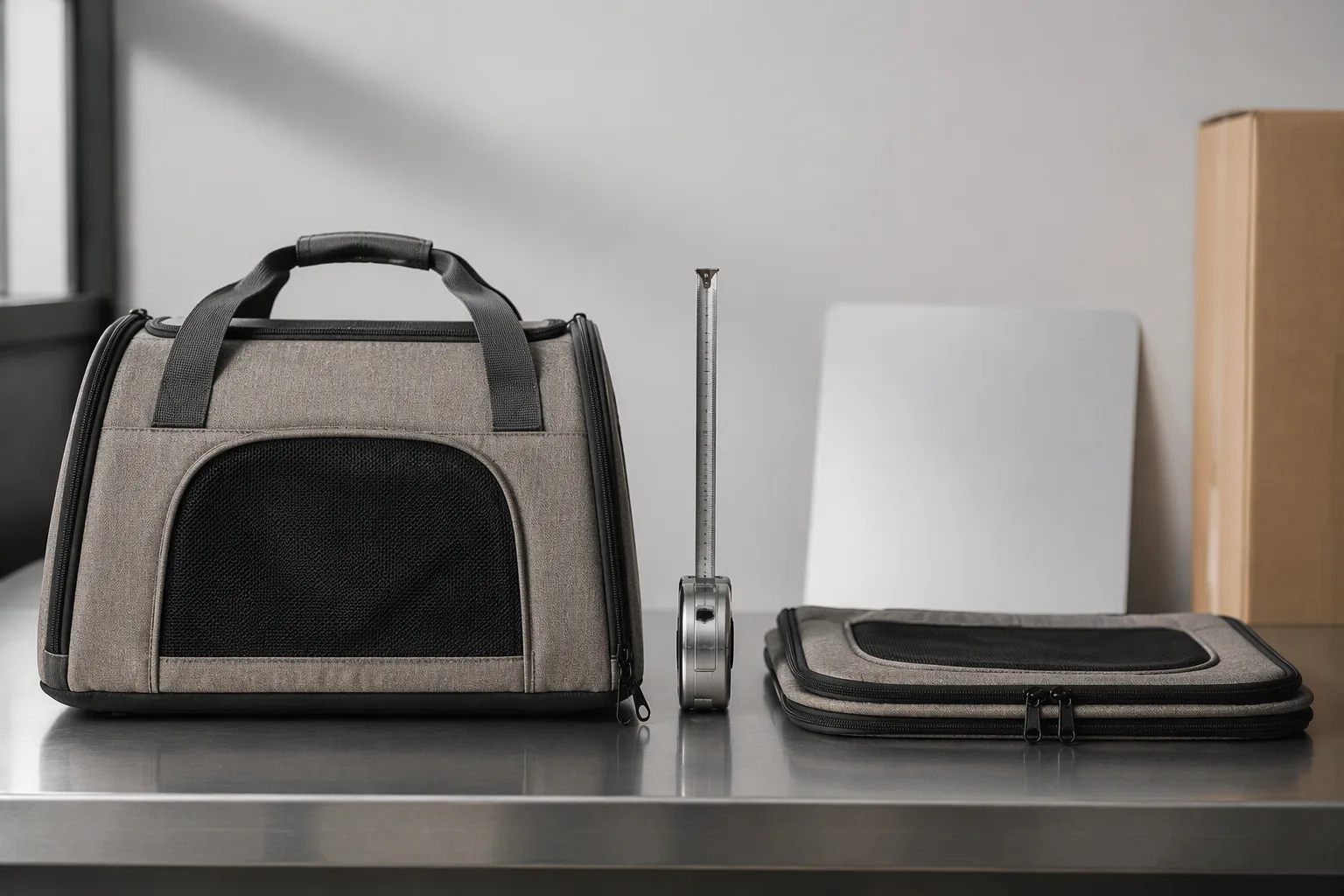
Recovery at Destination: The Standard That Makes Compression Acceptable
Compression is only legitimate if the bag returns to its approved form. That requires an explicit recovery standard, written into the specification, and validated on a shipped sample — not on a bag folded at the factory for five minutes.
Define the standard in four parts:
Recovery time. How long after unpacking the bag must reach its dimensional tolerance — commonly 24 hours at 20–25 °C, sometimes 48 hours for heavily laminated materials in cold conditions.
Dimensional tolerance. The permitted deviation from the approved sample in length, width, height, and base flatness, measured after the recovery period.
Crease acceptance. Which creases are acceptable, where, and at what severity. Photographic standards are the only reliable way to communicate this; language such as "minor creasing" is not a specification.
Recovery method. Whether the bag recovers unaided, requires shaping by hand, requires the base board to be reinserted, or requires heat — and if heat, at what temperature and for how long, because a retailer will not steam a carrier before putting it on a shelf.
Test the standard the way the product will actually travel. Pack a pilot carton, subject it to the intended transit profile, open it at the destination, and measure at 0, 24, and 48 hours. If the bag does not recover, the compression method is wrong — not the standard.
Writing It Into the Purchase Order
Volume clauses that live in emails are not enforceable. They belong in the packing specification attached to the purchase order, with measurable fields and a defined inspection point.
| Clause | What to state | Inspection point |
|---|---|---|
| Packed unit volume | Target and maximum per unit, method of measurement | Pre-shipment, 5 units per carton |
| Master carton dimensions | Internal and external, with tolerance ±3 mm | Carton approval before production |
| Units per carton | Fixed count, no substitution | Pre-shipment count |
| Cube utilisation | Minimum percentage of carton internal volume occupied | Pilot run and pre-shipment |
| Board grade | Flute, GSM, and BCT target | Carton approval with test report |
| Pallet plan | Layers, units per layer, stack height, overhang limit | Pre-shipment, photographed |
| Compression method | Base board removal, handle fold, nesting diagram | Pilot run, photographed |
| Recovery standard | Time, tolerance, crease acceptance | Shipped sample test |
| Documentation | Packing list per carton, board bundle labels | Pre-shipment audit |
Two clauses do most of the work in practice. The first is a fixed carton dimension with a tight tolerance, because carton substitution is the most common source of quiet volume loss — a factory that runs out of the specified carton will use the nearest available size and rarely report it. The second is a photographed packing diagram, because packing methods erode when a line is re-staffed, and a photograph survives staff turnover better than an instruction sheet.
Validating the Change Before It Ships
A volume change is a product change until proven otherwise. Validate it with the same discipline as any other specification change, at the pilot stage rather than after the container is loaded.
Carton compression test. Verify the board grade against the calculated stack load with humidity conditioning. A carton that passes in a dry lab and collapses in a humid container is a common and expensive result.
Drop and vibration test. The compressed carton has less cushioning margin, so the drop test must be run on the new packing, not inherited from the old one. ISTA 1A or 3A sequences are the usual references for parcel and palletised distribution respectively.
Recovery test. As described above, on a sample that has been through the simulated transit.
Count and label audit. Confirm that nesting counts, board bundle counts, and carton labels reconcile, because volume programmes create exactly the kind of multi-component packing that produces short-shipments.
Freight re-quote. Confirm the new dimensions with the forwarder before the first shipment. Carton dimensions that sit just above a rounding threshold can erase the saving — a carton at 0.1004 m³ may be billed as 0.11 m³, which is why dimension targets are usually set just below round numbers.
Building the Freight-per-Unit Model
Volume targets stick when they are translated into a per-unit freight figure that the buyer can see. The model is simple enough to run in a spreadsheet and specific enough to settle arguments about whether a structural change is worth making.
The calculation chain is: packed unit volume → units per carton → carton external volume → cartons per pallet and per container → freight per shipment → freight per unit. Run it for the current packing and for each candidate change, and the ranking of levers becomes obvious.
| SKU | Packed unit volume | Units per carton | Carton volume | Units per m³ | Freight per unit (USD, illustrative) |
|---|---|---|---|---|---|
| Soft carrier, current | 0.062 m³ | 6 | 0.072 m³ | 83 | 0.66 |
| Soft carrier, base board removed | 0.031 m³ | 6 | 0.036 m³ | 167 | 0.33 |
| Wheeled trolley, current | 0.148 m³ | 2 | 0.156 m³ | 13 | 1.58 |
| Wheeled trolley, handle folded | 0.121 m³ | 2 | 0.128 m³ | 16 | 1.29 |
| Hard crate, current | 0.230 m³ | 1 | 0.245 m³ | 4 | 2.45 |
Two refinements make the model trustworthy. First, use the forwarder's actual rounding rules, because a carton at 0.0724 m³ billed as 0.08 m³ changes the ranking of levers. Second, include the non-freight costs the change introduces — board bundles, extra packing labour, additional carton handling — so the comparison is total landed cost rather than freight alone. A change that saves USD 0.33 per unit in freight but adds USD 0.10 in packing labour is still worth doing; a change that adds USD 0.40 in labour is not, and only the full model shows the difference.
Decision Rules by Bag Type
Volume strategy is not uniform across a product range. The following rules reflect where the hard points sit and how much the product can tolerate.
| Bag type | Dominant hard point | Primary lever | Secondary lever | Caution |
|---|---|---|---|---|
| Soft-sided carrier | Base board, handles | Remove and bundle base board | Fold handles along the long axis | Fold memory in coated fabric |
| Wheeled trolley carrier | Wheel housing, telescopic handle | Fold or detach the handle assembly | Nest two units per carton | Never compress the axle mount |
| Backpack carrier | Frame sheet, shoulder harness | Ship frame sheet flat and separate | Compress harness against the back panel | Harness foam takes a set under load |
| Sling and pouch carrier | None significant | Roll or sleeve, high nest count | Reduce carton to the rolled diameter | Crease risk is the main constraint |
| Airline cabin carrier | Rigid shell, ventilation | Carton fit and pallet geometry only | Nest two shells rim to rim | Voids inside the shell must be filled |
| Hard travel crate | Moulded shell, door mechanism | Pallet and container geometry | Ship doors unassembled where allowed | Certification basis may forbid disassembly |
The pattern behind the table is that volume work migrates to carton geometry as the product becomes more rigid. A programme that tries to compress a moulded crate wastes months; a programme that ignores the base board on a soft carrier wastes the single largest available gain.
Ten Failure Modes That Recur
Most volume programmes fail in the same handful of ways. Knowing them in advance is cheaper than discovering them in a container.
- The stock carton substitution. Production runs out of the specified carton and uses a larger one without notification, adding 10–40% volume and no visible defect.
- Nesting count drift. The line nests two units instead of three, and the carton count is short at destination.
- Board bundle short-shipment. Base boards are removed but not counted, and the customer receives bags that cannot be assembled.
- Carton shrunk, board grade unchanged. Cube improves, stack collapses, and the bottom layer arrives deformed.
- Drop test inherited rather than repeated. The old packing's test result is reused for a packing with less cushioning margin.
- Rounding threshold loss. The new carton measures just over a billing increment and the saving disappears at the invoice.
- Pallet overhang after re-cutting. Carton grows 10 mm in one dimension, the pallet no longer fits two abreast, and container utilisation halves.
- Unlabelled hard-point orientation. Hardware is packed point-to-point and arrives with compressed wheels or bent D-rings.
- Recovery standard written in adjectives. "Minor creasing acceptable" produces a dispute on the first shipment in cold weather.
- Volume target set without a density check. The programme compresses a product that was already weight-limited, spending engineering time for no freight benefit.
Each of these has a cheap control: a carton dimension tolerance in the purchase order, a photographed packing diagram, a reconciliation count, a compression test, a repeated drop test, and a density calculation done before the programme starts.
Running the Programme: Sequence and Gates
A volume reduction programme follows the same gates as any other specification change, and trying to compress the sequence is how products get damaged.
Gate 1 — Baseline measurement. Measure every SKU at the three stages described earlier, calculate cube utilisation and compression headroom, and identify the hard-point envelope. No proposals before this is complete.
Gate 2 — Lever ranking. Model the freight effect of each available lever, including the non-freight costs it introduces, and rank by saving per unit of engineering effort. Present the ranking to the buyer with the product risk noted for each item.
Gate 3 — Pilot packing. Pack a pilot carton using the intended method, photograph the packing diagram, and run the compression, drop, and recovery tests. This is the gate at which most programmes discover that their best lever damages something.
Gate 4 — Buyer sign-off on recovery. The buyer accepts the recovery standard in writing — time, tolerance, crease acceptance, method — before production packing begins. Without this, the first container will be argued about.
Gate 5 — Production packing audit. Audit the first production cartons against the specification: dimensions, count, board grade, pallet plan, labels. Photograph and retain. This audit is what catches stock carton substitution before it repeats for a season.
Gate 6 — Freight re-quote and post-shipment review. Confirm the dimensions with the forwarder, compare the invoiced freight against the model, and record the actual density achieved. The comparison closes the loop and gives the next SKU a better starting point.
Frequently Asked Questions
Can packing volume be reduced after the production sample is approved? Yes, but only as a formal change with the same controls: the packing specification is revised, the pilot tests are repeated, and the buyer accepts the recovery standard. Changing how an approved bag is packed without re-testing transfers risk to the shipment, and the failure appears at the customer's warehouse rather than at the factory's.
How much volume reduction is realistic without changing the product? For soft-sided carriers with a removable base board and folding handles, 40–50% is routinely achievable purely through packing method and carton re-cutting. For rigid moulded products, expect single digits, mostly from carton fit and pallet geometry. Anything above 50% usually requires a structural change or a vacuum-assisted method with a negotiated recovery standard.
Does compressing bags increase damage rates? It increases the risk, and the risk is manageable rather than avoidable. Damage rises when cushioning margin is consumed without re-testing, when hardware is packed point-to-point, and when stack load increases while board grade stays flat. Programmes that repeat the drop and compression tests on the new packing typically see damage rates fall, because the carton is better fitted and the product moves less inside it.
Is vacuum packing acceptable for pet carriers? For direct-to-consumer channels, often yes, provided the recovery standard is written and the bag recovers without heat. For retail, usually no: a vacuum-flattened carrier does not merchandise well and store staff will not wait 48 hours for it to recover. It is a channel-specific decision, not a universal one.
What is the most common reason a volume target is missed? Carton substitution. The specification is correct, the packing diagram is correct, and the cartons that arrive are not the cartons that were approved. A dimension tolerance in the purchase order plus a first-article measurement at every production run is the control that actually holds the target.
Should packing volume appear on the specification sheet or the purchase order? Both. The specification sheet states the engineering target and the measurement method; the purchase order states the enforceable dimension, count, and board grade with tolerances and an inspection point. The first aligns the design; the second protects it during production.
Conclusion
Packing volume is decided by structure and geometry, not by how hard someone presses on the bag at the packing table. The manufacturers who control it treat volume as a specification: they measure the packed unit before proposing anything, decide collapsibility at the pattern stage rather than after approval, design cartons backward from the pallet and the container, refuse to compress the features that carry the product's function, and write a recovery standard that can be measured after a real transit.
Done in that order, the results are ordinary rather than dramatic — a soft carrier that ships at 167 units per cubic metre instead of 83, a wheeled trolley that gains 20% from folding a handle, a pallet plan that fills a 40HQ instead of wasting a row. None of those changes is inventive. Each of them converts, shipment after shipment, into freight that is paid once rather than twice: once for the product, and once for the air around it.