How Do You Choose Mesh and Ventilation Panels for Pet Carriers?
- Why Ventilation Decides Acceptance
- What Ventilation Has to Deliver
- Mesh Types in a Carrier Programme
- Aperture Size and Safety
- Panel Placement and Area
- Strength, Load Path and Framing
- Edge Treatment and Assembly
- Openness, Heat and Visibility
- Testing Ventilation Panels
- Specifying Mesh for Production
- Sourcing and Cost Drivers
- Durability, Cleaning and Service Life
- Safety, Comfort and Clear Communication
- Common Mesh Failures and Prevention
- A Practical Selection Sequence
- Matching Mesh to Carrier Types
- FAQ
Ventilation is the one feature of a pet carrier that the animal experiences before anything else. Before the buyer judges a stitch line or a handle, the pet is deciding whether the bag is bearable — and that judgement is made on airflow and sightlines.
Mesh is how the industry answers that requirement, and it is also the most common place where a carrier fails in service. A panel that is specified only as "mesh" leaves aperture, yarn, coating, edge treatment and strength undecided, and each of those decides whether the panel survives a season.
This guide covers what ventilation has to deliver, the mesh types that appear in carrier programmes, how aperture size interacts with safety, where panels belong and how much of the surface they should occupy, how mesh carries load and how the framing transmits it, how openness affects heat and visibility, what to test before bulk, how to write the specification, what drives cost, and how mesh behaves over time.
Why Ventilation Decides Acceptance
A carrier is a small enclosed space, and the animal inside has no way to change its conditions. That asymmetry makes ventilation a welfare requirement rather than a comfort feature.
Airflow Into and Out of the Bag
Air moves through openings, so a carrier with panels on one face only circulates less than its total open area suggests. Cross-ventilation, with openings on two opposing faces, moves air far more effectively than the same area concentrated on one side.
Placement therefore matters as much as aperture size, and it should be decided in the pattern rather than adapted afterwards.
Sightlines and Stress
Animals settle faster when they can see out. An opaque carrier with a small window keeps the animal in a darkened space, which raises stress on unfamiliar journeys and increases vocalisation.
Mesh that provides a wide view while restricting exit satisfies both the animal's need to observe and the owner's need for containment.
Containment and Claw Resistance
Every opening is also a potential escape route, and mesh is the weakest part of the envelope. Dogs and cats test panels with paws, claws and teeth, and the panel that fails first is usually the one with the largest apertures and the lightest yarn.
Containment strength is therefore a design input, not a quality-control afterthought.
| Ventilation requirement | Primary design response | Failure if neglected |
|---|---|---|
| Air exchange | Openings on opposing faces | Heat build-up |
| Sightlines | Wide screened panel | Stress and vocalising |
| Containment | Controlled aperture | Escape or damage |
| Structural integrity | Framed and bound panel | Panel deformation |
| Durability | Suitable yarn and coating | Tearing and snagging |
| Cleanability | Smooth, washable screen | Soiling and odour |
What Ventilation Has to Deliver
Four requirements have to be satisfied at once, and they pull in different directions.
Openness
Openness is the share of the panel that is actually open, and it decides how much air passes for a given panel size. A tightly woven screen with small apertures is strong but restricts flow, while an open screen moves air but offers less containment.
The balance is set by the animal's size and the transport conditions, not by a universal percentage.
Strength
The panel must resist a sustained push from inside and a puncture from outside. Aperture size, yarn thickness, weave and coating all contribute, and the weak point is usually the joint between the panel and the surrounding material.
Strength should be specified for the assembled panel, not for the raw roll.
Visibility
Visibility is a perception requirement that also has a practical side, because owners check on the animal through the same panel. A screen that is too dense keeps the interior dark and defeats both purposes.
Colour affects this more than most specifications acknowledge: a dark screen reads as closed even when its apertures are wide.
Durability Over the Product Life
The panel is exposed to claws, zips, buckles and repeated folding. Durability is therefore about snag resistance and edge integrity rather than about the initial appearance of the roll.
A panel that looks identical to a better one at sampling can behave differently after fifty cycles of use.
| Requirement | Pushes toward | Tension with |
|---|---|---|
| Openness | Larger apertures | Containment strength |
| Strength | Heavier yarn, tight weave | Weight and airflow |
| Visibility | Wider panel, lighter colour | Structural support needed |
| Durability | Coated, bonded screen | Cleanability and weight |
| Cleanability | Smooth, non-absorbent screen | Grip of the coating |
| Cost | Lighter, uncoated screen | Service life |
Mesh Types in a Carrier Programme
Most programmes settle on one or two screens, and the difference between them is mostly in how the yarn is formed and finished.
Woven and Knitted Mesh
Woven mesh forms apertures from interlaced warp and weft yarns, which gives a stable, predictable aperture and a firm handle. Knitted mesh forms loops, which allows stretch and conforms around curves but varies in aperture as it stretches.
Woven screens are the default where aperture control matters, while knits are used where the panel must follow a strongly shaped shell.
Coated and Bonded Screens
A coating stabilises the weave, improves abrasion resistance and gives the screen a firmer feel. The trade is in airflow and cleanability, because a coating closes part of the aperture and adds a surface that can wear.
Where a coating is used, the requirement should be stated as the behaviour needed rather than by coating name.
Screening Fabric and Honeycomb Structures
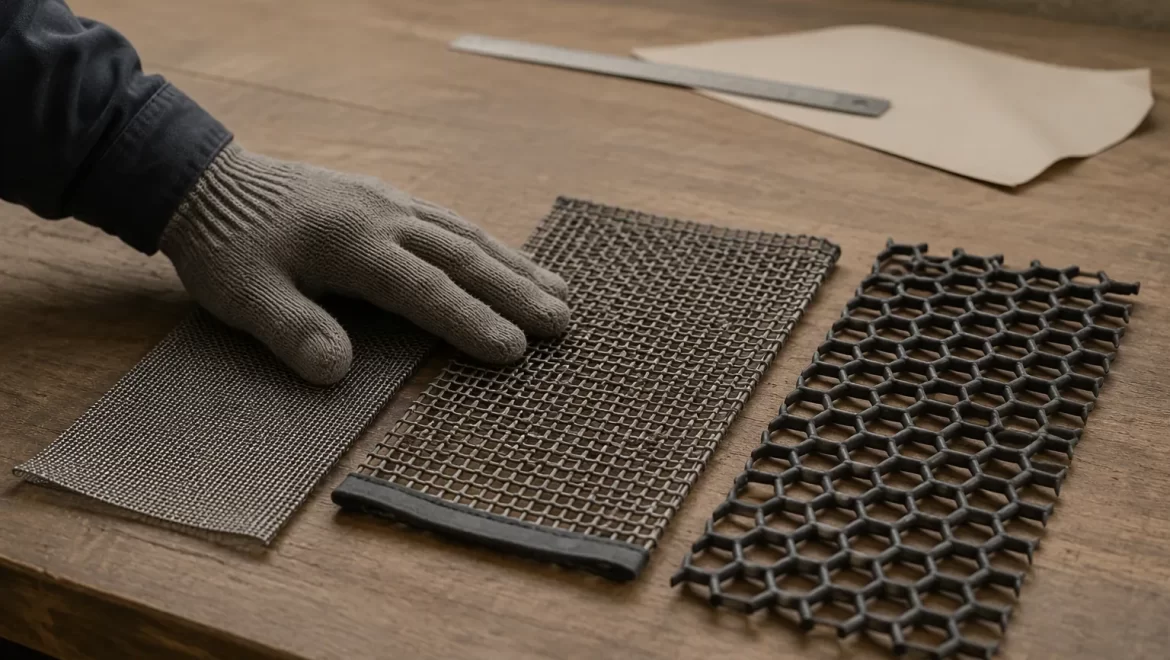
Fine screening fabric delivers high visibility with small apertures, which suits small animals and insect protection. Honeycomb and hexagonal structures offer a distinct visual language and good openness, but their corners concentrate stress and need careful edge treatment.
Both are legitimate choices where the design intent supports them.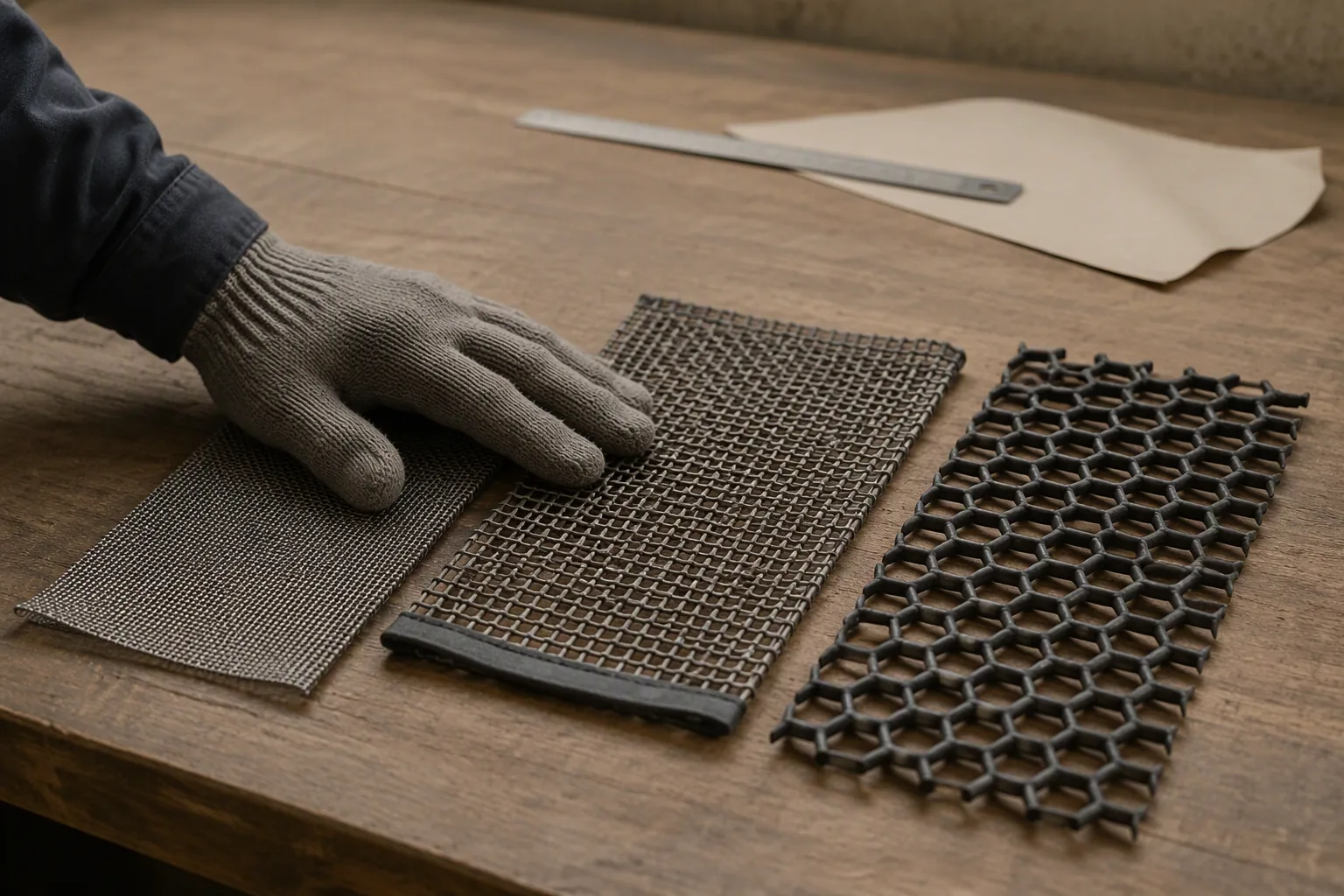
Aperture Size and Safety
Aperture is the single number that decides how a panel performs for containment, airflow and durability at the same time.
Matching Aperture to the Animal
The useful test is whether a paw or a muzzle can pass through or become caught. Small animals need smaller apertures for containment, while larger animals need less restriction but far more strength.
Aperture should be confirmed against the intended animal size rather than applied uniformly across a range that serves several sizes.
Claw and Tooth Behaviour
Claws catch in apertures that are large enough to admit a toe but small enough to trap it as the paw turns. Teeth work differently, concentrating force on a small area until the yarn yields or the coating cracks.
Both behaviours argue for rounded, coated yarn and for apertures outside the trapping range.
Escape and Deformation
The panel deforms before it fails, and deformation is what opens a gap at the frame. Where the panel is only sewn to the shell lining without framing, a determined animal can push the fabric until an aperture widens enough to pass.
Framing, binding and reinforced attachment points are the controls that keep deformation local.
| Concern | Aperture direction | Supporting measure |
|---|---|---|
| Small animal containment | Smaller apertures | Firmer weave |
| Large animal strength | Heavier yarn | Framed panel |
| Claw trapping | Rounded aperture profile | Coated yarn |
| Tooth damage | Denser weave | Reinforced corners |
| Deformation | Moderate aperture | Bound edge and frame |
| Airflow | Larger apertures | Two opposing panels |
| Visibility | Lighter colour | Wider panel |
| Cleaning | Smooth yarn | Non-absorbent finish |
Panel Placement and Area
Where a panel sits changes how effective the same square centimetres of opening will be.
Opposing Faces for Cross Flow
Two panels on opposing faces create a path for air to move through the bag rather than only into it. This is the cheapest improvement available in ventilation design, because it uses the same material area more effectively.
Panels on adjacent faces help, but they produce less through-flow than a true opposing pair.
Door and End Panels
The door is usually the largest available opening, which makes it the logical place for a full screen. End panels add sightlines from the side and are often the first place a buyer looks through.
Where a door is screened, the zip or closure becomes part of the ventilation assembly and must not block the opening when closed.
Roof and Side Panels
Roof screens release warm air that rises inside the bag, which is useful in warm conditions and in vehicles. Side panels contribute visibility more than airflow.
Adding panels beyond two or three faces increases cost and assembly complexity faster than it increases comfort, so the count should be justified by the transport conditions the carrier is designed for.
| Panel position | Main benefit | Design caution |
|---|---|---|
| Front door | Maximum open area | Closure must not block it |
| Rear or opposite face | Cross ventilation | Needs framing support |
| Side panels | Sightlines | Less airflow benefit |
| Roof panel | Heat release | Water entry in rain |
| End caps | Side visibility | Small area only |
| Roll-up flap | Adjustable opening | Hardware adds weight |
| Two-face only | Best value | Restricted sightlines |
| Full wrap screen | Maximum openness | Weakest structure |
Strength, Load Path and Framing
Mesh is strong in tension and weak when unsupported, so the panel is only as good as the structure that holds it.
Tensile Behaviour and Yarn
Load in a screen is carried by the yarns, and it concentrates at the points where the panel meets the shell. A denser weave distributes load across more yarns and deforms less under a sustained push.
Yarn thickness raises strength but also reduces openness, which returns the decision to the aperture table.
Puncture and Tear Resistance
Puncture resistance depends on the force needed to break the yarn, while tear resistance depends on how easily a break propagates. A screen can be strong in one and weak in the other, and the failure seen in service is usually a tear that runs from a small break.
Where an animal is likely to bite, tear resistance should be specified explicitly rather than assumed from tensile strength.
How the Frame Carries Load
Framing converts a local push into a distributed load, and it also protects the seam from repeated flexing. A bound edge, a piping cord or a reinforcing strip all achieve this at different cost and weight.
The attachment should be continuous around the panel rather than at corners only, because an interrupted attachment lets the screen bulge between the fixing points.
| Load case | Weak point | Control |
|---|---|---|
| Sustained push | Panel centre | Denser weave or frame |
| Corner pull | Panel corner | Reinforced corner patch |
| Bite | Single yarn | Tear-resistant weave |
| Snag | Edge zone | Bound edge |
| Repeated flex | Seam line | Piping or tape |
| Zip abrasion | Along closure | Protective tape |
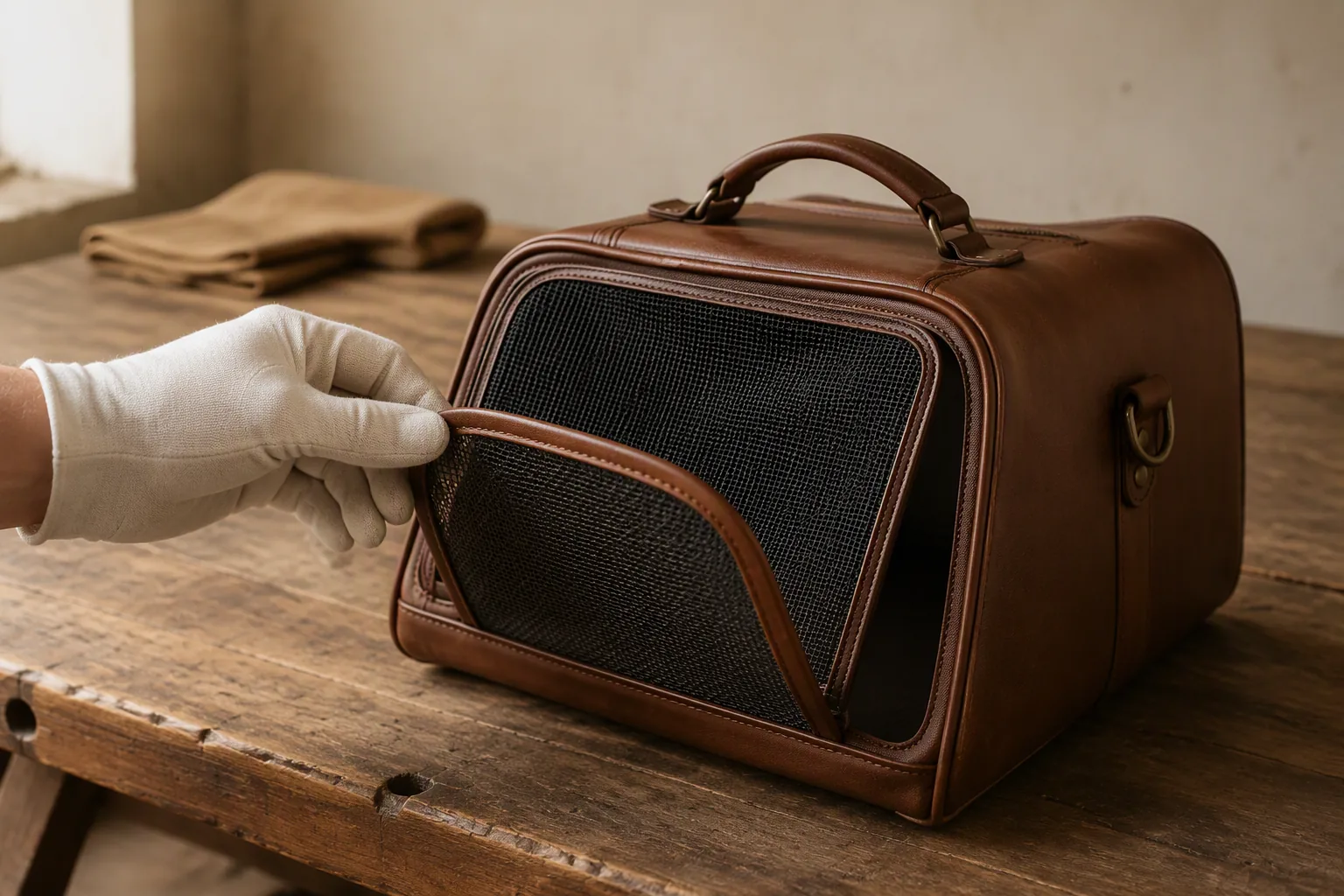
Edge Treatment and Assembly
Most mesh failures begin at the edge, where the screen is cut and joined to the rest of the bag.
Binding and Piping
Binding folds a strip of material over the raw edge, which protects the yarns and gives the assembler a consistent line to follow. Piping adds a raised cord that absorbs contact and stiffens the boundary.
Both are simple operations, and both are frequently omitted to save time at the cost of the panel's life.
Which Way the Screen Faces
A screen fitted with its coated side outward resists abrasion, while the same screen reversed presents the coating to the animal. The orientation should be stated on the drawing, because it changes both durability and feel.
Where the panel is reversible, the difference is visible in the finished bag and should be checked at first-article approval.
Sewing Parameters for Mesh
Mesh needs a smaller needle and lighter tension than leather, or the stitches perforate the yarns and create a line of weakness along the seam. A suitable presser foot and a stabilising tape behind the seam reduce distortion.
Sewing trials should be part of the sampling stage, since a mesh substitution changes the required parameters.
| Assembly decision | Benefit | Risk if ignored |
|---|---|---|
| Bound edge | Protects yarns | Edge fraying |
| Piping | Absorbs contact | Deformation at seam |
| Continuous attachment | Distributed load | Bulging between fixes |
| Stated face orientation | Predictable wear | Inconsistent durability |
| Matching needle and tension | Intact yarns | Perforated seam |
| Stabilising tape | Flat seam | Puckered panel |
| Corner reinforcement | Resists pull | Corner tear |
| Rolled opening | Comfortable contact | Abrasion on animal |
Openness, Heat and Visibility
Ventilation is easier to design once the open area is treated as a measurable quantity rather than a visual impression.
Measuring Open Area
Open area can be estimated from aperture dimensions and the spacing between yarns, which gives a comparison between two candidate screens before any sampling. Comparing panels on this basis shows quickly whether a design has enough opening to move air.
The calculation ignores restriction from the interior, so it should be read as an upper bound rather than a prediction.
What Blocks Airflow Inside
Padding, lining panels, inner cushions and folded flaps all sit behind the screen and reduce the effective opening. A carrier with generous mesh and a thick filling behind it ventilates less than its screen suggests.
Where a pad sits against a panel, the design should either move the opening or reduce the blockage.
Heat in Vehicles and Warm Climates
Standing air inside a car or a warm room is the hardest condition a carrier faces, and airflow through the bag is what limits the interior temperature rise. Roof openings and opposing panels do the most work here.
Material colour also matters, because a dark shell absorbs more heat than a light one and radiates it inward.
| Factor | Effect on effective airflow | Control |
|---|---|---|
| Aperture and spacing | Sets upper bound | Screen selection |
| Padding behind panel | Blocks flow | Reposition or thin |
| Lining layers | Restrict passage | Open the lining |
| Dark shell colour | Raises interior heat | Lighter exterior |
| Panel count | Adds paths | Two opposing faces |
| Roof opening | Releases rising heat | Add roof screen |
| Occupancy | Reduces free volume | Size the carrier |
| Flap position | Adjustable | Roll-up closure |
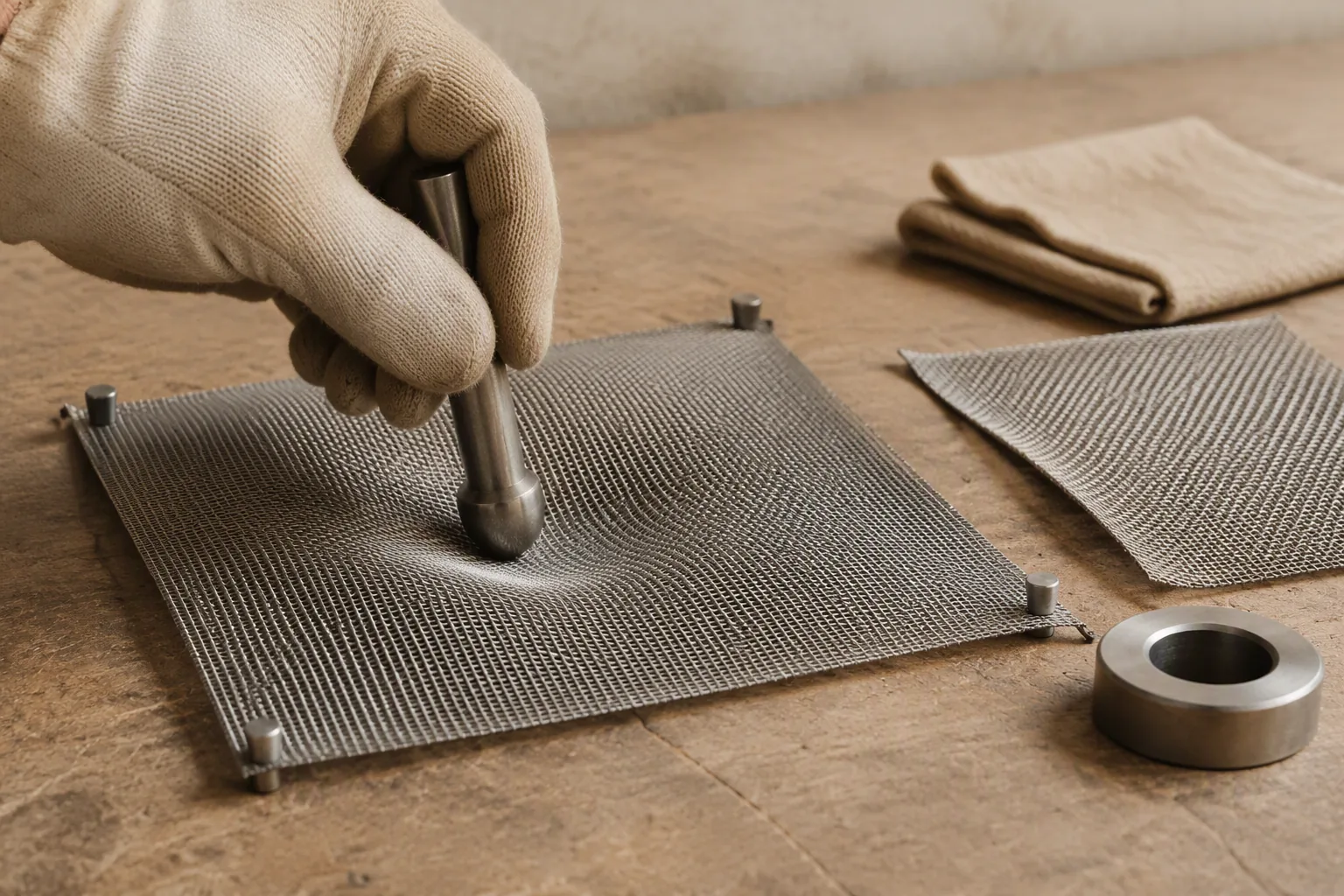
Testing Ventilation Panels
Mesh tests are quick and reveal most of the failures that generate returns.
Aperture and Containment Checks
Aperture is measured on the finished panel, not on the roll, because sewing and coating change the opening. Measuring a sample of panels across the production run catches the drift that occurs when a supplier changes yarn.
A simple gauge representing the animal's paw scale turns this into a repeatable pass-or-fail check.
Puncture, Tear and Snag Tests
A push test with a rounded probe shows how the panel behaves under sustained load, while a snag test with a hook shows how easily a break starts. A tear test then shows how far that break travels.
Running all three on the assembled panel is more informative than testing the raw roll, because the failure usually involves the seam.
Cycle and Cleaning Tests
Repeated opening and closing subjects the screen to zip abrasion, which is best tested by cycling the closure rather than by inspecting the panel once. Cleaning tests show whether the screen survives the method printed on the label without losing its coating or its shape.
Both tests are short, and both predict service failures that inspection alone misses.
| Test | What it reveals | Stage |
|---|---|---|
| Aperture gauge | Containment drift | Incoming and final |
| Push probe | Deformation under load | Sampling |
| Snag hook | Break initiation | Sampling |
| Tear test | Propagation | Sampling |
| Zip cycle | Abrasion along closure | Sampling |
| Clean test | Coating and shape loss | Sampling |
| Flex cycle | Edge fatigue | Sampling |
| Visual check | Colour and openness | Each lot |
Specifying Mesh for Production
A mesh requirement that names only the material leaves the decisions that matter to the supplier.
What the Specification Must State
Yarn and fibre, aperture dimensions with tolerance, open area, coating or finish, colour reference, roll width and the face orientation on the panel are the minimum. Adding the intended animal size range closes the gap between what the screen can do and how it will be used.
Where a coating is required, the specification should describe the behaviour wanted rather than a proprietary name.
Sealed Samples and References
A sealed sample held by both parties turns the specification into something comparable, and it settles arguments about openness and hand feel that words handle poorly. Where two suppliers are qualified, one reference keeps their outputs aligned.
Reference samples should be renewed when the yarn or coating changes, otherwise the comparison loses its meaning.
Handling Substitutions
Substitution is the most common reason a panel changes without a decision being made. A written rule that any alternative must pass the same tests and be approved against the sealed sample removes most of the risk.
Where a substitution is accepted, the test result and the reason should be recorded so a later reviewer can see what changed.
Sourcing and Cost Drivers
Mesh is bought by area, so the number that matters at the end is the cost per finished carrier rather than the cost per metre.
What Moves the Cost
Yarn type, aperture density, coating, colour and roll width are the main drivers, followed by order quantity and the number of colours in the range. Narrow rolls increase waste when panels are cut from them, which raises the effective cost.
Limiting the screen to one or two colours per range is usually the largest available saving.
Supplier Consistency and Availability
A screen that changes openness between deliveries alters both containment and airflow, so consistency should weigh more than a marginal price difference. Suppliers that can hold a reference sample and trace batches are worth preferring for this reason alone.
Because mesh is often ordered in small quantities, it is also a common cause of delayed production starts, which argues for buffer stock in the standard specification.
Durability, Cleaning and Service Life
Mesh ages differently from leather, and the difference is worth planning for rather than discovering.
Snagging and Surface Wear
Snags start at edges and at hardware contact points, and they propagate further than the original damage suggests. Keeping zips, buckles and clips away from the screen surface removes most of the risk.
Where contact is unavoidable, a tape or a leather tab between the hardware and the screen absorbs the abrasion.
Safety, Comfort and Clear Communication
Ventilation touches welfare, so the way it is described to the buyer is part of the product rather than marketing decoration.
Welfare Expectations
A carrier should let the animal breathe easily, see out and lie down without contact against the openings. These expectations are testable in a sample review: a hand inside the finished carrier shows whether padding blocks the screen or whether framing rubs against the animal.
Where the intended journey is long, the design should be checked against the conditions the animal will actually meet.
Describing Ventilation Honestly
Claims about airflow should match what the panels do, and where a screen covers only part of a face, that should be stated. Buyers compare carriers on this feature, so an overstated claim is discovered quickly in use.
Describing open area, panel positions and closure behaviour is more useful than an adjective such as breathable.
Common Mesh Failures and Prevention
Most failures in this part of the carrier come from a small set of causes, and each one is preventable in the specification rather than on the line.
Failures at the Panel Edge
Edge failure appears as fraying, as a break running along the seam or as a panel that has pulled away at a corner. The cause is usually an unfinished raw edge, an attachment that stops between fixing points, or a seam sewn with too much tension.
Binding the edge continuously, reinforcing corners and matching needle and tension to the screen address all three.
Failures From Aperture Choice
Aperture problems show up as trapped claws, an animal that works a paw through, or a screen that tears when it is pushed. Each points to a different correction: rounding and coating the yarn, reducing the aperture, or increasing yarn thickness and adding framing.
Because aperture is fixed once the roll is ordered, this decision belongs in the pattern stage.
A Practical Selection Sequence
Deciding a ventilation panel in a fixed order avoids the common cycle of changing one parameter and disturbing another.
Step One to Step Four
Start with the animal and the journey, because they set aperture and open area. Then choose panel positions for cross-flow and sightlines, which fixes the total panel area rather than the screen first.
Only then select the screen and its framing, and finally confirm the assembly details that decide service life.
What to Freeze and When
Aperture, panel positions and open area should be frozen before screens are ordered, because a later change invalidates the consumption figures and the sampling that was approved. Colour and coating can move later with less disruption, provided the sealed reference is renewed.
Freezing in the wrong order is what produces a carrier that passes sampling and disappoints in service.
Matching Mesh to Carrier Types
The same screen performs differently once the carrier changes shape, and the shape is what decides how the panel is loaded.
Soft-Sided Carriers
A soft-sided carrier relies on the shell for shape, so the mesh panel becomes part of the structure as soon as the bag is lifted. The screen is loaded in tension along its perimeter, which makes a continuous bound edge and a framed opening more important than yarn thickness alone.
Where the carrier collapses for storage, the panel also folds, so the fold lines should avoid the corners of the screen.
Rigid and Semi-Rigid Crates
A rigid frame carries most of the load, so the mesh can be lighter and more open. The trade appears at the fixing points, where screws, rivets or channels concentrate stress on a few yarns.
Adding a local reinforcement or a wider attachment strip at each fixing point keeps the panel intact under vibration during transport.
Backpack, Bike and Travel Carriers
Carriers worn on the body or fixed to a frame experience repeated vibration plus contact with straps, buckles and the wearer. The screen is abraded by everything it touches, which argues for a coated weave and for keeping hardware clear of the panel face.
Where the carrier is also used in rain, a roof screen other than an open panel avoids rainwater entering directly.
| Carrier type | Mesh requirement | Main caution |
|---|---|---|
| Soft-sided | Framed, bound perimeter | Panel carries lift load |
| Storage folding | Flexible screen | Folds away from corners |
| Rigid crate | Light, open screen | Stress at fixings |
| Semi-rigid | Reinforced fixings | Vibration fatigue |
| Backpack | Coated, abrasion resistant | Strap contact |
| Bike carrier | Coated, close weave | Vibration and weather |
| Air travel | Open, low weight | Baggage handling |
| Multi-pet | Larger panels | Reduced structure |
Mesh Weight Against Structure
Every square centimetre of screen removes a square centimetre of shell, so a heavily meshed design needs its stiffness from somewhere else. Framing, edge tape, corner reinforcement and a stiffer base board are the usual substitutes.
The decision is therefore a balance between openness and the support it costs, and both should be reviewed on the finished sample rather than in the specification alone.
| Openness level | Structural support needed | Best fit |
|---|---|---|
| One screened face | Minimal framing | Everyday carriers |
| Two opposing faces | Bound edges | Travel carriers |
| Three or more faces | Frame plus base board | Warm-climate designs |
| Full wrap screen | Full internal frame | Ventilated crates |
| Roof plus front | Edge tape | Vehicle use |
FAQ
What is the best mesh for a pet carrier?
A: There is no single best option. Woven mesh with a stable aperture suits containment and predictability, knitted mesh suits strongly curved shells, and fine screening suits small animals needing high visibility.
What aperture size should a pet carrier mesh have?
A: It should be set from the animal's paw and muzzle size — small enough that a paw cannot pass or become trapped, but large enough to allow real airflow. The aperture must be measured on the finished panel, not on the roll.
Why do mesh panels tear in service?
A: Most tears start at the edge or from a snag that propagates. An unfinished raw edge, an attachment that stops between fixing points, and abrasive contact with zips or clips are the usual causes.
Does coating mesh improve durability?
A: A coating stabilises the weave, resists abrasion and firms the handle, but it also reduces open area and can wear through in high-contact zones. Specify it by the behaviour required rather than by coating name.
Where should ventilation panels be placed?
A: Two panels on opposing faces give the best airflow for the same material area, and the door is usually the largest opening available. Additional panels add cost and assembly complexity faster than they add comfort.
Why does a heavily meshed carrier still feel warm?
A: Because padding, lining and inner cushions behind the screen block the effective opening. A carrier with generous mesh and a thick filling behind it ventilates less than the screen area suggests.
Is knitted mesh suitable for a pet carrier?
A: It can be, where the shell is strongly shaped, because a knit conforms to curves without wrinkling. The trade is that its aperture varies as it stretches, which makes containment less predictable than with woven mesh.
How much of the carrier should be mesh?
A: There is no universal figure. The useful approach is to compare candidates on estimated open area, then confirm the result with a hand inside the finished sample to see how much is blocked by padding.
How should mesh be sewn?
A: With a smaller needle and lighter tension than leather, plus a stabilising tape behind the seam. Otherwise the stitches perforate the yarns and create a line of weakness along the seam line.
Should the coated side of the mesh face in or out?
A: Either can work, but the orientation must be stated on the drawing and checked at first-article approval, because it changes abrasion resistance and how the panel feels against the animal.
How can panels be made easier to replace?
A: Build them as separate sub-assemblies rather than integrating them into the shell. A local snag can then be reworked at the factory or serviced later instead of writing off the whole carrier.
What mesh tests are worth running before bulk?
A: An aperture gauge for containment drift, a push probe for deformation, a snag hook and tear test for propagation, and a zip cycle for abrasion along the closure — all run on the assembled panel.
Why do mesh apertures change between deliveries?
A: Because yarn thickness, weave tension and coating weight vary between lots and suppliers. Specifying aperture with a tolerance plus a sealed reference sample is what keeps deliveries comparable.
Does mesh colour affect comfort?
A: It affects perception and heat. A dark screen reads as closed even when its apertures are wide, and a dark shell absorbs more heat and radiates it inward, which matters most in vehicles and warm climates.
How should a damaged panel be cleaned?
A: Non-absorbent screens respond well to wiping and poorly to aggressive brushing, which pulls yarns and opens apertures. Cleaning instructions should match what the screen can tolerate.
How do you stop a mesh panel being substituted without approval?
A: State in the purchase terms that any alternative must pass the same tests and be approved against the sealed sample, and record the reason and result whenever a substitution is accepted.
Ready to specify the mesh properly rather than naming a material and hoping? List the animal size range and the journeys the carrier must survive, set aperture and open area from those two inputs, place panels on opposing faces for cross flow, choose the screen and its framing together, confirm binding, face orientation and sewing parameters at sampling, run the aperture, push, snag and zip-cycle tests on the assembled panel, and keep the sealed