Functional Leathers: Antimicrobial and Performance Finishes for Bags
- What Performance Leathers Are
- Antimicrobial Treatments in Detail
- Stain-Resistant and Easy-Clean Finishes
- Water Repellence and Breathability
- Hydrolysis and Coating Durability
- How Performance Finishes Affect Production
- Testing and Verification
- Claims, Compliance and Care Instructions
- Durability Over the Product Life
- Specifying Performance Leather
- Cost Considerations
- Common Misconceptions
- Care, Cleaning and Refreshing Performance Finishes
- Sustainability and Chemical Stewardship
- Working With Suppliers on Performance Leathers
- FAQ
Performance leathers promise something ordinary leather does not: a surface that resists moisture, releases stains, stays cleaner and, in some versions, limits the growth of odour-causing microorganisms. For a bag brand these promises are commercially attractive, and they are also easy to overstate.
The gap between what a treatment can deliver and what a marketing claim implies is where most problems start. A water-repellent finish reduces the rate at which liquid wicks in; it does not make a bag waterproof. An antimicrobial treatment limits microbial growth on the treated surface; it does not sterilise the bag or protect the user from illness.
Buyers also discover, usually late, that performance finishes change how the material behaves in production. Adhesives may not bond as expected, edge paint may not adhere, stitch holes may create leak paths, and a treated surface can be harder to press cleanly than untreated leather.
This guide explains what performance finishes are, how the main families work, where each one stops being effective, how they behave in manufacturing, how to test them, how to write claims that survive scrutiny, and what drives cost.
What Performance Leathers Are
The term covers a range of materials and treatments that are often described as though they were a single product, which causes confusion during specification.
Base Leather Versus Added Performance
Every performance leather starts as ordinary leather: a hide that has been tanned, dyed and finished. Performance is added at one of three points during that chain.
The first is in the tanning or retanning bath, where additives become part of the fibre structure. The second is in the finishing coat applied to the surface. The third is a separate treatment applied after finishing, often as the last step before packing.
Where the performance sits explains its durability. A treatment in the bath is distributed through the material but may be diluted; a surface coating is concentrated where it matters but wears away with abrasion.
What "Antimicrobial" Usually Means
In bag materials the word almost always describes a treated surface that inhibits the growth of bacteria, mould or mildew on the material itself. It does not describe a product that kills pathogens on contact with a person, and it does not make the bag hygienic in a clinical sense.
Suppliers who understand the distinction will state the test organism and the test method. Suppliers who do not will use the word without qualification, which is a warning sign during sourcing.
Performance Families at a Glance
| Family | Where applied | Main benefit | Main limitation |
|---|---|---|---|
| Antimicrobial additive | Bath or topcoat | Limits microbial growth | Only on treated surface |
| Stain-resistant topcoat | Surface finish | Slows oil and dye uptake | Wears with abrasion |
| Water repellent | Surface treatment | Slows liquid absorption | Not waterproof |
| Hydrolysis-resistant coating | Coating formulation | Resists coating breakdown | Depends on storage |
| Easy-clean film | Surface finish | Aids cleaning | Alters hand feel |
| Abrasion-resistant finish | Surface finish | Resists scuffing | Can look synthetic |
Antimicrobial Treatments in Detail
Antimicrobial treatments are the most misunderstood part of the category, and the most likely to generate a claim that cannot be supported.
How the Active Chemistry Works
Three approaches dominate. Silver-based additives release ions that interfere with microbial metabolism. Quaternary ammonium compounds disrupt cell membranes on contact. Zinc-based additives work through a similar contact mechanism with different spectra and durability.
Each has different behaviour: silver systems tend to be durable but slower acting, quaternary ammonium systems act quickly but can be depleted by cleaning, and zinc systems sit between the two.
Bath Addition Versus Surface Coating
Adding the additive to the retanning bath distributes it through the thickness of the leather, so abrasion of the surface does not immediately remove all protection. The trade-off is that a large proportion of the additive sits where it is not needed.
Applying it in the topcoat concentrates the effect at the surface, where contamination occurs, but ties its durability to the coating. Once the coating is scuffed through, protection in that area is gone.
What Antimicrobial Treatments Can and Cannot Do
They can reduce the rate at which odour-causing bacteria proliferate on the material, which matters in linings, handles and any surface that traps moisture and skin contact residue. They can also help limit mildew growth during humid storage and shipping.
They cannot sterilise a bag, prevent illness, or compensate for a design that traps moisture. A wet interior in a humid climate will support microbial growth regardless of treatment, and a claim that implies otherwise creates liability rather than value.
Effect Duration and Depletion
Effectiveness declines with abrasion, cleaning and time. Aggressive cleaning removes surface actives; repeated flexing opens the coating and exposes untreated material beneath.
Any durability statement should be tied to a test method and a defined number of cycles or washes rather than expressed as a permanent property.
Antimicrobial Approaches Compared
| Approach | Distribution | Durability | Notes |
|---|---|---|---|
| Silver-based | Bath or topcoat | Good | Slower acting, broad spectrum |
| Quaternary ammonium | Mainly topcoat | Moderate | Depleted by cleaning |
| Zinc-based | Bath or topcoat | Moderate to good | Different spectrum |
| Silver in topcoat | Surface only | Tied to coating life | Concentrated effect |
| Silver in bath | Through thickness | Not removed by scuffing | Higher additive use |
Stain-Resistant and Easy-Clean Finishes
Stain resistance is the performance property buyers target most often, and the one whose limits customers test fastest.
Surface Energy and Soil Release
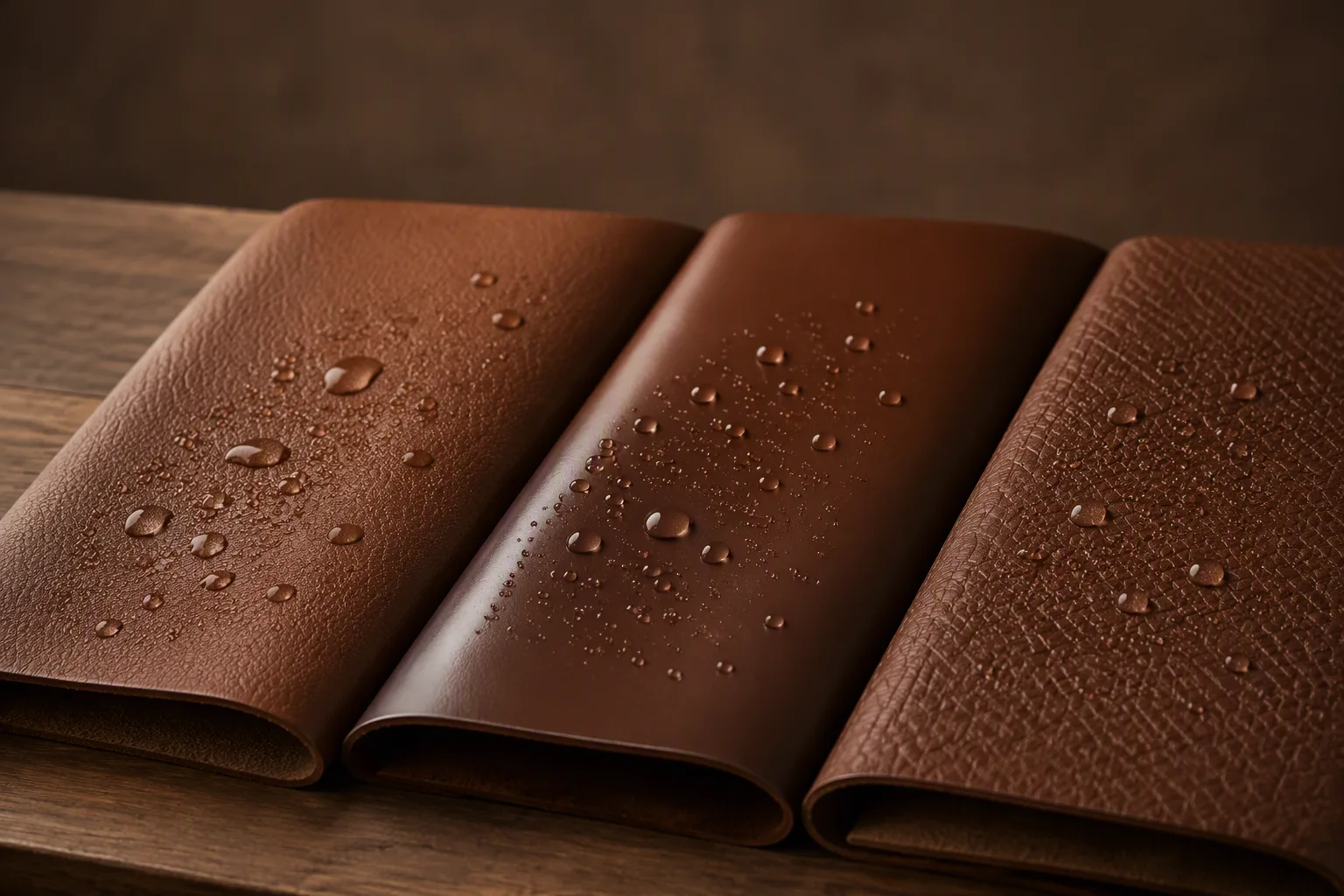
A stain-resistant finish lowers the surface energy of the leather so that oils and dyes do not readily wet it. Liquid sits on the surface instead of soaking in, which buys time to blot it away.
Soil-release finishes go further by allowing a stain that has penetrated to be lifted during cleaning. They are common in textiles and appear in leather finishes, though with more limited effect.
Fluorine-Free Versus Conventional Chemistry
Conventional repellents rely on fluorinated chemistry, which delivers strong oil and water repellence. Regulatory pressure in several markets has pushed brands toward fluorine-free alternatives, which perform well against water but are generally weaker against oils.
Where a brand chooses fluorine-free chemistry, the specification should distinguish water repellence from oil repellence, because the two no longer travel together.
Effect on Hand Feel and Appearance
Performance topcoats change the surface. A highly repellent finish often feels drier and slightly stiffer, and it can reduce the depth of colour that makes leather attractive.
Finishes with a heavy polymer load can also look more uniform and less natural, which conflicts with the visual character a leather goods brand is usually paying for.
Stain Resistance Trade-Offs
| Property | Conventional repellent | Fluorine-free repellent |
|---|---|---|
| Water repellence | High | Good |
| Oil repellence | High | Lower |
| Hand feel | Drier | Slightly softer |
| Appearance | Can look coated | More natural |
| Regulatory exposure | Higher | Lower |
| Relative cost | Baseline | Often higher |
Water Repellence and Breathability
Water repellence is where marketing language most often outruns the material, so the specification needs to be precise.
Repellence Is Not Waterproofness
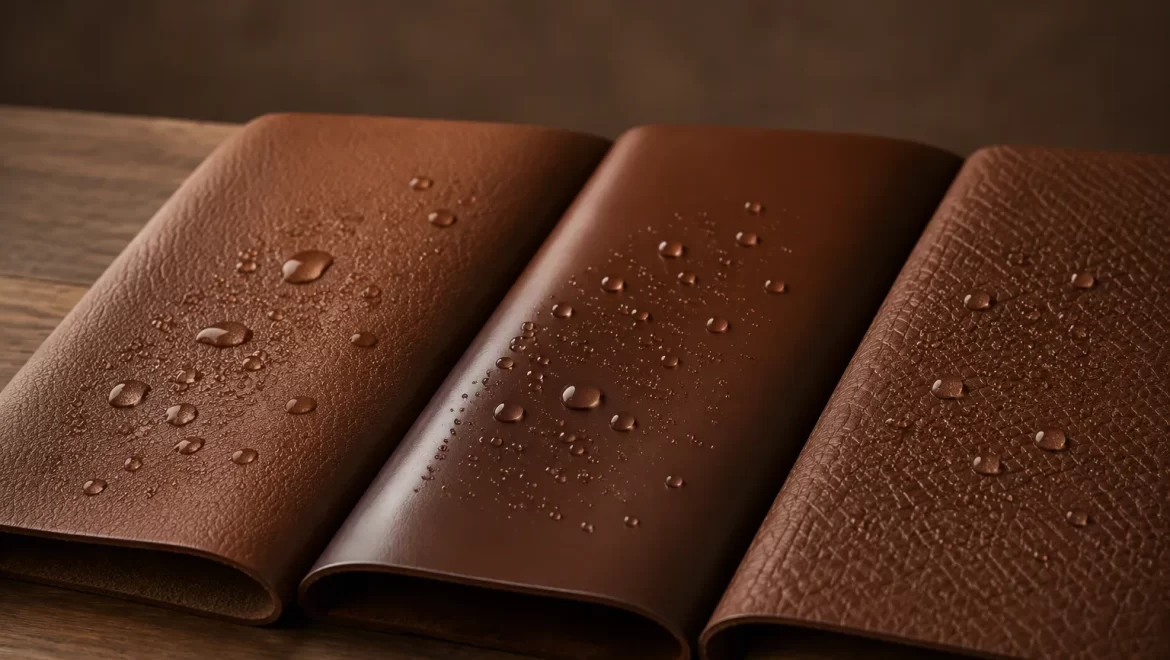
A repellent surface causes water to bead and roll off. Under sustained pressure, such as a heavy downpour on a shoulder panel, water will eventually penetrate through seams and stitch holes even if the surface itself resists.
A waterproof construction requires a barrier layer, sealed seams and closures designed to exclude water. Leather bags are rarely built this way because the result is stiff, heavy and expensive.
Breathability in a Bag Context
Breathability matters less in bags than in footwear or clothing, because a bag does not enclose a sweating body surface. It matters in linings and in straps that rest against the body, where trapped moisture leads to odour and staining.
Where breathability is claimed, it should be tied to a measurable property of the material rather than implied by the word.
Seams, Stitch Holes and Leak Paths
Stitch holes penetrate any surface treatment and become the route by which water enters. This applies to coated textiles and to treated leather alike.
Options include taping or sealing seams, using a bonded rather than stitched closure in exposed areas, or accepting that the product is water-repellent rather than weatherproof and saying so.
Water Performance Claims
| Claim | What it should mean |
|---|---|
| Water repellent | Liquid beads, slow absorption |
| Water resistant | Withstands light exposure |
| Weather resistant | Tolerates rain with some penetration |
| Waterproof | Barrier layer, sealed seams |
| Easy clean | Stain lifts with light cleaning |
Hydrolysis and Coating Durability
Coated and treated leathers can fail from the inside through hydrolysis, a process that is accelerated by heat and humidity rather than by use.
What Hydrolysis Does
Hydrolysis breaks down polymer coatings, particularly polyurethane, through reaction with moisture. The coating becomes tacky, then chalky, then delaminates from the leather beneath.
Early signs are a sticky feel, a dull surface and, in severe cases, a distinctive smell. By the time delamination is visible, the material is usually unusable.
Conditions That Accelerate It
Heat and humidity together are the main drivers, which makes tropical shipping and warehousing the highest-risk stage of a product's life. A bag stored in a hot, humid container for weeks may age more than in a year of temperate retail display.
Time also matters independently: coatings have a shelf life even in good conditions, which is why extended storage of finished goods carries material risk.
Managing the Risk
Specify hydrolysis-resistant coating formulations where the product will ship to or be stored in humid climates. Control storage conditions, keep stock moving, and avoid holding finished goods across a humid season without inspection.
Where a bag has been stored for an extended period, inspect before shipment rather than assuming it is unchanged.
Hydrolysis Risk Factors
| Factor | Effect |
|---|---|
| High humidity | Accelerates breakdown |
| High temperature | Accelerates breakdown |
| Long storage | Cumulative degradation |
| Coating chemistry | Determines resistance |
| Lining bonding | Can trap moisture |
| Ventilation in storage | Reduces risk |
How Performance Finishes Affect Production
A treatment that performs well in a test can still cause problems on the factory floor, and these issues should be anticipated at sampling.
Adhesive Bonding
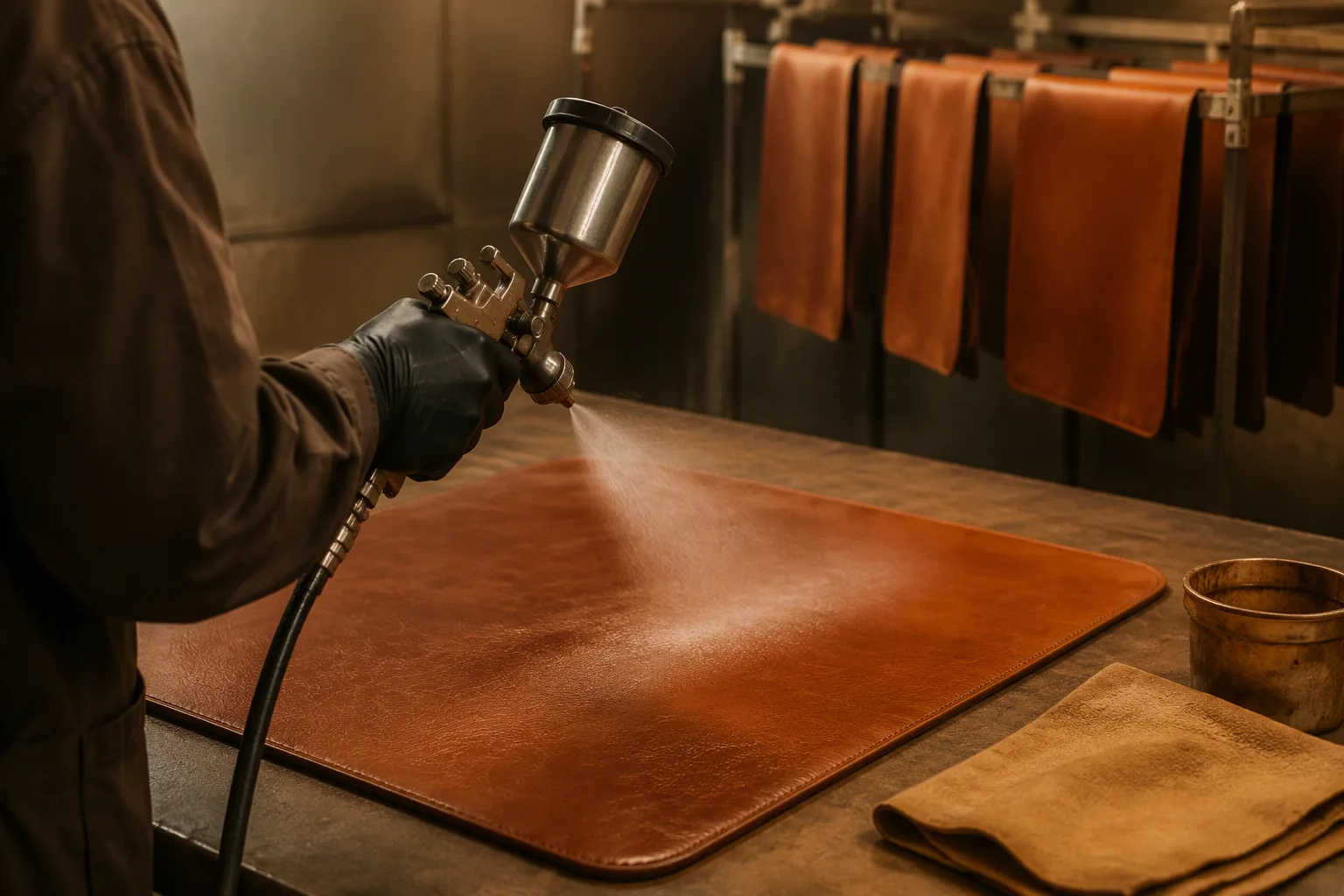
Repellent and stain-resistant finishes lower surface energy, which is exactly what makes adhesives struggle. Glue that bonds reliably to untreated leather may fail on a treated surface.
The practical answer is to specify an adhesive matched to the finish and to test the bond, or to mask the bond area so it is not treated. Masking costs a process step but removes a whole class of failure.
Edge Paint and Folded Edges
Edge paint adheres poorly to a low-energy surface, producing edges that crack or peel. Where edge paint is essential, the edge should be prepared mechanically before application, or the finish should be kept away from the edge zone.
Folded and bound edges are usually a safer choice on heavily treated materials.
Stitching and Skiving
Stitch holes through a treated surface are permanent paths for liquid, and skiving removes the treated layer entirely, exposing untreated material at the edge.
Where skived edges will be visible, the specification should state whether re-treatment is required and who performs it.
Pressing and Heat
Heat can damage both the treatment and the coating beneath. Pressing temperatures and pressures should be set with the finish supplier's guidance rather than inherited from untreated leather work.
Production Impact Summary
| Operation | Risk with performance finish | Control |
|---|---|---|
| Adhesive bonding | Poor bond strength | Matched adhesive or masked zone |
| Edge painting | Poor adhesion, peeling | Edge preparation or avoid |
| Stitching | Liquid paths at holes | Seam sealing or design change |
| Skiving | Untreated edge exposed | Re-treatment or coverage |
| Pressing | Treatment or coating damage | Reduced heat per supplier |
| Lining bonding | Trapped moisture, hydrolysis | Ventilation, adhesive choice |
Testing and Verification
Performance claims should rest on tests that match the intended use, run on production material rather than a laboratory sample.
Antimicrobial Testing
Antimicrobial testing exposes the material to a defined organism and measures growth reduction against an untreated control. The result is only meaningful with the organism, method and contact time stated.
Because performance declines with use, testing after abrasion or cleaning cycles is more informative than testing new material.
Repellence and Soil Release
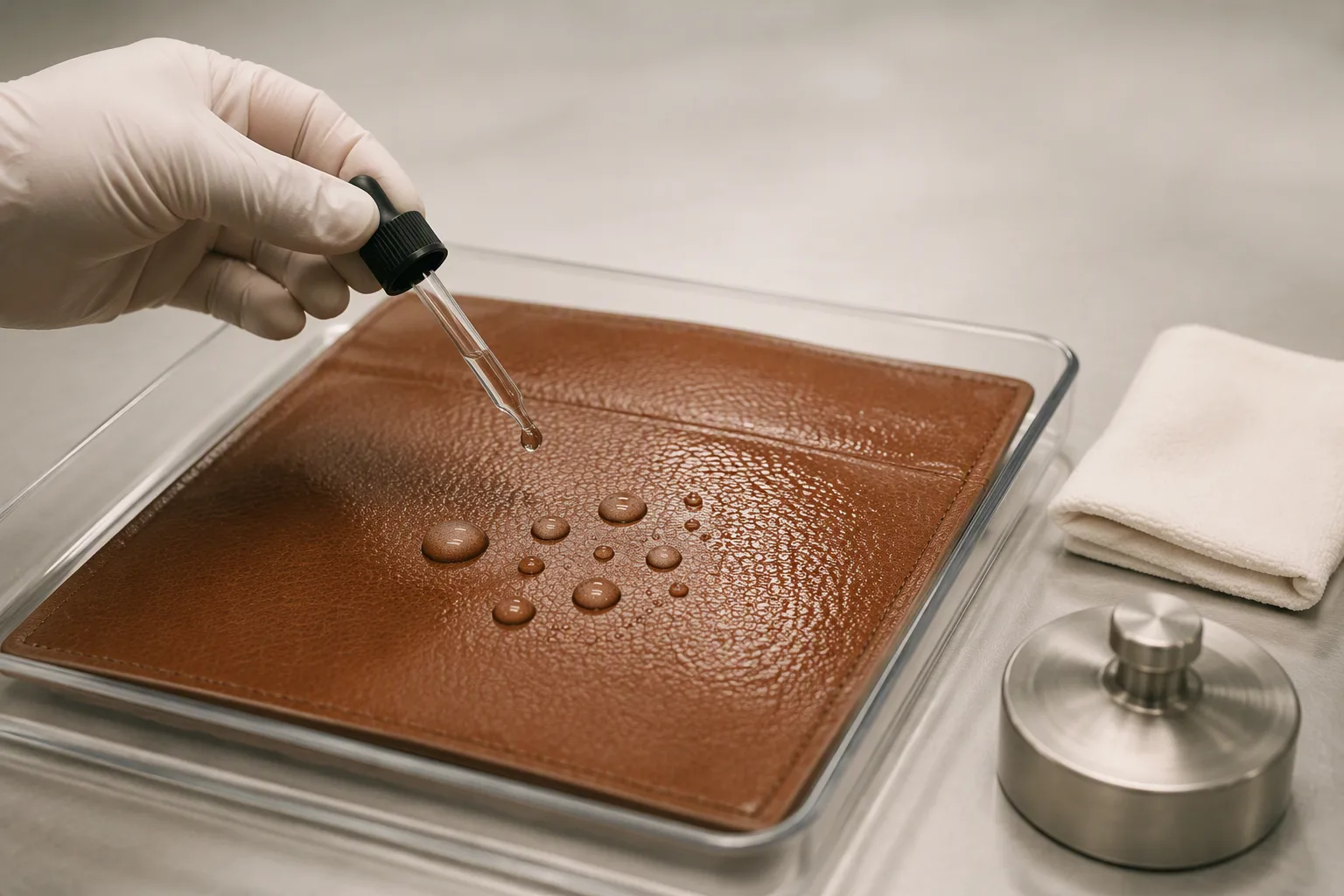
Water repellence is measured by applying liquid and observing whether it beads or penetrates, often with a rating scale. Oil repellence is measured similarly with an oil-based liquid.
Stain release is assessed by applying a staining agent, cleaning under a defined procedure, and measuring the residual mark against a reference.
Hydrolysis and Ageing
Hydrolysis resistance is assessed by accelerated ageing: material is held at elevated temperature and humidity, then checked for tackiness, discolouration and delamination.
This test predicts what will happen to a bag in a container or a humid warehouse, which is why it belongs in the specification for any product shipping to a tropical market.
Colour Fastness and Abrasion
Performance finishes can change colour behaviour. Wet and dry rub tests, plus light exposure, reveal whether the finish resists transfer to clothing and whether it fades.
An abrasion test run long enough to break through the finish shows how the material behaves once protection is lost, which is the state most bags reach.
Test Matrix
| Property | Test focus | Why it matters |
|---|---|---|
| Antimicrobial effect | Growth reduction against control | Supports the claim |
| Durability of effect | After cleaning or abrasion | Predicts real performance |
| Water repellence | Beading and penetration | Sets expectation correctly |
| Oil repellence | Oil resistance rating | Distinguishes finish types |
| Stain release | Residual mark after cleaning | Matches customer experience |
| Hydrolysis | Accelerated heat and humidity | Predicts storage failure |
| Colour fastness | Rub and light | Prevents transfer claims |
| Abrasion | Loss of finish | Shows end-of-life behaviour |
Claims, Compliance and Care Instructions
Claim language is regulated in most markets, and the burden of substantiation sits with the brand that makes the claim.
Substantiation Discipline
Every claim should map to a test on production material, with the method and conditions recorded. Where a supplier provides a claim, ask for the underlying test report rather than a certificate summary.
Where the tested material is not the production material, the claim does not transfer. A common failure is to test a laboratory swatch and then apply the result to a differently finished production run.
Market-Specific Considerations
Requirements vary by market and change over time, so the specific rules should be checked against the latest applicable requirements for each destination rather than assumed from one market to another. What is publishable in one region may not be permitted in another.
Where a treatment is regulated, the safe route is to confirm the applicable requirements with the treatment supplier and a compliance specialist before artwork is finalised rather than after.
Care Instructions and Honest Limits
Care guidance should tell the customer how to preserve the treatment. Mild cleaning preserves repellence; solvent cleaners strip it. Repeated machine washing is rarely appropriate for leather regardless of treatment.
Instructions should also state the limits: that repellence reduces absorption rather than preventing it, and that antimicrobial treatment reduces microbial growth on the material rather than sterilising the product.
Claim and Care Alignment
| Claim type | Required support | Care note to include |
|---|---|---|
| Antimicrobial | Test report on production material | Avoid aggressive cleaners |
| Water repellent | Repellence test result | Blot, do not rub |
| Stain resistant | Stain release test | Clean promptly |
| Easy clean | Cleaning procedure tested | Mild agents only |
| Abrasion resistant | Abrasion cycle result | Accept eventual wear |
| Hydrolysis resistant | Accelerated ageing result | Store dry and ventilated |
Durability Over the Product Life
Performance finishes are consumable properties, and the honest position is that they decline.
Wear Patterns
Abrasion removes surface treatment from high-contact areas first: bases, corners, handle attachments and closure flaps. Those areas will behave like untreated leather before the rest of the bag does.
Where a brand specifies performance finishes, understanding where protection disappears first allows selective reinforcement of those areas during construction.
Cleaning and Re-Application
Some treatments can be refreshed by the customer with a spray product; others cannot be re-applied outside a factory because they require controlled conditions. Guidance should say which applies.
Refreshing a treatment over a dirty surface simply seals in contamination and usually looks worse than an untreated area.
Honest Communication
Bags that behave as described produce fewer complaints than bags that exceed expectation in the showroom and disappoint in use. Setting expectations during purchase is the cheapest way to protect satisfaction.
Life-Cycle Expectations
| Stage | Behaviour |
|---|---|
| New | Full treatment performance |
| Light use | Little visible change |
| Regular use | Wear at high-contact areas |
| Cleaning | Surface actives partly removed |
| Extended use | Untreated behaviour in worn zones |
| Refresh | Possible for some treatments only |
Specifying Performance Leather
A performance specification should be explicit enough that a factory can execute it and an inspector can verify it.
Required Statements
State the property claimed, the test method used to verify it, the material that was tested, and the acceptance threshold. Where the finish is applied by a supplier rather than the tannery, name that supplier and require batch records.
Sample and Batch Control
Approve a physical sample that carries the treatment as it will be produced, and keep it as the reference. Keep treatment lot references with production records so a later claim can be traced.
Exclusions and Masking
State where the finish must not be applied, such as bond lines and edges that will be painted, and confirm the masking method during sampling rather than leaving it to the line.
Specification Checklist
| Item | Must be specified |
|---|---|
| Property claimed | Yes |
| Test method and threshold | Yes |
| Material tested | Yes |
| Treatment supplier | Where applicable |
| Application point | Bath, finish or after-treatment |
| Masked zones | Yes |
| Batch records | Yes |
| Care instructions | Yes |
| Exclusions | Yes |
Cost Considerations
Performance treatments add cost at several points, and the drivers differ from those of ordinary finishing.
Treatment Chemistry
The additives and coating chemistries themselves carry a cost that varies with the property claimed. Fluorine-free repellents often cost more than the conventional chemistry they replace, and antimicrobial additives add a further component.
Additional Process Steps
Bath additions extend retanning time; topcoat applications add drying and handling; masking adds a manual step; re-treatment of skived edges adds another. Each step also adds the risk of a defect.
Testing and Documentation
Verification testing, batch record keeping and compliance review are costs that scale with the number of properties claimed. Claiming four properties multiplies the evidence needed.
Cost Drivers
| Driver | Relative weight |
|---|---|
| Treatment chemistry | Moderate to high |
| Additional process steps | Moderate |
| Masking and re-treatment | Low to moderate |
| Testing and documentation | Low but scaling with claims |
| Compliance review | Low but essential |
| Rework from adhesion failures | High when it occurs |
Common Misconceptions
Several beliefs lead brands into claims they cannot defend and specifications factories cannot meet.
"Antimicrobial Means Hygienic"
The treatment limits microbial growth on the material surface. It does not sterilise the bag or protect anyone from infection, and wording that implies otherwise invites both regulatory and legal problems.
"Water Repellent Means the Contents Stay Dry"
Repellence slows absorption at the surface. Seams, stitch holes and closures remain routes for water, and sustained rain will penetrate.
"The Finish Never Comes Off"
Every surface treatment wears. The useful question is where it wears first and whether the bag still behaves acceptably once it does.
"Any Adhesive Will Work"
Low-energy surfaces are difficult to bond. Adhesive selection and bond testing belong in sampling, not in a corrective action after production starts.
"A Treatment Certificate Proves the Claim"
A certificate summarising a laboratory test on a different material proves little. What matters is a test report on production material under defined conditions.
Care, Cleaning and Refreshing Performance Finishes
Care guidance protects the investment in a performance finish, and it is the cheapest way to reduce complaints after purchase.
Cleaning Chemistry Matters
Mild pH-neutral cleaners preserve repellent and antimicrobial treatments. Solvent-based cleaners, alcohol and abrasive creams strip them, and the loss is usually visible as a dull patch that no longer beads water.
Where a brand supplies a care product, it should be tested against the finish rather than assumed compatible because both come from the same supplier.
Refreshing Repellence
Spray repellents can restore water repellence on some finishes at home. They work best on a clean, dry surface and poorly over contamination or worn coating.
Treatments applied in the retanning bath cannot be refreshed this way, because the active material sits within the leather structure. Guidance should distinguish the two cases.
Drying and Storage at Home
Wet leather should be dried at room temperature, away from direct heat, and shaped while damp so it dries without distortion. Heat dries the surface faster than the interior, which stresses coatings and can promote cracking.
Storage in a humid space with poor ventilation undermines both the finish and the leather, regardless of the treatment applied at the factory.
Care Guidance Summary
| Action | Effect on the finish |
|---|---|
| Mild neutral cleaner | Preserves treatment |
| Solvent or alcohol cleaner | Strips treatment |
| Abrasive cream | Removes coating |
| Spray repellent refresh | Restores water repellence |
| Direct heat drying | Stresses coating |
| Ventilated storage | Slows degradation |
Sustainability and Chemical Stewardship
Performance chemistry is under increasing scrutiny, and the choices made at specification stage determine how much documentation a brand will need later.
Restricted Substance Management
Treatments that deliver performance often involve chemistries that are regulated or under review. The practical approach is to require a declaration of the substances present in the treatment and confirm their status for each destination market.
Where a substance is restricted in one market and permitted in another, the simplest production solution is usually to adopt the stricter standard across the range rather than managing two versions of the same material.
Fluorine-Free Migration
Moving away from fluorinated repellents reduces regulatory exposure and aligns with customer expectations in several markets. The performance cost is mainly in oil repellence, which is why the specification should separate water from oil performance rather than treating repellence as one property.
Durability as a Sustainability Argument
A finish that extends a bag's usable life reduces replacement frequency, which is a defensible sustainability argument. A finish that fails early and forces replacement undermines it.
This is one reason to test performance after abrasion rather than only on new material: durability is the property that supports the environmental claim.
Stewardship Decisions
| Decision | Consequence |
|---|---|
| Substance declaration required | Traceable compliance |
| Stricter standard applied globally | One production version |
| Fluorine-free repellent | Lower regulatory exposure |
| Separated water and oil claims | Accurate expectations |
| Durability testing | Supports longevity argument |
| Supplier treatment records | Enables later verification |
Working With Suppliers on Performance Leathers
Performance finishes involve at least two suppliers: the tannery that produces the leather and the chemical supplier whose treatment is applied. Coordination between them determines whether the claim survives production.
Who Owns the Property
Establish clearly whether the tannery or a separate finisher applies the treatment, and who holds the test evidence. Where the tannery applies a third-party chemistry, the batch record should name both.
Where a bag brand specifies the treatment directly, the brand owns the substantiation, which means it also owns the responsibility for testing.
Questions Worth Asking Early
Ask what the treatment is, where it is applied, what the expected durability is and how it was measured, what it does not do, and what it interferes with in downstream operations. A supplier who cannot answer the last question has not seen the finish used in bag production.
Ask also for the material handling guidance: masking requirements, adhesive recommendations and pressing limits.
Supplier Questions
| Question | Why it matters |
|---|---|
| Who applies the treatment? | Determines accountability |
| Where in the process? | Predicts durability |
| How was durability measured? | Tests the claim |
| What does it not do? | Prevents over-claiming |
| What does it interfere with? | Protects production |
| Adhesive and pressing guidance? | Prevents bond failures |
| Batch record format? | Enables traceability |
FAQ
What is a functional leather?
A: It is leather to which a performance property has been added, usually through an additive in the retanning bath, a treatment in the surface finish, or an after-treatment applied before packing.
Does antimicrobial treatment make a bag hygienic?
A: No. It limits microbial growth on the treated material surface. It does not sterilise the bag, and it does not protect a person from illness.
How long does an antimicrobial treatment last?
A: Effectiveness declines with abrasion, cleaning and time. A durability statement should be tied to a test method and a defined number of cleaning or abrasion cycles, not described as permanent.
Is water-repellent leather waterproof?
A: No. Repellence causes water to bead and slows absorption. Seams, stitch holes and closures remain routes for water, so sustained rain can still penetrate.
Will a performance finish change how the leather feels?
A: Usually. Highly repellent topcoats tend to feel drier and slightly stiffer and can reduce colour depth. This is a trade-off to judge on an approved sample.
Why does glue fail on treated leather?
A: Repellent and stain-resistant finishes lower surface energy, which is what makes liquid bead and also what makes adhesives struggle. Specify an adhesive matched to the finish, or mask the bond area.
Can edge paint be used on performance leather?
A: It can, but adhesion is often poor, producing edges that crack or peel. Edge preparation or keeping the treatment away from the edge zone usually works better, and folded or bound edges are safer.
What is hydrolysis and why does it matter?
A: Hydrolysis is the breakdown of polymer coatings by moisture, accelerated by heat. It makes coatings tacky, then chalky, then delaminated, and it is the main ageing risk for bags stored in hot, humid conditions.
How should performance leather be tested?
A: Test production material under defined conditions, and test again after abrasion or cleaning so the result reflects the state the product reaches in use, not only its condition when new.
Do I need to change care instructions?
A: Yes. Mild neutral cleaners preserve treatments while solvents strip them, and guidance should also state what the finish does not do so expectations match real behaviour.
Can repellence be refreshed by the customer?
A: Spray repellents can restore water repellence on some finishes, applied to a clean dry surface. Additives applied in the retanning bath cannot be refreshed this way.
Are fluorine-free finishes as good as conventional ones?
A: They perform well against water but are generally weaker against oils. Specify water and oil repellence separately, because with fluorine-free chemistry the two no longer travel together.
What happens to the finish as the bag wears?
A: Abrasion removes surface treatment from high-contact areas first, such as bases, corners and handle attachments, so those zones behave like untreated leather before the rest of the bag does.
Does the treatment expire in storage?
A: Coatings and treatments have a shelf life, and heat combined with humidity accelerates degradation. Long storage before shipment carries material risk, so inspect goods that have been held.
Can a treatment certificate support my marketing claim?
A: Only partly. A summary of a laboratory test on different material proves little. The claim should be supported by a test report on the production material under defined conditions.
Should I apply the strictest market standard across the range?
A: In most cases that is the practical route, because it avoids managing two versions of the same material and reduces the risk of a restricted substance reaching a market that prohibits it.
Ready to build performance features into a leather bag without over-promising? Share the properties you want to claim and the markets you sell into, and we will help you match treatments to real use, verify them on production material, and write care instructions that describe what the material actually does.