Hand-Stitched vs Machine-Stitched Bags: Cost, Speed and Craft
- The Two Stitching Systems Explained
- Structural Differences and Failure Behavior
- Durability: What Testing Shows
- Labor Hours and Cost Structure
- Where Hand Stitching Makes Sense
- Machine Stitching: What Good Looks Like
- Thread and Needle Selection
- Common Defects in Both Methods
- Specifying Stitching in a Tech Pack
- Machine Capability Limits: When Factories Switch Methods
- Costing Hand Work Honestly
- Stitching by Bag Type
- Blending Methods: The Practical Middle Path
- Common Misconceptions About Stitching
- Quality Control for Stitched Goods
- FAQ
"Hand-stitched" is one of the most valuable phrases in leather goods marketing and one of the most misunderstood in production planning. Some bags genuinely require dozens of hours of hand saddle-stitching. Others combine machine construction with a few hand-finished details, and some carry the label without a single hand-sewn seam.
For a brand developing a line, the question is not which method is better in the abstract. It is which method serves each part of the bag, at what cost, with what durability outcome and with what story the product can honestly tell.
This guide compares the two systems as a factory sees them: how the stitches are actually formed, how they fail, what testing shows, how labor translates into price, and which bag categories and specific joints justify the added hours.
The Two Stitching Systems Explained
Hand and machine stitching are not variations of the same process. They form different stitch structures, and that structural difference drives everything else.
Machine Lock Stitch
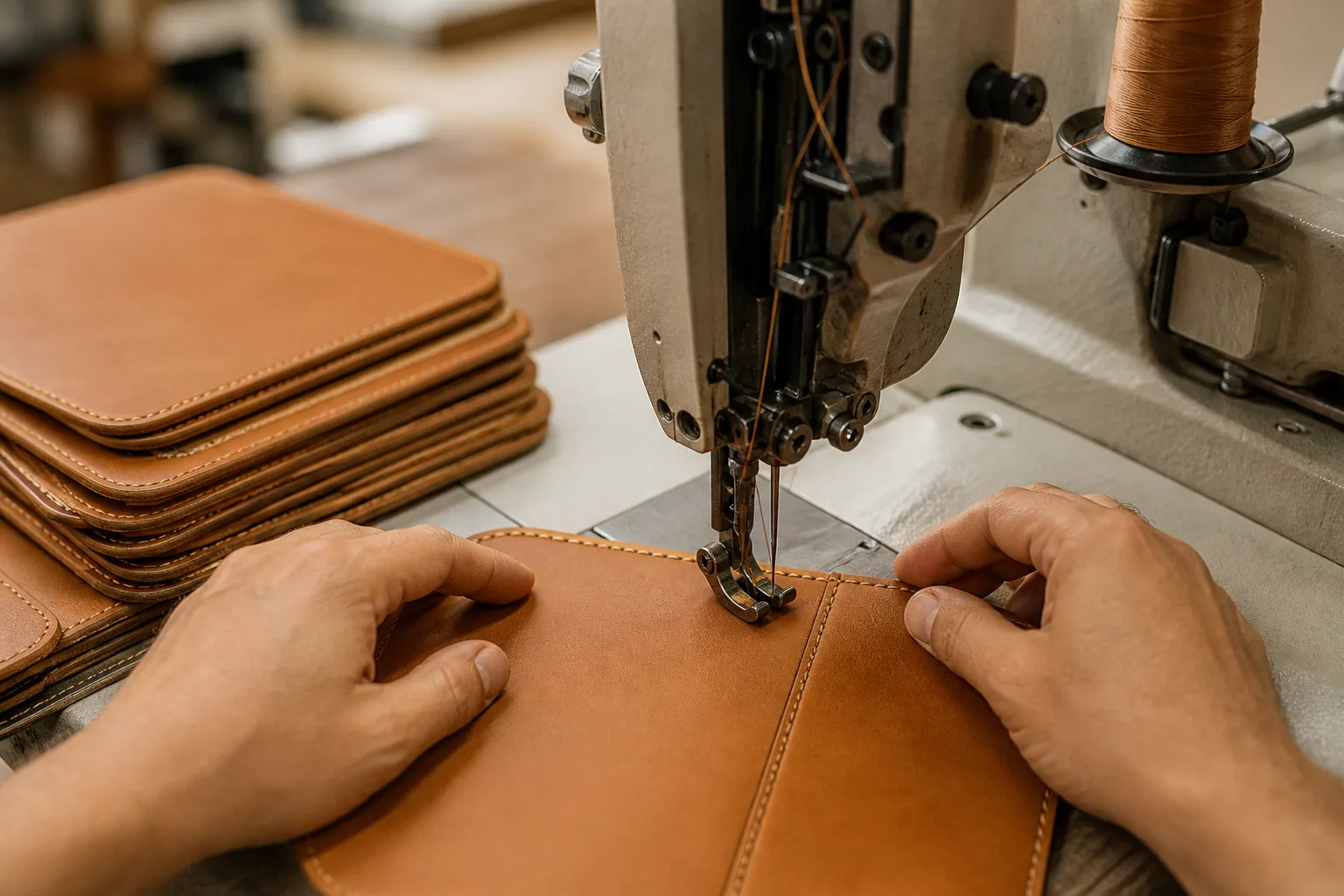
A lock-stitch machine uses two threads. The needle carries the top thread through the leather, a hook catches it underneath and pulls a second thread — the bobbin thread — through the loop, locking the two together in the middle of the material.
The result is a fast, even, symmetrical stitch that looks identical on both sides when tension is correct. Machines can place more than a thousand stitches per minute, and a skilled operator can follow a curved or reinforced seam with high consistency.
Hand Saddle Stitch
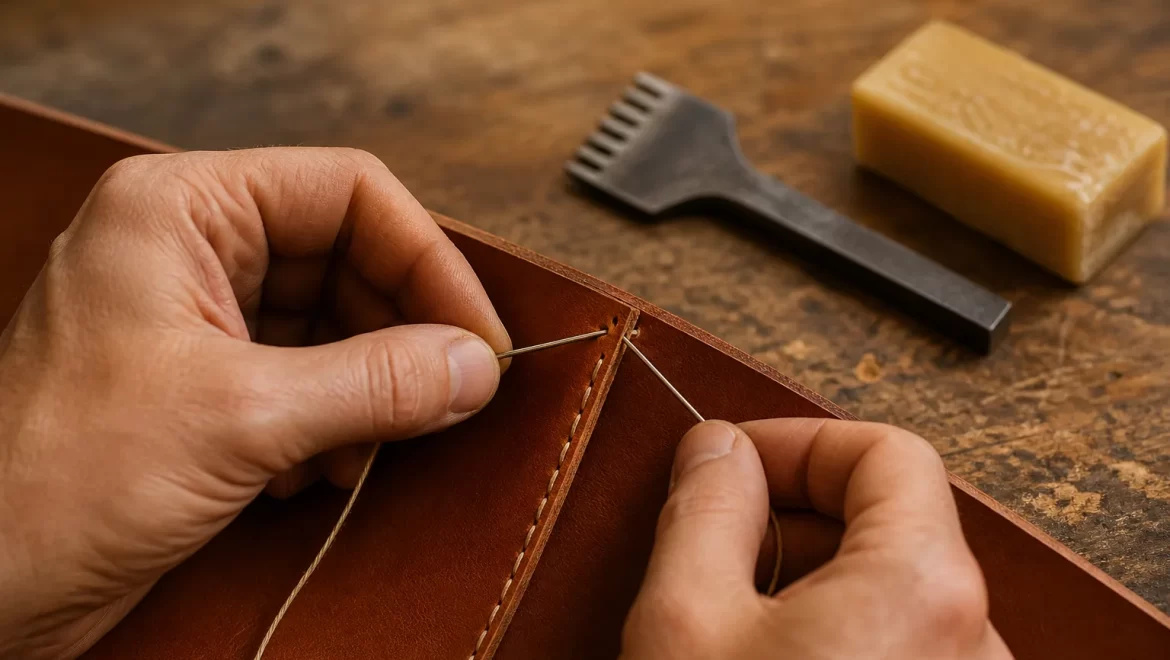
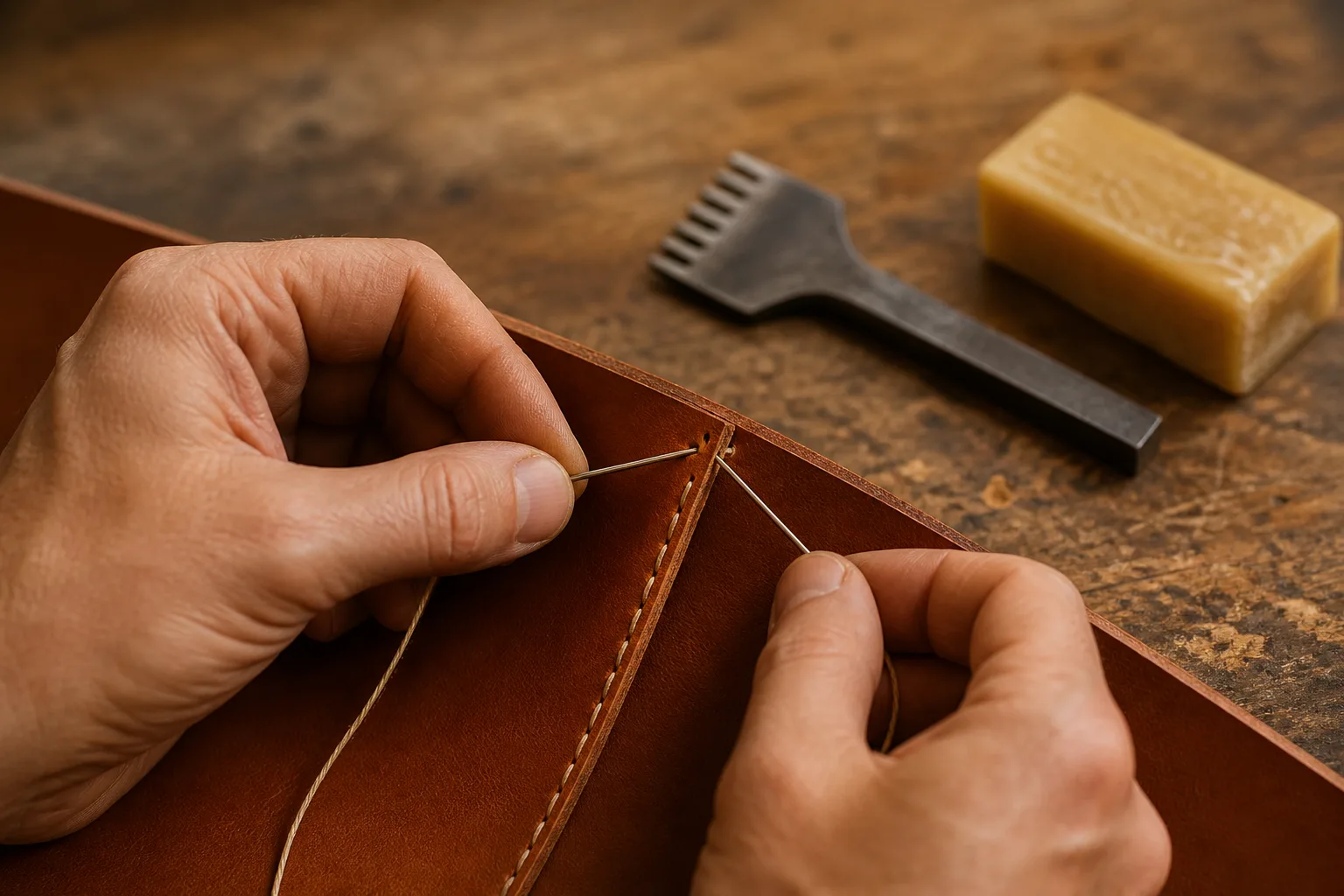
Hand stitching uses two needles and a single length of thread. Each needle passes through the same hole from opposite sides, and the two threads cross in the middle of the leather, forming an interlocked structure at every stitch.
Because the threads cross inside each hole, a hand saddle stitch is not a chain of dependent loops: it is a series of independent locked units. This is the origin of its much-discussed durability advantage.
Other Construction Methods
Between these two extremes sit several other options that factories use for specific purposes. Chain-stitch machines form a looped stitch that is fast and flexible but unravels easily if a thread breaks, so it appears mostly in decorative or temporary work.
Double-needle machines produce two parallel rows in a single pass, common on straps and panel edges. Decorative machine programs replicate a hand-stitched look at production speed, though the stitch structure remains a machine lock stitch.
| Method | Structure | Speed | Typical use |
|---|---|---|---|
| Machine lock stitch | Two threads interlocked | Very fast | Production seams |
| Hand saddle stitch | Two threads crossed per hole | Very slow | Premium edges, straps |
| Chain stitch | Looped single thread | Fast | Decorative, temporary |
| Double-needle | Two parallel lock rows | Fast | Straps, panel edges |
| Decorative machine | Lock stitch, styled | Fast | Simulated hand look |
Structural Differences and Failure Behavior
The practical difference between the two systems appears when a stitch fails. How a seam behaves after one broken thread determines whether a repair is a five-minute fix or a full replacement.
How a Lock Stitch Fails
In a lock stitch, each stitch depends on the previous one. If one thread breaks — from abrasion, a weak spot or a sharp edge cutting the thread — the stitches adjacent to the break can loosen, and the seam can begin to unravel along its length.
A well-made lock stitch with correct tension and appropriate thread is strong; the concern is the failure mode, not the initial strength. On a heavily loaded seam, a single failure can progress.
How a Saddle Stitch Fails
A hand saddle stitch fails locally. Because each stitch is independently locked, a broken thread affects at most the two stitches it passes through. The rest of the seam holds.
This property is why hand-stitched load-bearing joints — handle roots, strap attachments, corner seams — are prized in premium goods. The seam degrades gracefully rather than catastrophically.
Stitch Holes and Leather Longevity
Every stitch creates a perforation, and perforations are permanent. On a machine stitch, tight spacing and high tension can perforate the leather close to the edge, creating a tear line if the leather is stressed.
Hand stitching typically uses wider spacing, larger thread and lower tension per hole, which distributes stress differently. On thick, firm leathers, this contributes to longer seam life even when the two methods use comparable thread.
Durability: What Testing Shows
Claims about hand stitching's superiority are usually asserted rather than measured. Testing shows a more nuanced picture: the method matters, but thread, leather and construction details matter just as much.
Tensile and Cyclic Testing
Seam strength tests pull stitched samples apart and record the force at failure. Well-executed machine seams on appropriate leather often reach high breaking loads; the difference appears in cyclic testing, where repeated loading gradually loosens machine stitches but leaves a saddle-stitched seam stable.
Fatigue testing, which flexes a seam thousands of times, is the most revealing comparison for a bag that will be carried daily for years.
Abrasion and Thread Wear
Abrasion wears the thread where it crosses the leather surface. Larger thread with a wax finish — typical of hand work — resists abrasion longer than fine machine thread, particularly on exposed seams such as handle edges.
On protected seams, both methods perform similarly, because the leather itself absorbs the abrasion.
Repairability
A saddle-stitched seam can be repaired stitch by stitch, and a single damaged section can be replaced without disturbing the rest. Repairing a machine seam often means removing and re-stitching a longer section, and on molded or bonded constructions, a full section may need replacing.
For brands offering repair services, this difference is a genuine cost consideration over a product's lifetime.
Labor Hours and Cost Structure
The cost gap between hand and machine work is large enough to change a product's positioning. Understanding where the hours go makes the pricing decision concrete.
Hand Stitching Time
A skilled craftsperson hand-stitches at roughly 6 to 10 stitches per minute on thick leather, including hole marking, thread waxing and consistent tension control. A single 20-centimeter seam at 5 millimeters spacing requires about 40 stitches, or four to seven minutes.
On a full bag with multiple long seams, hand stitching alone can consume 10 to 30 hours. That labor is the dominant cost of a hand-stitched product.
Machine Stitching Time
The same 20-centimeter seam takes seconds on a machine, and an experienced operator can complete hundreds of equivalent seams in an hour, including handling and alignment.
Machine time is so fast that it is rarely the main cost driver in production. Leather, hardware, lining and the assembly labor around stitching usually exceed the stitching cost itself.
| Factor | Hand saddle stitch | Machine lock stitch |
|---|---|---|
| Stitches per minute | 6–10 | 1,000+ |
| 20 cm seam, 5 mm pitch | 4–7 minutes | Seconds |
| Typical bag total | 10–30 labor hours | Under 1 labor hour |
| Dominant cost | Labor | Materials and assembly |
| Minimum skill threshold | Very high | Moderate, trainable |
| Equipment needed | Awl, needles, wax | Industrial machine |
How the Difference Reaches Pricing
The wholesale price of a hand-stitched bag can be several times that of a machine-stitched equivalent with identical leather, because the labor is embedded in the cost of goods. At retail, that multiple typically grows.
This is not a markup for romance: it reflects real hours. A brand that specifies hand stitching for a whole bag is choosing to pay for those hours, and the retail price must support them.
| Positioning | Stitching approach | Cost impact |
|---|---|---|
| Entry / volume | All machine stitching | Baseline |
| Mid-market | Machine with reinforced key joints | 5–15% above baseline |
| Premium | Hand-stitched edges and straps | 40–120% above baseline |
| Luxury / artisan | Fully hand-stitched construction | 200%+ above baseline |
Where Hand Stitching Makes Sense
Hand work is most defensible where it produces an outcome the machine genuinely cannot, or where the labor cost is small relative to the value it adds.
| Area | Why hand work helps | Cost level |
|---|---|---|
| Handle and strap roots | Independent stitches resist progressive failure | Medium |
| Rounded corners | Machine cannot turn tightly without distortion | High |
| Thick multi-layer stacks | Machines struggle past a depth limit | High |
| Exposed visible edges | Uniform, attractive stitch appearance | Medium–high |
| Repairable luxury pieces | Seams can be repaired stitch by stitch | High |
| Brand-signature details | Verified craft claim for marketing | Varies |
Load-Bearing Joints
Handle roots, strap anchors and corner junctions carry the highest loads. Hand saddle stitching in these locations gives independent stitch locking exactly where progressive failure would be most damaging.
Hard-to-Reach Geometry
Machines need access for the needle and the presser foot. On tight curves, three-dimensional constructions and narrow gussets, the machine physically cannot reach or will distort the leather while trying. Hand work solves geometry problems, not just durability ones.
Thick Material Stacks
Lock-stitch machines have a practical thickness limit, and exceeding it causes skipped stitches, bent needles and broken thread. Where a design stacks five or more leather layers at a junction, hand stitching is often the only reliable option.
Visible Craft Value
On premium goods, visible hand stitching signals labor and skill to a customer who cannot inspect internal construction. It is a legitimate value signal when it is real, and a liability when it is not.
Machine Stitching: What Good Looks Like
Machine stitching done well is a precision operation, not a shortcut. Good machine work is defined by measurable parameters.
Key Parameters
Stitch density is measured in stitches per inch (SPI). Leather bags typically run 6 to 9 SPI on structural seams and 8 to 12 SPI on finer work, with higher density on thin leather and lower density on thick, firm material.
Thread tension must be balanced so the lock sits in the middle of the material rather than pulling to one surface. Needle size and point type must match leather thickness and whether the needle crosses a seam.
| Parameter | Typical range | Consequence if wrong |
|---|---|---|
| Stitch density (SPI) | 6–9 structural, 8–12 fine | Tearing or weak seam |
| Thread tension | Balanced, lock inside | Loops on one surface |
| Needle size | 110–140 for bags | Enlarged holes, broken needles |
| Needle point | Cutting or round per leather | Leather tear or skipped stitch |
| Thread size | Tex 40–80 | Weak or bulky stitch line |
Common Machine Defects
Skipped stitches indicate needle, timing or thickness problems, and they leave an unstitched section that can open. Thread looping on one surface means tension imbalance. Puckering means the feed or tension is pulling leather faster than the material tolerates.
These defects are visible at inspection, which is why machine seams are checked at the panel stage rather than after assembly.
Inspection Points
Check stitch density against specification, verify start and end reinforcement, look for skipped or doubled stitches, confirm the thread color matches across all panels of one bag, and inspect the seam line for waver on long straight runs.
Thread and Needle Selection
Thread choice interacts with the stitching method. Hand work favors thick, waxed thread; machine work favors fine, consistent, high-strength thread.
| Thread | Strength | Character | Best for |
|---|---|---|---|
| Polyester (bonded) | High | Consistent, UV resistant | Machine production |
| Nylon | Very high | Abrasion resistant | Heavy load seams |
| Linen / cotton | Moderate | Natural, traditional | Hand work, heritage goods |
| Waxed linen | Moderate | Grips, seals holes | Saddle stitching |
| Poly-cotton core | High | Low stretch | Structural machine seams |
Thread for Hand Work
Waxed linen or waxed polyester supports the saddle stitch: the wax holds tension, seals the hole and protects the thread from abrasion. Thread size is deliberately large, typically from 0.6 to 1.0 millimeter, because the visual weight of the stitch is part of the design.
Thread for Machine Work
Bonded polyester dominates machine production for its strength, color consistency and resistance to UV degradation. Fine thread allows higher SPI without perforating the leather excessively.
Needle Selection
Needle point type matters more than many buyers realize. Cutting points (diamond or triangular) are used where the needle must pass through multiple layers or bonded leather; round points separate fibers rather than cutting them and suit softer leathers where tear resistance matters.
Using a cutting point on a soft leather enlarges the perforation and creates a tear line. Using a round point on a bonded stack can bend the needle.
Common Defects in Both Methods
Defects differ by method, but both produce the same outcome: a seam that looks acceptable in the sample room and fails in the market.
| Defect | Method | Cause | Prevention |
|---|---|---|---|
| Skipped stitches | Machine | Wrong needle, timing, thickness | Match needle and adjust feed |
| Loops on surface | Machine | Tension imbalance | Balance bobbin and top tension |
| Puckered seam | Machine | Feed or tension mismatch | Adjust pressure and stitch length |
| Perforation tear | Machine | Dense stitch near edge on soft leather | Reduce SPI, move seam inward |
| Loose stitch | Hand | Inconsistent tension | Wax thread, consistent pull |
| Uneven spacing | Hand | Marking error | Pricking iron, guide lines |
| Thread fraying | Hand | Poor wax coverage | Wax with care, quality linen |
| Visible repair | Both | Cut thread after breaking | Re-stitch section properly |
Machine-Specific Problems
Skipped stitches are the most consequential machine defect because they leave a structural gap that looks like a stitch. Inspectors must look for the missing stitch, not just the presence of a line.
Puckering is a cosmetic defect that also signals stress in the leather: the seam is compressing the material, which will cause wear and distortion over time.
Hand-Specific Problems
Hand stitching defects are usually about consistency: uneven spacing, variable tension, or thread that frays because the wax layer is incomplete. These defects are visible on close inspection and are the reason hand work is judged on uniformity rather than presence.
Defects That Appear Later
Both methods can produce a seam that passes inspection and fails after use: a machine seam with internal tension imbalance, or a hand seam stitched through leather that was too dry and later cracks along the stitch line.
Testing on a finished sample, not just on a flat panel, is the only way to catch this class of defect.
Specifying Stitching in a Tech Pack
Stitching specifications are frequently vague, and vague specifications produce inconsistent production. A short, numeric specification resolves the ambiguity.
| Spec element | What to write | Why |
|---|---|---|
| Method | "Machine lock stitch" or "Hand saddle stitch" | Defines structure |
| Stitch density | "7 SPI structural, 10 SPI trim" | Controls strength and look |
| Thread | "Bonded polyester Tex 60, color 012" | Ensures consistency |
| Needle | "135×17, size 130" | Prevents skipped stitches |
| Reinforcement | "Backstitch 3 stitches at each end" | Prevents seam opening |
| Hand areas | "Handle roots hand saddle stitched" | Defines mixed construction |
| Termination | "Thread ends buried, not glued" | Prevents visible repair |
| Inspection | "Check SPI and tension at panel stage" | Catches defects early |
Be Specific About Mixed Construction
On bags that combine methods, state exactly which seams are hand stitched and which are machine stitched. Without that list, the factory will choose based on its production flow, and a "hand-stitched" claim may end up covering a small fraction of the work.
Specify Reinforcement at Ends and Corners
Seam failure usually begins at a termination: the start, the end, or a direction change. Requiring backstitching or hand-finishing at these points costs almost nothing and prevents the most common warranty claim.
Require Panel-Stage Inspection
Stitch defects are visible before assembly and difficult to fix after. Specify that stitch density and tension are verified per panel, with a checklist signed by the line supervisor.
Machine Capability Limits: When Factories Switch Methods
Machines are not infinitely capable, and designs that ignore their limits create production problems. Knowing where those limits sit helps a brand design parts that can actually be built as drawn.
| Situation | Machine limitation | Practical alternative |
|---|---|---|
| Stack over 8 mm | Needle cannot pass cleanly | Hand stitch or reduce layers |
| Tight inside curve | Presser foot cannot turn | Hand stitch the section |
| Closed tubular forms | Access blocked | Stitch before closing |
| Very firm 4 mm leather | Feed and needle deflection | Slower feed, larger needle |
| Narrow gusset interiors | No tool clearance | Hand work or redesign |
| Bonded multi-layer panels | Needle gumming from adhesive | Clean needle path, lower SPI |
Thickness and Layering
Lock-stitch machines handle a practical maximum thickness that varies by machine class, typically around 6 to 8 millimeters of leather for a heavy-duty walking-foot machine. Beyond that, needles deflect, stitches skip and leather distorts.
Designs that stack layers at junctions — handle roots, strap anchors, corner reinforcements — commonly exceed this limit. Factories handle it by skiving the layers thinner, splitting the joint into staged seams, or switching to hand stitching at that specific point.
Geometry and Access
The presser foot needs a flat approach path, and the needle needs clearance. Tight inside curves, narrow gusset interiors and closed tubular constructions cannot be machine stitched after assembly.
The standard factory solution is to sequence the work differently: stitch the interior seam while the panel is still flat or open, then close the bag. When that is impossible, hand stitching is the fallback.
Material Behavior on the Machine
Very firm leather resists the feed, causing the operator to push or pull — which produces uneven stitch length and puckering. Adhesive residue on bonded panels can gum the needle, causing skipped stitches and thread breaks.
Both problems show up as inconsistent seam quality, and both are solved by adjusting process parameters rather than by changing the design: slower feed, larger needle, higher presser pressure, and a clean needle path.
Designing for the Machine You Have
Factories with different equipment produce the same design in different ways, so a design approved on one supplier's line may need re-engineering at another. Documenting the intended stitching method per seam — and confirming equipment capability before quoting — prevents surprises mid-production.
Costing Hand Work Honestly
Hand work is expensive, and understanding how to estimate it prevents both underpricing and false economies.
Estimating Hand Labor
Estimate by stitch count, not by seam length alone. Measure the seam, divide by the stitch pitch to get the stitch count, and apply a realistic rate: roughly 6 to 10 stitches per minute for hand work on thick leather, including marking, hole punching and finishing.
Add time for hole marking, thread waxing, thread ends and inspection. These steps often equal or exceed the stitching time itself.
Comparing Whole-Bag Scenarios
A fully hand-stitched tote may require 15 to 30 productive labor hours. The same tote machine-stitched uses under an hour of stitching labor. At typical factory rates, that difference alone can move cost of goods by a factor of two or more, before any of the leather or hardware is considered.
The Mixed Strategy That Usually Wins
Most commercially successful "hand-stitched" lines are mixed: machine construction throughout the bag with hand saddle stitching at strategic, load-bearing or highly visible joints. This captures much of the durability and craft value at a fraction of the labor cost.
The key is honesty in specification and marketing. A bag with hand-stitched handle roots and machine-stitched body seams should describe exactly that, because buyers increasingly inspect and can tell.
Stitching by Bag Type
The right stitching plan follows the bag's construction, its loads, and its price point.
| Bag type | Typical plan | Rationale |
|---|---|---|
| Volume tote | Machine throughout | Cost control at scale |
| Mid-market shoulder bag | Machine plus reinforced joints | Durability where loaded |
| Structured briefcase | Machine, double-needle on straps | Even, visible seams |
| Premium handbag | Hand-stitched edges and straps | Craft value, repairability |
| Full-grain work bag | Mixed, hand at corners and handles | Load distribution |
| Small leather goods | Hand-stitched perimeter | Premium signal, small area |
Volume and Mid-Market Bags
At volume, machine stitching is the only economically viable method, and it can be genuinely excellent. Reinforcement at load points — extra backstitching, rivets where appropriate, double stitching on handle roots — addresses the durability concern at minimal cost.
Premium and Luxury Bags
Hand stitching carries both durability and narrative value in this tier. The most defensible use is on seams that a customer will touch and inspect: edges, straps and handle attachments.
Small Leather Goods
Wallets and cardholders have small perimeters, so hand stitching their full perimeter costs far less in total hours than hand stitching a large bag. This makes full hand construction realistic at this size, which is why so many premium small goods are genuinely hand-stitched.
Blending Methods: The Practical Middle Path
Most production decisions are not binary. Factories routinely combine methods within one bag, and the combination is where most of the value sits.
Selecting the Hand Zones
Choose hand stitching where it changes an outcome: joints that carry load, geometry a machine cannot reach, edges the customer will inspect, and repairs that should remain possible. Everything else goes to the machine.
A practical rule is to hand-stitch the seams that would be catastrophic to repair, and machine-stitch the seams that could simply be remade.
Keeping Quality Consistent Across Methods
Mixed construction creates a consistency challenge: hand stitches and machine stitches should look related, even though they will not be identical. Matching thread color and approximate thread weight across methods keeps the bag visually coherent.
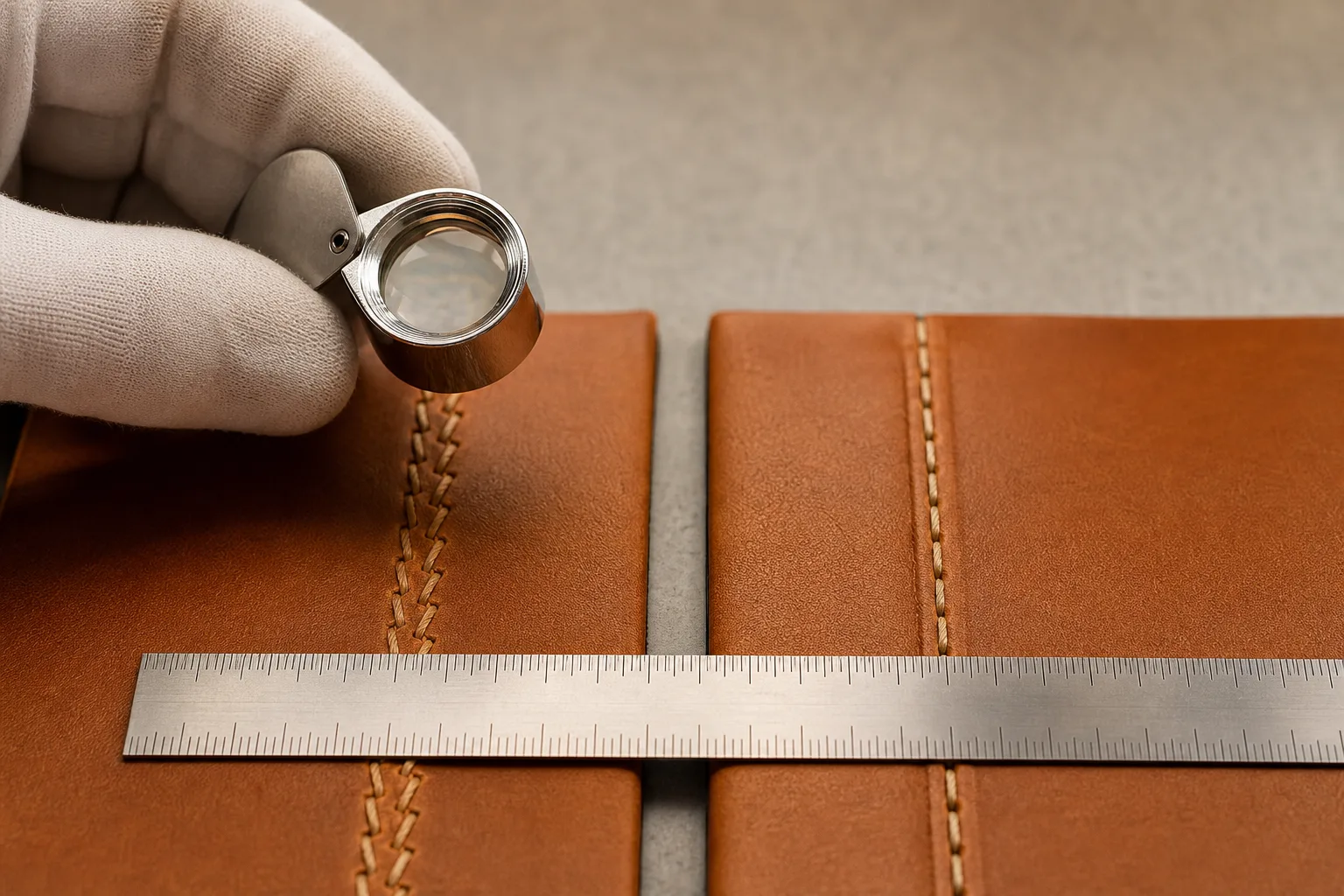
Factories that build mixed constructions well keep a reference sample showing both stitch types side by side, so the line can compare production output against a known standard.
Documenting for Marketing Accuracy
If a product claims hand stitching, document which seams are hand stitched and keep that record with the technical file. It supports honest labelling, helps answer customer questions and protects the brand if a claim is ever challenged.
Common Misconceptions About Stitching
Several widespread beliefs about stitching lead to poor specification decisions or overstated product claims.
"Hand-Stitched Always Means Stronger"
Hand saddle stitching has a superior failure mode on load-bearing seams, but strength also depends on thread, leather and execution. A poorly tensioned hand stitch can be weaker than a well-executed machine seam.
"Machine Stitching Is Low Quality"
Machine lock stitching, correctly specified and inspected, is strong, consistent and standard in high-end production. Poor machine stitching is a process control failure, not an inherent limitation of the method.
"Higher Stitch Density Is Always Better"
Excessive density perforates the leather, creating a tear line and weakening the panel. Density should match leather thickness and load, not be maximized.
"Hand Stitching Cannot Be Verified by a Consumer"
It can be verified visually, at least in broad terms: saddle stitches cross and sit at an angle, with slight irregularity, while machine lock stitches are perfectly uniform and flat. Brands that claim hand work should expect scrutiny.
"Machine Stitching Cannot Be Repaired"
It can, but the repair is usually sectional: a length of seam is removed and re-stitched. The limitation is scale, not possibility.
"Thicker Thread Always Looks More Premium"
Thick thread on thin leather creates oversized perforations and a coarse look. Thread weight should be proportional to the leather and the stitch density.
Quality Control for Stitched Goods
Stitch inspection follows the same logic as other QC: catch defects at the smallest possible unit of work.
Verifying Stitch Density
Count stitches over a measured distance on every new panel and periodically during production. Density drift is common as machines are adjusted or operators change, and it directly affects both strength and appearance.
Checking Tension and Appearance
Inspect both surfaces of the seam. On a machine seam, the lock should sit inside the leather; visible loops on either face indicate tension imbalance. On hand seams, check that thread crosses consistently and that no stitch sits loose.
Testing End Reinforcement
Pull the seam ends gently and confirm the backstitch or hand finish holds. Seam failures frequently begin at the terminations, which is exactly where inspection is easiest to skip.
| QC check | Method | Frequency |
|---|---|---|
| Stitch density | Count over 50 mm | Every panel at startup |
| Tension | Inspect both surfaces | Continuous sampling |
| End reinforcement | Visual and gentle pull | Every seam end |
| Thread color | Compare to standard | Every batch |
| Skipped stitches | Visual scan under light | Every panel |
| Seam line straightness | Sight along length | Every long seam |
FAQ
Is hand stitching stronger than machine stitching?
A: On load-bearing seams, hand saddle stitching has a better failure mode because each stitch is independently locked, so a broken thread does not unravel the seam. Overall strength still depends on thread, leather and execution quality.
Why is hand stitching so much more expensive?
A: Speed. A craftsperson completes roughly 6 to 10 stitches per minute, while a machine places more than a thousand. On a full bag, hand stitching can require 10 to 30 labor hours.
How can I tell if a bag is genuinely hand stitched?
A: Hand saddle stitches cross at a slight angle inside each hole and show minor natural irregularity. Machine lock stitches are uniformly flat and perfectly even. On a genuine hand-stitched seam, the thread pattern is mirrored on both sides.
Can a machine replicate the look of hand stitching?
A: Decorative machine programs can approximate the appearance, but the stitch structure remains a lock stitch. Close inspection reveals uniform machine spacing and flat stitch formation.
Which parts of a bag benefit most from hand stitching?
A: Handle and strap roots, corner junctions, thick multi-layer stacks, tight curves a machine cannot reach, and highly visible edge seams. These are where hand work changes durability and appearance most.
What is a saddle stitch?
A: A hand stitching method using two needles and one thread. Each needle passes through the same hole from opposite sides, so the threads cross and lock inside the leather at every stitch.
What stitch density should a leather bag specification use?
A: Typically 6 to 9 stitches per inch on structural seams and 8 to 12 on finer work, adjusted for leather thickness. Denser stitching on thin leather risks perforation and tearing.
What causes skipped stitches in leather sewing?
A: Wrong needle type for the material, incorrect needle timing, thread tension imbalance, or exceeding the machine's thickness capability. Skipped stitches must be re-stitched, not left in place.
Is a fully hand-stitched bag worth the price?
A: If the design requires repairability, load-bearing joint integrity or verifiable craft, the labor can justify the price. For a bag that will not be repaired and whose seams are not inspected, the value is mostly narrative.
What thread is used for hand stitching leather bags?
A: Waxed linen and waxed polyester are standard, typically 0.6 to 1.0 millimeter. The wax holds tension, seals the hole and improves abrasion resistance.
How long does it take to hand stitch a handbag?
A: A small leather good may take 1 to 3 hours; a structured handbag with long seams can take 15 to 30 hours of stitching labor, excluding cutting, edge finishing and assembly.
Does machine stitching damage leather?
A: Not inherently. Damage comes from wrong needle type, excessive stitch density or too much tension, all of which enlarge perforations and create tear lines.
What is backstitching and why does it matter?
A: Backstitching reverses the stitch direction for a few stitches at the seam start and end to lock the thread. It prevents the most common seam failure, which begins at a termination.
Can hand-stitched seams be repaired more easily?
A: Yes. Individual stitches or short sections can be replaced without disturbing the rest of the seam, while machine seams typically require removing and re-stitching a longer section.
Should I specify stitching method in the tech pack?
A: Yes, with density, thread type and size, needle specification, and the exact seams that are hand stitched. Without this, production choices will vary between batches and suppliers.
What is the most cost-effective way to get a hand-stitched look and durability?
A: Machine-stitch the construction and hand-stitch the high-load and high-visibility seams, such as handle roots, top edges of key panels and corners. This captures most of the durability and craft value at a fraction of full hand labor.
Ready to plan stitching for your next bag line without overspending on labor or overstating your claims? Send us your designs and we will map each seam to the right method, specify thread and density, build a mixed-construction sample with hand-stitched load points, and document exactly what is hand worked so your product description matches the bag.