Hardware Selection for Leather Bags: Zippers, Buckles, and Metal Quality
The zipper that glides, the buckle that clicks, the rivet that holds — hardware is where a bag's daily usability is decided. A bag can have perfect leather and flawless stitching, and a cheap zipper will still ruin it within a year. Conversely, quality hardware can elevate a modest bag into something that feels genuinely premium. Hardware is the interface between the bag and every action a customer takes with it: opening, closing, adjusting, carrying. And it is the component most often downgraded in production, because hardware quality is hard to judge from a photo and easy to swap without notice.
This guide covers hardware selection the way a factory sees it: the components that matter most, the materials and finishes behind them, how hardware behaves in manufacturing, the tests that separate quality from decoration, and how to write a hardware spec that survives production. Whether you are designing your first bag or auditing a factory's quality, this is the knowledge that turns "nice metal parts" into a defensible specification.
Why Hardware Defines the "Expensive Feel"
The "expensive feel" of a bag is not one thing — it is a stack of tactile impressions, and hardware contributes more than most designers realize. Every time a customer opens the bag, the zipper's smoothness is felt. Every time they fasten a buckle, the click's solidity is judged. Every time they set the bag down, the feet's quality is heard. Hardware is the most-handled metal in the product, and its feel is registered unconsciously with every use.
Three mechanisms make hardware a quality signal. First, touch and sound: quality hardware has a weight and a sound — a solid click, a smooth glide — that cheap hardware lacks. The difference is audible and tactile; customers register it even when they cannot name it. Second, durability visibility: hardware fails visibly and quickly. A tarnished buckle, a stuck zipper, or a pulled-out rivet is an obvious defect that customers photograph for reviews. Hardware failures are the most common complaint category in bag reviews — more than leather defects, because hardware is exercised constantly. Third, cost visibility: hardware is where the factory can save the most money without changing the bag's appearance in photos. The zipper that costs $0.80 versus $2.50 looks identical in a listing photo — and fails completely differently in a year. A buyer who does not specify hardware is leaving the single largest quality-variance line item to the factory's discretion.
The strategic conclusion: hardware is the highest-leverage quality investment in a bag. A $1.50 per-bag hardware upgrade is invisible in the photo, modest in the price, and transformative in the customer experience and review score.
The Hardware Categories That Matter
Not all hardware is equal — some components carry the bag's function, others carry its decoration, and the priority order matters for budgeting and QC.
| Category | Components | Role | Quality impact |
|---|---|---|---|
| Closures | Zippers, buckles, snaps, magnets | Daily opening/closing | Highest — exercised constantly |
| Carrying | D-rings, swivel hooks, chains, handles hardware | Load-bearing, movement | High — failure is structural |
| Fasteners | Rivets, screws, Chicago screws | Holds parts together | High — silent failures |
| Protection | Feet, corner guards, piping | Contact with surfaces | Medium — wear resistance |
| Decoration | Charms, logo plates, nameplates | Brand identity | Medium — visible premium cue |
The budgeting logic follows the roles: closures and carrying hardware deserve the quality budget first, because their failure is felt daily and can be structural. Fasteners are cheap per unit but catastrophic when they fail — a rivet pulled out of a handle is a return. Protection hardware is wear management, worth more than its cost suggests because it prevents the bag's most common cosmetic damage. Decorative hardware is the brand surface — where custom engraving and logo parts create recognition.
Zippers: The Most-Used Hardware
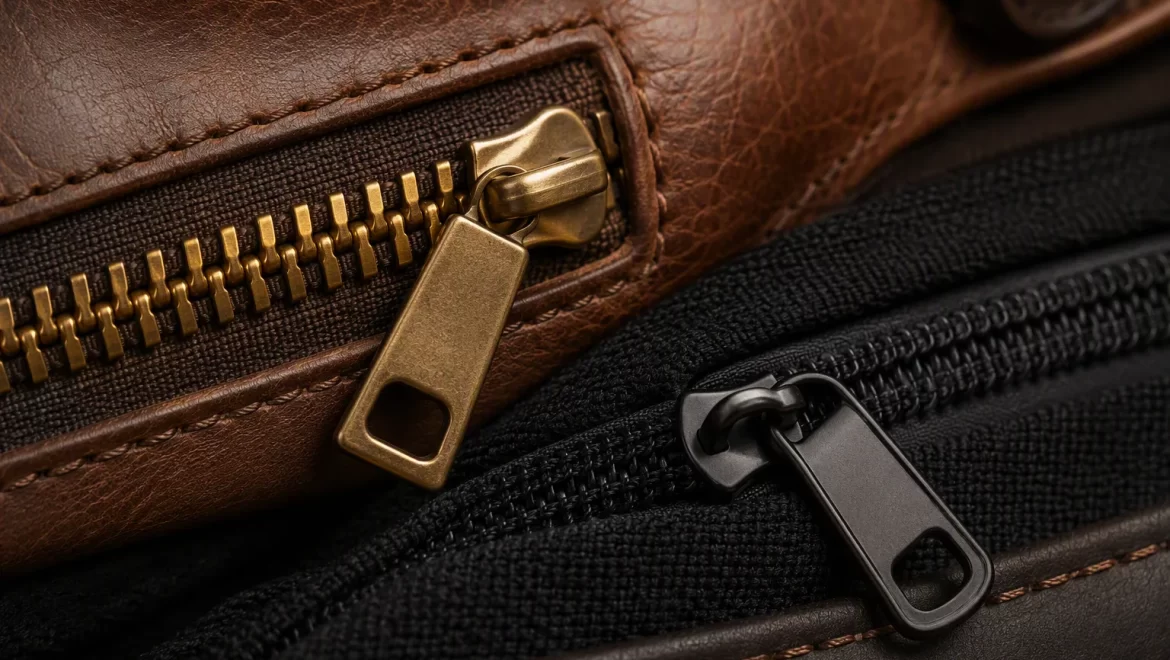
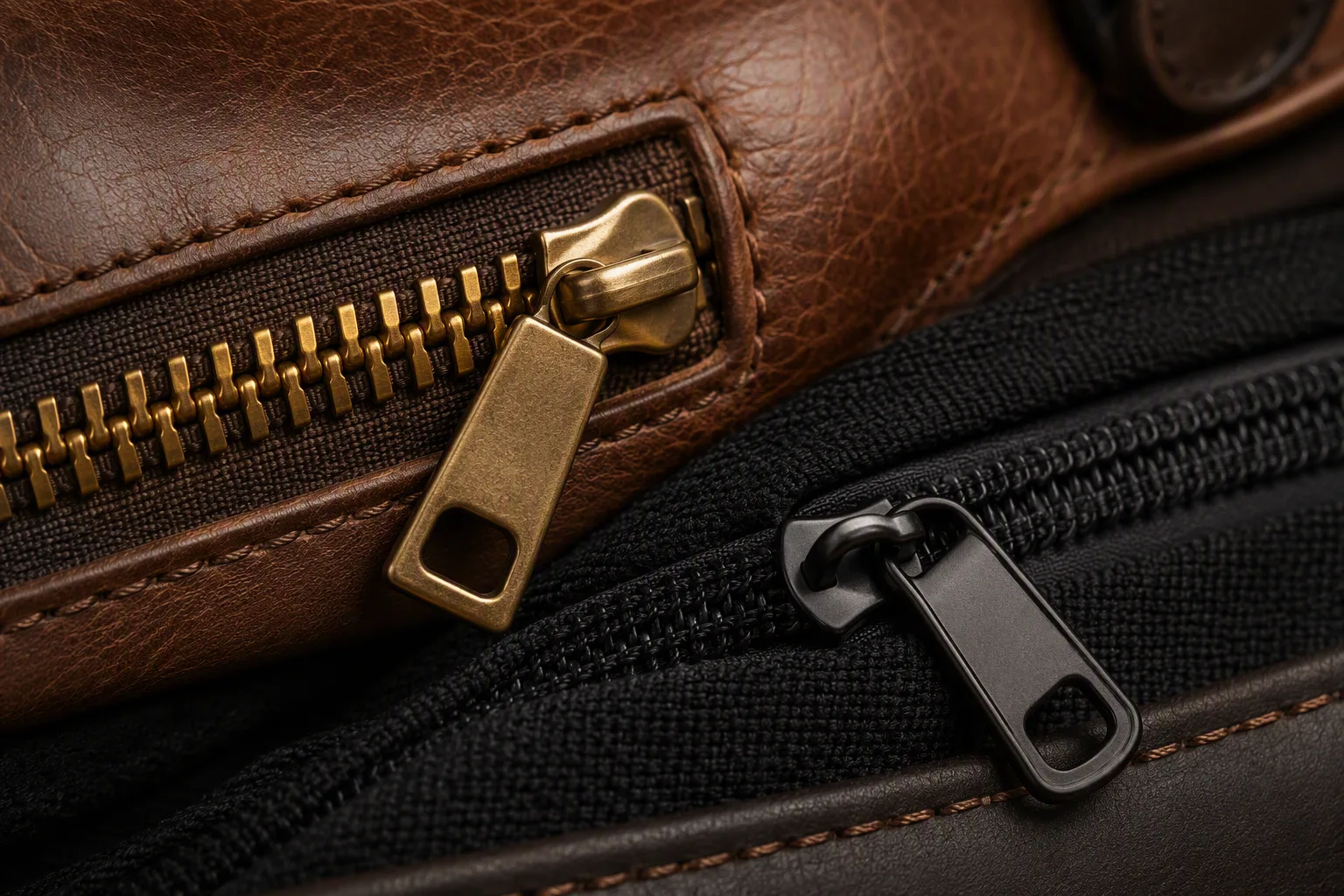
The zipper is the single most-used piece of hardware on a bag, and the component where quality differences are felt most directly. A great zipper glides, a mediocre one catches, and a bad one fails. Understanding the basics lets you specify with confidence.
Zipper types. Three constructions dominate bags:
| Type | Construction | Best use | Notes |
|---|---|---|---|
| Coil (nylon) | Nylon coil sewn to tape | Soft bags, curved openings, backpacks | Flexible, forgiving on curves, quiet |
| Metal | Brass/aluminum teeth | Fashion statement, structured bags | Durable, distinctive look, heavier |
| Invisible | Coil hidden behind tape | Minimalist design, hidden closures | Smooth appearance, less robust |
The brands and grades. YKK is the industry benchmark — its zippers are the default quality reference, and most quality bags use YKK or equivalent (RIRI and Lampo at the luxury end). What matters more than the brand is the grade within the brand: YKK's standard, heavy, and water-repellent lines serve different purposes, and a factory quoting "YKK" may mean the entry grade. Specify the line, not just the brand.
The slider is the soul of the zipper. The slider's quality determines the zipper's feel: a quality slider engages the teeth cleanly, pulls smoothly, and resists sideways force that separates the chain. Sliders also carry the finishes — antique, brushed, or plated — that match the bag's hardware theme. A zipper is only as good as its slider, and sliders are where cheap zippers fail first.
Pulls and tape. The zipper pull is a daily-touched surface — a branded or weighted pull adds premium feel and carries logo hardware. The tape (the fabric the teeth are sewn to) matters structurally: cheap tape stretches and lets the zipper pucker, while quality tape is stable and sews cleanly into the leather.
Buckles and Closures
Buckles and closures are the bag's mechanical personality — the parts customers fiddle with, adjust, and judge by feel. They also carry more design weight than zippers, because they are visible hardware rather than functional invisibility.
Buckle types. Center-bar buckles (the classic belt buckle), side-release buckles (the plastic snap-together kind, common on straps), and magnetic closures (the quiet snap of a tote flap) each suit different bag personalities. The manufacturing consideration: center-bar buckles thread leather straps and are sized to the strap width; side-release buckles are functional and quick; magnetic closures are convenient but their strength varies — a weak magnet is a daily annoyance, and a strong one is a daily struggle.
What quality means in a buckle. A quality metal buckle is cast or stamped from solid material, not plated plastic: it has weight, its edges are smooth, its mechanism engages with a positive click, and its finish matches the bag's hardware theme. The test is in the hand: a quality buckle closes with one clean motion and releases without resistance. A cheap buckle is light, sharp-edged, and its plating wears at the friction points within months.
Snaps and magnetic closures. Metal snaps (the press-studs of bag flaps) come in two quality tiers: spring-type (quality, repairable) and flange-type (cheap, crimped once). Magnetic closures need the magnet strength matched to the flap's weight and the leather's stiffness — the engineering is in the pairing, and factories that test closures against the actual flap construction deliver bags that close properly.
Rivets, Screws, and Fasteners
The invisible hardware holds the bag together, and its failures are the most damaging because they appear suddenly. A handle rivet that pulls out is not a cosmetic issue — it is a structural failure and a return.
Rivets. The standard in bag making is the tubular or solid rivet, set with a press or hammer. Quality depends on three variables: the material (brass, copper, steel, or aluminum — brass is the premium standard), the length (matched to the leather stack; too short clinches poorly, too long deforms the head), and the setting pressure (calibrated per material; too little = loose, too much = crushed leather). The same rivet in the wrong length or pressure fails — which is why rivet setting is a skilled operation, not a machine default.
Screws and Chicago screws. Chicago screws (also called screw posts) are the removable fasteners used for replaceable straps and hardware — the quality marker is the thread: quality screws engage smoothly and hold tight, cheap ones strip within a few uses. For permanent connections, machine screws with thread-locking compound prevent the slow-loosening failure that sends handles back.
Framed constructions. Bags with metal frames (structured top frames, box bags) are assembled with frame screws and rivets that carry the entire structure. The frame-to-leather interface is where alignment errors show: a frame screw set off-angle distorts the opening, and a frame that flexes cracks the leather at stress points. Structured bags live or die on their frame hardware quality.
Metal Materials and Finishes
The metal itself determines the hardware's honesty — what it is made of, and how it is finished. This is where "gold-toned" and "brass" diverge, and where buyers are most often misled.
Base metals. The three main options:
| Base metal | Properties | Cost | Best use |
|---|---|---|---|
| Brass | Heavy, warm tone, ages well, corrosion-resistant | $$$ | Premium bags, heritage styles |
| Zinc alloy (zamak) | Castable to fine detail, good plating base | $$ | Most mid-range hardware, custom shapes |
| Stainless steel | Strong, corrosion-proof, cool tone | $$–$$$ | Technical/outdoor bags, hardware under stress |
| Aluminum | Light, anodizable | $–$$ | Lightweight bags, sport styles |
| Iron/steel (plated) | Cheap, corrodes if plating fails | $ | Budget bags — avoid for closures |
Plating and finishes. The finish layer determines appearance and wear resistance:
| Finish | Process | Wear resistance | Look |
|---|---|---|---|
| Electroplating | Metal deposited by current | Moderate | Bright, standard |
| PVD (physical vapor deposition) | Vacuum coating | Excellent | Rich, scratch-resistant |
| Antique/burnished | Darkened and highlighted | Good | Heritage, aged look |
| Brushed/matte | Mechanical texture | Good | Modern, understated |
| Powder coating | Plastic coating | Good | Colored, matte |
The key rule: plating quality is about thickness and base metal preparation. A zinc alloy part with thick PVD plating outperforms a steel part with thin electroplating — the plating thickness is the real specification, not the finish name. Buyers should ask for the plating spec (typically 0.5–1.0 micron for electroplating, higher for premium), and for salt-spray test results that prove the finish survives humidity and wear.
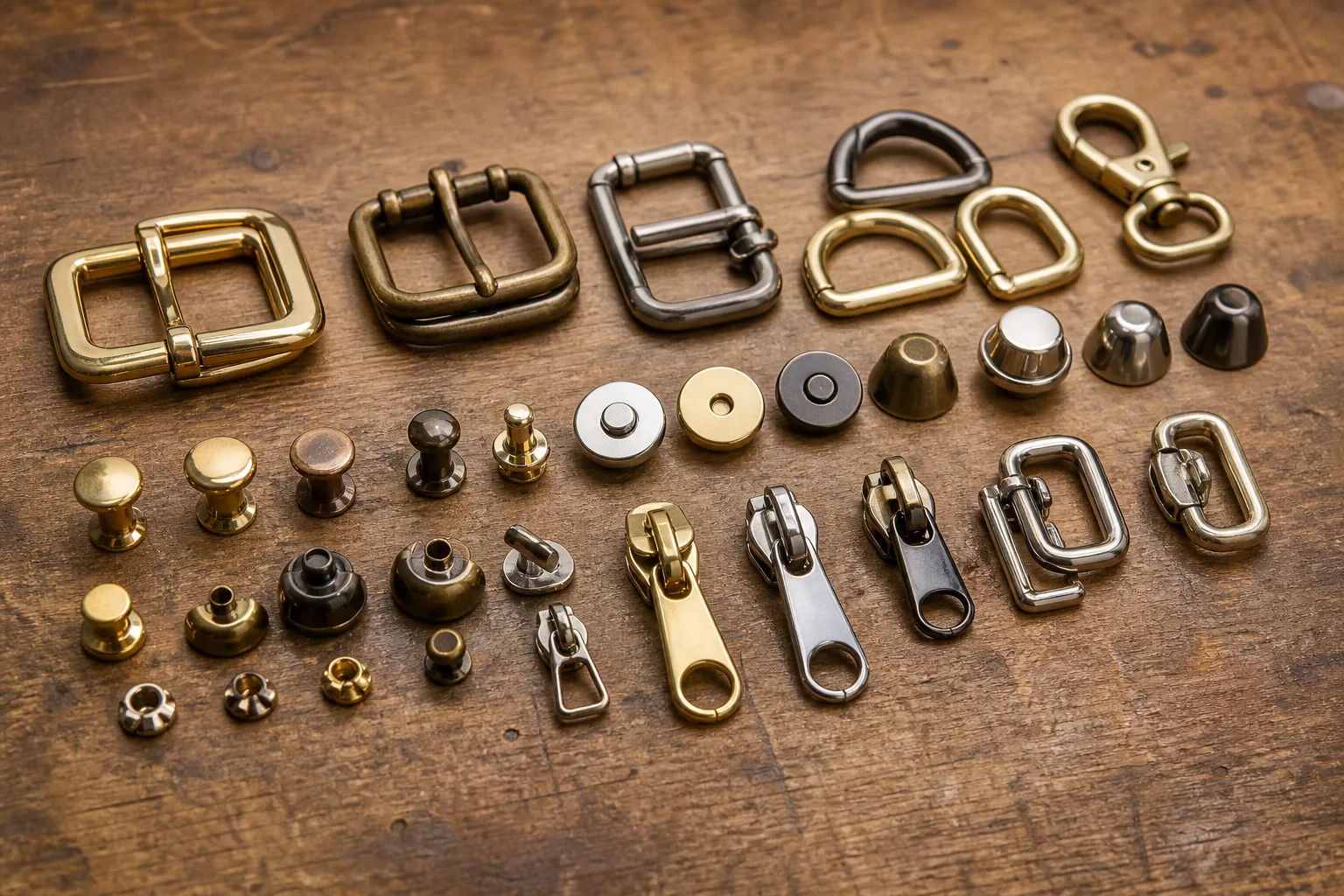
Head-to-Head: Metal Options
| Attribute | Brass | Zinc alloy | Stainless | Aluminum |
|---|---|---|---|---|
| Premium feel | Excellent | Good | Good | Moderate |
| Casting detail | Good | Excellent | Fair | Good |
| Corrosion resistance | Excellent | Good | Excellent | Good |
| Weight | Heavy | Moderate | Moderate | Light |
| Plating adhesion | Excellent | Excellent | Moderate | Fair |
| Custom shapes | Castable | Castable | Machined | Castable |
| Cost | High | Moderate | Moderate | Low |
| Best positioning | Heritage/luxury | Mid-range | Utility | Light bags |
The practical guidance: brass for heritage and luxury (warmth, weight, aging character), zinc alloy for most mid-range and custom designs (castability, plating base, cost), stainless for utility and stress hardware, and aluminum for lightweight lines. The metal choice should match the bag's price positioning — and the finish choice should match its design language. Mixing metals across a bag (brass buckles with steel zipper) is a design decision that must be deliberate, because mismatched tones read as sloppy.
How Hardware Affects Manufacturing
Hardware is not just a bill-of-materials line — it changes how the bag is assembled, how long production takes, and how many rejects you get. A factory that knows its hardware saves you both time and failures.
Rivet and fastener setting. The setting operation is where most hardware quality is determined. Skilled operators calibrate the press per material stack, check clinch quality, and position hardware against alignment marks. Unskilled setting produces loose rivets, crushed leather, and misaligned parts — the classic "hardware failure" that is actually a labor failure. When auditing a factory, watch the rivet station: the discipline there predicts the hardware reliability of every bag.
Zipper installation. Sewing a zipper into leather is one of the hardest operations in bag making — the zipper must lie flat, the tape must not pucker, and the slider must work after the seam is sewn. Quality factories use dedicated zipper operators and test every installed zipper. Cheap factories treat zippers as a standard seam, and the puckered, catching zippers that result are a top complaint.
Hardware-to-leather matching. The hardware spec must match the leather and construction: rivet length to the leather stack, buckle size to strap width, magnet strength to flap weight. This matching is a design engineering step that belongs in the tech pack — a factory that receives "use standard hardware" is choosing the match itself, usually toward the cheaper end.
Finishing and protection. Hardware must be protected during production: wrapped or masked to avoid scratches, plated parts stored away from humidity, and set after the bag's final cleaning (some finishes dull from cleaning solvents). A factory that handles hardware carelessly ships bags with microscratched plating that customers find within days.
Hardware Testing: What to Demand
Quality hardware is provable — the tests are simple, standardized, and worth putting in your contract. Here are the tests a serious buyer demands:
| Test | What it proves | Standard/typical threshold |
|---|---|---|
| Pull test | Load-bearing hardware won't fail | D-rings/loops withstand rated load (e.g., 15–30 kg) |
| Zip cycle test | Zipper survives repeated use | 2,000–5,000 open/close cycles without failure |
| Salt spray test | Plating resists corrosion | 24–72 hours depending on finish grade |
| Plating thickness test | Finish is actually applied | 0.5–1.0+ micron per spec |
| Closure cycle test | Snaps/magnets survive use | 1,000+ engagements without weakening |
| Flex/abrasion test | Finish survives handling | No visible wear after abrasion cycles |
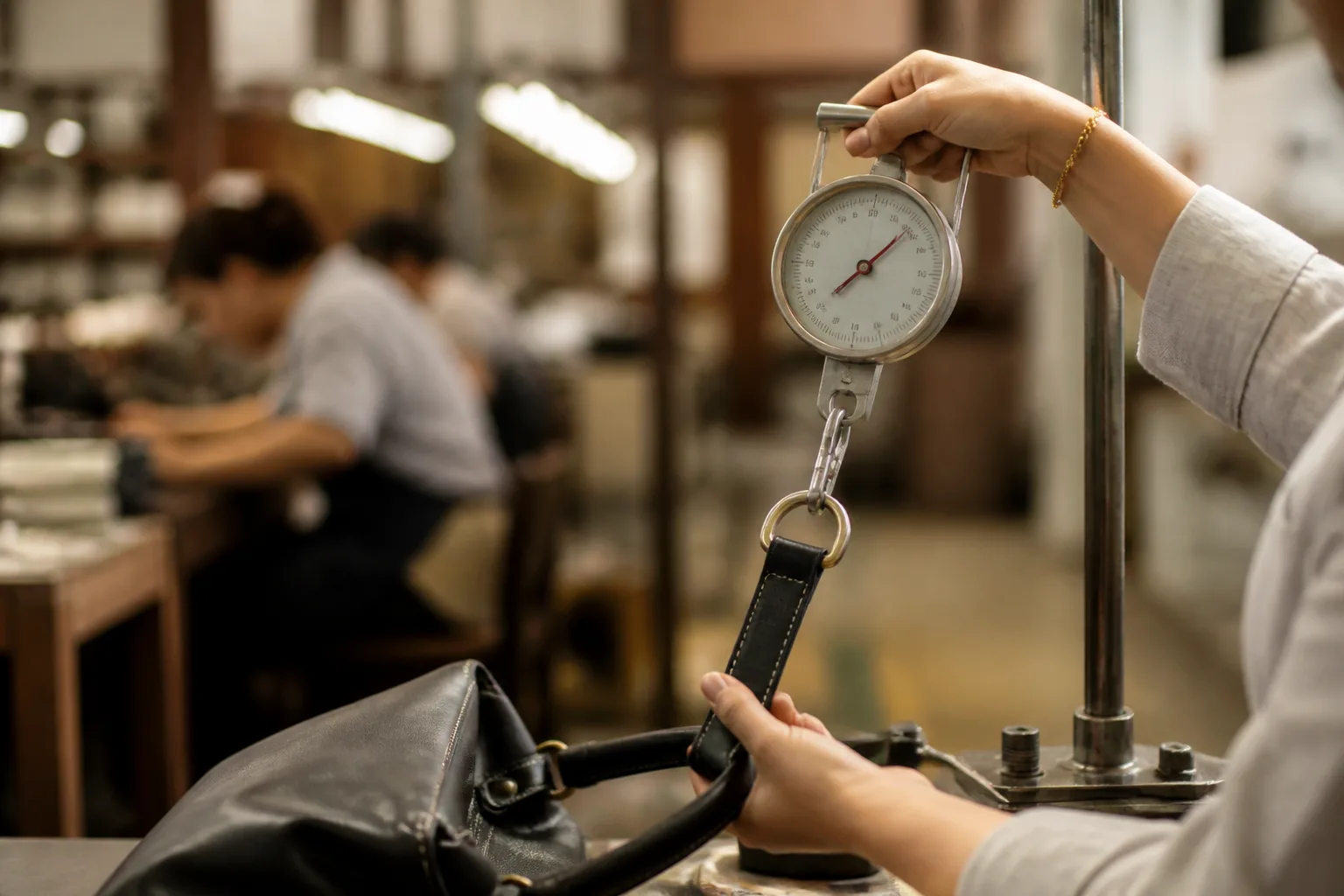
Three notes on testing. First, specify the test, not just the result — a "pull test" without a load figure is meaningless, and a "salt spray test" without hours is decoration. Second, request the factory's test data, not a promise — a factory that tests has records, and a factory that does not test has opinions. Third, test the production batch, not just the sample — hardware is swapped between sample and production more than any other component, because the change is invisible in photos. The production-level sample must carry the production hardware, and the first production batch should be tested against the same criteria.
Matching Hardware to Bag Style
| Bag style | Recommended hardware | Why |
|---|---|---|
| Heritage tote | Brass, antique finish | Warmth, aging character, craft story |
| Luxury handbag | Brass or zinc alloy, PVD | Rich tone, scratch resistance |
| Fashion bag | Zinc alloy, colored/brushed finishes | Design freedom, cost balance |
| Work / laptop bag | Stainless or zinc alloy | Durability, professional look |
| Travel bag | Stainless, heavy-duty zippers | Stress resistance, corrosion |
| Backpack | Zinc alloy or aluminum | Weight, durability at price |
| Diaper / family bag | Zinc alloy, water-resistant zippers | Daily abuse, washability |
| Evening clutch | Brass or zinc alloy, jewel tones | Decorative, premium feel |
| Utility/sport | Aluminum or stainless | Light weight, function |
The matrix follows the same logic as every other material decision: match the hardware to the bag's price, use, and story — and specify it with the same rigor you apply to leather. A heritage tote with steel zippers and bright plating contradicts its own narrative; a travel bag with delicate brass buckles fails its own promise.
Hardware, Branding, and Custom Parts
Hardware is also a branding surface — and custom hardware is one of the most effective ways to make a bag recognizable. The options range from cheap to serious investment:
Logo engraving. Engraving the brand name or monogram onto standard hardware (buckles, zipper pulls, nameplates) is the entry level — modest cost, real brand presence. The quality is in the execution: clean, deep, well-positioned engraving reads as premium; shallow, crooked engraving reads as cheap regardless of the metal.
Custom pulls. A shaped zipper pull — a signature silhouette, a branded shape — is a recognizable brand cue at a moderate cost. Custom pulls are cast or stamped, and their cost scales with complexity and minimum quantities.
Cast logo hardware. Full custom hardware — a cast buckle or logo plate in the brand's shape — is the premium branding move. It requires tooling (a mold, typically several thousand dollars) and minimum quantities, but it creates the strongest recognition: the hardware itself becomes the logo, visible in every photo and every hand.
Three rules for custom hardware: budget the tooling (mold costs amortize over the production run), protect the design (register the shape if it is a brand asset), and specify the finish (the same casting in different finishes is different products — lock the finish at sampling). Custom hardware done well is a brand asset; done carelessly, it is a logo printed on a failure.
Common Hardware Failures and Prevention
| Failure | What happens | Root cause | Prevention |
|---|---|---|---|
| Zipper catching/sticking | Daily annoyance | Cheap slider, poor installation | Quality zipper, tested installation |
| Plating wear/tarnish | Surface dulls, corrodes | Thin plating, wrong finish | Plating spec, salt spray test |
| Rivet pulling out | Structural failure | Wrong length/pressure | Set correctly, pull test |
| Buckle plating flaking | Cosmetic damage | Cheap plating on cast part | Thick PVD, finish spec |
| Magnet too weak | Flap won't stay closed | Undersized magnet | Match magnet to flap weight |
| Screws loosening | Handles/parts work loose | No thread-locking | Thread compound, periodic check |
| Zipper tape stretching | Zipper puckers in seam | Cheap tape, bad sewing | Quality tape, zipper operators |
| Frame distortion | Bag won't close straight | Off-angle frame screws | Alignment QC at frame stage |
The pattern is consistent with the rest of the bag: hardware failures are specification and process failures. A spec without tests, and a process without checks, produce exactly these outcomes. The fix is not better luck — it is better specs, tested batches, and process discipline at the hardware stations.
Hardware Care and Maintenance for Customers
Hardware is the most-handled part of a bag, and how customers care for it determines how long it stays beautiful. Your care card should treat hardware as deliberately as the leather — and the instructions differ by finish and metal.
Zippers. A zipper that catches is usually a zipper that is dirty or bent. Advise customers to keep zippers free of grit (a soft brush along the teeth works wonders), to close zippers without forcing them (forcing bends the teeth), and to store bags with zippers half-open to relieve tape tension. A drop of silicone or wax on the teeth every few months keeps the glide smooth — but never oil, which attracts dirt and stains the leather.
Plated hardware. The enemy of plating is friction, moisture, and cosmetics: hand cream and perfume are the common accelerators of plating wear. Advise customers to wipe hardware dry after rain, avoid abrasive cleaners, and store bags in dust bags so hardware does not rub against other metal. For antique and brushed finishes, the rule is "less is more" — gentle dry cloth only, no metal polishes that strip the aged look.
Brass and solid metal. Solid brass is the forgiving metal: it can be polished back to brightness with a brass cleaner (the patina returns with use, which is part of the charm), and minor tarnish is cosmetic, not failure. Advise heritage customers that brass aging is a feature: the warm darkening over months of use is the same story the leather's patina tells.
Rivets and fasteners. Advise customers to check rivets and screws periodically — a loose Chicago screw is a 30-second fix with a screwdriver, and catching it early prevents lost hardware. This small maintenance note prevents the most avoidable returns: hardware that loosens over months of carry.
Write these instructions into the care card by hardware type, not as a generic "care for hardware" line. Customers who know how to maintain the metal keep the bag beautiful — and the brand that teaches them earns the maintenance ritual as a loyalty ritual.
Budgeting Hardware Across Your Line
Hardware budgeting is a strategic act: the same line can carry different hardware tiers, and the allocation should follow the product's role in the line, not a single blanket spec.
| Line tier | Hardware budget (per bag) | Suggested spec |
|---|---|---|
| Entry line | $1.50–$3.00 | Zinc alloy, standard plating, YKK standard zips |
| Core line | $3.00–$5.00 | Zinc alloy or brass mix, PVD on visible parts, YKK heavy |
| Premium line | $5.00–$8.00 | Brass, PVD/antique finishes, branded pulls, custom details |
| Flagship | $8.00+ | Full custom hardware, solid brass, luxury-grade zips |
Three rules for allocating. First, spend where customers touch: closures and carrying hardware earn the budget first; decorative parts come second. A $3 budget spent entirely on a beautiful buckle with a cheap zipper fails daily; the same budget on a quality zipper with a standard buckle serves daily. Second, upgrade the visible, standardize the hidden: custom hardware on the visible surfaces (buckle, zipper pull, logo plate) with standard quality underneath (rivets, feet, frame screws) delivers brand recognition at controlled cost. Third, protect the flagship: the flagship tier's hardware is the brand's quality statement — never let cost pressure downgrade it, because the flagship is what customers and reviewers judge the whole line by.
The strategic payoff: hardware budget allocated by tier and by touch creates a line where every bag is appropriately specified — and where the customer's hand can feel the brand's pricing logic in every zipper, buckle, and click.
FAQ
What hardware brand should I use?
A: YKK is the industry benchmark for zippers; RIRI and Lampo sit at the luxury end. For other hardware, the brand matters less than the material, plating, and test results. Specify the quality standard, not just a name.
What is the difference between brass and zinc alloy hardware?
A: Brass is a solid metal — heavy, warm, corrosion-resistant, and it ages beautifully. Zinc alloy is a castable metal that takes fine detail and excellent plating at a lower cost. Brass for heritage and luxury; zinc alloy for most mid-range and custom designs.
How do I know if plating will last?
A: Ask for the plating thickness spec (0.5–1.0+ micron) and the salt spray test result (24–72 hours depending on grade). Thick PVD plating on a well-prepared base is the most durable standard finish.
Why do zippers fail?
A: Cheap sliders and tape, or poor installation — usually both. A quality zipper with a quality slider, installed by a trained operator and tested after installation, is the reliable combination.
How much should hardware cost per bag?
A: Typically $2–$8 per bag for quality mid-range hardware (zips, buckles, rivets, feet), more for custom or luxury parts. Hardware is 5–15% of factory cost — and the most visible quality-per-dollar investment in the bag.
Can I use the same hardware on different bag styles?
A: Yes, but match the grade to the use: a travel bag needs heavy-duty zippers and stainless or heavy brass; an evening clutch can use lighter, more decorative hardware. Using one spec across the whole line under-specs some bags and over-specs others.
What tests should I put in my contract?
A: Pull test (with load figure), zip cycle test (with cycle count), salt spray test (with hours), plating thickness (with microns), and closure cycle test. Specify the test and the threshold, and require the factory's test data.
How can I verify hardware quality on a sample?
A: Feel the weight (quality hardware is heavier), test the zipper (smooth, no catching), click the closures (positive engagement), examine the plating under magnification (even, no thin spots at edges), and check the rivets from inside (clean clinch, no crushed leather).
Writing the Hardware Spec in Your Tech Pack
A professional hardware spec leaves nothing to interpretation. Here is the template we use:
- Zippers: YKK (or approved equivalent), coil #5 or metal #5 per design, slider finish X, branded pull as per drawing, tested to 2,500 cycles
- Buckles: Brass or zinc alloy per design, antique/PVD finish X, sized to strap width, plating ≥ 0.8 micron, salt spray 48h
- Rivets: Brass tubular, length matched to leather stack (spec per location), press-set, pull-tested to X kg
- Closures: Magnet strength spec per flap construction; snaps spring-type per design
- Testing: Pull test X kg, zip cycle 2,500, salt spray 48h, closure cycle 1,000 — test data required with production-level sample
- Substitution rule: No hardware substitution without written approval and re-testing
That last line is the guardian of everything above it: hardware is the most-swapped component in production, and the substitution rule is what makes the spec real.
Conclusion
Hardware is the interface between a bag and daily life — the zipper that opens a thousand times, the buckle that fastens a thousand more, the rivet that quietly holds everything together. Its quality is felt in every use, judged in every review, and decided in every spec. The materials (brass, zinc alloy, stainless, aluminum), the finishes (electroplating, PVD, antique), the tests (pull, cycle, salt spray), and the manufacturing discipline (rivet setting, zipper installation, protection) together determine whether hardware elevates the bag or undermines it.
For buyers, the professional path is the same as for every other component: specify the hardware deliberately, demand the test data, verify the production batch, and protect the spec with a substitution rule. Hardware is the highest-leverage quality investment in a bag — and the component most worth defending in your contract. The bag that closes with a solid click, opens with a smooth glide, and holds together for years is the bag that earns its reviews — and the spec that made it so was written before a single bag was cut.
Designing a bag and want to compare hardware quality for yourself? Contact our factory — we will prepare samples with brass, zinc alloy, and stainless hardware in multiple finishes, share our test data (pull, cycle, salt spray), and walk you through the hardware options on your design so you can feel the difference before you commit.