How Should Water-Repellent Linings Be Specified for Pet Bags?
- Two Requirements, Not One
- How Water Repellency Works
- What Repellency Cannot Do
- Building the Wipe-Clean Interior
- Coatings, Films and Their Trade-Offs
- Detachable and Washable Interiors
- Edges, Seams and Liquid Paths
- Pet Soiling and What It Does to Surfaces
- Airflow and Moisture in a Sealed Interior
- Testing Repellency and Cleanability
- Coating Durability and Ageing
- Specifying the Interior Surfaces
- Cost Drivers and Material Claims
- FAQ
Two words carry most of the confusion in pet bag interiors: water-repellent and wipe-clean. They sound like the same property, they are often sold as the same property, and they are produced by different means with different limits.
A carrier whose interior sheds a spilled drink and a carrier whose interior can be wiped back to a usable state are not the same product. Getting the distinction right at the specification stage is what decides whether the interior still performs after a season of use.
This guide covers where the two requirements differ, how water repellency is actually produced, what repellency cannot do, how a wipe-clean interior is built, how coatings and films compare, when detachable liners make sense, how seams and edges carry liquid, how pet soiling behaves on different surfaces, the tension between a sealed interior and ventilation, what to test, how coatings age, how to write the specification, and what drives cost.
Two Requirements, Not One
The first decision is which property the product actually needs, because they are met by different construction choices.
Shedding Liquid Versus Surviving Cleaning
Repellency is about what happens in the first seconds after liquid lands: how much beads up and how much soaks in. Cleanability is about what happens afterwards, when the surface is wiped, and how much of the soiling and odour remains.
A lightly treated woven lining can shed a spill reasonably well and still be difficult to wipe clean once the liquid has carried into the weave.
Where Each Requirement Belongs
Repellency matters most on surfaces that will meet rain, drinks, wet paws and outdoor ground. Cleanability matters most on the surfaces that will meet accidents, saliva and food residues, which is to say the base and the lower walls.
A single interior often needs both, but in different zones, and the specification should say which zone needs which.
Why the Distinction Changes the Cost
A repellent finish on a woven lining is a comparatively low-cost treatment, while a sealed, wipe-clean construction adds materials, operations and inspection steps. Spending the sealed construction across the whole interior raises cost without improving the parts that never see liquid.
Zoning the two requirements is usually where the saving is found.
| Requirement | Measured by | Typical zone | Construction response |
|---|---|---|---|
| Repellency | Beading and absorption | Upper walls, opening | Treated woven surface |
| Cleanability | Removal of soiling | Base, lower walls | Smooth sealed surface |
| Odour control | Retention after cleaning | Base, cushion | Non-absorbent surface |
| Abrasion | Surface loss over cycles | Contact points | Coated or film surface |
| Weight control | Additional grams | Whole interior | Selective zoning |
| Cost control | Added operations | Whole interior | Zone the requirement |
How Water Repellency Works
Repellency is a surface property produced by lowering the surface energy of the fibres or by putting a continuous layer in front of them.
Finishes on Woven Surfaces
A repellent finish coats individual fibres so that water beads rather than wets them. The treatment is thin, keeps the fabric's handle and breathability, and is applied during finishing or added later.
Because the finish sits on the fibre surfaces, it is sensitive to abrasion and to repeated washing, which is where its behaviour over time diverges from a coated surface.
Coatings and Backings
A coating or a laminated backing puts a continuous layer behind or in front of the weave, so liquid meets a film rather than a fabric. The result is a stronger barrier, a firmer handle and a surface that wipes more readily.
The trade is weight, flexibility and cleanability of the coating itself, which can be scuffed or cracked in use.
Films and Membranes
A thin film bonded to the lining gives repellency without the stiffness of a heavy coating, and some films allow vapour to pass while blocking liquid. This is the construction that best supports an interior which must stay dry without becoming clammy.
Films delaminate if the bond is poor or if the lining flexes sharply, so the bonding method belongs in the specification.
| Construction | Repellency | Cleanability | Weight |
|---|---|---|---|
| Untreated woven | Low | Moderate | Lowest |
| Treated woven | Moderate | Moderate | Low |
| Coated surface | Strong | Strong | Moderate |
| Laminated backing | Strong | Strong | Higher |
| Bonded film | Strong | Strong | Low to moderate |
| Film plus brushed face | Strong | Moderate | Moderate |
What Repellency Cannot Do
Repellency is frequently described as if it were waterproofing, and the gap between the two is where customer disappointment lives.
Seams, Zips and Openings
Liquid entering an interior usually arrives through a seam, a zip or an open aperture rather than through the surface. A repellent lining does nothing about the needle holes along a stitched seam, and it does not close a zip.
Where an interior must resist liquid ingress rather than merely shed it, the seams, closures and openings become the design problem.
Gravity and Standing Liquid
A repellent surface beads liquid, and beading depends on the liquid leaving. Where liquid pools in a base with nowhere to drain, it eventually finds a path through the weave or the seam, however well the surface performs.
Shape matters here: a slight slope towards an absorbent or removable pad is more effective than a stronger finish on a flat base.
The Limits of Any Finish
No finish survives unlimited abrasion, and none is permanent. Repellent treatments wear where the surface is rubbed, which is exactly where pets and their harnesses contact the lining.
Describing a finish as durable is therefore a claim about how it behaves over a stated number of cycles, not about whether it wears.
| Situation | What repellency gives | What is still needed |
|---|---|---|
| Splash on a wall panel | Beading and run-off | Nothing further |
| Drink spilled in the base | Containment | Drain or removable pad |
| Wet paws entering | Reduced absorption | Wipe access |
| Liquid at a seam | Little protection | Sealed or taped seam |
| Liquid at a zip | No protection | Closure design |
| Repeated abrasion | Diminishing effect | Coated or film surface |
| Long contact time | Reduced benefit | Non-absorbent surface |
| Sand and mud | Easier removal | Smooth, sealed face |
Building the Wipe-Clean Interior
Cleanability is a construction outcome, not a material property, and it is achieved by removing the places where soiling can hide.
Smooth, Non-Absorbent Faces
A wipe works when the surface releases what is on it. A tight weave or a coated face with low absorbency releases soil, while a brushed or sueded face holds it and requires deeper cleaning.
Where a soft face is needed for comfort, it belongs on a removable part rather than on the fixed interior.
Sealed and Coved Joins
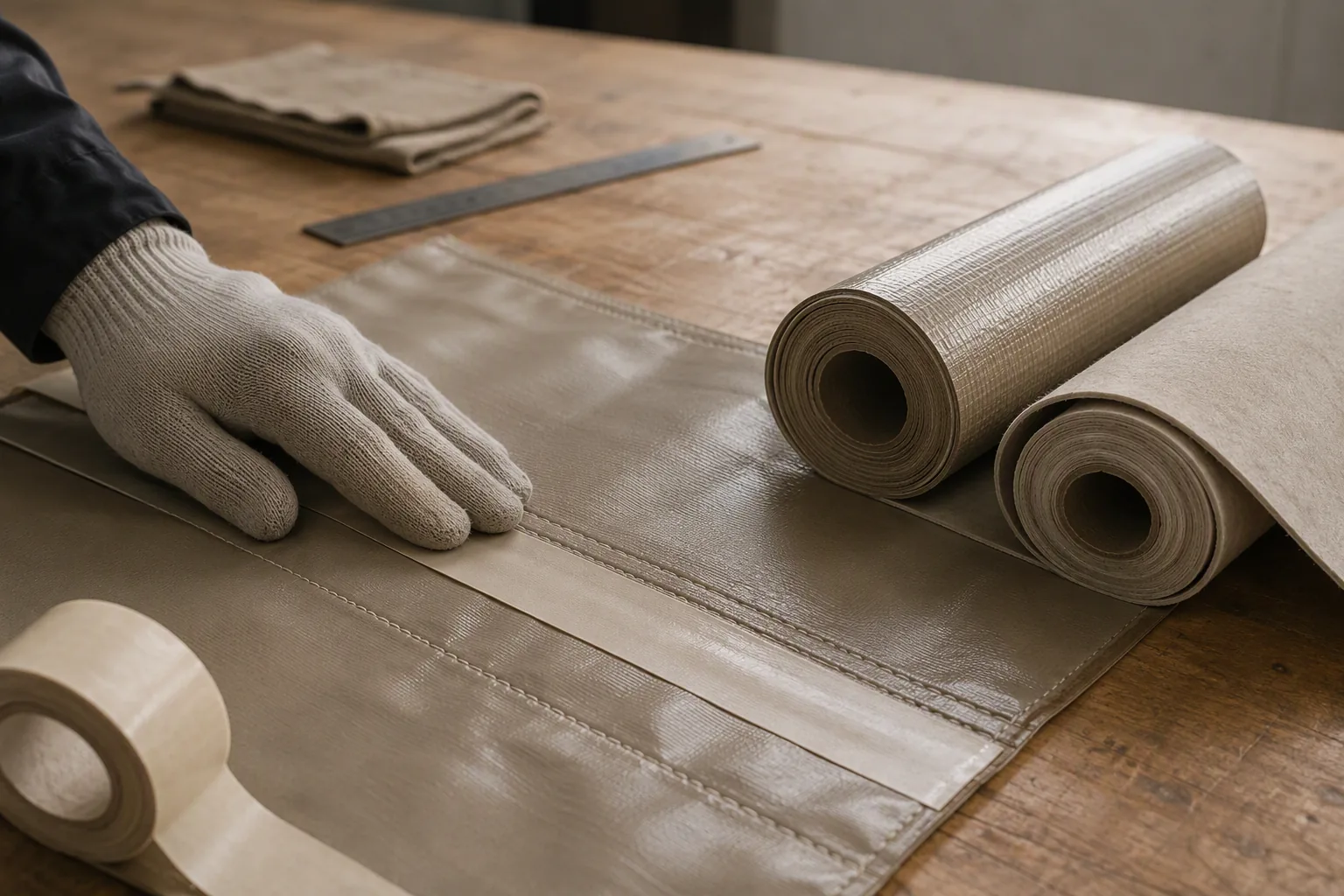
Every join is a trap for liquid and soil. Sealed, taped or welded joins remove the needle holes and the gap between two panels, and a coved or curved transition at the base removes the corner where liquid normally collects.
These changes are visible in the finished product and should be confirmed on the sample rather than assumed from a drawing.
Fewer Parts and Smaller Gaps
Each additional panel adds a seam, and each seam adds a cleaning problem. Reducing the number of interior panels improves cleanability directly, even where the materials stay the same.
Gaps around frames, boards and stiffeners behave like corners and should be closed or made accessible.
Access for Cleaning
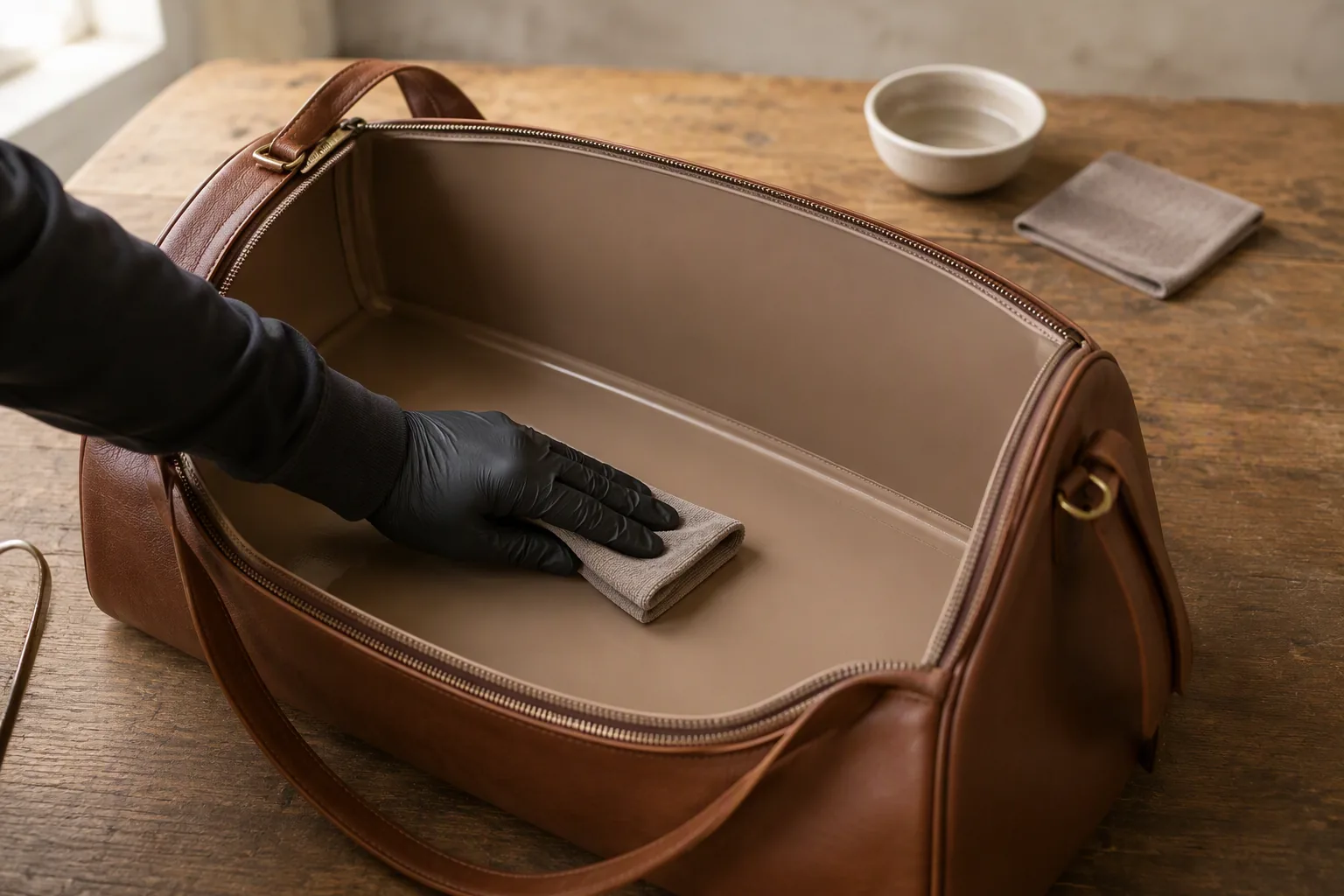
A surface that cannot be reached cannot be wiped. Where an interior is deep or shaped, the design should allow the base to be removed, folded back or reached with a hand.
Accessibility is the cheapest improvement available, and it is often omitted in favour of a better surface.
| Construction choice | Effect on cleanability | Cost direction |
|---|---|---|
| Coated smooth face | Strong improvement | Adds material cost |
| Taped or welded joins | Removes hidden soil | Adds operations |
| Coved base transition | Removes collection point | Pattern change |
| Fewer interior panels | Fewer traps | Simplifies assembly |
| Removable base pad | Full access | Adds a component |
| Closed frame gaps | Removes crevices | Adds steps |
| Brushed soft faces | Reduces cleanability | Lower surface cost |
| Deep shaped interior | Limits access | No cost, design limit |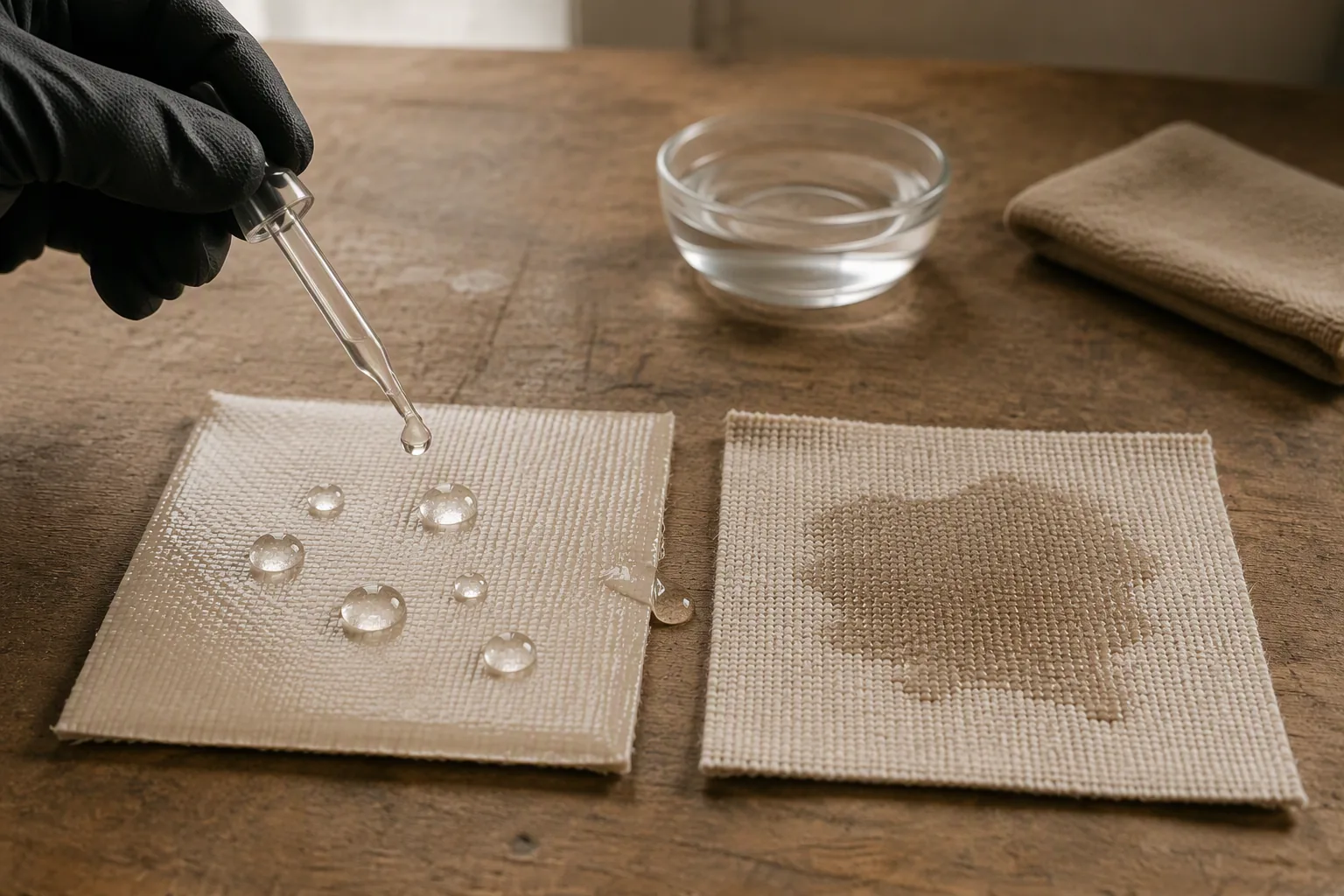
Coatings, Films and Their Trade-Offs
The material chosen for a wipe-clean face decides how the interior feels, how much it weighs and how long it lasts.
Polyurethane and Vinyl-Type Coatings
A polyurethane coating gives a soft, flexible surface with good resistance to wiping and to flexing, which suits interiors that fold and compress. Vinyl-type coatings are firmer and often cheaper, but they stiffen in cold conditions and can mark.
Where an interior folds flat for storage, flexibility is worth more than initial surface hardness.
Bonded Films and Laminates
A film bonded to a woven or knitted backing gives a strong barrier with a controlled weight, and the backing decides how the composite feels. Laminating with adhesive adds weight and can fail at high temperature, while direct bonding holds better if the process is controlled.
Silicone, Wax and Natural Finishes
Silicone treatments and wax finishes suit materials where a natural appearance matters, and they shed liquid well when fresh. They are less durable than a bonded film and they change the surface appearance as they wear.
Because these finishes are sensitive to cleaning agents, the cleaning instruction and the finish must be chosen together.
| Face material | Feel | Durability | Cleaning |
|---|---|---|---|
| Polyurethane coating | Soft, flexible | Good | Wipe and mild soap |
| Vinyl-type coating | Firmer | Good but cold-stiff | Wipe |
| Bonded film on knit | Soft, supple | Good if bond holds | Wipe |
| Bonded film on woven | Firmer | Good | Wipe |
| Silicone treatment | Natural | Moderate | Gentle agents only |
| Wax finish | Natural, darkens | Lower | Re-application needed |
| Tight woven, untreated | Natural | Moderate | Deeper cleaning |
| Coated mesh | Firm | Good | Wipe, avoid brushing |
Detachable and Washable Interiors
Removing the interior entirely solves cleanability in cases where no surface treatment can.
Liners and Base Pads
A removable base pad or full liner can be lifted out, washed or replaced, which keeps the fixed structure out of the cleaning cycle. This is the most effective way to handle accidents, because the soiled part is the part that leaves the bag.
The trade is an additional component, a closure method and a fit that must stay in place under an animal's movement.
Fixing Methods
Hook-and-loop tape is convenient and collects hair, press studs are clean but punctual, and captive channels hold a pad without fasteners. Each has a different failure mode and a different cleaning behaviour, and the choice should follow how the interior will be washed.
Where the pad is held by tape, the tape should be positioned so that soil does not accumulate in it.
When a Removable Interior Is the Wrong Answer
A removable interior adds depth, weight and a component that can be lost or fitted incorrectly. For carriers used briefly and occasionally, a sealed fixed interior may be simpler and more predictable.
The decision should follow the soiling risk rather than the market expectation.
| Fixing method | Cleaning behaviour | Risk |
|---|---|---|
| Hook-and-loop tape | Traps hair | Clogging over time |
| Press studs | Easy to wipe | Punctures the surface |
| Captive channel | No fasteners | Hard to fit correctly |
| Zipped liner | Fully removable | Zip abrasion |
| Elastic corners | Simple | Stretches loose |
| Loose pad | Simplest | Shifts in use |
| Fixed sealed interior | No removal | Requires wiping |
| Replaceable insert | Serviceable | Inventory of parts |
Edges, Seams and Liquid Paths
Liquid follows construction, not intention, and the paths it takes are decided by how the interior is joined.
How Liquid Travels
Liquid entering at an opening runs down a wall, reaches the base seam and then spreads along it. Capillary action carries it further along fibres and through needle holes, which is why a small spill can reappear well away from where it landed.
Understanding this path shows where the sealing effort should go: the base perimeter and the lower wall joins matter more than the upper panels.
Sealing and Binding Options
Binding covers a raw edge, tape seals a seam, and welding removes the needle holes entirely. Binding alone does not prevent liquid passing through needle holes, so where sealing is required, tape or welding must be specified rather than assumed.
Choosing Where to Stop
Sealing every seam in a carrier is expensive and rarely necessary. A workable rule is to seal where liquid collects, bind where the surface is only splashed, and leave decorative joins untreated.
That rule should be written into the specification so the intent survives a later cost review.
| Join type | Liquid behaviour | Where it fits |
|---|---|---|
| Stitched with binding | Passes at needle holes | Upper panels |
| Stitched with tape | Blocked at seam | Base perimeter |
| Welded or sealed | Blocked | Lower walls |
| Coved base | Spreads to pad | Base transition |
| Folded edge | Slow path | Opening |
| Sealed zip | Blocked when closed | Base or door |
| Overlocked edge | Wicks along thread | Hidden areas |
| Bound and sealed both | Blocked and covered | Heavy soiling zones |
Pet Soiling and What It Does to Surfaces
Pet soiling is a mixture of materials with different behaviours, and an interior that handles one may fail on another.
Accidents and Their Residue
Liquid accidents leave both moisture and dissolved material behind, and it is the residue rather than the water that holds odour. A surface that beads water well can still hold odour if its texture traps the residue.
This is why cleanability, not repellency, is the controlling property at the base of the carrier.
Saliva, Food and Grease
Saliva and food residues are partly oily, and oil spreads on surfaces rather than beading. A repellent finish designed for water may do little against grease, which argues for a smooth coated face where food is carried.
Wiping a greasy surface with water spreads it further; the cleaning instruction should reflect that.
Hair, Sand and Mud
Hair and sand lodge in texture, and mud dries into a powder that works into weave gaps. Smooth, tight faces release all three far more easily than brushed ones, which is the same conclusion as for cleanability generally.
Where a soft face is essential, hair removal is easier if the surface is short rather than deep-pile.
Odour and Repeated Use
Odour accumulates where residue stays, so the practical measure of an interior is how it performs after repeated cleaning rather than how it looks when new. Non-absorbent faces with removable pads age best on this measure.
Where the carrier is used regularly, this consideration outweighs small differences in surface feel.
| Soiling type | Behaviour on surfaces | Best response |
|---|---|---|
| Liquid accident | Beads, then residue stays | Smooth sealed face |
| Residue drying | Holds odour | Non-absorbent surface |
| Saliva | Spreads, partly oily | Wipe with suitable agent |
| Food and grease | Spreads on water-repellent face | Smooth coated face |
| Hair | Lodges in texture | Tight short surface |
| Sand | Traps in weave gaps | Smooth face |
| Mud | Dries to powder | Wipe before drying |
| Repeated use | Cumulative odour | Removable pad |
Airflow and Moisture in a Sealed Interior
Sealing an interior and ventilating it pull in opposite directions, and both are legitimate requirements.
The Tension Between Sealing and Breathing
A fully sealed interior keeps liquid out and also keeps moisture in, which raises humidity around the animal and increases odour. Ventilation panels solve this but reintroduce liquid paths.
The resolution is normally zoning: a sealed base, ventilated upper panels, and a gap between the two.
Managing Condensation
Moisture from the animal condenses on the coolest surface available, which in a closed carrier is often the interior wall. A removable absorbent pad at the base collects that moisture where it can be removed rather than leaving it against the lining.
Where the carrier is used in warm conditions, a breathable film performs better than a solid coating for this reason.
Keeping Ventilation Outside the Wet Zone
Openings placed above the level that liquid reaches inside the bag stay out of the wet path, while those near the base become part of it. Positioning the ventilation above the pad line reduces the conflict substantially.
That decision should be taken together with the panel placement discussed for ventilation rather than afterwards.
| Interior approach | Liquid protection | Humidity | Best use |
|---|---|---|---|
| Fully sealed base | Strong | Higher | Short journeys |
| Sealed base plus pad | Strong | Managed | Regular use |
| Sealed lower, open upper | Strong | Moderate | Travel carriers |
| Breathable film interior | Moderate | Lower | Warm conditions |
| Full coated interior | Strongest | Highest | Wet environments |
| Removable absorbent pad | Moderate | Lowest | Accidents likely |
| Ventilation above pad line | Strong | Lower | Most carriers |
| Ventilation near base | Weak | Lower | Dry, cool use |
Testing Repellency and Cleanability
Both properties can be tested with simple methods, and testing them on the assembled interior is more informative than testing the fabric alone.
Repellency Checks
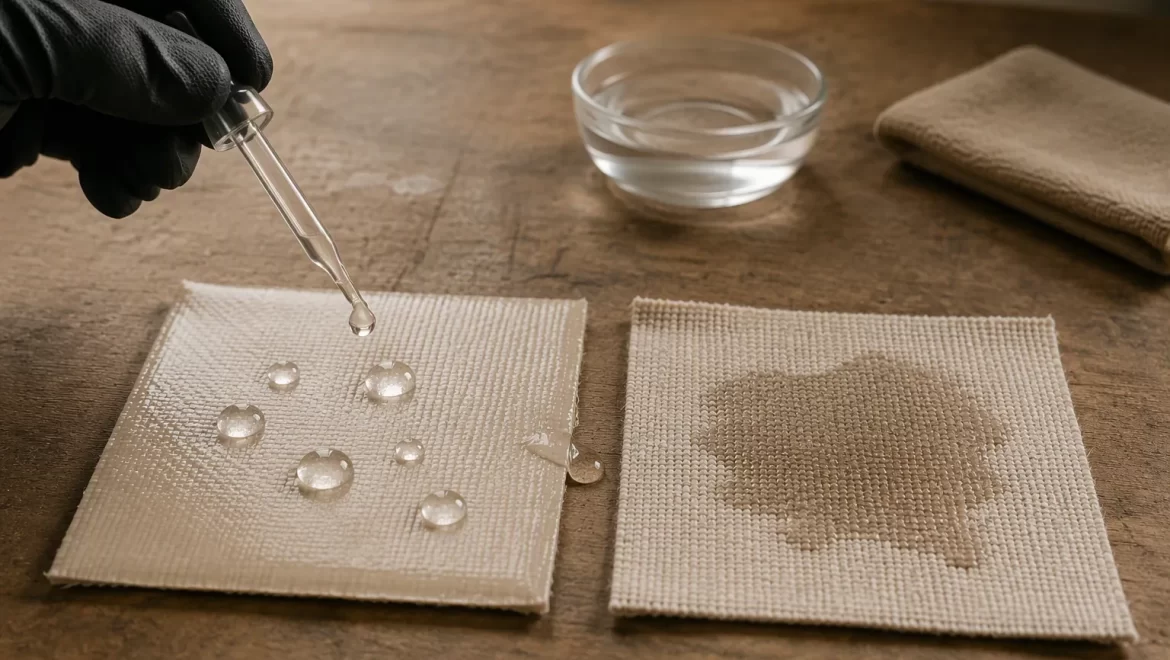
Applying a measured amount of liquid and observing whether it beads, spreads or absorbs gives a repeatable comparison. Running the same test after abrasion shows how the finish behaves once the surface has been used.
Recording the result as the time taken to absorb, or the volume retained, turns an impression into a number.
Cleanability Checks
A soiled sample wiped with a defined cloth and agent, then assessed for visible residue, shows how easily the surface releases soil. Repeating the cycle several times reveals buildup that a single test misses.
Where the interior is removable, the same assessment should be run after the stated washing method.
Abrasion, Flex and Wash Tests
Abrasion cycles applied to the face show coating wear, while repeated folding tests the bond between a film and its backing. Washing or wet-wiping cycles then show whether the surface survives the cleaning instruction printed for the buyer.
These tests are short, and each one predicts a specific service complaint.
| Test | What it reveals | Typical stage |
|---|---|---|
| Liquid bead test | Initial repellency | Incoming |
| Absorption time | Finish strength | Incoming |
| Post-abrasion bead | Finish durability | Sampling |
| Wipe soil removal | Cleanability | Sampling |
| Repeat wipe cycle | Residue buildup | Sampling |
| Flex cycle | Delamination risk | Sampling |
| Wash or wet-wipe cycle | Instruction validity | Sampling |
| Odour retention check | Residue behaviour | Sampling |
Coating Durability and Ageing
A coated or filmed surface changes over time, and the change is predictable enough to plan for.
Abrasion and Surface Loss
Coating wear appears first at the contact points, where harnesses, pads and paws rub the surface. The coating thins locally, which shows as a dull patch before it shows as a functional failure.
Where those points can be identified in the sample, moving the contact or adding a sacrificial layer keeps the main surface intact.
Flex Cracking
Repeated folding along the same line eventually cracks a coating or a film, and the crack then admits liquid. Creases that fall on the same line every time the carrier is packed are the highest risk.
Varying the fold line, or keeping the coated face out of the fold, extends the surface life considerably.
Delamination
Delamination is a bond failure between a film and its backing, and it appears as bubbling or as a lifted edge after heat, humidity or flexing. It is usually a process problem rather than a material problem, which means it should be detected in the sample review rather than in service.
A peel-style check on a bonded sample at both edges and in the middle is enough to catch most of it.
| Ageing effect | Where it appears | Preventive measure |
|---|---|---|
| Surface dulling | Contact points | Sacrificial layer |
| Coating thinning | High-rub zones | Move the contact |
| Flex cracking | Repeated fold lines | Vary fold position |
| Edge lift | Panel boundary | Better edge sealing |
| Bubbling | Warm storage | Control the bond |
| Colour shift | Sunlight | Stable pigments |
| Hardening | Cold conditions | Flexible formulation |
| Odour pickup | Worn surfaces | Replaceable pad |
Specifying the Interior Surfaces
The specification is what keeps a good sample from becoming a different product in the next order.
What the Specification Must Contain
Face material, backing, coating or film type and weight, method of bonding, surface finish, colour reference, the zones where sealing applies and the cleaning method intended for the product are the minimum. Adding the soiling conditions the carrier is designed for closes the gap between the material and its use.
Where a film is specified, the bonding method should be described rather than left to the supplier.
Sealed Samples and Reference Panels
A sealed sample of the interior assembly, kept by both parties, is the only reliable way to compare a later delivery against the approved one. Because these materials change appearance as they age, the sample should be stored away from light and renewed when the construction changes.
Reference panels showing sealed and bound joins are more useful than descriptions of those joins.
Managing Substitutions
Substitution in these materials is common because coatings and films are supplied under many trade names. A written rule that any alternative must pass the same tests and be approved against the sealed sample keeps the construction stable, and each accepted substitution should be recorded with its reason.
Without that record, a later reviewer cannot tell whether the interior was changed deliberately.
| Specification item | Why it matters | Common omission |
|---|---|---|
| Face material and weight | Sets feel and durability | Weight only |
| Coating or film type | Decides performance | Trade name only |
| Bonding method | Controls delamination | Left to supplier |
| Sealing zones | Targets the wet path | Applied everywhere |
| Cleaning method | Matches the surface | Written after packing |
| Colour and finish | Consistency across lots | No reference |
| Sealed sample | Basis for comparison | Not retained |
| Substitution rule | Prevents silent change | Not stated |
Cost Drivers and Material Claims
Two commercial questions decide how far a sealed interior can be taken: what drives the cost, and what may be claimed about it.
What Drives Interior Cost
The face material and its coating or film are the largest material drivers, followed by sealing and taping operations, the number of interior panels and whether a removable pad is included. Cleaning-agent compatibility adds a testing cost rather than a material cost.
Restricting the sealed construction to the zones that see liquid is the largest available saving, and it also reduces weight.
Claims That Can Be Supported
Claims should describe what the construction does: sheds a spill, resists rain, can be wiped. Claims that imply a barrier against all liquid are difficult to support once seams, zips and openings are considered, and they invite complaints.
Where a buyer requires a specific claim, the test behind it should be identified and recorded.
Documentation to Keep
Keeping the material certificates, the sealed sample, the bonding specification and the test results together makes later questions answerable and supports the buyer's own market obligations. This record also protects the factory when a claim is challenged.
| Cost driver | Direction | Lever |
|---|---|---|
| Face material | Strong | Zone the requirement |
| Coating or film | Strong | Match the soiling risk |
| Sealing operations | Moderate | Seal the wet path |
| Panel count | Moderate | Fewer interior parts |
| Removable pad | Adds a component | Include where soiling is likely |
| Testing | One-off | Test the assembled interior |
| Cleaning agent check | One-off | Choose finish and agent together |
| Documentation | Administrative | Keep with the sample |
FAQ
What is the difference between water-repellent and wipe-clean?
A: Repellency describes what happens when liquid first lands and how much beads up, while cleanability describes how easily soiling and residue are removed afterwards. A surface can shed a spill well and still hold odour if its texture traps residue.
Does a water-repellent lining keep a pet bag dry?
A: It reduces how much liquid soaks into the surface, but it does not stop liquid entering through seams, zips and openings. Where the interior must resist ingress, the joins and closures are the controlling design problem.
Why does liquid reappear away from where it spilled?
A: Because capillary action carries it along fibres and through needle holes. This is why the base perimeter and the lower wall joins are the places where sealing effort pays off most.
Should every seam in the interior be sealed?
A: Not usually. Sealing where liquid collects, binding where the surface is only splashed and leaving decorative joins untreated is normally enough, and it keeps cost and weight under control.
Is a brush-finished lining a bad choice for a pet bag?
A: It is a trade rather than a fault. Brushed faces feel softer but hold hair, sand and residue, so where they are used they belong on a removable part rather than on the fixed interior.
What is the most effective single change for cleanability?
A: Making the base accessible, ideally as a removable pad or liner, because a surface that cannot be reached cannot be wiped. This usually costs less than upgrading the surface material.
Do bonded films or coatings last longer?
A: Both can last well, and both fail in different ways: coatings wear and crack, films delaminate. The bonding method and the flex behaviour of the composite matter as much as the material chosen.
How should a sealed interior be ventilated?
A: By zoning: seal the base and lower walls, ventilate the upper panels, and keep the openings above the level that liquid reaches inside. This keeps most of the liquid protection without closing the bag.
What happens if liquid pools in the base?
A: It eventually finds a path through the weave or the seam, however good the finish is. A slight slope towards a removable absorbent pad is more effective than a stronger repellent treatment.
How can a repellent finish be checked before bulk?
A: By applying a measured amount of liquid and recording whether it beads, spreads or absorbs, then repeating the check after abrasion cycles. Recording it as a time or volume makes it comparable between lots.
Why does a greasy stain behave differently from water?
A: Because oil spreads on surfaces rather than beading. A finish designed for water may do little against grease, which is why a smooth coated face is preferred where food is carried.
What causes delamination in a laminated lining?
A: Usually a process rather than a material problem, appearing after heat, humidity or repeated flexing. A peel-style check at the edges and the middle of a sample catches most cases before bulk.
Are removable liners worth the extra component?
A: Where accidents are likely, yes, because the soiled part can leave the bag entirely. For carriers used briefly and occasionally, a sealed fixed interior is simpler and more predictable.
How should the cleaning instruction be decided?
A: Together with the finish, not after it. A repellent treatment sensitive to aggressive agents and an instruction that recommends aggressive agents is a combination that produces complaints.
What claims about repellency are safe to make?
A: Claims that describe behaviour the construction supports, such as shedding a spill or being wipeable. Claims that imply a barrier against all liquid are difficult to support once seams and closures are considered.
How can a factory prevent silent material substitution?
A: By stating in the purchase terms that any alternative must pass the same tests and be approved against the sealed sample, and by recording the reason and result whenever a substitution is accepted.
Ready to stop treating water-repellent and wipe-clean as the same requirement? Map the interior by zone, decide where liquid must be shed and where it must be wiped, choose the face material and the sealing method together, keep soft surfaces removable, and run the bead, wipe and flex checks on the assembled interior before bulk. Write the zones, bonding method and cleaning instruction into the specification, and keep the sealed sample with it.